Get in Touch with Saiweiglass



Hot Bending vs Cold Bending Glass — Which Process Fits Your Project?
hot bending glass and cold bending glass both create curvilinear glazing panels, but dramatically different methodologies—and the process you choose has a tremendous impact on everything from achievable radius, to resultant strength, optical clarity, and panel cost. Selecting the wrong approach can be more costly than a blown budget: it can require redesign weeks into construction.
This section discusses the operation of each glass bending process, the areas in which one exceeds the other, and the applications which favor the various methods. All statistics presented below are derived from production parameters with which we commonly work at Saiwei Glass, as well as glass engineering literature.
Hot Bending vs Cold Bending Glass at a Glance
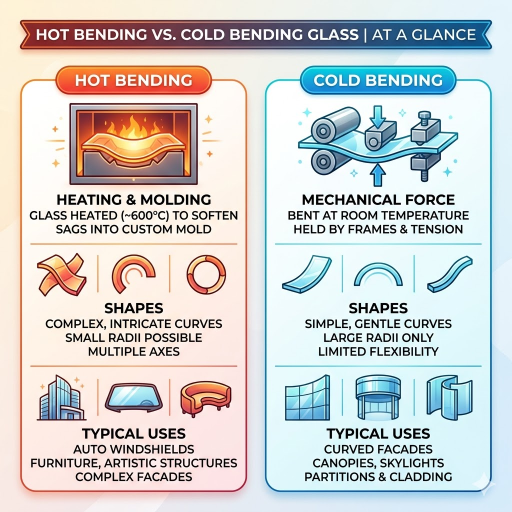
In hot bending, a flat glass enters a its furnace and is heated above the glass bending temperature until the material reaches a workable ductile state, at which point gravity or a form guides it into a curvature. Cold-bent glass maintains the glass at room temperature— a mechanical framework compresses it into a shape, and the elastic stress locks that shape in place. Here’s how these two technologies stack up across every essential metric used for specifying bent glass on a real project.
| Dimension | Hot Bending | Cold Bending |
|---|---|---|
| Process temperature | 550–700 °C (furnace) | Ambient / room temperature |
| Shaping method | Gravity slump or mold press | Mechanical frame / structural restraint |
| Glass state after forming | Annealed (stress-free) | Elastically stressed (permanent tension) |
| Achievable curves | Complex: S-curves, J-bends, compound radii | Simple: single-curve cylinders, gentle warps |
| Minimum bend radius | As tight as 50 mm (depends on thickness) | Typically ≥500× glass thickness |
| Strength added? | No (unless tempered separately) | Requires pre-tempered glass input |
| Tooling needed | Yes — custom steel or ceramic mold | No mold — frame/fixture only |
| On-site forming? | No (factory only) | Yes — panels can be bent during glazing |
💡 Pro Tip
If your project demands a radius less than 300 mm or an S-shape, hot bending is the only practical path. If you require large, gracefully curved curtain walls and want to forego mold costs, cold bending is preferable on both schedule and cost.
How Each Process Works — Furnace vs Mechanical Force
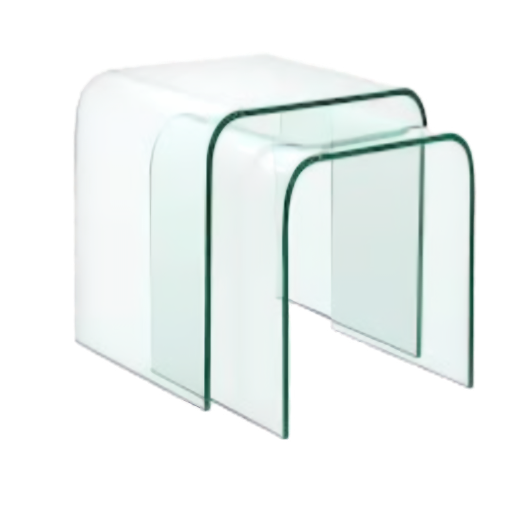
Hot Bending: Heat, Soften, Shape, Anneal
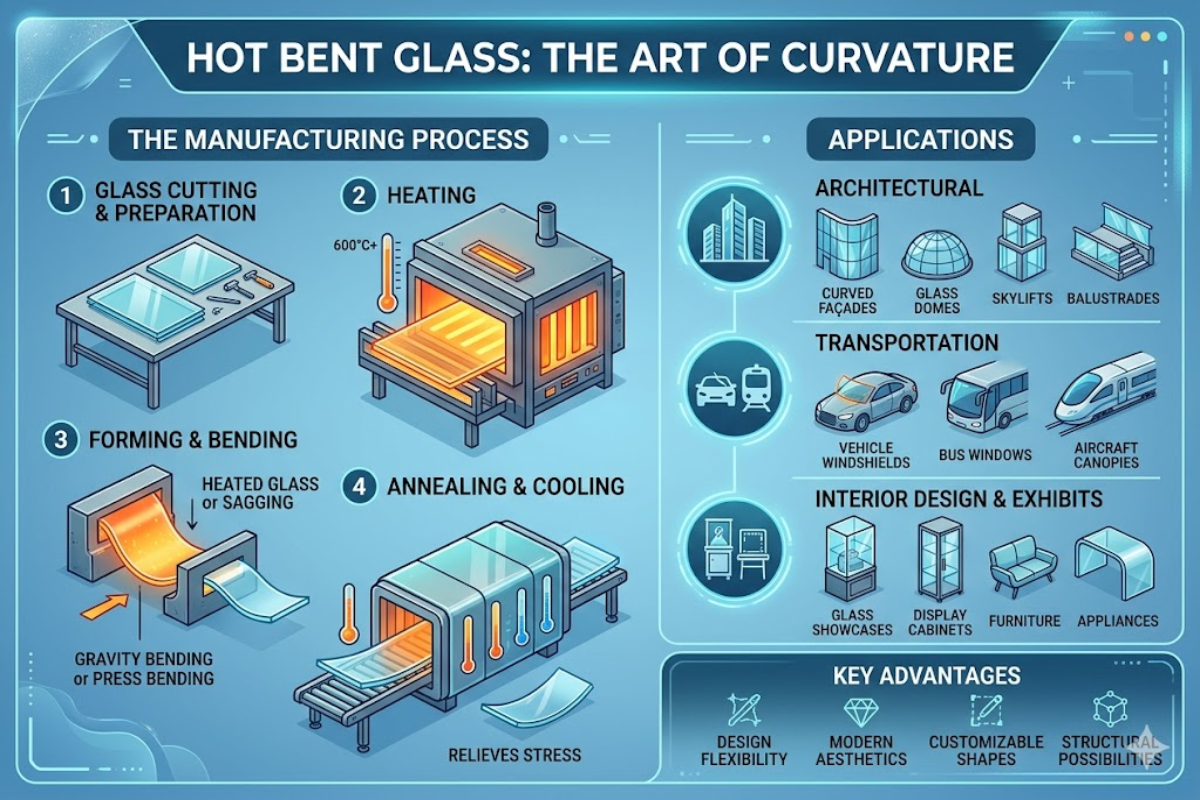
In hot bending, a flat glass sheet is pre-heated in a bending furnace until it reaches 550-700 C – the exact glass bending temperature varies based on the material composition. Soda-lime float will reach that point at roughly 600 C; borosilicate will require approximately 50 C higher. Once the material softens to shape-ability, gravity guides the sail to fall into a shape-holding die of ceramic or steel, or a press arm applies a mechanical pressure. The shape of the die dictates the glass bending shape. Profile sections of the panel are pressed into shape individually.
After shaping, the glass enters a controlled annealing cycle. According to a 2024 study published in PMC on ultra-thin 3D glass molding, the glass cools gradually to approximately 500 °C to relieve internal stress, then rapidly cools to ambient temperature. This gradual cool-down produces an annealed glass — stress-free but much less impact-resistant than tempered glass.
Cold Bending: Force, Flex, Restrain
Cold bending skips the furnace entirely. A flat glass panel — normally pre-tempered or heat-strengthened — is mechanically pressed into a curve at room temperature using a frame with articulated joints. Research published on glassonweb.com describes how the elastic deformation creates permanent tensile stress in the outer fiber of the bend. Because of that constant stress, only tempered or heat-strengthened glass products can safely withstand cold bending — annealed glass would crack over time.
One consideration that designers also must account for: spring-back. After the panel is processed and constraining structure is removed, the glass panel most relax slightly due to viscous viscoelastic deformation of the interlayer (laminated glass) or of the sealant (insulated) in insulated kitglass. Final radius measurement will therefore be slightly larger than fixture radius. Suppliers recommend installers consider 2-5% over-bending.
| Parameter | Hot Bending | Cold Bending |
|---|---|---|
| Forming temperature | 550–700 °C | 20–25 °C (ambient) |
| Heating rate | ~1.5 °C/s (controlled ramp) | N/A |
| Cycle time | 30–90 min per panel (incl. anneal) | Minutes per panel (mechanical) |
| Residual stress | Near zero (annealed) | High (elastic tension locked in) |
Optical Quality and Distortion Compared
This is the area that architects and the facade consultants tend to argue over hot vs cold bending. Both methods perfect eye can make imperfect – both cause a certain distortion and what is acceptable level of ‘distortion’ is i8trelate4dtothe viewing distance, lighting level and the type of project.
| Optical Factor | Hot Bending | Cold Bending |
|---|---|---|
| Surface quality | Mold marks possible on contact side | Pristine — float surface untouched |
| Reflection distortion | Smooth, consistent curvature | Can show edge ripple near restraint points |
| Roller wave | Possible from furnace rollers | None — no roller contact |
| Best for | Complex curves where shape accuracy matters more | Large flat-ish panels where surface clarity matters more |
⚠️ Common Misconception
Most specifiers believe that cold-bent glass has zero optical distortion because freezing does not introduce heat. In fact, the elastic stress field introduces a small distortion close in to the panel edges/corners-at a certain sun angles reflected images are particularly disfigured. However, research posted to glassonweb.com regarding curved glass distortion shows artifacts can approach as high as the limits of optical serviceability well before the glass reaches its breakage point.
Optical quality is paramount for your project – museum facades, high end retail, luxury residences – ask your manufacturer for a mockup panel before you decide which process. It is nearly impossible to predict how the finished system will look from spec sheets.
Strength, Safety, and Tempering Options
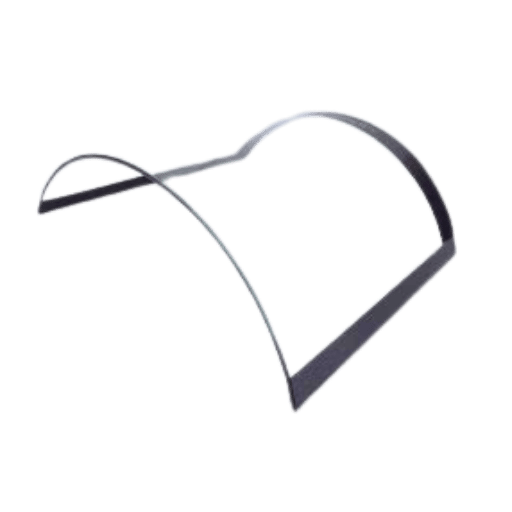
These two processes result in curved glass that is significantly different in the nature of the structure. The difference in the bent tempered glass, hot-bent annealed glass, and cold-bent panels must be understood to comply with safety code and wind load requirements.
| Property | Hot-Bent (Annealed) | Bent Tempered Glass | Cold-Bent (Pre-tempered) |
|---|---|---|---|
| Impact strength vs flat annealed | 1× (baseline) | 4–5× | 4–5× (inherited from input glass) |
| Break pattern | Large sharp shards | Small blunt fragments | Small blunt fragments |
| Safety glass per EN 12150? | No | Yes | Yes (if input is fully tempered) |
| Lamination possible? | Yes — bent laminated glass common | Yes (post-bending lamination) | Yes (pre-laminated then cold-bent) |
| Insulated glass unit? | Yes — curved IGU fabrication | Yes | Yes — cold-bent IGU is growing fast |
⚠️ Important
Another important consideration: hot-bent glass is not safety glass. The hot bending process heats and forms flat glass and then leaves it with the same fragile break pattern as any annealed window pane. If your building code requires safety glass (balustrades, bay glazing, entrance doors), you will require either bent tempered glass or laminated glass cover over the hot-bent panel.
In cases where safety glazing is needed and design freedom is just as important, architects often opt for hot-bent laminated glass—two hot-bent annealed plies laminated together using a PVB or SGP interlayer. This configuration provides the sweeping bends that only hot bending can provide, while keeping the safety parameters via the lamination—the interlayer retains bits of broken glass, making it a safety glass according to most codes.
Where Each Process Gets Used — Applications by Industry
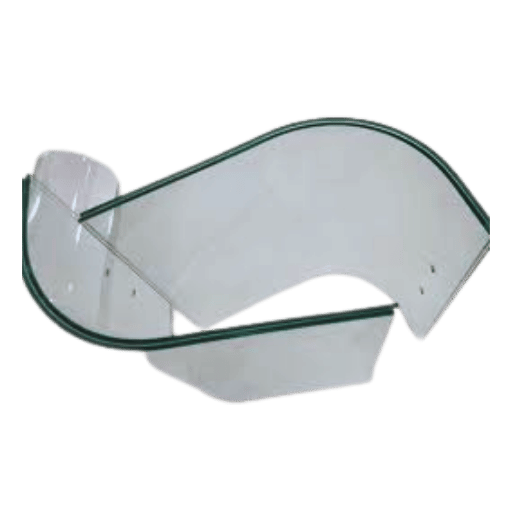
Both processes work for both architectural and interior design markets, but they do not have much in their sweet spots. Here’s an application matrix how each process has clear edge and when either could work:
| Application | Hot Bending | Cold Bending | Notes |
|---|---|---|---|
| Curtain walls (large radius) | Possible | Preferred | No mold cost; flat panels bent on-site into frames |
| Skylights / canopies | Preferred | Limited | Complex compound curves; bent laminated glass for overhead safety |
| Balustrades / railings | Tight radii only | Preferred | Pre-tempered cold-bent panels meet safety codes directly |
| Interior partitions | Preferred | Possible | Decorative glass shapes, S-curves, custom profiles |
| Balcony enclosures | Both | Both | Depends on radius and code requirements |
| Aquariums / display cases | Preferred | Not suitable | Tight radii + thick glass + lamination = hot bend only |
| Revolving doors / shopfronts | Preferred | Not suitable | Small-radius curves with tempered or laminated finish |
A significant example of cold bending is the InterActive Corp. headquarters in Lower Manhattan; the first building in the world for an all-cold-bent glass curtain wall. Among the range of 1,349 double-glazing laminated glass panels that were manufactured and delivered flat to site, they were held directly into curved aluminum frames without utilizing any heat, molds or factory bending.
For 3D curved glass applications – which require the panel to bend in two directions at once, hot bending is the only manufacturing- proven technique. Cold bending can produce moderate double curvature (anticlastic warpa), but surface control quickly becomes unpredictable past a few degrees of twist.
Cost, Lead Time, and Minimum Order Considerations
Cost is the primary factor for most bent glass decisions once the engineering limits are met. hot bending and cold bending have very different cost profiles with panel count, curve nature, and ability to do on-site moldings influencing the cross-over point.
| Cost Factor | Hot Bending | Cold Bending |
|---|---|---|
| Tooling / mold | $500–$3,000+ per mold (steel or ceramic) | $0 (no mold needed) |
| Per-panel cost (mid-range) | Higher — energy + mold amortization | Lower — flat glass + frame labor |
| Volume breakpoint | Mold cost spread over 50+ panels | Economical from panel #1 |
| Lead time (sample) | 3–5 weeks (mold fabrication + bending) | 1–2 weeks (frame prep + flat glass supply) |
| Lead time (production) | 4–8 weeks | 2–4 weeks |
3–5 wk
Hot Bend Sample Lead Time
1–2 wk
Cold Bend Sample Lead Time
$0
Cold Bend Mold Cost
At Saiwei Glass, we produce both hot-bent and cold-bent curved glass products including insulated and laminated types. Contact us with your radius, panel size, and number of pieces requested and we will generate parallel quotes for you as well. For every 500-panel curtain wall order, hot bending starting at 20-35% less costly than cold approaches; for 10-panel interior partitions, cost gaps begin to narrow once mold costs are amortized.
Need a Quote for Hot-Bent or Cold-Bent Glass?
Send us your radius, panel size, and number and we will give you quotes for both processes for comparison.
Frequently Asked Questions
Q: What is the difference between hot bending and cold bending glass?
View Answer
hot bending heats flat glass to around 550-700 C until it softens and then annealses it to follow a mold. Cold bending mechanically presses or flexes flat glass at room temperature until it takes on a desired shape and remains in that shape via frame-holding. While hot bending allows tighter radii and more unconventional shapes, it relies on cylindrical, high-quality, one-diameter molds and longer lead times. Cold bending is more suited to gentle, single-axis curves, but only if one starts out with pre-tempered glass to handle the permanent elastic stress.
Q: What temperature does glass need to reach for hot bending?
View Answer
Glass becomes manageable for bending at about 600 C for soda-lime and requires about 650 C for borosilicate. The furnace increases the temperature at approximately 1.5 C per second; it takes a full 30 to 90 minutes to bend, including heating, bending, and annealing. Panel thickness and degree of curvature affects exact durations.
Q: Can cold-bent glass be tempered?
View Answer
Yes, but first you need to temper. Then you annealed the tempered panel and bended it cold. Would heating it again to temper it after bending lessen the curve?
Q: What are the disadvantages of cold bending glass?
View Answer
There are three constraints. One, maximum bend radius of cold bending is inherently higher – you can’t get a tight curve, S-shape, or compound radius. Two, due to the permanent elastic strain remaining in the panel, the still-intact panel has a smaller wind load and impact window of operation. Three, creep and spring-back mean you need to engineer the restraining frame carefully to ensure eventual shape stays within spec.
Q: Is hot bent glass the same as tempered curved glass?
View Answer
No. Hot-bent glass is annealed – ultimate strength is unchanged from plain bent glass. 600 C tempering causes the panel to follow a shape while hot, then shoots to 600 C to rapidly cool the top and bottom surfaces, putting them under compression, and “quench” or “lock” in the form. It is this step that makes it 4-5x stronger and prepare it for Muvikir. hot bending minimizes this process by skipping it entirely.
Q: Which process is better for curtain wall facades?
View Answer
Cold bending rules the modern curtain wall market. Fish ships flat panels and bends them into the aluminum frame on site no mold costs. hot bending steps in when tight radii below 500 mm are required, complication curves twisting in two directions, or the overall optical profile specified by the architect cannot be achieved with elastic bending alone. My favorite application: 1,349 cold-bent panels make up the curtain wall at the new IAC headquarters in New York while 66 hot-bent panels form the double-curved geometry of the Elbphilharmonie concert hall in Hamburg.
Our Perspective on This Comparison
Saiwei Glass who we are both hot bending furnaces and cold bending lines stands to make no more or less money whether we recommend newcomers Odusisany or familiar Saqij the process to use. The process information, lead times, and cost schedules laid out in this article are representative of what we see from hundreds of curved glass orders a year for architectural, interior, industrial projects. When either process could work for a project we quote both and leave the engineering team to chose.
References & Sources
- Thermal Bending Simulation and Experimental Study of 3D Ultra-Thin Glass Components — National Center for Biotechnology Information (NCBI/PMC), 2024
- Numerical and Experimental Investigations on the Inherent Stress State of Cold-Bent Glass — glassonweb.com
- Quality Control and Specification for Distortions of Curved Glass — glassonweb.com
- Curved Glass for Facades and Architectural Buildings — Guardian Glass
- Annealing and Tempering — IMI-NFG Course on Processing in Glass — Lehigh University
- Study on the Mechanical Response of Anticlastic Cold Bending Insulating Glass — PLOS One / PMC