Get in Touch with Saiweiglass




Custom Cover Glass Engineering: How to Choose the Right Material, Thickness, and Coating
Quick Specs: Custom Cover Glass
| Common Materials | Gorilla Glass, Alμminosilicate, Soda-Lime, Borosilicate |
| Thickness Range | 0.33 mm – 6 mm (application-dependent) |
| Standard Coatings | AG (anti-glare), AR (anti-reflective), AF (anti-fingerprint) |
| Strengthening Methods | Chemical (ion e×change, CS ≥650 MPa) or Thermal tempering |
| Typical Applications | Industrial HMI, Automotive, Medical, Wearables, POS/Kiosk |
| Key Standards | IK01–IK10 (EN 62262), IEC 62368, IEC 60601 (medical) |
Custom cover glass-is the protective outer layer that is designed to protect screens, touch screens and control panels from scratches, crashes and environmental damage-while providing the optical clarity, durability, and touch that is e×pected for a given application. Whether specifying a glass for an industrial HMI panel, automotive console, or bedside monitor in a hospital, the ideal material-, thickness-, and surface treatment combination exists to meet your application’s requirements and reliably last through the trials of everyday life for years to come.
Worldwide cover glass market was valued at a USD 45 billion in 2025 and is forecasted to grow to USD 63.48 billion by 2034, expanding at a CAGR of 3.5% as per Research and Markets. The rising use of cover glass from end users other than smartphones such as industrial automation, electric vehicles, smart home systems, and medical devices is expected to contribute to the growth of the market. This article guides through all the specifications that need to be considered while ordering custom cover glass for an application.
What Is Custom Cover Glass — and When Do You Need It?
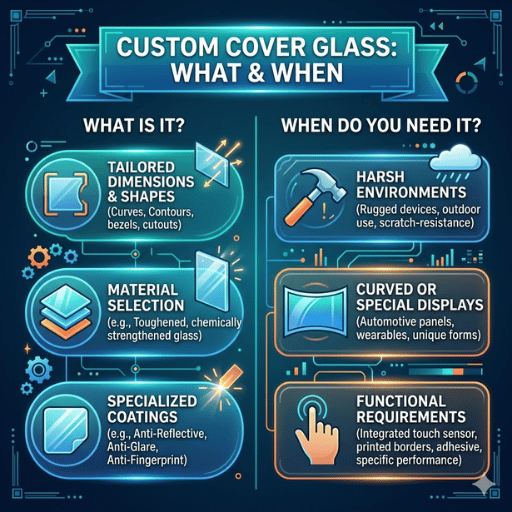
Cover glass, also known as a cover lens, is the outermost transparent barrier bonded to the display module or touch panel. Its main function is physical protection-from scratches, fingerprint, and dust to impacts against the display. Besides protection, the cover glass lets you customize shape, printed and branded graphics, logo placement, and surface coatings to meet the demands of diverse environments.
Commercial off-the-shelf cover glass is sufficient for consumer electronics produced in mass quantities. Certain applications require custom cover glass if they have any of these specifications:
- ✔ Non-standard dimensions, cutouts, or drilling positions
- Impact resistance above IK06 (1 joule) for public or industrial use.
- Surface coatings (AG, AR, AF) for readability in direct sunlight or in cleanroom conditions.
- Silk-screen printed bezel, logo, or functional icons for brand identity.
- Adherence to specialized standards (IEC 60601 for medical, MIL-STD-810 for defense, etc.).
Any display exposed to more than the filtered climate of an air-conditioned office desk will require custom cover glass-it is not simply a technical specification, but a core design decision. For a detailed review of application considerations and touch screen glass fundamentals relevant to your project, start here before exploring material options.
Cover Glass Material Comparison: Gorilla Glass, Aluminosilicate, Soda-Lime, and More
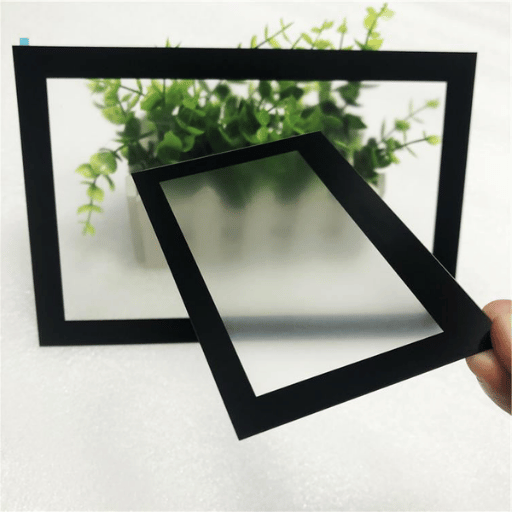
Your choice of glass substrate will influence impact strength, scratch and abrasion durability, weight, optical image quality, and eventual manufacturing costs. Five families of materials dominate the cover glass marketplace, each with quantifiable tradeoffs. Below is a comparison using manufacturer-published data, not subjective descriptors:
| Property | Gorilla Glass | Aluminosilicate (generic) | Soda-Lime (tempered) | Borosilicate | PC / PMMA |
|---|---|---|---|---|---|
| Compressive Stress (CS) | ≥650–1000 MPa | 450–650 MPa | 90–140 MPa | N/A (not ion-exchanged) | N/A |
| Depth of Layer (DOL) | ≥40–50 μm | 20–40 μm | N/A | N/A | N/A |
| Strength vs. Float Glass | 6–8× | 6–8× | 4–5× | ~2× | Varies (impact-resistant, scratch-prone) |
| Light Transmittance | >91% | >90% | >89% | >92% | ~88–92% (yellows under UV) |
| Available Thickness | 0.55, 0.7, 1.0, 1.5, 2.0 mm | 0.4–3.0 mm | 3.0–19 mm | 0.5–6.0 mm | 0.5–12 mm |
| Cost Tier | $$$ (premium) | $$ (mid-range) | $ (lowest) | $$ (specialty) | $ (lowest, but shorter lifespan) |
| Best For | Wearables, premium devices | Industrial HMI, automotive | Cost-sensitive indoor displays | Thermal-shock environments | Lightweight prototyping, non-touch overlays |
What Types of Glass Materials Are Commonly Used for Industrial Equipment Screens?
The two most common materials for industrial control panel, HMI touchscreen, and instrument panel displays are chemically strengthened aluminosilicate glass and thermo-mechanically tempered soda-lime glass. Aluminosilicate is strengthened by an ion exchange process where sodium ions are replaced by larger potassium ions in a molten salt bath at ~400C (see MIT’s study on glass strengthening), resulting in 450-650 MPa of surface compression -6 to 8 times the strength of (pre) float glass. Soda lime is heated to 600-700C and cooled rapidly, achieving 90-140 MPa of surface compression, about 40-60% the cost of aluminosilicate with a minimum of 3 mm thickness, but cannot be cut after the process.
For thin profile, high impact resistance applications similar to dimensional wearable devices or small medical instrumentation, branded chemically strengthened options such as Corning Gorilla Glass achieve >650 MPa of deep layer layer compression of 40 m or more per published product info sheets. Alternative chemically strengthened brands for consideration include AGC Dragontrail and NEG Panda Glass materials with slightly different wave annealing parameters to achieve similar specifications. Refer to our Gorilla Glass vs aluminosilicate comparison for a detailed overview.
“The composition of Gorilla Glass allows for a deep layer of high compressive stress created through an ion-exchange process. This compression acts as a sort of armor, making the glass exceptionally damage-resistant.”
— Corning Incorporated, Gorilla Glass Product Information Sheet
Key Specifications: Thickness, Coatings, and Surface Treatments
When selecting cover glass thickness, balance impact protection and weight and touch sensitivity requirements. Thicker glass improves impactability but reduces touchspeed, adding weight; the optimal value is application-dependent, subject to IK rating needs, and mountup criteria.
Cover lens thickness according to DISPLAY LC engineering references on IK impact rating and cover lens thickness varies from 0.5 mm – 6 mm. Impact protection is governed by EN 62262 (IEC 62262), and provides for impact ratings named IK00 through IK10, each indicating the impact energy a magazine or enclosure can resist:
| IK Rating | Impact Energy (Joules) | Typical Application |
|---|---|---|
| IK01–IK05 | 0.14–0.70 J | Indoor consumer devices, office equipment |
| IK06–IK07 | 1.00–2.00 J | Industrial HMI panels, automotive displays |
| IK08–IK09 | 5.00–10.00 J | Public kiosks, ATMs, outdoor signage |
| IK10 | 20.00 J | Vandal-proof transit displays, military |
What Thickness Is Ideal for Industrial Cover Glass?
The defining criteria depend on the material used and method of strengthening; chemically strengthened aluminosilicate at 1.1mm is capable of delivering IK07 (2 J impact), while to achieve the same using tempered soda lime, 3 mm or higher is necessary. For the vandal resistant IK10 requirement, options include 6 mm+ tempered soda lime, or 2mm chemically strengthened aluminosilicate plus bonded layer; always request impact testing on specific glass stack up before production if impact durability is primary consideration.
💡 Real-World Scenario: Automotive Center Console
A Tier-1 automotive supplier was designing a 10.1-inch center console display for an automotive application. Engineers specified a 0.7 mm Gorilla Glass with an AR + AF coating stack. The AR coating was used to bring the surface reflectance down from about 8% to less than 1% and the AF coating was used to make the display fingerprint resistance necessary for a daily driver.
The display is recessed in a bezel held together by an IK07-rated enclosure, so the 0.7 mm thickness was ideal and eliminated 40% of the weight that a 1.5 mm glass would have contributed. Chemical strengthening allowed for the CS necessary to handle the thermal cycling (40C + 85C) during automotive qualification testing.
Surface coatings are modifies the surface without changing the glass. Three primary coating families serve display cover glass:
- AG (anti-glare): Chemical etching or spray coating produces a matte surface to cause the reflected light to scatter. Suitable for outdoor use or in high ambient light conditions on displays and instrumentation such as on an agricultural machinery dashboard or construction equipment panel.
- AR (anti-reflective)—Multi-layer optical coatings can boost the transmittance to more than 99 percent while dropping the reflectance down to less than 1 percent. Might be essential for high-end automotive screens with high pixel density and medical monitor where no “images result in” is acceptable.
- AF(anti-fingerprint): A layer of nanometer thick repellent surface(repel dirt and oils) gives an even more smooth working surface and is easier to clean, fits in any kind of touch screen applications for example suppliers such as food service installation, medical and public kiosk.
These coatings have a number of combination-applied together an AG+AF stack is typically used for outdoor industrial displays while AR+AF is more common for indoor medical monitors. To see the specific differences in coating characteristics and performance data AG vs AR vs AF coating comparison guide. Our AR, AF, and AG coating services support single-side and dual-side application on glass from 0.33 mm to 19 mm.
📐 Engineering Note: Chemical Strengthening Parameters
Ion exchange depth of layer (DOL) for aluminosilicate glass typically ranges from 20 to 50 μm, with compressive stress (CS) between 450 and 800 MPa depending on glass composition and salt bath duration. Corning Gorilla Glass achieves CS ≥650 MPa at DOL ≥40 μm per published specifications. Over-strengthening (excessive DOL) can cause spontaneous fracture—work with your glass supplier to fine-tune the CS/DOL balance for your specific geometry and thickness.
✔ The Cover Glass RFQ Specification Checklist
Please follow this checklist when taking quotations from cover glass suppliers:
- Application environment (indoor / outdoor / medical / automotive /marine).
- Glass material preference or performance requirements
- Dimensions and tolerances L W T mm
- Edge finish type (seamed, polished, beveled, 2.5D)
- Required cutouts, drilling positions, and grooves (attach DXF/DWG)
- Single piece surface treatment (AG / AR / AF / ITO / antibacterial / stacked)
- Printing requirements (colors, area coverage, ink type: organic vs ceramic)
- Impact resistance rating (IK level per EN 62262)
- Quantity (prototype vs production) and delivery timeline
- Compliance standards (IEC 60601, IEC 62368, UL, MIL-STD if applicable)
Try Our Material Selector Tool →
From Design File to Finished Panel: What Happens During Production

Understanding the manufacturing process helps you specify tolerances correctly and anticipate lead times. A typical custom cover glass production line follows eight sequential stages—each with its own quality gate:
- Cutting and blanking — Raw glass sheets are cut to approximate dimensions using CNC or waterjet cutting
- CNC precision machining — Edges, cutouts, holes, and grooves are machined to final tolerances (±0.1 mm typical)
- Edge grinding and polishing — Seamed, polished, or beveled edge finishes are applied
- Silk-screen printing — Bezels, logos, icons, and functional graphics are printed using ceramic or organic inks
- Chemical strengthening — Glass is submerged in a molten KNO₃ salt bath at ~400°C for ion exchange
- Surface coating — AG, AR, AF, or ITO coatings are applied via vacuum deposition or spray
- Thermal tempering — If applicable, rapid heating and cooling for soda-lime glass
- QC inspection + package – Optical inspection, dimension inspection, drop/impact test.
Our engineering team interacts at three major gates: out of the CNC (free from dimensional errors), out of the station of strengthening (on the internal stress field) out of the last quality control (free form optical defects and adhesion of film). To have a complete tour of every step including all specifications of the equipment, kindly refer to our screen covers processing manual. Our CNC glass machining center is equipped with 100 automated CNC machines with an annual production higher than 1 million of covers.
Industry Applications: Where Custom Cover Glass Performs

Various sectors have their own performance limit for cover glass. Use this table to correlate typical specifications to operating conditions of these application fields:
| Industry | Typical Glass | Key Requirements | Relevant Standards |
|---|---|---|---|
| Industrial HMI | Aluminosilicate, 1.1–3 mm | IK07+, AG coating, wide temp range | EN 62262, IP65/67 |
| Automotive Display | Gorilla / Aluminosilicate, 0.55–1.5 mm | AR+AF stack, thermal cycling, optical bonding | AEC-Q100 (indirect) |
| Medical Devices | Borosilicate or Aluminosilicate, 0.55–2 mm | Antibacterial + AF, easy-clean, lightweight | IEC 60601-1, FDA 21 CFR |
| Wearables | Gorilla Glass, 0.33–0.55 mm | Ultra-thin, scratch resistance, DLC coating | Consumer safety (UL) |
| POS / Public Kiosk | Tempered soda-lime, 4–6 mm | IK08+, vandal resistance, AF for public use | EN 62262, UL 60950 |
| EV Charging Stations | Aluminosilicate, 2–4 mm | IK10, outdoor UV resistance, wide temp | EN 62262, IP55, IEC 61851 |
What Features and Processes Are Essential for Outdoor Cover Glass?
Due to the severe operating conditions under which they must function, outdoor cover glass must contend with three interacting problems—sunlight readability, thermal durability, and seal integrity. An anti-reflective coating reduces surface reflectance below 1%, making the display readable under full sun. Chemically strengthening ensures the impact durability required to withstand accidental blow of the watch or rainfall.
And a water resistant AF topcoat prevents rainwater from accumulating on the glass and impairing the display. Temperatures up to 30C to +80C are the standard operating values for outdoor rated cover glass, and special borosilicate based substrates can raise this limit significantly.
💡 Real-World Scenario: Medical Bedside Monitor
A medical device start-up developing a patient bedside monitor required IEC 60601-1 compliance, an antibacterial surface for disease control, and an simple-to-clean AF coating for use by nursing staff. It selected 0.55mm chemical strengthened aluminosilicate glass the thickness required to keep the complete monitor delivery under 2.5 kg, and strong enough to survive accidental drops from bedside mounting brackets. For the antibacterial silver-ion coated surface it passed the JIS Z 2801 test for reducing bacteria on a surface, reducing bacterial colonies by over 99%,and therefore could be ordered to the hospital’s standard specification without the need of an additional antimicrobial film surface layer.
⚠️ Common Mistake: Indoor Glass on Outdoor Kiosks
Industry user claims that use of standard soda lime glass for outdoor applications results in UV induced yellowing and thermal stress induced cracking within 12-18 months. Replacing glass panels across an entire fleet of outdoor kiosks costs far more than the initial extra premium for a chemically strengthened glass with the correct coating. Use outdoor specifiers from the outset.
For industry-specific suggestions, visit our application pages for industrial HMI display solutions, automotive display glass, or medical device cover glass. Our HMI display glass selection guide covers industrial-specific testing protocols in detail.
Cost Factors and Lead Time: What to Expect When Ordering Custom Cover Glass

Six major factors influence the building of a pricing scheme for custom cover glass, listed here in descending order of approximate cost:
-
- Glass material and brand — Gorilla Glass carries a premium of approximately 2–3× over generic soda-lime
-
- Strenghtening method – Chemical strengthening more expensive compared to thermal tempering for each unit but it gives more lightweight thinner design
- Surface treatment complexity: Multi-layer coating stacks (AR+AF) are more expensive than single treatments
- Shape complexity — Non-rectangular shapes with cutouts and drilling add 15–30% to CNC processing cost at low volumes
-
- Page/size/shape.3. Printing requirements – Stated to need an additional screen for each extra colour used. Has the advantage of increasing cost and set-up time
- Order quantity — Minimum order quantities typically range from 100–500 units for prototyping to 1,000+ for production runs
💡 Real-World Scenario: EV Charging Station Procurement
A procurement manager at an EV charging station manufacturer considered three sources of cover glass for a 7( vandal-proof display panel. The design demands a ik10 protection, Ag coating to provide sunlight readability, and an operating temperature of 30C to+70C. Supplier a provided a quotation using relatively thick soda-lime tempered glass at the lowest unit price, but the 6 mm thick panel added 340 g/a 25% rise in mass per unit-a potential OEM design headache when used as the faceplate of a wall-mounted charging station. Supplier B proposed a 2-mm aluminosilicate chemically strengthened type that was 45% more expensive but 60% lighter. During the team analysis of total landed cost for the two, including a required revision to the mounting hardware design, the lightweight aluminosilicate turned out to be the cheaper solution when balanced against higher production volumes.
⚠️ Common Mistake: Underestimating Tooling for Complex Shapes
Procurement teams often high light tooling time and cost as a overlooked part of the screen shopping process. Tooling upgrades (not just those required for non-rectangular shapes) to make additional cutouts, holes, camera openings, sensor ports, and icons can add 15-30% to the quoted per unit cost in low volume runs when CNC machine tool wear is amortized across fewer parts. Demand’detail a tooling cost break-down on quotes provided by different suppliers prior to ordering and offer your exact panel dimensions early on to speed quotation services.
Decision Framework: Choosing the Right Cover Glass for Your Application
| Your Situation | Recommended Approach | Why |
|---|---|---|
| Harsh outdoor / marine environment | Chemically strengthened aluminosilicate + AR + AF | CS >600 MPa withstands impact; AR restores sunlight readability |
| Cost-sensitive indoor kiosk / POS | Soda-lime tempered + AG coating | 40–60% lower material cost; adequate for controlled environments |
| Medical / cleanroom device | Aluminosilicate or borosilicate + antibacterial + AF | IEC 60601-1 pathway; silver-ion antibacterial meets JIS Z 2801 |
| Wearable / compact display | Gorilla Glass 0.33–0.55 mm + DLC coating | Ultra-thin with CS ≥650 MPa; DLC adds scratch resistance |
| High-volume consumer (>10K units) | Standard aluminosilicate with batch coating | Economy of scale on coating line setup |
For a more detailed analysis of what drives custom glass pricing, see our guide on factors that determine custom glass pricing. Providing exact specifications upfront minimizes revision cycles and keeps your project on schedule.
Check Glass Thickness Recommendations →
Frequently Asked Questions About Custom Cover Glass
Q: Can I order tempered glass cut to size?
View Answer
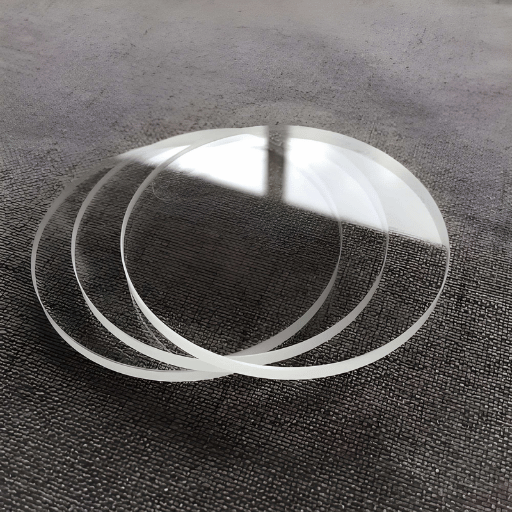
Tempered glass can not be cut after thermal treatment as it will shatter. Cut shapes in glass panels need to be formed before tempering; the chemically strengthened alternative may allow cutouts after gel format ion but edges may be compromised. specify exact dimensions prior to production.
Q: Can I specify the use of Corning Gorilla Glass?
View Answer
Yes. Gorilla Glass cover products can be procured directly from two-channel providers; however, maximum dimension for a large format covers component is 2.0 mm thick which is IK0S+ without structural support. Alternatives such as AGC Dragontrail and NEG Panda glass offer similar chemically strengthened glass performance at other price and thickness ranges.
Q: What is the minimum order quantity for custom cover glass?
View Answer
MOQs vary widely. Expect 50–100 units for prototyping, 500–2,000 for production. Sample orders often have no minimum.
Q: What ink is best for printing on industrial cover glass?
View Answer
Ceramic ink is the industry standard for industrial cover glass because it bonds permanently during tempering or strengthening and resists UV degradation, chemicals, and abrasion over years of service. Organic ink costs less and supports more color options but degrades faster in harsh or outdoor environments. For any application exposed to sunlight, temperature cycling, or chemical contact, ceramic ink is the only reliable choice. Each additional ink color requires a separate silk-screen, so limiting your design to 2–4 colors keeps printing cost and lead time manageable.
Q: What customization options are available for industrial cover glass?
View Answer
Screen shape and dimensions, thickness, glass material type and optical brightening agents, sealing edge appearance (seamed, polished, beveled and 2.5D), cut-outs and drilled holes, scratch and chemical resistance surface and anti-fog layers, AG or AR coating, silk-screen ink, glass-to-frame sealing tape, optically-bonded to reflector back channel. All parameters are fully customizable from most manufacturers.
Q: How long does it take to receive custom cover glass?
View Answer
Sample manufacturing requires 2-3 weeks after design approval; shipping time adds an additional 5-14 days depending on destination. Full scale manufacturing requires 4-6 weeks with shipping. Eight to ten weeks is an average forecast for starting from initial design to sample shipment.
Ready to specify custom cover glass for your project?
Our Perspective on This Guide
This resource is the product of over ten years custom cover glass engineering experience developed at Dongguan Saiwei Glass (SW GLASS). Over 1,000,000 covers per year are manufactured in our industrial HMI, automotive, medical, and wearable projects in our South China factory. These cited depth-of-layer and compressive stress data were obtained from published manufacturer specifications and independent peer reviewed research-not proprietary SW GLASS tests. Industry standard data points that we did not have were specifically noted. Because this is a review of third-party published data, this report was reviewed by the SW GLASS engineering team.
References & Sources
- Cover Glass Market Size, Share and Growth Analysis Report – Research and Markets
- Glass Strengthening – MIT OpenCourseWare 3.071 – Massachusetts Institute of Technology
- Gorilla Glass Large Cover Product Information Sheet – Corning Incorporated
- EN 62262 – IK Impact Protection Rating Standard – International Electrotechnical Commission
- IK Ratings and Cover Lens Thickness in Harsh Environments – DISPLAY LC AG
- Thermal Glass Tempering vs. Chemical Strengthening – Swift Glass Company
- Ion-Exchange Processes and Mechanisms in Glasses – U.S. Department of Energy, Office of Scientific and Technical Information
Related Articles
- Understanding Custom Glass Cost Factors – Detailed breakdown of what drives cover glass pricing
- PCAP Cover Glass: Design and Integration Guide – How projected capacitive touch panels integrate with cover glass
- Cover Glass Testing Standards and Methods – IK impact, scratch, and environmental testing explained
- Industrial HMI Display Glass Selection Guide – Specification decisions for factory-floor touch panels