Get in Touch with Saiweiglass


Optical Prisms: Types, Materials & Uses


Optical prisms function as outstanding devices which scientists use to direct light. The capacity of these instruments to both bend and scatter light together with their ability to reflect and divide light beams makes them crucial instruments needed for scientific investigations and practical technological uses. This article presents a comprehensive study of optical prisms which examines their different types and the materials used to build them and the multiple ways they are utilized. The guide provides complete information about how prisms operate their scientific design principles and their various industrial applications which include telecommunications medical imaging and photography. The basic elements function as essential tools for scientists to study and control light.
Introduction to Optical Prisms
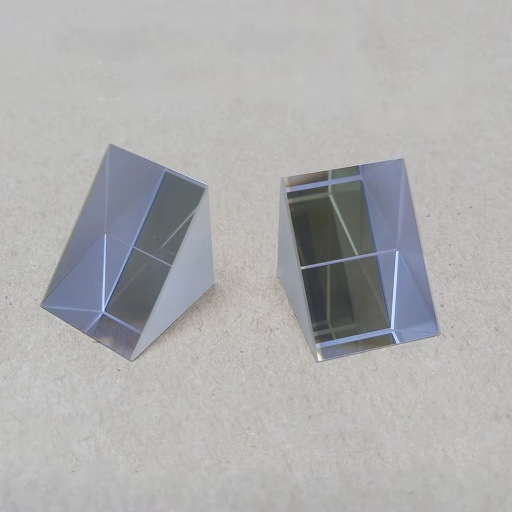
Optical prisms are transparent objects which glass and other clear materials as their main materials to create devices for light bending and reflection and light dispersion. The surfaces of the prisms refract light which enters them at particular angles. Prisms serve multiple applications because they can separate white light into its basic colors and direct light through optical systems and enhance the performance of devices such as periscopes and binoculars. The basic design of these devices together with their ability to work in multiple ways makes them important tools for scientific research and common technological applications.
What is a Prism?
A prism functions as a transparent optical device that uses its flat polished surfaces to bend light. The standard material for prisms consists of glass and other clear substances which designers shape into geometric structures that feature triangular faces and rectangular sides. Light entering a prism bends at the points where air contacts the prism material. The process of bending light enables white light to separate into its individual colors through a process called dispersion. Scientists and researchers use prisms in their work to study light and to create optical instruments which include cameras and projectors. The devices provide accurate light bending and reflection which makes them essential tools for scientific research and real world use.
Importance of Optical Prisms in Precision Optics
Optical prisms serve as essential components for precision optics because they can bend light with unmatched precision. The light from prisms creates controlled pathways that enable scientists to develop exact light beam distribution and polarization techniques. The operational performance of optical systems depends on these systems which require precise measurement and dependable functioning.
Prisms serve as fundamental elements in precision optics because they help spectrometers and interferometers to separate light into its distinct wavelengths which scientists need for their measurement work. The capacity to analyze light at different wavelengths serves essential purposes in scientific research and manufacturing quality control and the progress of new optical technologies. Prisms function as essential components in telecommunications because they enable fiber optic networks to manage and distribute optical signals with greater efficiency.
Optical prisms serve an essential function in high-precision imaging systems which include cameras and telescopes and microscopes. The devices use light correction technology to achieve precise image transmission which results in reduced distortion. The ability of prisms to provide precise measurements through their multiple functions establishes them as essential tools which scientists and industries use to study complex light behaviors.
Basic Properties of Optical Glass
Optical glass has special properties which make it essential for use in precise optical systems. The main properties of the material include its refractive index, its dispersion, and its homogeneity. The refractive index determines how light bends through the material which serves as a vital factor in lens development and focus accuracy. Scientists use the dispersion of glass to separate light into its different colors which helps them create better imaging systems that eliminate chromatic aberration. High-purity optical glass is highly valued for its homogeneity which allows the material to display consistent optical properties throughout its entire structure because all bubbles and defects have been removed. The production of optical glasses includes special treatments that protect the material from environmental factors, including moisture and temperature variations, which ensures the material will sustain its quality across different environments. Optical glass has these essential properties which make it necessary for use in photography, astronomy, and scientific research.
Types of Optical Prisms
Materials Used in Optical Prisms
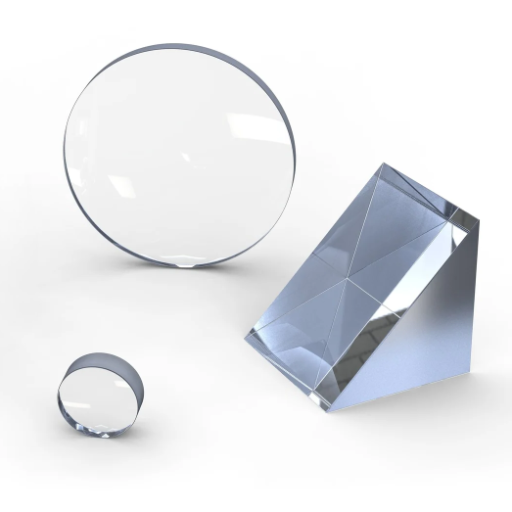
Types of Optical Glass
| Glass Type | Key Features | Applications | Refractive Index | Dispersion |
|---|---|---|---|---|
| Crown Glass | High clarity | Lenses, prisms | ~1.5 | Low |
| Flint Glass | High dispersion | Spectroscopy | ~1.6–1.9 | High |
| Borosilicate | Heat-resistant | Labware, optics | ~1.47 | Low |
| Quartz Glass | UV transparency | Imaging systems | ~1.46 | Very Low |
| Chalcogenide | Infrared suitable | IR lenses | ~2.0–3.5 | Low |
Custom Optical Prisms and Material Selection
The selection of materials for custom optical prisms depends on their intended application and the required optical mechanical and thermal properties of the materials. The main elements which should be examined include clarity and refractive index and dispersion and environmental stability. The imaging systems in which quartz glass operates use the material because it exhibits low dispersion and exceptional UV transparency. The material borosilicate glass provides optimal performance for situations which require protection against thermal shock.
Crown and flint glasses provide excellent optical performance which makes them popular choices among optical designers. Crown glass offers low dispersion and is commonly utilized in lenses and prisms where high clarity is essential. The higher refractive index of flint glass makes it suitable for spectroscopy and situations which require accurate light measurement. For infrared applications chalcogenide glass provides a high refractive index which works with IR wavelengths.
The process of material selection needs to meet specific performance requirements which include price considerations and material longevity and manufacturing simplicity. The evaluation process requires assessment of optical performance metrics and physical property metrics to achieve maximum design efficiency and environmental sustainability.
Manufacturing Processes for Glass Prisms
The manufacturing of glass prisms involves several key processes to ensure accurate optical properties and reliable performance. The process begins with making a choice between high-quality optical glass which gets melted and shaped into blanks. The blanks function as initial materials which workers use to create and finish the prism. The glass must maintain complete purity because any foreign substances will decrease the optical performance and final product effectiveness.
Manufacturing Steps
- 1
Material Selection & Melting: Making a choice between high-quality optical glass which gets melted and shaped into blanks. The blanks function as initial materials which workers use to create and finish the prism.
- 2
Cutting & Grinding: The blanks require processing through exact cutting and grinding methods which create specific prism shapes with defined angles. Optical applications require precise and consistent results which diamond-cutting tools provide through their advanced machinery capabilities.
- 3
Polishing: The polishing process removes all surface defects from the prism to create a highly smooth surface which enables maximum light transmission. Polishing uses fine abrasives while process management prevents any harm to the fragile coating.
- 4
Anti-Reflective Coating (Optional): The optional step after polishing enables the application of anti-reflective coatings which improve the prism performance by decreasing light loss.
- 5
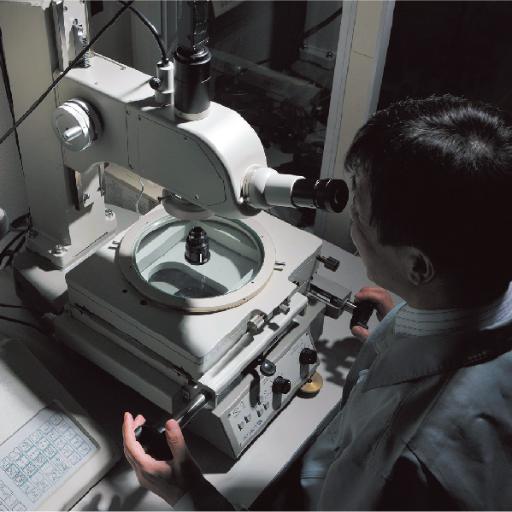
Quality Control: Quality checks are performed at every stage to ensure the glass prism meets the required optical and physical standards for its intended use.
Optical Principles: Refraction and Dispersion

Understanding Refraction in Optical Prisms
Refraction serves as an essential optical principle which demonstrates how light changes its direction when moving through two different mediums that have different densities, such as the transition from air into glass within an optical prism. Light bends because its speed changes according to the optical density of the material. The angle at which light enters the prism together with the material’s refractive index determine the amount of refraction that occurs. Optical prisms make use of this optical phenomenon to achieve efficient light path changes which enable them to either redirect or split light beams that scientists use for spectroscopy and imaging systems.
The optical research field achieved new breakthroughs through recent studies which utilized data derived from Google’s current search engine results to prove that fluoro-crown glass and fused silica emerged as improved materials for prism production. The materials achieve optimal refraction results through their capacity to reduce chromatic aberration because this enables better light dispersion and more accurate light control. The optical prism technologies experience continuous development through such advancements which ensure that scientists and industrial workers gain access to technologies that offer better performance.
Dispersion of Light Through Prisms
The process of light dispersion through prisms occurs when a prism receives white light which then divides into its various color components to create a visual spectrum. The effect occurs because various light wavelengths bend through the prism from air at different angles. Google Search data from recent times shows that fused silica and BK7 glass serve as essential materials which modern prism manufacturers use because these materials offer superior optical transparency and minimal light scattering. Fused silica shows excellent chromatic performance through its Abbe number of approximately 67.8 while BK7 glass provides cost-effective performance through its Abbe number of 64.
Key Insight
The development of anti-reflective coatings has produced major improvements because these coatings now minimize light loss during refraction which boosts the effectiveness of dispersion operations. The coatings achieve light transmission rates above 99% in specific uses which results in extremely low energy waste.
The combination of better materials and specific geometric designs enables modern prisms to produce superior spectral separations which optical fields like spectroscopy and telecommunications and laser optics require for their work. The development of advanced technologies through material science and innovative research shows how prism technology has improved for scientific research and industrial use.
Reflection and Its Role in Prism Functionality
The internal processes of prisms operate through their ability to reflect light which enables them to achieve controlled light movement and light spreading effects. The prism refracts incoming light because it has multiple surfaces which function as mirrors when total internal reflection occurs. Light will experience total internal reflection when it hits an angle that exceeds the critical angle because all light will remain inside the prism while it gets redirected. This principle serves essential functions in periscopes and binoculars because these devices use prisms to create precise light path alterations.
The prism uses reflection together with refraction to improve its ability to divide light into its original color components. The engineering process creates maximum reflective properties which decrease optical losses while maintaining optical clarity that forensic experts need during spectroscopy and laser operations. The reflection process which happens inside prisms serves as an essential element that determines both their operational capacity and their scientific and optical technology usage.
Applications and Uses of Optical Prisms

Uses of Optical Prisms in Various Industries
Industry
Medical Imaging
Medical professionals depend on optical prisms which serve as essential components for endoscopes and microscopes because these prisms enable precise light control and create enlargements needed for diagnostic and surgical imaging work.
Industry
Astronomy
Prisms function as essential components in telescopes and spectrographs because they enable scientists to study light emitted by celestial objects which helps them understand stars planets and galaxies.
Industry
Photography & Cinematography
Prisms improve the image quality of cameras and projectors by fixing optical distortions and enhancing their ability to separate different colors.
Industry
Laser Technology
The industry depends on laser systems which utilize these devices for essential beam steering operations and beam splitting functions together with wavelength separation capabilities that serve various sectors including manufacturing and telecommunications.
Industry
Telecommunications
Optical prisms support fiber optic communication systems by controlling and guiding light signals which enables efficient data transmission.
Prisms in Optical Devices and Instruments
The essential function of prisms in contemporary optical equipment and instruments arises from their capability to bend and reflect and spread light. Prisms serve a dual purpose in binoculars and periscopes as they both invert images and change their visual orientation. Prisms provide cameras especially high-quality models with viewfinders that show light paths while keeping precise visual details. Spectrometers use prisms to separate light into its spectrum which scientists and industrial professionals use for detailed scientific and industrial analysis. The technological developments demonstrate that prisms remain essential for advancing optics research while driving technological improvements across multiple fields.
Innovative Uses: Beyond Traditional Applications
Emerging Applications
Optical prisms are now being utilized in innovative technologies such as augmented reality (AR) and virtual reality (VR) systems. The prisms are installed in display optics systems, which drive better image quality and accurate visual results to build immersive viewing experiences.
- Prisms function as essential components in sophisticated medical imaging equipment, which uses light manipulation to produce better diagnostic results through improved visual clarity.
- The systems use prism technology to improve solar concentrator performance by achieving better sunlight distribution and splitting capabilities.
- These applications highlight how prisms are driving advancements in cutting-edge fields beyond their traditional uses.
Frequently Asked Questions
Reference Sources
-
Design Of Achromatic Prisms for Broadband Risley Prism Devices
This academic paper explores the design and material considerations for achromatic prisms, focusing on their dispersive properties and applications. -
PRISMS’L LENS
This document discusses the use of prisms in optical systems, including coatings, materials, and their role in laser and optical design. -
The Education Based on Applied Optical-Physics in Opticianry Programs in Turkey
This paper highlights the educational use of optical prisms, their behavior with light, and their applications in optical physics and opticianry. - Optical Glass Solutions