Get in Touch with Saiweiglass



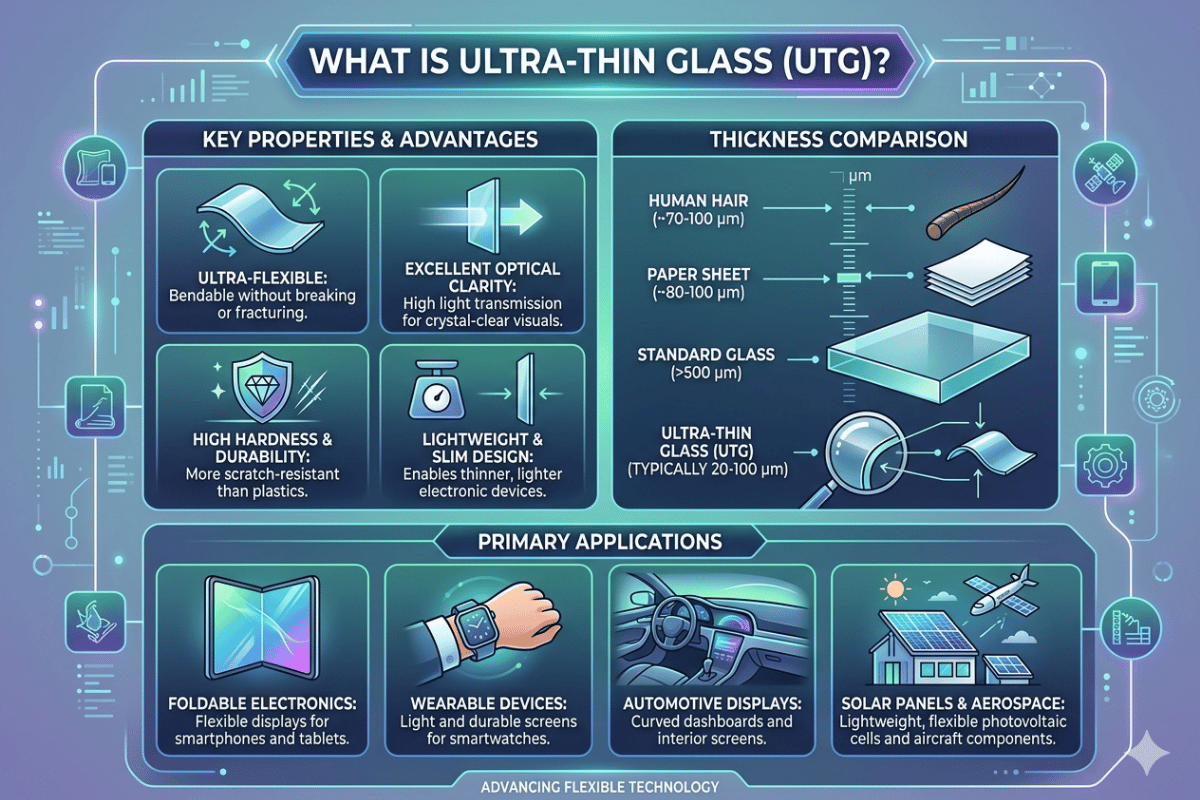
Ultra-Thin Glass (UTG) is very thin, real glass, which can be used in designs that require flexible glass. NEG reports that G-Leaf has a thickness of 25 µm, but having a thickness value does not determine the safe minimum bend radius for that material.
Possible uses are for designs requiring foldable displays and other diagnostic and industrial devices which use thin-glass structures.
The article describes ultra-thin glass, provides information on how it is made and describes the key characteristics of the material for use in design and procurement. It explains the importance of selecting the right specification and how to procure it.
25 µm
G-Leaf thickness reported by NEG
Grade-specific
Confirm transmittance, thickness, wavelength, and test method
$37.7B
Projected market by 2030
500,000 folds
Fold7 OLED panel test at 25°C
What Is Ultra-Thin Glass, Definition, Thickness Range, and Classification
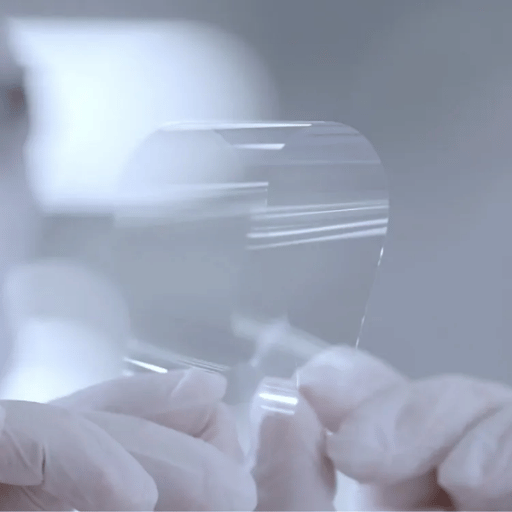
Ultra-thin glass is made from inorganic compounds and is shaped in very thin sheets. Certain grades of the material can bend or roll. Manufacturers use the term for different thickness ranges; this guide focuses on glass below 0.1 mm (100 µm), while also discussing thicker thin-glass examples.
When used in a display, Ultra-thin glass can be combined with a polymer structure.
The table below provides illustrative thickness bands to help frame purchasing questions. The bands do not represent standard product categories, and thickness does not determine composition or application.
| Thickness Range | Use of this band in this guide | Material selection | Application qualification |
|---|---|---|---|
| <0.05 mm (<50 µm) | Example band below 50 µm | Confirm the selected glass grade | Verify bending and handling limits for the assembly |
| 0.05–0.1 mm | Example band from 50 to 100 µm | Specify composition and surface treatment | Verify optical, mechanical and processing requirements |
| 0.1–0.5 mm | Thicker examples discussed alongside UTG | Use the grade-specific material data sheet | Qualify the complete part for its intended use |
For Aluminosilicate glass, borosilicate or soda-lime glass, consider which grade offers the best strengthening, thermal and chemical properties, rather than assume one composition is best for every application.
For ultra-thin glass state nominal thickness, total thickness variation (TTV), the dimensions of the substrate, and the measurement method. The supplier and the customer should agree on application-specific acceptance limits. ISO 9385 addresses Knoop hardness, and ISO 7884 addresses viscosity and viscometric fixed points; neither is a thickness-measurement standard.
How Ultra-Thin Glass Is Made, Manufacturing Processes Explained

When reviewing manufacturing paths for thin glass, review how the supplier controls thickness and surface quality. The process descriptions below distinguish what manufacturer-documented forming methods are versus routes that require confirmation of the quoted product.
Manufacturing routes to discuss with your supplier:
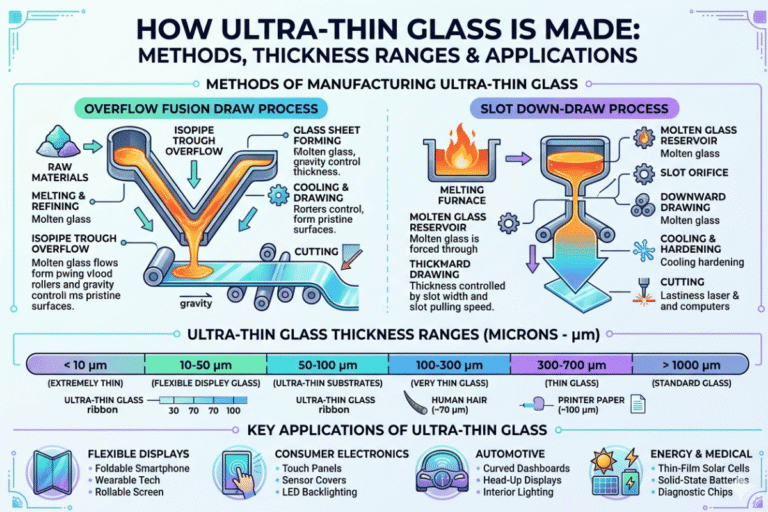
- Overflow fusion-draw (Corning process) describes a process where molten glass flows over both sides of a trough with a V-shaped bottom, joins in the center, and is drawn down and cooled in mid air. The surfaces created don’t make contact with the forming trough. Corning Willow Glass is described in a Corning overview as fusion-formed glass that’s supplied as a roll and is 100 or 200 µm in thickness. Confirm availability and supply format for the requested specification.
- Down-draw (SCHOTT process) – Molten glass is pulled downward via rollers and an annealing furnace. SCHOTT describes its down-draw process as producing fire-polished surfaces with roughness below 0.5 nm and thicknesses from 30 µm to 1.1 mm. Verify the range available for the selected glass grade.
- Chemical thinning reduces glass thickness by chemical etching. For chemically thinned products, ask for the starting glass, final thickness, nominal-thickness tolerance, total thickness variation (TTV), surface quality and cost.
- Redraw process: For redrawn glass, ask the supplier to describe the process for the glass being quoted, provide measured thickness uniformity, and surface quality, and other pertinent dimensions.
| Method | Thickness Range | Surface Quality | Volume | Relative Cost |
|---|---|---|---|---|
| Overflow fusion-draw | 0.1 and 0.2 mm (Willow rolls) | Excellent (fire-polished) | Corning describes roll supply for Willow Glass; confirm current availability | Request a product-specific quote |
| Down-draw | 0.03–1.1 mm (SCHOTT process range) | Fire-polished; roughness <0.5 nm (confirm roughness metric) | Confirm available production capacity | Request a product-specific quote |
| Float + chemical thinning | Confirm final thickness for the quoted product | Request measured final surface quality | Confirm available production capacity | Request a product-specific quote |
| Redraw | Confirm the available redraw thickness range | Variable (composition-dependent) | Confirm available production capacity | Request a product-specific quote |
In the end, the decision for process selection is generally based on the intended use. For process, ask for surface quality measurements and edge or face condition acceptance criteria for the finished part. Include any bend test samples.
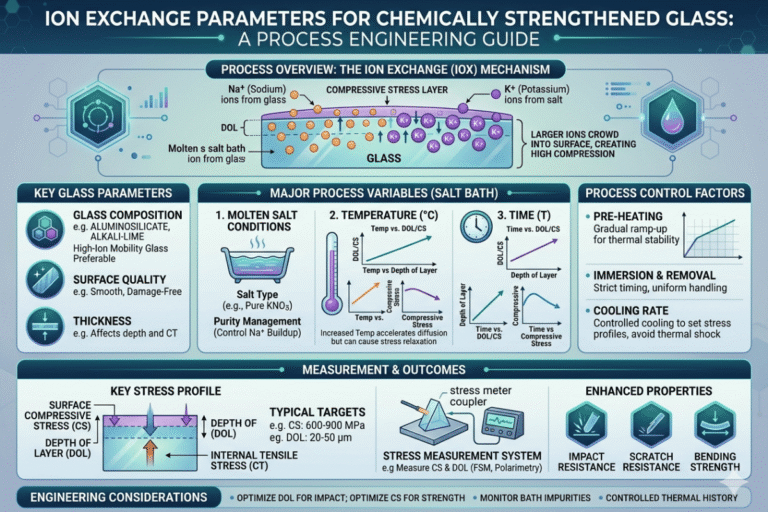
Compatible glass grades can be chemically strengthened by ion exchange. In the sodium–potassium process described by Corning, larger potassium ions replace smaller sodium ions near the surface, creating a compressive stress layer. Confirm the strengthening conditions and finished-part performance for the selected grade and thickness.
Key Properties, Comparing Ultra-Thin Glass and Plastic Film

UTG and CPI (colorless polyimide) should be assessed as finished cover stacks.
Evaluate the finished construction based on actual measured performance. Request transmittance, haze and color measurements with specimen thickness, wavelength range and test method stated. Compare equivalent coated or uncoated constructions.
Mechanical hardness. NEG lists a Vickers hardness of 600 HV for G-Leaf. This is a product value, not a universal UTG rating or a direct conversion to Mohs or pencil hardness. Request relevant scratch-test results for the exposed surface of the finished cover.
Flexibility and bend radius. SCHOTT describes UTG for foldable displays. Ask for the qualified bend radius and repeated-folding results for the proposed thickness, edge condition, strengthening treatment, and display stack.
Ultra-Thin Glass (UTG)
- Transmittance: confirm grade, thickness, and wavelength
- Hardness: confirm grade and test method
- Min bend radius: request qualified product data
- UV stability: confirm exposure-test results
- Chemical: confirm compatibility with process fluids
- Thermal: confirm operating limits for the complete part
Plastic Film (CPI / PET)
- Transmittance: confirm film grade and test method
- Hardness: confirm film, coating, and test method
- Min bend radius: confirm film and cycling conditions
- UV stability: confirm film and coating test results
- Chemical: confirm compatibility with process fluids
- Thermal: confirm film and coating temperature limits
Chemical resistance. State the actual solvents, cleaning agents, concentrations, temperatures, and times. Request data for compatibility with respect to the glass or film grade and any coatings, especially for use in the medical and laboratory fields.
Heat resistance. Confirm the allowable processing and operational temperatures for the complete part. A glass transition temperature does not guarantee a service temperature: For example, SCHOTT’s AS 87 eco datasheet states Tg at 621°C. Request data for dimensional stability and thermal cycling pertinent to the environmental conditions of interest.
Where Ultra-Thin Glass Is Used, Applications Across Industries
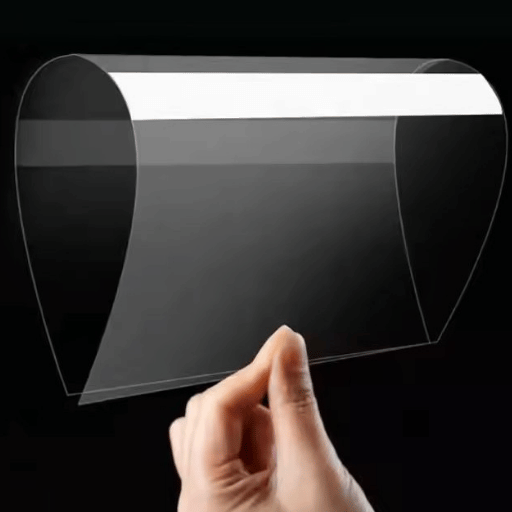
Ultra-thin glass is found in displays, wearable tech, touch panels, and solar cells, per manufacturers. Review the qualification process for each.
Foldable Smartphones and Consumer Electronics
In 2020 Samsung introduced UTG in the Galaxy Z Flip. Samsung announced the Galaxy Z Fold7 on July 9, 2025, with a UTG layer 50% thicker than its predecessor’s.
Samsung Display separately reported that the Fold7 OLED panel remained functional after 500,000 folds in a 13-day test at 25°C. This is a result for the tested panel construction, not a universal bare-glass guarantee.
To verify other handsets or wearables, review the cover material and layer construction to assess scratch performance and folding.
Automotive
For a different design of automotive HUD, touch panel, or sensor window, assess the glass grade and thickness for the optical design. Identify the required wavelength range, optical distortion limits, temperature exposure, surface durability and environmental tests. Confirm the appropriateness of thin glass for the application.
Medical and Diagnostic Devices
For a medical or diagnostic design, assess optical performance, chemical compatibility, extractables and leachables, and fabrication process. Do not assume a glass or coating is appropriate for implantation, without the required biological evaluation.
Semiconductor and Industrial
Used in semiconductor processes such as fan out Wafer-Level Packaging, glass carriers and interposers require application specific design and dimensional requirements. For other telecom, spectroscopy and imaging systems, filters require substrates with controlled thickness and surface quality. For a flexible solar cell, confirm the selected glass grade’s bending limits, gas-barrier performance and optical properties.
| Industry | Application | Thickness to Confirm | Key Property Required |
|---|---|---|---|
| Consumer electronics | Foldable display cover | Confirm for the display stack | Bend radius, scratch resistance |
| Automotive | HUD substrate, touch panel | Confirm for the optical design | Thermal stability, optical clarity |
| Medical | Lab-on-chip, sensor window | Confirm for the diagnostic component | Chemical compatibility, transparency |
| Semiconductor | Wafer carrier, interposer | Confirm for the carrier or interposer process | TTV, surface flatness |
| Energy | Thin-film solar substrate | Confirm for the solar-cell construction | Flexibility, barrier properties |
Sourcing teams evaluating thin glass panels for industrial uses can use this matrix as a starting point. Specify the dimensional, optical and environmental requirements for the particular application.
📊 Market Data Snapshot
Grand View Research estimates the global ultra-thin glass market at $21.7 billion in 2024 and forecasts $37.7 billion by 2030, with a 9.7% CAGR for 2025–2030. Its separate semiconductor-segment growth forecast is 10.2%. These are market-research estimates, not product specifications.
Ultra-Thin Glass vs. Standard Glass vs. Plastic Film, Comparison
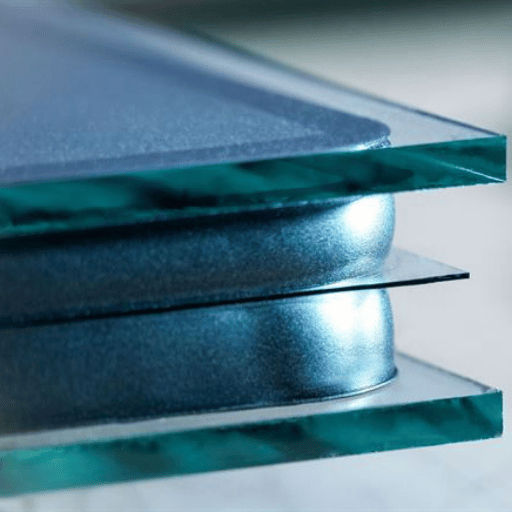
The comparison below covers ultra-thin glass, thicker glass, and plastic film. For this comparison, the UTG column is covering thicknesses below 0.1 mm and the thicker glass column is covering 0.5-1.1 mm. Compare grades and finished constructions for each before setting a budget and selecting a material.
| Property | Ultra-Thin Glass (<0.1 mm) | Thicker Glass (0.5–1.1 mm examples) | Plastic Film (PET/CPI) |
|---|---|---|---|
| Thickness | Below 100 µm in this comparison | 500–1,100 µm | Confirm the selected film gauge |
| Weight per m² | Calculate from the selected grade’s density and thickness | Calculate from the selected grade’s density and thickness | Calculate from the film construction and thickness |
| Min bend radius | Request qualified bend-radius data | Confirm allowable curvature for the selected grade | Confirm for the film and cycling conditions |
| Scratch resistance | Confirm grade, coating, and scratch-test method | Confirm the grade and scratch-test method | Confirm film, coating, and scratch-test method |
| Light transmittance | Confirm grade, thickness, wavelength range, coatings, and test method | Confirm grade, thickness, wavelength range, coatings, and test method | Confirm film grade, thickness, wavelength range, coatings, and test method |
| UV stability | Confirm exposure-test results for glass and coatings | Confirm exposure-test results for glass and coatings | Confirm film and coating aging data |
| Chemical resistance | Confirm compatibility with specified chemicals | Confirm compatibility with specified chemicals | Confirm film and coating chemical compatibility |
| Operating temp range | Confirm qualified operating limits | Confirm qualified operating limits | Confirm film and coating operating limits |
| Cost tier | Request a comparable delivered-cost quote | Request a comparable delivered-cost quote | Request a comparable delivered-cost quote |
| Typical MOQ | Confirm MOQ for the quoted size and grade | Confirm MOQ for the quoted size and grade | Confirm minimum roll quantity and length |
When considering ultra-thin glass, define requirements for flexibility, scratch resistance, and optical quality, as well as environmental considerations, and request data for an appropriate grade and finished construction.
When considering thicker glass, consider whether the thickness, mass, and rigidity of the glass are appropriate for the component, as well as whether adequate processing is available.
When considering plastic film, review whether film and coatings satisfy the same optical, mechanical, and environmental requirements.
Compare quotations on the same basis, including dimensions, coatings, edge finishing, inspection, packaging, handling and assembly yield. Assess total cost using your production and service data.
How to Choose the Right Ultra-Thin Glass for Your Project

The selection of a particular ultra-thin glass type is not just choosing the thinnest option. Thickness, composition, surface treatment and edge work, all influence the design of the device, the way it is assembled, and how it is used in its environment. Below is a step-by-step process.
✔ Selection Checklist
- State the dimensional requirements of the ultra-thin glass type, nominal thickness, thickness tolerance, total thickness variation (TTV), warp, and agreed measurement method. Indicate the substrate’s dimensions.
- Composition of the substrate – Determine which grade of substrate meets your requirements of mechanical strengthening, thermal, chemical and other considerations. Review the datasheet and test results and don’t select a substrate based on the grade name only.
- Identify surface treatments. Specify the required AR, AF, ITO-ready or bare-glass characteristics for each substrate face.
- State the required edge treatment, if any, and acceptance criteria for the selected thickness. Request strength or bending data for parts made with the proposed cutting and edge-processing method.
- MOQ and lead time. Obtain written confirmation of the minimum order quantity, current stock status, production lead time and shipping schedule for the exact grade, dimensions, coatings and quantity.
- Compliance documentation, Request applicable RoHS and REACH declarations and supporting documents for the quoted product. For medical use, determine the biological evaluation required under the applicable ISO 10993 standards for the intended device and contact conditions.
⚠️ Common Specification Mistakes
- Ambiguous thickness tolerance, State both the nominal thickness and whether the tolerance is bilateral. For example, 50 µm ±10% means 50 µm ±5 µm, or 45–55 µm. Confirm the units and acceptance limits on the quotation.
- Ignoring edge processing: Confirm how the proposed cutting and edge-processing method affects finished-part strength. For a mechanically stressed part, request bending or strength data for that edge condition rather than assuming grinding is always required.
- Ignoring dynamic fatigue: A static bend radius spec (e.g. 3 mm) won’t ensure the performance of ultra-thin glass when subjected to cyclic loading. Request your supplier to provide dynamic-fatigue data, including fold count at the required bend radius under specified humidity and temperature conditions.
- Neglecting handling specifications: Request the supplier’s instructions for packaging, separation layers, cleanliness, storage and handling of the product of interest. Evaluate the effect of the required packaging, shipping and handling on your assembly budget.
Always ask for representative samples to validate fitness for use (e.g. in assembly/test fixtures) prior to committing to an order. Confirm samples grade, size, processing, cost and terms of delivery.
For an inquiry about ultra-thin glass sheets, please include your drawings indicating any features which require certain dimensions and tolerances. Also provide intended operating conditions and any surface conditions such as quality or roughness. Which products and/or processes can be offered for your requirements?
The Future of Ultra-Thin Glass Technology
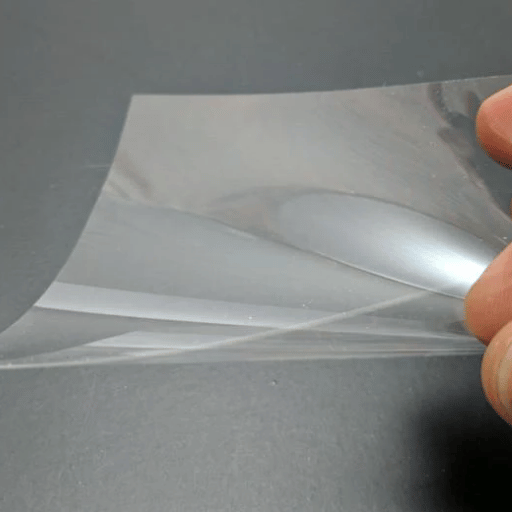
Foldable and rollable devices offer further design opportunities. For devices containing UTG, request qualification data for the target bend radius, repeated cycling, operating environment and complete layer construction rather than assuming a universal thickness or fatigue limit.
Thinness does not guarantee suitability for body contact (such as in medical devices) or an ingestible device (in a medical or pharmaceutical device) or automotive glazing.
Grand View Research projects the global ultra-thin glass market will reach $37.7 billion by 2030. This is a market forecast, not a guarantee of product availability or performance. When reviewing the saiweiglass ultra-thin glass catalog, ask which grades, thicknesses, processing options, and quantities are currently offered.
Frequently Asked Questions
Is ultra-thin glass real glass?
View Answer
Yes. UTG is an inorganic material and not a polymer or plastic film. Hardness, optical performance, and chemical resistance depend on the glass grade and any coatings. Review the manufacturer’s datasheet for the product in question.
What is very thin glass called?
View Answer
Industry terminology varies. UTG and thin glass may refer to flexible glass. Examples include Corning’s Willow Glass and SCHOTT’s UTG. These names do not define a universal thickness range.
How is ultra-thin glass made?
View Answer
Manufacturing routes include Corning’s fusion-draw process and SCHOTT’s down-draw process. Chemical thinning is another route for reducing glass thickness. Ask the supplier to identify the forming and thinning processes used for the quoted grade and provide its thickness, surface-quality and tolerance specifications.
What is ultra-thin glass used for?
View Answer
Examples of applications are foldable displays, touch screens, wearable devices, and solar cells. Thin glass is used in diagnostic components and carriers in semiconductor manufacturing. For each of these applications, an appropriate glass grade is used, and there is no single ultra-thin glass (UTG) specification for all applications.
Is ultra-thin glass plastic?
View Answer
No. UTG is inorganic glass; CPI means colorless polyimide, a polymer film. A foldable display can have both glass and polymer layers, and so, in the absence of other information, the presence of UTG does not mean the exposed surface of the foldable display is bare glass.
Can ultra-thin glass replace plastic screen covers?
View Answer
Considering UTG for a cover glass design is possible, but the operating conditions, complete cover stack, and end-use environment determine its suitability. Evaluate proposed glass and film grades for scratch, optical, folding, and environmental tests. Consider handling requirements and delivered cost.
What is the thinnest glass available?
View Answer
There is no single minimum glass thickness for all products. NEG reports 25 µm G-Leaf, while SCHOTT lists sheets starting at 30 µm. These do not establish the world’s thinnest glass. Confirm the minimum thickness, dimensions, tolerances and current availability for the specific grade you need.
About This Analysis
This document discusses terminologies, applications, and procurement of UTG. Specifications provided by manufacturers are valid for named products and test conditions. For procurement, request the most recent datasheet, and a quote to state the offered material and processing.
Need Ultra-Thin Glass for Your Next Project?
Contact saiweiglass with your requirements for thickness, dimensions, quantity, and use case. Ask which types of glass are available, what tolerances exist, what kinds of edge processing and coatings are available, and if they have any samples. Make sure you verify your understanding of the specifications and delivery terms in writing.
References & Sources
- Grand View Research, Ultra Thin Glass Market Size & Share Report. Measurement of market value, breakup by segment, and to 2030 forecast mentioned throughout this document.
- SCHOTT, Ultra-Thin Glass for Foldable Displays. Manufacturer information on UTG for foldable displays. Confirm numerical properties in the selected grade’s datasheet and qualification data.
- Corning, Willow Glass. Manufacturer overview of fusion-draw manufacturing and Willow Glass roll specifications.
- Samsung Newsroom, Inside Samsung’s Ultra-Thin Glass Innovation. UTG adoption information. For the Fold7 OLED panel’s 500,000-fold result and test conditions, consult Samsung Display’s separate panel-test report.
- Display Daily — With Ultra-Thin Glass, Schott Leads the Way. Market analysis of Schott’s UTG manufacturing industry leadership and foldable display market dynamics.
- ISO 9385:1990, Glass and Glass-Ceramics: Knoop Hardness Test. Standard reference for the Knoop hardness method; identify the tested grade and test conditions.