Get in Touch with Saiweiglass




Quick Specs
| Surface Compressive Stress (CS) | 600–1,200 MPa (substrate-dependent) |
| Depth of Layer (DOL) | 20–100 µm (K⁺–Na⁺ exchange) |
| Salt Bath Temperature | 380–500 °C (molten KNO₃) |
| Immersion Time | 4–30 hours typical; up to 120 hours for deep DOL |
| Strength Gain vs. Annealed Glass | 6–8× (standard process) |
| Governing Standard | ASTM C1422 / C1422M |
Chemically strengthening by ion exchange is now the most common way of achieving high-strength thin glass for markets as diverse as consumer electronics through to aerospace glazing. However, despite widespread publication of the technique, most do not go beyond stating that the basic process involves sodium ions being exchanged for potassium ions in a molten salt bath, to define the process parameters that lead to a compliant or non-compliant final part.
This guide goes further, mapping correlations between bath temperature, immersion duration, depth of layer (DOL), and compressive stress (CS) across the 3 main glass substrates and then summarizes the failure modes and quality control procedures that are relevant on the production line. If you require ultra-thin chemically strengthened glass for a display cover or need to qualify a salt bath for pharmaceutical vials, the data here has been gathered from published, peer-reviewed studies between 2019 and 2025.
What Is Chemically Strengthened Glass?

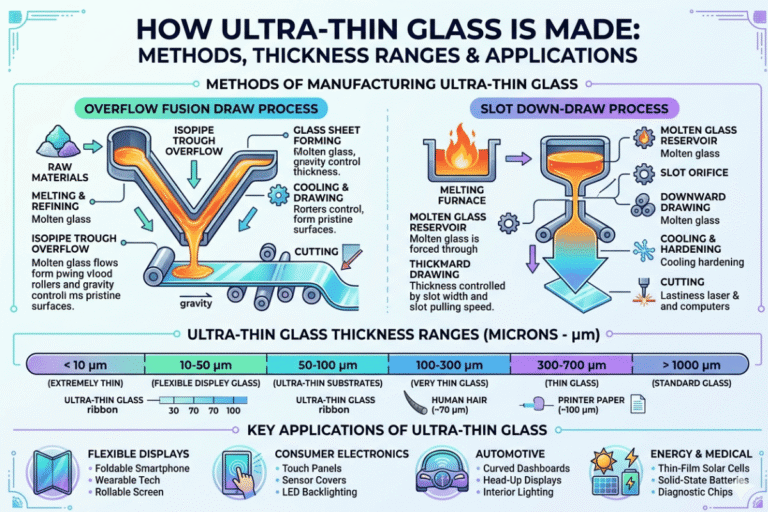
Chemically strengthened glass refers to a class of glass strengthened by a post production ion-exchange mechanism. Unlike thermal tempering this process involves immersing cut-to-size glass in a hot bath of potassium nitrate salt. The vapor flow generated causes potassium ions to diffuse into the surface of the glass.
After treatment, the resulting surface compression makes glass six to eight times stronger than untreated annealed glass under testing per ASTM C1422, the specification for chemically strengthened flat glass. Unlike thermally tempered alternatives, chemically strengthened glass preserves its original optical clarity with close to no distortion — a trait which has made it the default choice for precision optical, display cover glass, and instrumentation windows.
Dimensional stability of the glass is also retained in the glass. This is due to the fact that the roll firing takes place below the temperature at which the glass flows, so there is no softening of the glass, no imprint of roller-wave and shape change. The parts can be strengthened after they have been cut, ground and polished – a process which is not otherwise possible in the case of thermal tempering, as all the fabrication must be done prior to the heat treatment.
How the Ion Exchange Process Works

Chemical strengthening involves a diffusion-controlled ion-exchange mechanism. When a glass with alkali content is soaked in a molten potassium salt bath (such as potassium nitrate, KNO3), the larger potassium ions (1.38 ), will substitutes the smaller sodium ions (0.95 ) in the host glass surface. Since potassium ions are larger (by volume) by about 45%.
The process follows four distinct stages:
- Pre-treatment of cleaning – The glass components are cleaned in order to eliminate oils, particulates and any surface contaminants that would impede the ion diffusion pathway. Any lingering surface flaws (particularly at cut edges) must be eliminated prior to immersion in order to prevent splitting under the 7000psi compression.
- Salt bath immersion: Insert parts into hot molten KNO (sea 380-500 C), the diffusion rate is directly proportional to the bath temperature; the higher the temperature, the greater the speed of the migration of the ions at the expense of the availability of the stress relaxation. in present production techniques, the range of temperature is mainly between 410 and 450 C.
- Hold period The glass is held immersed for a period determined by the target DOL and composition. Typical cycling is 4-30 hours, although cycles as long as 120 hours are sometimes used when much deeper compressive layers are needed (as in aerospace windscreen use rated for surviving bird collisions at mach+/- 400 knots – see American Ceramic Society).
- Controlled cooling and inspection The part is slowly cooled from the bath at a controlled ramp rate to prevent thermal shock. Final surface compressive stress (CS) and DOL is measured with polarimeter or surface stress meter.
📐 Engineering Note
The ion-exchange reacts according to Fick’s second law of diffusion. At 420 C in typical soda lime glasses, the interdiffusion coefficient of K-Na exchange is approximately 5-15 m/hour, providing a 16 hour cycle with a resulting DOL of approximately 40-60 m. Increasing the bath temperature to 480 C speeds this rate by a factor of around 2, but at the cost of speeding up the relaxation rate of the viscous stresses – that is, speed the internal stress relaxation without changing the cooling cycle that quenches it (see Journal of the American Ceramic Society (PMC)). This trade-off is the predominant factor in chemical strengthening optimization.
Critical Ion Exchange Parameters

Three independent parameters define the mechanical qualities of a chemically strengthened glass: CS, DOL and central tension (CT). Achieve the one without proper regard for the others and the part ends up either under-strength or spontaneously shattering. The table shows the typical ranges achievable for a glass in a given substrate range (see Gurocak).
| Parameter | Typical Range | Measurement Method | Effect on Performance |
|---|---|---|---|
| CS (Compressive Stress) | 600–1,200 MPa | Surface stress meter / scattered light polariscope | Higher CS increases resistance to crack initiation from surface flaws |
| DOL (Depth of Layer) | 20–100 µm | SIMS / XPS / prism coupler | Deeper DOL resists deeper surface damage and improves fracture toughness |
| CT (Central Tension) | Must remain below 40–50 MPa | Calculated: CT ≈ CS × DOL / (t − 2 × DOL) | CT exceeding threshold causes spontaneous fracture and fragmentation |
| Bath Temperature | 380–500 °C | Thermocouple / PID controller | Higher temp = faster diffusion but greater stress relaxation |
| Immersion Time | 4–120 hours | Process timer / batch record | Longer time = deeper DOL but diminishing CS returns |
| Salt Purity (NaNO₃ content) | < 0.5 wt% NaNO₃ | Chemical titration / ICP-OES | Exceeding threshold reduces CS and strength by ~25% |
Here’s where all the specification failures happen. Longer time immersed in the bath to get an appropriate DOL also cause additional relaxation at high temperatures that lowers the final surface CS. A 2025 finite element model published in the Journal of the American Ceramic Society demonstrated that ternary ion exchange (using mixed Li-Na-K baths) can, to a certain extent, break the DOL by CS tradeoff.
💡 Pro Tip
Always calculate the CT before you approve the process. Its most devastating when working with glass less than 2 mm in thickness; we see the ratio of CT/CS exploding around this thickness.
Chemical Strengthening vs. Thermal Tempering
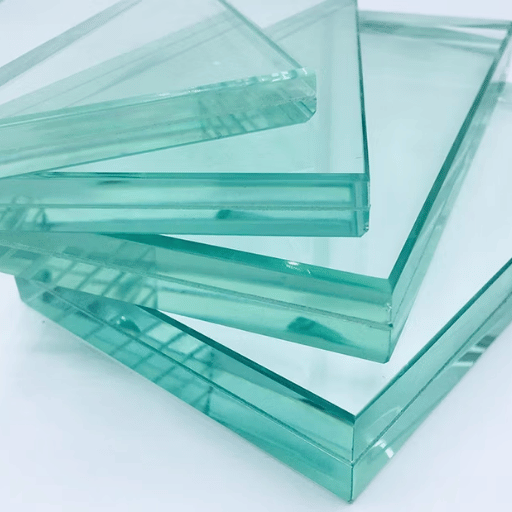
Which approach creates the strongest glass? The simple one that simply relieves the existing stress profile in the glass with a heat soak, or the more complex one that uses ions to actually push apart the glass structure? This question has ramifications for every specification a glass engineer ever wanted to specify.
| Property | Chemical Strengthening | Thermal Tempering |
|---|---|---|
| Surface CS | 600–1,200 MPa | 80–150 MPa |
| Minimum Thickness | 0.1 mm (ultra-thin cover glass) | 3.0–3.2 mm (furnace/roller limitation) |
| Optical Distortion | None (no softening occurs) | Roller-wave distortion inherent |
| Edge Strength Retention | ~100% (uniform compression) | ~50% (tension zone at midplane) |
| Post-Treatment Fabrication | Not possible (removes compressive layer) | Not possible (shatters) |
| Break Pattern | Large fragments (similar to annealed) | Small dice fragments (safety glass classification) |
| Process Time | 4–30 hours per batch | 2–5 minutes per piece |
| Relative Cost | 3–10× higher per unit | Baseline |
✔ Advantages of Chemical Strengthening
- Treats glass as thin as 0.1 mm – impossible with thermal tempering
- Zero optical distortion preserves display and sensor clarity
- Surface CS 4–8× higher than thermally tempered glass
- Uniform edge-to-center strength distribution
- Compatible with complex shapes and tight dimensional tolerances
⚠ Limitations of Chemical Strengthening
- Cycle times of 4-30 hours vs. minutes for thermal tempering
- Cost 3-10x depending on batch size and glass type
- Saves leaving the stir factors in the glass and good for safety glass break pattern (no dice fracturing)
- Salt bath requires ongoing purity monitoring and maintenance
- Limits depth of layer in single step K-Na exchange to About 100 m
Break pattern differences carry regulatory weight. Thermally tempered glass fragments into small dice and qualifies as safety glass under EN 12150. Chemically strengthened glass, however, breaks into larger shards similar to annealed glass, so lamination may be required for safety-rated architectural and automotive applications. When specifying thin glass substrates for ion exchange, downstream safety classification requirements must be factored into the design.
Glass Substrate Selection for Ion Exchange

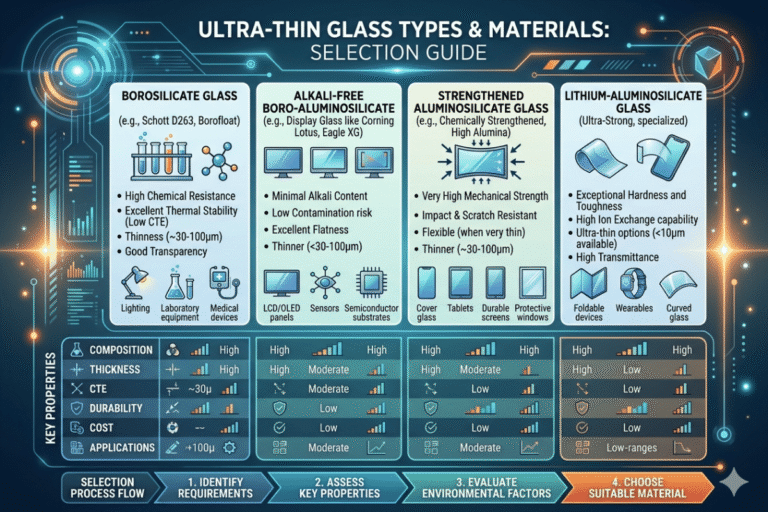
Not all glass responds to chemical strengthening equally. Performance depends almost entirely on the composition’s alkali oxide content and network structure. Soda-lime silicate, aluminosilicate, and borosilicate — the three most common substrate families — generate radically different CS and DOL characteristics under identical bath conditions.
| Glass Type | Na₂O Content | Achievable CS | Relative DOL | Strain Point | Primary Applications |
|---|---|---|---|---|---|
| Aluminosilicate | 5–15 wt% | Up to 1,200 MPa | Deepest (benchmark) | 570–650 °C | Smartphone cover glass (Gorilla Glass), avionics, high-performance displays |
| Soda-Lime Silicate | 12–15 wt% | Up to 800 MPa | Moderate | 500–510 °C | Architectural, transportation, general industrial |
| Borosilicate | 4–8 wt% | 55% lower than aluminosilicate | 89% shallower than aluminosilicate | 510–560 °C | Pharmaceutical vials, laboratory glass, chemical processing |
Aluminosilicates dominate the cover glass market because their open network readily accepts potassium ions and produces high CS coupled with a deep DOL. Corning’s Gorilla Glass family of commercially available toughened glass consists of proprietary aluminosilicate compositions specifically optimized for ion-exchange performance. A paper authored by the American Ceramic Society Bulletin affirms that soda-lime composition, while capable of reaching hundreds of MPa of CS, cannot achieve the same strains of other compositions due to its lower strain point, or DOL potential.
Boronsilicate compositions have traditionally been considered undesirable candidates for chemical strengthening with commercial viability only established in a 2024 journal article published on ScienceDirect. Researchers benchmarked the performance of boroshilicate vials versus aluminosilicate and achieved a 55% lower CS and 89% shallower DOL.
Most applications which demand ultra-thin glass for electronics and displays entrust aluminosilicate as the substrate of choice. Applications which demand chemical durability over mechanical strength, such as pharmaceutical packaging or laboratory apparatus, may instead opt for boro composition with a modified ion-exchange cycle at a per unit cost savings.
Industrial Applications of Chemically Strengthened Glass

Industry market projections estimate the market for chemically strengthened glasses achieved a value of $51.1 billion in 2025 with an expected compound annual growth rate of 6% through 2033. Five distinct market segments are driving this growth, each with its own specific performance needs.
Consumer Electronics – Mobile phones, tablets, e-readers, and laptop displays constitute the largest consumption areas of chemically toughened glass. The emphasis is on ultra-thin (0.3-0.7mm) cover glass with scratch resistance and good optical quality. Ultra-thin cover glasses such as Gorilla Glass have driven the CS target values up well above 900 MPa for these applications so as to enable consumer devices to survive the occasional crash onto a hard surface.
Automotive – The automotive industry has emerged as a significant growth application thanks to the growth in advanced driver-assistance systems (ADAS) and in-cabin display systems and monitors. Chemical toughening lends the scratch resistance and optical clarity that allows LIDAR sensors and head-up displays to be effective, while the reduced thickness supports vehicle fuel savings and emission reduction goals.
Aerospace and Defense – Aircraft windshields proved capable of bird-strike perforation at Mach 0.4 by the 1960s, once strengthened with chemical treatments. Military applications include transparent armor, helmet-mounted display visors, and window sensor arrangements capable of enduring ballistic loads.
Pharmaceutical – use ion exchanged borosilicate glass vials to reduce breakage during filling-line process. Saxon Glass Technologies has indicated a chemical require strengthening of cartridge glass EpiPen reduced failures from 10 percent to practically nil 10, which was itemized by the American Ceramic Society.
Architecture and Interior Design Areas – in situations where optical distortion unacceptable in display cases, museum glazing, or curved glass partitions require chemically strengthened glass offers tempered glass strength without the roller-wave defects. Applications with tight tolerances, thin profiles, or unique curves are best served by the dimensional stability of the ion-exchange process.
💡 Pro Tip
Identify the governing standard before specifying new glass products. For construction, transportation, solar, and electronic applications, ASTM C1422 covers chemically strengthened flat glass. In safety-rated applications, verify whether the break pattern requirement calls for tempered-glass fragmentation — if so, chemically strengthened glass may need lamination as a secondary safety measure.
Common Process Failures and Troubleshooting
Low. even to apply specifications in with ion exchange produce improperly parts as time is needed and process of the condition for drift. below will take account failures are the in run-ins most rejects of operation the modes.
Salt Bath Contamination
Sodium is by far the most usual mode of bath degradation. As migrates from out of into the potassium nitrate bath and the ions, the NaNO has slowly upwards the accumulate maximum concentration in the without a reduction in residual strength or compressive stress of the glass found in the research paper Journal of Non-Crystalline Solids we in shown that concentrations over 0.5wt% negatively affect can result.
Alkali earth contamination from float glass surface issues worsens the problem though you can precipitate and recover up to 97% of residual stress with a range of additives, as demonstrated in the Journal of the Ceramic Society of Japan – this process extends the salt bath service life and can lower operating costs.
Warpage in Thin Glass
Thin glass below 1.6mm can warp during ion exchange. Two mechanisms drive this;
- Float process imbalance – Glass float process tin-rich bottom surface is different to air side Sodium profile and causes the bow through unequal ion exchange as well as.
- dealkalisation – storage or pre-treatment treatments can deplete sodium at one face causing uneven compressive stress.
⚠️ Important
Existing damage near the edge – chips, shells, grinding scratches can cause fracture during salt bath immersion moment. Compressive stress at defects causes local stress concentration sites exceeding the strength of the glass. Edges should therefore be examined and polished where appropriate prior to chemical strengthening.
Quality Control Methods
- ✔Measure surface CS and DOL on every production batch using a scattered-light polariscope or surface stress meter
- ✔Monitor salt bath NaNO₃ concentration weekly via chemical titration; replace or purify when NaNO₃ exceeds 0.5 wt%
- ✔Measure warpage on thin substrates (<1.6 mm) using a flatness gauge; reject parts exceeding the application tolerance
- ✔Calculate CT for every process recipe change — verify CT remains below 40–50 MPa to prevent spontaneous fracture
- ✔For development or forensic analysis, use SIMS or XPS to map ion penetration profiles and verify diffusion uniformity
Frequently Asked Questions
Q: Is chemically strengthened glass scratch resistant?
View Answer
Chemically reinforced glass has a far more scratch-resilient surface than annealed or heat-strengthened glass. Compressive stress (600–1,200 MPa) in the surface layer helps withstand lateral forces, though diamond and silicon carbide particles can still mark the surface. Aluminosilicate compositions such as Gorilla Glass are tuned for maximum scratch resistance in consumer electronics, while soda-lime varieties provide moderate protection for architectural and industrial use.
Q: What is the process of strengthening glass called?
View Answer
Ion exchange. Also called chemical strengthening or chemical tempering — all three refer to the same salt bath process where K⁺ ions replace Na⁺ in the glass surface.
Q: How strong is chemically strengthened glass compared to regular glass?
View Answer
Under ASTM C1422 testing, chemically strengthened glass measures six to eight times the strength of ordinary annealed float glass. Surface compressive stress falls within 600 MPa to 1,200 MPa depending on glass composition, DOL, and processing conditions — compared to near-zero residual stress in untreated annealed sheets. Strength gains are most pronounced under bending loads and repeated surface impacts.
Q: Will chemically strengthened glass break?
View Answer
Yes. Chemically strengthened glass can fracture when applied forces exceed the surface compressive stress capacity, when point loads penetrate through the compressive layer into the tension zone, or when central tension (CT) rises above roughly 40–50 MPa — at which point spontaneous breakage can occur without external load. Fragments tend to be large and sharp, similar to annealed glass. Thermally tempered glass, by contrast, shatters into small dice fragments classified as safety glass.
Q: What is the difference between Gorilla Glass and chemically strengthened glass?
View Answer
Gorilla Glass is Corning’s brand name for a proprietary aluminosilicate glass that is chemically tempered via ion exchange. It is one specific product within the broader category of chemically strengthened glass — the base composition is engineered to maximize ion-exchange performance, achieving higher CS and deeper DOL than generic soda-lime or borosilicate substrates treated under the same conditions. Other manufacturers produce competing aluminosilicate cover glass products using similar chemical strengthening methods.
Q: Can chemically strengthened glass be cut or drilled after treatment?
View Answer
No, or at least, not without destroying the strengthening benefit. Cutting or drilling after ion exchange removes the compressive surface layer at the cut line, creating an edge that is weaker than its predecessor. Cutting, drilling, and edge finishing must be completed before ion exchange, in broad terms. For the above reason, all final dimensions are set before treatment begins.
Need chemically strengthened ultra-thin glass for your next project?
About This Analysis
Saiwei Glass developed this guide using peer-reviewed glass science research published between 2019 and 2025. CS, DOL, and process parameter ranges cited here come from published experimental data in the Journal of the American Ceramic Society, the American Ceramic Society Bulletin, and the Journal of Non-Crystalline Solids — sources our team references daily when specifying ion-exchange processes for ultra-thin glass product lines. Where industry data is cited, we have verified the original source and publication date.
References & Sources
- ASTM C1422/C1422M Standard Specification for Chemically Strengthened Flat Glass — ASTM International
- Introduction to Chemically Strengthened Glasses — Glass: Then and Now — The American Ceramic Society
- Measurement of Stress Build-up of Ion-Exchange Strengthened Lithium Aluminosilicate Glass — PMC / National Institutes of Health
- Modeling of Ternary Ion Exchange and Stress Evolution in Lithium-Containing Glass (2025) — Journal of the American Ceramic Society
- Effect of Na Contamination on Chemical Strengthening of Soda-Lime Silicate Float Glass — Journal of Non-Crystalline Solids
- Additive Effect in Salt Bath for Glass Strengthening — Journal of the Ceramic Society of Japan
- Ion-Exchange Enhancement of Borosilicate Glass Vials for Pharmaceutical Packaging (2024) — ScienceDirect / Open Ceramics
- Prospects for Ion-Exchange Processing of Commercial Soda-Lime-Silica Glasses — American Ceramic Society Bulletin
Related Articles