Get in Touch with Saiweiglass



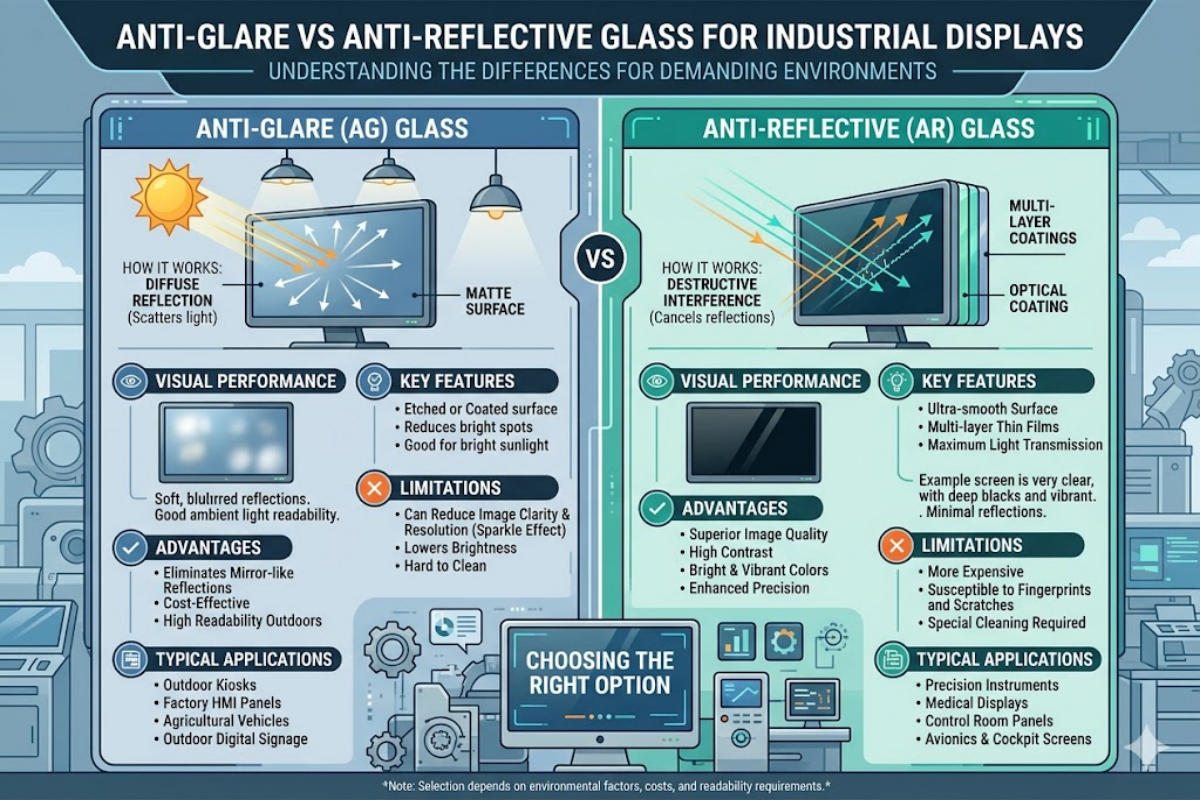
Top industrial surface treatments for display cover glass fall into two categories – anti-glare (AG) etching and anti-reflective (AR) coating. Both deliver some degree of glare reduction by reducing the apparent effect of outside light on screen readability, but they do so through radically different optical processes. AG scatters reflected light by chemically roughening the surface of the glass. AR effectively cancels it by using a multi-layer coating of selectively transparent materials to cause destructive interference. Which type of anti-glare vs. anti-reflective cover glass best suits your industrial display application depends on your environment of use, quality of image required, and budget.
At a Glance — Anti-Glare and Anti-Reflective Glass Compared
Here is the simple comparison between anti-glare and anti-reflective glass. Both surfaces reduce annoying glare, but AG does so by manipulating light’s path while AR suppresses its reflection. When establishing the difference between anti-glare and anti-reflective surfaces, keep these factors in mind.
| Property | Anti-Glare (AG) | Anti-Reflective (AR) |
|---|---|---|
| Method | Chemical etching creates micro-texture on glass surface | Multi-layer thin-film deposition (MgF₂, SiO₂, TiO₂) |
| Reflectance | ~2–3% (light scattered, not eliminated) | <0.5% per surface (light cancelled by destructive interference) |
| Light Transmission | 90–92% | >95% (up to 99% with premium stacks) |
| Haze (ASTM D1003) | 10–40% (adjustable by etch depth) | <1% |
| Image Clarity | Slightly softened (matte appearance) | Crystal-clear (glossy finish preserved) |
| Fingerprint Visibility | Low — texture masks prints | High — glossy surface shows prints |
| Scratch Durability | High — etched surface is inherently hard | Moderate — coating can be scratched |
| Cost | Lower | Higher (vacuum deposition process) |
| Best For | Factory HMI, outdoor kiosks, touchscreens with frequent contact | Medical displays, inspection stations, high-resolution panels |
For most industrial use, anti-glare always tends to be more practical for HMI panels with direct operator interaction. Space any control elements away from ambient viewing angles where they may glare. De-prioritize AR coatings unless visibility becomes critical.
How Anti-Glare Glass Works — Surface Etching and Light Scatter
The research begins with light hitting the AG etched surface. Chemically etching the glass creates a 6-50 micron surface roughness (described as “aggressive” or “mild” by different suppliers). This diffuse reflection spreads back a wide angular distribution of incoming light – diluting the intensity, making it less likely to cause distraction. Engineers instead call this scatter -a broadband angular redistribution of reflected light energy which otherwise forms blotchy glare.
Antiglare haze levels are rated per ASTM D1003. Around 10% haze engenders very mild glare suppression with the least impact on sharpness. 15% haze targets avoid nuisance glare and are easier on the eye, while 25-40% haze levels make even strong ambient glare manageable, at the expense of a duller matte appearance of the surface. Anti-glare coatings actively diffuse reflected light rather than eliminating it.
From Our Production Floor:
“We offer an anti-glare etching process capable of handling up to 40% haze levels, specified per customer project. The industry standard, feelable AG etch produces a 15-25% haze layer as the best compromise between glare control and image clarity under typical factory lighting conditions.”
See all of our custom HMI cover lens options, including anti-glare and anti-reflective glass treatments.
How Anti-Reflective Glass Works — Multi-Layer Thin-Film Coating
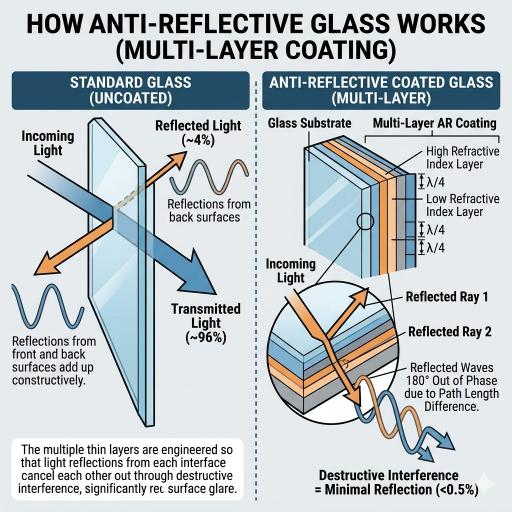
AR coated glasses are built up as multi-layer thin films in specialized vacuum chambers. Layers are made of deltas of magnesium fluoride (MgF), silicon dioxide (SiO), or titanium dioxide (TiO). Each layer’s thickness is laser-calibrated to match a certain narrow band of visible light (400-700 nm). When the light waves reflect from each layer, they destructively interfere with each other preventing the reflected light from forming. This multi-film approach is how AR coatings achieve the best anti-reflection optical performance.
According to the Wikipedia article on anti-reflective coatings, broadband, stacks that are tailored for the entire normal visual spectrum (roughly 400-700nm) routinely yield maximum AR of less than 0.5%. Narrowband stacks focused on discrete wavelengths (such as 555nm-yellowish green for human eye brightest) can push reflectance below 0.1%, undercutting our eye’s sensitivity.
A bare glass surface reflects around 4% of incident light. This means almost 8% of light incident on 2 surfaces, reflecting back into our eye. Triple-layer AR coatings reduce this to nearer 0%, giving ultra high transmittance. In an industrial display, this can directly translate to an added fidelity in contrast, color and imaging depth.
Optical Clarity and Image Quality
Regarding raw image fidelity, AR coated glass is better. By preserving a clear, shiny, non-greasy, non-matte surface, the image content through the glass looks just like what the panel is rendering. Healthcare displays, machine vision inspection stations, and any color critical application require AR coating.
The reflection on uncoated glass would be so mirror-like that the image would be impossible to analyze.
AG glass imposes a manageable compromise. Applying current AG etches at 15-25% haze is generally consistent with perceptually reading standard industrial HMI panels. At a resolution of less than 200 PPI (typical of 7 15 inch industrial touch-screens), the effects of AG haze on sharpness are barely visible.
Even at moderate haze levels, the operator’s ability to read status numbers, browse menus, and interpret color-coded alarms is still reasonably achievable.
Frequent Error: AG haze does not equal fuzziness. Present day chemical etching methods lend a micro-texture of consistent light scattering (thru hard coat, stain, or paint finishes) that reduces glare but does not detract from the viewing clarity of the display. Less than 25% haze is barely perceptible on a typical HMI.
Durability, Cleanability, and Environmental Resistance
AG glass is more durable in a practical sense. Since the surface is embossed into the glass itself, over time it will not flake, peel or wear off when washed repeatedly. Workers that wash screens with industrial strength cleaning agents or disinfectants in a factory environment will prefer AG.
Smudges are actually less visible since the matte finish doesn t show them well, which also means less cleaning.
In contrast, the AR coating is on the surface of the glass and is therefore more susceptible to scratching. Most high-end stacks have a hardcoat top layer that provides scratch resistance, but aggressively-abrasive cleaning chemicals and equipment can still damage the coating. When the glass is constantly handled in a clean-room or other controlled-environment application, AR performance can be very long-lived.
For instance, many radiology monitoring equipment may have AR coatings in place for their entire functional life.
Either AG or AR surface coatin……gs can be used on brittle current tempered glass with no change in impact resistance.
Cost, Lead Time, and Minimum Order Considerations
Surface costs: AG etching vs. AR coating. In terms of per-unit cost, chemically etching the panels holds a significant advantage over AR coating.
Since it is a batch process, chemical etching can process several panels in a single batch, keeping per-unit cost low. AR coating, by contrast, requires vacuum deposition — a process that demands expensive chamber equipment and adds lead time.
Commonly for the budget restricted project, AG is used as the practical baseline. Anti reflective coating is justified in the added cost, when the spec requirements for image quality are stringent-, (such as when the user views fine text or valuable colors through the cover glass on medical displays or signage behind a glass enclosed display). The project engineers should compare the incremental cost of AR coating against the incremental improvement gained in the optics.
Which Should You Choose for Your Industrial Display?
Use Anti-Glare (AG) When:
✔ Operators touch the screen frequently (fingerprint tolerance)
The factory or outside lighting provides significant ambient light sources.
✔ Display resolution is below 200 PPI
✔ Cleaning with industrial solvents is expected
✔ Cost must stay low on high-volume production
Use Anti-Reflective (AR) When:
✔ Image clarity and color accuracy are non-negotiable
✔ Display resolution exceeds 200 PPI
✔ Environment is controlled (clean room, lab, office)
Glass is placed behind the façade and is infrequently handled directly
✔ Application requires maximum light transmission (>95%)
AG/AR combo glass can be applied to projects where AG etching and AR coating are coated on one piece of glass. AG and AR together combine scatter-based glare reduction from the etching with reflectance suppression from the thin-film coating. Outdoor HMI panels working in direct sunlight are one typical application of this combo.
For outdoor HMI panels under direct sunlight, see our guide to sunlight-readable display glass coating stacks.
Review our complete industrial viewing glass with the appropriate surface treatment.
Our Perspective
At SW Glass we provide in-house applying of AG etching, AR coating and AF (anti-fingerprint) coating at our Dongguan plant. In our factory we perform both surface treatments types each day on chemically strengthened and tempered cover glass for industrial HMI, medical device, automotive and consumer electronics customers. The above has been based on our production knowledge of coating of tens of thousands of cover glass panels per month over a period of 10+ years.
Frequently Asked Questions
Which is better, anti-glare or anti-reflective?
View Answer
Neither is necessarily the best option. AG is better suited for hightouch, bright light environments where fingerprint spec is a concern. Controlled environments where image quality is a priority work best with AR coatings.
Can I use both AG and AR together?
Show Answer
Yes. This is a hybrid approach: the AR coating is deposited directly on an AG-etched substrate. The combination of scatter-based glare minimization with thin-film-based reflectance suppression is a very nice solution in applications with OCT fingerprint tolerance and state-of-the-art optical needs – for example outdoor medical displays or sun-readable HMI panels for transportation.
Why does anti-glare glass sometimes look cloudy?
Read Answer
Haze levels over 35% cause a visual surface texture, which some users associate with cloudiness. Haze at 15-25% will still avoid this problem yet provide glare reduction.
What are the disadvantages of an anti-glare screen?
Show Answer
AG etching dulls the displayed image, softening the perceived sharpness just a touch. On high resolution screens above 300 PPI, the micro-texture seen on the AG surface can cause the display to display a sparkle or moir pattern that can mask fine detail. Colors will also be somewhat muted compared with a glossy AR-coated panel.For most medical imaging workstations or color grading monitors, this pushes the specification towards AR coating anyway.
Is anti-reflective glass suitable for outdoor use?
Read Answer
AR coating drops the reflectance below 0.5% per surface, even under bright sunlight. But, an outdoor kiosk or signage application, with its frequent public finger contact, typically uses an AR/ hardcoat combination, or selects AG, for fingerprint tolerance.
Does surface treatment affect touch sensor performance?
Show Answer
No. Neither AG etching or AR coating has any impact on the PCAP touch sensing. Each treatment preserves the dielectric characteristics which the PCAP sensors need in order to sense finger contact on the cover glass.Capacitive sensitivity, multi touch accuracy and palm rejection are all unaffected. Our engineering team ensures touch performance on all surface treatments before approving them for production.
References & Sources
- ASTM — “D1003 Standard Test Method for Haze and Luminous Transmittance of Transparent Plastics” — astm.org
- Wikipedia — “Anti-reflective coating” — en.wikipedia.org
- Wikipedia — “Thin-film interference” — en.wikipedia.org
- Corning — “Anti Glare Glass and Anti Reflective Glass Solutions” — corning.com
- Corning — “How It Works: Anti-Reflective” — corning.com