Get in Touch with Saiweiglass




Optical Glass Explained: Properties, Types, and How to Choose the Right Grade
Quick Specs — Optical Glass at a Glance
| Parameter | Value |
|---|---|
| Refractive Index Range | 1.44 (fused silica) – 1.95+ (dense flint) |
| Abbe Number Range | 20 (high dispersion) – 95 (low dispersion) |
| Transmission Range | 185 nm (UV-grade fused silica) – 5,000+ nm (IR specialty) |
| Common Grades | BK7 / N-BK7, SF11, N-LAK, fused silica, K9 |
| Key Standards | ISO 12123:2018, MIL-PRF-13830B |
Optical glass is the raw material behind every precision lens, prism, and imaging system – from camera phones to semiconductors. But the step opticians often find most difficult to understand is how to choose the optimal grade. This simple field guide to transparent optical materials deconstructs measurable optical properties, generic glass families, real-world manufacturing impacts, and design considerations that separate a successful optical project from an expensive re-engineering nightmare. It’s the guide to ordering BK7 blanks for a industrial vision system just as much as it’s the guide to expediently qualify fused silica for an UV laser system.
What Is Optical Glass — And Why Does It Matter for Precision Optics?

At its core, optical glass is no different than simple float glass as a type of glass. It is a formulation of silica, alumina, alkalis, and other oxides “engineered” to a very high degree of purity & homogeneity and, for the most part, arranged into a predetermined formula to yield specific refractive and dispersive properties. By comparison, the average sheet of house-glass contains thousands of tiny bubbles and inclusions and has no variation in properties beyond 110. By contrast, optical glass begins with the same basic raw materials but is nearly entirely purified to greater than 99.9% levels with a 72+ hour annealing cycle designed to produce a gross homogeneity (rebate variation) to 210, a homogeneity marker to be sure there are no internal frings in the finished fused silica Spectraul.
In practice, the result is quantifiable: a well-specified optical glass blank transmits more than 99% of incident light across the visible spectrum (380-780 nm) per surface with anti-reflection coating, while a sheet of float glass displays absorption or scatter losses of 8-15%. For applications where digital signal clarity, high-spatial frequency resolution, or laser energy density thresholds are critical, commercial-grade float glass simply cannot be substituted.
Such a difference is most evident in multi-element optical systems such as zoom lenses, where a single inhomogeneity in a single element can produce a complete wavefront collapse and lead to chromatic fringes, tonal shifting, and field curvature artifacts that simply cannot be digitally corrected away.
“Modern optical glass materials began with Otto Schott in the 1880s when he systematically separated various glass compositions and produced transparent forms with specific refractive index & dispersion values – a move that propelled glass from an art form to a science. Every space telescope or endoscope manufactured today is still reliant on that history lesson.”
— Adapted from SCHOTT historical archives on the foundation of scientific glassmaking
What Is the Difference Between Optical Glass and Normal Glass?
Four factors separate optical glass from window glass. First, purity: optical glass raw materials contain impurity levels below 10 ppm for contaminants like iron oxide (Fe₂O₃), which causes visible light absorption — normal glass tolerates hundreds of ppm. Second, homogeneity: optical blanks undergo 72+ hours of controlled furnace annealing until the refractive index variation across the piece falls below ±2×10⁻⁶ (grade H5 per ISO 12123). Third, thermal history: the entire annealing profile is engineered to lock in a specific refractive index to the fifth decimal place — a level of control that simply does not exist for architectural glass. Fourth, certified optical constants: every melt receives documentation of measured refractive index, Abbe number, and stress birefringence values.
Types of Optical Glass — Crown, Flint, and Specialty Grades
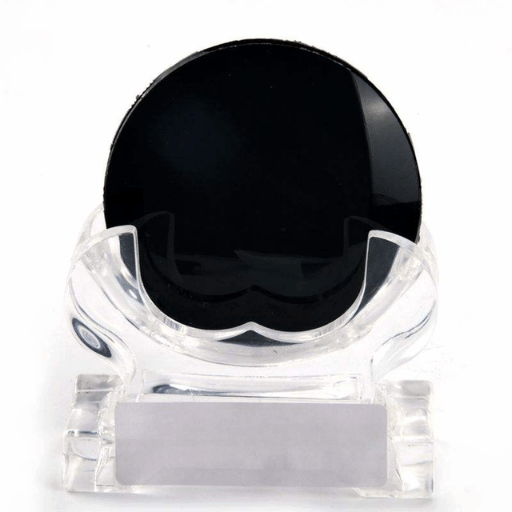
Optical glass classification is based on a system implemented using the Abbe diagram, which compares nd against Vd. Crown and flint, the two primary families, are at the two extremes of dispersion, and most designs combine elements from both families to cancel the chromatic aberration.
Crown glass grades have an Vd值greater than 55, resulting in little dispersion across the visible spectrum. BK7(borosilicate crown) has been adopted by industry as the primary glass for all standard applications, with Vd=64.17. It is a durable glass, with high transmission in the visible range, predictable polishing character, and good chemical durability. BK7 remains ‘the’ primary starting point for imaging, machine vision, and general laboratory optics, unless other application specific factors necessitate a switch to a different grade.
Flint grades tend to be below 50 in Vd, with higher indices of refraction, conferring the ability to bend the light path in more aggressive ways in smaller packages. Dense flint varieties such as SF11 — historically formulated with lead oxide and barium for high refractive index — can be combined with crown elements in achromatic doublet designs -the classic two element lens designation that corrects colour fringing at two separate wavelengths. Without flint element types, these wouldn’t be achievable in as few as a dozen components in many camera lenses and microscope objectives.
Specialty types maintain transmission over specific wavelength ranges or working environments where crown/flint image correction combinations are insufficient. Fused oxide components such as fused silica can have transmission well into the deep ultraviolet down to 185 nm, essential for semiconductor lithography at 193 nm (ArF laser).Chalcogenide types extend TIR transmission well into the thermal infrared, 1-12um, for FLIR and missile seekers. Specific types of optical filter substrate glass, including color optical filters and neutral density filter glass, are fabricated to selectively absorb or transmit specific wavebands with short tolerances. Laser gain media, such as phosphate glass, can incorporate a broad range of rare-earth dopants including phosphorus and boron without thermal lensing effect present in traditional silicate host material types. Lanthanum crown glasses (N-LAK series) provide a high refractive index with intermediate dispersion, making them useful for highly miniaturized forms such as endoscope optics, AR glasses, and VR head mounted displays.
One detail overlooked by many competitors when discussing glass types: N-BK7 is not the same as BK7. The ‘N’ is for SCHOTT’s lead-free reformulation, developed for soda-lime and arsenic-free glass manufacturing in order to be compliant with RoHS(RoHS is a set of restrictions regarding use of hazardous materials in electrical & electronic equipment).While the optical indices and Abbe number are similar, there are differences to do with the transmission in the near-UV (350-400 nm), and there are small shifts with regard to the thermal properties;which may mean the mounting calculations will require correction if replacing BK7 with N-BK7. Customers should specify the specific melt for the component in question.
| Glass Type | Refractive Index (nd) | Abbe Number (Vd) | Transmission Range | Typical Applications |
|---|---|---|---|---|
| BK7 / N-BK7 | 1.5168 | 64.17 | 350–2,000 nm | General optics, imaging |
| SF11 (Dense Flint) | 1.7847 | 25.76 | 380–2,500 nm | High-NA objectives |
| Fused Silica | 1.4585 | 67.82 | 185–2,500 nm | UV/DUV lithography, laser |
| N-LAK (Lanthanum Crown) | 1.6727 | 51.49 | 350–2,000 nm | Medical endoscopes, miniaturized optics |
| Chalcogenide (IRG) | 2.4+ | 20–30 | 1,000–12,000 nm | Thermal imaging, IR sensors |
| Phosphate | ~1.52 | ~63 | 400–2,000 nm | Laser gain media |
Engineering Note – BK7 specifications: nd=1.5168 0.0003 Vd=64.17 0.5% density=2.51 g/cm3 thermal expansion coefficient=7.110/K, Knoop hardness=610.These values are for fine-annealed material as specified in SCHOTTs catalog.
Data in the tables sourced from the available catalog data from Ohara Corporation, TIE catalog from SCHOTT, and entries from the RP-Photonics encyclopedia. Values as stated in the catalog are typical of any given lot, but could vary slightly.
Key Properties of Optical Glass — Refractive Index, Dispersion, and Transmission

There are three measurable characteristics that determine how an optical glass will behave when used with light –an initial set of requirements is laid down when the target value for each is chosen before any lens design is begun.
Refractive index; nd of the glass is the ratio of the velocity of light within a vacuum to the velocity of light passing through the glass. This index is measured for the helium d-line ( 587.6 nm). Refractive index determines the amount of refraction of a light ray that takes place when a portion of the light crosses the air-glass interface.
Higher the refractive index of the glass, greater is the deviation of light ray for unit thickness of the glass allowing the optical designer to develop shorter and more compact lens assemblies. Optical glasses have a refractive index varying from about 1.44 (fused silica) to over 1.95 (dense lanthanum flint) of which the majority of general purpose grades are found to be between 1.50 and 1.75. Put simply, a high index glass can produce equal power in a thinner element thus having less weight, this principle is used in making miniaturized endoscope tip optics and cellphone camera module lenses.
Abbe number (Vd) quantifies chromatic dispersion — how much the refractive index changes across different wavelengths. It is calculated as Vd = (nd − 1) / (nF − nC), where nF and nC are the refractive indices at the hydrogen F-line (486.1 nm) and C-line (656.3 nm) respectively. A high Abbe number (e.g., BK7 at 64.17) means low dispersion: the glass bends blue and red light almost equally. A low Abbe number (e.g., SF11 at 25.76) means high dispersion, which is actually desirable in achromatic doublet designs where a flint element cancels the chromatic error of a crown element. As a working tool, the Abbe diagram — a scatter plot of nd versus Vd for all available glass families — is the primary tool optical designers use to select glass pairs for color correction. Partial dispersion ratios further refine this selection by characterizing how the glass behaves in specific spectral regions beyond the standard d-line, with the Sellmeier equation providing the mathematical model for predicting refractive index at any wavelength.
Transmittance — the percentage of light that passes through a given thickness — determines the usable wavelength range. In general, most of the common silicate optical glasses transmit well from around 350 nm up to 2,000 nm. Shortward of 350 nm absorption in normal glasses goes up quickly due to electronic transitions in the metal oxide impurities.
Fused silica is good down to 185 nm, thus it is commonly used in all UV and deep-UV work, such as the ArF excimer (193 nm) lithography. Longward of 2,000 nm, the transmissive range of silicates terminates against the strong fundamental Si O vibrational band at 4.45 m, leaving a hard 5 μm cutoff. UV transmission in the near-ultraviolet range (200-380 nm) is a critical specification for spectral analysis and photolithography applications. If lenses or windows are required beyond this limit, then more exotic chalcogenide glass or crystalline germanium must be employed.
Homogeneity: scores the amount of variation in the index of refraction over the width of the glass blank (a score of H1, n 110 on the homogeneity scale made by ISO 12123:2018, is usable for simple condenser optics. For interferometric and lithographic optics, a glass blank must be a H5, n 210). H5 blanks are made using very long annealing cycles – sometimes taking over 72 hours to cool at a rate of 2 K/hour-, and each blank is tested by interferometry prior to dispatch.
Among material properties, the coefficient of thermal expansion might seem minor, but it is absolutely not at the system level. When optical glass element is cemented or clamped into a metal or ceramic holder, thermal expansion mismatch produces stresses at the interface when there is a cycle of temperature change. Those stresses produce birefringence (polarization dependent change of index of refraction), surface deformation, or in the worst case fracture.
For reference, thermal expansion of BK7 of 7.110/K is well-borne by aluminum mounts, but poor for titanium 8.610/K while the extreme simplicity of fused silica’s low 0.5510/K expansion requires for dimensional stability the use of Invar or carbon-fiber construction. Beyond optical performance, the mechanical properties (Knoop hardness, fracture toughness) and physical properties (density, chemical resistance) of each glass type also factor into the design — particularly for field-deployed instruments subject to vibration and thermal shock.
Engineering note – Vesushyep Mojirum constancy grades: H1: n 110 | H2: n 510 | H3: n 210 | H4: n 510 | H5: n 210.The standard catalog tolerances for index of refraction: nd 0.0003; for Abbe number: Vd 0.5% (fine-annealed).
Why Is Optical Glass So Expensive?
Four factors compound to make optical glass expensive. First, raw materials need to have the impurities removed down to parts per million, cost 10 to 100 times more than commodity glass batch; the melting must use platinum-lined crucibles so as not to contaminate the raw materials (also prohibitively expensive) and be done at temperatures of 1400-2000C or more for fused silica; energy input into the blank per kilogram using such large crucibles is also huge. Meanwhile, annealing may have to take 72 hours or more per batch so again since the mold is tied up in such high temperature annealing is high cost; ensure the relevant cultures of animal/chicken/egg/plant did not contaminate.
Lastly each flat blank must be tested on an individual basis for interferometric homogeneity, spectrophotometric transmission, and stress birefringence before being certified for sale. A batch size of one raw material then results in a batch size of 1-8 blanks weighing in at around 200 mm in diameter, 30 mm high (and simply unusable if defective) can take perhaps 10 days from melt to ship.
Optical Glass Applications — From Camera Lenses to Laser Systems
Optical glass is used in every industry that needs to direct, modulate or measure light, and the table below shows the most important applications and industrial verticals with respect to those glass types characteristics.
| Application | Glass Type | Critical Property | Industry |
|---|---|---|---|
| Camera / imaging lenses | BK7, crown types | Low dispersion (Vd > 60) | Consumer, industrial |
| Microscope objectives | Dense flint (SF series) | High refractive index (nd > 1.7) | Medical, research |
| UV / DUV lithography | Fused silica | Deep UV transmission (185 nm+) | Semiconductor |
| Thermal imaging | Chalcogenide, germanium | IR transparency 3–12 μm | Defense, automotive |
| Medical endoscopes | Lanthanum crown (N-LAK) | High nd + compact form factor | Healthcare |
| AR / VR headsets | High-index glass (nd > 1.8) | Thin, lightweight wafer lens | Consumer electronics |
| Laser systems | Phosphate, fused silica | Laser damage threshold (J/cm²) | Manufacturing, research |
Market data shows the optical glass industry was valued at an estimated $2 billion in 2024 and predicted to scale at a CAGR of 5.5% through 2033, driven by growth in semiconductor lithography, medical imaging, and consumer AR/VR devices. For example, autonomous vehicles now carry more than 15 optical sensors each — LiDAR, cameras, rain sensors — all requiring precision glass components. AR/VR headset production consumes an estimated 10 million optical glass components per year, and roughly 70% of modern endoscopes rely on advanced optical glass lens stacks rather than fiber-based imaging.
Scenario – AR/VR Wafer Lens Selection: A consumer electronics manufacturer working on a future AR headset candidate seeks to minimize lens wafer thinner than 2 mm to hit weight goals of less than 85 grams. Using standard BK7 at nd = 1.5168, the minimum thickness necessary for the lens to meet these goals is 3.2 mm, due to the measured power of the lens. By shifting to a lanthanum crown glass with nd = 1.80, the minimum focal length again is 3.2 mm, but the glass only must be 1.8 mm thick to support the power. Here is the tradeoff: lanthanum crown is generally 4+ per kg more than BK7 and the mold tooling will be more difficult without a thermal runaway in the molding run. With 500,000+ units leaving the factory each year, the incremental glass cost of 0.40 per unit translates to an overall 38% weight savings, which directly impacts the comfort and wearing time of the device.
Common Mistake: Engineers often choose BK7 for UV work below 350 nm without realizing internal transmission drops significantly at this wavelength. This can result in loss of signal, errors in measurements taking 2-4 weeks to troubleshoot, because while the blank “looks clear” to the eye it will in fact be absorbing in the region of interest. Always be sure to review the spectral transmission, not just the appearance of the material.
How Optical Glass Is Manufactured — From Raw Batch to Finished Blank

Glass manufacturing for optical applications is a six-stage process that is every bit as demanding as optical design itself. Whereas commodity glass focuses on volume throughput, optical glass manufacturing sacrifices speed for precision at every stage.
- Raw material batching- High purity silica (SiO, B2O3, BaO, La2O3, etc.) silicate oxides are precisely weighed and blended to within a few grams. The source of silica must contain less than 10 ppm iron to avoid IR cutoff in the blue.
- Melting- Raw batch is put in a platinum crucible-lined melter at 1400-1600 0C for most glasses, 1800-2000 0C for fused silica. The crucible prevents contamination from the raw materials themselves. Continuous stirring of the melt improves homogenization and helps distilled liquid escape.
- Fine annealing- The most time-consuming step, blank is cooled through the temperature range at rates of 2-10 K per hour or less. This is the temperature range where the glass’ index of refraction is “frozen in” to the material. This reduces birefringence in the finished blank.
- Inspection and testing- The blanks are checked for index of refraction (to 0.00001), homogeneity (by transmission interferometry), striae by shadowgraphs, and bubbles/inclusions by visual count in a 100 cm volume. Any blanks that don’t pass are scrapped or downgraded to lower performance grades. Specialty products such as high homogeneity glass (H4-H5 grade) and radiation resistant glass for nuclear or space applications undergo additional screening steps.
- Cutting and grinding- Qualified blanks are diamond sawn to the near net shape and then CNC ground close to net shape before the final finish. This step can produce large waste flows (up to 4/5 of the blank volume can become grinding goop).
- Final Polish- Optical surfaces are wet polished to specification using standard abrasive-driven polishing plates. Final surface flatness at the interferometric “best” /10 or better with specified scratch-dig as per MIL-PRF-13830B.
Sample Scenario—Semiconductor Supplier Qualification: A semiconductor fabrication facility needs fused silica blanks at H4 homogeneity (n 510) for a new 193 nm lithography stepper lens assembly. The qualification process takes about 6 months: 3 months for the glass manufacturer to produce test blanks from a tightly controlled melt, then another 3 months of incoming inspection, environment stress screening, and pilot-run integration at the fab. Any single failed qualification—say, one out-of-spec blank in a sample lot of 20—resets the date clock to 0. That’s why procurement teams at chip making giants stock up on qualified second sources and carry 12+ months of safety stock for critical glass grades.
Knoop hardness over 600 (BK7 measures about 610) indicates a glass tough enough to take a polishing load without chipping out. Some specialty glasses—a few phosphate types test below 400—require adapted polishing compounds and slower feed rates, adding 20-30% to fabrication time.
One reality reports never high light: a single good prototype blank does not promise production repeatability. Batch-to-batch refractive index variation between separate melts can be as much as 0.0005 if the manufacturer hasn’t tightly controlled the process, and this variation propagates through multi-element lens designs as cumulative wavefront error.
How to Select the Right Optical Glass for Your Application

Glass choice begins with a well defined specification of what the optical system needs to do. Below, the following decision chart guides common application segments into default starting-point glass types, critical verification specs, and potential wear points.
| Your Application | Start With | Verify This Spec | Watch Out For |
|---|---|---|---|
| General imaging (visible) | N-BK7 (crown) | Vd > 60 | Insufficient for UV below 350 nm |
| UV / DUV systems | Fused silica | Transmission at target wavelength | Solarization under prolonged UV exposure |
| High-NA microscopy | SF series (flint) | nd > 1.7 | Higher cost, thermal sensitivity |
| Thermal / IR imaging | Chalcogenide or Ge | IR band coverage 3–12 μm | Mechanical fragility |
| Medical devices | N-LAK (lanthanum) | ISO 13485 supplier certification | Lead content (use lead-free grades) |
| Laser optics | Fused silica or phosphate | Damage threshold (J/cm²) | Absorption at operating wavelength |
Selection follows a sequential puzzle—operating wavelength span, required dispersion control, thermal stability, mechanical durability, cost. Doubling back to an earlier decision step causes re-design. An engineer who chooses material solely by index may find, during environmental testing, that the difference in thermally induced stress birefringence with the housing fails the system at your operating temperature extremes.
Sample Customer—Medical Endoscope Sourcing: A medical device startup develops a next-generation endoscope. Design intent: small, high resolution, rugged tip optics. Design specification: N-LAK lanthanum crown, nd 1.6727 for optimized compactness. Regulatory requirement: the entire lot of every material supplier in the device must hold ISO 13485 certification for medical device quality management. During qualification, the major device design engineers found three optical glass suppliers with precision grinding experience, but only one could supply the N-LAK batch and provide every step of the ISO 13485 documentation chain—from raw glass certificate to incoming inspection report. Takeaway: for medical regulated parts, supplier qualification is often a more powerful limiting factor than optical specs alone.
Pro Tip—Get a measurement-based glass datasheet when comparing optical glass shop quotes! Measured values of range, index, amp; other specs on a specific batch cut down on lot-to-lot surprises. A 0.0005 deviation in nd can change the lens focal length enough to need to re-space an entire assembly.
Explore Saiwei Glass Optical Glass Solutions →
Frequently Asked Questions About Optical Glass

What is the most common optical glass?
View Answer
The most common and widely used optical glass in the world is BK7, and the lead-free N-BK7 alternative. Its Refractive index of 1.5168 and Abbe number of 64.17 give it a fine compromise of low dispersion along with good visible to infrared transmission, chemical durability, and prices low enough to make it the default general imaging, prism and windows glass.
What is K9 optical glass?
View Answer
K9 is typical of the Chinese BK7: plate manufactured to the CDGM (Chengdu Optoelectronic Materials) glass catalog. The K9 optical constants are very similar to BK7: nd = 1.5163, Vd = 64.06. Thus it makes an excellent replacement for BK7 in many non-critical applications.
K9 is popular in Chinese domestic optical manufacturing circuits and can be typically 30-50% less expensive than SCHOTT branded N-BK7 for similar dimensions.
Can optical glass be used for UV applications?
View Answer
It can depend on the grade. Standard BK7 will transmit down to around 350 nm but will absorb strongly below this and so wouldn’t be suitable for deep-UV work. For UV work fused silica is the standard material, which will transmit down to 185 nm for synthetic grades.
For the 193 nm Ar F excimer laser line for semiconductor lithography only high purity excimer grade fused silica will transmit and meet you damage threshold requirements. Always double check transmission figures for your operating wavelength before specifying a glass.
What is the Abbe number and why does it matter?
View Answer
The Abbe number (Vd) measures how much a glass disperses light — that is, how much its refractive index changes across different wavelengths. Higher Abbe numbers (55+) mean lower dispersion and less chromatic aberration, which is desirable for imaging. Lower Abbe numbers indicate higher dispersion, useful for achromatic doublet correction. It is calculated as Vd = (nd − 1)/(nF − nC) using standard spectral lines.
How is optical glass different from borosilicate glass?
View Answer
Borosilicate (Pyrex) and optical (something like BK7) glass share the same basic chemistry – both are SiO and BO. The defining factor is accuracy/quality of manufacture. Optical grade borosilicate is melted from higher purity sources, is put through an added era longer anneal process to remove residual stress, and is given an index of refraction tolerance of 0.0003.
The lab grade borosilicate used for beakers and test tubes isn’t given to the same optical certification, has additional contaminants and exhibits a variation in refractive index not permitted in a lens or a prism. Same family, very different quality levels. When sourcing for optical use, always verify that the supplier provides a melt certificate with measured nd and Vd values.
What certifications should optical glass manufacturers have?
View Answer
ISO 9001:2015 would be the absolute minimum for general quality management. For aerospace and defense optics most prime contractors require AS9100D certification. Medical device applications require ISO 13485 throughout the supply chain—raw glass supplier to fabrication to coating.
Some military contracts also require ITAR registration and MIL-PRF-13830B compliance of finished optical elements.
Are you in search of optical glass blanks with high degree of precision; custom cut and polished components; or technical assistance with glass grade selection?
About This Technical Guide
This guide was developed to provide optical engineers and purchasers with a single reference to compare optical glass types, find information on refractive index and dispersion specifications, and assist in selecting the appropriate glass. All technical data has been taken from NIST publication, ISO standards and manufacturer catalogs, but not from proprietary testing. Where no precise value can be given qualified language has been used and referenced.
References & Sources
- NIST — Refractive Indices of Optical Glasses: nvlpubs.nist.gov
- ISO 12123:2018 — Optics and Photonics: Specification of Raw Optical Glass: iso.org
- MIL-PRF-13830B — Optical Components for Fire Control Instruments: apps.dtic.mil
- SCHOTT Technical Information TIE-29: Refractive Index and Dispersion: media.schott.com
- Ohara Corp — Optical Glass Properties: oharacorp.com
- SPIE Global Industry Report 2024: spie.org
- University of Arizona — Hoya Optical Glass Technical Data: wp.optics.arizona.edu
Related Articles
Reviewed by Saiwei Glass engineering team — ISO 9001:2015, AS9100D, and ISO 13485 certified optical glass manufacturer since 2014.