Get in Touch with Saiweiglass




Food-contact surfaces are where microorganisms thrive between cleaning cycles. Commercial facilities commonly use soda-lime glass for processing windows, packaging, and deli or display cases. But plain glass supports Listeria monocytogenes biofilm growth above levels seen on stainless steel in the critical 4°C to 22°C band — the exact temperature range used across processed cold chains. Antibacterial glass for food industry applications solves this by embedding or coating the substrate with silver ions, zinc oxide, or titanium dioxide, delivering a 99%+ reduction in bacterial load between cleaning cycles. These antibacterial properties can be tested under ISO 22196 and carry different regulatory pathways depending on the food industries involved. Here is your guide to component mechanisms, industry regulators, and engineering constraints to consider before selecting antibacterial glass for food contact.
Quick Specs: Antibacterial Glass for Food Contact
| Active mechanism | Silver ion release / ZnO photocatalysis / TiO₂ UV-activated |
| Typical substrate | Soda-lime, borosilicate, or glass-ceramic, 3–12 mm |
| Efficacy benchmark | R ≥ 2.0 log reduction (99%) per ISO 22196 / JIS Z 2801 |
| US food-contact pathway | FDA 21 CFR 170.39 (Threshold of Regulation) or 170.106 (FCN) |
| Coating durability | 5–10 years with compliant CIP chemistry |
| Cost factor | 1.4× to 2.8× over comparable regular glass |
How Antibacterial Glass Works: Ion Release, Photocatalysis, and Coating Mechanisms
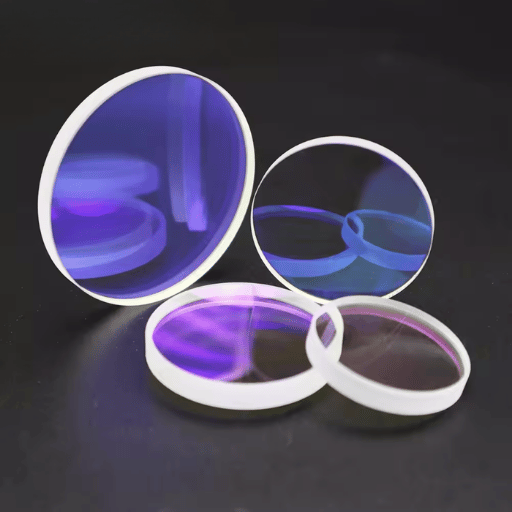
Antibacterial glasses limit microbial contamination on food-contact surfaces through one of three distinct mechanisms, each conferring antimicrobial properties to the substrate. Your choice depends on the operating environment — whether illuminated, washed, or exposed to ambient air. Each mechanism interrupts a different stage of the bacterial life cycle (cell wall attachment, osmotic balance, or intracellular metabolism) and each carries its own regulatory implications and durability profile.
Silver-Ion Release in Glass and Coatings
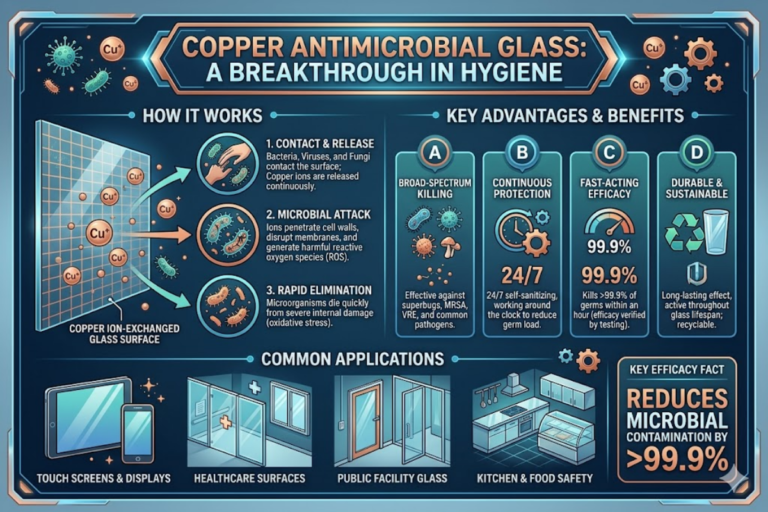
Commonly, silver is ionically embedded into a glass matrix or a zeolite-based coating. In the presence of moisture, silver ions migrate to the surface and bind thiol groups within bacterial cells, disrupting metabolic pathways. Silver is one of the most heavily studied antimicrobial agents because it reaches lethal doses at concentrations far below levels that affect humans — the WHO and US EPA limit for silver in drinking water is 0.1 mg/L, and certified antibacterial glasses leach well below this threshold. For a deeper comparison, see silver vs copper antimicrobial glass.
ZnO-Doped Borosilicate Glass and Glass Ceramics
Zinc oxide doping targets gram-positive and gram-negative microbes via reactive oxygen species. A 2023 PMC-indexed study on antibacterial borosilicate glass and glass ceramic materials doped with ZnO reported measurable antibacterial activity against S. aureus and E. coli for pharmaceutical-grade substrates, with results transferable to food packaging and processing environments where borosilicate is already standard. Because ZnO is active under UV and visible light, it performs well in covered environments with moisture cycling.
TiO₂ and Photocatalytic Coatings on Glass
Titanium dioxide coatings rely on UV or strong visible light to generate hydroxyl radicals on the glass surface. Those radicals oxidize organic material and disrupt cell membranes. Food display cases lit by overhead LEDs (tuned for color rendering, not UV output) see limited benefit from TiO₂. Covered processing environments with UV sterilization cycles produce the strongest effect.
📐 Engineering Note
Ion-release mechanisms require moisture. On a bone-dry industrial freezer door, silver-ion coated glass delivers only a fraction of its rated efficacy. Specify ZnO for low-humidity environments and plan for condensation-assisted activation on refrigerated display cases.
Why the Food Industry Drives Demand for Antibacterial Glass

Food and beverage operators have specific, quantifiable reasons to go beyond regular glass on food-contact surfaces. The CDC estimates 48 million foodborne illnesses each year in the United States, with 128,000 hospitalizations and 3,000 deaths. Listeria monocytogenes ranks as the third leading cause of death among foodborne pathogens, and its ability to form persistent biofilm on food-contact surfaces is what keeps it in processing environments for years.
Here is the counterintuitive finding that shapes glass specification decisions: plain glass is not naturally cleaner than stainless steel. A peer-reviewed study on Listeria biofilm formation recorded significantly higher biofilm levels on glass than on polystyrene or stainless steel at 4°C, 12°C, and 22°C — the exact bands used in cold-chain storage, prep tables, and display cases. Follow-up research documented 10⁶ to 10⁸ CFU/cm² of Listeria in biofilms established on glass coupons. Antibacterial glass closes this gap, restoring the microbial-control parity operators assume they already have.
Market forces amplify the technical case, and the antibacterial glass market has responded to regulatory and insurance pressure with broader product offerings scoped for food industries. Recalls tied to Listeria contamination rose from 47 to 65 between 2023 and 2024, and a single 2024 Boar’s Head deli-meat outbreak sickened 61 people across 19 states with 10 linked deaths. Regulatory and insurance pressure has expanded demand for antibacterial glass across processing plants, packaging lines, retail display, and commercial kitchens. For the healthcare use case, see our antimicrobial glass in hospitals guide.
Core Applications: Food Processing, Packaging, and Storage

Antibacterial glass is not a singular product. Substrate, coating type and profile, level of edge grounding and dressing are found in a range of specifications, and finding the one best suited for a work environment is the distinction between a usable specification and a cluttered expense.
Food Processing Equipment
Sight glasses on mixing tanks, inspection windows on conveyor systems, and viewing ports on clean-in-place vessels all benefit from silver-ion or ZnO-doped borosilicate. Borosilicate withstands the thermal cycling of CIP routines (80–90°C caustic wash followed by a cold rinse) better than soda-lime glass. Typical thickness runs 6–12 mm for pressure-rated sight glasses, with ground and polished edges to promote cleanability and remove crevice zones where biofilm accumulates.
Packaging and Containers
Pharmaceutical quality borosilicate vials have used antibacterial agents for over a decade. This technology scales to foods and glass packaging for other high-value products – infant formula, specialty beverage, prepared meal – when the contact surfaces meet migration maxima, and the surface layers do not release into the final product exceeding the regulatory levels documented below.
Display Cases, Sneeze Guards, and Retail Surfaces
High-touch surfaces carry the heaviest microbial loads — bakery cases, deli displays, self-serve buffets. Silver-ion or ZnO-doped tempered soda-lime panels (usually 4–8 mm thick) pair with hygienic framing to reduce cross-contamination between cleaning cycles. NSF/ANSI 51 certification applies when these panels are integrated into commercial food service equipment assemblies.
Commercial Kitchens and Food Prep Surfaces
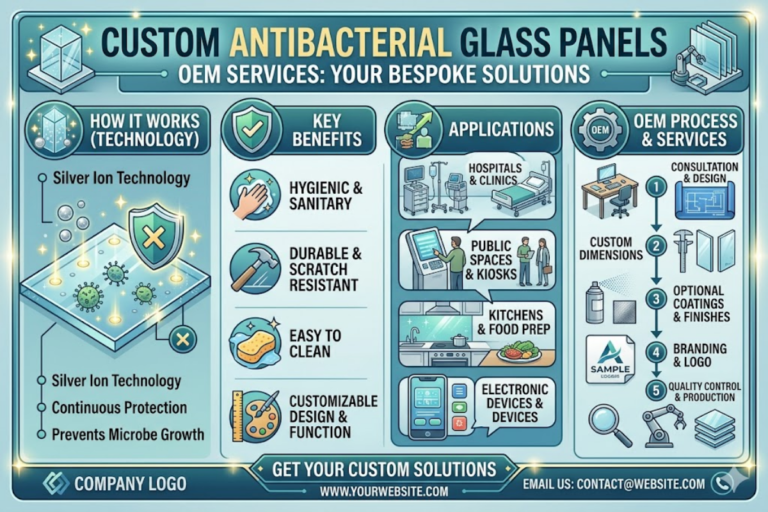
All splashbacks, prep-table tops and refrigerator interior panels are made of 6-10 mm tempered antibacterial glass. All must meet the standards of the FDA Food Code 4-101.11 (smooth, non-absorbent, easily cleanable). For custom fabrication specifications, please refer to our custom antibacterial glass panels for food and pharmaceutical.
Antibacterial vs Antimicrobial Glass: Material and Specification Differences

Marketers often use the two terms interchangeably, but the engineering definition matters when drafting a specification. Bactericidal glass is a specific claim against gram-negative and gram-positive bacteria. Antimicrobial is a more general claim against bacteria, fungi, viruses and in some cases biofilm architecture. To see a term-by-term comparison, see our dedicated antimicrobial-vs-antibacterial glass.
| Specification | Antibacterial Glass | Antimicrobial Glass |
|---|---|---|
| Target microbes | Bacteria (gram-positive and gram-negative) | Bacteria, fungi, mold, some viruses |
| Active agent | Silver ions, ZnO doping | Silver, copper, ZnO, TiO₂, or blends |
| Typical test | ISO 22196 / JIS Z 2801 (dry surface, R ≥ 2.0) | ISO 22196 plus ISO 7581:2023 (wet surface) and antiviral protocols |
| Substrate options | Soda-lime, borosilicate | Soda-lime, borosilicate, glass-ceramic, bioactive glass |
| Cost factor vs regular glass | 1.4× to 2.0× | 1.8× to 2.8× |
| Typical food industry fit | Processing lines, packaging, prep surfaces | Display cases, public-facing surfaces, mold-prone zones |
For easy-to-clean food-contact application antibacterial glass is generally acceptable and less expensive. When the risk of mold (produce storerooms, dairy aging rooms) or respiratory germs (public buffets) is encountered the larger antimicrobial specification warrants the premium delta.
Regulatory Compliance: FDA, EU, NSF, and ISO Standards for Food Contact
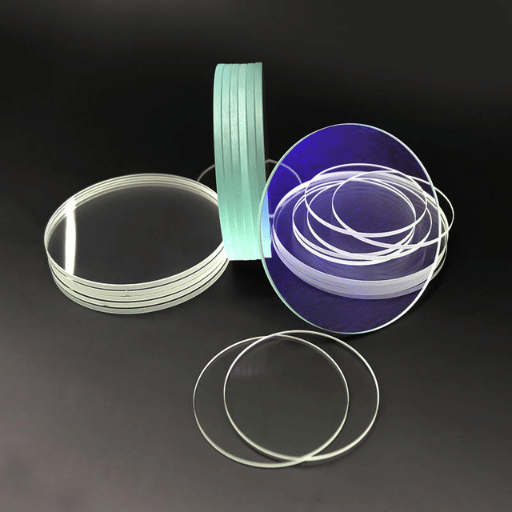
Compliance is precisely where food-grade antibacterial glass differs markedly from other industrial or architectural grades. There are three interconnected pieces of regulation and each must be covered by the Declaration of Compliance if the product is to be marketed in the intended market.
United States: FDA Pathways
In the US, the FDA regulates antimicrobial ingredients in food-contact materials under 21 CFR. The Threshold of Regulation under 21 CFR 170.39 exempts substances that migrate below 200 parts per billion (0.6 mg per person per day) for biocide uses, or below 1 part per million for non-biocide uses. Most commercial silver-ion glass coatings for food contact operate under Food Contact Notifications (FCN) filed under 21 CFR 170.106 rather than the Threshold of Regulation pathway. Silver itself has been regulated by the EPA as a biocide since 1954 under the Federal Insecticide Fungicide and Rodenticide Act.
European Union: EU 10/2011 and Glass-Specific Legislation
Commission Regulation (EU) No 10/2011 sets rules for plastic materials and articles in food contact, enforcing specific migration limits in mg/kg against a standard 6 dm²/kg surface-to-food ratio. Glass itself falls under Framework Regulation (EC) 1935/2004 plus national legislation, but any organic coating on antibacterial glass intended for the EU market typically has to demonstrate compliance with 10/2011 for the coating layer.
Efficacy Testing: ISO 22196, JIS Z 2801, and the New ISO 7581:2023
ISO 22196 (harmonized with Japan’s JIS Z 2801) measures antibacterial activity in dry conditions by comparing treated and untreated surfaces after 24-hour incubation. The passing benchmark is a log reduction R ≥ 2.0 (a 99% reduction in bacterial count). The newer ISO 7581:2023 adds a wet-surface protocol that better represents food-processing conditions. Industry marketing still rarely cites ISO 7581 results, so requesting them in a specification is a quick filter for credible suppliers.
Equipment-Level: NSF/ANSI 51
NSF/ANSI 51 approval is specific to the type of glass used in North America for food-equipment applications. As such, any finished commercial food processing equipment, dispensing or beverage system that incorporates the antibacterial glass panels, will require NSF/ANSI 51 approval for that particular glass as well as coating combination without consideration of the substrate.
Engineering Notes: Specifying Antibacterial Glass for Food Environments

These are the details that separate a spec sheet that clears procurement from one that clears a pre-operational health inspection. Food-industry engineers ask about these parameters when qualifying a new supplier.
📐 Engineering Note — Edge Finish and Tempering
Specify ground-and-polished edges (not cut-and-seamed) on any antibacterial glass panel used in wet food-contact zones. Crevices at cut edges trap biofilm that the antibacterial surface cannot reach. For display panels and any glass that could be impacted by utensils or equipment, specify tempering to ANSI Z97.1 Class A or EN 12150 Type 1, 4-6 mm minimum thickness.
📐 Engineering Note — CIP Chemistry Compatibility
Standard alkaline CIP cycles run pH 11–13 at 70–85°C. Most silver-ion glass coatings survive this chemistry for 5–10 years of weekly cycles, but acidic sanitizers (peracetic acid, hypochlorous acid below pH 4) accelerate silver leaching. Request a coating-compatibility statement from the supplier covering the specific chemistries your facility uses — not a generic “food-safe cleaning” claim.
Specification Checklist for Food-Grade Antibacterial Glass
- Substrate: soda-lime, borosilicate, or glass-ceramic (borosilicate for thermal cycling)
- Thickness: 3–12 mm, sized to application pressure and impact
- Coating type: silver ion, ZnO, or TiO₂ (matched to moisture and UV exposure)
- Efficacy: ISO 22196 R ≥ 2.0 for E. coli and S. aureus; ISO 7581:2023 for wet zones
- US food-contact: FDA 21 CFR 170.106 FCN or 170.39 compliance letter
- EU food-contact: EU 10/2011 Declaration of Compliance for the coating layer
- Edge treatment: ground and polished, no seamed edges in food-contact zones
- CIP compatibility statement: specific chemistries, not generic “food-safe”
Limitations, Durability, and Common Implementation Mistakes
Antibacterial glass performs well under specific defined conditions. Three implementation mistakes cause the technology to disappoint.
✔ Advantages
- 99%+ bacterial reduction between cleaning cycles
- 5–10 year service life on compliant chemistry
- Works on gram-positive and gram-negative pathogens
- Compatible with tempering and standard fabrication
⚠️ Limitations
- Does not replace SSOP or scheduled sanitation
- Reduced efficacy on dry, low-humidity surfaces (silver-ion)
- Coating degrades under acidic sanitizers below pH 4
- Biofilm still forms at edges and seams outside coating reach
⚠️ Three Common Mistakes
- Treating antibacterial glass as a replacement for cleaning; you still need sanitation SSOPs, auditors treat it as a supplement not a replacement
- Using incompatible sanitizer chemistry. Acidic peracetic acid routines common in poultry and dairy strip silver coatings within 12-18 months, well under the 5-10 year rated life.
- Ignoring edges, seams, gasket contact zones. The coating protects the flat face. Biofilm accumulates where the panel meets frames or gaskets; those zones need specific attention.
Frequently Asked Questions
What type of glass is safe for food contact?
View Answer
Borosilicate and soda-lime glass are both common for food contact applications provided they meet the necessary migration and hygiene standards. For antibacterial and other specialized applications the coating or dopant must also support an FDA 21 CFR 170.106 Food Contact Notification or 170.39 Threshold of Regulation exemption in the US, and a Declaration of Compliance with EU 10/2011 for coated versions imported into the EU.
Can bacteria survive on glass?
View Answer
Yes. Conventional soda-lime glass supports bacterial survival for days to weeks depending on humidity. Listeria monocytogenes biofilm levels on glass actually exceed levels on stainless steel at 4–22°C per Di Bonaventura et al., with 10⁶ to 10⁸ CFU/cm² documented on glass coupons. Antibacterial glass reduces this by R ≥ 2.0 log (99%) but does not eliminate bacterial growth entirely.
How long does an antibacterial coating last on glass?
View Answer
Silver-ion coatings typically last 5-10 years with standard alkaline CIP cycles. Ion-exchanged glass (where silver is fused into the glass matrix rather than surface-coated) can retain activity for the full service life of the panel. Acidic sanitizers or abrasive mechanical cleaning make this last a shorter period.
What’s the difference between antibacterial and antimicrobial glass?
View Answer
Antibacterial glass specifically targets bacteria and is tested under ISO 22196. Antimicrobial glass is a broader claim covering fungi, mold, and some viruses, tested under both ISO 22196 and ISO 7581:2023 plus antiviral protocols. Antimicrobial products typically cost 1.8×–2.8× over regular glass, compared to 1.4×–2.0× for antibacterial.
Can antibacterial glass be customized for specific food equipment?
View Answer
Yes. Antibacterial glass can be cut to shape, tempered, edge-finished, drilled, and combined with coating chemistries matched to the CIP protocol and the target regulatory market. Borosilicate works for thermal-cycling zones; soda-lime suits cold and ambient zones. Custom shapes and OEM production runs are standard for process equipment manufacturers.
Does antibacterial glass meet FDA food-contact requirements?
View Answer
Yes, it can. Compliance depends on the coating or dopant rather than the glass itself. For US food-contact use, ask the supplier for the FDA 21 CFR 170.106 Food Contact Notification number or a 170.39 Threshold of Regulation letter that specifically covers the coating chemistry at the migration level you require. Generic “FDA compliant” marketing claims without a documented pathway are a red flag.
Need a Specification Review?
Tell us your food-contact glass specifications—substrate, coating chemistry, size and regulatory market—and we will find the appropriate solution.
Related Articles
- Antimicrobial vs Antibacterial Glass: Specification Differences
- Copper vs Silver Antimicrobial Glass: Which Ion Chemistry Fits Your Use Case
- Antimicrobial Glass in Hospitals: Pathogen Control in Healthcare Settings
- Custom Antibacterial Glass Panels for OEM Equipment Builders
- Antibacterial Glass Product Overview and Specifications
References & Sources
- Burden of Foodborne Illness in the United States — US Centers for Disease Control and Prevention
- Di Bonaventura et al., Influence of Temperature on Biofilm Formation by Listeria monocytogenes on Various Food-Contact Surfaces — Journal of Applied Microbiology
- Demirel et al., Antibacterial Borosilicate Glass and Glass Ceramic Materials Doped with ZnO — PMC / National Library of Medicine
- 21 CFR 170.39 — Threshold of Regulation for Substances Used in Food-Contact Articles — Electronic Code of Federal Regulations
- Commission Regulation (EU) No 10/2011 on Plastic Materials and Articles in Food Contact — EUR-Lex
- Antimicrobial Non-Porous Surfaces: ISO 22196:2011 and ISO 7581:2023 — Frontiers in Microbiology, 2024
- Silver Nanoparticle-Based Antimicrobial Coatings — MDPI / Macromol, 2025
About This Analysis
This guide synthesizes regulatory texts, peer-reviewed biofilm research, and ISO/JIS efficacy standards as of April 2026. It does not draw on a specific factory case study — if you need first-party performance data on a particular coating chemistry or CIP chemistry combination, request the supplier’s ISO 22196 and ISO 7581 test reports rather than relying on the general ranges above. The focus here is antibacterial glass for food industry applications specifically, including processing, packaging, display, and commercial kitchen use.