Get in Touch with Saiweiglass



Step into a hospital supply catalog and the word “antimicrobial” appears on door pulls, ceramic tiles, and display glass. Step into a drug store and “antibacterial” dominates soap, antibacterial products, and hand-wipe labels. Those two words tend to show up on similar hygiene products, so buyers — and occasionally even specifiers — treat them as interchangeable. They are not.
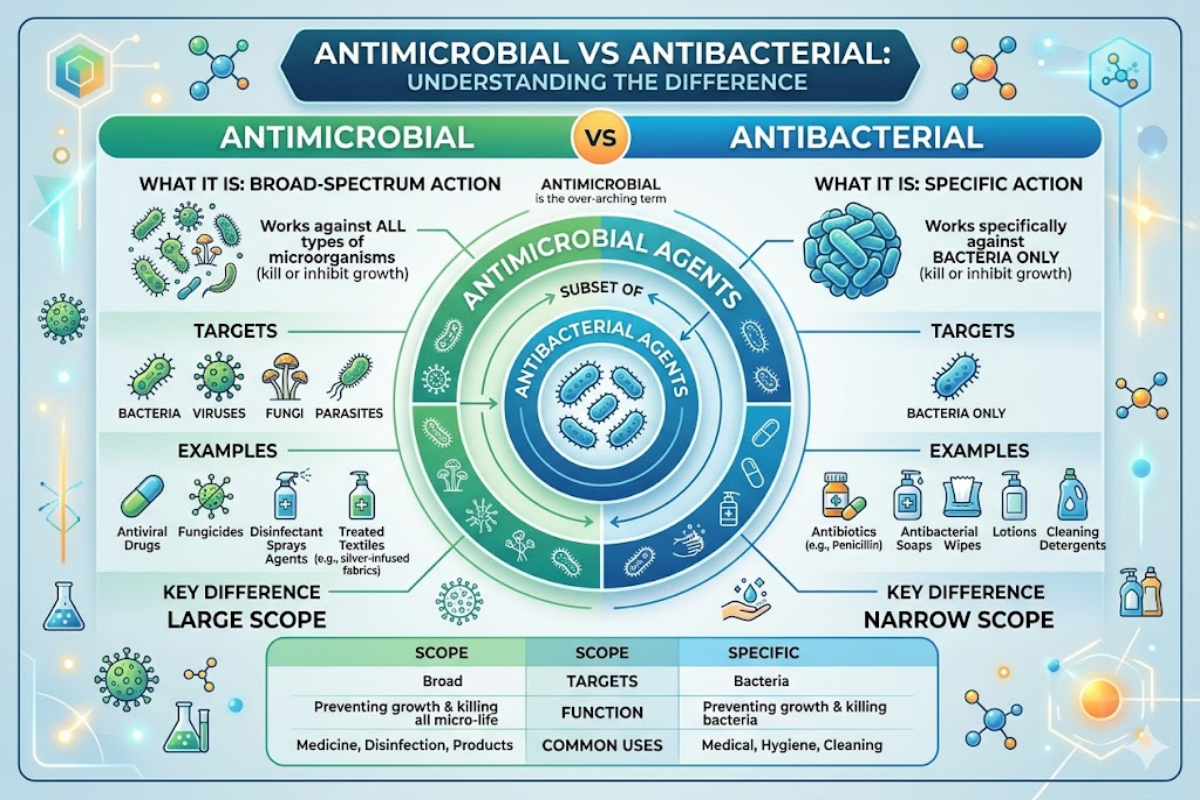
A primary distinction between “antimicrobial” and “antibacterial” is scope. “antimicrobial” is the more general term, or broader spectrum term. “antibacterial” is the more specific term, or narrower spectrum. Which term appears in a product’s description has specific implications for claims relating to how effective that product is, where regulations that apply to the product are concerned, and how a coated glass surface can perform over time – specifically in a glass application.
Quick Specs: Antimicrobial vs Antibacterial
- Antimicrobial – works against bacteria, viruses, fungi, and protozoa (parasites)
- Antibacterial — acts on bacteria only
- Regulatory body (US, surfaces) — U.S. EPA under FIFRA
- Regulatory body (US, drugs/soaps) – US, FDA under the OTC monograph system
- Surface testing commonly used – ISO 22196 / JIS Z 2801, pass/fail threshold rated R 2 (99% reduction at 24 hours)
- Glass coatings – ion embedded antimicrobial glass (Ag+, Cu) + Tio2 photoreactive variants
The Primary Difference in 60 Seconds

An antimicrobial substance works against a broad set of microorganisms — including bacteria, fungi, viruses, and parasites. An antibacterial substance works only against bacteria. Every antibacterial is an antimicrobial, but not every antimicrobial is antibacterial. WHO applies the same hierarchy in its AMR fact sheet, grouping antibiotics, antivirals, antifungals, and antiparasitics as the four classes of antimicrobials (WHO, 21 November 2023).
Whichever term is chosen on product packaging dictates significant elements: whether EPA registration is required for any claims made, whether the claim can refer to a specific pathogen, and – especially with display glass for hospitals or building glass – whether the material needs to clear a specific test standard.
💡 Key takeaway
If a surface suppresses or kills parasites, fungi, algae, or bacteria as well as viruses, the label should call out the “antimicrobial” functionality. “Antibacterial”, a more specific term, technically refers to a narrower group of organisms.
Defining Each Term (and the Related Words That Confuse Buyers)

Word choices on spec sheets and marketing copy also refer to antibiotic, antiseptic, disinfectant, bactericidal, and bacteriostatic. These terms have specific scientific and regulatory meanings.
| Term | Scope | Where it is used |
|---|---|---|
| Antimicrobial | Bacteria + fungi + viruses + parasites | Umbrella term — drugs, surfaces, textiles |
| Antibacterial | Bacteria only | Soaps, wipes, some surface treatments |
| Antibiotic | Bacteria (taken internally or topically as a drug) | Prescription medicine (penicillin, amoxicillin) |
| Antiseptic | Microbes on living tissue (skin, mucosa) | Pre-surgery skin prep, hand rubs |
| Disinfectant | Microbes on non-living surfaces | Bleach, quat cleaners on counters |
| Bactericidal | Kills bacteria outright | Agents with MBC/MIC ratio ≤ 4 |
| Bacteriostatic | Inhibits bacterial growth; cells remain viable | Agents with MBC/MIC ratio > 4 |
The bactericidal/bacteriostatic distinction is a matter of degree, not style. The 2024 edition of the Journal of Antimicrobial Chemotherapy defines the difference by the ratio of Minimum Bactericidal Concentration (MBC) to Minimum Inhibitory Concentration (MIC): a ratio of 4 or less equals bactericidal, and anything higher indicates bacteriostatic activity. That number counts when a specifier considers active ingredients on a data table – “bacteria are killed” and “bacteria growth is inhibited” are separate effects, and the lab numbers are how they are distinguished.
Regulatory jurisdiction also follows this difference. The NIH NCBI Bookshelf explains that antimicrobial drugs are regulated by the FDA monograph rules, and surface-mounted antimicrobials by the EPA’s pesticide standards. Whichever word is used on the label is frequently what determines the agency responsible.
How They Work: Mechanisms of Action

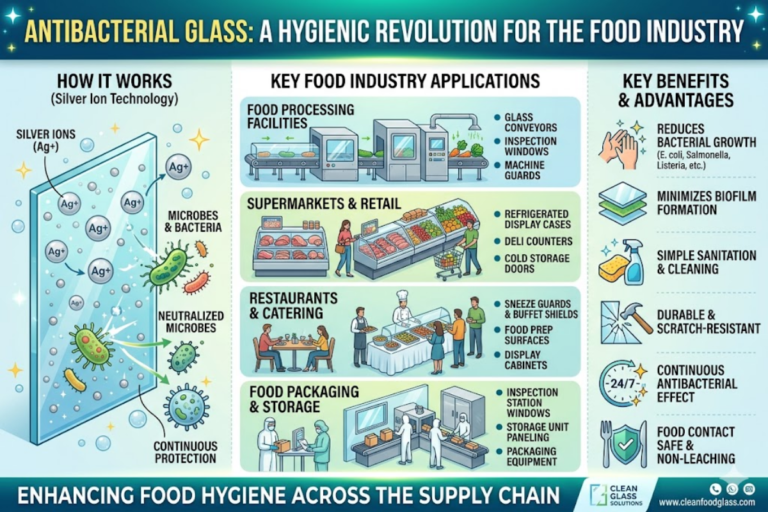
Both antibacterials and antimicrobials do the same basic thing – use damage a given microorganism’s cell – but they take different approaches depending upon the agent, the target and the application. A silver-ion coating on a piece of display glass and a bleach-saturated wipes intended for a counter are antimicrobials, but the physics and chemistry involved could not be more different.
Three mechanism families you will see on data sheets
- ✔
Membrane disruption — positively charged metal ions (Ag⁺, Cu²⁺, Zn²⁺) bind to negatively charged cell walls, puncture them, and collapse the cell. In a landmark 2008 study (Jung et al., PMC2292600), silver ions drove both Staphylococcus aureus and Escherichia coli into an active but non-culturable state followed by death. - ✔
DNA / protein damage — copper ions catalyse hydroxyl-radical formation inside the cell, cross-linking DNA and denaturing enzymes. Triclosan and benzalkonium chloride interfere with protein synthesis or bind lipid membranes. - ✔
Reactive oxygen species (ROS) — photocatalytic TiO₂ generates hydroxyl radicals and superoxide under UV or visible light, oxidising anything organic on the surface. Effective against bacteria, moulds, and many viruses, but needs activating light.
Compared to agents that are solely antibacterial agents, broad-spectrum antimicrobials cover more features of microbe classes (eg. membrane lipids, proteins denatured by oxygen reactive chemistry). Antibiotic-specific features include bacterial cell walls and DNAs, amininidubmodules.
📐 Engineering Note: Ion Release on Glass
In ion-exchange glasses silver or copper ions are introduced below the surface and diffuse towards it with time. These release rates have to be carefully balanced – too rapid – antimicrobial activity will decline along with the reservoir (within 2-3 years); too slow – the surface concentration may be below the minimum inhibitory concentration point. well formulated silver-ion antibacterial glasses will have activity throughout the service life of the substrate and not alter the optical transmittance by more than 1-2%.
Spectrum Comparison: Bacteria, Fungi, Viruses, Protozoa

The question “Is the treatment enough?” depends entirely on the spectrum of microbes required to be controlled on the site. A hospital touch-screen has different risk than a kitchen splashback which has different risk than a subway handrail.
| Microbe class | Examples | Antibacterial | Antimicrobial |
|---|---|---|---|
| Bacteria (Gram-positive) | S. aureus, MRSA, Enterococcus | ✔ Covered | ✔ Covered |
| Bacteria (Gram-negative) | E. coli, Klebsiella, Pseudomonas | ✔ Covered | ✔ Covered |
| Fungi / mould | Candida auris, Aspergillus, black mould | ✘ Not covered | ✔ Depends on agent |
| Enveloped viruses | Influenza, SARS-CoV-2 | ✘ Not covered | ✔ Alcohols, quats, Cu²⁺ |
| Non-enveloped viruses | Norovirus, rhinovirus | ✘ Not covered | ⚠ Only strong oxidisers |
| Protozoa | Giardia, Cryptosporidium | ✘ Not covered | ⚠ Limited (water-treatment chemistries) |
The table even takes a stab at proving why scale is important. The WHO’s most recent GLASS surveillance report showed a median 42% third-generation cephalosporin resistance among E. coli and a 35% prevalence of MRSA among 76 reporting countries – over the majority being Gram-negative and Gram-positive bacteria where antibacterials tend to still work. But even Candida auris, a fungus, is showing up on the same priority-pathogen list, and an antibacterials-only coating won’t have any impact against it.
Testing Standards: JIS Z 2801, ISO 22196, and the “99.9%” Claim

For product data sheets, the statement “kills 99.9 % of bacteria” or “R 2” are often associated with the same test. JIS Z 2801 is the Japanese Industrial Standard for antibacterial activity of non-porous surfaces. ISO 22196:2011 is equivalent protocol used worldwide.
A look at ISO 22196 studies (PMC10813364, 2024) proves both standards to be the same test with other labels.
This test applies a standard bacterial suspension, often S. aureus or E. coli, on a sample surface and leaves it for 24 hours at 35 °C and ~90% humidity before recovering and counting the surviving cells. Reduction is calculated as an R-value:
R-value math (ISO 22196 / JIS Z 2801)
R = log₁₀(Ut) − log₁₀(At)
- Ut = number of viable cells on untreated control after 24 h
- At= the number of viable cells on antibacterial sample after 24hours
- R 2 99% kill; 2-log reduction—it is barely considered an antibacterial activity anyhow.
- R 3 (99.9% kill) is the value quoted in nearly all consumer marketing
- R 5 (99.999 %) is the typical value for a well prepared silver-ion glass sample after 24 h
Here’s where consumers can be misled. “99.9” on the advertising copy is a higher claim (R 3) than the standard’s minimum pass mark (R 2 99%). a product which is just passing is still legally “antibacterial” in the standard – but a supplier willing to show third-party data at R 5 is providing real evidence of performance, not pass/fail.
⚠️ Specifier tip
Request the raw R-value and use organism. “Passes JIS Z 2801” without a number means R 2 minimum; that is five orders of magnitude weaker than a product claiming R 5. That’s a difference that matters on high-touch surfaces where residual bacterial load drives re-infection.
Other relevant standards include ASTM E2180 for water-repellent materials, AATCC 100 for textiles, and ASTM E2149 for dynamic-contact tests. For specifying aluminosilicate glass substrate used in touchscreen cover glass, the default is JIS Z 2801 / ISO 22196.
Consumer Products: Soap, Sanitizer, and the Triclosan Ban
The debate around bacterial vs. antimicrobial allergiccars most explode in the soap aisle. But we need to know the background, because the scope of a term can tighten inside a single year.
On 2 September 2016, the US FDA published a final rule 81 FR 61106 that declared 19 active ingredients in consumer antibacterial wash products as not generally recognized as safe and effective (GRAS/GRAE). triclosan, triclocarban, and 17 less-famous actives. Manufacturers had one year to reformulate. That regulatory action came into force on 6 September 2017.
Three points the label aisle often misses:
- Scope is narrow. As they stated in the Q & A, the rule includes consumer antiseptic wash products (soap and body wash) meant for use with water. It does not include hand sanitizer (another separate final rule, 2019), wipes, or healthcare facility antiseptic rubs.
- Triclosan has not been totally banned. 2016 action targeted consumer wash specifically. Triclosan is still approved by the FDA as an active ingredient in one prescription toothpaste (Colgate Total) via a separate review process.
- “Antibacterial” though hasn’t ceased to exist. Reformulated soaps still use benzalkonium chloride, benzethonium chloride, or chloroxylenol as the active antibacterial – but each has their own upcoming monograph.
FDA’s expressed justification for the regulation was that producers failed to prove these consumer antibacterial washes outperformed plain soap and water at staving off disease. That fits with our experience: quite a bit of soap’s germ removal is mechanical – oils and dirt containing microogansims get emulsified and rinsed off – rather than chemical kill. Plain soap plus running water will do the mechanical job just fine, with less active-agent exposure – which is why the CDC continues to rank routine hand washing with plain soap above antibacterial wash for everyday hygiene.
In contrast, alcohol-based hand sanitisers (60-95% ethanol or isopropanol) are classified as antimicrobial because the active agent denatures bacterial proteins, enveloped viruses like SARS-CoV-2, and some fungi. Wider scope is exactly what justifies the label.
Surfaces and Glass: Where the Label Matters Differently

When you’re working with a hard, non-porous platform like display or architectural glass, the game is different. There is no rinse-off, no water, no contact time, measured in 20-second commercial hand washes. An antimicrobial or antibacterial chemist has to stand in one place and cut microbial load all day between cleanings. And here, the product label sets in motion different regulatory tracks.
In the US, the EPA (Environmental Protection Agency) regulates antimicrobial surface claims under FIFRA (Federal Insecticide, Fungicide, and Rodenticide Act). Two routes are relevant for glass:
| Path | Claim scope | Registration |
|---|---|---|
| Treated Article Exemption (EPA PR Notice 2000-1) | “Protects the product itself from microbial degradation, odour, or staining” | No FIFRA registration required if both conditions met and only product-protection language is used |
| Full antimicrobial pesticide registration | “Kills bacteria that cause disease,” “reduces the spread of germs,” named-pathogen efficacy | Full FIFRA registration with efficacy data required |
It is the wording on the product’s marketing literature, not the ion itself, that moves a treatment from one category to the other. A silver-ion glass sold as “antibacterial glass for product protection” can exist under the Treated Article Exemption; the same glass sold as “kills 99.9% of S. aureus” generally cannot.
Advantages and Limitations of Antimicrobial Glass
Advantages
- Active 24/7, no manual reapplication
- Optical transmittance ≥ 91% (ion-embedded variants)
- Mohs hardness 7+ on aluminosilicate base — resists wear
- service-life activity when ions are introduced via ion exchange rather than surface coating
- Compatible with AG, AR, and AF secondary coatings
Limitations
- not a surrogate for routine cleaning – kill time is hours
- copper-ion formulations create a slight tint; silver-ion preferred for clear applications
- Regulatory label controls (“antibacterial” vs “antimicrobial”) drive claim language
- Photocatalytic TiO₂ requires UV/visible light activation
- No proven barrier to non-enveloped viruses (norovirus, rhinovirus)
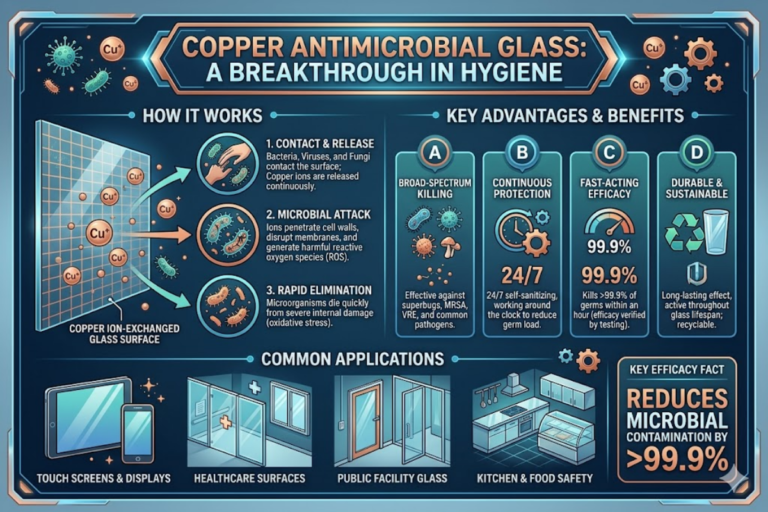
For a detailed comparison of the two most common ion chemistries, see copper and silver ion comparison. Silver has broader spectrum of peer-reviewed published data and offers optical clarity; copper is EPA-registered as a contact-kill sanitiser for specific alloys. Many projects embed both in different depths.
📐 Engineering Note: Spec Checklist for Antibacterial Glass
Before executing a purchase order for coated or ion-embedded glass, request: (1) R-value according to JIS Z 2801 / ISO 22196 with the name of the test organism specified; (2) optical transmittance pre- and post-treatment; (3) test for ion-leach rate after 500-cycle simulated cleaning; (4) compatibility statement with any planned AG, AR, or AF (anti-fingerprint) coating; (5) regulatory pathway statement (treated-article exemption versus registered pesticide). Buyers most often overlook the fifth point by first-time buyers, but the one that can halt a product launch.
Any sourcing discussion about display-grade or medical-grade glass should also address the substrate. Aluminosilicate base (as used with many consumer electronic devices with antibacterial ion-exchange coatings) is preferred for larger architectural screens; Corning Gorilla Glass is often used as a base substrate.
Frequently Asked Questions
Is antibacterial the same as antimicrobial?
View Answer
No. Antibacterial is defined as a subset of antimicrobial. Antibacterial agents have activity only against bacteria. An umbrella term encompassing bacteria, fungi, viruses and parasites is “antimicrobial.” Labels and regulatory agencies use the differences to determine which pathogen(s) can be mentioned and what claim route is invoked.
Which is better — antimicrobial or antibacterial?
View Answer
Neither chemistries wins always and every where. If only bacterial load control is needed – an industrial handle, an aisle product – an antibacterial could be the best choice. Fungal contamination, enveloped virus transmission or mould growth risks require an antimicrobial spectrum broader than bacteria and should be their own design driver. Better choice depends on the risk addressed, not the larger word.
Is silver antimicrobial or antibacterial?
View Answer
Silver is an antimicrobial agent. Silver ions may break bacterial cell membranes (see the 2008 Jung et al. work on S. aureus and E. coli), damage the cells of fungus including Candida albicans, and inactivate envelopes of specific viruses. For glass and medical device applications, the most familiar application is as an antibacterial agent but the chemistry has more reach.
Is copper antimicrobial or antibacterial?
View Answer
Copper is antimicrobial. Certain copper alloys ( 95.6% Cu) are registered by the EPA as sanitisers against specific bacteria including MRSA and Klebsiella pneumoniae on hard non-porous surfaces. Copper has activity against enveloped viruses and some fungi. In glass, copper’s main limitation is the brown-pink coloration, which limits its use where optical clarity is required.
What are the 4 types of antimicrobials?
View Answer
The WHO classifies antimicrobials according to the target organism – [bacteria = antibiotics, viruses = antivirals, fungi= antifungals, protozoa and worms= antiparasitics]. This is the universal categorization adopted within global stewardship activities, national policies and most academic textbooks. Surface antimicrobials – such as the silver-ion glass – employ the same classification scheme.
What is the difference between antibiotic and antimicrobial resistance?
View Answer
Antibiotic resistance is a subset of antimicrobial resistance. It describes bacteria that no longer respond to antibiotic drugs. Antimicrobial resistance (AMR) is the broader phenomenon: bacteria, viruses, fungi, and parasites all evolving to evade the drugs used against them. WHO estimates bacterial AMR was directly responsible for 1.27 million deaths globally in 2019 and contributed to 4.95 million (The Lancet, 2022). Not every antimicrobial agent causes the same resistance pressure — clinical antibiotics drive more evolutionary pressure than short-contact surface ions under laboratory conditions.
Specify Antibacterial Glass with Confidence
Determining whether a project requires antimicrobial or antibacterial requires three questions to be answered: which pathogens are actually involved in the threat model, what exact claim language is required of the end product, and what test standard is required of the substrate. For glass, the answer frequently involves the use of a documented R-value for silver-ion or copper-ion formulations per JIS Z 2801.
Antibacterial toughened glass from Saiweiglass is manufactured across three production sites in China with more than ten years of OEM experience — see About Saiweiglass (10+ years OEM) for capacity, certifications, and reference projects. Silver-ion, copper-ion, and TiO₂ photocatalytic variants are available on aluminosilicate, soda-lime, and chemically strengthened base substrates.
Need antibacterial glass for a medical, display, or architectural project?
Request a specification-level quote that includes R-value test data, optical transmittance curves, and paths to regulatory approval.
Editorial note: This article is an educational comparison of the terms “antimicrobial” and “antibacterial” as used on surfaces and consumer products. It is not medical, clinical, or regulatory advice. Performance claims on specific antibacterial glass products depend on ion formulation, substrate, and third-party test results — request the datasheet and R-value report for any project spec. Sources were verified against primary FDA, EPA, WHO, and peer-reviewed NIH/PMC publications at the time of writing.
References & Sources
- Antimicrobial resistance — Fact sheet — World Health Organization, 21 November 2023
- 81 FR 61106 — Consumer Antiseptic Wash Final Rule — U.S. Food and Drug Administration / Federal Register, 6 September 2016
- Antimicrobials including antibiotics, antiseptics and antifungal agents — NIH NCBI Bookshelf NBK363143
- Antibacterial Activity and Mechanism of Action of the Silver Ion — Jung et al., NIH PMC2292600, 2008
- Bactericidal versus Bacteriostatic Antibacterials — Ishak et al., NIH PMC11695898, 2024
- A Closer Look at Studies Using the ISO 22196:2011 Standard — NIH PMC10813364
- Label Review Manual, Chapter 1 — Treated Articles Exemption — U.S. Environmental Protection Agency, Pesticide Registration Notice 2000-1
Related Articles
- Copper vs Silver Antimicrobial Glass — head-to-head comparison of the two dominant ion chemistries
- What Is AF Coating — Working Principle Explained — fluoropolymer anti-fingerprint layers compatible with antibacterial glass
- Aluminosilicate Glass Substrate — high-strength base substrate for ion-exchange antibacterial treatments
- Corning Gorilla Glass Overview — ion-exchanged cover glass and antibacterial compatibility
- Antibacterial Glass Products — toughened, laminated, and display-grade variants with JIS Z 2801 R-value datasheets