Get in Touch with Saiweiglass



How Curved Glass Shapes Modern Architecture — From Facades to Railings
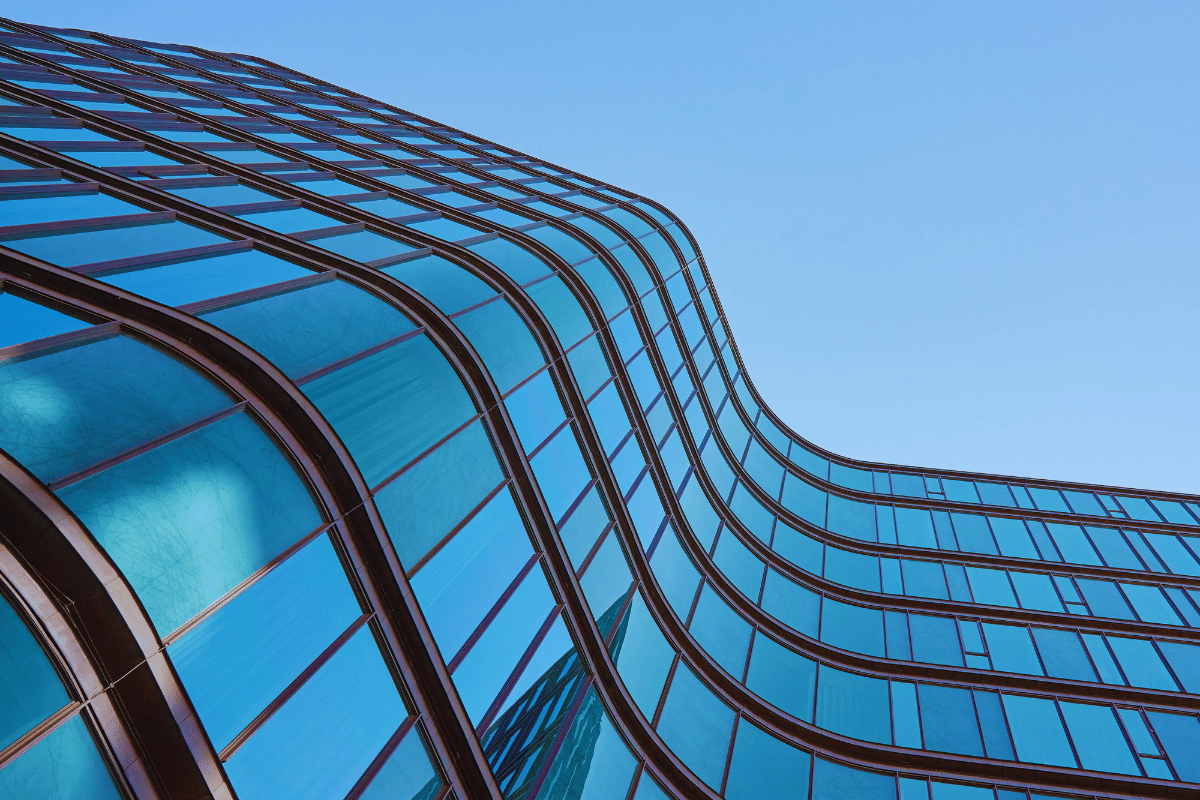
As you bus through a large metropolitan area the profile alone is unveiling the story: flat planes give way to sweeping arcs, sharp corners dissolve into flowing curves. What was once a specialty novelty has become a dominant element of commercial, institutional and luxury residential construction. And this change is more than superficial-bent glass panels address issues flat glass systems cannot: entrapping continuous expanses of wall around oddly shaped floor plates, and fabricating continuous railing systems in helical stairwells.
However, ordering curved glass is quite different from buying a standard flat pane. Different manufacturing methods, glass types, minimum bend radius and dimensional tolerances all work together in ways which can directly impact cost, lead times and structural performance. Let us explain exactly what architects, contractors and project managers need to understand – how curved glass is made, what it costs and where the industry is going.
What Is Curved Glass and How Is It Made?
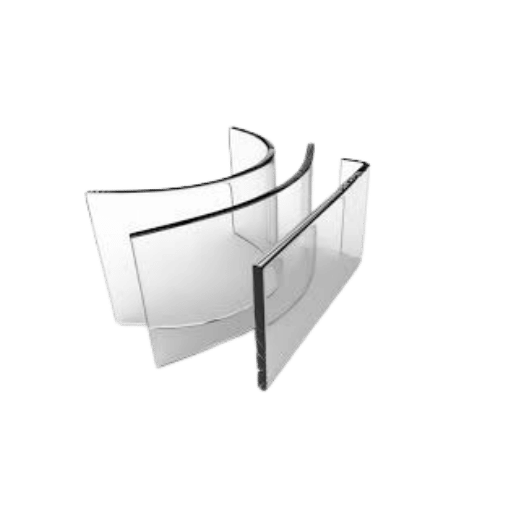
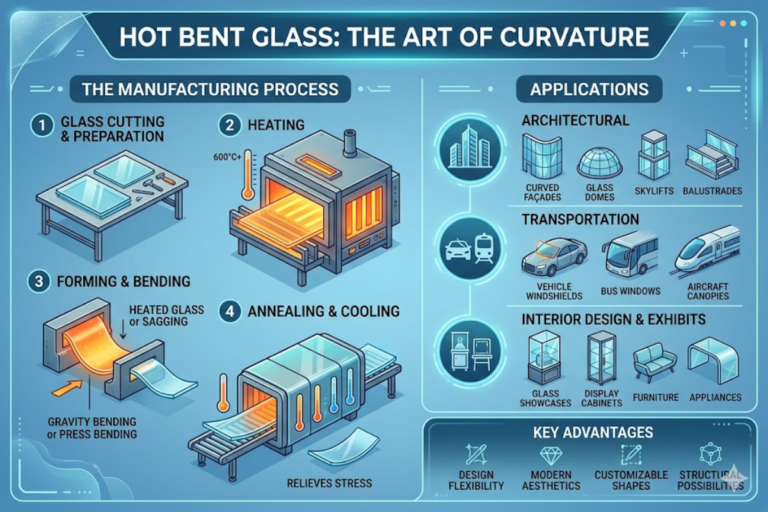
Also known as bent glass it is a flat glass that has been shaped into a curve through a heat, with a mechanical force or with both combined. This term covers a light bend in a window display to a complex bend wrapping around two axes at the same time. ASTM C1464-21 (Standard Specification for Bent Glass) defines bent glass as “flat glass that has been taken while hot” and categorizes its bends as cylindrical, single, multiple or compound — covering bent or curved glass in all standard configurations.
There are three ways that manufacturers manufacture these for the architects and designers, namely:
| Method | Temperature | How It Works | Best For |
|---|---|---|---|
| Hot Bending | 580–620°C | Glass is heated until visco-plastic, then draped or pressed over a mold. Slow annealing follows to relieve internal stress. | Tight radii, decorative glass, furniture, complex shapes |
| Gravity Bending | ~600°C | Glass softens on a concave mold and sags under its own weight into the desired shape. No mechanical pressure applied. | Large architectural panels, gentle curves, facade glazing |
| Cold Bending | Ambient (~20°C) | Mechanical force bends the glass into a curved frame at room temperature. Can be done on-site. Glass retains tempered properties. | Large-radius facade panels, curtain walls, cost-sensitive projects |
A 2007 paper in HERON Journal (Delft University of Technology) documented that cold bending of laminated glass panels can reach radii as small as 2-3 meters for standard thicknesses without fracture, though the practical limit depends on glass thickness and interlayer stiffness. Hot bending allows manufacturers to fabricate bends with radii of less than 100mm—tight enough to create curved glass for furniture and decorative applications with crystal clarity.
💡 Pro Tip
In our glass bending facility, the furnace cycle for a normal hot-bent panel runs about 4-8 hours depending on thickness. Rush orders are rarely possible because the cooling rate cannot be accelerated without causing thermal fracture.
Types of Bent and Curved Glass for Architectural Projects
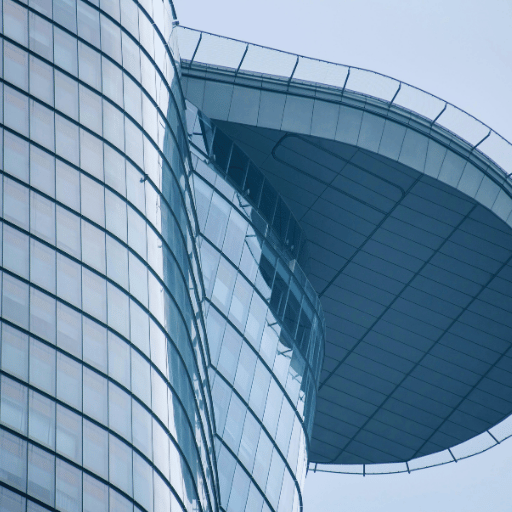
tempered, laminated, and insulating glazing units in curved all have different goals. Selecting an incorrect type of glass for an application means more than just a compromised art piece — it can lead to building code violations. Our selection framework for custom glass begins by asking three things: What is the safety requirement?
What thermal performance is required of the project?
And, what is the aesthetic consideration?
| Glass Type | How It Is Made | Key Properties | Common Applications |
|---|---|---|---|
| Curved Tempered | Bent during the tempering quench cycle; heated to ~620°C then rapidly cooled while curved | 4–5× stronger than annealed; breaks into small granular pieces (safety glass); cannot be cut after tempering | Railings, balustrades, shower enclosures, storefronts |
| Curved Laminated | Two or more bent glass panes bonded with PVB (polyvinyl butyral) or SGP interlayer under heat and pressure | Holds fragments when broken; excellent acoustic dampening (performs acoustically better than single-pane); UV filtering; available in tinted and decorative options | Overhead glazing, skylights, facades, 3D curved glass panels for complex geometries |
| Curved Insulating Glass Units (IGU) | Two curved panes separated by a sealed spacer with argon or air gap | Thermal insulation (U-values typically 0.28–0.35 for double-pane Low-E); reduces condensation; energy code compliance | Exterior facade glazing, curtain walls, commercial skylights |
| Curved Annealed | Hot-bent then slowly cooled without strengthening | Allows tightest radii; can be cut and drilled after bending; weakest mechanical strength | Furniture, display cases, decorative glass, interior partitions |
Safety glass regulations are different in various locations, but IBC 2021, Chapter 24 (Glass and Glazing) requires safety glazing – tempered or laminated – in all ‘hazardous locations’; this area covers glazing anywhere in glass railings, glass near doors, and in wet areas. curved annealed glass is usually excluded from these applications unless it is laminated.
💡 Pro Tip
Be aware that for curved tempered glass, every perforation, groove, and edged shall be implemented preceding tempering. tempered curved glass cannot be cut or drilled post processing as a rule, since unlike annealed glass it will shatter.
Curved Glass Facade Design — From Concept to Installation
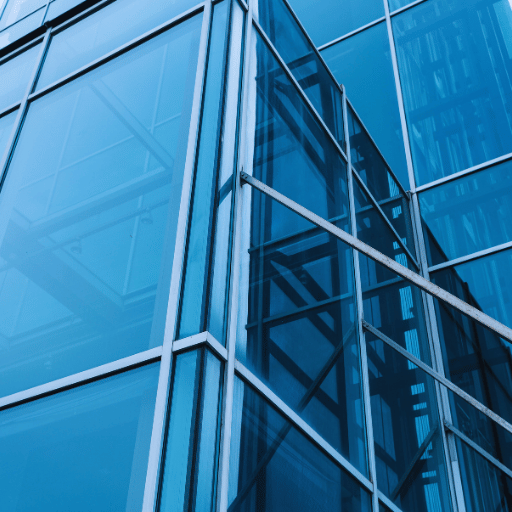
A curved glass facade does more than draw attention. It lets architects and designers incorporate continuous glazing around irregular floor plates, push daylight deeper into concave surfaces, and build a visual identity that flat curtain walls simply cannot match.
As we deliver facade panels as commercial products, the common engineering problem is not the curve—it is maintaining consistent thermal performance on both convex and concave panes. On convex curved glass, low-E coatings sit on surface #2 (the interior-facing side of the exterior pane). On concave panels, the coating sometimes needs to be on surface #3.
This alteration affects the U-value and the visible light transmittance, possibly resulting in slight color variations throughout the facade if not specified correctly.
$149.7B
Glass Facade Market (2025)
4.47%
CAGR Through 2034
45%+
Commercial Building Share
Industry data places the global glass facade market at an estimated $149.68 billion in 2025, with projections of steady growth to $221.9 billion by 2034 according to Market Research Future (2025 Glass Facade Market Report). Commercial buildings account for more than 45% of total architectural glass usage worldwide, and curved facades represent a growing share as parametric design tools make complex geometries easier to engineer.
Energy performance is now the gatekeeper. The U.S. Department of Energy Building Energy Codes Program monitors the implementation of more aggressive glazing U-factor and SHGC limitations based on climate zones.
For facades with three-dimensional curved glass elements, these objectives can only be achieved with a combination of low-E coating and gas fill selections that are optimized for the curvature geometry.
Curved Glass for Skylights, Railings, and Interior Applications
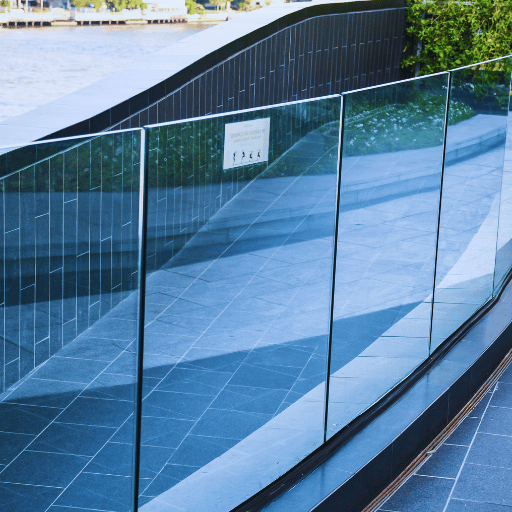
In addition to exterior faces, curved glass covers a remarkably wide range — interior and overhead applications—each having its own unique structural and code needs.
Curved Glass Railings and Balustrades
Spiral stair handrails, curved balconies, also the heads of mezzanine edges are supported by bent tempered or laminated glass to comply with mandatories for safety glazing. The National Glass Association’s analysis of IBC railing requirements notes that each handrail or guard section must be supported by at least three glass balusters, or must remain in place should any single panel fail. Performance testing follows ASTM E2353, which evaluates static strength, impact resistance, and post-breakage behavior of glass in permanent railing systems.
⚠️ Common Mistake
Common mistake with curved glass railings: Flat-glass dimensions installed but expecting the manufacturer to “make it curved” (fit). Arc length, chord length and rise are three independent parameters – mixing them up gets you panels that won’t fit the frame. Always give a full scale template or CAD geometry that it has been checked against.
Curved Glass Skylights
Overhead curved glass will be required to be laminated (rather than simply tempered) in most jurisdictions since laminated glass retains its fragments on broken, so no shards drop into the busy space below. Unlike flat skylights, curved versions face additional snow load and wind uplift considerations, since the curvature alters load distribution pattern on the pane surface. U-factor specifications for commercial curved skylights would be met by the use of insulating glass units with low-E coatings.
Interior Partitions, Furniture, and Decorative Glass
Within commercial and upscale residential spaces, curved glass partitions form fluidly open layouts that are visually translucent and daylight enabled. curved glass in staircases-both railing panels & enclosed stairwell walls-invokes a sense of space and elegance. For furnishings and display cases, hot-bent annealed glass allows very tight radii and artistic shapes that tempered glass can not achieve — the precision required for custom bent glass designs demands careful temperature control.
To achieve privacy, specify tinted-frosted-or switchable smart glass interlayers.
Interior 3D curved glass applications work well in retail environments and corporate lobbies where the curve itself becomes a design statement.
How to Specify and Order Custom Curved Glass
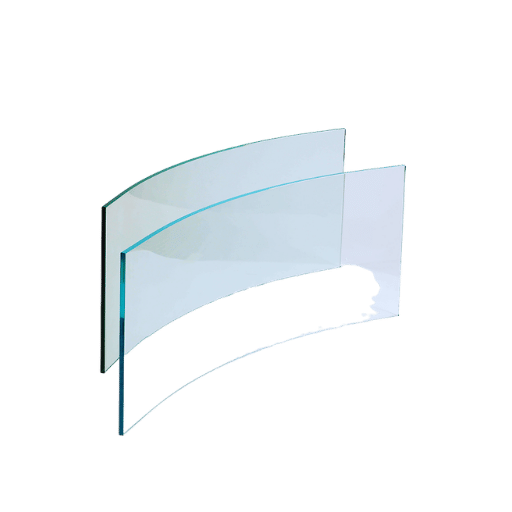
ordering custom curved glass are much more precise than flat glass, as the manufacturer is unable to trim or rework the curve once it leaves the production facility. About 30% of the time we get templates with incorrect measurements — and rework is costly.
Our engineering team relies on these specifications checklist to produce a functioning assembly:
- ✔
Arc length vs. chord length: The arc is the curved surface measurement; the chord is the straight-line distance between endpoints. Confusing them guarantees a misfit. Specify both. - ✔
Minimum bend radius: Each glass type has a minimum. For tempered curved glass, plan for a radius ≥500 mm for 6 mm thickness; hot-bent annealed glass can go below 100 mm. - ✔
Glass type and thickness: Tempered, laminated, or IGU — plus thickness (typically 6–19 mm for architectural applications). - ✔
Edge treatment: Polished, beveled, or seamed edges must be specified before manufacturing, since bent tempered glass cannot be processed after quenching. - ✔
Dimensional tolerances: ASTM C1464-21 defines acceptable deviation for bent glass. Bends up to 90 degrees and compound bends have different tolerance bands — verify with your manufacturer. - ✔
Template or CAD file: For complex geometry, provide a full-size template or 3D CAD file. A 2D drawing alone can miss compound curvature details.
Standard lead time for custom 3D curved glass is approximately 3-6 weeks for standard bends, 8-12 weeks (or more!) for large-format or compound-curve panels that require custom mold fabrication.
Curved Glass Cost Factors and Pricing Considerations
Is curved glass costly?
To be honest, it really all relies on the requirements. bent glass runs 2× to 5× more than flat glass, with the multiplier driven by several interacting factors:
| Cost Driver | Impact | Why |
|---|---|---|
| Bend Radius | Tighter radius = higher cost | Tighter bends require slower processing, higher breakage rates, and sometimes custom molds |
| Panel Size | Larger panels = exponential cost increase | Large glass sheets need larger furnaces and molds; handling risk and breakage increase |
| Glass Type | IGU > Laminated > Tempered > Annealed | Each layer and process adds cost; curved IGUs require precise spacer bending |
| Order Quantity | Below 10 units = premium pricing | Mold setup cost is amortized across units; small orders carry full setup cost |
| Compound Curves | 3–5× more than single-axis bends | Compound bends require CNC-machined molds and multi-axis forming equipment |
ordering below minimum quantity triggers very high per-unit cost. Try to combine curved glass orders from different parts of a project phase to achieve volume price breaks. For actual project / phase specific quotes, always request a quote for 3D curved glass with details of the radius, dimensions, Glass Type & Qty.
💡 Pro Tip
Cold bending can give you 30-50% cost savings versus hot bending for large-radius facade panels. Glass is bent to the curved frame on site or in shop at room temperature – no furnace, no mold, no custom tooling. While cheaper, cold bending only applies to soft curves with big radii:
Emerging Design Trends in Curved Glass Architecture
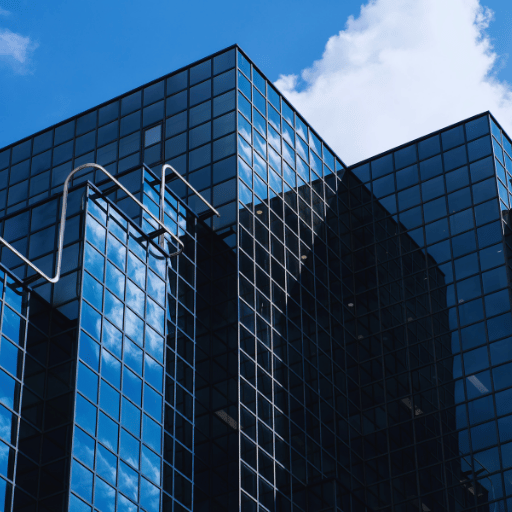
The architectural glass sector was estimated to be worth close to $60 billion in 2025, with a CAGR of 5.64% over the period 2019 to 2030. Within this market, curved glass is gaining share as converging three trends.
Parametric facade design. Today CAD programs enable architects to produce curvy glass skins that adapt to sun angles, sights, and forces of the structure. Every pane of glass can get its own curvature trace, all made from a digital form sent straight to the CNC mold-making machines.
The time previously spent on manually-fitted patterns can now be turned into code.
Cold-bent curtain walls. Cold bending technology has matured to where the creation of sweeping curved facades using standard bent glass mechanically deflected into curved frames is now a flexible, cost-effective alternative to hot-bent panels for large-radius applications.
Integrated smart glass. The electrochromic glass and the PDLC foil interlayers now adhere consistently to curved surfaces. A curved smart glass wall panel has an “instant-opaque” transition between transparent and opaque—curved glass gives privacy control, without a shading exterior.
Building-integrated photovoltaics (BIPV) is an emerging area: semi-transparent solar cells sandwiched into curved facade panels generate power while admitting daylight. As cell efficiencies rise above 15% transparency, curved BIPV facades are ready to replace traditional spandrel glass in the net-zero building designs.
Frequently Asked Questions About Curved Glass
Q: What do you call curved glass?
View Answer
curved glass is most often called ‘bent glass’ in the industry. Technical terms include hot-bent glass (shaped at high temperature), cold-bent glass (mechanically curved at room temperature), and curved tempered glass (bent during the tempering process). ASTM C1464 uses the official term ‘bent glass’ in its standard specification.
Q: Is curved glass expensive?
View Answer
curved glass typically costs 2× to 5× more than equivalent flat glass. Exact premium costs are a function of bend radius (tighter = more expensive), panel size, glass type (tempered, laminated, or IGU), and quantity purchased. Cold-bent glass for large-radius applications can cut this premium by 30-50% relative to hot bending.
Q: Can curved glass be tempered?
View Answer
Yes. Curved tempered glass is produced by bending the glass while undergoing the tempering quench cycle – glass is heated to about 620C, curved, and cools rapidly. This 4-5 time glass is significantly stronger than annealed glass and shatters into small, relatively harmless granular pieces. Minimum bend radius depends on thickness – commonly 500 mm for 6 mm glass.
Q: Can curved glass be laminated?
View Answer
Yes. curved laminated glass adds a PVB (polyvinyl butyral) or SGP interlayer adhered between two or more curved glass panes using heat and pressure. The interlayer keeps shards contained even in the event of breakage, making it a requirement for overhead glazing like skylights and mandated by building codes in many safety-critical applications.
Q: Is curved glass stronger than flat glass?
View Answer
It is a function of type of glass, not the curvature itself. Curved tempered glass is 4-5 times stronger than curved annealed glass due to the tempering process. curve provides some structural benefit by spreading loads over the tempering surface in a way similar to an arch but the Fakuruziel is in the heat treatment, not the shape.
Q: What is the minimum bending radius for curved glass?
View Answer
Minimum radius differs by method and thickness. hot-bent annealed glass can achieve radii under 100 mm. curved tempered glass approximately requires a minimum radius of 500 mm for 6 mm thickness with larger radii desirable as well. Cold-bent glass may have minimum radii of 2 m or more.
Q: Do they still make curved glass?
View Answer
Yes – curved glass manufacturing is a rapidly evolving segment of the architectural glass industry. The global curved glass market was estimated at roughly $10.5 billion in 2023 and demand is growing as parametric facade design and cold-bending technology makes curved glass more practical and affordable for commercial structures.
Need Custom Curved Glass for Your Project?
From single-radius facade panels to complex-curve architectural structures, we bring curved glass solutions to projects of all sizes. Share your project parameters for a custom quote.
About This Analysis
Saiwei Glass has engineered curved tempered, laminated, and insulating glass packages for facade, railing, and skylight applications throughout Asia, Europe, and North America. Cost data and specification advice provided here are representative of actual curved glass project costs processed by our curveded facility from hundreds of custom orders. All standards and market statistics cited are independently verifiable and obtained from ASTM International, the International Code Council, and market research firms rather than competitors.
References & Sources
- ASTM C1464-21: Specification for the Structural Performance of Architectural Glazing – ASTM International
- IBC 2021, Chapter 24: Glazing and Glass – International Building Code (IBC)
- ASTM E2353: Performance of Glazing in Permanent Railing Systems – ASTM International
- 2018 International Building Code (IBC) Railing Regulations – National Glass Association
- Cold Bonding of Insulating Glass Panels (HERON Vol. 52, 2007) – Delft University of Technology
- Building Energy Codes Program – U.S. Department of Energy
- Market Analysis on Glass Facade Market (2025-2034) – Market Research Future
- Standards and codes for installation of Glass in Buildings – National Glass Association