Get in Touch with Saiweiglass



📋 Quick Specs — Anti-Fingerprint Coating for Wearable Cover Glass
| Property | Specification |
|---|---|
| Coating Chemistry | Fluorosilane (perfluoropolyether) |
| Water Contact Angle | >110° (new) |
| Oleic Acid Contact Angle | >70° |
| Surface Energy | <15 mN/m |
| Transmittance Impact | <0.5% loss |
| Haze | <0.5% (ASTM D1003) |
| Abrasion Durability | 2,000–5,000 steel wool cycles |
| Typical Lifespan | 6 months – 3+ years (method-dependent) |
What Is Anti-Fingerprint (AF) Coating — and Why Every Wearable Needs It
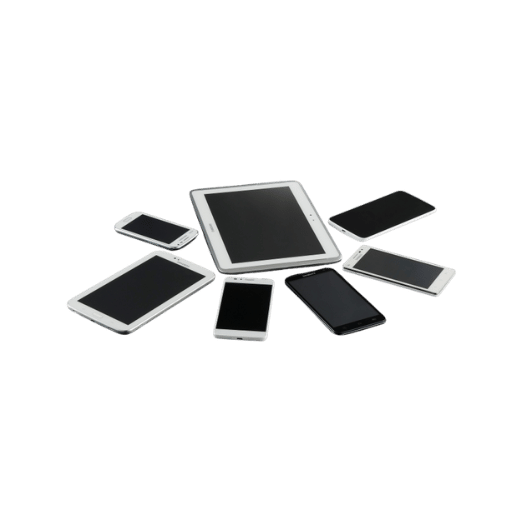
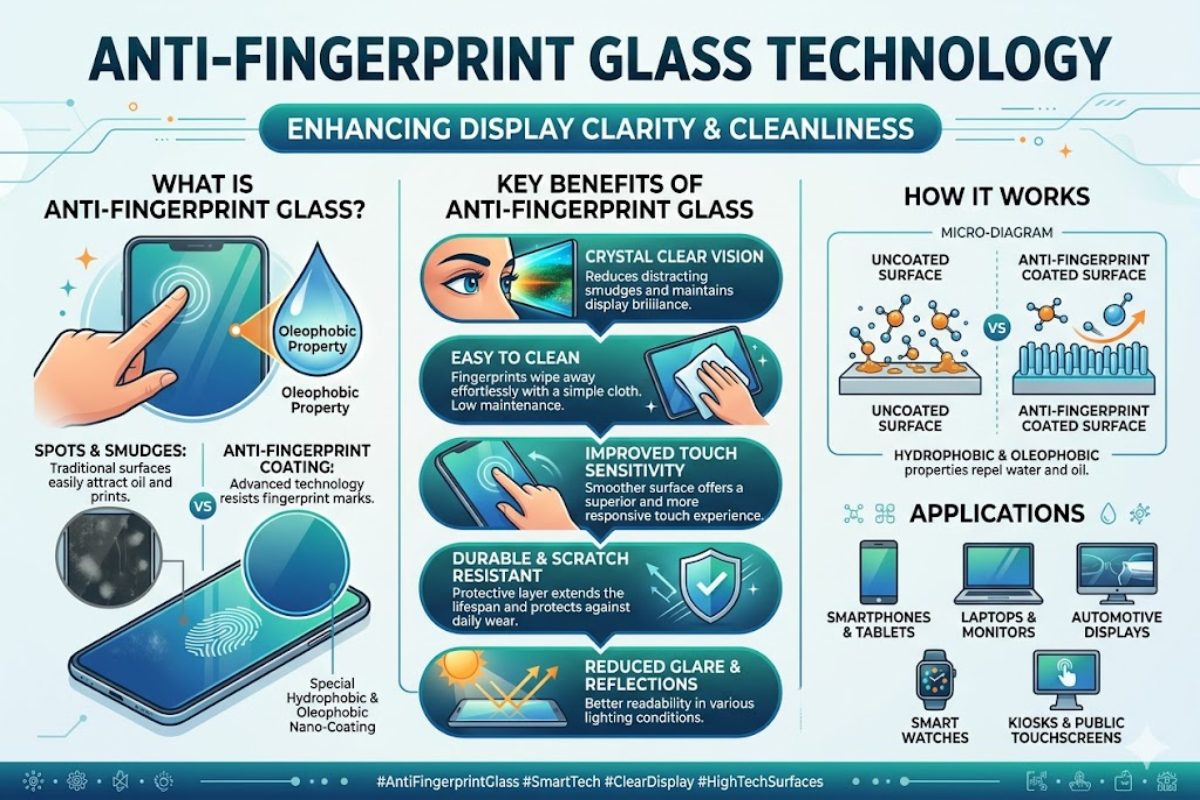
Anti-fingerprint glass, also known as oleophobic cover glass, is glass treated with a thin fluorosilane film (typically 5-20 nanometers thick) that prevents oils, sweat, and human skin residues from adhering to the surface. When an AF coating is referenced on the OEM side of the industry, that means one thing: a molecular coating applied to the glass that drops its surface energy below 15 mN/m, making it physically difficult for fingerprints and smudges to stick.
Picture a lotus leaf. Its micro-texture creates superhydrophobicity; fluorosilane achieves a similar effect through chemistry rather than geometry. CF3 terminal groups at the end of each fluorosilane molecular chain create an ultra-low surface energy barrier that repels oils and water alike. These molecules bond to the glass substrate through Si-O-Si chemisorption — a permanent covalent linkage, not a temporary Van der Waals deposit.
Quality anti fingerprint coatings push the water contact angle above 110, measured per ASTM D7334. Drop below 100 and users start noticing smudge buildup within days.
Why does this matter for wearables specifically? Your smartwatch sits against your wrist all day. Sebum, sweat, sunscreen, and hand lotion accumulate on the display surface constantly. Without an AF coating applied to the glass, readability degrades within hours — the display looks hazy, touch sensitivity feels sluggish, and users instinctively wipe the screen on their shirt every few minutes. That kind of user experience kills product reviews.
For wearable manufacturers sourcing wearable cover glass, the AF layer is no longer optional — it is a baseline specification. Anti-fingerprint coating is applied to prevent fingerprints from bonding to the surface, so a simple wipe restores full clarity. And because the film is only nanometers thick, it adds zero weight and has no measurable impact on transmittance or touch detection.
Saiwei supplies anti-fingerprint glass products with factory-applied coatings on both sapphire and aluminosilicate substrates — ready for integration into watch assemblies, fitness trackers, and medical wearable housings.
AF Coating Technologies — Vacuum vs. Spray vs. Dip

Three coating technologies dominate AF production for electronic devices. Each trades off between film quality, throughput, and cost. Choosing between them depends on your product tier, glass panel size, and annual volume.
| Method | Thickness | Uniformity | Throughput | Equipment Cost | Best For |
|---|---|---|---|---|---|
| Vacuum evaporation (PVD) | 5–20 nm | ±2 nm | 200–500 pcs/batch | $500K–$2M | Premium wearables, optical |
| Spray coating | 50–200 nm | ±15% | 1,000–3,000 pcs/day | $20K–$100K | Mid-volume consumer |
| Dip coating | 100–500 nm | ±20% | 5,000–10,000 pcs/batch | $5K–$30K | High-volume, all-surface |
PVD (vacuum evaporation) delivers the thinnest, most uniform AF films. An electron beam vaporizes fluorosilane precursor inside a vacuum chamber; molecules deposit onto the glass surface and form a permanent chemical bond. Each pass builds a 5-20 nm film with nanometer-level thickness control — ideal for optical applications where every fraction of a percent of transmittance matters.
Spray coating uses an ultrasonic nozzle to atomize a fluorosilane solution onto the substrate. Film thickness runs 50-200 nm. It is scalable, easy to re-coat, and works well for mid-volume consumer electronics. Its tradeoff: uniformity is ±15%, and durability trails PVD by 50-70%.
Dip coating submerges the glass cover panel in a fluorosilane bath; withdrawal speed controls film thickness. It handles large batches at the lowest equipment cost, but produces the thickest films (100-500 nm) with the least uniformity.
Pro Tip: For AF coated glass for wearables under 42 mm diameter, PVD is the preferred method. At that scale, optical clarity and coating durability matter far more than throughput gains from dip or spray.
Durability — How Long Does AF Coating Last on Wearables?
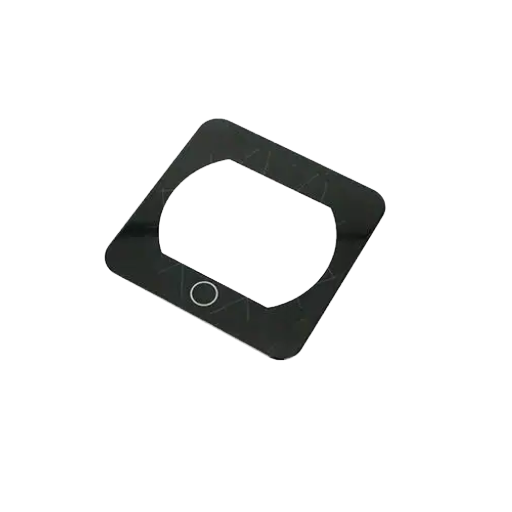
Durability separates a 3-month coating from a 3-year one. Industry benchmarks for anti-fingerprint coating life rely on abrasion tests and contact angle degradation tracking – not calendar time alone.
| Test | Standard | Pass Criteria | Typical PVD | Typical Spray |
|---|---|---|---|---|
| Steel wool abrasion | ISO 9211-4 | WCA >100° after test | 3,000–5,000 cycles | 500–1,500 cycles |
| Eraser abrasion | MIL-C-48497A | No visible damage, 20 strokes | Pass | Variable |
| Cheesecloth wipe | MIL-C-48497A | No streaks, 50 strokes | Pass | Pass |
| Tape adhesion | MIL-C-48497A | No coating removal | Pass | Pass |
Contact angle degradation tells the real story. PVD-coated anti-fingerprint glass starts at 110 and holds above 100 for 12+ months under normal wearable use. Spray-coated panels start around 110 as well but drop below 95 by month six — at which point the appearance of fingerprints becomes clearly visible.
5,000
Steel Wool Cycles (PVD)
6–12 mo
Real-World Lifespan (Spray)
Warning: Initial contact angle does not equal in-service durability. A coating that measures 115 out of the box may fall below 95 after 500 abrasion cycles. Always specify post-abrasion WCA when evaluating AF suppliers — that number reveals actual long-term performance.
Here is a common mistake: judging AF quality by out-of-box contact angle only. Two coatings can both start at 112, but one survives 4,000 steel wool cycles while the other fails at 800. Substrate preparation, fluorosilane molecular weight, and deposition method all influence durable AF glass performance far more than any single measurement.
How to Test AF Coating Performance — Industry Standard Methods
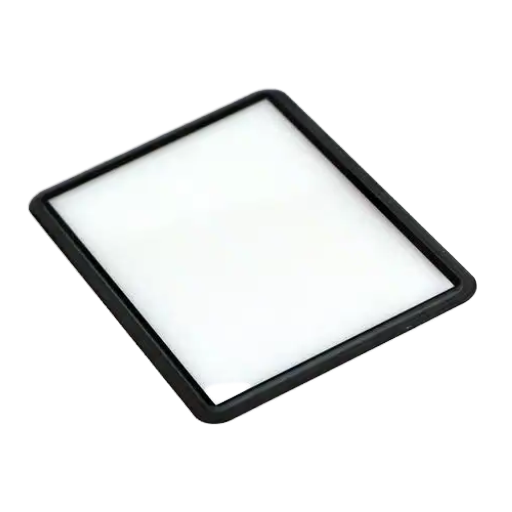
Quality inspection for anti-fingerprint coating follows a set of well-established test standards. Whether you are qualifying a new cover glass supplier or running incoming inspection on received glass panels, these six tests cover the full picture.
| Test | Standard | What It Measures | Equipment | Pass/Fail |
|---|---|---|---|---|
| Water contact angle | ASTM D7334 | Surface oleophobicity | Goniometer | >110° (new), >100° (post-wear) |
| Oleic acid contact angle | Internal spec | Oil repellency | Goniometer | >70° |
| Cross-hatch adhesion | ISO 2409 | Coating-substrate bond | Blade + tape | 0–1 rating |
| Pencil hardness | ASTM D3363 | Surface hardness | Pencil set | ≥3H |
| Haze | ASTM D1003 | Optical scattering | Hazemeter | <0.5% |
| Abrasion | MIL-C-48497A / ISO 9211-4 | Wear resistance | Steel wool jig | No visible damage |
Engineering Note: MIL-C-48497A has been inactive since 1997. Modern coating programs are replacing it with ISO 9211-4, which covers abrasion, adhesion, and environmental testing in a single framework. If your spec still references MIL-C-48497A, consider updating to ISO 9211-4 for current compliance.
Here is a practical 5-step QC inspection protocol for incoming AF-coated cover glass:
- Visual inspection — check for coating defects, pinholes, and edge delamination under 10x magnification
- Water contact angle — measure at three points (center, edge, corner) with a goniometer; all three must exceed 110
- Cross-hatch adhesion test — score a 6×6 grid per ISO 2409, apply tape, pull at 60 angle; adhesion rating must be 0 or 1
- Steel wool abrasion — run 500 cycles at 1 kg load with #0000 steel wool, then re-measure water contact angle; must remain above 100
- Haze and transmittance — measure per ASTM D1003; haze <0.5%, transmittance within 0.5% of uncoated substrate baseline
For cover glass testing at production volume, steps 1 and 2 run on every batch while steps 3-5 apply to first-article and periodic sampling.
Optical Impact — How AF Coating Affects Display Clarity
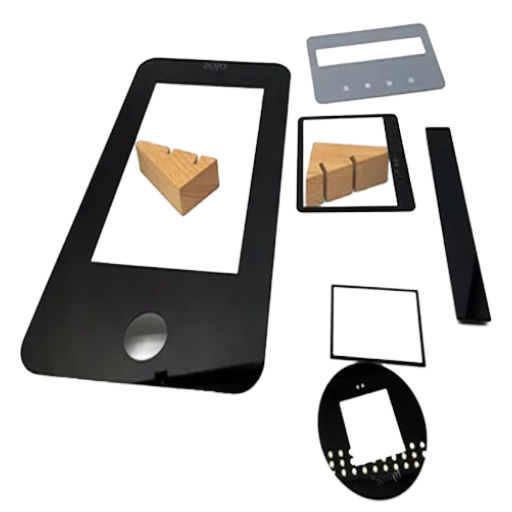
One of the most frequent questions from product engineers: does anti-reflective anti-fingerprint coating reduce display brightness or clarity? Short answer: no — not in any measurable way for films under 20 nm.
PVD-applied AF adds less than 0.5% transmittance loss to tempered glass or sapphire substrates. At 5-20 nm thick, the film is thinner than a single wavelength of visible light, so it produces virtually zero optical interference. Haze stays below 0.5% per ASTM D1003, measured within a 4.0 forward scatter cone.
<0.5%
Transmittance Loss
98%+
Clarity with AF+AR Stack
Where optical performance really improves is when you combine AF with AR (anti-reflective) multi-layer coatings. In this stack, anti-reflective layers sit beneath the AF topcoat, reducing surface reflections from ~4% to under 0.5% while the AF layer handles smudge resistance. Combined result: 98%+ clarity with anti-glare and anti-smudge properties in a single glass panel assembly.
Engineering Note: Your AF layer must always be the outermost (user-facing) surface. AR goes below AF. Reversing this order degrades both functions — oils get trapped between layers, and fluorosilane cannot bond properly to an AR dielectric surface.
For wearable displays and automotive displays where outdoor readability is critical, the AF+AR combination on optical cover glass delivers the best balance of scratch resistance, fingerprint repellency, and light transmission. Many smartphones already ship with this dual-layer approach — wearables are catching up as display quality expectations rise.
Wearable Applications — Smartwatches, Fitness Bands, Medical Wearables
Different wearable devices impose different demands on the AF coating. Consider: a fitness band worn during a triathlon faces different chemical exposure than an AR headset used indoors. Here is how application requirements break down by device category:
| Device Type | AF Requirement | Recommended Method | Key Challenge |
|---|---|---|---|
| Smartwatch | Daily skin contact, 8–16 hr/day | PVD | Sweat + sunscreen resistance |
| Fitness band | Continuous moisture exposure | Spray or PVD | Salt water + chlorine contact |
| Medical wearable | Chemical disinfectant survival | PVD (chemical-resistant) | Alcohol wipe 20×/day |
| AR/VR headset lens | Facial oil + breath condensation | PVD | Fog + oil film buildup |
| Automotive display | UV + temperature cycling | Dip or spray | -40°C to +85°C range |
When selecting an AF coating method for your wearable product, follow this checklist:
- Identify chemical exposure — skin oils only, or also alcohol, chlorine, sunscreen, disinfectants?
- Define your durability target — how many abrasion cycles does your product lifecycle require?
- Set optical requirements — does the display need AR+AF stack, or is AF alone sufficient for touch sensitivity?
- Match the coating to the substrate — sapphire, aluminosilicate, or soda-lime tempered glass? Each bonds differently with fluorosilane chemistry.
Common Mistake: Using a consumer-grade spray AF coating on a medical device that gets alcohol-wiped 20 times daily. Isopropyl alcohol strips spray-applied fluorosilane within weeks. Medical wearables need PVD-applied coatings with verified chemical resistance — anything less fails in the field.
Saiwei manufactures wearable glass products across all three coating methods. For smartphones and medical devices, we recommend our PVD line. For fitness bands at scale, spray-coated options offer a strong balance of cost and performance. We also provide custom cover glass solutions with AF, AR, and anti-glare coatings combined into a single stack. Whether your project needs 500 prototypes or 500,000 production units, our saiweiglass wearable division handles the full process from glass cutting through final coating.
Frequently Asked Questions
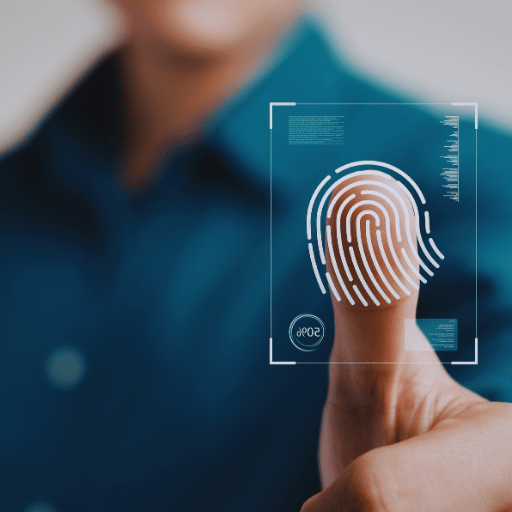
What is anti-fingerprint glass?
Anti-fingerprint glass is any glass substrate — sapphire, aluminosilicate, or soda-lime — with a thin fluorosilane oleophobic coating applied to the surface. This coating repels skin oils and prevents visible smudge buildup. A quality AF glass measures above 110 water contact angle when new. You will also see it called oleophobic glass or simply AF glass in industry specifications.
How durable are anti-fingerprint coatings?
PVD-applied anti-fingerprint coatings typically survive 3,000-5,000 steel wool abrasion cycles and last 2-3 years under normal use. Spray coatings are less durable — 500-1,500 cycles, lasting 6-12 months. Actual lifespan depends on the application method, coating thickness, and how frequently the surface contacts skin oils or cleaning agents.
Does AF coating affect touchscreen sensitivity?
No. AF films are 5-20 nm thick — far too thin to interfere with capacitive touch detection on smartphones or wearable touchscreens.
How do you test anti-fingerprint coating quality?
Standard test battery includes water contact angle measurement per ASTM D7334 (must exceed 110), cross-hatch adhesion per ISO 2409 (rating 0-1), abrasion resistance per MIL-C-48497A or ISO 9211-4 using steel wool, pencil hardness per ASTM D3363 (3H or above), and haze measurement per ASTM D1003 (under 0.5%). Together these five tests confirm oleophobicity, adhesion strength, wear resistance, and optical clarity.
What is the difference between oleophobic and hydrophobic?
A hydrophobic surface repels water only. An oleophobic surface repels both water and oils. Because oil has lower surface tension than water, any coating that repels oils automatically repels water too. AF coatings are oleophobic — which is why they handle both water splashes and oily fingerprints.
Can AF coating be applied to sapphire glass?
Yes. Fluorosilane bonds to sapphire (Al2O3) through the same Si-O chemistry used on aluminosilicate glass. Saiwei applies AF coating on sapphire and aluminosilicate substrates for wearable cover glass.
How are anti-fingerprint coatings applied?
Three main methods exist. PVD vacuum evaporation deposits a 5-20 nm film with the highest durability and uniformity — preferred for premium wearables. Spray coating uses an ultrasonic nozzle to apply 50-200 nm films at mid-range cost. Dip coating submerges glass in a fluorosilane bath for 100-500 nm films at the highest throughput and lowest equipment cost. Each method trades off between film quality, production speed, and price.
Need Anti-Fingerprint Cover Glass for Your Wearable Product?
We apply PVD and spray AF coatings to sapphire and aluminosilicate cover glass for smartwatches, fitness bands, and medical wearables — from sample to mass production.
Our Perspective
Saiweiglass manufactures AF-coated cover glass for wearable devices. We work with fluorosilane coating chemistry daily — applying PVD and spray processes, measuring water contact angle, and testing durability on the same equipment described in this article. Our recommendations reflect what we see across thousands of wearable cover glass production runs. Where we reference specific benchmarks, we cite the applicable industry standards.
References
- ASTM D7334 — Standard Practice for Surface Wettability
- MIL-C-48497A — Military Coating Specification Explained
- Fluorosilane AF Coating Study — Journal of Sol-Gel Science and Technology, Springer
- ASTM D1003 — Standard Test Method for Haze and Luminous Transmittance
- US Patent US20100285275A1 — Fingerprint-Resistant Glass Substrates
- ISO 9211 vs. MIL-C-48497 — Optical Coating Test Standard Comparison