Get in Touch with Saiweiglass


★★★★★
Trusted Manufacturer
Optical Glass Solutions
Custom Optical Glass Solutions from China’s Leading Manufacturer
A professional optical glass manufacturer specializes in precision glass fabrication, BK7 optical glass production, fused silica windows, and advanced optical coatings. ISO 9001 certified for semiconductor, medical, and aerospace sectors.
ISO 9001:2015
SGS AUDITED
RoHS COMPLIANT
CE MARKED
Get Free Quote
→



15+
Years Experience
50+
Countries Served
98%
On-Time Delivery
500+
OEM Partners
Understanding Optical Glass
What Is Optical Glass?
The silent hero of display technology and lens systems and optical measurement tools depends on optical glass which determines performance through its glass solutions. The main purpose of optical glass exists as a technical glass type which scientists designed to achieve specific optical attributes that include refractive index and Abbe number and transmittance measurements for designated wavelength ranges. The production process of these optical glass products establishes conditions that require high material purity and precise dimensional control because these factors determine the optical performance of both optical devices and optical systems.
The selection of glass material establishes essential attributes that include light dispersion and optical transmission which subsequently affect display image sharpness and color fidelity and overall visual separation. Crown glass provides lower light dispersion and maintains a constant Abbe number while flint glass reaches higher refractive index values. The application of quartz (fused silica) and borosilicate glass materials creates new options that provide both thermal resistance and protection against chemical damage. The Chinese optical glass manufacturer provides custom glass solutions which enable display glass and precision glass components to meet specific optical needs through the implementation of predetermined optical and mechanical design specifications.
Product Solutions


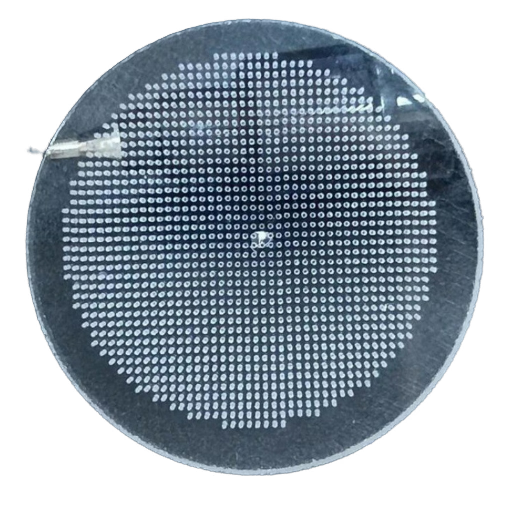


Custom Optical Components from a Trusted China Manufacturer
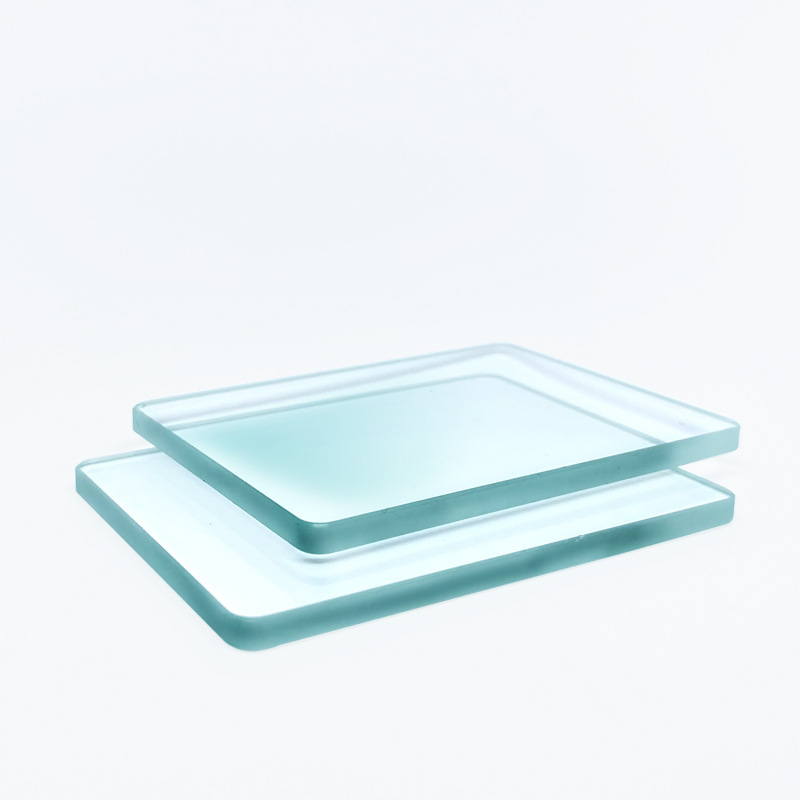
We offer a wide selection of high-quality optical glass products that have been fabulously crafted with ultra-precision, the most advanced optical coatings, and unbelievable tolerances for the most demanding optical applications across industries, worldwide.
AR Anti-Reflective Glass
Precision anti-reflective coated optical glass with ≥98% light transmission. Engineered for display glass, touchscreens, and optical systems.
Learn More →Key Specs
AG Anti-Glare Glass
Chemical and physical etched anti-glare glass display that diffuses reflections and delivers superior readability under direct sunlight.
Learn More →Key Specs
AF Anti-Fingerprint Glass
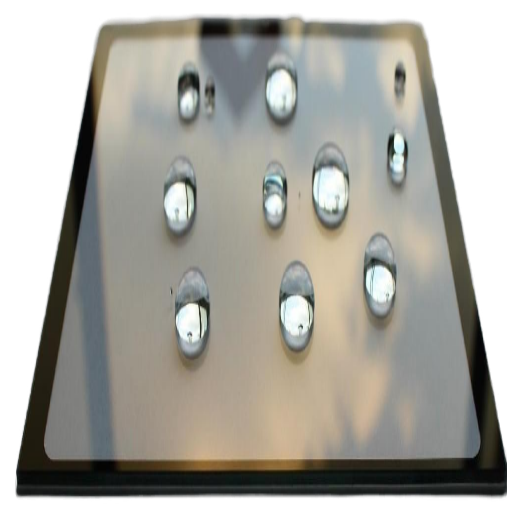
Designed for repellent of fingerprints and smudges. Coated with AF, maintains highest optical quality with contact angle ≥110°.
Learn More →Key Specs
ITO Conductive Glass
Precision glasses coated with indium tin oxide for touch panels and solar cells. Electrical properties are customizable.
Learn More →Key Specs
Custom Cover Glass
Selective fabrication services including CNC profiling, diamond cutting, drilling. Borosilicate, fused silica with tight tolerances.
Learn More →Key Specs
Chemically Strengthened Glass
Ion-exchanged tempered glass delivering high impact resistance (CS ≥600 MPa) and scratch durability (DOL ≥20μm).
Learn More →Key Specs
Serving Custom-made Glass Solutions?
Provide us an outline, sketch, or performance statement and let our engineers detail the proposal within one day.
Manufacturing Capabilities
Precision Optical Glass Cutting & Fabrication — Full-Service China Manufacturer
From raw material to finished component: Advanced CNC equipment, meticulous process control, and tight tolerances.
Precision Glass Cutting Techniques
One cannot afford to gamble away on an opportunity when minutely small prisms or intricate display glass plates are expected to fulfill not only esoteric optical requirement but also technical standards. Indirectly getting the job done, a diamond wire saw or even dicing could be used in place of harsh cutting that introduces micro-cracks, light scattering, and transmittance reduction.
Glass Type Handling: The ultimate decision will largely be based on the glass type: very sensitive fused silica, or quartz, will require the correct temperature management for complete control of the thermal behavior during processing; borosilicate is rather resilient to thermal shock but chips easily if you feed it too fast. Flint glass benefits from controlled feed rates.
Key Capabilities
Method
Diamond Saw / Dicing
Tolerance
≤ 0.05mm
Best For
Prisms, Display Plates
Post-Processing: Lapping & Polishing
Post-processing can clear rough surfaces to maintain homogeneity to know optical performance by cutting cautiously precisely. To grind to the exactness level of flatness specification by using appropriate lapping is followed by progressive finer polishing stages to decrease the surface roughness below the scratch-dig of the given value.
The cutting chips and micro-fractures are painstakingly removed from the edges that can otherwise obstruct structural integrity or cause light scattering. With these well-protected processes, the Abbe number of the glass products is thus saved from deterioration.
Surface Quality
Roughness (Ra)
< 0.2μm
Feature
Homogeneity Maintenance
Edge Finish
Chip-Free / Beveled
Chemical Strengthening (Ion Exchange)
Our chemical-hardening process, employing potassium ion exchange, creates a compressive stress layer in the glass surface, thereby significantly enhancing resistance to impact and scratching. A compressive stress (CS) of ≥600 MPa can reach a layer depth (DOL) of ≥20μm.
Note: Due to several variables such as different glass thickness readings and specific application requirements, these parameters can be varied to perfect production glass.
Strength Data
Compressive Stress
≥ 600 MPa
Layer Depth (DOL)
≥ 20μm
Method
KNO3 Ion-Exchange
Custom Glass Shaping & CNC
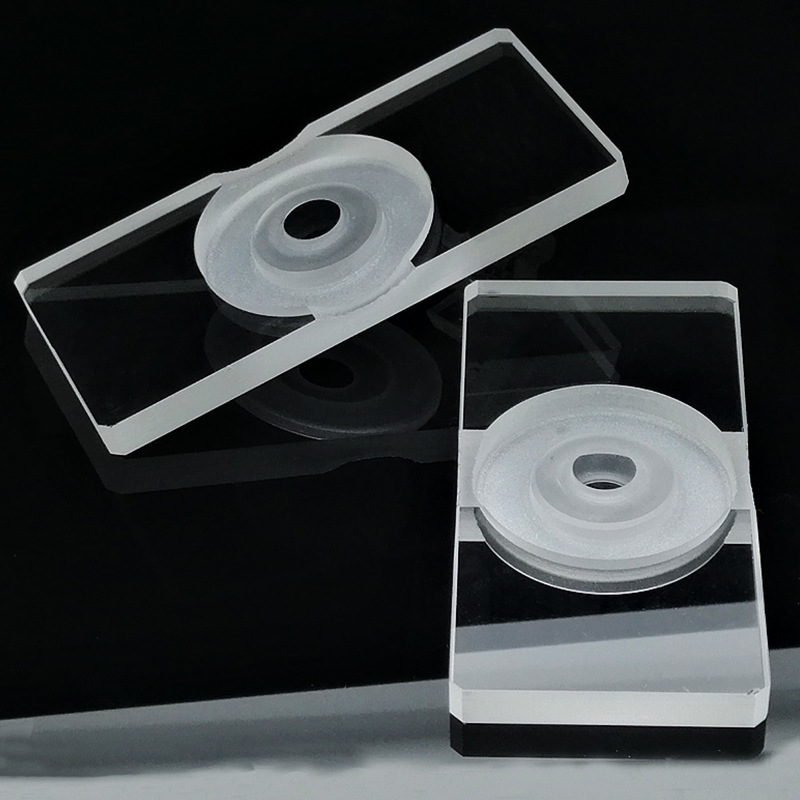
Custom shape precision glass allows you to construct optical components more over performance than making do with performance from stock shapes. Complex display shapes of glass, beveled edges for improved mounting, holes for cable routing, and aspheric profiles on optical windows are some of the objects that can be engineered with CNC equipment.
By selecting the correct glass type, such as a crown glass for low dispersion, flint glass for a high refractive index, borosilicate for thermal stability, and quartz for UV, geometric irregularity is utilized to maximize optical characteristics.
Fabrication Specs
Equipment
5-Axis CNC
Features
Bevels, Holes, Aspheric
Tolerance
≤ 0.01mm
Equipment Tolerance & Materials
| Process | Tolerance | Materials |
|---|---|---|
| CNC Profiling (5-axis) | ≤0.01mm | All types |
| Diamond Sawing | ≤0.05mm | Crown, Flint, BK7 |
| Waterjet Cutting | ≤0.1mm | Thick substrates |
| Ultrasonic Cutting | ± 2mm | Quartz, Fused Silica |
| CNC Drilling | ± 5mm | All types |
| Edge Polishing | Ra < 0.2μm | All substrates |
| Chemical Strengthening | CS 600+ MPa | Soda-lime, Alum-silicate |
| Optical Coating | Thickness ± 2% | All substrates |
| Silk Screen Printing | ±0.15 mm | All types |
Glass Weight Calculator
Precision estimation tool
Material Density
Geometry
Length (mm)
Width (mm)
Thk (mm)
Qty (pcs)
Density: 2.50 g/cm³
Analysis
Net Weight
75.0g
Single Piece75.0 g
Volume30.0 cm³
Surface Area100.0 cm²
Optical Glass Materials
Types of Optical Glass & Materials from a Direct China Supplier
We supply high-quality optical materials which we develop according to your specifications for refractive index, Abbe number, transmittance, and dispersion.
Standard Grade

BK7 Optical Glass
Standard Grade • Versatile
↗
BK7 Optical Glass
Standard Grade • VersatileRefractive Index1.5168
Abbe Number64.17
Excellent homogeneity. Best for Windows, Lenses.
High Performance
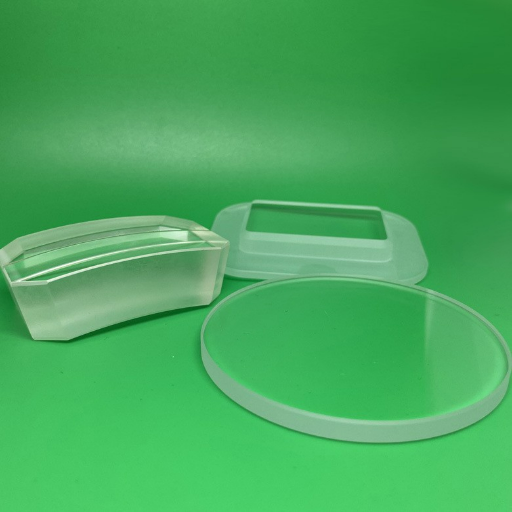
Fused Silica (Quartz)
UV–IR • High Performance
↗
Fused Silica (Quartz)
UV–IR • High PerformanceRefractive Index1.4585
Wavelength185–2500nm
Exceptional transmittance. Best for Laser, UV, High-Power.
Thermal Stability

Borosilicate Glass
Thermal Stability • Industrial
↗
Borosilicate Glass
Thermal Stability • IndustrialRefractive Index1.47-1.52
Max Temp500°C
Excellent chemical resistance. Best for Industrial, Mirrors.
Crown Glass
nd: 1.50-1.54
Flint Glass
nd: 1.55-1.75+
Soda Lime Glass
nd: 1.51-1.52
Crown Glass vs. Flint Glass: Choosing the Right Type
The preferred choice between crown glass and flint glass exists because crown glass meets two requirements. Crown glass offers consistent refractive index behavior which enables its use in precision lenses. Flint glass offers a higher refractive index paired with greater dispersion, used for achromatic doublet assemblies.
Borosilicate vs. Soda Lime Glass for Display Applications
Borosilicate maintains its thermal stability while showing chemical resilience. It can endure temperature fluctuations which would damage soda lime glass. However, soda lime remains the cost-effective choice for consumer display glass covers that will undergo chemical strengthening.
Understanding Fused Silica (Quartz) Glass
Fused silica provides exceptional transmittance and stability from deep UV (185nm) to IR (2500nm). The quartz optical system maintains its alignment through all temperature changes because of its exceptionally low thermal expansion rate.
BK7 Optical Glass: The Industry Standard
The optical engineering profession uses BK7 as its primary reference material for all borosilicate crown glass applications. BK7 exhibits excellent homogeneity and good transmittance from 350nm to 2000nm.
| Glass Type | Refractive Index (nd) | Abbe Number (Vd) | Transmittance | Thermal Stability | Cost Level |
|---|---|---|---|---|---|
| Crown Glass | 1.50–1.54 | 58–65 | ≥92% | Moderate | Medium |
| Flint Glass | 1.55–1.75+ | 25–50 | ≥90% | Moderate | High |
| BK7 | 1.5168 | 64.17 | Excellent | Good | Medium |
| Borosilicate | 1.47–1.52 | ~60 | High | Excellent | Medium |
| Fused Silica | 1.4585 | 67.8 | ≥93% (UV) | Superior | Very High |
| Soda Lime | 1.51–1.52 | ~59 | Good | Low | Low |
Not Sure Which Optical Glass Material Is Right? Our optical engineers help you select the best glass type.
Get Instant Quote Optical Glass Material Selector
Complete Optical Glass Guide
Understanding Optical Glass Properties
Optical glass properties which determine optical performance require assessment to support correct material selection. Essential technical details enabling appropriate material selection for your applications.
What Makes High-Quality Optical Glass?
Optical glass differs from regular glass which people use for windows and containers because it needs to meet strict requirements for light transmission and uniformity and defect-free performance. The quality of optical glass directly affects optical system performance because it determines camera image clarity and instrument measurement accuracy.
Why China Manufacturing?
Chinese optical glass manufacturers like Saiwei Glass have invested heavily in modern production equipment, quality systems, and technical expertise. We provide optical materials which match European and Japanese high-quality products at lower prices and offer flexible customization options which include CDGM glasses that match Schott standards.
Key Quality Factors
Homogeneity
Std (±5×10⁻⁵) / Precision (±2×10⁻⁶).
Striae
Internal streaks minimized by precision optics.
Inclusions
Bubbles maintained at lowest allowable levels.
Stress
Annealing reduces birefringence issues.
Transmittance
Optimized for application wavelengths.
Scratch-Dig (S-D) Specs
| Value | Standard |
|---|---|
| 80-50 | Commercial quality |
| 60-40 | Standard optical quality |
| 40-20 | Precision optical quality |
| 20-10 | High-precision quality |
| 10-5 | Ultra-precision standard |
Surface Flatness (λ)
| Value | Measurement (@632.8nm) |
|---|---|
| λ | Standard Measurement |
| λ/2 | Commercial products |
| λ/4 | Precision flatness |
| λ/10 | High-precision (Laser) |
| λ/20 | Ultra-precision (Metrology) |
Problems and Opportunities
Typical Problems in Sourcing Custom Optical Glass from China Manufacturers
Dealing with the toughest obstacles of selecting and buying precision optical glass from global suppliers should enable you to address important concerns with clear-cut, proven solutions.
Ensuring Actual Manufacturing Ability
Most optical glass suppliers merely get components manufactured by subcontractors, making verification difficult.
Verified Solution
We are a direct manufacturer with holistic, in-house production—CNC shaping, drilling, chemical strengthening, coating, and inspection. We provide virtual factory tours and equipment lists to prove capability.
Maintaining Uniform Quality (Batch to Batch)
Divergence between batches produces defective assemblies or system performance degradation.
Verified Solution
ISO 9001-certified quality verification includes cross-cut adhesion, drop ball impact, Delta E color inspection, and spectrophotometric evaluation. SPC ensures properties are maintained.
Lead Time and Uncertainty of Delivery
Custom orders often fall victim to unpredictable schedules, disrupting installation plans.
Verified Solution
Standard lead time is 10-15 days; rush option is 5-7 days. We maintain raw material stockpiles and provide real-time manufacturing status updates via project managers.
High Supply Barrier on High MOQs
Big order requirements create hurdles for prototyping, validation, and testing.
Verified Solution
Low MOQ of 100 pieces for standard products; lower for custom prototyping. Qualified B2B customers get FREE sample making and shipping, reducing risk before production.
Custom Specifications & Communication Barriers
Nonstandard shapes and unique requirements cause communication issues across languages.
Verified Solution
Dedicated bilingual engineering support provides DFM feedback in 24 hours. We provide detailed technical proposals, production timelines, and tolerance analysis for any drawing format.
Balancing Cost & Optical Performance
Premium materials exceed budgets. Customers need cheaper glasses without compromising properties.
Verified Solution
Direct factory pricing. Our engineers select the most cost-effective material meeting your specs. Volume discounts and alternative material suggestions balance cost with performance.
Why Choose Saiwei Glass
Why Source Optical Glass from a Direct China Manufacturer & Supplier
The optical glass factory in China provides your business with better cost efficiency and faster delivery times and tailored product options which trading companies and distributors are unable to provide.
Direct Factory Pricing
Our company operates as a manufacturer which allows us to remove intermediary costs through our direct sales approach. Our production facility sells custom optical glass and precision components and coated display glass products at wholesale rates. Customers save 20 to 40 percent by purchasing through us instead of through distributors.
Full In-House Capabilities
Our facility operates as a complete manufacturing center which performs all operational tasks from CNC glass cutting through ITO sputtering while maintaining all quality standards under one building.
Engineering Support
Our optical engineers provide DFM analysis, material selection guidance, and bilingual technical support from concept through production. We help choose the right type of glass for your refractive index, Abbe number, and transmittance targets.
Fast Turnaround
The standard lead time lasts 10 to 15 days while the rush period requires 5 to 7 days. The minimum order quantity starts from 100 pieces which we use for prototype development. The company keeps popular glass types in stock which enables us to fulfill wholesale orders without any delays.
Rigorous Quality Assurance
ISO 9001:2015 certified with testing at every stage: spectrophotometric transmittance mapping, cross-cut adhesion, drop ball impact, Delta E color inspection, and dimensional verification. Testing process includes all necessary steps.
Global Export Experience
Our company operates in more than 50 countries through established logistics partnerships. The company possesses expertise in international packaging requirements and export documentation needs and export compliance procedures and insurance processes for worldwide optical glass shipments.
Factory Capabilities & Workshop
State-of-the-art optical glass processing facilities including dust-free workshops, CNC machining centers, and chemical strengthening lines.
01
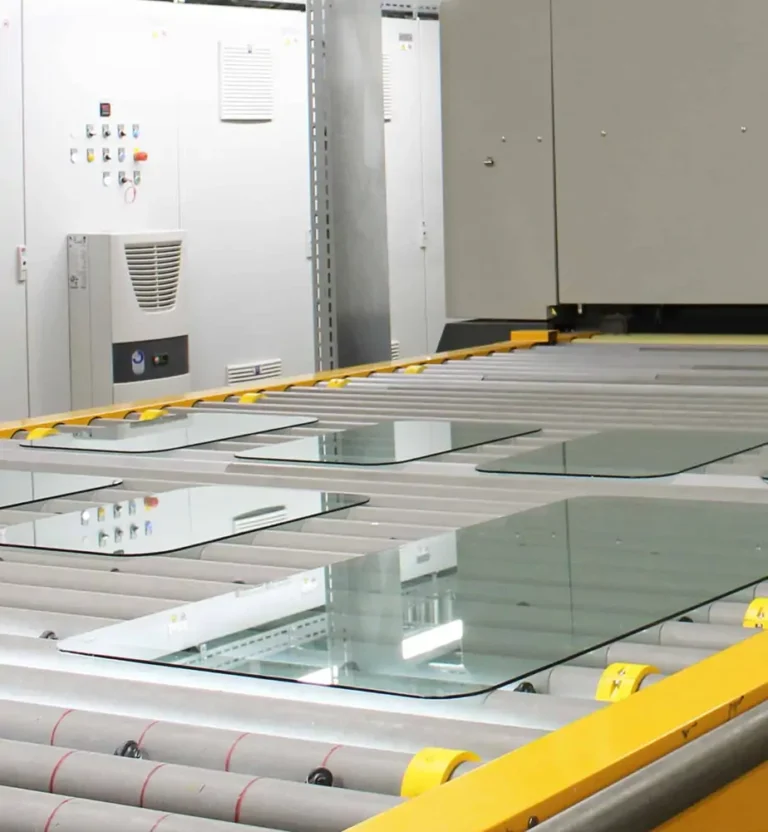
Thermal Tempering
02

Chemical Strength
03

Precision Drilling
04

CNC Fabrication
05

CNC Machining
06

High-Temp Printing
07

Clean Room
08

Silk Screen
09

Ultrasonic Clean
×
![Full View]()
Reference Data
Optical Glass Properties Chart
Refractive index, Abbe number, and specifications for common optical glass types
| Glass Type | nd (Refractive Index) | Vd (Abbe Number) | Dispersion | Transmittance | Density (g/cm³) | Applications |
|---|
How We Work
Optical Glass OEM Manufacturing: From Design to Delivery
Our production process delivers precise optical glass custom orders with consistent quality and rapid order fulfillment.
1
Technical Consultation
You need to provide your optical glass specifications and drawings and application details to our engineers who will assess your request and deliver DFM analysis within a 24-hour period.
2
Material Selection
We recommend the optimal glass type — crown glass, borosilicate, fused silica, or specialty formulations — based on your refractive index, dispersion, and transmittance needs.
3
Precision Fabrication
We provide CNC profiling services together with glass cutting and drilling and edge polishing and chemical strengthening to meet your specific dimensional requirement.
4
Optical Coating
Our facility provides AR and AG and AF and ITO coating services together with spectrophotometric testing which verifies transmittance and optical performance results.
5
QC & Delivery
Our testing process evaluates all quality aspects through adhesion testing and impact resistance assessment and Delta E color uniformity examination. We provide secure packaging together with global shipping services to your facility.
Case Studies
How We Tackle Real Glass Challenges with Full Real Clients
With BK7 custom manufacturing to low-MOQ precision optics shaping our spread of manufacturing solutions, different across industries have the potential to achieve their target goals.
Case 01
Next-Gen AR Headset Precision BK7 Optical Glass Fabrication
How we assisted a Silicon Valley startup in achieving λ/4 surface accuracy on custom BK7 waveguide substrates — within 18 days.
Client Problem
An AR/VR startup located in California set out to create a mixed-reality headset. They needed custom BK7 glass substrates with exceptionally tight tolerances (≤ λ/4 flatness) for an investor demo. Their European supplier quoted 8-10 weeks, missing the deadline.
Our Solution
Our engineering team completed DFM analysis in 24 hours. We used Schott-equivalent BK7 blanks from inventory, eliminating lead time. With 5-axis CNC grinding and MRF polishing, we reached λ/4 accuracy and shipped the pilot batch in 18 days.
Technical Details
MaterialBK7 Equivalent
Dims38x26x1.8mm
Flatness≤ λ/4
Quality40/20 Scratch-Dig
CoatingDual-side BBAR
Qty200 pcs
18 Days
Total Turnaround
42%
Cost Reduction
λ/4
Surface Finish
100%
First-Pass Yield
"When we were just weeks away from our Series B demo, our last vendor let us down. In 18 days, they completed 200 AR-coated BK7 substrates, and made no mistakes."
Frequently Asked Questions (FAQs)
What are the different types of optical glass and their differences?
Crown glass, flint glass, borosilicate, BK7, and fused silica (quartz) are a few examples of optical glass. Various types of optical glass can be distinguished by their refractive index, Abbe number (dispersion), density, thermal expansion (CTE), and transmittance across different wavelengths. As an example, fused silica provides exceptional tropospheric properties, is highly homogeneous, and possesses high light transmission in the UV to IR ranges, making it suited for high-powered laser applications and more difficult environments. Crown glass is lower in refraction and has a greater Abbe number (lower dispersion) than flint glass.
What is the impact of optical glass solutions on metrology and precision glass components?
The precision components of glass used in metrology and the glass itself rely on a high degree of homogeneity, with tight tolerances and impressive surface polish. For precise optical systems, this is critical. Manufacturers and fabricators of glass provide strict tolerances with precision polishing for gauge glass, prisms, and lenses. These optical properties do not vary and are critical for research and development, industrial applications, and optical devices, from telescopes to telescopes, and control panels.
Which optical properties should one consider when selecting glass materials for optics?
Key optical properties are refractive index, Abbe number, transmittance, wavelength range, and optical homogeneity. It is also important to consider thermal and mechanical properties, such as CTE, to know how the glass will perform at varying temperatures and how easily it will cut and polish. For applications requiring low dispersion, consider materials with a high Abbe number. Select flint or specialty high refractive index glass products for high refractive index requirements. For UV or IR applications, use fused quartz or silica for better transmission.
Can glass manufacturers produce custom-shaped glass components for optical devices and display glass?
Yes, several optical custom fabricators and glass manufacturers produce custom display glass and custom-shaped glass to meet the requirements of their customers. They make custom glass for optical assemblies, displays, prisms, lenses and add custom coatings, thicknesses, and edge processing. Products such as displays, control panels, and industrial and consumer devices with high optical clarity and durability are made with custom glass to meet high precision tolerance requirements, in contrast to stock glass.
What part do glass cutting and polishing play in developing quality optical products?
Achieving quality optical products requires careful glass cutting and polishing to obtain the dimensional tolerances and surface quality needed. In glass cutting, proper cutting minimizes subsurface damage, and fine polishing reduces scatter and improves transmittance. Industry standards in polishing and metrology ensure that the surfaces of lenticular, prism, and display glass products, which are critical in light transmission, chromatic performance, and homogeneity, are met, which improves their optical performance.
What are the differences in optical glass solutions for astronomy and telescopes?
BK7, fused silica (quartz), and low-CTE borosilicate glass are used in astronomy and telescope optics because of their low thermal expansion, high homogeneity, and excellent visible and near-infrared transmittance. Telescope optics require large and uniquely shaped elements along with stringent standards in polishing and coatings. This maximizes light transmission and minimizes chromatic aberration for high-resolution imaging across the light spectrum.
What role do tolerance and gauge glass play in optical systems and other industries?
Tolerance is the term used for the permitted deviations in measurement and optical characteristics. Gauge glass and precision glass parts give standards of reference and can be used to accurately assemble optics. In optical systems and in other highly precise industries like metrology and industrial applications, low tolerances are very important. These are then used to describe the tolerances in thickness, flatness, and the other surface qualities of optical components to ensure that the optical systems perform to the industrial standards of the given industry.
How do glass types, borosilicate, soda lime, and silica, affect optical performance and durability?
Borosilicate is chosen for harsh conditions for its improved chemical and thermal resistance, while soda lime is used for low-standard optical applications for its low cost. Silica (fused quartz) is chosen for high-power laser applications for its low expansion, high transmittance, and thermal resistance. Choosing between these types of glasses depends on the optical performance and durability required, cost and quality of optics, resistance to thermal shocks, and the wavelength at which the glass must be used.
What considerations are important when sourcing glass optics products from manufacturers?
When sourcing optics glass products, check details like what technical glass products manufacturers specialize in, types of optical glass (for instance, high homogeneity, high refractive index), glass quality control, polishing, and custom glass or custom optical capabilities. Also, assess material data, optical glass (refractive index, Abbe number, transmittance), tolerances, and certifications. Ensure they support display glass, optical components, high-precision R&D, and industrial optical systems.