Get in Touch with Saiweiglass



How the Glass Tempering Process Creates Stronger, Safer Glass
Thermally tempered glass is used in shower doors, vehicle side windows and storefront glazing where the specified glass meets the application’s requirements.
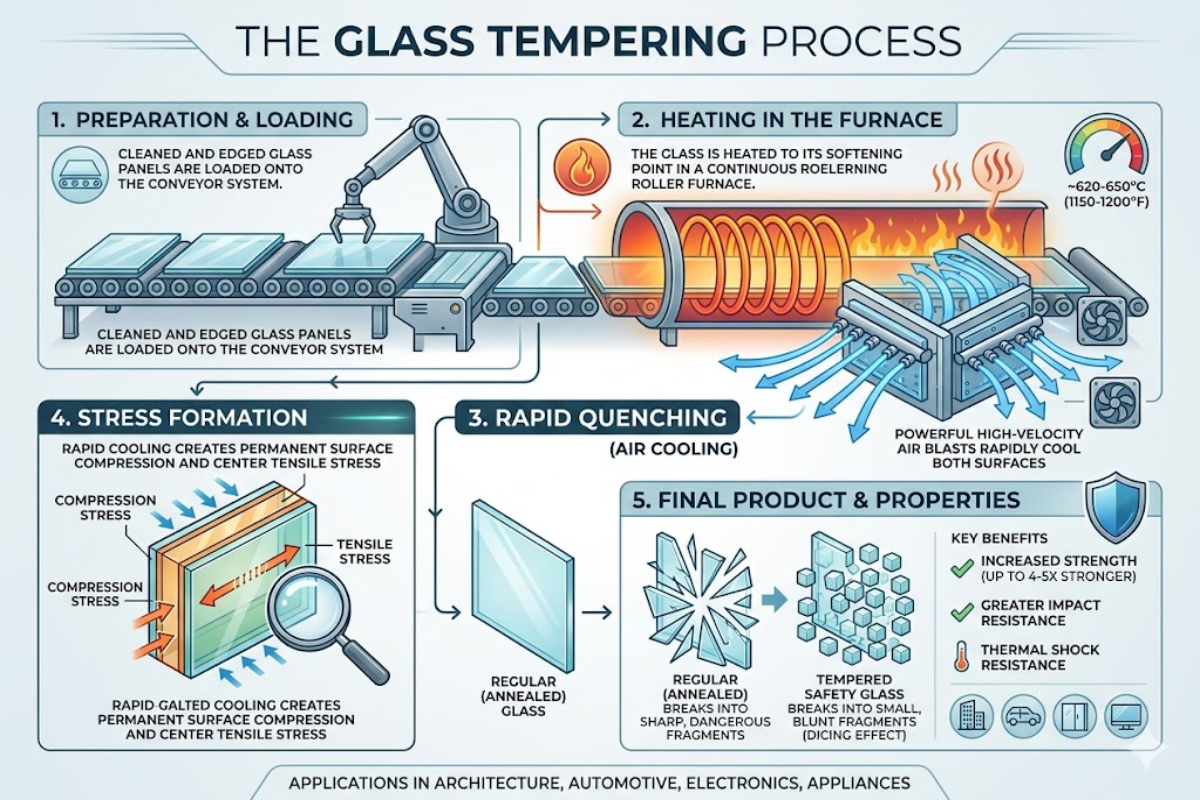
Annealed glass becomes strengthened glass through a controlled heating and cooling process called tempering. Compared to annealed glass, tempered glass breaks into smaller, less dangerous fragments and reduces the risk of cutting injuries. Breakage of tempered glass can still cause injuries.
Heating and cooling conditions affect the final tempered glass. Below is an overview of tempered glass fabrication, the tempering process, and the checks the buyer should discuss with their processor.
What Is Tempered Glass and Why Does It Matter?
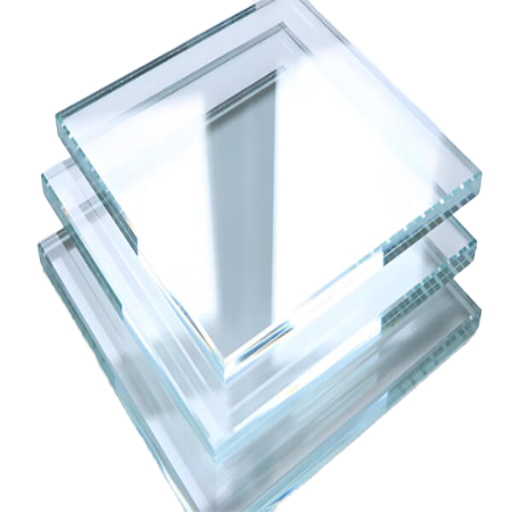
Thermally tempered glass is approximately 4 to 5 times stronger than annealed glass of the same thickness. It breaks into small fragments and reduces the risk of injuries.
This breakage pattern is due to the stress profile created during tempering.
| Property | Annealed Glass | Tempered Glass |
|---|---|---|
| Strength | Baseline (1×) | 4–5× stronger |
| Break Pattern | Large jagged shards | Small granular chunks |
| Thermal Resistance | Lower thermal-stress resistance; assess the application | Higher thermal-stress resistance; confirm product limits |
| Post-Processing | Can be cut, drilled, edged | Cutting, drilling and edgework must precede tempering |
| Risk of Injury | Large, sharp fragments can cause serious cuts | Reduced cutting risk; fragments can still cause injury |
⚠️ Common Misconception
Tempered glass is not unbreakable. Compared to annealed glass, tempered glass has greater mechanical and thermal stress resistance and safety. However, breakage can still occur.
The Glass Tempering Process, Step by Step

Complete all cutting, drilling and edgework before thermal tempering. Mechanical processing after tempering can cause the glass to shatter. Below are the different steps in the thermal tempering process.
Step 1: Cutting and Fabrication
Float glass is cut to size. Holes, notches, and cutouts are made prior to tempering. Edges are prepared and checked to make sure there are no defects that could result in breakage while heating or quenching.
Step 2: Cleaning and Inspection
Prior to heating, the glass is cleaned and inspected for surface and edge defects. Confirm the processor’s inspection criteria for the specified glass.
Step 3: Heating
In a roller-hearth tempering furnace, architectural glass is generally heated to above 600°C and then quenched. The required heating conditions depend on the glass and equipment. Non-uniform heating can cause the glass to deform. Roller wave occurs when the glass, while still soft, sags between the furnace rollers.
Above 600°C; process-dependent
Tempering Temperature
4–5×
Strength vs Annealed
≥69 MPa
Surface-compression threshold described in NGA’s 2019 guidance on ASTM C1048; confirm the specified edition and qualification route
Step 4: Quenching (Rapid Cooling)
The glass is then quenched with high velocity air jets that quickly cool the glass from both sides. The surfaces cool faster than the interior, leaving the surfaces in compression and the core in tension. The air jets provide cooling; they do not mechanically compress the glass into its tempered state.
Heating and quenching conditions depend on the glass and the equipment. Confirm the processor’s conditions for the specified product.
Step 5: Quality Inspection
Confirm visual inspection, sampling, test and marking requirements. ASTM C1048 and EN 12150 have different scopes and assessment requirements; a single fragment count does not establish compliance with both. Obtain documentation from the processor to show which standards, editions, glass thickness, and acceptance criteria apply.
💡 Pro Tip
Ask the processor to confirm heating, quenching and total cycle times for your specified glass. A furnace cycle time should not be considered the order’s production or delivery lead time.
The Science Behind Glass Tempering, Compression vs Tension

Tensile stress can cause cracks to grow. Compressive stresses that occur on the surface of glass as a result of tempering can help to restrain further crack growth.
For fully tempered glass, The National Glass Association’s 2019 guidance on ASTM C1048 states that one route of qualification is surface compression of at least 69 MPa (10,000 psi), another route is edge compression of at least 67 MPa (9,700 psi), and a third route is through specified safety-glazing performance. Verify which route of qualification is employed for the product, and check the edition of the specified standard. This historical summary should not be interpreted to mean the product is compliant with a more current edition of the standard.
The stress profile yields compression at the surfaces and tensile stress in the center. This profile produces the characteristic small-fragment breakage pattern, which reduces cutting risk compared with annealed glass but does not eliminate injury risk.
Key Stress Values in Tempered Glass
- Surface-compression threshold in NGA’s 2019 ASTM C1048 guidance: ≥69 MPa (10,000 psi); confirm the specified edition and qualification route.
- Surface compression (heat-strengthened): 24–52 MPa (3,500–7,500 psi)
- Core tensile stress: Approximately half the surface compression value
- Tempered glass can have a higher resistance to thermal stress compared to annealed glass. Check the allowable conditions for the product and the conditions for its installation.
Thermal Tempering vs Chemical Tempering
Thermal tempering is a common method of glass strengthening for architectural, automotive and appliance glass. Chemical strengthening (i.e. ion-exchange) for cover glass applications can be done, but confirm the limits of strength and the suitability for the desired performance.
In one common ion-exchange process, larger potassium ions replace smaller sodium ions near the glass surface, creating compression. Corning describes a molten-salt bath temperature of approximately 400°C for Gorilla Glass. This example is for a specific product and not a general case for ion-exchange glass processing. Confirm the limits and tolerances of the product being processed.
| Feature | Thermal Tempering | Chemical Tempering |
|---|---|---|
| Process | Heat above 600°C, then air-quench; recipe depends on the product | Ion exchange in molten salt; bath conditions depend on the product |
| Min. Glass Thickness | Equipment-dependent; confirm the specified thickness | Product-dependent; confirm the specified thickness |
| Optical Distortion | Possible roller wave / quench marks | Confirm product-specific flatness and optical tolerances |
| Compression Depth | ~20% of thickness at each surface (deep) | Product- and process-dependent; request compression-depth data |
| Cycle Time | Product- and equipment-dependent; confirm heating, quenching and total cycle times | Can take hours; confirm the product-specific cycle |
| Cost | Request a quote for the specified product and volume | Request a quote for the specified product and volume |
| Primary Uses | Architecture, automotive, appliances | Phone screens, aircraft glass, optics |
Chemical tempering creates surface compression through ion exchange. Surface compression and compression depth depend on the glass and treatment; request product-specific data rather than assuming a universal value.
💡 Pro Tip
Discuss glass composition, thickness, dimensions, curvature, optical tolerances and required safety performance with the processor. For railings and facades, also confirm the complete glazing construction and any post-breakage retention with the processor before selecting a strengthening process.
Where Tempered Glass Is Used, Applications by Industry

The National Glass Association’s Technical Paper FB45-14 discusses recommended architectural applications for heat-treated glass. Product selection must account for the design, structural requirements and applicable safety codes.
| Industry | Applications | Why Tempered |
|---|---|---|
| Architecture | Facades, shower doors and enclosures, partitions and storefronts; railings and skylights require application-specific glazing constructions | Building codes require safety glass in hazardous locations (IBC 2021 Section 2406) |
| Automotive | Side windows, rear windshield, sunroofs | FMVSS 205 specifies glazing performance and permitted vehicle locations |
| Electronics | Phone screen protectors, display covers, touchscreens | Scratch and impact resistance (chemical tempering for thin glass) |
| Furniture | Table tops, shelving, display cases | Safety and strength for everyday impact loads |
| Food Service | Appliance doors and commercial refrigerator glazing, where specified | Confirm the specified glass type, operating temperatures and thermal-shock limits |
For architectural glazing, determine the proposed manufacturing route, achievable geometry and glass construction with the supplier, and confirm applicable test documentation.
Quality Control and Testing Standards for Tempered Glass

Prior to ordering, understand which inspections and tests will be performed on the specified glass, the connection between production records and the order, and the supporting documentation provided.
| Standard | Scope | Key Requirements |
|---|---|---|
| ASTM C1048 | Heat-treated flat glass (US) | Requirements depend on glass kind and the applicable qualification route; request supporting test documentation |
| EN 12150 | Thermally toughened safety glass (EU) | Fragmentation, dimensional and flatness requirements; confirm the applicable part and edition |
| CPSC 16 CFR 1201 | Safety glazing for specified architectural products in the US | Categories I and II; covered products include doors and bathtub or shower doors and enclosures, subject to the regulation’s scope |
| ANSI Z97.1 | Safety glazing in buildings (US) | Safety-glazing performance tests; confirm the required impact classification and standard edition |
Nickel sulfide (NiS) inclusions can create a risk for spontaneous breakage in tempered glass. Heat-soak testing reduces this risk by breaking susceptible panes during the test. This risk cannot be entirely eliminated. If heat-soaking is required, describe the necessary EN 14179 requirements, and request supporting documentation for the glass.
- ✔
What visual and optical inspection will be performed and what acceptance criteria will be used? - ✔
What method of measurement of stress will be performed, does ASTM C1279 apply, and how will the results be evaluated against ASTM C1048? - ✔
What fragmentation test and sampling plan and acceptance criteria will apply to the specified glass and thickness? - ✔
Heat-soak testing, where specified: Confirm the applicable EN 14179 requirements and test documentation. Heat soaking reduces but doesn’t eliminate NiS-related breakage risk.
Frequently Asked Questions About Glass Tempering

Q: How is tempered glass made step by step?
View Answer
Thermal tempering can be outlined in five stages: (1) Complete cutting, holes, notches and edgework. (2) Clean and inspect the glass. (3) Heat it under conditions suited to the glass and equipment. (4) Rapidly cool both faces with air jets. (5) Inspect the finished glass and perform the tests required by the applicable specification.
Q: What temperature do you temper glass at?
View Answer
Architectural soda-lime glass is generally heated above 600°C (1,112°F) before quenching. The required temperature depends on the glass and process; confirm the heating conditions for the specified product.
Q: How long does it take to temper glass?
View Answer
Cycle time depends on the glass thickness and processing conditions. Ask the processor to confirm heating, quenching and total cycle times for the specified glass, separately from the order’s production and delivery lead times.
Q: Can you temper glass at home?
View Answer
No. Producing thermally tempered safety glass requires controlled heating, rapid air quenching and verification of the finished glass. A domestic oven isn’t a substitute for this industrial process.
Q: Can tempered glass be cut after tempering?
View Answer
No. Cutting, drilling or edge grinding after tempering can cause the panel to shatter. Complete these operations before tempering, and confirm dimensions and hole locations before ordering.
Q: What’s the difference between tempered and laminated glass?
View Answer
Tempered glass is strengthened by heating and rapid cooling and typically breaks into small fragments. Laminated glass consists of two or more glass layers bonded with an interlayer that helps retain fragments after breakage. Neither construction makes glass unbreakable or guarantees that no fragments will fall. Confirm the required safety performance and retention for the complete glazing system.
Need Tempered Glass for Your Project?
Contact Saiwei Glass, with your drawings, dimensions, construction of glass, and your project requirements to confirm if the glass can be processed, what options are available to you, and the supporting documentation.
Our Perspective on Glass Tempering
When ordering from Saiwei Glass, find out where the glass will be processed, if tempering is done in house or subcontracted, what standards apply, and what test documentation is provided for the specified glass.
References & Sources
- ASTM C1048: Standard Specification for Heat-Strengthened and Fully Tempered Flat Glass ASTM International
- How Is Tempered Glass Made? Scientific American
- Technical Paper FB45-14: Recommended Applications for Heat-Treated Glass National Glass Association
- Thermal Tempering, Overview ScienceDirect / Elsevier
- Chemical Tempering, Overview ScienceDirect / Elsevier
- Tempered Glass Wikipedia