Get in Touch with Saiweiglass


Differences Between AG Glass and AR Glass


With the advancement in glass technology, the AG (Anti-Glare) and AR (Anti-Reflection) glasses have been the subject of much curiosity and debate. However, these two glasses stand opposite each other due to opposite functions while aimed at appliqué of visibility and utility for different application requirements. Knowledge about their diverging differences is worthwhile for an interested party selecting the kind of glass best for their requirements, whether for their displays or architectures or industrial applications. In this guide, info has been given on the peculiar features of the two anti-glare and anti-reflective glass materials to further elucidate their working mechanism, advantages, and some situations in which one could surpass the other. The article is intended to bring a clear understanding of how these advanced materials change the world of industries and our everyday life.
Glass Type 01
AG Glass
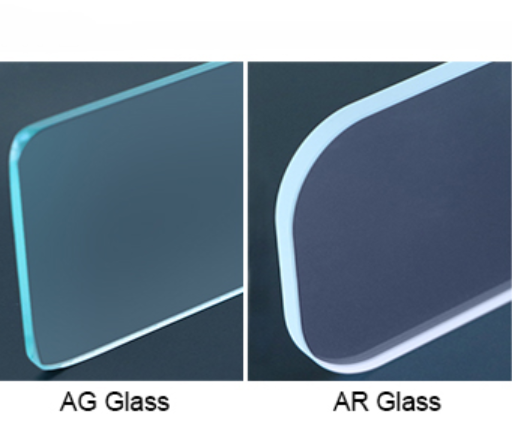
Anti-Glare — Diffuses light to scatter reflections, producing a matte finish that maximizes readability under bright ambient light.
- — Matte / diffused surface
- — Best for high-glare / outdoor use
- — Chemical etching or coating process
Glass Type 02
AR Glass
Anti-Reflective — Uses multilayer optical coatings to reduce surface reflections and maximize light transmission for superior image clarity.
- — Transparent / clear surface
- — Best for controlled / low-light environments
- — Vacuum / chemical vapor deposition
Understanding AG Glass

AG glass is an abbreviation for Anti-glare glass, which immensely minimizes reflections on its surface. This is achieved with a special coating or treatment applied to deflect the light such that monitors or objects in front of light sources can be clearly seen. This is one of the reasons AG glass is so popular material wise for use in display screens, auto displays, and storefront windows, especially as it maximizes visibility, reducing eye weariness. The main role of AG glass is to improve visibility under the most challenging lighting conditions while continuing to feature-product durability and elegance.
What is AG Glass?
AG (Anti-Glare) glass is specifically engineered to eliminate glare by spreading light that hits it. This allows for continuous visible light in clear and well-lit conditions and is highly effective in smartphones, tablets, computer monitors, and automotive displays. Contemporary AG glass is fabricated utilizing lesser-known but cutting-edge chemical etching and coating technologies that cause light to disperse in multiple directions, thereby obviating the dreaded reflections while retaining the highest visual performance. Recent novel algorithms involve making RE-less AG Glasses, which also bear heavy scratch resistance, enhanced strength, and compatibility with touchscreen usage to withstand consumer electronics and industrial competitiveness. AG Glass changes the game by delivering higher performance under varying lighting conditions without sacrificing aesthetic beauty.
Manufacturing Process of AG Glass
The anti-glare (AG) glass is produced by an elaborate mean that would keep surface reflections at minimal, thereby improving the visual clarity. The procedure in itself often starts with a high-quality sheet of glass being taken as a base sheet for enhancement. That is generally done by treating the surface with corrosive materials such as acids or abrasively for a satin finish. The end result of these procedures is such diffusing the incoming light to thereby minimize any reflection and make all writings alive in the eyes of the beholder when the light conditions differ.
In addition, a so-to-speak thin layer of coating might be applied in order to upgrade and further strengthen anti-glaring characteristics. This material will be developed in such a way as to be expected to facilitate an excellent performance in terms of light transmission and its durability, thus resistance to scratching. If applicable, additional treatment can allow chemical strengthening or thermal tempering aimed at improving its mechanical integrity for the targeted service life.
Quality control is vital for manufacture of AG glass. The glass undergoes intensive testing during manufacture ensuring that its optical and physical properties, such as uniformity of the matte finish, scattering of light intensities, and resistance to scratches, etc., are precisely defined and controlled. In ensuring that the final product maintains the required standards for this industry, a reliable product would provide performance to devices or distinct surfaces which could enable clear visibility and reduce reflections.
Optical Properties of AG Glass
Anti-glare (AG) glass is formulated to limit glare and reflections and offers better visual clarity over different lighting conditions. It achieves this using treatment processes to create a matte surface that refracts light instead of reflecting it as is the case in AG. AG glass proper must exhibit uniform light transmission, high contrast visibility, and effective light scattering. All three properties are there so that content displayed on electronic components such as monitors, mobile phones, and control panels remain highly readable even when light beams fall straight upon them in sunny daylight or under artificial incandescent lights.
Recent technological developments in AG glass, as indicated by the recent literature of industry references, is towards safeguarding image sharpness while keeping the specular reflection to the minimum. The best strategies that are being investigated currently include the use of the most up-to-date coatings and etching methods, to produce a tough product that will maintain its anti-glare properties in continuous use. AG glass is, therefore, essential for applications such as car displays, medical devices, and high-end electronics where visual performance and reliability are considered above all.
Exploring AR Glass

What is AR Glass?
AR Glass, as abbreviated for Anti-Reflective, is aimed towards reducing surface reflections, which positively effects content visibility and clarity. AR coating in glass works in step with technically advanced multicolored coatings or yield to surface treatments being kept minimal while employing additional light passing through the glass with minimizing light reflected off the surface. The contrast ratio becomes better, color is more true to life, and the image quality becomes perfect, even when surrounded by luxury light as typical in whichever industry: eyeglasses, camera lenses, solar panels, or electronic displays, where no doubt optical clarity and glare minimization is required for proper functioning and improved efficiency.
Manufacturing Process of AR Glass
The manufacturing process of anti-reflective (AR) glass involves a series of steps to ensure that the glass demonstrates optical clarity and durability.
- 1
Base Glass PreparationThe glass-making technique is carried out with glass materials to make a base glass, which is melted at high temperatures and shaped in sheets. - 2
Substrate CleaningThe plate glass is thoroughly cleaned to achieve a pure substrate for coating. - 3
Anti-Reflective Coating ApplicationThe anti-reflective coating is manufactured using techniques like vacuum deposition or chemical vapor deposition (CVD). In this process, layers of thin film(s) of materials such as magnesium fluoride or titanium dioxide are coated on the surface of the glass. These coatings are very carefully constructed with light waves interfering with any incident wave to improve the transmission of light through the glass by reducing reflectivity. - 4
Quality TestingThe last step is to test the glass for its quality to check whether it has been coated with the desirable optical properties and durability for its respective applications, such as displays, optics, and solar panels.
Optical Properties of AR Glass
Performance Specifications
0.5%
Min. Reflectance
99.5%
Max. Light Transmittance
The optic brilliance of the antireflective (AR) glass is rather helpful in the actual reduction of display and maximization of the transmittance of light. The AR glass, by way of innovative multilayer coatings, could minimize reflectance to a low of 0.5% while attaining a transmittance up to approximately 99.5% of the overall light. This union leads to an amplified measure of seeing and vision, especially in state-of-the-art applications such as display devices, camera lenses, and telescopes. It also serves as an antiscattering barrier to color-linearity improvement and contrast characteristics in images. According to a number of recent studies held in the twilight of last century, the layers’ greater durability promises shield against scratching and ambient conditions, ensuring that the coatings hold up equally well under extensive use. An interruption of the exciting alliance between large transparency and strength, the AR glass still stays highly relevant to the state-of-the-art in optical technology.
Key Differences Between AG Glass and AR Glass
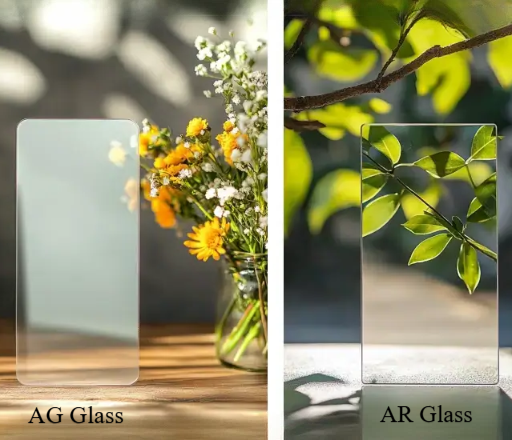
| Feature | AG Glass (Anti-Glare) | AR Glass (Anti-Reflective) |
|---|---|---|
| Surface Type | Matte / Diffused | Smooth / Transparent |
| Primary Function | Scatters / diffuses light | Reduces reflections, increases transmission |
| Manufacturing | Chemical etching / acid treatment | Vacuum / CVD thin-film coating |
| Image Sharpness | Moderate (matte reduces sharpness) | High (preserves clarity) |
| Best Lighting | Bright / outdoor / direct sunlight | Controlled / indoor / low-light |
| Reflectance | Diffused (scattered) | As low as 0.5% |
| Typical Applications | Monitors, automotive displays, outdoor screens | Camera lenses, medical imaging, premium displays |
Surface Treatment Techniques
AG (Anti-Glare) glass and AR (Anti-Reflective) glass require completely different techniques for their surface treatment. For the most part, the AG glass would be obtained through surface-imaging or coating techniques that are typically employed for diffusion of light and the reduction of glare, thus leading to a matte finish. This very property makes the glass very suitable for strong ambient-light surroundings like outdoor screens and automotive displays, areas where the visibility can be otherwise affected clearly.
On the other hand, AR glass requires the use of multilayer-coating technology deliberately designed to pretreat high transmission against enhancing light reflection. Typically, such treatments of AR glass are based on layer depositions on the surface of the glass substrates containing thin-film layers of alternating refractive indices of relatively high or low values. Thus, this glass will be suitable for employment in applications requiring utmost clarity and ability to sustain vivid colors, such as camera lenses, microscopes, or larger, high-quality full-color displays.
The two technologies leverage advanced research in material physics, besides — each being better fit for some areas of use thereof. Quite simply, while AG glass focuses on clarity by reducing screen glare under strong ambient light conditions, AR glass technology has been formed to offer aesthetically perfect lenses in carrying the best achievable light to the eyes.
Performance Under Various Lighting Conditions
AG (Anti-Glare) glass manipulates ambient lighting to reduce glare and enhance screen readability, especially in the presence of severe lighting conditions such as direct sunlight. Consequently, it provides better service to portable units being over-used outdoors or under very harsh lighting conditions, e.g., tablets and monitors, along with automotive displays. Being anti-glare, it means it displays the content in a visible manner without hurting the user’s eyes.
AG glass has a reflectance influenced to a greater degree by better transmittance; superior color, therefore, and sharp image quality. This is selected over AR glass for its great low-light capability and is perfect for poor light conditions combined with a high contrast. It makes it a strong choice for applications as high-end displays, cameras, and medical tools where clarity is important.
Among the two technologies, it is the end-user’s choice based on lighting conditions and the use anticipated. AG Glass wins in a high-brightness and diffused light environment in which good readability is crucial, while AR Glass remains the best performer in terms of optical performance in the event of moderate to poor light conditions. Together, the pair are working toward trying to create user experiences that ride over unique lighting challenges.
Clarity and Image Sharpness
The correct use of AG/AR glass will provide clarity and image sharpness advantages owing to their design and function. AG glass simply diffuses light and stops reflection of light by absorbing the glare, and the matt finish does not for image sharpness. AG glass is perfect for areas like outdoor displays or a device used under direct sunlight, where the reflection must be kept as minimal as possible while making it viewable from a considerable distance without regard to precise picture quality.
On the other hand, AR glass is designed to heighten picture clarity by curtailing reflection and upgrading light transmission, hence maintaining display fine-tune clarity that complies with those typical AG diffuse characteristics. This is why AR glass is the choice for applications with top-notch finish needs where it gets down to brilliant and high-quality visualization, such as at the likes of high-end photographic equipment, top-grade monitors, or medical imaging machines, just to mention but a few.
AR glass is more favored in applications where image quality and color accuracy are top priority whereas AG glass is the top solution for cutting down eyestrain in a contagious glare environment. Ultimately, the choice of either comes down to finding the right equilibrium between sharpness necessity and environmental challenges to achieve a user-friendly result.
Applications of AG Glass and AR Glass
01
Use in Electronic Displays
AG (Anti-Glare) glass and AR (Anti-reflective) glass are both of crucial significance for the enhancement of electronic displays, they each possess special features designed to suit specific applications. AG glass addresses the issue of glare through the diffusion of light and reduction of reflections, which make it suitable for devices that are meant for use in high-glare scenarios like laptops, GPS screens, and outdoor displays. Given this place, the implemented function of reducing surface gloss ensures that viewing remains comfortable even in very bright lighting conditions, thus also minimizing eye strain during long usage hours.
On the one hand, an anti-reflective coating greatly improves image sharpness and color accuracy by significantly cutting down surface reflection and increasing light transmission. This ensures much sharper images and vibrant colors and positions AR glass as a natural choice for any high-tech device, such as flagship-grade smartphone displays, tablets, telecom touchscreen systems, and computer monitors, where considerable image precision is expected. Other niche markets where such kinds of surfaces work very well are medical imaging equipment and all those high-tech optical devices that need to offer accurate images.
The two glasses find their individual uses according to their relativities with the environmental setups of the intended users. Glass treated for antiglare or AG is more suitable for outdoor circumstances or under conditions under which glare poses a problem. The specialized surface known as AR glass is unequaled whenever ultimate visual clarity — with minimum distraction from reflection — is a critical factor.
02
Application in Museum Cases
AG (Anti-Glare) Glass and AR (Anti-Reflection) Glass have their own unique roles in museum showcases, giving so much to viewing and preservation of the exhibit.
- AG
AG Glass in Museum EnvironmentsAG glass is the best glass for reducing glare emanating from ambient lighting from overhead. It is particularly important in a museum lit by light that goes on the top surface or any of the powerful museums using natural light because it ensures visitors can look at the exhibit without any visual glare. - AR
AR Glass in Museum EnvironmentsAR glass is the type of glass that minimizes reflections and therefore enhances the optical clarity to produce a clearer and more pronounced view of artifacts — where more detailed and demanding views seem rather important: where do you find so many fine details inside an artwork that deserve capturing to a real life degree or where there are much more delicate items to be in clear sight.
It is the quality of the lighting environment and the delicate nature of these items on show that select between the two glasses — the best combination for either safeguarding these items or showing them as effortlessly as possible abreast.
03
Architectural Windows and Other Uses
Anti-Glare (AG) Glass and Anti-Reflective (AR) Glass are widely used in modern architecture for reduced glare and enhanced clarity effect. Architectural windows made from these types of glasses help in natural light penetration, whilst preventing reflections, promoting comfortable indoor environments. It is mainly used in cases like offices, museums, and residential applications, where the desired quality is both visibility and aesthetics.
On another note, AG and AR glass are increasingly being embedded in electronic views, signage, and control panels to counter readability against light conditions. The glass’ durability and functionality have considerably broadened its applications, including transportation systems such as automobile and mass transit anti-glare screens, and gadgets and solar-pole covers for the enhancement of efficiency. As versatile solutions, they match both necessity and visual appeal and thereby, they embed their usage in the various industries.
Making an Informed Decision
Factors to Consider When Choosing
In considering the dichotomy between antiglare (AG) and antireflection (AR) glasses, the specific needs of the applications must be understood. AG glass is suitable in ambient lighting conditions, having an edge. AG glass can be seen as an edge over operating devices in bright natural light environment, such as outdoor displays, interactive touchscreens, reads information via dispersing rather than reflecting light and therefore increases the perceptibility. On the other hand, AR glass will let more light through to allow better visibility and improved contrast while reducing reflection as much as possible, especially in internal settings and where surroundings are commonly seen as reflecting issues.
When selecting glass, further consideration must be given to the environment: the area in which it will be installed, the degree to which visibility is needed, and desired strength. Most instances characteristics of light reflectivity is important for outdoor or very high-visibility areas, AG glass can be preferred to AR glass, whereas in controlled lighting conditions or other applications in which it is highly desirable, AR glass would be more appropriate. When budgeting with respect to maintenance, they come in. The two glasses are by no means identical with regard to fabrication and cleaning processes. To make a good decision, discover the details in your specific case.
Common Misconceptions about AG and AR Glass
It is a common belief that anti-glare (AG) and anti-reflective (AR) glasses mean the same thing. These serve the same purpose of improving visibility toward the objects beneath them; however, they serve this purpose in alternative ways. Specifically, AG glasses scatter light so as to nullify reflections off bright sources, making it ideal for uncontrollable circumstances such that are outdoors or where light happens to be very strong. AR glasses reduce reflective behavior and nearly enhance light transmission, hence showing suitability in conditions where the clearest yet brightest image is to be retained. A hoax is that one of the two is mostly better than the other one. However, consideration of environment and use shall be warranted herein.
Conclusion: Which Glass is Right for You?
Summary
The choice between AG glass and AR glass will depend entirely on your specific requirements and the surroundings themselves. For anyone with a regular need to work outside or in an area that has high glare, AG glass is ideal. It scatters light efficiently to render improved visibility, reducing overall eye strain. In contrast, AR glass is suitable for achieving crystal-clear image quality under a controlled environment such as that found in offices, labs, or display devices, which is all about what AR glass does with very little reflection and improved light transmission.
Today’s time finds AG being more useful for electronic devices like smartphones and tablets where glare is more noticeably an issue; meanwhile, AR is growing in utility for applications in AR/VR devices, high-end displays, and optical instruments calling for precision and clarity. With a brief description of the benefits from each category, along with given usage scenarios, one can determine the best solution concerning preeminent technology that satisfies the end-use case. While searching for the best technology for glass, there are important facts for consideration: the environment around it, the eventual use of the product, and the visual experience you are seeking.
Frequently Asked Questions (FAQs)
Q1
Difference between ALI glass and AG glass
Difference between ALI glass and AG glass
In this world of technological advancement, advanced materials have leaped great lengths. For this very reason, the existence of AR and AG must be closely looked into, as they bear a mutual relationship. AG belongs to the smallest family of ARs, if not the same, either very close to ALI or a completely different term suited towards the LCD industry today.
AF or af herein mostly likely indicates an anti-reflective anti-fingerprint on the front side; now, this differs from anti-glare anti-reflective persons. As such there shall be af-glass that also bears ar coating or an ag process, and it follows that one piece of glass could contain fairly many optical coatings to provide non-glare glass, if not indeed for their reduced reflectivity, at the least on an anti-smudge surface. In the pattern of glass industry, sealing on the front or on some side(s) can bring about the properties that we desire.
Q3
How does AR-coated glass improve display visibility?
How does AR-coated glass improve display visibility?
Anti-reflective glass erases some reflective light through thin-film optical coatings and increases transparency so that the visibility of the display content is uncompromised by a strong ambient light. AR glass also plays a vital role in enhancing the contrast yet reducing the unwanted reflections off of the surface of the glass since they decrease reflections contributing to overall contrast to behave much like a favored reflector to display image clarity even clearer. The possibility is greatest in producing vivid colors through accurate reproduction from mobile phone cameras and a lot of different instruments, not forgetting that ar glass very pro-actively regains sensitivity as well for any corrections wanted shifts in a cover or a glass cover plate so far for enhancing viewing.
Q4
Can one glass piece have both AR and AG treatments?
Can one glass piece have both AR and AG treatments?
Yes, manufacturers can combine AR/Anti-reflection and AG/Anti-glare glasses: the ordinary glass layer can be changed into a glass with AR coating on one side to reduce reflection, while AG processing is done to the other side to create a mat, diffuse reflecting surface. A combination of anti-glare glass and anti-reflective glass balances the decreased reflectance with clearer visualization, although each added coating might possibly alter the roughness of the glass surface and require AF coating for easy washing and being oil-proof.
Q5
Where does the difference in manufacturing of ordinary glass and AR-coated glass manifest?
Where does the difference in manufacturing of ordinary glass and AR-coated glass manifest?
A piece of normal glass or a piece of glass typically employed as a cover plate for a lens is generally flat and has a reflective surface, while AR coating covers the glass with thin layers of optical coating, each nanometer thick, applied by vacuum deposition-methods that alter the reflection properties of the glass. AG coating or AG processing, by way of contrast, creates a surface that is physically roughened or chemically etched to create a matte finish, thus diffusing the reflected light. Furthermore, the process steps for the two vary greatly: AR coating is very simple but geared toward specific thin-film coatings, while AG is oriented more toward modifying surface textures or creating matte finishes.
Q6
How are the formats to choose from AR and AG glasses for the glass cover in a mobile device?
How are the formats to choose from AR and AG glasses for the glass cover in a mobile device?
When focusing on commodities like high contrast, low brightness disparity, or minimal screen glare when viewed perpendicularly, AR glass is fit for the occasion, whereas AG glass should be chosen to counter glare and reflections when working under vivid daylight or light impedes readability. Some hybrids/cross treatments, i.e. together/one side, could be preferable to prevent detrimental fingerprints. Also, conducting an analysis, using some high-strength and durable materials to protect the front glass would be great, bearing in mind that original glass types and AR-coated glass highlight glare and touch screen functionality.
Reference Sources
-
Kinetic Study on Preparation of Anti-Glare and Anti-Reflective Frosted Glass by Acid Dissolving Salt Solution Etching Method – Explores the preparation methods and surface properties of AG and AR glass, providing insights into their differences.
-
Evaluation of Anti-Glare Coating Glass for Photovoltaic Modules – Compares the reflectance and transmittance properties of AG and AR glass, particularly in photovoltaic applications.
-
Eyeglass Lens Coatings (Anti-Reflective, Blue Light Blocking): Literature Review – Reviews functional coatings, including anti-glare and anti-reflective properties, applicable to both glass and plastic surfaces.
- AG Glass