Get in Touch with Saiweiglass



Built at the turn of the century, hospitals installed glass for one reason – light. Today, hospitals install glass for two – light, and a fighting chance against healthcare-associated infections. Today, around 1 in 31 US hospital patients has already acquired at least one HAI on any given day, and high-touch glass surfaces are one of the paths along which microbial reservoirs are moated. That single statistic is why silver-ion and copper-ion treated glass moved from a product sheet gimmick in 2014, to a serious specification discussion now.
This guide peels back what antimicrobial glass really does in a healthcare setting, what the peer reviewed literature reports on surface led infection mitigation, what standards test the claim, and what integrity-expecting specifiers should understand before raising a purchase order.
Quick Specs: Antimicrobial Glass for Healthcare
- Active ion species — silver (Ag⁺), copper (Cu²⁺), or photocatalytic TiO₂
- Primarily-tested- ISO 22196:2011 / JIS Z 2801 (R-value)
- Typical efficacy on well-making silver-ion glass – R 3 (99.9% kill at 24 h); R 5 (99.999%) achievable
- Optical transmittance — ≥ 91% LT on ion-exchange variants
- Durability — service-life (ion-exchange) vs 3–5 years (photocatalytic coating)
- US legal pathway- EPA Treated Articles Exemption (product protection) or full FIFRA registration (pathogen claim)
Hospital Surfaces and the HAI Burden
HAIs are not unusual. As stated in the CDC 2024 HAI Progress Report, on average 1 out of every 31 patients who received care in a US hospital in 2024 contracted at least one HAI during their stay. In long-term-care settings, it is 1 in 43 nursing home residents. These figures, published by the CDC on 29 January 2026, were calculated using the standardised infection ratio across four major care environments.
1 in 31
U.S. hospital patients with HAI at any given time
1 in 43
Nursing home residents with HAI
$28–45B
Estimated annual direct cost (AHRQ range)
Pathogens most associated with hospital surface transmission are Clostridioides difficile, methicillin-resistant Staphylococcus aureus (MRSA), vancomycin-resistant Enterococcus, Acinetobacter baumannii, norovirus, and — for contact-transfer risk on shared touchscreens — respiratory virus strains including influenza and SARS-CoV-2. Since the COVID-19 pandemic, specifiers have added enveloped-virus persistence to the germ load they budget for. A virus or bacterium deposited on a hospital surface survives from hours (many enveloped viruses) to months (C. difficile spores). Between terminal cleanings, a fomite such as a monitor bezel, a pull-handle, or a patient-room cabinet door can accumulate bacterial loads that become seed points for patient-to-patient transmission.
Antimicrobial glass is one of several engineered surface tools – along with copper-alloy rails, silver-coated linens, and UV-C terminal disinfection – that aim to break the surface transmission vector. It is not a human hand hygiene replacement, the mainstay of a deep clean, or barrier-precaution cantrips, but a sure-countermeasure in the interim.
What Is Antimicrobial Glass?
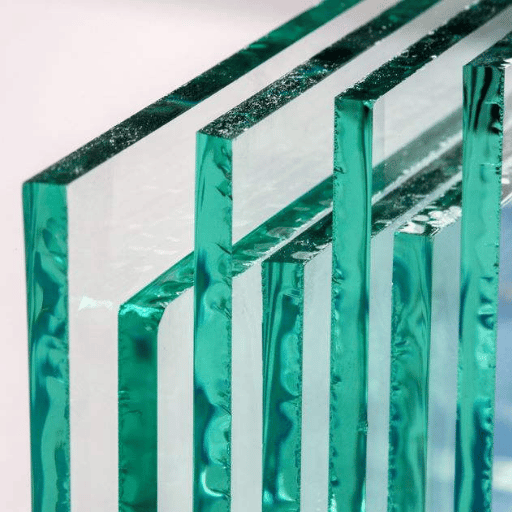
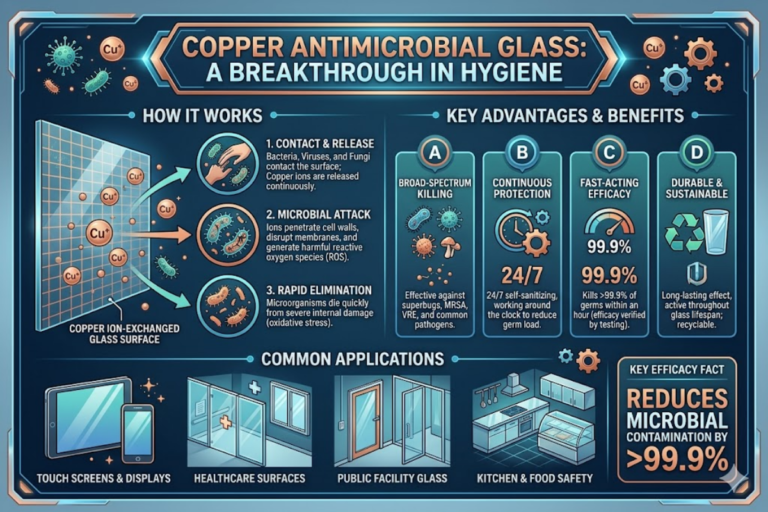
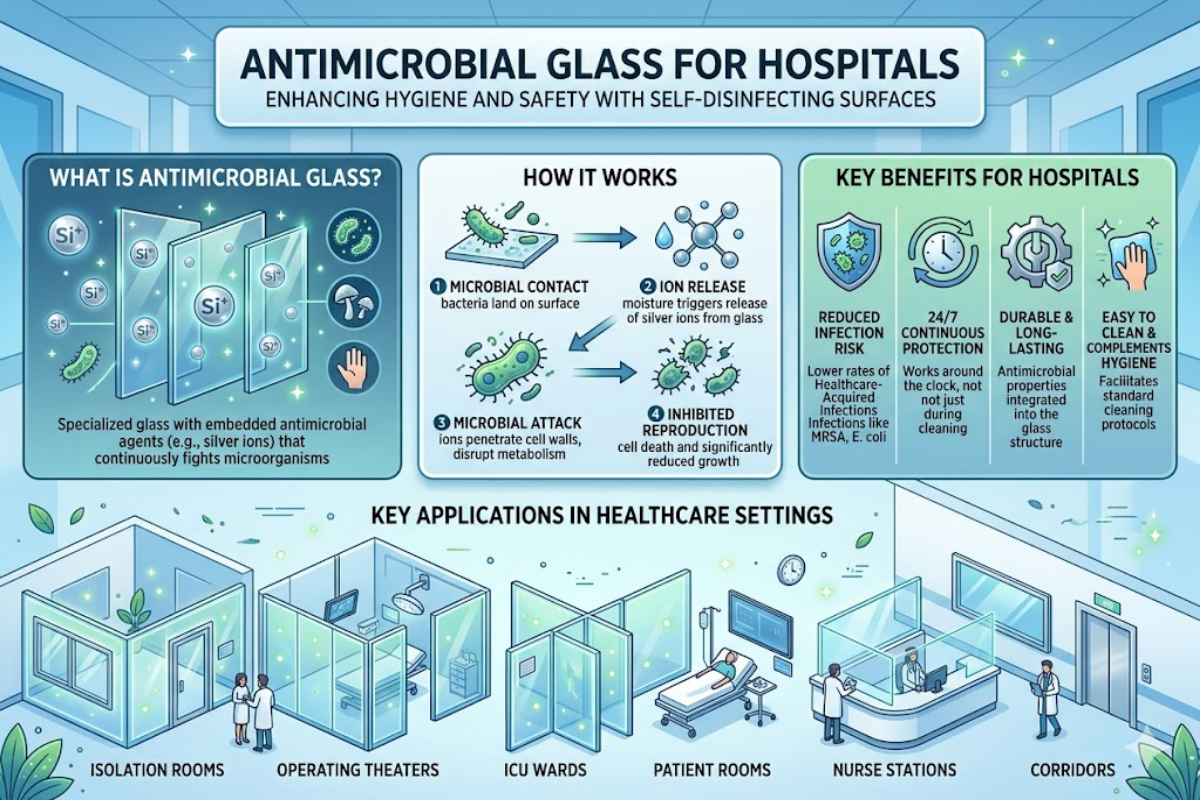
Antimicrobial glass is glass engineered to reduce microbial load on its surface, either by embedding silver or copper ions inside the substrate via ion exchange, or by applying a photocatalytic coating (typically titanium dioxide, TiO₂) activated by light. In all three mechanisms, pathogens that contact the glass experience one or more of cell-membrane disruption, DNA damage, or reactive-oxygen-species exposure.
– Cell wall disintegration
– DNA damage
– Reactive-oxygen-species exposure
To see a side-by-side translation of the chemistry involved, see our silver vs copper ion chemistry comparison, and to understand where the choice of “antimicrobial” leaves off at the narrower “bactericidal” scope, see the “antimicrobial” versus “bactericidal” definition guidelines.
Three physical formats dominate hospital specifications. First, ion-embedded cover glass (type of very-thin cover glass on phones, tablets and displays, where silver or copper (or both) are introduced through the substrate to produce antimicrobial activity). Second, laminated antibacterial architectural glass (layered PVB or SGP on partition walls and sliding doors). Third, photocatalytic-coated glass (TiO₂ surface layer, active under UV or visible-light radiation, typical in naturally-lit waiting areas). Each format is optimized for a different zone within a hospital’s surface mix.
💡 Key distinction
Ion-exchange glass has the active agent inside the substrate, the antimicrobial behaviour continues for the service life of the glass. Coated glass has the active agent applied to the surface, activity continues for 3 to 5 years depending on the coating process used and cleaning chemistry. On a 20-year hospital refit, that difference is material.
The Clinical Evidence: What Peer-Reviewed Studies Actually Show

Evidence for antimicrobial hospital surfaces is divided on two distinctly different outcome measures: microbial burden (how many colony-forming units survive on the surface) and clinical HAI rates (did actual patient infection counts fall). Both matter, and they do not always track precisely with each other.
Microbial burden — strong, consistent signal
A 2019 narrative review in Clinical Microbiology Reviews (PMC6730497) collected numerous copper-surface studies and found consistent 80-90%+ reductions in bacterial bio burden from treated versus untreated hospital surfaces. Schmidt and colleagues documented 88% reduction in bacterial burden on copper-inlay tray chairs and 90% reduction on copper-inlay chair arms compared to standard versions. A 2025 paper in Nature Scientific Reports (article s41598-025-88781-z) found copper-strontium-phosphate glass inhibits bacterial growth at low (a few mg/mL) doses, with bulk glass surfaces gradually leaching ‘low, non-toxic doses’ of active elements into simulated body fluid – strong evidence that solid antimicrobial glass can be a useful structural material, not a concept limited to spray-on surface coatings.
Clinical infection rates — signal exists but is setting-dependent
The most-cited study showing effects on clinical outcomes is Salgado et al. from the journal Infection Control and Hospital Epidemiology (vol 34 no 5, May 2013). Over three university medical centers, intensive care unit rooms in which six high-touch objects had been replaced with copper-alloy surfaces demonstrated a 58% reduction in overall HAIs as well as fewer device-related bloodstream infections, methicillin-resistant S. aureus, and vancomycin-resistant Enterococcus. It is, by some margin, the best-known publication on hospital antimicrobial surfaces and clinical effects.
| Study | Endpoint | Result |
|---|---|---|
| Salgado et al. 2013, ICHE 34(5) | ICU HAI incidence (3 sites, RCT-like) | 58% reduction vs control rooms |
| Schmidt et al. (Sage / Oxford OFID) | Bacterial burden on copper items | 88% reduction (tray chair); 90% (arm) |
| Nature Sci Reports 2025, s41598-025-88781-z | S. aureus on Cu-Sr-phosphate glass | Colony eradication within 24 h |
| PMC6730497 (copper review, 2019) | Cumulative burden-reduction data | 80–90%+ across multiple studies |
Clinicians encountering this research typically settle on a reasoned judgement: surface antimicrobials reduce microbial burden consistently, and some studies (Salgado 2013 in particular) connect that consistent reduction directly to decreasing clinical infections. A causal pathway from ‘fewer bacteria on a bedrail’ to ‘fewer patients infected’ depends on hand-contact frequency, cleaning adherence, baseline prevalence and patient-mix. This explains hospital-to-hospital variation. Specifying antimicrobial glass is an informed decision to reduce burden, and a statistically supported decision to reduce risk where it matters most – the ICU, oncology unit, or burn facility.
Where Antimicrobial Glass Fits in a Hospital

Silver is not necessary on every vertical surface glass in a hospital. A zone-based model enables ordering parties to allocate dollars most efficiently.
| Zone | Typical glass surfaces | Priority for antimicrobial specification |
|---|---|---|
| ICU / OR | Monitor cover glass, touchscreens on infusion pumps and anaesthesia machines, sliding doors | High — highest patient risk, intensive contact |
| Nurse stations | EHR touchscreens, countertop glass, cabinet fronts | High — staff use hundreds of times per shift |
| Patient rooms | Room-divider glass, TV cover glass, wall-mounted displays, pass-through windows | Medium — cleaned at discharge, high visitor/family contact |
| Pharmacy / lab | Analyser displays, cleanroom partitions, drug-prep pass-through windows | Medium — sterile environments have strict protocols, antimicrobial glass as an adjunct |
| Emergency / triage | Reception-counter glass, kiosk screens, vestibule doors | Medium — broad unscreened patient flow |
| Public / waiting | Waiting-area displays, vending-machine glass, lobby partitions | Lower — consider photocatalytic variants where natural light is available |
For touchscreen-intensive zones (ICU, OR, nurse stations), ion-exchange silver cover glass on an aluminosilicate glass substrate or Corning Gorilla base substrate gives the best combination of optical clarity, mechanical durability, and service-life antimicrobial activity. Pairing with anti-fingerprint (AF) coating has a secondary infection-control benefit: fewer visible fingerprints mean less urge to wipe with improper chemistries that could degrade the antimicrobial layer.
📐 Engineering Note: Cleaning Compatibility
Not all hospital-grade disinfectants are neutral to antimicrobial coatings. Quaternary ammonium and hypochlorite chemistries are generally safe with ion-exchange silver glass; accelerated hydrogen peroxide and high-concentration phenolics can progressively strip some photocatalytic TiO₂ coatings. Specify cleaning protocol compatibility on the spec sheet, not just the efficacy test — the surface’s eight-year durability depends on the chemistry it meets every day.
Testing Standards and Regulatory Framework

The two dominant standards for healthcare antimicrobial glass specifications are the Japanese standard Z 2801 for antimicrobial activity on non-porous surfaces and the international adoption, ISO 22196:2011. Both standards inoculate a trial sample with a known bacterial load – E. coli or S. aureus are common choices – keep the sample at 35 C, ~90% humidity for 24 hours, then count the surviving colonies compared to an untreated control. Percentage reduction in colonies relative to the untreated control is expressed as an R-value.
Reading an R-value on a datasheet
- R 2 = 99% reduction (“killed 99% of bacteria”). the minimum score for an antibacterial claim under ISO 22196 / JIS Z 2801
- R 3 = 99.9% reduction (“kills 99.9% of bacteria”). the commercial marketing threshold.
- R 5 = 99.999% reduction (“kills 99.999% of bacteria”). Standard on properly-constituted silver-ion based glass. Always ask for the raw number.
A silver-ion surface that “meets JIS Z 2801 with R equal to 2” does legitimately kill bacteria, but only 0.1% of the bacteria that would be quickly removed by the same sample at R of 5. An antimicrobial glass specification that concerns hospital results would do well to request both the R number, and lab organism.
Legal regulation in the US regarding hospital antimicrobials sits under the EPA FIFRA framework. The EPA Label Review Manual, Chapter 1 (PR Notice 2000-1, March 2000), establishes the pathways:
- Treated Articles Exemption – the antimicrobial treatment is exclusively incorporated into the product itself to prevent it from staining or odoring, or in some way depredating. Label requirements are tight; no FIFRA registration is necessary.
- Full registration as an antimicrobial pesticide – the product specifically claims to kill bacteria of public health concern, or names specific threats such as MRSA, C. difficile, SARS-CoV-2, etc. Full FIFRA registration with efficacy data is a must.
Most of what is marketed to hospitals in the US as antimicrobial glass is in the first group – the Treated Articles Exemption- “intended to protect its own surface from bacteria that cause odour and stain”. Hence the Corning Gorilla disclaimer that the protection is limited in scope, and makes no stated health benefit. If an antimicrobial glass specifier is pursuing hospital organism claims, the supplier should be asked which path they are registered under and if possible, shown the registration documentation.
Limitations: What Antimicrobial Glass Does NOT Do

Understanding honest limits is just as critical as marketing figures. Specifying antimicrobial glass without understanding the boundaries can give false confidence in the glass, and even inadvertently undermine the various existing hospital cleaning protocols.
What it does
- Continuously reduces microbial burden between cleanings
- Active against most Gram-positive, Gram-negatives, MRSA, VRE
- Active against many fungi and enveloped viruses
- Provides an auditable test R-value for infection-control specifications
What it does NOT do
- Replace hand hygiene, isolation precautions, or terminal cleaning
- Allow “instant” kill – standard tests show reduction at 24 hours
- Reliably inactivate non-enveloped viruses (norovirus, rhinovirus) or bacterial spores (C difficile)
- Provide direct health-protection claims unless registered under FIFRA
- Operate without continuous exposure – films & coatings degrade, only ion-exchange grades maintain service-life activity
The strongest published evidence on clinical outcomes (Salgado 2013) was observed in ICU rooms as part of a broader infection-control package. Antimicrobial glass is one component, not a substitute for the package. Infection-prevention committees that treat it as a primary intervention overstate the evidence; committees that reject it because it is not a silver bullet understate it.
Specification Checklist for Procurement
Before signing a purchase order for antimicrobial glass in a hospital, walk the supplier through the ten items below. Any supplier worth working with can answer each in writing.
- ✔
1. R-value on ISO 22196 / JIS Z 2801 — request the raw number and the test organism, not a pass/fail - ✔
2. Active ion species and mechanism — silver ion, copper ion, or TiO₂ photocatalytic; ask why each was chosen for this application - ✔
3. Activity durability — service-life for ion-exchange, a dated year-rating for coatings - ✔
4. Optical transmittance before and after treatment — critical for display-grade applications - ✔
5. Cleaning-chemistry compatibility — list of approved disinfectants and dilutions - ✔
6. Ion-leach or release-rate data — for medical-device displays especially; confirm non-toxic release levels - ✔
7. Compatibility with secondary coatings — AG anti-glare, AR anti-reflective, AF anti-fingerprint - ✔
8. Regulatory registration path — EPA Treated Article vs full FIFRA registration; request documentation - ✔
9. Certifications — ISO 9001 manufacturing; SGS, TÜV, or INTERTEK third-party validation on efficacy - ✔
10. Sample lead time and minimum order quantity — for pilot installation in a single unit before full rollout
Antimicrobial glass from Saiweiglass is available in toughened, laminated, and display-grade formats, with silver-ion, copper-ion, or TiO₂ photocatalytic variants on aluminosilicate, soda-lime, or chemically strengthened substrates. The manufacturing base — three production sites across Guangdong and Henan with 10+ years of OEM experience — is documented at Saiweiglass (10+ years OEM), including ISO 9001, SGS, TÜV, and INTERTEK certifications.
Frequently Asked Questions

What is antimicrobial glass?
View Answer
Antimicrobial glass is glass engineered to reduce microbial load on its surface, either by embedding silver or copper ions inside the substrate via ion exchange, or by applying a photocatalytic coating (typically titanium dioxide, TiO₂) that is activated by light. Tested against bacteria such as Staphylococcus aureus and Escherichia coli under ISO 22196 / JIS Z 2801, properly formulated antimicrobial glass achieves 99.9% to 99.999% reduction at 24 hours.
What kind of glass is used in hospitals?
View Answer
A hospital will adopt: bolstered safety glass for partitions and sliding doors, impact resistant laminated glass for impact resistant dividers, touch-screen antimicrobial cover glass, radiology lead glass and switchable or smart glass for privacy walls. When infection-control is the primary concern, the best practice specification of the different formats is: most commonly silver-ion aluminosilicate for displays, followed by silver-ion toughened or laminated for architectural surfaces.
Do hospitals use antimicrobial sheets?
View Answer
To clarify, yes antimicrobial textiles – including bedsheets, curtains and uniforms infused with silver, copper or quaternary ammonium compounds – are used complementary to surface antimicrobials as part of layered infection-control strategy. Textile-based interventions cover different contact vectors than surface interventions, and are now typically specified together for intensive-care, oncology, and burn unit applications.
How long does antimicrobial coating last?
View Answer
Exact resistance depends if the active agent is incorporated or coated. Ion-exchange silver or copper in glass, because the active atom lives deep within the substrate, can sustain antimicrobial property for the duration of the substrate service life – in hospital conditions, 15-25+ years. Photocatalytic TiO₂ and organic antimicrobial coatings invariably last 3-5 years before requiring reapplication, and are affected by cleaning chemistry, exposure to UV and degree of abrasion. Request the suppliers’ accelerated-wear data if used in a demanding environment
Does antimicrobial glass replace routine cleaning?
View Answer
A. No. Antimicrobial glass daily diminishes microbial burden, but does not kill rapidly or address every class of pathogen.
Standard test methods measure a 24 hour reduction—fine if measuring between-cleanings continuity but not for terminal disinfection. Hospital protocols should regard antimicrobial surfaces as a complement to, never a substitute for, cleaning and hand hygiene procedures.
Is antimicrobial glass regulated by the FDA or EPA?
View Answer
In the US the surface claims are within FIFRA jurisdiction of the EPA, not the drug pathway of the FDA (see end of section 1.2). Glass sold under the Treated Articles Exemption (EPA PR Notice 2000-1) is not registered with the FIFRA since it is only make use-surface only claims. Glass that makes public health claims, either “kills the bacteria that cause disease” or per-pathogen specific language, is registered with the full FIFRA and gene level efficacy data is supplied to the EPA.
FDA regulation applies only when the glass is part of an approved medical device.
Specify with Confidence
Antimicrobial glass sits inside a broader infection-control package. Specifying it correctly means matching the zone, the evidence, the standard, and the regulatory path to the project. For a specification-grade quote that includes R-value test data, optical transmittance curves, and a documented regulatory pathway, the procurement conversation is a short one.
Specifying antimicrobial glass for a hospital project?
Can I please get a quote that includes R-value test data, optical transmittance, the ion-leach rate and the Regulatory path info.
Editorial note: This article is an educational overview of antimicrobial glass as one component of a hospital infection-control strategy. It is not medical, clinical, or regulatory advice. Test results, regulatory pathways, and published outcomes cited depend on formulation, substrate, and study context — verify against the specific datasheet and study for any procurement decision. Sources were checked against primary CDC, EPA, ICHE, Nature Scientific Reports, and NIH/PMC publications at the time of writing.
References & Sources
- 2024 National and State Healthcare-Associated Infections (HAI) Progress Report — U.S. Centers for Disease Control and Prevention, 29 January 2026
- HAIs: Reports and Data — HAI Hospital Prevalence Survey — U.S. Centers for Disease Control and Prevention
- Salgado CD et al. Copper Surfaces Reduce the Rate of Healthcare-Acquired Infections in the Intensive Care Unit. Infection Control and Hospital Epidemiology, May 2013; 34(5): 479–486.
- The Use of Copper as an Antimicrobial Agent in Health Care, Including Obstetrics and Gynecology — NIH NCBI PMC6730497
- Copper strontium phosphate glasses with high antimicrobial efficacy — Nature Scientific Reports, 2025, article s41598-025-88781-z
- Label Review Manual, Chapter 1 — Treated Articles Exemption (PR Notice 2000-1) — U.S. Environmental Protection Agency
- ISO 22196:2011 — Measurement of antibacterial activity on plastics and other non-porous surfaces. International Organization for Standardization.
- JIS Z 2801 — Antibacterial products — Test for antibacterial activity and efficacy. Japanese Standards Association.
Related Articles
- Antimicrobial vs Antibacterial Glass — definitional guide to what each term covers and why the distinction matters
- Copper vs Silver Antimicrobial Glass — head-to-head comparison of the two dominant ion chemistries
- What Is AF Coating — Working Principle Explained — anti-fingerprint coating compatibility with antimicrobial glass
- Aluminosilicate Glass Substrate — high-strength base substrate for medical ion-exchange applications
- Antibacterial Glass Products — toughened, laminated, and display-grade formats for healthcare