Get in Touch with Saiweiglass




Glass that is thinner than a human hair is now so flexible that it can be bent over a 5 mm radius and not shatter. Glass that will be used in devices before they are rolled, folded, worn, or inserted into a cockpit comes from a material that begins life on a planet made mostly of ordinary sand that has then traversed a ladder of heating and drawing steps through furnaces, molten baths of tin and high-speed towers of precision-calibrating rollers. This guide unravels three key ultrathin glass manufacturing processes, explains the chemistry behind unprecedented thinness, and describes the post-forming steps from fleeting ribbon to everlasting component.
Quick Specs
| Commercial Thickness Range | 25 μm – 200 μm (roll format); 30 μm – 1.1 mm (sheet format) |
| Lab Record | ≤ 3 μm via precision thermal stretching (Yuan et al., 2021) |
| Primary Compositions | Borosilicate (80% SiO₂) or Soda-Lime (75% SiO₂) |
| Surface Roughness (Down-Draw) | < 0.5 nm Ra |
| Melting Temperature | 1,500 – 1,675 °C (depending on composition) |
| Global Market (2025) | USD 14.18 billion, CAGR 11.34% through 2031 |
What Is Ultra-Thin Glass?

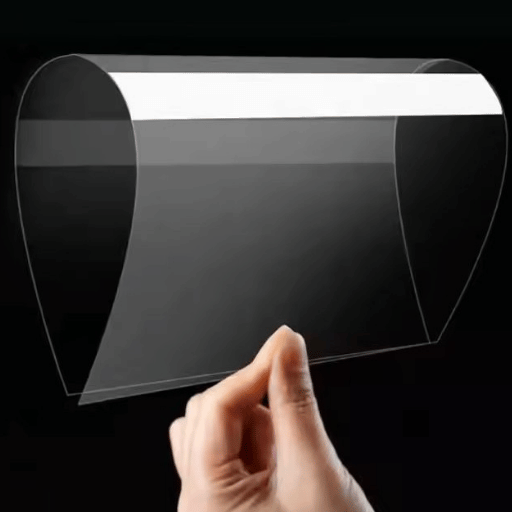
Ultrathin glass is defined as a substrate less than or equal to 100 μm thick, roughly the diameter of a human hair. In the display and electronics fields, the cutoff point is often taken as 100 μm; thin can be 200 μm but the no-return point is 100 μm both in physical dimension and in nomenclature. When ultra-thin, the surfaces of the glass are so compliant that it will bend, roll, and conform to a curved surface without fracture.
What exactly is ultra-thin glass made of? Given the same base material as ordinary window glass (silica or SiO₂), the key differentiator in ultra-thin is the method of manufacture. Glass sheets are generally made at 2-6 mm thick so as to keepively usable. Ultra-thin glass manufacturers bring that number dramatically down – to as low as 30 μm for commercial glass. With roll widths of as much as 1.3 m and lengths up to 300 m, Corning’s Willow Glass is one of the truly building-sized ultra-thin glass products. Schott’s D 263 T eco borosilicate sheets are distributed at 30 μm thick.
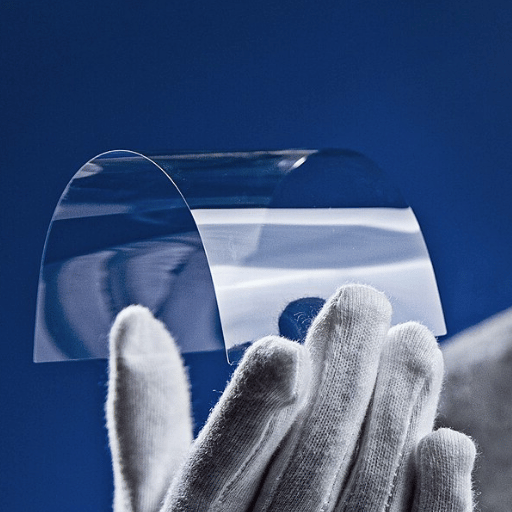
In practice, ultra-thin glass is not always synonymous with flexibile glass films. When thickness is the critical aspect, ultra-thin glass at 50 μm or less is remarkably pliant enough to wrap itself around the thickness of a pencil.
💡 Key Distinction
Flexible glass and ultra-thin glass are both subject to the “thin” moniker. Since the elastic limits of all varieties of glass are exceeded at roughly 100 μm thickness, flexibility in this context equates to thinness. Flexibility in the broadest sense increases exponentially as a material diminishes in thickness – as 3 in theory and just half that in reality.
Raw Materials and the Melting Process

The art of making glass begins with batching – measuring the raw ingredients, mixing them, and feeding them into thefurnace. From a chemistry standpoint, ultra-thin glass production introduces two types of glass with very different properties.
Soda-lime glass composition hovers around 75% silica (SiO₂), 15% soda (Na₂O), 9% lime (CaO), with a smattering of alumina and magnesium. When used as a flat plane for architectural windows or as an ultra-thin display substrate, this material melts at roughly 1,500 °C. According to the science of glass, soda ash added to molten silica acts as a flux to lower the melting point from well above 1,700 °C.
Borosilicate glass replaces some of the soda with boric oxide (B₂O₃). Relative to soda-lime (75/13/4/8) this material consists of roughly 80% SiO₂, 13% B₂O₃, and 4% alkali oxides. Melting temperature rises to 1,650 °C, but in return borosilicate exhibits a glass coefficient of expansion of approximately 3.3 × 10⁻⁶/K (three orders of magnitude better than mainstream glass). This stability is critical when the ultra-thin glass donor sheets are master-batched for the deposition of functional, hot filmetal films.
Inside the furnace, raw materials melt into a uniform liquid. Industrial furnaces run on natural gas or electric boosting and can attain 1,675 °C in hotspots. Any dissolving gases are expelled off in a refining step prior to the flowing of the molten glass to the forming section.
Three Manufacturing Methods for Ultra-Thin Glass
Four methods of manufacturing ultra thin glass substrates have been identified. All three direct the flow of molten glass as its cooling and forming from a viscous liquid into a solid ribbon—and all three have a different thickness floor.
Float Process (Pilkington Method)
The float process, developed by Alastair Pilkington in 1959, is currently the world’s leading method of producing flat glass. Under an inert atmosphere of hydrogen and nitrogen, glass in a melting condition is poured onto a bath of molten tin held at a temperature of approx 600 °C. As the glass floats across the surface of the tin, the surface tension causes it to spread out into a ribbon while the thickness and width is controlled by rollers which top the ribbon.
On leaving the bath, the hot ribbon is set into a slowly cooling annealing lehr.
In 2025, ultra-thin-glass production using float process has comprised 50.68% as released from market information obtained from Mordor Intelligence market data. In fact, the practical thickness limit from float line as a whole reasoned to be approximately 0.3 mm (300 μm). Nonetheless, tin-bath interaction results in topography of approximately 2 nm on the bottom surface- that would be suitable for architectural applications but would be inappropriate for display substrates.
Overflow Fusion Down-Draw (Corning Method)
Corning also developed this in the 1960s. The overspill fusion process involved pouring a stream of molten glass into a trough shaped-forming pocket. The glass overflowed both sides of the trough, ran down the sides of the outer wall, and fused at the bottom between the two stream to produce one continuous ribbon.
This ribbon was pulled downward by gravity. The outside surface was in contact with neither a solid former nor a tool so both outside surfaces were fire polished having a roughness of a few tenths of nanometer.
Down-draw will deliver a 30 μm glass sheet in commercial production while Schott’s down-draw borosilicate is providing 20 μm with a sub nanometre roughness—performance that tin-bath float cannot support. For a zero-defect device; i.e. OLED glass interposers or foldable screens; fusion and down-draw are the only processes.
Redraw (Up-Draw) Process
Redraw. Begins with a pre-formed glass sheet or tube. The preform is heated in a furnace above its softening point and drawn up or down into much thinner sheet.
Draw speed, furnace temperature and feed rate set final thickness.
Redraw can produce the thinnest glass sheet possible to date. In laboratory redraw, an independent ultra-thin glass sheet of ≤ 3 μm – the world’s thinnest – was successfully manufactured through weight-controlled load-assisted thermal stretching, in Sensors and Actuators A (Yuan et al., 2021). For industries, redraw usually focuses on the 5 μm – 100 μm stratum for premium substrates, such as interposers in semiconductor wafers.
| Parameter | Float Process | Overflow Fusion / Down-Draw | Redraw |
|---|---|---|---|
| Thickness Range | ≥ 0.3 mm (300 μm) | 20 μm – 700 μm | 3 μm – 100 μm |
| Surface Roughness (Ra) | ~2 nm (tin side) | < 0.5 nm | Depends on preform quality |
| Surface Contact | Tin bath (bottom face) | None (free-form) | None (free-draw) |
| Production Volume | 50.68% market share (2025) | Primary for displays | Specialty / low-volume |
| Typical Applications | Architectural, automotive, solar | OLED covers, display substrates | Semiconductor interposers, sensors |
| Relative Cost | $8–15/m² (commodity grade) | $50–200/m² (display grade) | $200–1,000+/m² (specialty) |
Achieving Extreme Thinness — From 100 μm to 3 μm
Attaining ultra-thin sheet follows the same rules as thicker sheets: the four process variables—glass viscosity, draw speed, temperature gradient, and mechanical tension—must be meticulously balanced. Glass viscosity is a function of temperature. When molten glass gets hot enough, its viscosity becomes unusually low; it begins to flow easily and the thickness of each sheet becomes independent of its thickness at the previous stage. To do this precisely, glassmakers keep each batch of glass just slightly above the point at which the viscosity drops to an acceptable level for the drawing operation, not so hot that the sheet gets ultra-thick or dimpled or uneven all the way across.
For soda-lime compositions, the softening point sits near 600 °C. For borosilicate, it is near 820 °C. To achieve consistent ultra-thin sheet, all forming zone temperature levels must be maintained within ±2 °C in order to keep the thickness of the glass uniform across its full width.
📐 Engineering Note
Commercial tolerances for ultra-thin glass varies by method and thickness. Minatyan-semospecification—calls for a tolerance of ±30 μm for SEMI MF 1530, Schott D 263 T eco slices. Precision fabricators achieve ±0.5 μm TTV on SEMI standard wafers and ±1 μm TTV on sheets of just 12.5 μm thickness. Typical TTV for fire-polished, down-draw glass (excepting thickness target) range between 5–10 μm.
Glass yield has advanced dramatically over the years. In 2023, 60% yield was considered exceptional; by 2025 that figure had risen to 85% thanks to advances like selective etching—by Corning and Samsung Display—to convert the comparatively wasteful chemical etching to purely mechanical thinning. Scrap costs drop, making the production lines accessible for consumer-level volumes.
In record, the thinnest flat sheet of glass ever fabricated measured less than 10 μm. According to an industry patent, Yuan et al. (2021) demonstrated heat-pressurized thermal stretching that could reduce a mere 150 μm preform into an independent 3 μm sheet—thin enough that the volume of glass is nearly impossible to weigh by measurable means.
Post-Forming — Cutting, Annealing, and Surface Treatment
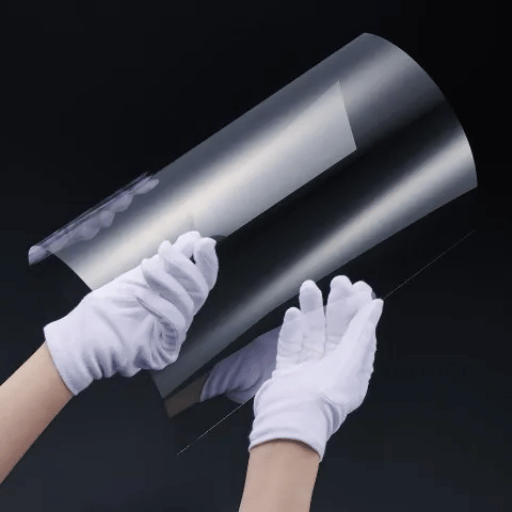
Once the formed glass ribbon leaves the forming zone, a number of steps are taken to ready it for final end-use. Each step responds to a different physical or chemical property of the ultra-thin sheet.
Cutting. Regular float glass is generally scored with carbide wheels; the glass breaks consistently along the score line.Ultra-thin glass thinner than 0.1 mm cannot handle mechanical scoring without chipping. To prevent this, manufacturers use the precision technique of CO₂ laser scribing, in which a narrow line of heat is created along the desired line of break, which then elongates a fracture. Each piece—cut to size—contains a clean, safe edge free of any micro-cracking damage. Matching industry standard serrated scoring wheels exist, with the correct process parameters, for sheets approaching the 0.3 mm mark.
Annealing. There is still physical tension present in the sheet when the forming process completes, reducing strength and inducing cracks, sometimes catastrophically. After forming, the sheet is slowly cooled through a carefully controlled temperature lehr-drying tunnel to relax those mechanical stresses. If too quick, residual stress will cause the surface of the sheet to explode at any second when subjected to future handling and processing. For ultra-thin substrates, vibrational stabilization is absolutely essential—if you can jar a laser beam, you can shatter that 50 μm sheet.
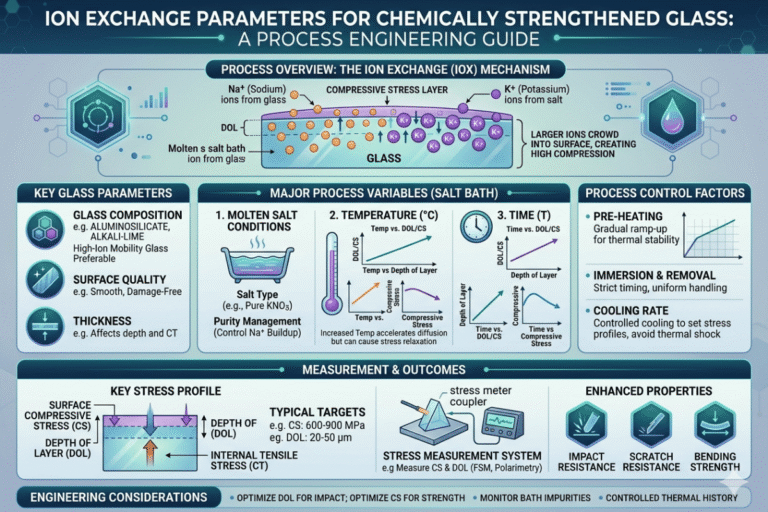
Surface Treatment. Post-forming polishing with cerium oxide (CeO₂) brings the surface to optical quality — scratch/dig ratings of 10/5 and surface roughness (Ra) below 5 Angstroms. Anti-reflective coating can be applied via vacuum deposition. For cover glass applications, chemical strengthening through ion exchange replaces smaller sodium (Na⁺) ions with larger potassium (K⁺) ions in the glass surface, creating a compressive stress layer that makes the glass roughly five times stronger than untreated material of the same thickness.
⚠️ Handling Precaution
Carriage for * ultra-thin glass below 50 μm must be stored vertically. Double-sided interleaving material should be used to help prevent static charge build up, which can attract particles that during handling cause micro scratching to the surface. Specialized processing lines utilise ionized air bars and automated, vibration free handling systems for safe handling.
Where Ultra-Thin Glass Is Used
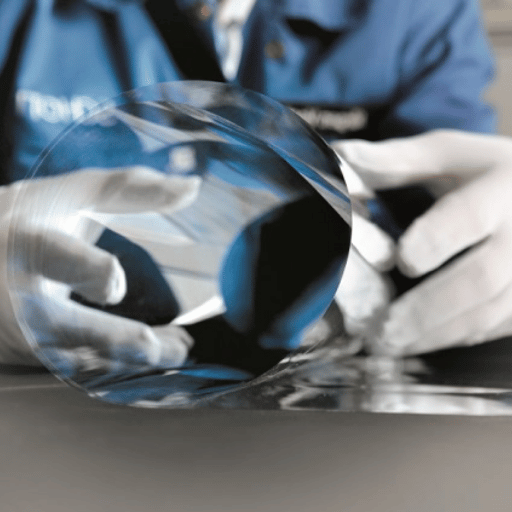
The combination of optical clarity, hermeticity, thermal stability and flexibility is something that no polymer film can fully provide. Whilst the development of an ultra-thin glass is a relatively recent innovation, it has progressed incredibly quickly from the initial laboratory experiment to being commercially widespread. This can be attributed largely to the growth of the display industry.
OLED & foldable displays. Foldable devices are on the rise and Samsung’s Galaxy Z Fold series uses ultra-thin glass (UTG) for the inner cover. This replaces the plastic films used in previous foldable devices. Valued at USD 16.37 billion in 2025, the flexible OLED display market is growing at a CAGR of 22.8%, and the number of shipments being projected to drive the flexible display market from USD 20.52 billion in 2025 to USD 75.14 billion by 2030
Flexible electronics. Ultra-thin glass substrates are used to carry thin-film transistors, wearable sensors and flexible printed circuits. Unlike polymer substrates, glass provides a hermetic seal which prevents the in-flow of oxygen and moisture, this is fundamental to the longevity of OLED displays.
Automotive. ‘head-up display’ (HUD) systems project information onto the internal surface of the car’s windscreen using a thin glass optical combiner. This technology also helps to provide a reduced weight in components such as the panoramic roof and interior display panels. Glare-proof (anti-reflective) variants of ultra-thin glass have a direct impact on displaying information.
Medical & scientific. Glass plate substrates are widely used in scientific investigations as slides for microscopy, micro-fluidic chips and physical/chemical sensor arrays due to their optical transparency and inert nature.
Within all segments, the Ultrafine Glass market was forecast to be worth USD 14.18 billion in 2025, and reach USD 26.87 billion by 2031. Over 68% of this was dedicated to display technology.
✔ Advantages Over Polymer Films
- Surface roughness < 1 nm (Compared to 5-20 nm for PET/PEN)
- Hermetic seal blocks O₂ and moisture (WVTR < 10⁻⁶ g/m²/day)
- Thermal stability to 600 °C (compared to 150–200 °C for polymers)
- No yellowing or UV degradation over time
- Superior optical transmission (> 92% at visible wavelengths)
⚠ Limitations
- Impacts can cause the material to be brittle, and so these will generally require lamination or coating to ensure durability.
- Minimum bend radius about 3-5 mm (it is unable to be folded flat as can be done with plastic)
- Higher material cost ($50–1,000+/m² vs $2–10/m² for polymer films)
- Handling requires cleanroom-grade automation
- Edge strength degrades rapidly with micro-defects
Choosing Ultra-Thin Glass for Your Project

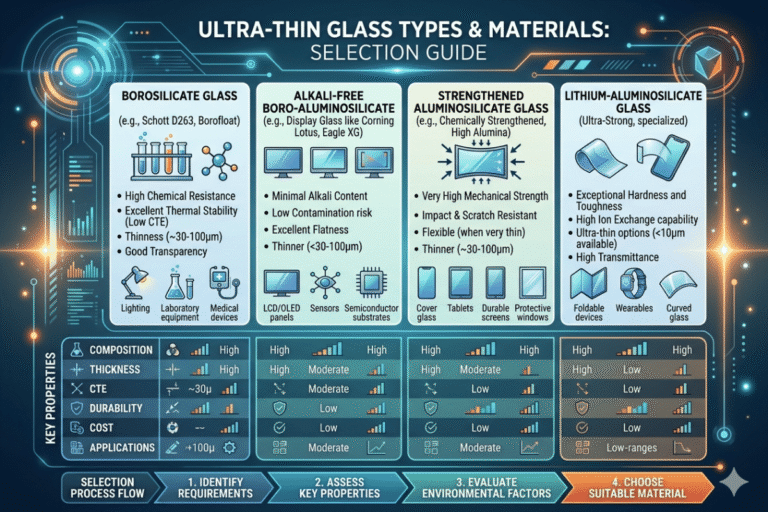
The physical/chemical properties of the available glass options have more influence on the selection of ultra-thin glass than costs. For a thorough comparison, the application specific requirements for the arrangement of the following five criteria should be compared.
- ✔
Thickness requirement: Define your target thickness and tolerance. Display covers typically need 30–100 μm. Semiconductor substrates may need ≤ 25 μm. - ✔
Thermal expansion compatibility: Your glass coefficient of thermal expansion (CTE) must match bonded layers. Borosilicate (3.3 ppm/K) pairs with silicon wafers. Soda-lime (~9 ppm/K) matches metals and adhesive layers. - ✔
Surface quality needs: Optical applications demand Ra < 1 nm and low total thickness variation. Structural or protective applications tolerate rougher surfaces. - ✔
Chemical resistance: Borosilicate resists acids and alkalis better than soda-lime. Choose accordingly if the glass contacts aggressive chemicals or undergoes repeated cleaning. - ✔
Downstream processing: Will the glass undergo thin-film deposition, ion exchange, or high-temperature lamination? Map every production step before specifying the substrate.
Additional benefits of studying independently with a manufacturer are such properties as custom ultra-thin glass in specific compositions or dimensions can be manufactured to ensure your production process is provided with exactly the correct properties.
Frequently Asked Questions
Q: How is ultra thin glass made?
View Answer
Ultra-thin glass is produced by melting silica sand and other raw materials at 1,500–1,675 °C and rolling the resultant glass into an extremely thin ribbon of one of three types; the float process in which the heated liquid glass is poured onto a bath of molten tin and rolled into a ribbon; the overflow fusion down-draw which involves flowing the heated glass over a thing and fusing the glass at the bottom of the edge of the flat sheet; and the redraw process in which a preformed flat sheet is reheated and stretched. The glass ribbon produced is annealed, cut and coated or chemically strengthened if so required. Float minimizes the thickness at approx 0.3 mm although both down-draw and redraw are below 30 μm.
Q: Is ultra thin glass actually glass?
View Answer
Yes. Ultra-thin glass is just plain glass, an amorphous silicon dioxide solid. It is identical to other types of glass in physical and chemical character (including chemical inertness, optical transparence and hermeticity), the only difference being that of thickness; when ultrathin (≤50 μm) glass becomes flexible enough to be able to bend without fracturing, a characteristic often confused with plastic film.
Q: What is ultra thin glass made of?
View Answer
The ultra-thin glass substrates are normally made of either ‘soda-lime ‘ (75% silica, 15% sodium oxide and 9% calcium oxide) or’ borosilicate’ (80% silica, 13% boric oxide and 4% alkali oxides). Soda-lime is cheaper and easier to strengthen chemically. Borosilicate has lower thermal expansion and is chemically more resistant, the former means that it is better for semiconductor use while the latter means that it is more suitable for high temperatures.
Q: What is the thinnest glass ever made?
View Answer
The thinnest independent glass sheet fabricated through the precision thermal stretching process was 3 μm, fabricated by the team of Yuan et al. in the year 2021. In commercial production, the Schott company produced a 20 μm sheet with its down-draw process and precision fabricators produced down to 12.5 μm wafers.
Q: Does the manufacturing method affect ultra-thin glass strength?
View Answer
Yes, to a large extent. The way how the glass is fabricated depends directly on its surface quality, which in turn are governing its strength. Down-draw and overflow fusion generate fire polished surface with roughness of below 0.5 nm which contain less stress pinholing flaws, therefore achieve a much higher practical strength.
The tin-side asperities of float glass occurs by circa 2 nm providing weak points. The strength after post-forming treatment such as chemical strengthening by ion exchange can be achieved up to 5 times no matter what was the original forming method.
Q: How does ultra thin glass work in foldable phones?
View Answer
The inner cover of the fold-able phones are made of ultra thin glass layers (about 30 μm thick UTG). At this thickness, the glass can bend around a 3–5 mm radius without breaking. Once chemically strengthened with ion exchange, the UTG was glued to adhesive layers and films of protective material.
Samsung Galaxy Z Fold was among the first ones to use the UTG instead of polyimide plastic films that scratched easily and yellowed over time.
Need ultra-thin glass in custom thicknesses or compositions?
About This Guide
This article was prepared by the technical content team at Dongguan Saiwei Glass Co., Ltd, a manufacturer of ultra thin glass for display, optical, and electronic applications. Quoting on manufacturing data is derived from published reports by Schott AG, Corning Inc., and peer-reviewed glass science papers. We have referenced third-party analyst reports on market figures.
References & Sources
- Soda-Lime Glass: Composition and Properties — Wikipedia (reviewed by glass science community)
- Borosilicate Glass — Wikipedia
- Fabrication of Ultra-Thin Glass Sheet by Weight-Controlled Thermal Stretching — Yuan et al., Sensors and Actuators A, 2021
- Ultra-Thin Glass Market Size, Share & Growth Report 2031 — Mordor Intelligence
- Flexible OLED: Introduction and Market Status — OLED-Info
- Float Glass Process — Wikipedia
- SCHOTT D 263 T eco Ultra-Thin Glass Specifications — Abrisa Technologies
Related Articles