Get in Touch with Saiweiglass
Compressive Strength of Glass: Bulk Properties, Surface Compression & Engineering Design

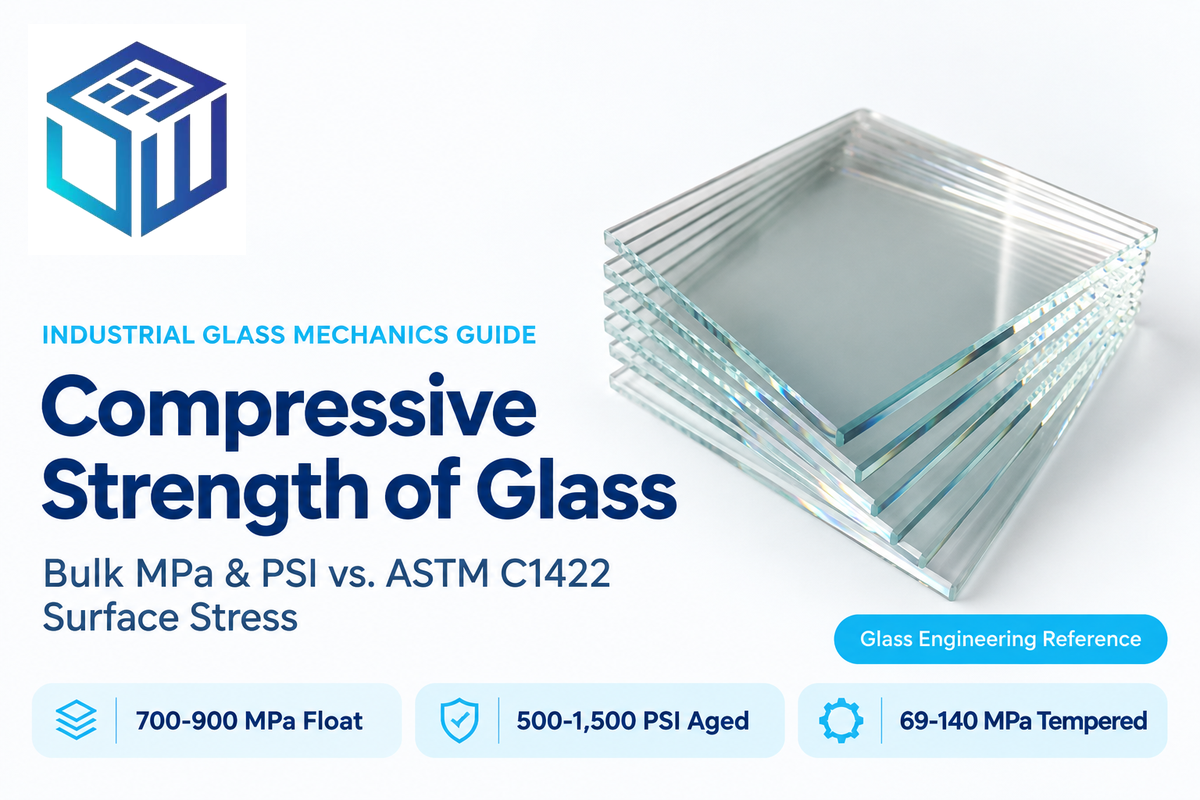
Industrial Glass Mechanics & Viewport Design
Reviewed by the Dongguan Saiwei Glass Co., Ltd. technical team · Last updated: November 2026 · Standards: ASTM C1036-25, ASTM C1048-25, ASTM C1279-23, ASTM C1422/C1422M-26, EN 12150
Standard float glass reaches a uniaxial bulk compressive strength of glass between 700 and 900 MPa according to Guardian Glass physical property data. Standard silicate reference tables report 1,000 MPa (150,000 psi) according to Wikipedia. High-purity fused silica exceeds 1.1 GPa in compression according to Translume fused silica data. Yet mechanical panels rarely fail by pure compressive crushing. Bending deflection, gasket seating gradients, and point contact convert external compression into local tensile stress.
Our companion reference on compressive strength of glass and bulk physical properties surveys optical refractive indices and dielectric constants across glass families. Because general physical properties of glass cover four broad domains, this guide focuses specifically on load-bearing mechanics. Uniaxial crushing limit, Griffith flaw static fatigue, and ASTM C1422/C1422M-26 surface stress are provided below.
Float Glass Bulk Compression
700–900 MPa
100,000–130,000 psi per Guardian Glass; 1,000 MPa (150,000 psi) in standard silicate glass
Aged Working Tensile Stress
500–1,500 PSI
Long-term annealed silicate glass limit per SightGlassWindows (1,500–4,000 PSI tempered)
Thermal Tempered CS
69–140 MPa
10,000–20,000 psi surface compression per NGA FB39-25 & ASTM C1048-25
KNO3 Ion-Exchange CS
>7 to >690 MPa
ASTM C1422/C1422M-26 Levels 1–5; up to 700 MPa CS & 50 μm DOL per SpotMaterial
What Is the Compressive Strength of Glass in MPa and PSI?
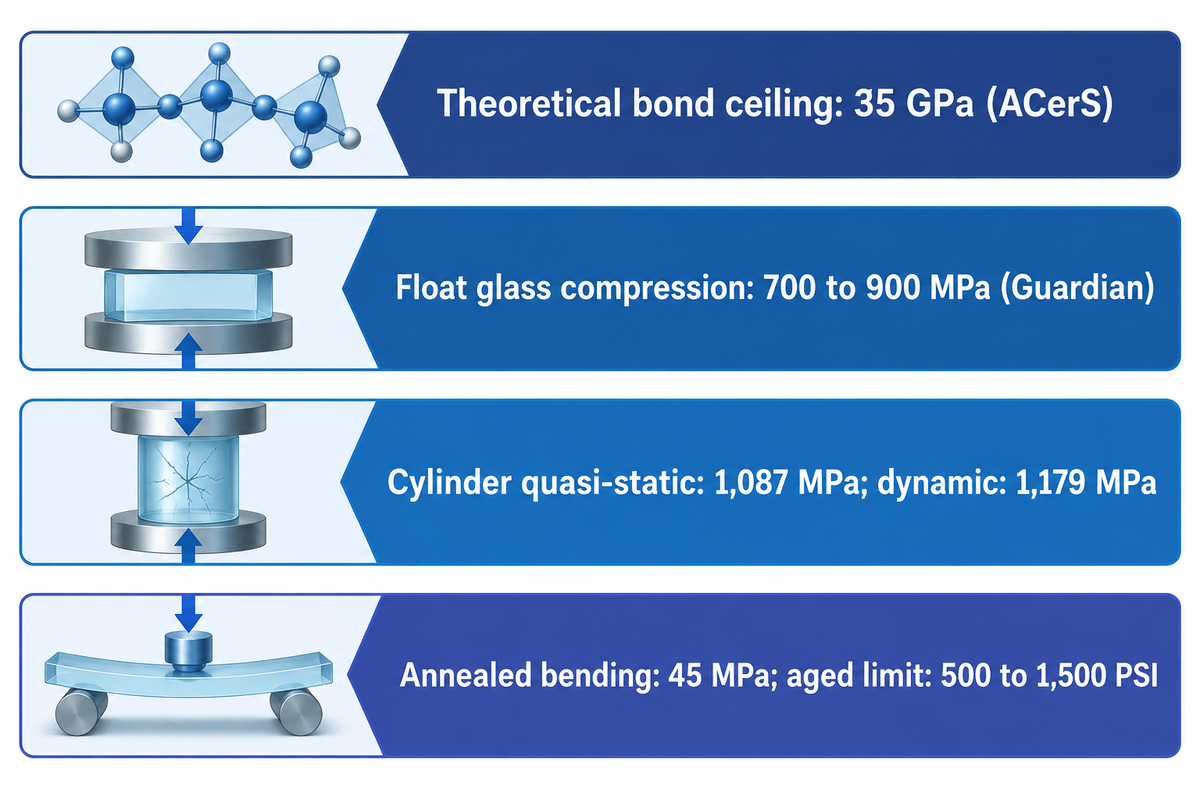
Uniaxial compressive strength of float glass spans 700 to 900 MPa (100,000 to 130,000 psi) according to Guardian Glass. Annealed tensile breakage occurs near 45 MPa (6,500 psi). Fused silica reaches 73 GPa elastic modulus according to Translume. Glass therefore resists pure compression 10 times better than tension.
Evaluating the strength of glass requires separating four distinct engineering values. These four metrics often get mixed together on supplier datasheets. The first metric is intrinsic atomic bond cohesion. According to Arun K. Varshneya at The American Ceramic Society (ACerS), flawless silicon dioxide bonds hold a theoretical tensile ceiling of 35 GPa. The second metric is laboratory uniaxial bulk compression strength, which reaches 1000 MPa (150,000 psi) in standard silicate glass references.
In 2024 quasi-static compression testing published in the Journal of Non-Crystalline Solids, Peroni tested commercial glass cylinders. Mean quasi-static compressive strength reached 1,087 MPa at a strain rate of 5×10⁻⁴ s−1. Under dynamic loading at 1.1×10³ s−1, the crushing threshold rose to 1,179 MPa. Without lateral confinement, precision dumbbell specimens of soda-lime glass achieved 1.3 to 2.2 GPa in the same study. Borosilicate specimens reached 1.4 to 2.6 GPa in U.S. Army Research Laboratory DTIC report AD1117665.
But laboratory uniaxial values only exist when the specimen is without lateral tension and without point-contact shear. In real viewports, the mechanical properties of glass depend on two practical limits: short-term flexural modulus of rupture (MOR) and long-term static fatigue stress. When our engineering team at SW GLASS inspects failed customer viewports, we almost never see bulk compressive crushing.
The laboratory uniaxial crushing value only deals with pure compression blocks and can’t be used as the allowable working stress for suspended cover panels.
What PSI Breaks Glass Under Compression Versus Bending Tension?
It takes 100,000 to 130,000 psi of uniform pressure to crush float glass according to Guardian Glass. Standard silicate glass reaches 150,000 psi (1,000 MPa) per Wikipedia. Conversely, Guardian Glass reports that 6,500 psi (45 MPa) of bending tensile stress triggers fracture in annealed float glass. Under continuous long-term loads in humid air, acceptable working tensile stress drops to 500 to 1,500 PSI according to SightGlassWindows.
According to Guardian Glass physical property specifications, the density of glass in float panels is 2,500 kg/m3 (156 lb/ft3). Each 1 mm of panel thickness equals 2.5 kg/m2 (0.51 lb/ft2) of surface weight. A 6 mm float glass pane weighs 15 kg/m2, and a 10 mm pane weighs 25 kg/m2. Until fracture occurs, glass exhibits linear elastic deformation governed by its Young’s modulus (70 to 90 GPa per Biesse glass mechanics data).
Compressive vs. Tensile and Flexural Strength of Glass: Why Griffith Surface Flaws Govern Breakage
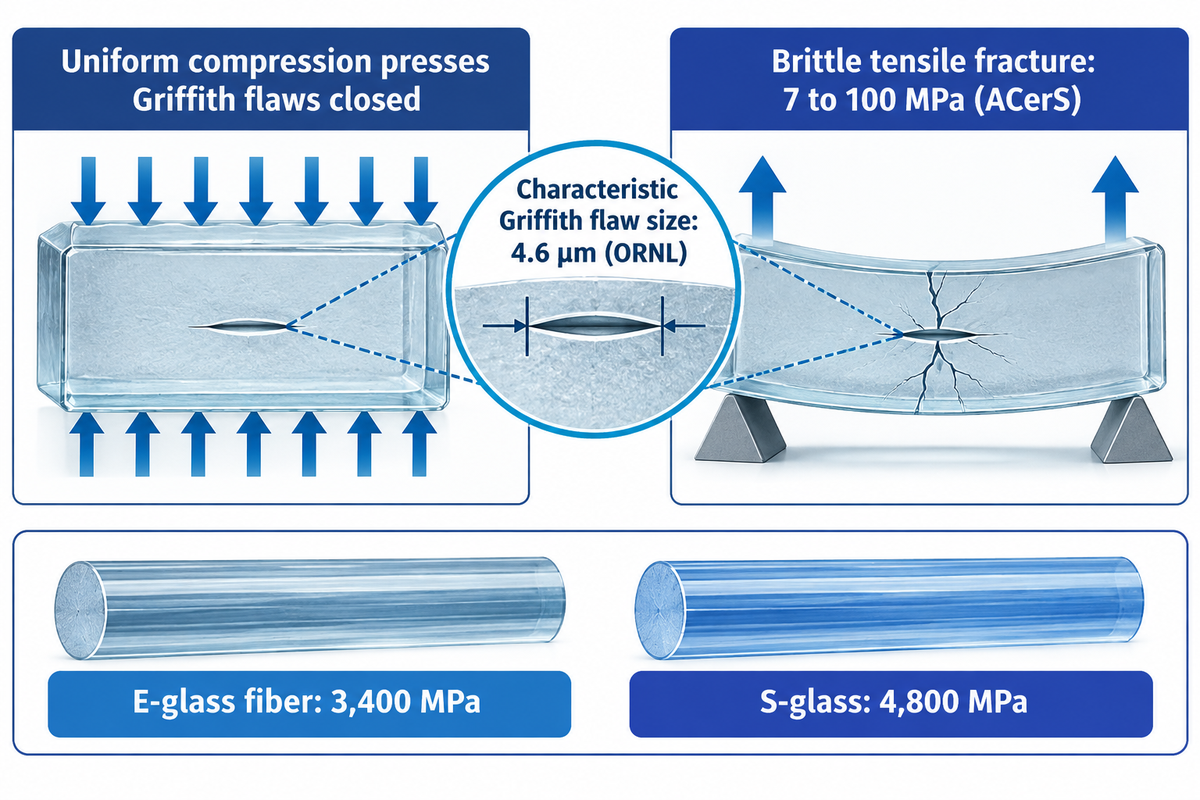
Float glass is 10 times stronger under compression as compared to tension according to Guardian Glass. The material “fails” (fractures) when experiencing “tensile stress” at stress levels of 7 to 100 MPa as per a report in ACerS. In uniform “compression” (like pressure against surface) “Griffith” flaws are pressed closed.
If tension (stretching of bonds across crack tip) is applied they’re pulled open and cause catastrophic brittle cleavage.
According to some estimates, the theoretical strength of a perfect glass can reach 35 GPa in tensile mode. However, the breaking strength of standard glass products has a brittle failure mode at 7-100 MPa.
This gap between the 35 GPa theoretical cohesion and 7 to 100 MPa practical breakage comes to define the mechanical nature of glass. Like other brittle materials, glass has no slip plane of a crystal lattice. Ductile metals can withstand 150 to 350 MPa because plastic yielding dulls the local stress concentration.
Glass can’t plastically yield. Under opening tension, applied tensile stress concentrates at the tip of the deepest micro-crack. Because silicate glass has low fracture toughness, microscopic surface flaws initiate fracture immediately.
Oak Ridge National Laboratory report Pub21473 predicted a characteristic Griffith flaw size of 4.6 μm on glass spheres.
Even when an assembly is loaded in nominal axial compression, three physical mechanisms convert compressive force into fatal tension. We call this failure transition The Compression-to-Tension Flaw Conversion Effect. First, Poisson lateral expansion makes a compressed glass prism expand outward perpendicular to the load axis. That expansion creates transverse splitting tension. Second, when a flat glass plate bends under wind or hydrostatic load, the loaded face enters compression while the opposite face stretches in tension. Standardized bending tests evaluate this flexural strength across the tension face. Glass fabricators report the peak outer-fiber breaking stress as the modulus of rupture (MOR) per Guardian Glass. Increasing surface compression directly raises panel bending strength under wind or hydrostatic load. Third, ambient water molecules cleave strained silicon-oxygen bonds at crack tips. As shown by Bryan Kim, PhD in SightGlassWindows engineering failure analysis, moisture-assisted aging limits acceptable working stresses to 500 to 1,500 PSI for annealed silicate glass. For thermally tempered glass, SightGlassWindows reports an acceptable working stress range of 1,500 to 4,000 PSI.
Why Is Glass Stronger Than Concrete and Structural Steel in Pure Compression Yet Brittle in Bending?
In pure uniaxial compression, float glass exceeds the compressive strength of concrete and tops the 150 to 350 MPa strength of ductile metals reported by ACerS. However, metals yield plastically to absorb energy, whereas glass has zero plastic yield in tension and fractures at 7 to 100 MPa (ACerS).
When molten glass is drawn into fine filaments, its cross-section shrinks below the size of large surface defects. Commercial glass fiber therefore reaches 200 to 500 times the tensile strength of regular glass. Wikipedia composite data reports 3,400 MPa (500,000 psi) for E-glass and 4,800 MPa (700,000 psi) for S-glass. Because bulk strength of glass is much higher in compression than tension, engineers comparing building materials must evaluate compression and tension limits together.
How Glass Composition Affects Compressive Strength, Hardness, and Thermal Behavior
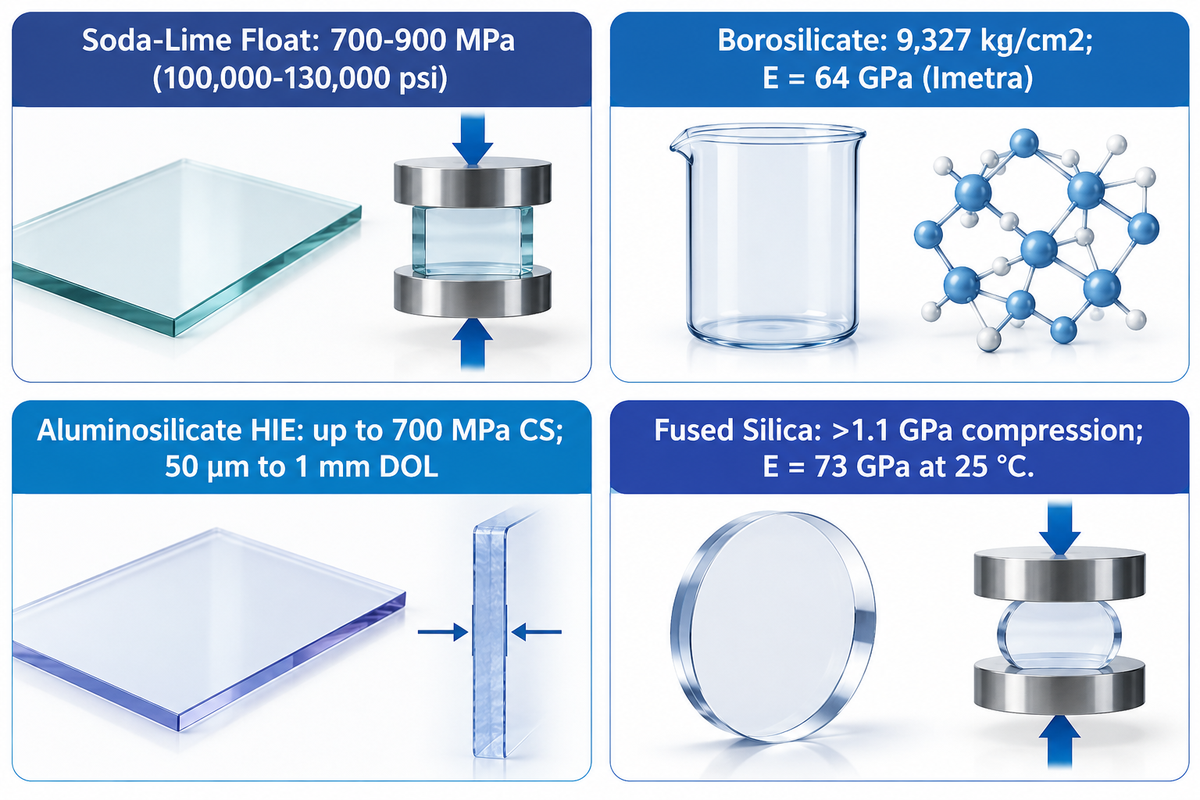
Bulk compressive strength reaches 100,000 to 130,000 psi in soda-lime glass (Guardian Glass) and 9,327 kg/cm2 in borosilicate glass (Imetra). Fused silica exceeds 1.1×10⁹ Pa (1.1 GPa) per Translume. While crushing limits stay in a similar order of magnitude, thermal expansion and ion-exchange response differ dramatically.
Buyers comparing different types of glass and glass materials often expect borosilicate or custom aluminosilicate cover glass substrates to be much stiffer than soda-lime float glass. In reality, bulk Young’s modulus stays within a narrow range. It measures 64 GPa in borosilicate glass per Imetra. Fused silica measures 73 GPa at 25 °C (versus 205 GPa for steel) per Translume. General commercial glass spans 70 to 90 GPa per Biesse. If a buyer objects that switching from soda-lime to borosilicate won’t reduce touch deflection on a thin panel, that objection is valid. Reducing elastic deflection requires thicker glass, whereas borosilicate solves thermal shock and chemical corrosion.
The thermal properties and thermal behavior of a substrate determine whether thermal expansion crushes the panel edge inside a rigid metal frame. According to Guardian Glass, standard float glass has a linear coefficient of thermal expansion of 8.3×10⁻⁶ strain per °C (4.6×10⁻⁶ per °F) and a specific heat capacity of 840 J/kg·K. According to Biesse, glass exhibits low thermal conductivity between 0.8 and 1.4 W/m·K. When a heat source deposits a high amount of heat into the center of a soda-lime window while the metal bezel stays cold, differential linear expansion creates tensile stress around the cold perimeter. Annealed float glass therefore withstands sudden surface temperature changes (thermal shock) of only 40 K (40 °C / 72 °F) before cracking according to Guardian Glass.
In contrast, borosilicate glass features low thermal expansion. Fused silica (pure amorphous silicon dioxide, SiO2) lowers mean linear CTE to 0.52×10⁻⁶/K (5 °C to 35 °C) and 0.57×10⁻⁶/K (0 °C to 200 °C) per Translume. Its thermal conductivity is 1.38 W/m·K at 25 °C. That low thermal expansion provides strong thermal shock resistance and acid chemical resistance. Float glass has an annealing range of 520 to 550 °C and a softening point of ~600 °C per Guardian Glass. However, fused silica contains zero mobile sodium ions and can’t undergo KNO3 chemical ion exchange. According to Translume, fused silica uses a conservative design tensile strength of 5×10⁶ Pa (5 MPa) alongside its >1.1×10⁹ Pa design compressive strength.
Surface hardness depends on composition as well. On the Mohs hardness scale, float glass scores 5.5 per Guardian Glass. General commercial glass ranks 5.5 to 6.0 per Biesse, while specialty glass reaches 6.5 per Wikipedia. All four compositions are resistant to scratching by copper or a steel knife. However, harder materials like quartz sand will scratch the surface and degrade practical glass strength.
Our engineer team prepared The 4-Substrate Compressive & Contact Stress Matrix from these sources of verified datasheets.
Table 1: The 4-Substrate Compressive & Contact Stress Matrix (Verified Datasheet Parameters)
| Mechanical & Thermal Parameter | Soda-Lime Float Glass (Guardian Glass / NGA) | Borosilicate Glass (Imetra / ScienceDirect) | Aluminosilicate HIE Glass (SpotMaterial / US9567254B2) | Fused Silica SiO2 (Translume Datasheet) |
|---|---|---|---|---|
| 1. Uniaxial Bulk Compressive Strength | 700–900 MPa (100,000–130,000 psi per Guardian Glass) | 9,327 kg/cm2 (Imetra borosilicate datasheet) | 1,000 MPa silicate baseline (Wikipedia) | >1.1×10⁹ Pa design compressive (Translume) |
| 2. Unconfined Cylinder Compression (ScienceDirect) | 1.3–2.2 GPa unconfined; 1,087 MPa cylinder quasi-static | 1.4–2.6 GPa unconfined (Danneman & Chocron) | 1.1 GPa quasi-static to 1.42 GPa dynamic (ScienceDirect) | Densifies under dumbbell compression (DTIC AD1117665) |
| 3. Annealed Tensile / Bending Threshold | 45 MPa (6,500 psi) annealed tensile threshold (Guardian) | 7–100 MPa brittle fracture range (ACerS) | 7–100 MPa before ion exchange (ACerS) | 5×10⁶ Pa (5 MPa) design tensile strength (Translume) |
| 4. Aged Static Fatigue Working Limit | 500–1,500 PSI annealed (SightGlassWindows) | 500–1,500 PSI annealed silicate (SightGlassWindows) | Protected by deep compressive DOL layer | 5×10⁶ Pa accounting for fatigue (Translume) |
| 5. Thermal Tempering Surface Compression | 69–140 MPa (10,000–20,000 psi per Glass Magazine) | 1,500–4,000 PSI aged working stress if tempered | 90–100 MPa (13,000–15,000 psi) for EN 12150 | Not thermally temperable due to ultra-low CTE |
| 6. KNO3 Chemical Strengthening CS & DOL | ASTM C1422 Level 1 (>7 to ≤172 MPa) and higher | Chemically strengthened for autoinjectors (ACerS) | Up to 700 MPa CS; 50 μm to 1 mm DOL (SpotMaterial) | Not ion-exchangeable (pure SiO2 without alkali ions) |
| 7. Young’s Modulus (E) | 70–90 GPa commercial range (Biesse) | 64 GPa (Imetra borosilicate datasheet) | 70–90 GPa range (unchanged by ion exchange) | 73 GPa at 25 °C vs. 205 GPa steel (Translume) |
| 8. Bulk Density & Mohs Hardness | 2,500 kg/m3 (156 lb/ft3); Mohs 5.5 (Guardian Glass) | 2.4–2.8 g/cm3 range; Mohs 5.5–6.0 (Biesse) | Mohs 6.5 (Wikipedia Strength of glass) | 2.202 g/cm3 vs. 2.6 g/cm3 aluminum (Translume) |
| 9. Linear CTE & Thermal Conductivity | 8.3×10⁻⁶/°C (Guardian); 0.8–1.4 W/m·K (Biesse) | Low CTE for thermal shock stability (Biesse) | 0.8–1.4 W/m·K thermal insulator range (Biesse) | 0.52×10⁻⁶/K (5–35 °C); 1.38 W/m·K (Translume) |
| 10. Thermal Shock Limit & Chemical Resistance | 40 K (40 °C) thermal shock; acid resistant except HF | High thermal shock & laboratory chemical resistance | ASTM C1422 Level 5 (>690 MPa) impact durability | Inert to most chemicals except HF and hot KOH (Translume) |
Surface Compressive Stress vs. Bulk Compression: Thermal Tempering and KNO3 Chemical Strengthening
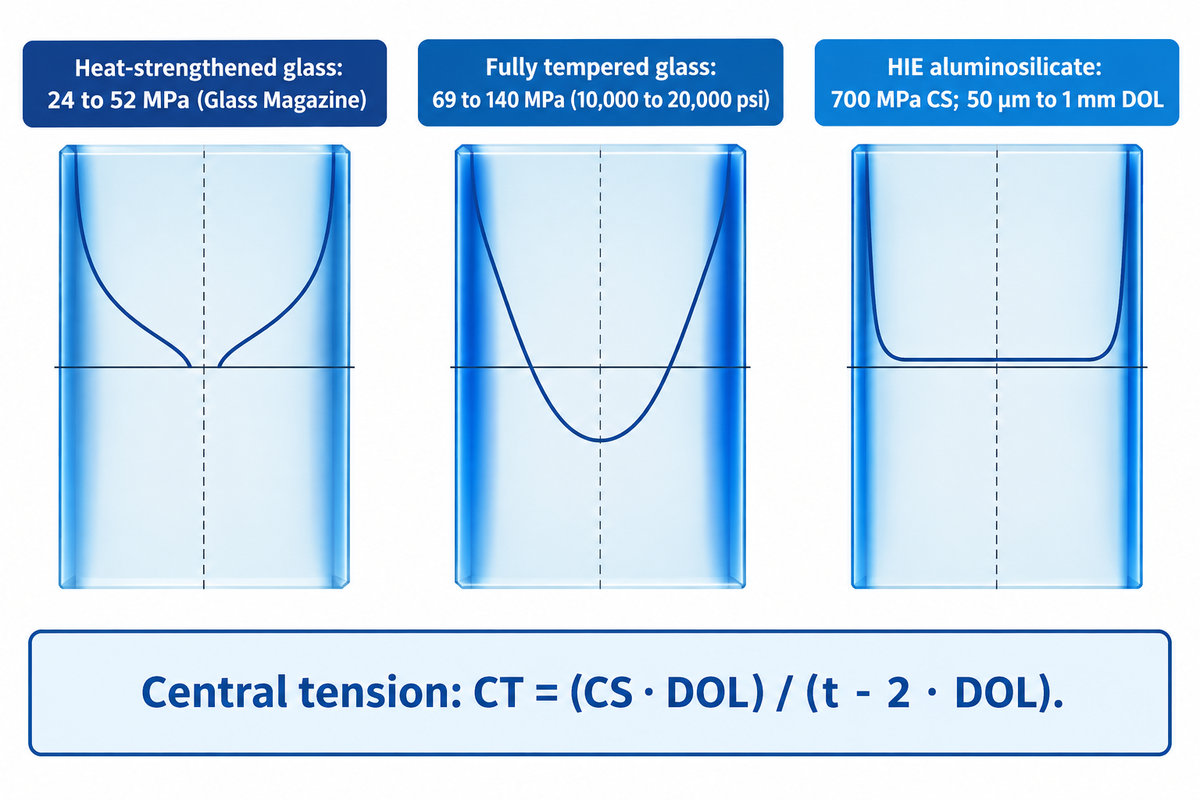
Heat-strengthened glass carries 24 to 52 MPa (3,500 to 7,500 psi) of surface compressive stress per Glass Magazine. Fully tempered glass holds 69 to 140 MPa (10,000 to 20,000 psi). High-ion-exchange aluminosilicate glass reaches 700 MPa with a 50 μm to 1 mm depth of layer according to SpotMaterial.
Actually many product designers are led to believe that chemically strengthened glass has an inherent intrinsic atomic crushing limit or bends less than annealed glass, even though neither process modifies the bulk atomic stiffness, but rather engineering a compressive surface shield across the glass surface and since fracture only originates when surface tension acts to open a Griffith flaw, placing the surface permanently into a state of compression requires external bending loads to firstly negate and overcome that compressive shield to bring the overall surface tension greater than zero. At our Dongguan, Heyuan, and Henan factories, SW GLASS operates both KNO 3 chemical strengthening baths (Step 04) and physical tempering lines (Step 06).
In physical tempering, as detailed in our guide to the thermal glass tempering process and quench stress profiles, we heat pre-machined glass to 620–650 °C according to Biesse. High-pressure air jets then rapidly cool both faces. The outer surfaces solidify first while the hot core continues to contract, pulling the outer skins into compression. According to Glass Magazine (NGA FB39-25), heat-strengthened glass is twice as strong as annealed glass. Fully tempered glass is four times as strong and requires 13,000 to 15,000 psi (90 to 100 MPa) for EN 12150 compliance.
In chemically strengthened glass, we immerse alkali-containing glass in a molten potassium salt bath. Our technical guide on potassium nitrate ion-exchange chemical strengthening parameters explains the diffusion mechanism. Larger potassium ions replace smaller host sodium ions in the outer surface. According to Wikipedia’s two-stage chemical strengthening reference, an advanced two-stage process first immerses the glass in a sodium nitrate bath at 450 °C (842 °F) before potassium exchange. This ion exchange produces high surface compression across a deep potassium layer per SpotMaterial. It leaves no measurable optical distortion on thin plates per ACerS.
Common Mistake #1: Specifying Chemical Strengthening to Reduce Panel Deflection (Stiffness Myth)
MIT 3.071 Amorphous Materials Lecture 9 and Interelectronix industrial monitor engineering data confirm that strengthening never changes Young’s modulus (70 to 90 GPa across commercial glasses per Biesse) or elastic deflection. Under a given touch load, a chemically strengthened lens deflects by the exact same distance as an annealed lens of identical thickness. Strengthening lets the glass bend 4 times further in tempered glass (Glass Magazine) without breaking, but reducing deflection requires increasing thickness.
Can a Hammer Break Toughened Glass, and Does Tempering Change Bulk Compressive Strength?
Yes, a sharp edge hit from a hammer that hits a short edge will break toughened glass but the face will need to resist from 10,000 to 20,000 psi (69 to 140 MPa) of surface compression (Glass Magazine). For ASTM C1422 Level 5, surface compression surpasses 690 MPa (ASTM C1422 Section 5.1.1). Pointed impact on a long exposed perimeter edge punches the compressive skin into the central tension core, and the pane snaps apart.
Tempering never alters bulk uniaxial compressive strength.
To anneal glass is to cool it through the 520 to 550 °C transformation range (Guardian Glass) to relieve all internal stresses. Conversely, to temper glass is to balance surface compression against interior tension. Materials engineers in r/materials fracture discussions explain how stored core tension causes a panel with high compressive strength on its face to dice when chipped on its edge. According to Corning USPTO Patent US9567254B2, central tension (CT) follows CT = (CS · DOL) / (t − 2 · DOL). Balancing CS and DOL governs the true impact strength, strength and durability, and mechanical behavior of glass that a finished cover glass can withstand.
ASTM C1422, ASTM C1048, and Surface Stress Metrology for Strengthened Glass
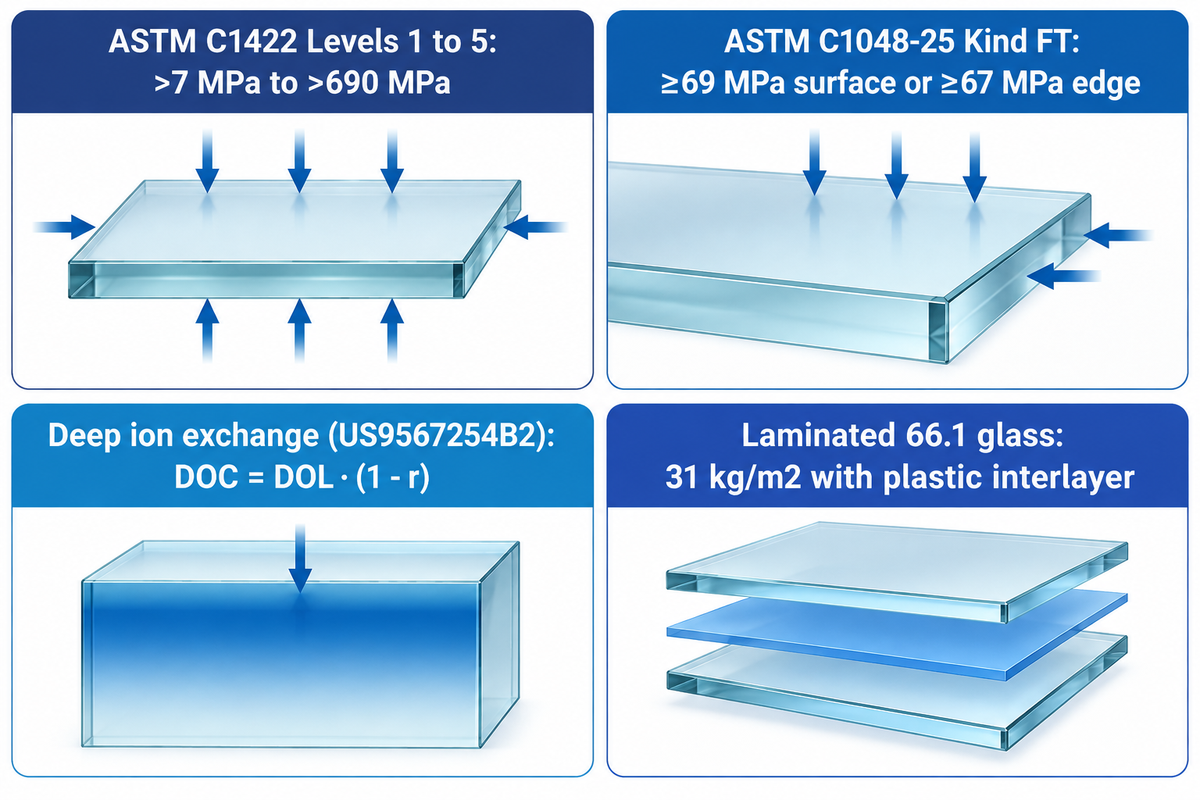
Active ASTM Subcommittee C14.08 standards classify chemically strengthened glass under ASTM C1422/C1422M-26. Section 5.1.1 defines five surface compression levels from >7 MPa (Level 1) to >690 MPa (Level 5). Meanwhile, ASTM C1048-25 mandates ≥69 MPa (10,000 psi) surface compression or ≥67 MPa edge compression for fully tempered flat glass (ASTM C1048 Section 1.2).
1.2 The classification of chemically toughened glass products shall be determined on surface compression (CS) and case depth (depth of compression, DOC) in the laboratory, and not on the modulus of rupture (MOR).
This Section 1.2 rule avoids a frequent procurement pitfall. Buyers that specify only a bending MOR value on the drawing routinely end up with inconsistent productions as four-point bending depends on test span and edge finish. Calling out an explicit ASTM C1422 Section 5.1.1 Surface Compression Level and Case Depth Class binds the supplier to non-destructive optical stress testing on every lot under active standard ASTM C1279-23 (ASTM Subcommittee C14.08).
Corning USPTO Patent US9567254B2 highlights a critical metrology boundary for deep ion exchange (where DOL reaches 130 to 175 μm and DOC spans 90 to 120 μm). When the optical depth of layer (DOL) measured by a prism-coupling surface stress meter reaches DOL ≥ 0.1 · t, true zero-stress depth of compression (DOC) is noticeably lower than DOL. In a linear truncated profile, Patent US9567254B2 proves that DOC = DOL · (1 − r) where r = DOL/t.
Safety codes often require post-breakage retention when a pane of glass is subjected to impact or subjected to excessive stress. In those assemblies, fabricators bond two or more strengthened glass layers together with a viscoelastic interlayer to build a laminated composite. Our visual guide to laminated versus tempered safety glass post-breakage behavior illustrates this mechanism. According to Guardian Glass, laminated glass (such as 66.1 at 31 kg/m2) includes a plastic interlayer that transfers shear stress between plies and retains fragments after fracture.
Table 2: ASTM C1422/C1422M-26 & ASTM C1048-25 Surface Compression Classifications and Metrology
| Standard & Grade / Level | Surface Compression (CS) Range (MPa) | Surface Compression Range (psi) | Verified Depth / Profile | Verification Metrology & Standard | Typical Industrial Application |
|---|---|---|---|---|---|
| ASTM C1422 Level 1 | >7 to ≤172 MPa (ASTM C1422 5.1.1.1) | >1,000 to ≤25,000 psi | Laboratory measured DOC (C1422 1.2) | ASTM C1279-23 / Waveguide FSM | Light instrument covers, thin borosilicate slides |
| ASTM C1422 Level 2 | >172 to ≤345 MPa (ASTM C1422 5.1.1) | >25,000 to ≤50,000 psi | 50 μm to 1 mm DOL range (SpotMaterial) | Surface stress meter / ASTM C1279-23 | Chemically strengthened soda-lime display windows |
| ASTM C1422 Level 3 | >345 to ≤517 MPa (ASTM C1422 5.1.1) | >50,000 to ≤75,000 psi | 50 μm to 1 mm DOL range (SpotMaterial) | Waveguide prism coupler (US9567254B2) | High-grade soda-lime & industrial HMI touch panels |
| ASTM C1422 Level 4 | >517 to ≤690 MPa (ASTM C1422 5.1.1) | >75,000 to ≤100,000 psi | 90 to 120 μm deep DOC (US9567254B2) | FSM TE/TM spectra (US9567254B2) | Aluminosilicate marine & outdoor display kiosks |
| ASTM C1422 Level 5 | >690 MPa (up to 700 MPa per SpotMaterial) | >100,000 psi (ASTM C1422 5.1.1.5) | 130 to 175 μm deep DOL (US9567254B2) | DOC = DOL(1−r) correction (US9567254B2) | Rugged handhelds, avionics, marine bridge HMIs |
| ASTM C1048-25 Kind HS (Heat-Strengthened) | 24 to 52 MPa (Glass Magazine FB39-25) | 3,500 to 7,500 psi (Glass Magazine) | 2× annealed strength (Glass Magazine) | ASTM C1279-23 non-destructive photoelastic | Laminated architectural & solar PV superstrates |
| ASTM C1048-25 Kind FT (Fully Tempered) | 69 to 140 MPa (Glass Magazine FB39-25) | 10,000 to 20,000 psi (Glass Magazine) | 4× annealed strength (Glass Magazine) | ASTM C1279-23 surface & edge stress | Structural safety glazing, thick marine viewports |
| EN 12150 Thermally Toughened Safety Glass | 90 to 100 MPa (Glass Magazine FB39-25) | 13,000 to 15,000 psi (Glass Magazine) | Small granular rupture fragments (Glass Magazine) | EN 12150 fragmentation & CPSC 16 CFR 1201 | CE-marked machinery guards, solar modules |
| IEC 61747-40-1:2019 Cover Glass Testing | Cover-glass-level strength & damage resistance | Evaluated with chemically polished bevels (+20% per Springer) | 0 to 5 μm steep linear surface spike (US9567254B2) | IEC 61747-40-1:2019 mechanical performance test | Electronic flat panel display cover glass |
Thickness Sizing, Pressure Viewports, and Bearing Contact Rules for Marine and Outdoor Optical Glass
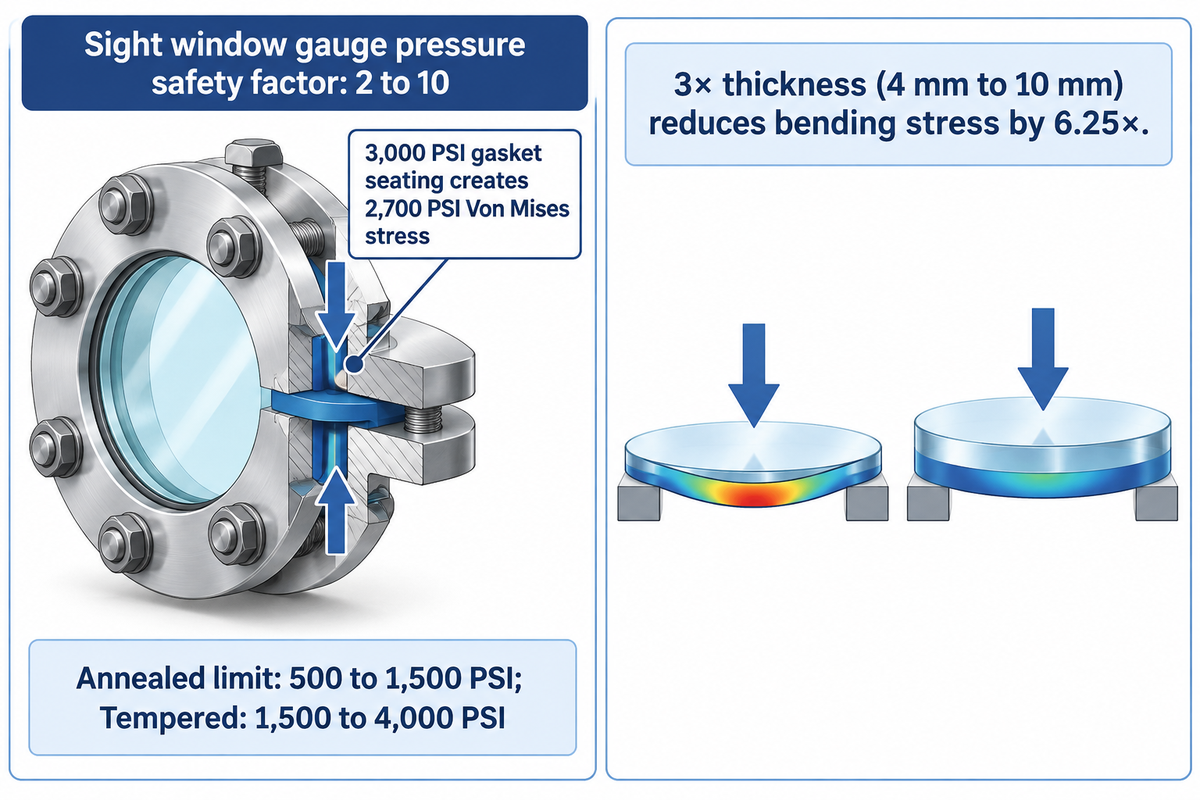
Commercial sight windows carry gauge pressure safety factors of 2 to 10 per SightGlassWindows. Yet a 3,000 PSI gasket seating load creates 2,700 PSI of Von Mises stress at the gasket edge. Reliable viewports therefore pair plate thickness with low-stress elastomer seating.
Throughout marine electronics, subsea housings and chemical reactors, applications of glass feature tubular sight gauges, explosion-proof well glass luminaires and bridge touchscreens. In each of these structural applications, a circular or rectangular glass plate acts as a load-bearing flexural barrier while maintaining high optical transmittance and stable optical properties. Engineers and designers examine industrial touchscreen cover glass thickness and IK impact selection to ensure both center bending stress and perimeter gasket stress.
Common Mistake #2: Over-Torquing Hard Flange Gaskets (The 3,000 PSI Seating Paradox)
Bryan Kim, PhD’s finite element simulation on SightGlassWindows models a 4-inch ANSI flange with a Garlock Gylon PTFE gasket (Styles 3500–3594, thicknesses 1/16 inch to 1/4 inch). Sealing just 2 PSIG of process pressure requires 800 to 4,000 PSI (generally 3,000 PSIG) of gasket seating compression. Inside the gasket edge, the glass sees 3,000 PSI compression, while outside that edge it sees zero pressure. That sudden step change of 3,000 PSI creates a 2,700 PSI Von Mises stress peak at the gasket seat edge. Because SightGlassWindows shows that acceptable working stress is only 500 to 1,500 PSI for annealed glass and 1,500 to 4,000 PSI for tempered glass, over-tightening flange bolts crushes the outer perimeter.
To prevent edge spalling in viewports made of glass, SW GLASS defines and enforces The 3-Zone Bearing Contact & Edge Clearance Rule across outdoor and marine enclosures:
- As first and foremost step in eliminating faulty equipment and/or sample damage, never allow any metal-to-glass contact nor unbuffered high-seating-stress PTFE gaskets against thin cover glass in the gasket cushion zone. Instead, cushion the glass within the metal bezel with a compressed elastomer gasket to keep seating stresses comfortably below the 500 to 1,500 PSI annealed working limit recorded by Sight Glass Windows.
- Second, in the perimeter expansion zone, account for differential thermal expansion between metal housings and glass (8.3×10 −6 /°C in float glass per Guardian Glass versus 0.52×10 −6 /K in fused silica per Translume). Maintain a perimeter clearance space around the glass outer diameter so that contraction of the frame at sub-zero temperatures will never constrict the glass edge.
- Third, in the edge chamfer zone, eliminate raw cut edge micro-cracks before heat treatment. As reported in the 2014 Springer soda-lime cover glass edge study, chemically polishing micro-cracks in chamfered edges with ammonium fluoride and organic acid improves edge strength without degrading optical transmittance.
How Strong Is 12mm Toughened Glass Compared to Thin Chemically Strengthened Cover Glass?
A thick thermally tempered viewport (carrying 10,000 to 20,000 psi surface compression per Glass Magazine) withstands far higher pressure than a thin 4 mm lens because pressure capacity scales with the square of thickness to diameter (SightGlassWindows). Thin chemically strengthened glass instead excels in surface scratch and point-impact resistance.
Worked Example: Circular Viewport Thickness Scaling & Gasket Seating Stress Comparison
Assumed Inputs & Scaling Law: Circular viewport held in a 4-inch ANSI flange (SightGlassWindows FEA model). By classical plate mechanics, pressure capacity scales with (t / D)2 and bending stress scales inversely with t2. Increasing glass thickness by 3× (for example, from 4 mm to 10 mm float glass listed in Guardian Glass thickness tables at 10 kg/m2 vs. 25 kg/m2) reduces bending stress by 6.25×.
Scope Notice: The comparison below separates center pressure blowout margin (2:1 to 10:1 safety factor per SightGlassWindows) from perimeter gasket seating stress (2,700 PSI Von Mises edge stress under a 3,000 PSI Garlock Gylon seating load).
| Glass Configuration & Source | Thickness / Weight (Guardian Glass) | Surface Compression (CS) | Aged Working Stress Limit (SightGlassWindows) | Response to 3,000 PSI Gasket Seating (2,700 PSI Edge Stress) |
|---|---|---|---|---|
| Option A: Annealed Float Glass Viewport | 10 mm (25 kg/m2 / 5.12 lb/ft2) | Annealed (45 MPa short-term bending threshold per Guardian) | 500–1,500 PSI | FAIL at gasket edge: 2,700 PSI edge tension exceeds 500–1,500 PSI working limit |
| Option B: Fully Tempered Float Glass (ASTM C1048-25) | 10 mm (25 kg/m2) or 6 mm (15 kg/m2) | 10,000–20,000 psi (69–140 MPa per Glass Magazine) | 1,500–4,000 PSI | PASS with low-seating gasket: 2,700 PSI falls within 1,500–4,000 PSI tempered range |
| Option C: Chemically Strengthened HIE Glass (ASTM C1422-26) | 4 mm (10 kg/m2 / 2.04 lb/ft2) | Up to 700 MPa (100,000 psi Level 5 per C1422 / SpotMaterial) | 50–175 μm DOL envelope | PASS for HMI cover glass: High surface compression resists surface & edge cracking |
This explains why engineers never depend on bulk compressive strength per se for sealing a view port. Even when a thin lens carries Level 5 surface compression, an unbacked thin plate will bend across a wide span unless optically bonded to a display or sized for flexural stiffness.
Pre-Strengthening CNC Machining, Ultrasonic Hole Drilling, and Coating Thermal Budgets
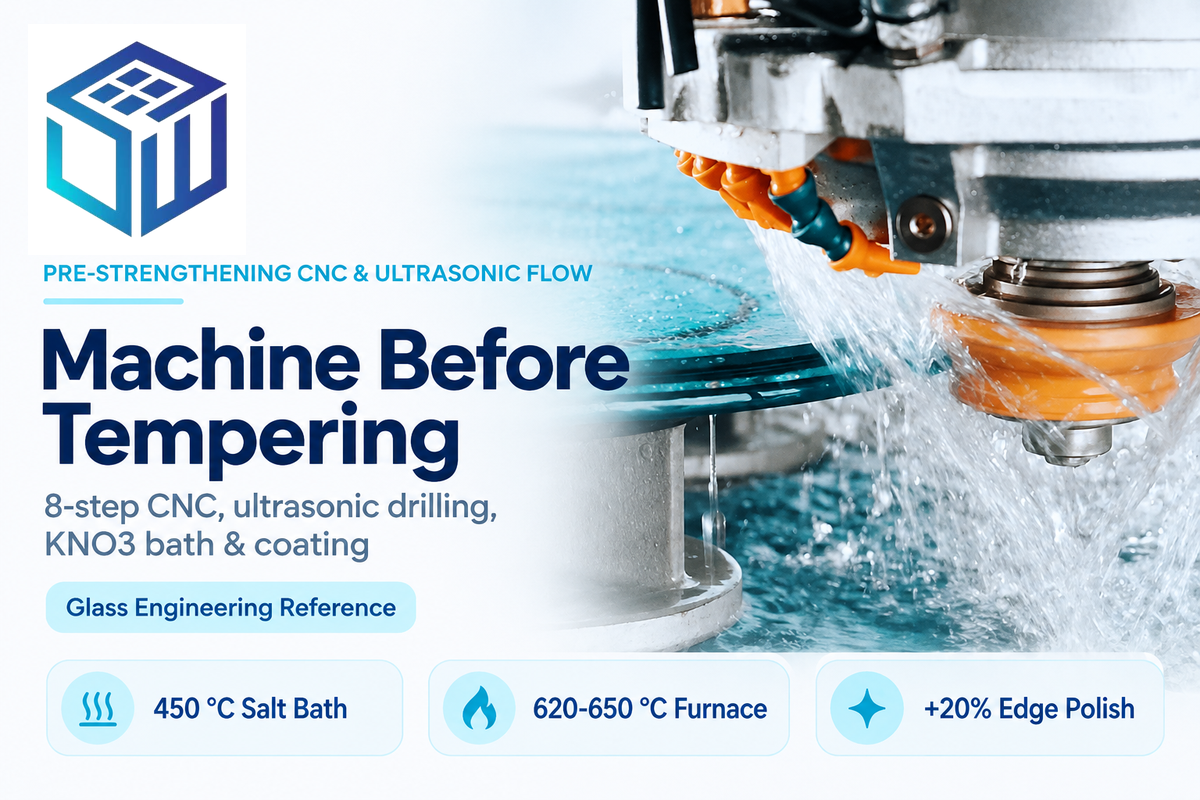
Any slicing, grinding or drilling of the glass after thermal tempering or chemical strengthening penetrates the surface compressive layer, revealing core tension. Conversely, taking the chamfered edge micro-cracks chemically polished in ammonium fluoride can increase strength by 20% (see 2014 Springer cover glass study).
Hardware buyers occasionally ask whether finished chemically strengthened cover lenses can be trimmed or drilled after delivery. As noted in Bent Glass Design’s chemical strengthening engineering guide, when the surface of chemically strengthened glass is deeply scratched or cut, that region loses its added strength. In two-stage chemically strengthened glass immersed at 450 °C (842 °F) in sodium nitrate followed by potassium nitrate, post-strengthening edge grinding destroys the dual-slope surface stress profile (US9567254B2).
In order to keep full edge and bore compression, SW GLASS provides an 8-step production process through our factory at Dongguan, Heyuan and Henan:
- In Step 01 raw substrate cutting, automated CNC tables score and singulate raw annealed soda-lime, borosilicate, or aluminosilicate sheets before any thermal treatment.
- In Step 02 CNC precision carving and edge polishing, multi-axis CNC spindles grind the perimeter and chamfered bevels to eliminate sub-surface micro-fissures.
- In Step 03 ultrasonic hole drilling and slot grooving, high-frequency ultrasonic CNC hole drilling and brittle glass tolerances form sensor ports and mounting holes while the glass is still in its stress-free annealed state.
- In Step 04 chemical strengthening or Step 06 physical tempering, the machined parts enter molten potassium salt (450 °C two-stage bath per Wikipedia) or a 620–650 °C tempering furnace (Biesse). Because all holes were drilled first, the molten salt contacts every bore wall and wraps irregular geometries in uniform surface compression (ACerS).
- In Step 05 surface coating (AG / AR / AF), we apply anti-glare, anti-reflective, and anti-fingerprint surface coatings below the 520–550 °C annealing transformation range (Guardian Glass) so residual surface compression does not relax.
- In Step 07 screen printing and Step 08 final inspection, cured bezel inks and optical transmittance are audited alongside ASTM C1279-23 and FSM surface stress measurements.
That 2014 International Journal of Precision Engineering and Manufacturing study also revealed an important optical tradeoff. Treating chamfered soda-lime cover glass edges with ammonium fluoride and organic acid increased mechanical strength by up to 20% while keeping light transmittance undegraded. Conversely, hydrofluoric acid (HF) solutions increased strength but degraded optical transmittance. Eliminating edge micro-cracks properly prior to ion exchange preserves both mechanical and optical glass properties.
Specifying Compressive Stress, Edge Tolerances, and Cost Drivers on Custom Cover Glass RFQs
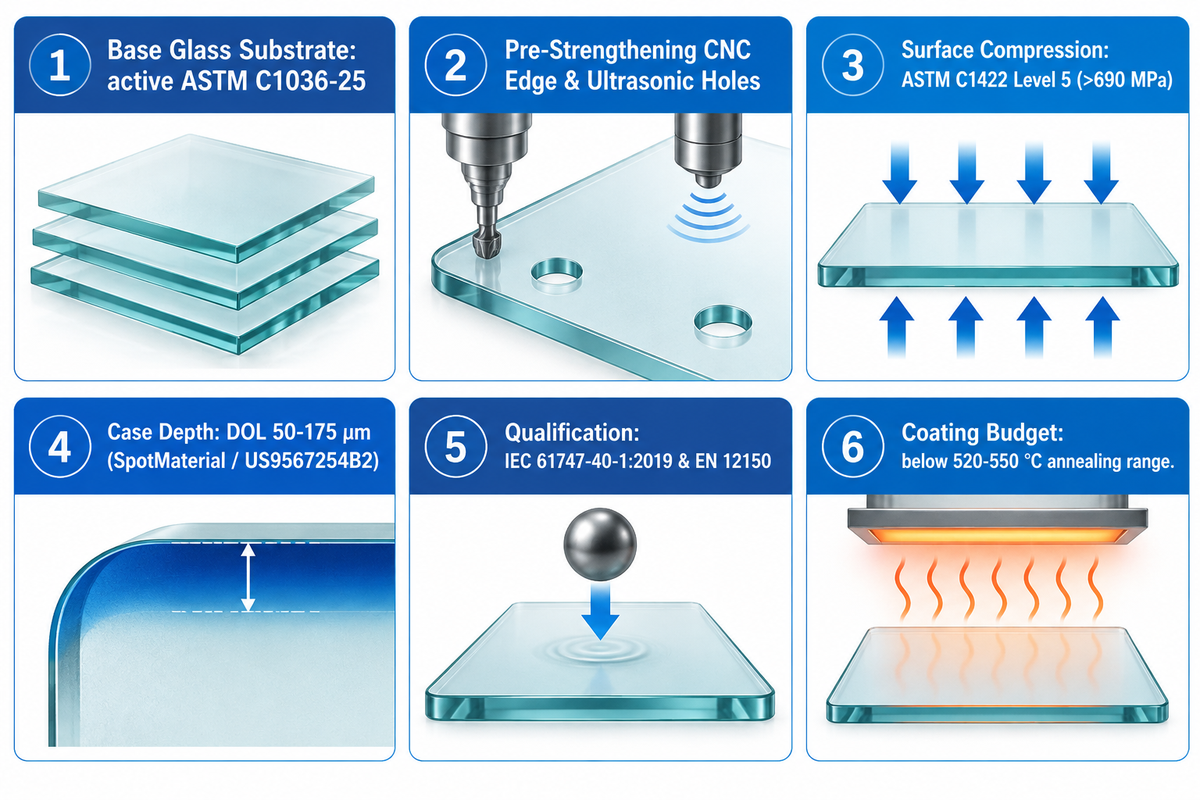
To prevent material substitution on custom cover glass RFQs, engineering drawings should specify six parameters under The 6-Point Surface Compression & Drawing Callout Protocol. The first three items are base glass family, thickness, and pre-strengthening CNC edge chamfer. The final three items are ASTM C1422/C1422M-26 or ASTM C1048-25 surface compression level, minimum case depth (DOC/DOL), and lot-level stress reports.
Two supply-chain developments in 2025 and 2026 directly affect custom cover glass sourcing. First, global demand for strengthened panels is expanding rapidly. The global tempered glass market is projected to grow from USD 18.26 billion in 2025 to USD 35.00 billion by 2034 at a 7.50% CAGR (TrendX Insights). Meanwhile, the chemically strengthened glass market reached USD 25.19 billion in 2025 and is projected to hit USD 50.49 billion by 2035 (LinkedIn Market Report). Electronic flat panel display qualification also references IEC 61747-40-1:2019 mechanical performance guidelines for cover glass. Second, as documented in our 2026 chemically strengthened glass supplier analysis, AGC announced on December 8, 2025 that it will exit the Dragontrail chemical-strengthening glass business in Q3 2026. Drawings that still name legacy Dragontrail grades should qualify custom aluminosilicate cover glass substrates under ASTM C1422/C1422M-26 Level 5 (>690 MPa).
Four fabrication factors control unit cost, minimum order quantity (MOQ), and lead time on specialty orders – exact unit pricing still requires RFQ inquiry by drawing dimension and coating stack.
- Substrate selection establishes the baseline for the raw materials. Soda-lime float glass offers the lowest cost, whereas borosilicate and aluminosilicate carry a premium for thermal shock stability or high-ion-exchange surface compression.
- Strengthening cycle time differs sharply between physical tempering in continuous 620–650 °C roller furnaces (Biesse) and multi-hour molten salt immersion at 450 °C (Wikipedia) for chemical ion exchange.
- Pre-strengthening CNC edging, ultrasonic hole count, and ammonium fluoride chemical edge polishing (+20% strength gain per the 2014 Springer study) add spindle and etching time prior to salt bath loading.
- Optical anti-glare (AG), anti-reflective (AR), and anti-fingerprint (AF) vacuum coatings add cleanroom batch processing after strengthening.
Table 4: The 6-Point Surface Compression & Drawing Callout Protocol (Copy-Pasteable OEM RFQ Checklist)
| RFQ Callout Field | Ambiguous Drawing Note (Avoid) | Recommended Engineering Callout (SW GLASS Standard) | Outgoing QC Verification Method |
|---|---|---|---|
| 1. Base Glass Substrate & Standard | “Clear tempered optical glass” | Flat Glass per active ASTM C1036-25 (Soda-Lime, Borosilicate, or Aluminosilicate) | Raw glass mill certificate + thickness micrometer audit |
| 2. Pre-Strengthening CNC Edge & Hole Profile | “Smooth ground edges, drill holes” | Pre-strengthening CNC polished chamfered edge + ultrasonic hole drilling prior to salt bath | Optical CMM vision measurement + edge micro-crack audit |
| 3. Surface Compressive Stress (CS) Target | “Chemically strengthened / high compressive strength” | ASTM C1422/C1422M-26 Level 5 (CS > 690 MPa / 100,000 psi) or ASTM C1048-25 Kind FT (≥69 MPa / 10,000 psi) | Non-destructive surface stress meter or ASTM C1279-23 polarimetry |
| 4. Case Depth (DOL / DOC) & Central Tension | “Standard ion exchange depth” | Specify DOL (50–175 μm per SpotMaterial / US9567254B2) and DOC = DOL(1−DOL/t) with CT = (CS·DOL)/(t−2·DOL) | Waveguide TE/TM spectrum report per production lot |
| 5. Mechanical & Display Qualification | “Must resist heavy impact” | Cover glass mechanical testing per IEC 61747-40-1:2019 and EN 12150 (90–100 MPa / 13,000–15,000 psi for safety glazing) | Witness coupon bending & impact qualification report |
| 6. Post-Strengthening Coating Thermal Budget | “Add AR and AF coating” | Multi-layer AG / AR / AF vacuum coating applied well below the 520–550 °C annealing range (Guardian Glass) | Spectrophotometer transmittance + post-coating surface stress audit |
Why We Published This Engineering Guide
Dongguan Saiwei Glass Co., Ltd. (SW GLASS) manufactures custom precision cover glass across three factories in Dongguan Tangxia, Heyuan, and Henan. As documented on our SW GLASS company profile, we operate automated CNC, ultrasonic drilling, KNO3 chemical strengthening, physical tempering, and AG/AR/AF vacuum coating lines. We published this guide so hardware teams have verifiable equations, ASTM C1422/C1048 stress benchmarks, and gasket contact rules before releasing production drawings.
Frequently Asked Questions About the Compressive Strength of Glass
Does compressive strength of glass change with temperature or sustained loading?
Yes, both elevated temperature and long-term static loading reduce the effective load capacity of glass components. Under sustained loads in humid air, water molecules cleave silicon-oxygen bonds at Griffith surface micro-flaws. According to SightGlassWindows, this aging lowers acceptable working tensile stress to 500–1,500 PSI in annealed glass and 1,500–4,000 PSI in tempered glass.
How is the compressive strength of glass measured in laboratory testing?
Intrinsic uniaxial compressive strength is measured by crushing precision cylindrical or dumbbell glass specimens until axial failure occurs at 1,087 MPa in commercial cylinders (ScienceDirect). Float glass specimens withstand 700 to 900 MPa (Guardian Glass). For flat glass under ASTM C1422/C1422M-26, laboratories instead measure surface compression and depth of compression non-destructively under ASTM C1279-23.
Why can you not cut or drill glass after thermal tempering or chemical strengthening?
Cutting, edge grinding or drilling glass after strengthening goes beyond the protected surface layer of compression and exposes the internal central tension region of the glass. In thermally tempered glass (620-650 °C, Biesse treatment), the defeat of compression skin leads to instant dicing fracture. Instead, all holes and bevels must be machined in the annealed state before the glass enters the salt bath or tempering furnace.
How much does laminated float glass weigh compared to monolithic float glass under compressive clamping?
Monolithic 6 mm float glass weighs 15 kg/m2, while laminated 66.1 glass with a plastic interlayer weighs 31 kg/m2 according to Guardian Glass.
How does the compressive strength of glass compare to concrete and structural steel in load-bearing assemblies?
Under uniform axial compression, silicate glass reaches 1,000 MPa (150,000 psi) per Wikipedia while commercial glass cylinders reach 1,087 MPa (ScienceDirect). Those values far surpass structural concrete and exceed the 150 to 350 MPa tensile capacity of ductile metals documented by ACerS. However, ductile metals yield plastically at contact points without cracking. Because glass is a brittle material that fractures at 500 to 1,500 PSI of aged working tension (SightGlassWindows), load-bearing glass joints require soft elastomer gaskets and 2:1 to 10:1 gauge pressure safety factors.
Does chemical strengthening increase the Young’s modulus or stiffness of thin cover glass?
No. Chemical ion exchange doesn’t alter the bulk Young’s modulus at 64 GPa in borosilicate (Imetra) or 73 GPa in fused silica (Translume); it only introduces surface compression.
What surface compression level under ASTM C1422 should be specified for outdoor and marine touchscreen cover glass?
Outdoor kiosks and marine bridge displays should specify ASTM C1422/C1422M-26 Level 5 (>690 MPa / 100,000 psi per ASTM C1422 Section 5.1.1.5) on high-ion-exchange aluminosilicate cover glass (up to 700 MPa CS and 50 μm to 1 mm DOL per SpotMaterial). Thicker thermally tempered marine windows should specify ASTM C1048-25 Kind FT (≥69 MPa / 10,000 psi surface compression, or 90–100 MPa for EN 12150 per Glass Magazine).
Need Custom Chemically Strengthened or Tempered Cover Glass With Certified Stress Reports?
Please send your STEP/DXF drawing or viewport pressure needs to our SW GLASS engineering department. We provide DFM review, CNC ultrasonic hole drilling, ASTM C1422/C1422M-26 Level 5 KNO 3 ion exchange, and ASTM C1048-25 physical tempering. Each production lot ships with AG/AR/AF optical coatings and surface stress test reports.
References & Sources
- ASTM International – Subcommittee C14.08 on Flat Glass Active Standards Roster (ASTM C1036-25, ASTM C1048-25, ASTM C1279-23, ASTM C1422/C1422M-26).
- ASTM International ASTM C1422/C1422M-26 Standard Specification for Chemically Strengthened Flat Glass (Section 1.2 & Section 5.1.1 Surface Compression Levels 1–5).
- Varshneya, Arun K. The American Ceramic Society (ACerS), “Introduction to Chemically Strengthened Glasses for Glass: Then and Now”.
- National Glass Association (NGA) Glass Magazine / NGA Technical Paper FB39-25, “Glass Properties Pertaining to Photovoltaic Applications” (Heat-Strengthened vs. Fully Tempered Surface Compression), Feb 2026.
- Kim, Bryan, PhD SightGlassWindows Engineering Reference, “Mechanical Damage Risks for Sight Glasses: Pressure, Fracturing, and Gasket Seating Stress FEA”.
- Corning Incorporated USPTO Patent US9567254B2, “Strengthened Glass With Deep Depth of Compression (CT and DOC vs. FSM DOL)”.
- Meredith, C. S. U.S. Army Research Laboratory (DTIC AD1117665 / ARL-TR-9120), “Compression Strength of Borosilicate and Soda-Lime Silicate Glasses Using a Dumbbell-Shaped Specimen”.
- Oak Ridge National Laboratory (ORNL) ORNL / TARDEC Technical Report Pub21473, “Surface Treatment Effects on Compressive Strength of Glass and Griffith Flaw Sizing”.
- Translume Fused Silica Material Properties Engineering Datasheet (>1.1 GPa Design Compressive Strength & 73 GPa Elasticity Modulus).
- Guardian Glass Physical Properties and Behavior of Float Glass: Compressive Strength (700–900 MPa) & Durability.
Related Posts
Trending now