Get in Touch with Saiweiglass




How Glass Fabrication Turns Raw Materials Into Finished Glass Products
Like a thousand other architectural facades, storefront curtain walls, and interior glass partitions, each panel we make begins as a pile of sand soda ash and limestone. The path from mineral input to finished flat sheet – what we call the glass fabrication line – is six measurable stages by which raw materials become glazed flat glass in compliance with ASTM C1036 and ANSI Z97.1 safety standards.
Our walk-through describes each step of the fabrication process – batching, melting, float forming, annealing, edge work, and tempering – along with the temperatures, tolerances, and quality metrics professionals need for each role. Drawing on on-site expertise in saiweiglass’ facilities, we share first-hand insights in addition to published guides so you can make informed decisions in sourcing fabrication partners.
This overview will teach you what is happening in a float glass line, why it happens, and how to specify high-quality glass that fits the project.
What Is the Glass Fabrication Process?

Glass fabrication is the industrial quality-assured sequence – batching, melting, float forming, annealing, cutting, secondary machining – by which silica-based raw materials turn into a finished glass product ready for architectural, automotive, or industrial installation.
That definition covers a broad spectrum of production; at a macro level, the glass manufacturing process begins with measured inputs of soda ash and limestone and ends with finished glass leaving a fabrication shop – using a batch house, float bath, annealing line, and cutting stations – via transportation on a shipping rack; the material passes through a melting furnace, floats on a bath of molten tin, cools through annealing lehrs, and is subjected to edge cutting – all under continuous quality inspection.
End applications span a wide field. Commercial building material accounts for the bulk: Glass railings, curtain walls, skylights, and office interior partitions. Laser glass, glass containers, cover plate glass for solar panels, and substrate glass for displays all rely on variations of the same core forming process. According to Grand View Research, the global flat glass market reached an estimated USD 311 billion in 2024, with architectural applications accounting for over 71 % of revenue.
💡 Key Takeaway: Understanding each step in the glass fabrication process helps procurement teams write tighter specifications and catch quality issues before glass ships to the job site.
Step 1 — Raw Material Selection and Batching
Every grade of glass begins with a specific glass composition. The batching formula for soda lime sheet – which comprises more than 90 percent of the flat glass production sold globally – is based around a mixture of silica, total alkali and alkalite component ratio, and recycled cullet content. A minor error of 0. 1% can systemically cause color variations, seed defect addition, or seed melt instability downstream.
| Material | Function | Typical % by Weight |
|---|---|---|
| Silica sand (SiO2) | Glass former — provides the silica network | 70 – 75 % |
| Soda ash (Na2CO3) | Flux — lowers the melting point of silica from ~1,710 °C to ~1,500 °C | 12 – 15 % |
| Limestone (CaCO3) | Stabilizer — adds chemical resistance and durability | 8 – 10 % |
| Cullet (recycled glass) | Accelerates melting, cuts production costs by ~3 % per 10 % cullet added | 15 – 25 % |
| Minor additives (MgO, Al2O3, etc.) | Refining agents, colorants, UV absorbers | 1 – 3 % |
silica sand is selected for SiO2 quality of 95% or greater, and the level of Fe2O3 present must be below 0. 6 % to prevent greenish tinting. We screen silica sand at our batching center for granule consistency (granule size outside the 0.1 to 0.5 mm window may mean unequal dissolution in the furnace and higher seed counts in the melt).
Cullet varies in its second role. It can be a fluxing accelerant: because recycled glass melts at a lower temperature than virgin batch, every 10 % increase in cullet content can translate to a 3% savings in furnace energy demand (per the Glass Packaging Institute). It can also save CO2: every 10 % cullet reduces emissions on either end by roughly 5 %. At saiweiglass in Minnesota, we keep cullet at 20-25 % of total batch weight in our float lines; we work with batch from our own breakage collection facilities or from proven external recyclers.
Once each raw material has been committed to recipe tolerance (usually 0.5 %), automated conveyors combine them with other batch ingredients, depositing them into the furnace hopper. We measure batch moisture accurately in real time; excess can cause spattering inside the furnace as well as bubble defects inside the melt pool.
Step 2 — Melting and Refining in the Furnace
During the melting process, a dry raw batch transforms into a homogeneous pool of molten glass inside a regenerative furnace. This step alone makes up about 75 % of line energy use, which we administer via natural gas fired side burners maintaining flame inside the melting zone at 1,500-1,700 C continuously 24/7.
A regenerative furnace captures its own waste heat. As a result, flue gases at 1,350-1,500 C travel through a series of stacked, refractory-brick chambers (“checkers”) that preheat incoming combustion air up to 1,300 C before it reaches the burners (“checkers”). This system allows for fuel economy of 30-40 %. Modern float glass float lines run their furnaces for a decade or more before the complete overhaul required for 12-18+ year continuous operation can occur, so thermal efficiency is extremely important.
At the furnace, the raw material passes through three distinct functional zones:
- melting zone – raw materials turn into a viscous liquid at 1,500-1,600 C. Baseline residence time in this zone is approximately 24-48 hours depending on pull rate and furnace size.
- Refining zone – temperatures rise slightly to 1,600-1,700 C, lowering the glass’s viscosity such that entrapped gas bubbles can rise to the surface, finally escaping. Refining agents (typically sodium sulfate) accelerate bubble removal.
- Conditioning zone – the melt cools gradually to approximately 1,100 C, reaching the viscosity demanded for forming.
“At saiweiglass, our furnace operators continually track three defect classes during the melt: stones (unmelted refractory particles), seeds (gas bubbles under 1 mm), and cord (compositional streaks). One stone greater than 0.5 mm in diameter usually guarantees breakage on tempering, so we run inline optical scanners at the furnace exit to flag anomalies.”
Consistent high temperatures across the full melt pool are necessary; cold spots cause a defect called “cord”, a visible and wavy visual distortion where various segments of glass did not merge homogeneously in the refining zone. When uniform heating is absent from the refining zone (leaving clusters of bubbles called “seeds” or craters called “blisters”), the molten glass forms defects, resulting in rejection under standard visual-quality grades (ASTM C1036).
⚠️ Common Issue: Furnace temperature swings of even ± 10 °C during a fuel changeover can spike seed counts for 6–8 hours downstream. Procurement teams should ask fabricators about their furnace age and rebuild schedule — a furnace past year 15 often shows higher defect rates.
Step 3 — Float Glass Forming
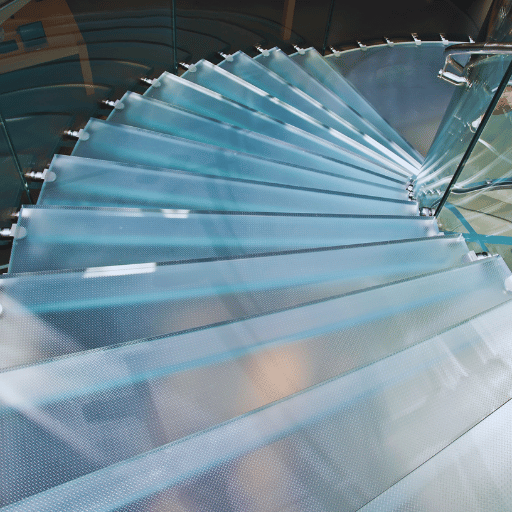
The float glass process – also called the Pilkington process after Sir Alastair Pilkington, who developed it commercially in 1959 – is the technique used to produce virtually all flat glass today. About midway through the conditioning zone of the furnace, 1,100 C glass flows onto a bath of molten tin housed in a sealed, nitrogen-fired chamber. Gravity and surface tension flatten the glass into a perfectly flat, fire-polished ribbon with optical purity on both faces.
Inside, the tin bath averages 3-4 meters wide, 50 meters long, and 6 cm deep. Tin remains molten through the working temperature range (melting point 232 C, Boiling Point 2,602 C) and is more dense than the glass: the ribbon floats on top as opposed to sinking to the bottom. A controlled gate (known as a “tweel”) meters the volume of molten glass onto a bath of molten tin. The glass ribbon enters the tin bath at roughly 1,100 C and leaves at 600 C – cool enough to enable top rollers to manipulate with and move without surface pressure being caused.
Top roller thickness commands are determined by current. When the ribbon is released to spread freely on the tin, the natural equilibrium needle is approximately 6-7 mm. To reduce the final flat glass sheets to somewhere down to 0.4 mm for electronic use, powered top rollers elongate the ribbon themselves crossways and diagonally. To produce beefier panels (up to 25 mm), edge restraints and slower draw speeds allow the glass to pool deeper.
0.4 – 25 mm
Thickness range achievable on modern glass float lines
~600 °C
Exit temperature from tin bath
6,000 × 3,660 mm
Maximum jumbo sheet size from a float line
Float forming replaced earlier plate-glass procedures that required extensive grinding to secure optical flatness. As the surfaces of the ribbon form against either molten tin or open atmosphere, the faces arrive with nearly perfect parallelism and absolutely no distortion – a characteristic which makes float glass the foundation for nearly every architectural glazing system, from insulated glass units to 3D curved glass panels.
According to Pilkington, a single float line can generate more than 6,000 tonnes of glass per week. Glass production at this scale runs continuously – a float furnace, once initiated, operates continuously for 12-18 years.
Step 4 — Annealing and Controlled Cooling
Once the glass ribbon leaves the tin bath at roughly 600 C, it moves into an annealing lehr – a bore tunnel oven more than 100 meters long. At this point, the objective is to eliminate internal stresses that developed as the outside surface of the glass cooled faster than the interior during the float process. Insufficient control over annealing would make the glass structure dangerously unstable during cutting and handling, and prone to breaking spontaneously.
Within the lehr, four functioning zones control the cooling schedule:
- Heattng / equalization zone – the glass is brought up to a uniform temperature at or slightly above the annealing point (~555 C for soda lime glass).
- Soaking zone – the glass retains the annealing temperature long enough for viscous flow to relax about 95 % of residual stress. Three minutes at the annealing point eliminates the vast majority of internal stresses for normal soda-lime compositions.
- Slow-cooling zone—cools the ribbon at a determined rate (many times 2-4 C a minute) through the critical interval between the annealing point (about 555 C) and the strain point (about 515 C). Cooling at too rapid a pace within this interval reintroduces permanent stress.
- Rapid-cooling zone- after the strain point, the glass cools more rapidly to ambient temperature because it cannot build any more permanent stress at these lower temperatures.
💡 Why This Step Matters for Buyers: Poorly annealed glass carries hidden residual stress that only reveals itself later — during cutting (unexpected crack propagation), during tempering (spontaneous breakage in the furnace), or after installation (delayed fracture from thermal cycling). At saiweiglass, every production run passes through polariscope inspection after the lehr to verify stress levels before the glass advances to cutting.
In the cooling process, the temperature must remain uniform across the entire width of the ribbon. Edge-to-center temperature differentials greater than a few degrees result in permanent warp rendering the sheet unsuitable for architectural glazing. Contemporary lehrs employ independently controlled heating elements in a number of lateral zones, infrared sensors delivering immediate feedback to the controlling computer.
What exits the lehr is called annealed glass – each sheet of glass now is in the base state from which all subsequent fabrication (cutting, tempering, laminating, coating) begins.
Step 5 — Cutting, Grinding, and Edge Processing
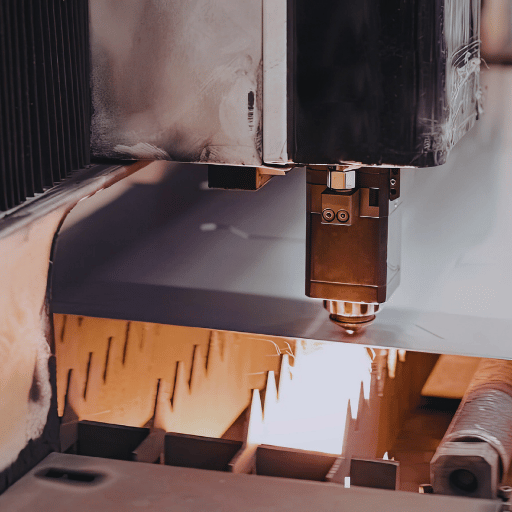
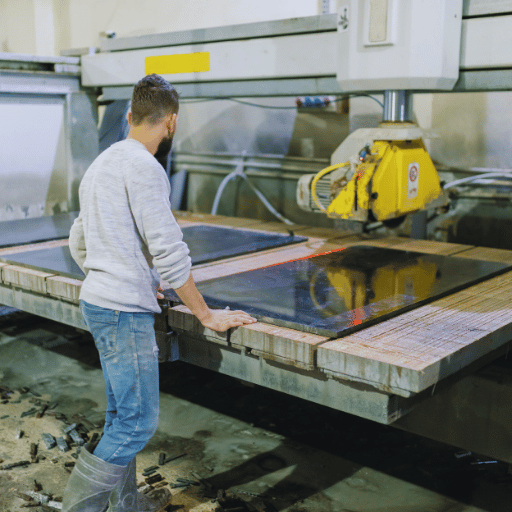
Following the annealed ribbon then leaves the lehr in the ambient condition of temperature, it is automatically cut and scored into stock sheets (usually up to 6,000 3,660 mm); from stock sheets to ordered panel is then cut by CNC scoring wheel as designated by pattern to be scored, followed by a precision mechanical snap along the scored line for dimensions and aesthetics.
Edge processing is carried out to the cutting side. Choice of which edge finish to use depends upon the end application:
| Edge Type | Description | Typical Use |
|---|---|---|
| Seamed (swiped) | Light abrasive pass to remove sharp arrises | Hidden edges in framed glazing |
| Flat ground | Machine-ground flat with a matte finish | IGU assembly, butt-joint glazing |
| Flat polished | Ground then polished to a transparent finish | Frameless shower enclosures, tabletops |
| Pencil (C-edge) | Slightly rounded, semi-polished profile | Shelving, display cases, mirrors |
| Beveled | Angled chamfer along the face edge, polished | Decorative mirrors, high-end furniture |
| Mitered | 45° angle cut for corner joints | Frameless glass corner assemblies |
Grinding or polishing is performed with diamond-impregnated wheels at controlled speeds. Coarse grits (80-120) are used for rapid stock removal; finishing grits (400-800) provide a glassy mirror surface for polish or bevel profiles. Water coolant flushes glass slurry and prevents thermal cracking during grinding.
ASTM C1036 established the visual and dimensional quality standards for flat glass for visual acceptable edge chipping, surface scratches and optical warpage. Except aging for the acceptable large architectural panes mentioned in the standard,3,3,3 seeds,3 scratches,3 surface debris spots should be separated from each other by the distance of 610 mm (24 in.) when viewed from 3m under daylight condition.
Custom shapes (such as arcs, notches and bolt-holes) are prerequisites to a CNC routing or waterjet cut before the starting point of edge working. Custom curved glass panels (demanding very small bending tolerances) need especially careful interaction between the cut geometry and the downstream bending tolerances.
Our edge inspection checklist also detects chip sizes greater than 1mm along with any polishing marks floating at a glance. We also perform 100% visual inspection on every panel prior to faxing to tempering.
Step 6 — Tempering and Secondary Processing
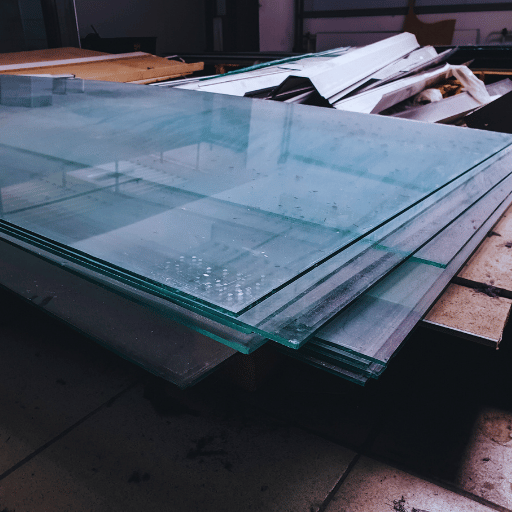
Tempering is the heat treatment that transforms annealed glass into safety glazing suitable for high-traffic and code-required use. The tempering cycle is simple in theory but requires very accurate and exacting control: reheat the cut glass panel until it just begins to soften, around 620 C then dramatically cool it by jets of high-pressure air blowing onto both faces simultaneously. The fast cooling preserves compressive stress in the surfaces while the panel’s interior is in tension, yielding a finished product four to five times stronger than the annealed stock sheet.
When tempered does break, the stress energy stored in the glass causes the break to result in many small, roughly cuboid granules rather than sharp, dagger-like shards like annealed glass will produce. It is this break pattern that accounts for glass being classified as safety glazing by ANSI Z97.1 in North America and by EN 12150 standards in Europe. Both standards call for a fragment count test where an specified number of granules being visible in a 50 50mm region after center punch breakage.
| Property | Annealed Glass | Tempered Glass | Laminated Glass |
|---|---|---|---|
| Relative strength | 1× (baseline) | 4–5× stronger | Varies (depends on glass type) |
| Break pattern | Large, sharp shards | Small, blunt granules | Cracked but held by interlayer |
| Can be cut after processing | Yes | No — will shatter | No (without special methods) |
| Thermal shock resistance | ~40 °C differential | ~200 °C differential | Same as component plies |
| Safety standard | ASTM C1036 (quality only) | ANSI Z97.1 / EN 12150 | ANSI Z97.1 / EN 14449 |
| Sound insulation | Low | Low | High (PVB interlayer dampens sound) |
A key, but important piece of information for project managers; tempered glass may not be cut, drilled or notched after the tempering cycle. Every hole, notch, and edge shaping has to be done on the annealed sheet prior to coming to tempering furnace. Attempting to modify tempered glass triggers instantaneous full-panel breakage.
Final fabrication drawings are also required to be approved well in advance of incoming sheet for production drawings, any change orders after tempering, would have to be a whole new panel
Beyond tempering, secondary processing steps add further performance characteristics:
- Laminating – the process of bonding two or more plies of glass with either a PVB or SGP interlayer used for impact resistance, sound control, and UV blocking.
- IGU assembly—bonding two or three panes with spaced bars and gas fills (argon or krypton) into thermal insulators.
- Low-E coating- the deposits of metallic oxide layers on the glass by magnetron to make reflect of infrared but transmit of visible ray.
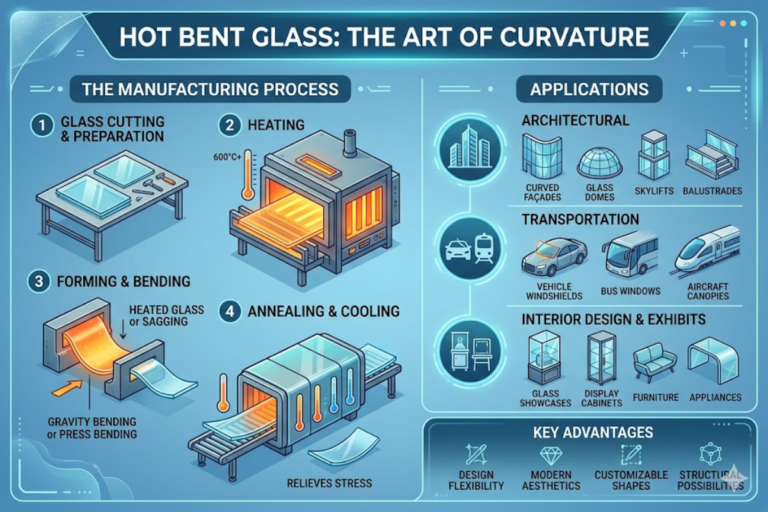
- Bending / curving—flat sheets are heated to the softening point and then formed over molds to produce saiweiglass 3D curved glass for facades, skylights, and interior features.
Each of these secondary steps has a corresponding quality standards and inspection protocol. For example, glass tempering is subject to fragments, surface stress (should be over 69 Mpa for fully tempered glass), and optical distortion, tests. At saiweiglass, all of the tempered panels are fragment- tested on a sampling basis for each production lot, and the surface-contact refractometer-measured for each stress.
Frequently Asked Questions
Q: What is the glass fabrication process?
View Answer
The glass fabrication process is the factory production flow which takes silica sand and other raw materials into finished glass panels. This flow covers 6 primary stages, namely raw material batching, furnace melting at 1,500-1,700 C, float forming on a heavy bed of molten tin, annealing within a temperature-controlled lehr, exacting cut and edging processes, and among tempering or else other secondary treatments. This flow design is all on a get-to-gether production line of 24 hour daily running.
Each formation process should be using a sequence based on a former one and no one formation process should be gone around or even rushed as it take as in the annealing step to show reject rate for more than 50%.
Q: What raw materials are needed to make glass?
View Answer
Soda lime glass has inputs of silica sand (70-75 % wt.), soda ash (12-15 %), limestone (8-10 %), and recycled glass cullet (15-25 %)… Soda ash, and limestone, contribute to the reduction of the melting point. limestone adds durability to the mixture…
Q: How is float glass made?
View Answer
Float glasses are formed by pouring molten glass onto a chamber of molten tin. The chamber is sealed and the blind is covered by molten tin. When the molten glass makes contact with the denser tin it floats and is further spread into a flat ribbon with fire polished surfaces on both sides. Thickness is controlled by the draw speed and top rollers. Commercial float glass manufacturing began in 1959 by engineers at Pilkington and continues to be the world standard for producing flat glass sheets with superior optical quality. Sheets from 0.4 mm to 25 mm thick can be produced this way.
Q: What is the difference between annealed and tempered glass?
View Answer
Annealed glass is slowly cooled in a lehr; this is the regular orthogonal “base” for all flat glass. Tempered glasses are annealed; though this is the standard “safety” condition for all flat glass, it must be deliberately produced ( heated back to ~620 C and spontaneously “quenched” with jets of air, in order to create a “surface layer” of compression). Some key practical attributes: tempered glass will break into unpredictable small granules; it has superior application performance in that it resists thermal shock up to ~200 C and can be cut or drilled; while its application in the final building piece it is not quite as effective or common as annealed, it will create unsafe, sharp pieces on breakage. Anneaed glass varies with application, retains its shape but breaks into dangerous sharp pieces; it suffers from a lack of thermal shock display and hotglue resistance. Building codes require tempered (or laminated) glass at dangerous locations; Entry ways (door and atrium panels), low elevation all around the skin, and anywhere a falling, semi-hard object poses a risk. Anneaed glass is being substituted by annealed for non-safety applications (cabinetry, partitions, etc) and creating laminated (6m thick layer or more) in double glazed glass for safety applications. The general cost of a tempered glass is approximately 15-30% higher than an equivalent structure annealed product…
Q: What are the properties of glass that matter for B2B projects?
View Answer
For B2B architectural and industrial projects, the critical properties of glass include: mechanical strength (tempered vs. annealed ratings), thermal performance (U-value, SHGC for IGUs), optical clarity (distortion level per ASTM C1036), safety rating (ANSI Z97.1 or EN 12150 compliance), chemical resistance to cleaning agents and atmospheric exposure, and dimensional tolerance. Durability under sustained wind load and thermal cycling is also important for curtain wall and facade applications.
Q: What types of glass are used in commercial construction?
View Answer
Commercial construction specifies several glass types: tempered safety glass for storefronts and glass doors; laminated glass for overhead glazing and balustrades; low-E coated insulated glass units (IGUs) for curtain walls and windows; spandrel glass for concealing floor slabs; fire-rated glass, acoustic glass, and curved glass. Tempered glass accounts for roughly 36 % of global flat glass revenue, while architectural applications as a whole represent over 71 %.
Q: How do you choose a custom glass fabrication partner?
View Answer
When evaluating a custom glass fabricator, use the following five criteria: (1) equipment capability- do they operate the necessary equipment, such as a tempering furnace, a laminating line, and CNC cutting stations? (2) certifications- inquire about their certifications, perhaps SGCC, IGCC/IGMA, and ASTM/ANSI compliance. (3) quality control- seek out fragment-test reports, stress measurements, visual-inspection documentation. (4) lead-time history- ask for references to other commercial projects. (5) specialty capacity- if your project entails bent glass, large-format panels, or complex shapes, make sure they have experience with these glass solutions. If you need curved architectural glass, investigate 3D curved glass from manufacturers who have already proved their know-how, such as saiweiglass.
Q: How is glass manufactured at scale for architectural projects?
View Answer
In scale, glass is made by the continuous float process. More than 6000 tonnes of raw glass per week are produced on a single float line with 24 hour, 7 days/week operations for 12-18 years between furnace rebuilds. Jumbo sheets of up to 6,000 x 3,660 mm are cut from the ribbon and routed to fabrication shops or tempering, laminating, IGU assembly, or coating tasks.
Contemporary glass manufacturing operations rely on batch weighing automation, live furnace control, and inline optical defect scanning measurements to achieve quality consistency across millions of square meters of yearly output.
Need glass fabricated to your project specifications?
Our company saiweiglass takes care of everything that is from the raw float glass to tempered up, laminated, and curved, for 1X or more. Delivered to your site on time.
About This Guide
This glass fabrication process manual was developed by the saiweiglass technical content team based on firsthand production-floor knowledge from our float glass, tempering and laminating facilities. All data points come frompublished industry standards, (ASTM, ANSI, EN) and peer-reviewed sources. In describing our specific practices – batch screening, defect inspection, edge-quality checks – those are representative procedures used at our own facilities.
References & Sources
- Britannica — Soda-Lime Glass
- Pilkington — The Float Process Step by Step
- ASTM C1036-21 — Standard Specification for Flat Glass
- ANSI Z97.1-2015 (R2020) — Safety Glazing Materials in Buildings
- Wikipedia — Soda-Lime Glass
- Wikipedia — Float Glass
- Wikipedia — Tempered Glass
- Wikipedia — Annealing (Glass)
- Glass Packaging Institute — Facts About Glass Recycling
- Grand View Research — Global Flat Glass Market
- Glass Technology Services — 7 Types of Glass Defects
- Lehigh University — Annealing and Tempering (IMI-NFG Course)
- CTCN (UNEP) — Glass Recycling Technology
- ScienceDirect — Glass Furnace (Engineering Overview)