Get in Touch with Saiweiglass



Quick Specs
| Definition | Glass substrates below 1.0 mm thickness |
| Thickness Range | 0.03 mm (30 µm) to 1.0 mm |
| Price Range | $8–$300+ per square foot (varies by thickness and chemistry) |
| Common Chemistries | Soda-lime, borosilicate, aluminosilicate |
| Key Applications | Foldable displays, semiconductor wafers, optical coatings, lab substrates |
| Market Size (2025) | $13.95 billion globally, 9.36% CAGR |
Ultra-thin glass transitioned from a niche laboratory material to one of the world’s leading growth segment in advanced manufacturing. Globally, the ultra-thin glass market was worth $13.95 billion in 2025 360iResearch market data, and is growing 9.36% per year. However, buyers have continually been faced with a difficult reality: published pricing for glass sheets less than 1.0 mm is effectively nonexistent.
Glass pricing guides for the most part mention tempered, laminated, or architectural glazing glass (often from manufacturers mentioned above), but do not often list the substrates of choice for electronic, optical, or metrological applications.
This detailed breakdown will be a useful resource. A table lists the typical price ranges by thickness category and type of glass, while another table highlights five key cost drivers for ultra-thin glass, providing tips to save money and maximize value on volume orders. If you are evaluating ultra-thin glass products for display, semiconductor, or industrial applications, these figures give you a realistic budget baseline before requesting formal quotes.
What Defines Ultra-Thin Glass — and Why Thickness Matters for Price
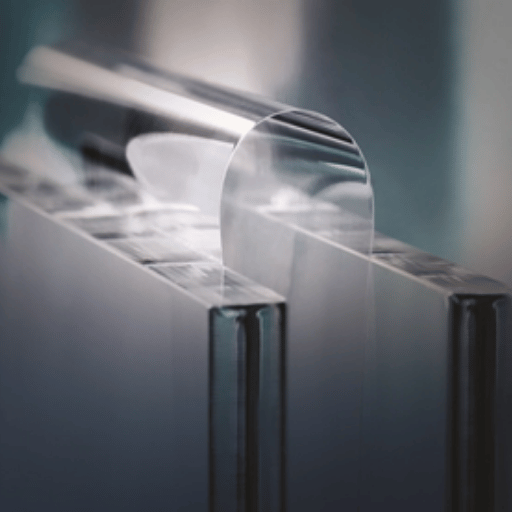
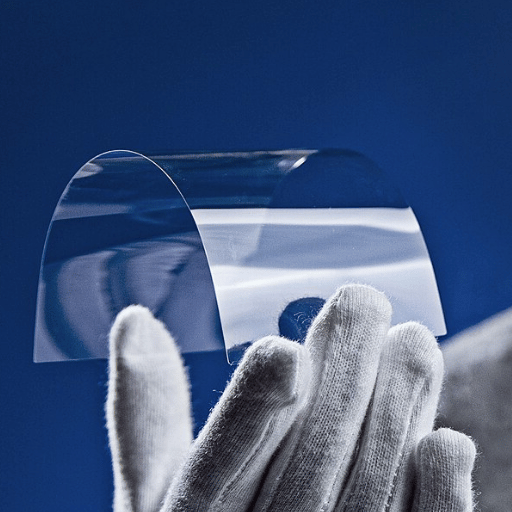
Ultra-thin glass: a flat sheet of glass, regardless of chemistry, measuring less than 1.0 mm thick. Some producers define it as being just under 30 µm thick (0.03 mm; roughly the thickness of a strand of human hair). Various glass chemistries exist at this level and are economically quite different, depending on the raw material makeup, glass features, and the application challenges.
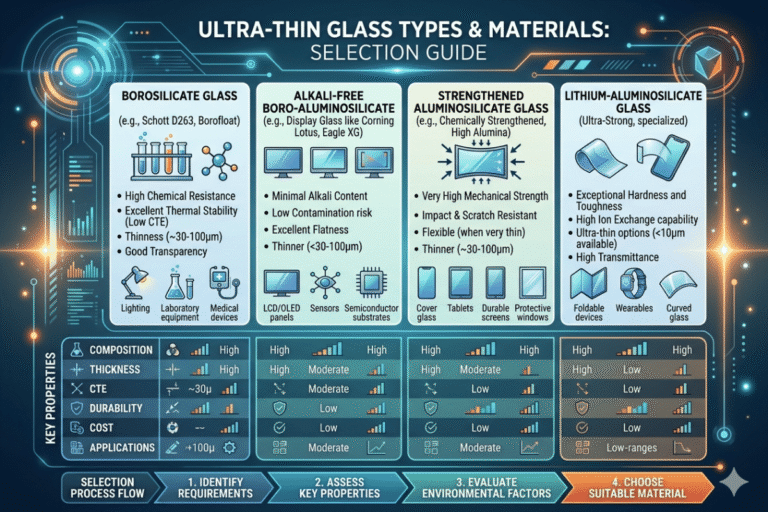
Performance envelope and price category are both set by a type of glass, because glass thickness directly determines manufacturing difficulty. Soda-lime glass (same chemistry used in windows and any clear glass panel) makes up roughly 46% of revenue for ultra-thin glass, as of 2025, according to Mordor Intelligence. Borosilicate glass (CTE around 3.3 × 10⁻⁶ K⁻¹) will be used if thermal stability is needed, such as in semiconductor wafer processing, which sees ~500 °C temperature cycles.
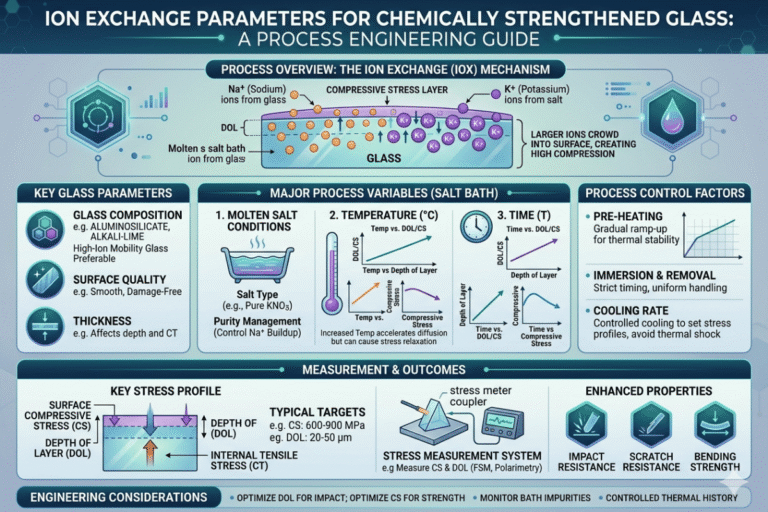
Aluminosilicate (the chemistry behind any foldable phone glass screen), will be chemically strengthened to surface compression over 800 MPa, making it the most expensive per sq. ft.
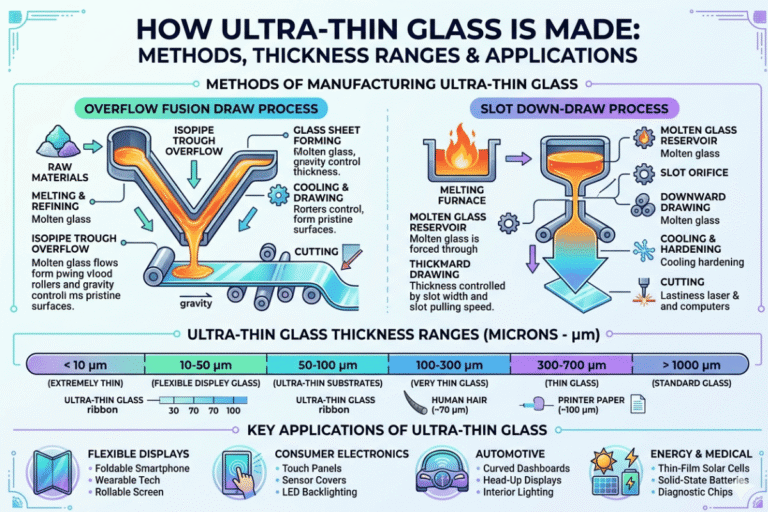
Manufacturing processes also differ with respect to thickness. The fusion draw process (e.g. Corning Willow Glass substrate with 100-200 μm thickness) yields defect-free surfaces compatible with optical standards; Doped down-draw processes have surface roughness under 0.5 nm.
Typical float glass lines cannot reliably manufacture under 0.4 mm flat glass without a secondary reduction process (chemical etch or mechanical polish) which increases cost.
To get a detailed insight into the production of these substrates, see our guide on how ultra-thin glass is made.
💡 Key Takeaway
Thickness and glass chemistry are the major two cost drivers. 0.5mm soda-lime glass versus 0.05mm aluminosilicate glass are two very different price ranges even though they both belong to the ‘ultra-thin glass’ category.
Ultra-Thin Glass Price by Thickness and Glass Type
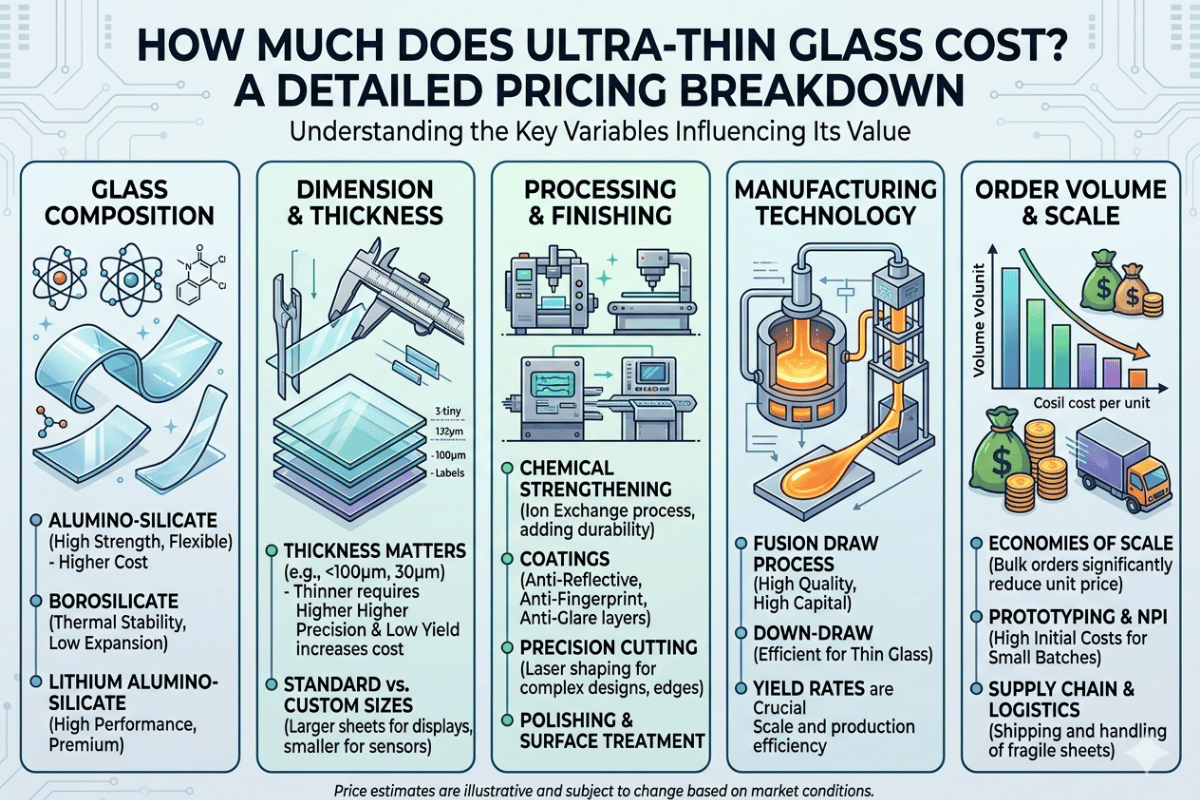
Ultra-thin glass prices range from below $8 per sq ft for relatively thick (around 1.0 mm) soda-lime substrates to several hundred dollars per sq ft for chemically strengthened aluminosilicate below 100 µm. Sources for this pricing include supplier catalog compilations, current B2B quotes, and published market indexes. Actual pricing is a function of quantity, edge finishing, and coating, so glass costs can vary widely even within the same thickness tier.
| Thickness Tier | Soda-Lime ($/sq ft) | Borosilicate ($/sq ft) | Aluminosilicate ($/sq ft) |
|---|---|---|---|
| 0.5–1.0 mm | $8–$18 | $20–$45 | $35–$65 |
| 0.1–0.5 mm | $15–$40 | $35–$80 | $60–$150 |
| <0.1 mm (UTG) | $40–$90 | $80–$200 | $150–$300+ |
| Chemically Strengthened UTG | N/A | $120–$250 | $200–$400+ |
NOTE: All prices are based on B2B wholesale per-unit rates for orders of 100 or more. Retail and small-lot prices can vary by 2-3x higher. Specialty coatings, custom cut glasses, and non-standard sizes all carry additional per piece surcharges.
To put this into perspective, most architectural glass falls far below those prices. Regular clear float glass (.75-2 in) “can generally be had at a price of between $3-$5 per sq. foot” while “costs for standard thickened, tempered glass were between $8-$12 per sq. foot ( Mannlee Construction & Windows 2026 pricing data)”. Prices can vary sharply because ultra-thin glass requires more accuracy in manufacture and specific glass chemistries, unlike thicker glass used in standard glazing.
3–10×
Price premium over standard glass
$13.95B
Global UTG market (2025)
46%
Revenue from soda-lime UTG
5 Factors That Drive Ultra-Thin Glass Cost Higher
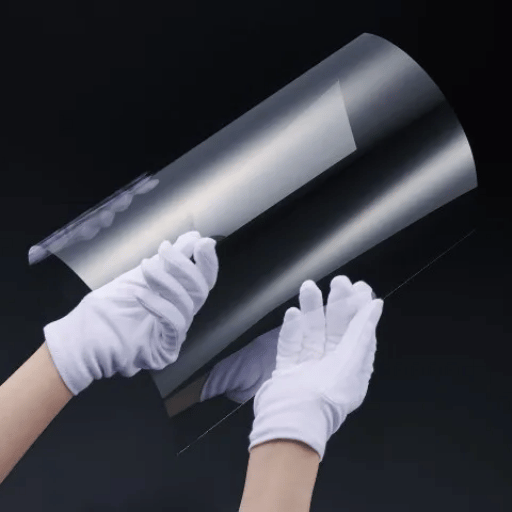
Five variables that drive glass costs higher need consideration for ultra thin substrates. Knowing these factors before requesting quotations helps engineers specify only what is truly required for a given application:
1. Thickness tolerance and yield loss The lowering of the thickness of a glass sheet to below 0.5 mm induces a higher breakage risk during manufacturing processes. For example, yield on sub-100 µm substrates on a precision draw line can be less than 70%, so the glass manufacturer is faced with proportionally high wastage.
For example, thickness tolerance in SCHOTT AS 87 eco can be maintained within ±5 µm from 50 µm to 350 µm, requiring constant process control. Tighter tolerances increase the glass unit cost.
2. Glass Chemistry. Our least expensive glasses are soda-lime, due to the abundance of readily available raw materials (silica, soda ash, limestone) in combination with proven float/microfloat manufacturing lines.
Borosilicate has a higher cost associated with it due to the addition of boron oxide to the mix, and the resultant higher melting point. Aluminosilicate ranks the highest in cost, since alumina feedstock must be added, and for foldable display applications, a follow-up ion-exchange strengthening process is performed for an additional $20-$50 per sq. ft. on top of the base cost of the glass.
3. Edging and Fabrication. Raw-cut glass sheets have rough, sharp edges unsuitable for most precision applications.
A seam along each edge removes those sharp portions before use. Flat-polishing edges for optical or display applications costs a 30-60% premium over seamed finishes. Custom cuts with drilled holes or notches result in higher material loss because of breakage potential on thin glass substrates.
Each added etch or polish step extends normal processing time.
4. Surface coating and treatment. Anti-reflective (AR) coatings, indium tin oxide (ITO) coatings for touch sensors, and low-e coatings for energy efficient glass can cost you anywhere from 5 to 40 dollars per square feet depending on how many layers you need.
Single side AR coating of 0.3 mm borosilicate may cost you 8 to 15 per square feet and multi layer ITO stacks used for display cover glass can cost even more than 30 per square feet.
5. Volume and customization. Standard sizes of glass (available at most firms—commonly 100 × 100 mm, 150 × 150 mm, or full sheets) are cheaper than custom cuts since they do not require tooling set-up and waste fewer pieces.
Volume discounts are established at 500+ pieces for standard size and 1,000+ pieces for custom cut glass. By order of several standard sizes at once in one p.o. per one standard size, one can save between 15 and 25% in comparison with small lots purchasing.
📐 Engineering Note
If your thickness target is below 100 µm, be sure to obtain the manufacturer’s yield data for your desired thickness tolerance band. For example, a ±10 µm tolerance at 50 µm substrate thickness is 20% of the nominal—far more stringent than ±10 µm at 500 µm (2%). This ratio will directly affect the costs, so be sure to inquire what the fabrication yield bands are for your project. ASTM C1036 and related industry standards cover thickness classes and tolerances for flat glass.
Ultra-Thin Glass vs. Standard Glass Types: Price and Performance
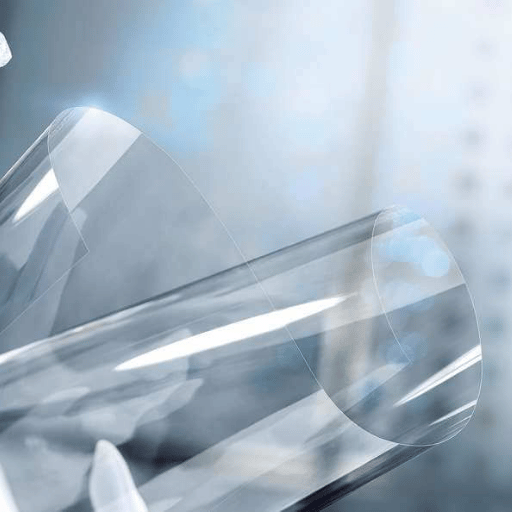
Most buyers compare ultra-thin glass to more common glass type products that they are familiar with. Since the thinnest sheet in a typical glass shop might be 2-3 mm tempered glass, industrial customers now procuring thicker glass alternatives at less than 1.0 mm find the material properties start to vary widely.
| Property | Soda-Lime Float | Tempered Glass | Laminated Glass | UTG Borosilicate | UTG Aluminosilicate |
|---|---|---|---|---|---|
| Typical Thickness | 3–12 mm | 3–19 mm | 6–12 mm | 0.03–0.5 mm | 0.03–0.35 mm |
| Price ($/sq ft) | $3–$5 | $8–$12 | $15–$25 | $35–$200 | $60–$400+ |
| Flexural Strength | 40–50 MPa | 120–200 MPa | 40–50 MPa (pane) | 80–120 MPa | 400–800+ MPa (strengthened) |
| CTE (ppm/°C) | 8.5–9.5 | 8.5–9.5 | 8.5–9.5 | 3.2–4.0 | 3.6–4.6 |
| Max Service Temp | 250 °C | 250 °C | 120 °C (interlayer limit) | 500+ °C | 600+ °C |
| Shatter Behavior | Sharp shards | Small granules (safety glass) | Held by interlayer | Fine fragments | Controlled fracture (strengthened) |
| Primary Applications | Windows, picture frames | Shower doors, table tops, glass railings | Automotive, curtain walls, safety glazing | Lab substrates, MEMS wafers, optics | Foldable displays, cover glass, sensors |
Tempered glass is 4-5 times stronger than annealed glass because the tempering process heats the glass to roughly 620 °C and rapidly cools it. However, thermal tempering cannot be applied to glass below about 3 mm thickness because the cross-section is too thin to develop an adequate compressive surface layer. For this reason, applications requiring sub-millimeter glass must rely on chemically strengthened or untempered substrates. Toughened glass and clear tempered panels mass-produced for shower enclosures, tabletop surfaces, and railing systems occupy an entirely different product category from ultra-thin industrial substrates, where safety and strength requirements differ fundamentally.
Borosilicate glass is renowned for its low thermal expansion of approximately 3.3 × 10⁻⁶ K⁻¹ compared to 9.0 for soda-lime, as documented in the borosilicate glass technical profile. This low thermal stress makes it the standard choice for laboratory equipment, semiconductor fabrication, and precision optical instruments where temperature cycling would crack soda-lime alternatives.
✔ Advantages of Ultra-Thin Glass
- Can be reduced by up to 60-90% when compared to standard glass of same area
- Flexibility enables curved, rolled, or folded form factors
- Higher optical transmission (fewer internal reflections in thinner pane)
- Better hermetic sealing than polymer films for OLED encapsulation
- Has a design temperature of 600 °C (aluminosilicate) versus 120 °C of plastic films
⚠ Limitations to Consider
- Is significantly more expensive per unit area: factor 3-10 beyond regular glass
- Greater risk of breakage during handling and shipping
- Limited availability of custom shapes below 0.1 mm thickness
- Requires specialized packaging to prevent damage in transit
- Is not thermally toughenable beneath 3 mm-chemical strengthening is the sole method for load-bearing substrates
How to Get the Best Value on Ultra-Thin Glass Orders
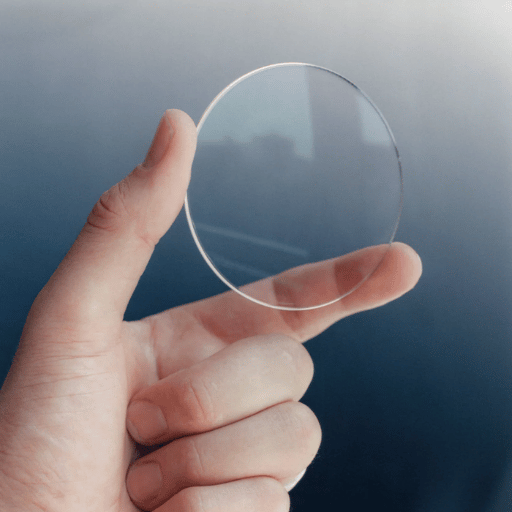
The prices for identical specifications may differ by 40-60% between different suppliers, so choosing your supplier is just as important as choosing a specification. The accompanying table highlights the five parameter selections that account for the most variance in price.
- ✔
Specify standard sizes first. Common formats (100 × 100 mm, 150 × 150 mm, 200 × 200 mm, 300 × 300 mm) cost 20–35% less than custom dimensions because they avoid setup changes. Match your design to available in thicknesses and standard sizes before requesting custom glass. - ✔
Consolidate edge finishing requirements. If your application tolerates a seamed edge rather than flat polished or beveled finishes, you eliminate 30–60% of the edge finishing cost. Specify the minimum acceptable finish quality. - ✔
Order at volume discount thresholds. Most suppliers offer tiered pricing at 500, 1,000, and 5,000+ piece breakpoints. Ordering multiple SKUs in a single PO often qualifies for volume requirements even if individual item counts are small. Volume discounts of 15–30% are standard for orders above 1,000 pieces. - ✔
Question whether you need the tightest tolerance. A ±15 µm tolerance versus ±5 µm on a 200 µm substrate can mean 25–40% cost difference. Many commercial projects accept the wider tolerance without performance degradation. - ✔
Evaluate chemistry alternatives. If your application does not require sub-4 ppm/°C thermal expansion or insulate against high temperatures, soda-lime ultra-thin glass delivers the most cost-effective option per square foot. Switching from borosilicate to soda-lime where thermally acceptable can cut material cost by 40–60%.
💡 Pro Tip
When requesting detailed quotes from specialty glass suppliers, always specify thickness, tolerance band, glass chemistry, edge treatment, quantity, and delivery timeline upfront. Incomplete specifications lead to conservative (higher) pricing because suppliers assume worst-case requirements.
Application-Specific Pricing: From Lab Substrates to Display Covers
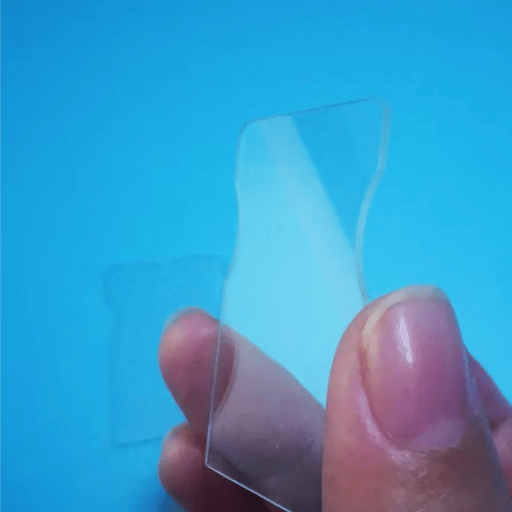
Glass solutions have very different performance and cost characteristics across application markets. A glass sheet intended to hold a microscope slide in a lab application might cost much less than one designed as the cover of a foldable smart phone. Glass is often used across these segments at very different price points, and understanding which market your project sits in helps you avoid over-specification.
| Application | Typical Glass Type | Thickness | Price ($/sq ft) |
|---|---|---|---|
| Lab cover slips / microscope slides | Soda-lime (clear float glass) | 0.1–0.2 mm | $5–$15 |
| Optical filters / AR-coated substrates | Borosilicate (ultra-clear, low-iron) | 0.2–0.5 mm | $40–$100 |
| Semiconductor wafers / MEMS substrates | Borosilicate (MEMpax-type) | 0.1–0.5 mm | $50–$150 |
| Touch panel cover glass | Aluminosilicate (strengthened) | 0.3–0.7 mm | $30–$80 |
| Foldable display covers (UTG glass) | Aluminosilicate (chem. strengthened) | 0.03–0.1 mm | $150–$400+ |
| Flexible solar encapsulation | Flexible glass (low-e coating) | 0.1–0.2 mm | $25–$60 |
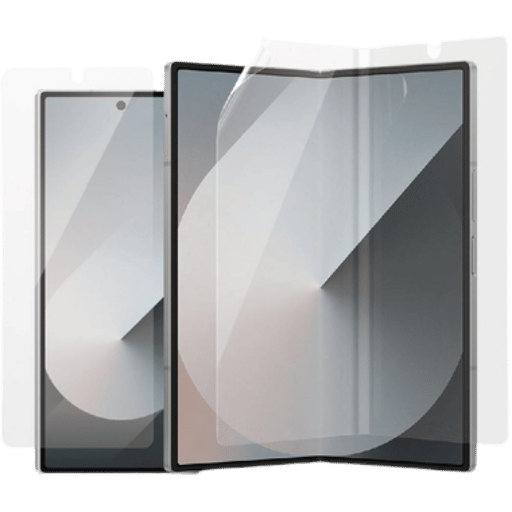
Ultra-thin glass for foldable displays sits at the top end of realistic market pricing. Substrates must survive over 200,000 fold cycles at a bending radius under 1 mm on a screen-sized panel while remaining optically clear and scratch-resistant, as documented in the Journal of Mechanical Science and Technology. That is the cost rationale for thinner (30-100 µm), chemically strengthened, defect-free surfaces.
In comparison, standard glass applications such as shower enclosures, glass railings, table tops use tempered or laminated glass at a 6-12 mm thickness-a completely different product range where pricing is driven by the residential and commercial construction market, including heating and cooling glass, tint, and frost treatments, rather than precision material specifications. Professional installation adds further cost in those segments.
⚠️ Common Specification Mistake
Requesting aluminosilicate when borosilicate will suffice results in 40-80% material cost waste. The only noteworthy exception is a mechanical flex in service, impact strength requirement above 200 MPa or full chemical strengthening. For static-use thin glass, the borosilicate / soda-lime substrate is the best value, especially for dynamic flex.
Frequently Asked Questions: Ultra-Thin Glass Pricing
Q: Is thin glass more expensive than standard glass?
View Answer
Yes. Ultra-thin glass below 1.0 mm runs 3–10 times the price of standard architectural glass. A 0.3 mm soda-lime sheet costs $15–$40 per sq ft versus $3–$5 for a 4 mm clear float pane.
Q: What is the thinnest glass you can buy?
View Answer
An ultra-thin glass sheet is available commercially down to 30 µm (0.03 mm). D 263 T borosilicate is available in thicknesses from 30 µm up to 1.1 mm for optical and electronic use through SCHOTT; in-house production has recently produced 16 µm, though it is not yet viable on a large production scale. For most industrial purposes, the practical minimum is 50–100 µm.
Q: How do you calculate ultra-thin glass price per square foot?
View Answer
Start with the base material cost for your chosen glass type and thickness tier. Apply coating surcharges ($5–$40/sq ft for AR or ITO layers), edge finishing additions (seamed versus flat polished accounts for 30–60%), and factor in volume pricing at your expected order quantity. Divide the total by the number of usable pieces accounting for yield loss in the production run. For substrates under 100 µm, add 10–20% for breakage allowance when processing.
Q: What factors make custom-cut ultra-thin glass cost more?
View Answer
If required, request CNC scribing capabilities and laser cutting processes modulated to the size of the delicate substrates, adding $50-$200 setup a pop to the fee. Cutting irregular shapes leads to increased material waste. For processing of glass below 0.3 mm thickness, a higher standard of drilling machinery used to penetrate holes and notches will introduce additional breakages. Factoring these concerns into the price per piece beyond the general rate is an important consideration.
Q: Can ultra-thin glass be chemically tempered?
View Answer
Yes, but only aluminosilicate and select borosilicate formulations permit effective chemical strengthening. Ion exchange immersion in a potassium nitrate salt bath at 380–450 °C forces larger potassium ions to replace smaller sodium ions in the glass surface, creating a compressive stress layer that increases surface strength to over 800 MPa. Chemical strengthening adds $20–$50 per sq ft and is the only viable method for strengthening glass below 3 mm, since thermal tempering cannot generate adequate thermal stress in thin cross-sections. Foldable smartphone covers at 30–50 µm thickness survive 200,000+ fold cycles at bending radii under 1 mm. Processing time runs 4–16 hours depending on target layer depth, and not all furnace operators can handle substrates below 0.1 mm without breakage losses.
Q: What minimum order quantity should buyers expect for ultra-thin glass?
View Answer
Different glass types and suppliers set OEM minimum order quantities. Standard catalog sizes (borosilicate or soda-lime glass) are often below 25-50 pieces. Custom specifications generally mandate 200-500 pieces. UTG type glasses for display tend to exclude less than 1,000 pieces because of the costs involved in tooling up. Price information can best be obtained by requesting quotes on 100, 500 and 1000 piece demand levels.
Need a quote for a certain ultra thin glass specification?
We can supply a custom quote within 24 hours.
About This Analysis
The pricing structure is based on supply chain catalog pricing data, B2B quotation analysis and published market research undertaken in the ultra-thin glass industry. Saiweiglass manufactures bespoke ultra-thin glass from borosilicate, soda-lime and aluminosilicate chemistries for display, semiconductor and industrial optics applications. Cost ranges shown illustrate 2025-2026 market conditions based on volume procurement, but actual supply chain costs will vary depending on the exact specifications, tolerance analysis and order quantities.
References & Sources
- Ultra-Thin Glass Market Size & Share 2026–2032 — 360iResearch
- Ultra-Thin Glass Market Size, Share, Growth & Industry Report — Mordor Intelligence
- Highly Flexible Cover Window Using Ultra-Thin Glass for Foldable Displays — Journal of Mechanical Science and Technology (Springer)
- Borosilicate Glass: Composition, Properties, and Applications — Wikipedia
- Glass Price per Sq Ft: What You Should Expect 2026 — Mannlee Construction & Windows