Get in Touch with Saiweiglass




Updated August 2026
Choosing an optical glass manufacturer is really two decisions, and most buyers only discover that after the first quotation comes back priced for something they didn’t ask for. An optical glass manufacturer is any supplier that produces or finishes glass whose optical properties are held to a stated specification, and that definition covers two very different kinds of company. One melts the glass. The other turns that glass into the part on your drawing. Fewer do both than the category name suggests, and the ranked supplier lists checked for this article don’t tell you which is which.
This guide fixes that. Twenty companies are profiled below, each tagged with the role it actually plays in the supply chain, whether it operates its own melting furnaces, and what it can and can’t quote. Every founding year carries the evidence behind it, because, as the checking for this article showed, ten of the twenty companies below carry a founding year that dates something other than the company you would actually be buying from: an invention, a predecessor trade, a rebrand or a separate incorporation. That’s a definitional problem more than a dishonest one, but it makes “years in business” a poor proxy for process maturity.
Note: Except for SW Glass, which is listed first as requested, the remaining companies are presented in no particular order. This article includes optical glass material producers, precision glass fabricators and custom optical component suppliers. Buyers should confirm the actual business type and production scope of each company before sourcing.
Ten Supplier Roles in the Optical Industry That All Call Themselves Optical Glass Manufacturers
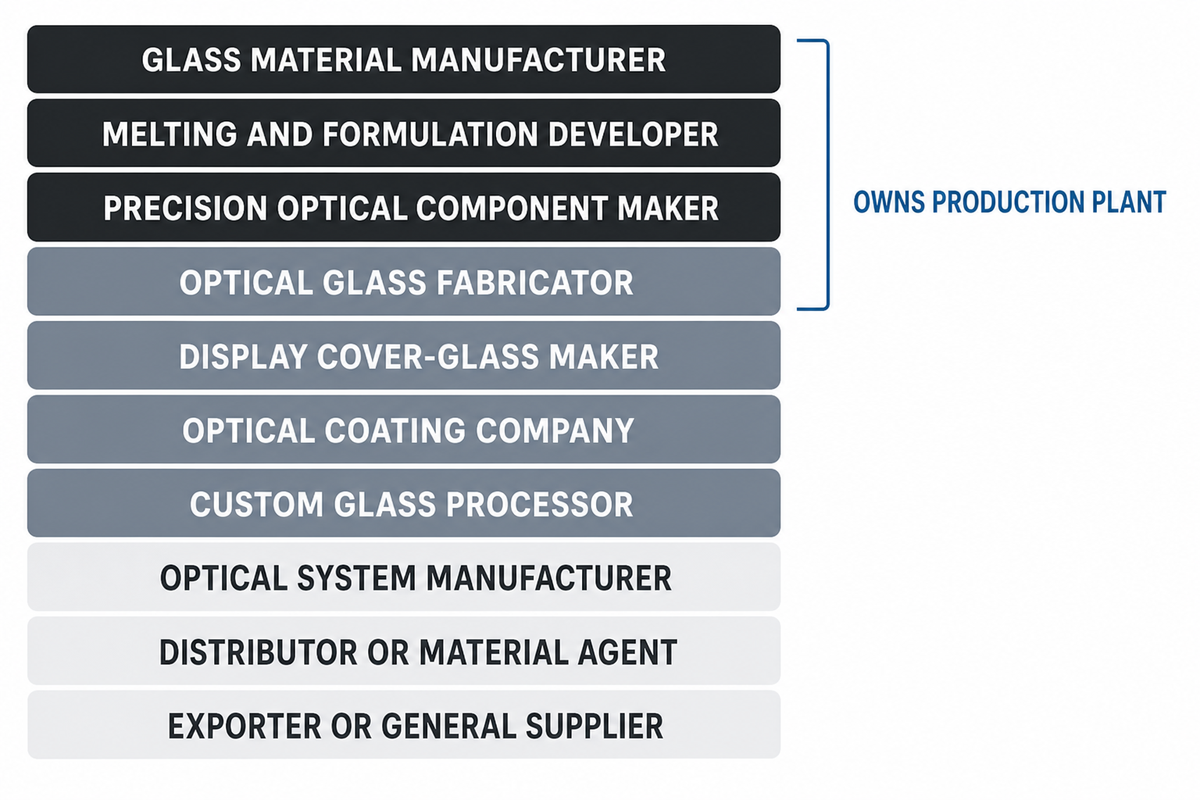
Ten distinct supplier roles sell under the same phrase. A furnace operator melting 300 tons a month, a shop polishing a 25 mm window to one-twentieth of a wave, a coating house that never cuts a substrate, and a trading agent holding no plant at all will each answer to “optical glass manufacturer” in a search box. The role decides what the vendor can quote.
That matters commercially because the roles fail differently. Send a finished-window drawing to a melter and you get a quotation for blanks, plus a polite note that finishing isn’t their business. Send a melt specification to a fabricator and you get a price built on somebody else’s glass, with the index and homogeneity inherited rather than controlled. Neither party has done anything wrong. The mismatch was in the shortlist.
| Role | What it physically owns | What it can quote | What it cannot do |
|---|---|---|---|
| Glass material manufacturer (melter) | Tank or pot furnaces, batch house, annealing lehrs | Raw glass, strip, blocks, pressings, preforms | Rarely quotes a finished polished optic to print |
| Melting and formulation developer | Composition laboratory plus melting capacity | A new glass type to a target index and dispersion | Cannot deliver quickly; new melts run on campaign schedules |
| Precision optical component manufacturer | Grinding, polishing, centring, interferometry | Lenses, prisms, windows, mirrors to a drawing | Cannot change the glass composition it buys in |
| Optical glass fabricator | Cutting, CNC machining, edging, drilling | Shaped flat parts, wafers, custom geometry | Not set up for sub-wave surface figure work |
| Display cover-glass manufacturer | Ion-exchange lines, printing, lamination | Strengthened cover lenses, touch panels, 3D shapes | Does not work to scratch-dig or wavefront specs |
| Optical coating company | Sputtering and evaporation chambers, spectrophotometry | Anti-reflective, filter, mirror and conductive coatings | Usually will not fix a substrate it did not make |
| Custom glass processing supplier | Mixed cold-working plant, often multi-material | Small-run custom shapes across many glass types | Limited metrology for optical acceptance criteria |
| Optical system manufacturer | Design, assembly, alignment, opto-mechanics | Lens assemblies and aligned modules | Component-only orders may be uneconomic to them |
| Distributor or material agent | Inventory and logistics, no production plant | Stock catalogue glass in small quantity, fast | Cannot influence melt lot, tolerance or schedule |
| Exporter or general supplier | Commercial office, subcontracted production | Almost anything, sourced from third parties | Traceability to a named plant is often unavailable |
The second row is the one buyers most often miss. A melting and formulation developer doesn’t just own a furnace; it owns compositions, and that ownership is visible in the public record: granted optical glass composition patents such as US9018116B2 are filed by the party that developed the melt, not by the shop that machines the result. If a vendor’s role is genuinely row two, there’s usually a patent family with its name on it.
One category sits deliberately outside this article. Optical fibre and communications glass (preform drawing, ultra-low-loss waveguide manufacture, and low-expansion substrates such as Corning ULE) is a separate supply chain with its own vendors, its own metrology and its own qualification cycle. It appears in the same searches because the words overlap, not because the buyers do.
Ten roles produce ten different quotation behaviours from one identical enquiry. A melter answers in glass types and melt campaigns, a fabricator answers in machining hours and tooling, and a coating house answers in chamber loads. Sorting the shortlist by role before the enquiry goes out removes the two-week round trip that a mis-sorted list guarantees.
The Furnace Question: One Test That Sorts Any Optical Glass Supplier
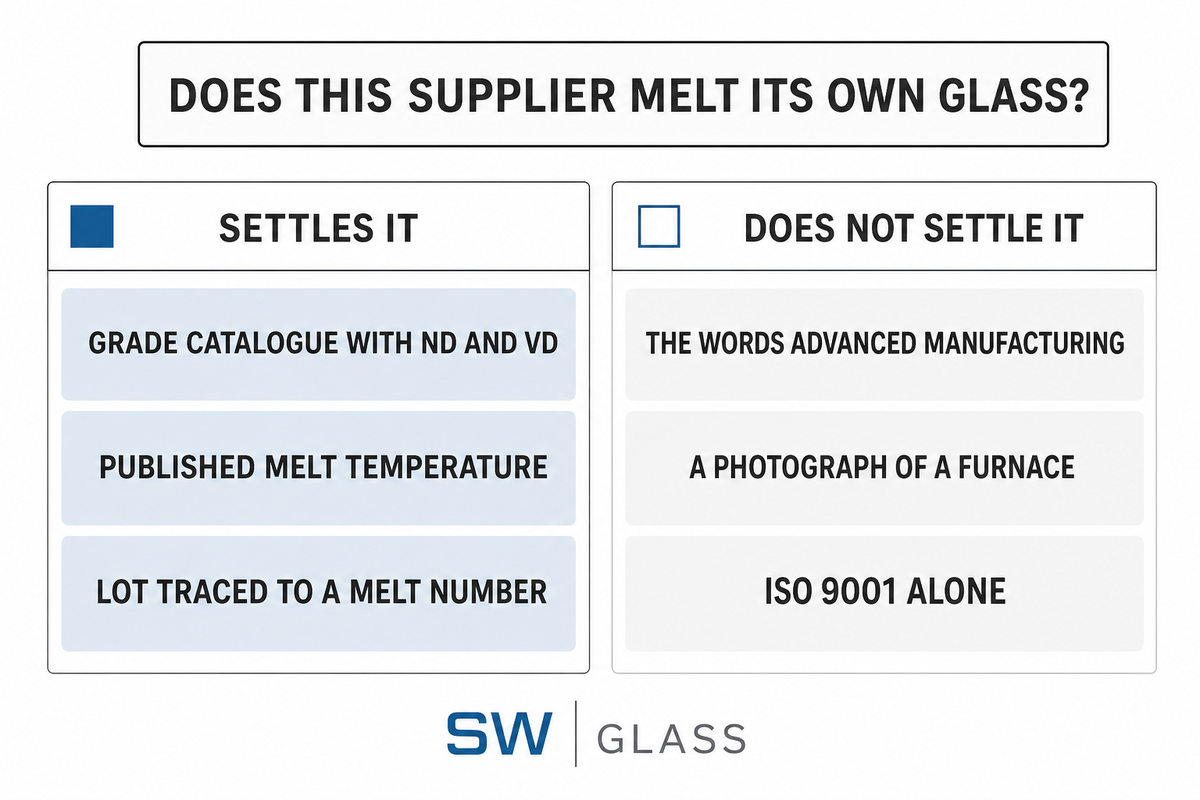
Three published artefacts separate a melter from a fabricator, and none of them can be faked with marketing copy. A downloadable catalogue listing refractive index and Abbe number per grade. A described melt-and-anneal process with real temperatures. Lot traceability quoted to a melt number. A company with all three runs furnaces. A company with none buys substrate.
The reason this works is that each artefact costs something real to produce. Publishing a catalogue of 120 glass types means committing to melt them. SCHOTT publishes melting of raw materials at up to 1,700 °C and continuous tank melting since 1911. OHARA publishes strip-glass melting between 1,000 °C and 1,450 °C, drain casting above 1,500 °C, and output of more than 300 tons per month. HOYA publishes a melting window of roughly 1,300 °C to 1,500 °C. Those numbers describe plant, and plant is expensive to invent.
Patent records give an independent second reading, because a composition patent is filed by whoever developed the melt. US9018116B2, “Optical glass”, assigned to Schott AG, carries a 2012 priority date. JP6505793B2, assigned to Chengdu Guangming Optoelectronics, carries a 2016 priority, and CN112159098B a 2020 priority. JP5729550B2, assigned to Nippon Electric Glass, dates to 2011, JP7371722B2, assigned to AGC to 2018, and JP6280015B2, assigned to HOYA to 2014. Across this sample, fabricators don’t file glass composition patents, because they aren’t designing glass.
The Furnace Question — what settles it and what does not
Settles it: a grade catalogue with index and Abbe number per type; a published melt temperature; annealing described as a controlled process; lot certificates quoting a melt number; a glass composition patent in the company’s own name.
Does not settle it: the words advanced manufacturing; a photograph of a furnace; a list of glass brands the company can work with; ISO 9001 alone; the phrase full production capability; decades of experience without a described process.
The second list matters more than the first, because it’s what most vendor pages actually contain. A page naming SCHOTT, OHARA and CDGM grades as available substrate materials is telling you, plainly, that the company buys glass from those three. That isn’t a criticism (it’s exactly what a fabricator should do), but it’s the opposite of what the same page’s heading usually implies.
One limit is worth stating plainly: knowing who runs a furnace does not by itself tell you who can make your part. Raw glass specification and finished component specification are separate layers (ISO 12123 governs the first and the ISO 10110 series the second), and converting a component requirement into a material requirement is its own step. The Furnace Question sorts vendors into the right column of the ten-role table; the drawing sheet further down decides which of them can quote.
The Furnace Question resolves a supplier in under ten minutes per vendor and costs nothing. Across the twenty companies below, the published evidence splits them 11 to 9: eleven operate melting furnaces, nine buy substrate and add value by machining, polishing or coating it.
All 20 Optical Glass Manufacturers and Precision Glass Suppliers at a Glance
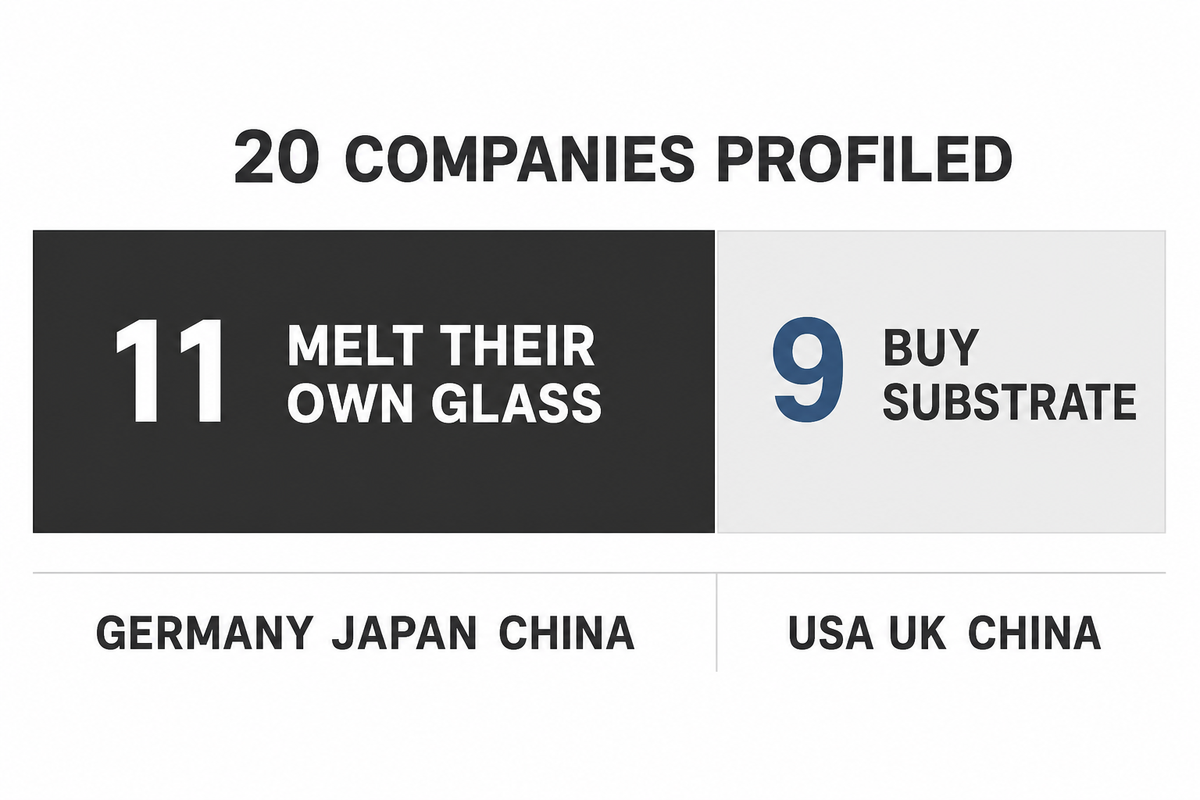
Twenty companies span four supply-chain positions: raw glass melting, fused silica and quartz, precision component manufacture, and fabrication with coating. The table records country, founding evidence, role and melting status. Where a company publishes no founding year, the row says so rather than repeating a figure from a commercial database. Where a registry record settles the question, that record is what the row follows. UK Companies House entry 03755966 for Knight Optical is the reason its row carries two dates instead of one.
| # | Company | Country | Founded | Primary role | Melts own glass | Main limitation for buyers |
|---|---|---|---|---|---|---|
| 1 | SW Glass | China | 2014 | Custom fabricator, display cover glass | No | No melting; certificate numbers not public |
| 2 | SCHOTT AG | Germany | 1884 | Glass material manufacturer | Yes | No published price, MOQ or component tolerances |
| 3 | Corning Incorporated | USA | 1851 | Glass material manufacturer | Yes | Publishes no crown or flint glass catalogue |
| 4 | HOYA Corporation | Japan | 1941 | Glass material manufacturer | Yes | Optics is a minor line in a diversified group |
| 5 | OHARA INC. | Japan | 1935 | Glass material manufacturer | Yes | Melt frequency governs lead time and is not public |
| 6 | SUMITA OPTICAL GLASS | Japan | 1953 | Glass material manufacturer | Yes | Smaller catalogue than the three largest melters |
| 7 | CDGM Glass | China | 1956 | Glass material manufacturer | Yes | Cross-referencing to Western grades needs requalification |
| 8 | Hubei New Huaguang | China | 1969 (company statement) | Glass material manufacturer | Yes | Limited English technical documentation |
| 9 | Isuzu Glass | Japan | 1905 founding, 1943 incorporation | Glass material manufacturer | Yes | Specialised in filter and infrared glass, not general optics |
| 10 | AGC Inc. | Japan | 1907 | Glass material manufacturer | Yes | No lens-designer catalogue of index and Abbe types |
| 11 | Nippon Electric Glass | Japan | 1944 incorporation, 1949 independence | Glass material manufacturer | Yes | Optical glass is a narrow line beside display glass |
| 12 | Heraeus Conamic | Germany | 1912 (not 1899) | Fused silica material manufacturer | Yes | Single-component silica only, no crown or flint glass |
| 13 | Edmund Optics | USA | 1942 | Precision component manufacturer | No | Glass properties inherited from the melter it buys from |
| 14 | Thorlabs | USA | 1989 (company statement) | Precision component manufacturer | No | Catalogue-led; deep custom work is not the model |
| 15 | Knight Optical | UK | 1991 founding, 1999 incorporation | Precision component supplier | No | Ownership of process steps is not published |
| 16 | Esco Optics | USA | 1955 | Precision component manufacturer | No | Flat optics focus; fewer curved-surface options |
| 17 | Valley Design Corp. | USA | 1975 | Precision glass fabricator | No | Lapping and polishing focus, not a coating house |
| 18 | Swift Glass | USA | Glass work from 1946; company timeline starts 1881 | Custom glass fabricator | No | No published coating capability |
| 19 | Abrisa Technologies | USA | 1980 per registry; none published | Fabricator and optical coater | No | Flat glass only; no curved or moulded optics |
| 20 | Shanghai Optics | China / USA | Not publicly disclosed on its own site | Custom optics and assembly | No | Substrate bought from SCHOTT, OHARA, CDGM and Corning |
1. SW Glass: Custom Optical Glass, Precision Glass and Display Cover-Glass Fabricator
SW Glass is a Chinese custom glass processing manufacturer that machines, strengthens and coats purchased substrate into finished optical and display parts. It doesn’t melt raw optical glass, and the description used here follows only what the company publishes. Its declared strength is a wide published process envelope across six substrate families.
Company name: Dongguan Saiwei Glass Co., Ltd. (SW Glass)
Year founded: 2014, stated on the company’s own profile as “Since 2014”
Headquarters: Dongguan, Guangdong, China, with a Tangxia office and factories in Heyuan and Henan
Company type: Custom optical glass manufacturer and precision glass fabricator; display cover-glass manufacturer; optical coating capability in-house
Official website: https://saiweiglass.com/
Main products. Touchscreen cover glass, industrial control and vehicle-mounted display glass, protective glass panels, sensor and camera windows, ultra-thin glass, 2D and 3D curved glass, anti-glare and anti-reflective glass, anti-fingerprint glass, conductive ITO-coated glass, and optically bonded display modules.
Materials and processing. The published substrate list covers aluminosilicate including Corning Gorilla Glass, Dragontrail and Panda, plus soda-lime, borosilicate, low-iron and fused silica. Machining runs to a dimensional accuracy of ±0.05 to ±0.1 mm with hole positional accuracy of ±0.05 mm and edge roughness of Ra 0.12–0.15 µm. Hole diameters run 0.5 mm to 80 mm. Published thickness bands differ per material: soda-lime 0.7–12 mm, aluminosilicate 0.4–2.0 mm, borosilicate 1.0–15 mm, low-iron 2.0–19 mm, ITO-coated 0.55–2.0 mm, and quartz or fused silica 0.5–6 mm.
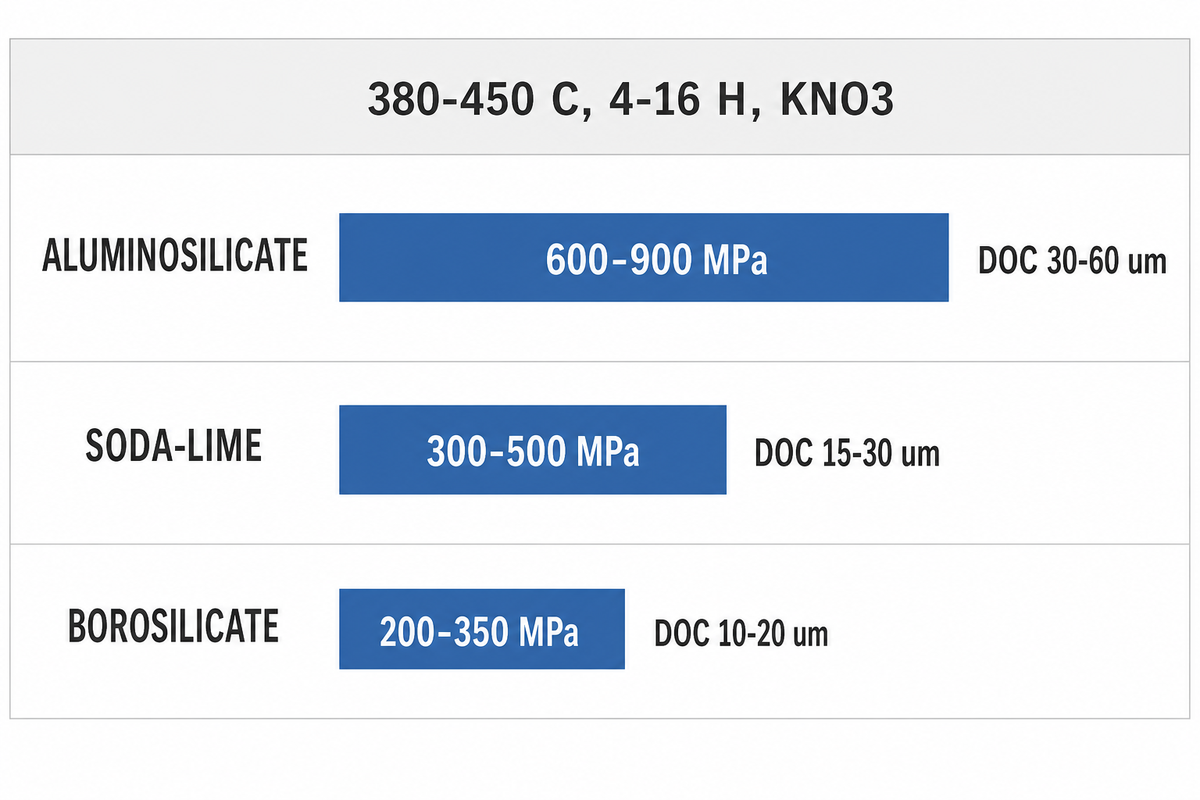
Core technology. Chemical strengthening is the most fully documented process. Ion exchange runs at 380–450 °C held to ±2 °C for 4 to 16 hours in at least 99% potassium nitrate, producing compressive stress of 600–900 MPa on aluminosilicate with a 30–60 µm depth of compression, 300–500 MPa with 15–30 µm on soda-lime, and 200–350 MPa with 10–20 µm on borosilicate. Coating output is published as anti-reflective transmittance above 94% single-sided and above 98% double-sided, an anti-fingerprint water contact angle of 105° ±5°, and anti-glare gloss between 50 ±10 and 70 ±10. Production is stated as 110 or more CNC units across 80,000 m² and three sites, with more than 50 technicians and annual output above one million cover-glass units.
Application industries. Industrial automation and human-machine interface panels, medical devices, automotive and instrument displays, aerospace, smart home and wearable products, point-of-sale terminals and kiosks, electric-vehicle charging equipment, and lighting.
Key advantages. The published process window is unusually specific for a fabricator: most publish neither the ion-exchange temperature nor the resulting compressive stress by substrate, and SW Glass publishes both. The machining, strengthening, printing, coating and bonding steps sit under one roof, which removes the subcontractor handoffs that normally sit between a cut blank and a bonded display module. Quartz and fused silica at 0.5–6 mm sits inside the same envelope, so an optical window and a cover lens can come from one source.
Key disadvantages and purchasing considerations. There is no melting capability, so glass grade, index homogeneity and striae are inherited from the substrate maker and cannot be corrected downstream. Certifications including ISO 9001:2015, EN 12150 and ISO 10993 are named on the site without public certificate numbers, so they should be requested and verified directly rather than treated as confirmed. No pricing, minimum order quantity or lead time is published. The published specifications describe cover-glass and flat-optic work; surface figure in waves, scratch-dig and centration are not published, so precision imaging optics should be evaluated against a drawing and a sample rather than against these figures.
SW Glass publishes a compressive stress of 600–900 MPa on aluminosilicate against a 30–60 µm depth of compression, which is the pairing that decides whether a cover lens survives a field drop rather than either number alone. Send it a cover-glass or flat-window drawing, not a melt specification.
Its capability pages are worth reading alongside its chemical strengthening process detail and its CNC glass machining tolerances, and against the material background in this introduction to optical glass and its properties.
Raw Optical Glass Melters and Glass Materials Suppliers (2–9)
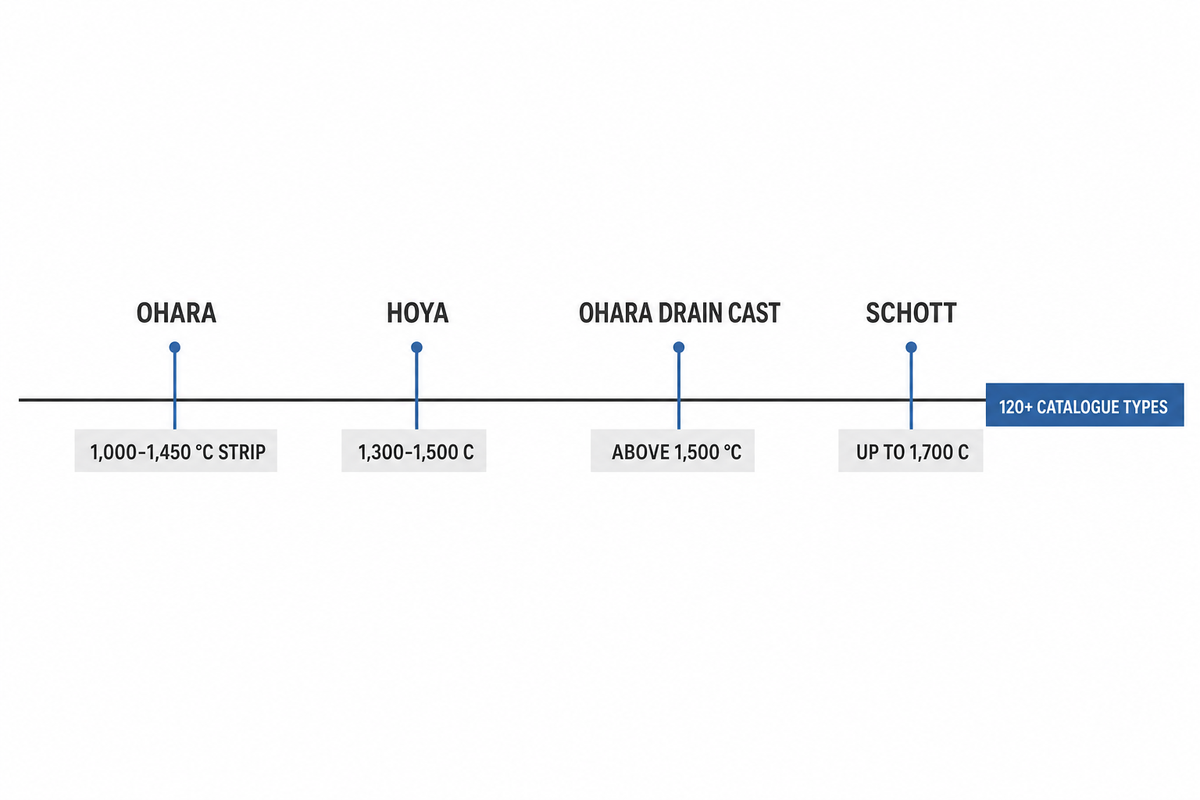
Eight companies in this list operate their own furnaces and publish their own material grade data. They control composition, index and homogeneity at source, which is exactly what a fabricator can’t do. They also share a commercial pattern: none publishes a price, and melt campaign scheduling rather than machine capacity sets their delivery date.
2. SCHOTT AG (Germany)
Founded in 1884 and headquartered in Mainz, SCHOTT AG is a specialty glass group owned by the Carl Zeiss Foundation. Its Advanced Optics division melts optical glass in its own tank and pot furnaces. Official website: https://www.schott.com
Type: optical glass material manufacturer, melting and formulation developer, precision component manufacturer and coating house. Products: more than 120 catalogue glass types supplied as raw glass, cut blanks, pressings, rods and finished components, plus i-Line glass for 365 nm lithography, 13 high-transmission HT and HTultra types, low-Tg glass for precision moulding, and radiation-resistant glass. Processing: continuous tank melting in use since 1911, pot melting for small volumes, fine annealing, down-draw, up-draw, rolled and microfloat forming, and thin-film coating. Industries: photonics, astronomy and space, semiconductor, automotive, defence, consumer electronics and life sciences.
“SCHOTT is the last remaining company in the Western Hemisphere that melts optical glass.”
That sentence is a company statement rather than an audited fact, and it should be read as one. It’s quoted here because of what it implies for sourcing: if it holds, every Western design standardised on catalogue optical glass has a single melt origin, and any second source has to be qualified in Japan or China.
Core technology. Refractive index is controlled to Step 0.5 with ±0.0001 nd accuracy. Castings reach 1000 mm diameter and 250 mm thickness. Raw materials are melted at up to 1,700 °C, drawn glass runs from 30 µm to 1.1 mm by down-draw and 0.9–12 mm by up-draw, and tube is drawn from 0.9 mm to 460 mm outside diameter. States certification to ISO 9001, ISO 14001, ISO 45001 and ISO 50001.
Advantages. The broadest published Western catalogue, so most catalogue substitutions stay with one supplier under one quality regime. Per-lot certificates record batch variation, mid-values and deviation. Large-format high-homogeneity castings have very few alternative sources.
Disadvantages. No price, minimum order quantity or lead time is published anywhere. The component and coating pages publish no surface figure, scratch-dig or centration figures at all, so its fabrication capability can’t be compared with a dedicated finishing house on published data. The company also states it’s the last remaining company in the Western Hemisphere that melts optical glass, which, taken at face value, means standardising on Western catalogue glass leaves no Western second source.
3. Corning Incorporated (USA)
Corning, founded in 1851 and headquartered at One Riverfront Plaza, Corning, New York, melts and synthesises its own glass. Official website: https://www.corning.com
Type: glass material manufacturer, display cover-glass manufacturer and precision component manufacturer. Products: HPFS synthetic fused silica in codes 7980, 7979 and 8655; ULE titania-silicate 7972 and Extreme ULE; telescope mirror and lens blanks; Gorilla Glass cover glass; Polarcor glass polarizers. Processing: batch melting in brick-walled tanks, fusion draw over a zircon isopipe where neither final surface contacts the pipe, flame hydrolysis synthesis of fused silica, ion exchange in molten salt at approximately 400 °C, and single-point diamond turning. Industries: semiconductor lithography, aerospace and defence, astronomy, mobile electronics, display and optical communication.
Core technology. HPFS raw glass reaches 1905 mm diameter with boules as large as 2 metres. ULE mirror blanks run from under half a metre to 8 metres in diameter and can be more than 90% lightweighted. Polishing achieves surface accuracy to two millionths of an inch, surface quality to 20/10 and roughness below 1 nanometre; diamond turning reaches 1.5 nanometres. More than 200 proprietary coating designs run from extreme ultraviolet to infrared. HPFS was invented in-house in 1934.
Advantages. Large-optics capability at 8 metres has almost no alternative supplier. The fusion draw leaves both sheet surfaces untouched by tooling, so thin display substrate needs no subsequent finishing. Deep-ultraviolet pedigree at 248 nm and 193 nm shortens qualification for lithography optics.
Disadvantages. Corning publishes no crown or flint optical glass catalogue on its Advanced Optics and specialty glass pages. A buyer needing catalogue lens glass must go elsewhere, which is the single most important sourcing distinction in this list. Finished precision optics are capped at 1 to 350 mm diameter; the 8 metre figure applies to blanks, not polished deliverables. Gorilla Glass isn’t sold as sheet material through any published channel.
4. HOYA Corporation (Japan)
HOYA, established on 1 November 1941 with corporate reorganisation in August 1944, began as Japan’s first specialist optical glass producer and still melts its own glass. Official website: https://www.hoya.com/
Type: optical glass material manufacturer, precision component manufacturer and coating house. Products: pressed blanks in direct-pressed, re-heat-pressed and rolled-and-sliced forms; preforms for precision moulding; glass-moulded aspherical lenses; polished lenses with centring, coating and cementing; coloured and coated filters; augmented-reality waveguide wafers. Processing: raw-batch melting at approximately 1,300–1,500 °C, continuous melting with platinum furnace systems, direct casting, precision press moulding, grinding and polishing. Industries: medical endoscopes, camera and imaging, semiconductor, security, projection and augmented reality.
Core technology. HOYA publishes a proprietary formulation library described as more than 50,000 ways to manufacture glass, producing over 100 optical glass varieties. Waveguide wafers come in Φ150, Φ200 and Φ300 mm at 0.3–1.0 mm thickness, grouped by index band up to nd above 2.0. Ball preforms run 1.8–6.4 mm with diameter tolerances of ±0.07 mm to ±0.15 mm and weight tolerance of ±1.0%.
Advantages. A published cross-reference index maps HOYA grades against SCHOTT, OHARA, HIKARI, SUMITA and CDGM equivalents, so an existing prescription can be re-sourced without redesigning it. The chain runs melt to preform to blank to moulded or polished lens under one organisation. Very few melters publish 300 mm wafer availability.
Disadvantages. Optical glass sits inside a diversified group whose published segment mix is Health Care 47%, Medical 15%, Electronics 32% and Imaging 6%, and the optics line isn’t broken out. No price, MOQ, melt frequency or lead time is published. Published component data is form and dimension only, with no surface figure, scratch-dig or centration, and sales are fragmented across separate regional entities and sites.
5. OHARA INC. (Japan)
Established on 1 October 1935 and headquartered at a combined head office and factory in Sagamihara, Kanagawa, OHARA manufactures and sells glass materials for optical and electronics applications. Official website: https://www.ohara-inc.co.jp/en/
Type: optical glass material manufacturer and formulation developer, with component work through group companies. Products: more than 140 optical glass types for polished lenses of which 130 are lead- and arsenic-free S-series grades; low-Tg L-series for moulded aspheres; glass blocks, reheat pressings, cylindrical blanks, polished balls and polished lenses; CLEARCERAM-Z ultra-low-expansion glass-ceramic. Processing: continuous melting in production since 1961, platinum pot melting since 1954, direct pressing since 1965, double-side polishing and centring. Industries: cameras, semiconductor lithography and inspection, projectors, augmented reality, astronomy, satellites and medical fibrescopes.
Core technology. Output exceeds 300 tons of optical glass per month across more than 130 environmentally safe types. Strip-glass furnaces run 1,000–1,450 °C and drain casting above 1,500 °C. Glass blocks are supplied at 15–40 mm thickness and 50–200 mm width and length. Refractive index is measured from 280 nm to 2400 nm and reported to five decimal places, with dispersion formula accuracy of ±5×10⁻⁶. Strip material is inspected by taking a 15 cm test piece every 5 metres.
Advantages. A pure-play optical and special glass melter, so the glass line can’t be deprioritised against unrelated divisions. Published monthly tonnage is rare in this industry and lets a buyer size the supplier honestly. Documentation depth (published melt temperatures, a published inspection sampling rule and index metrology to five decimals) is unusually strong for incoming-inspection work.
Disadvantages. Precision polishing sits in a separate group company, so a finished-optic order crosses corporate boundaries. Melt frequency governs availability of a rarely melted grade and the guide is contact-gated, which makes lead time unpredictable for niche types. No numeric finished-optic tolerances are published, and melting appears concentrated at a single Japanese site.
6. SUMITA OPTICAL GLASS, Inc. (Japan)
Established on 13 October 1953 and headquartered in Saitama City, SUMITA melts optical glass in-house and carries it through to finished components. A predecessor firm dates to 1923. Official website: https://www.sumita-opt.co.jp/en/
Type: optical glass material manufacturer, precision component manufacturer and optical system manufacturer. Products: bulk optical glass, gob and polished ball preforms, pressed blanks, cut bar, precision-moulded aspheric lenses and microlens arrays, infrared-transmitting and near-infrared absorptive filters, Faraday rotator glass, optical fibre bundles and image guides, and OEM endoscope assemblies. Processing: in-house melting at a dedicated facility installed in 1996, precision press moulding with in-house dies, optical fibre drawing, leached image-bundle manufacture in Class 1000 clean rooms, and magneto-rheological finishing. Industries: medical endoscopes, industrial inspection, automotive, laser systems and optical communications.
Core technology. Gob preforms cover nd from 1.52250 to 1.85070 with Abbe number 23.9 to 65.6; polished preforms extend nd from 1.43425 to 2.14400 with Abbe number 17.8 to 95.0. Polished balls run 1.2–20 mm with sphericity within ±0.005 mm. Gob weight classes carry tolerances from ±5 mg at 250–350 mg to ±20 mg above 1500 mg. Cut bar is supplied at 2–25 mm diameter to 150 mm length with ±0.1 mm outside diameter tolerance.
Advantages. The published preform index range reaches nd 2.14400, at the top of what oxide optical glass achieves, which matters for compact high-index designs. Vertical integration extends unusually far: the same company melts the glass and assembles the endoscope. Functional glasses including phosphorescent and Faraday rotator types aren’t available from most catalogue melters.
Disadvantages. The catalogue is narrower than SCHOTT, OHARA or HOYA, so a design specified in a mainstream grade may not have a direct SUMITA equivalent. No price or MOQ is published. Capital is 49,347,000 yen with 400 employees, so custom formulation bandwidth is smaller than the largest melters.
7. CDGM Glass Co., Ltd. (China)
CDGM, whose own site states it was established in 1956, is headquartered on Chenglong Avenue in Longquanyi District, Chengdu, and melts optical glass from raw batch. Official website: https://www.cdgmgd.com
Type: optical glass material manufacturer and formulation developer, with pressing and blank production. Products: H-series catalogue glass including H-K9L, H-BaK7, H-ZK50GT and H-ZF4AGT, supplied as strip blanks, pressed lens blanks and pressed rod blanks; coloured optical glass; environmentally friendly GT-suffix grades. Processing: continuous melting, pressing, annealing and blank finishing. Industries: imaging, projection, machine vision, automotive sensing, laser systems and scientific instruments.
Core technology. Strip blanks are supplied at 360 mm by 80–160 mm by 8–60 mm. Pressed lens blanks cover 7–350 mm outer diameter with centre thickness 1.1–50 mm, and pressed rod blanks run 3.2–10 mm outer diameter at 150 mm length. Its composition work is documented in granted patents including JP6505793B2 and CN112159098B.
Advantages. The catalogue maps closely onto Western grade families, and cross-reference tables published by other melters include CDGM equivalents, so re-sourcing is a documented path rather than guesswork. Blank dimensions are published, which many melters don’t do. Cost position is generally the strongest among catalogue melters.
Disadvantages. A nominally equivalent grade still needs requalification; see the cross-reference section below. Founding year 1956 is a heritage start date rather than the current legal entity’s registration. Neither price nor MOQ is published, and English technical documentation is thinner than the Japanese and German melters.
8. Hubei New Huaguang Information Materials Co., Ltd. (China)
Hubei New Huaguang, known as NHG, states a 1969 founding and is based on Changhong North Road in Xiangyang City, Hubei Province. This entry relies on the company’s own statements; no independent registry verification was completed. Official website: https://www.hbnhg.com
Type: optical glass material manufacturer and formulation developer, with component production. Products: colourless optical glass, infrared optical glass, H-series grades including H-ZF53, H-ZLaF54A, H-BiF200 and H-ZF76, plus finished optical components. Processing: melting, pressing, annealing, cold working and component finishing. Industries: defence and scientific optics, infrared imaging, industrial vision and consumer optics.
Core technology. Published annual output is 5,000 tonnes of colourless optical glass material, 150 million optical components and 5 tonnes of infrared optical glass. That combination of bulk material and high-volume component output is unusual; most melters do one or the other at scale.
Advantages. Infrared glass alongside conventional visible-light types removes a second supplier qualification for dual-band systems. The published 5,000 tonne material figure indicates genuine melting scale rather than a repackaging operation.
Disadvantages. English documentation is limited and grade data is harder to obtain than from the Japanese melters. The founding year rests on company statement alone in this research. No price or MOQ is published, and export routing for defence-adjacent grades should be confirmed before design-in.
9. Isuzu Glass Ltd. (Japan)
Isuzu Glass traces its business founding to 1905 as Tarumi Glass Manufacturing, with incorporation recorded in 1943 and the present name adopted in 1954. The company operates from Izumisano, Osaka. Official website: https://www.isuzuglass.com
Type: optical glass material manufacturer and formulation developer, specialising in filter and infrared glass. Products: IHU-series ultraviolet-transmitting and ISK-series heat-absorbing filter glass, catalogue filter plates, and custom-melted specialty glass. Processing: contract and test melting, filter plate production, cold working. Industries: optical measurement, machine vision, medical instruments, lighting and scientific research.
Core technology. Contract and test melting runs from 100 g to 100 kg per cycle, with furnace temperatures to a maximum of 1,600 °C. Standard catalogue filter plates are supplied at 50.0 ±0.2 mm square. The published grade list runs to 32 named types.
Advantages. The 100 g minimum melt is the single most useful figure in this profile: almost no other melter will run a batch that small, which makes Isuzu a realistic route for prototype quantities of a custom composition. Filter and infrared specialisation is deep rather than incidental.
Disadvantages. This isn’t a general-purpose optical glass catalogue house; a standard crown or flint prescription belongs elsewhere. Scale is small, so high-volume programmes need a capacity discussion up front. Documentation is largely Japanese-language.
Eight melters between them publish melt temperatures spanning 1,000 °C to 1,700 °C and catalogue depths from 32 named types to more than 140, which is why “melter” on its own is too coarse a label to shortlist from.
Large-Scale Melters Without a Lens Catalogue (10–12)
Three companies melt glass at industrial scale but don’t sell a lens-designer catalogue. Two of them, AGC and Nippon Electric Glass, are among the largest glass manufacturers on earth with optical glass as a narrow specialty line. The third, Heraeus, makes one material, high-purity silica, in more than 50 controlled variants.
10. AGC Inc. (Japan)
AGC, established on 8 September 1907 as Asahi Glass and renamed in 2018, is headquartered at 1-5-1 Marunouchi, Chiyoda-ku, Tokyo. It states that it’s the world’s largest flat-glass producer. Official website: https://www.agc.com/
Type: diversified glass material manufacturer and melter; display cover-glass manufacturer; specialty optical glass producer. Products: AQ-series synthetic fused silica, high-refractive-index wafers in the nd 1.80–2.10 band, infrared-absorbing filter glass, chalcogenide glass, Dragontrail cover glass, moulded aspheric lenses, microlens arrays and extreme-ultraviolet photomask blanks. Processing: float and fusion glass forming from its own melt, precision moulding, sputtering and chemical vapour deposition. Industries: architecture, automotive, display, semiconductor, augmented reality and electronics.
Core technology. AQ synthetic fused silica is published at refractive index nd 1.46, thermal expansion of 0.6 ppm/K between 50 °C and 200 °C, and a softening point of 1,600 °C. Composition development is documented in granted patents including JP7371722B2.
Advantages. Genuine melting scale with an integrated route from melt through forming to finished component. Its high-index wafer line covers augmented-reality waveguide work that most catalogue melters can’t supply. Multi-region production reduces single-site continuity risk.
Disadvantages. AGC publishes no general lens-designer catalogue of index and Abbe types and doesn’t appear in the industry glass cross-reference indices, so it isn’t a substitute for SCHOTT, OHARA, HOYA or CDGM. Optical glass is a small line inside Electronic Materials, and its coating capability is in-house rather than a merchant service. Architectural and automotive glass dominate the business.
11. Nippon Electric Glass Co., Ltd. (Japan)
NEG publishes both an incorporation date of 31 October 1944 and a founding date of 1 December 1949, the latter marking independence from NEC. The head office sits in Otsu, Shiga. Official website: https://www.neg.co.jp/en/
Type: vertically integrated specialty glass manufacturer that melts from batch; precision optical component manufacturer; display glass manufacturer. Products: OA-series alkali-free display substrates, Dinorex chemically strengthenable cover glass, G-Leaf ultra-thin glass, high-refractive-index Glass D at nd 2.0 with Abbe number 29, micro prisms, ball lenses, microlens arrays, glass polarizers and cold mirrors. Processing: oxy-fuel and all-electric melting furnaces, forming, precision component production at a dedicated Precision Glass Center, and in-house thin-film coating. Industries: display, augmented reality, optical communications, pharmaceutical glass and composites.
Core technology. OA-11 display glass is published at a density of 2.52×10³ kg/m³, thermal expansion of 37×10⁻⁷/K between 30 °C and 380 °C, and a strain point of 685 °C. Composition work appears in granted patents including JP5729550B2.
Advantages. Glass D at nd 2.0 with Abbe number 29 is a genuinely high-index option for light-guide plates. In-house coating and precision component production sit alongside the melt. Melting technology is developed internally rather than licensed.
Disadvantages. Optical glass is a minor line beside display glass, glass fibre and pharmaceutical glass, and NEG publishes no broad index and Abbe catalogue; the catalogue it does publish is for electronic components. The two founding dates on its own profile mean any “years in business” comparison needs the basis stated.
12. Heraeus Conamic (Germany)
The quartz glass business now trading as Heraeus Covantics, registered as Heraeus Quarzglas GmbH & Co. KG, was established in 1912, not 1899, which is the year Dr Richard Kuech developed the oxyhydrogen quartz melting process. The registered office is Heraeusstr. 12-14, Hanau. Official website: https://www.heraeus-covantics.com (the former heraeus-conamic.com redirects there)
Type: high-purity fused silica and quartz glass manufacturer and melter, plus custom quartz processing. Products: synthetic fused silica in named grades including Suprasil, Infrasil, HOQ, Spectrosil and HSQ, more than 50 published variants in total, plus ingots, rings, tubes, rods, near-net shapes and fabricated quartzware. Processing: flame fusion, electric fusion and synthetic vapour deposition, plus machining of semi-finished shapes. Industries: semiconductor, optics and photonics, telecom optical fibre and lamp.
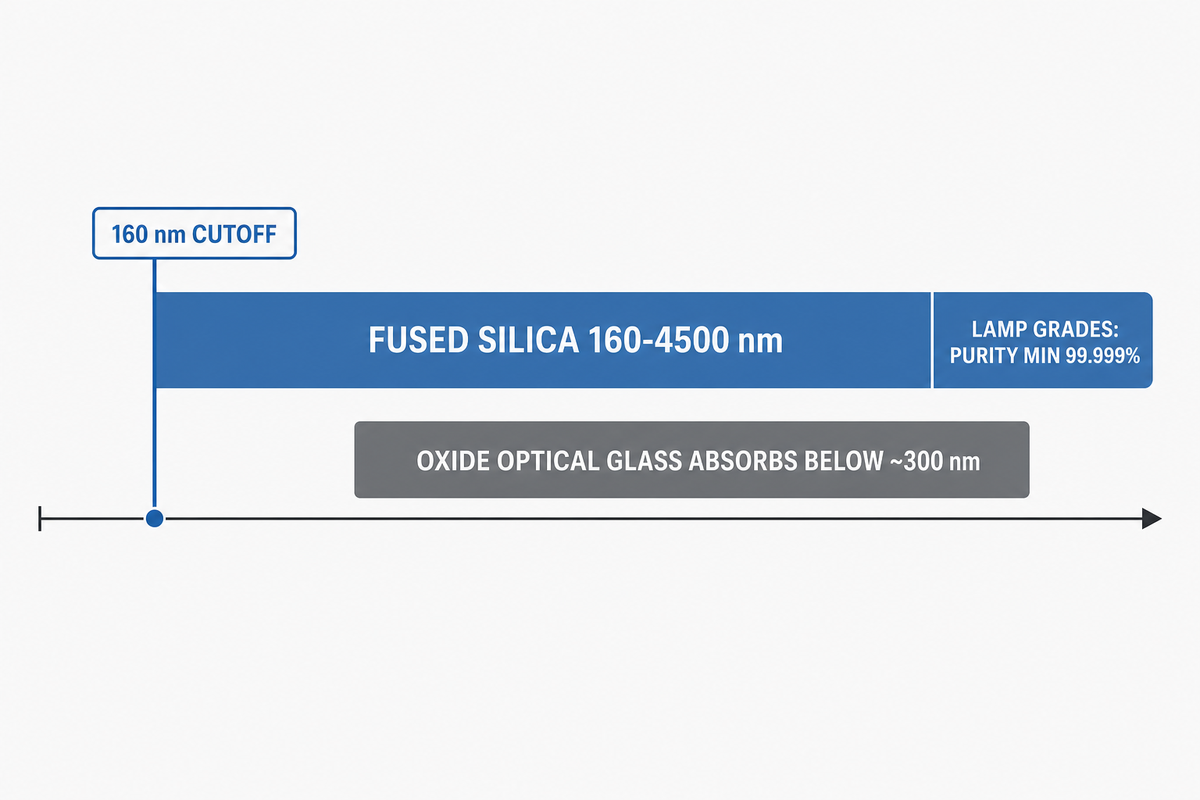
Core technology. Published silica purity reaches a minimum of 99.999% for its technical lamp fused silica grades, with a transmission range from 160 nm to 4500 nm across the grade portfolio and melting at temperatures above 1,800 °C.
Advantages. The published transmission window from 160 nm makes deep-ultraviolet work practical where conventional optical glass cuts off. Thermal stability is the other reason buyers cross over: AGC publishes 0.6 ppm/K for its synthetic fused silica, and practitioners choosing between otherwise identical quartz and N-BK7 components report roughly a twelve-fold expansion difference and a price premium in the region of 15%, which they judge worth paying whenever the instrument sees real temperature swings. Grade differentiation by melt route, hydroxyl content and dopant is documented, so a designer can select on physics rather than on a trade name.
Disadvantages. This is a single-component silica producer, not an optical glass house; there are no crown or flint multi-oxide glasses and the word formulation doesn’t really apply. Optics is one of four served markets, with semiconductor the largest. The 1899 date circulating in supplier lists describes a process, not a company.
Fused silica transmits from 160 nm where most oxide optical glass is already opaque, which is the single physical reason these three companies sit in a separate paragraph from the catalogue melters rather than competing with them.
Precision Optical Component Manufacturers for Imaging, Laser and Photonics Optics (13–16)
Four companies turn purchased glass into finished optics to a drawing. None melts glass, and none pretends to. What they publish instead is tolerance: diameter, centre thickness, surface figure and scratch-dig, which is precisely the data the melters leave out.
13. Edmund Optics, Inc. (USA)
Founded in 1942 as Edmund Salvage Corporation and headquartered at 101 East Gloucester Pike, Barrington, New Jersey, Edmund Optics manufactures precision optics from purchased glass. Official website: https://www.edmundoptics.com
Type: precision optical component manufacturer and optical glass fabricator. Products: spherical and aspheric lenses, windows, prisms, mirrors, filters, polarizers, imaging lenses and opto-mechanics. Processing: grinding, polishing, centring, coating and assembly. Materials: catalogue glasses including N-BK7, N-K5, N-PK51, N-SK11 and N-BAK4 among 34 published types. Industries: machine vision, life sciences, semiconductor, laser systems and research.
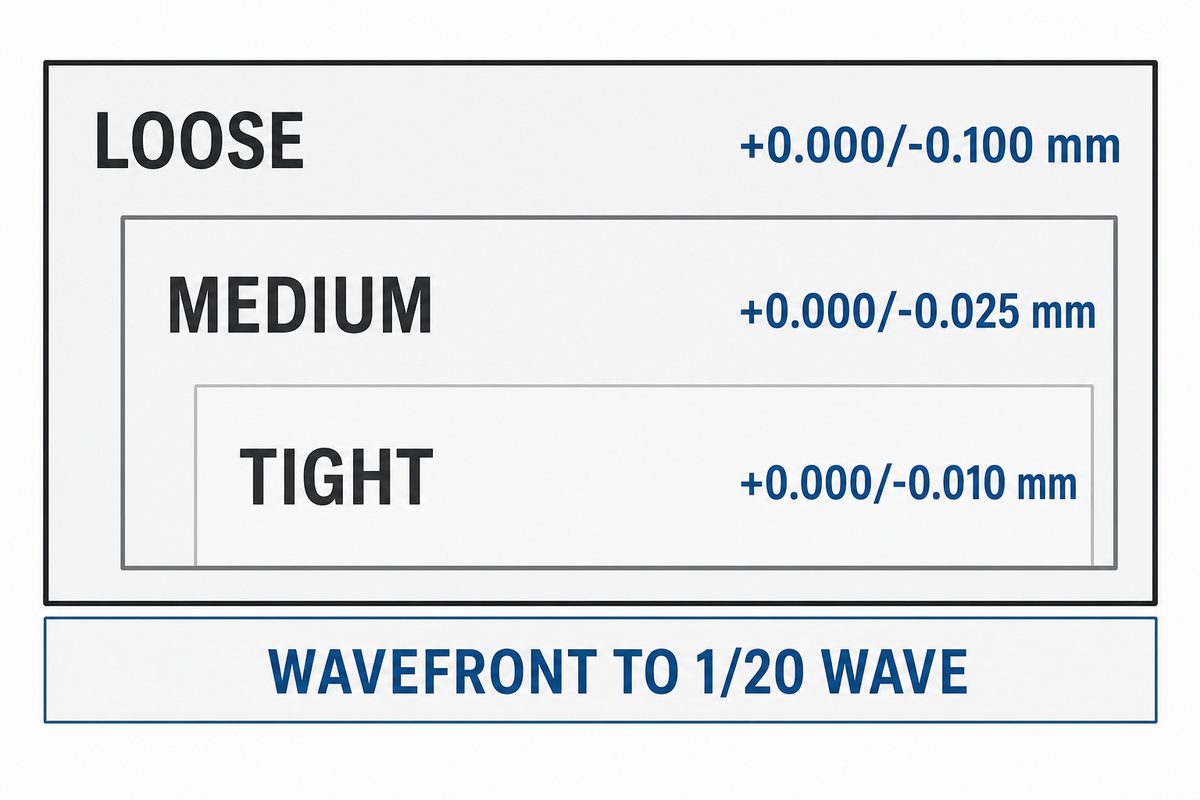
Core technology. Spherical lenses are published at 5–200 mm diameter with diameter tolerance from +0.000/−0.100 mm loose to +0.000/−0.010 mm tight, and centre thickness tolerance from ±0.10 mm to tighter grades. Publishing tolerance bands by grade (loose, medium and tight) lets a buyer price precision explicitly instead of discovering the cost later.
Advantages. Catalogue prices are public, which almost nothing else in this list offers, so budgetary numbers need no enquiry. Stock availability shortens prototype cycles from months to days. Tolerance grading is transparent.
Disadvantages. Glass properties are inherited from the melter, so index homogeneity and striae are outside its control. Catalogue economics mean deep custom work competes with dedicated job shops. Very large or very tight-figure optics aren’t the model.
14. Thorlabs, Inc. (USA)
Thorlabs states a 1989 founding and is headquartered at 43 Sparta Ave, Newton, New Jersey. This entry relies on the company’s own statement; no independent registry verification was completed. Official website: https://www.thorlabs.com
Type: precision optical component manufacturer and photonics supplier. Products: lenses, windows, mirrors, filters, polarizers, fibre optics, opto-mechanics and laser components. Processing: grinding, polishing, dicing and coating of purchased bulk glass. Materials: N-BK7, N-F2, N-SF11, F2, SF11 and Schott NG-series among nine published types. Industries: research laboratories, photonics, life sciences and industrial systems.
Core technology. Plano optics are published up to 10 inches in diameter or 7 inch square, dicing saws process flat plates up to 5 mm thick, and polishing machines each hold more than 300 one-inch round optics per run.
Advantages. Very broad catalogue with published pricing and rapid availability. Strong fit for research and prototype work where a week’s delay costs more than the part. Vertical integration across optics, mounts and positioning reduces the number of vendors on a build.
Disadvantages. Buys refined bulk glass rather than melting, so material provenance is one step removed. The catalogue model suits standard formats better than unusual geometry. High-volume production economics differ from a dedicated contract manufacturer.
15. Knight Optical (UK) Ltd (UK)
Knight Optical dates its business founding to 1991, while the UK limited company number 03755966 was incorporated on 21 April 1999. It’s based at Roebuck Business Park, Harrietsham, Maidstone. Official website: https://www.knightoptical.com/
Type: precision optical component supplier, fabricator and coating house. Products: windows, lenses, prisms, mirrors, filters, domes and custom optics. Processing: fabrication, polishing, coating and full incoming metrology. Materials: N-BK7 equivalents, B270, Borofloat, Gorilla Glass, JGS1 and JGS2 fused silica among nine published types. Industries: defence, aerospace, medical, metrology and scientific instruments.
Core technology. Metrology is the published differentiator: a ZYGO Verifire XPZ interferometer with radius slide measures form and transmitted wavefront on flats and spheres to a stated accuracy of one-twentieth of a wave, alongside a FISBA interferometer with a 100 mm aperture.
Advantages. Every batch is inspected in-house before shipment, which is the practical answer to variable subcontract quality. The one-twentieth wave figure is published rather than implied. Small-quantity and prototype orders are a normal part of the business.
Disadvantages. The site doesn’t state which processing steps run on its own equipment and which run at partner facilities, so lead time depends on a supply chain the buyer can’t see. Two founding dates exist depending on whether business start or incorporation is meant. It buys substrate, so glass-level properties are inherited.
16. Esco Optics, Inc. (USA)
Esco Optics, registered as Esco Products, Inc., was founded in 1955 and operates from 95 Chamberlain Road, Oak Ridge, New Jersey. Official website: https://www.escooptics.com
Type: precision optical component manufacturer, fabricator and coating house. Products: windows, mirrors, prisms, beamsplitters, filters and custom flat optics from a catalogue of more than 2,000 items. Processing: fabrication, polishing, coating and inspection. Materials: N-BK7, B-270, BSL-7, BSC7 and ultraviolet-grade fused silica among 12 published types. Industries: defence, laser systems, medical devices, semiconductor and research.
Core technology. Components are published from 1/8 inch, roughly 3 mm, up to 16 inches, with a minimum diameter of 2 mm at the small end.
Advantages. A 2 mm to 16 inch published span covers an unusually wide part-size range from one shop. In-house coating removes a subcontract step. Seventy years of continuous operation is stated consistently by the company and corroborated by an industry association directory, though the operating entity is registered as Esco Products, Inc. and no incorporation record was located.
Disadvantages. Flat and prismatic optics are the focus; complex curved surfaces are less central. No melting, so material control is inherited. Pricing is by enquiry.
Precision component makers publish diameter tolerances as tight as +0.000/−0.010 mm and wavefront to one-twentieth of a wave, numbers no melter in this list publishes at all, which is the clearest evidence that the two halves of this market answer different questions.
Custom Glass Fabrication Suppliers and Optical Coating Companies (17–20)
Four companies cut, machine, strengthen and coat purchased glass into custom shapes. They’re the closest match to SW Glass in the supply chain, and the group where “manufacturer” most often misleads. All four are open about buying substrate; their published capability is machining and coating, not melting.
17. Valley Design Corp. (USA)
Incorporated in 1975 in the Merrimac Valley, Massachusetts, and now at 2 Shaker Rd, Shirley, Massachusetts, Valley Design is a precision glass fabricator. Official website: https://www.valleydesign.com
Type: precision optical component manufacturer, glass fabricator and custom processing supplier. Products: lapped and polished substrates, wafers, windows, thin glass parts and dicing services. Processing: single and double-sided lapping and polishing, dicing, edging. Materials: BK7, B270, Borofloat 33, D263, AF45 and Pyrex 7740 among 15 published types. Industries: semiconductor, medical devices, sensors, aerospace and research.
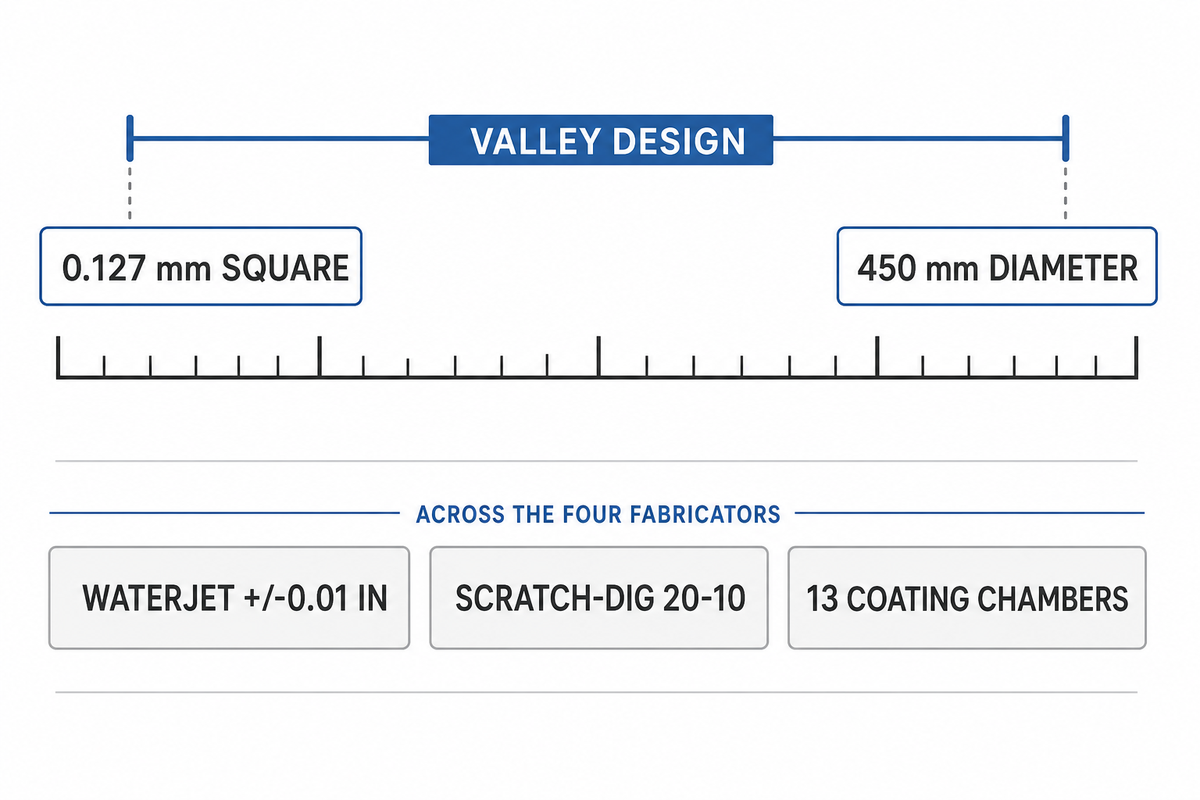
Core technology. More than 100 single and double-sided lapping and polishing machines run in diameters from 12 inches to 64 inches, handling parts from 0.127 mm square to 450 mm diameter and larger, with the site also citing work up to 48 inches in diameter.
Advantages. The published part-size span, from 0.127 mm square to 450 mm diameter and beyond, is exceptionally wide for a lapping house. Machine count means genuine parallel capacity rather than a single bottleneck. Thin and ultra-thin substrate work is a core competence.
Disadvantages. Lapping and polishing focus rather than a full optical shop; coating isn’t the published strength. No melting, so glass selection is limited to what it stocks or can buy. Flat geometry dominates.
18. Swift Glass Company, Inc. (USA)
Swift Glass dates its own published timeline to 1881, when Allen Swift founded the Swift Lubricator Company making sight-feed oilers. That same timeline puts the start of glass fabrication at 1946 and the Swift Glass name at 1963; the company’s About page separately claims nearly a century of glass work, which doesn’t reconcile with either date, so treat all three as company statements rather than verified facts. It operates at 131 W. 22nd Street, Elmira, New York 14903. Official website: https://www.swiftglass.com
Type: custom glass fabrication supplier with an optical department. Products: machined flat glass, windows, sight glasses, lenses, prisms and beamsplitters, glass wafers. Processing: waterjet cutting, CNC machining, drilling, grinding and polishing, thermal tempering and chemical strengthening. Materials: SCHOTT BOROFLOAT 33, D263, SUPREMAX, N-BK7, B-270 and ROBAX among 26 published types. Industries: optical, biomedical, appliance, industrial and aerospace.
Core technology. Waterjet cutting holds ±0.01 inch on two and three-axis machines, and drilling goes through glass up to 0.75 inch thick to the same tolerance; the optical department works to scratch-dig of 20-10.
Advantages. Thermal tempering and chemical strengthening sit alongside machining, so a strengthened custom shape needs one vendor rather than two. Twenty-six named substrate types is a broad working range. Long continuous experience with Corning-family materials.
Disadvantages. No coating capability is described anywhere on the site, so anti-reflective work needs a separate supplier. The 1881 date describes a lubricator business, not glass. Its own pages carry inconsistent heritage claims, so treat “years in business” cautiously.
19. Abrisa Technologies (USA)
Abrisa publishes no founding year. The California Secretary of State records Abrisa Industrial Glass, Inc., entity C1030464, as incorporated on 20 November 1980 at 200 S. Hallock Drive, Santa Paula, California. Official website: https://www.abrisatechnologies.com
Type: precision flat glass fabricator and thin-film optical coater; display cover-glass manufacturer. Products: coated and fabricated flat glass, filters, mirrors, anti-glare etched display glass, conductive coated glass. Processing: cutting, machining, chemical strengthening, chemical etching, and thin-film coating across 13 chambers. Materials: Corning Eagle XG, Gorilla Glass, Corning 7980 fused silica, SCHOTT BOROFLOAT 33, D 263 T eco and Duran among 15 published types. Industries: defence and avionics, display, medical, industrial and instrumentation.
Core technology. Manufacturing runs across a Santa Paula facility of more than 100,000 square feet, a Torrance coating operation of more than 21,000 square feet with 13 coating chambers of varying size, and, since May 2025, an 85,000 square foot plant in Clarksburg, West Virginia.
Advantages. Fabrication and coating under common ownership removes the most common handoff failure in flat optics. Thirteen coating chambers means real capacity for volume coating runs. Named ITAR registration matters for defence and avionics programmes.
Disadvantages. Flat glass only, no curved or moulded optics. No melting, and the substrate list is explicitly Corning and SCHOTT material. The company states no founding year of its own, and the 1974 figure repeated across commercial databases conflicts with the 1980 registry record.
20. Shanghai Optics Inc. (China and USA)
Shanghai Optics publishes no founding year on its own website. Its US operation is at 425 Main St Suite 2E, Metuchen, New Jersey, with production in Nanjing. Official website: https://www.shanghai-optics.com/
Type: custom optics manufacturer, optical system manufacturer and coating house. Products: spherical and cylindrical lenses, prisms, windows, filters, lens assemblies and opto-mechanical hardware. Processing: dicing, grinding, polishing, thin-film coating, CNC machining, diamond turning, active alignment and assembly, all stated as in-house from incoming material inspection onward. Materials: N-BK7, SF11, Corning 7980 fused silica, JGS1 and JGS2, with substrate named as SCHOTT, OHARA, CDGM and Corning. Industries: imaging, machine vision, medical, laser and research optics.
Core technology. Tolerances are published in three explicit grades: diameter to 100 µm base, 25 µm precision and 6 µm high precision; centre thickness to 200 µm base, 50 µm precision and 10 µm high precision.
Advantages. Publishing base, precision and high-precision tolerance tiers side by side is the clearest cost-versus-capability signal in this list. Design, fabrication, coating and assembly sit in one organisation. China-based production with a US commercial presence shortens the communication loop.
Disadvantages. Its own process chain begins at incoming inspection of material, which confirms it buys substrate from the melters it names. No founding year is published anywhere on its site, and third-party directories disagree by decades. Assembly-level work may carry minimum values that small component orders can’t meet.
Types of Glass Materials: What Separates Optical Glass From Ordinary Glass
Optical glass is a type of glass whose optical properties are held to a published tolerance instead of being left to whatever the batch produces. Refractive index, dispersion and transmission are specified per grade and certified per melt. That control is the entire difference between optical materials and the glass products used for windows and containers.
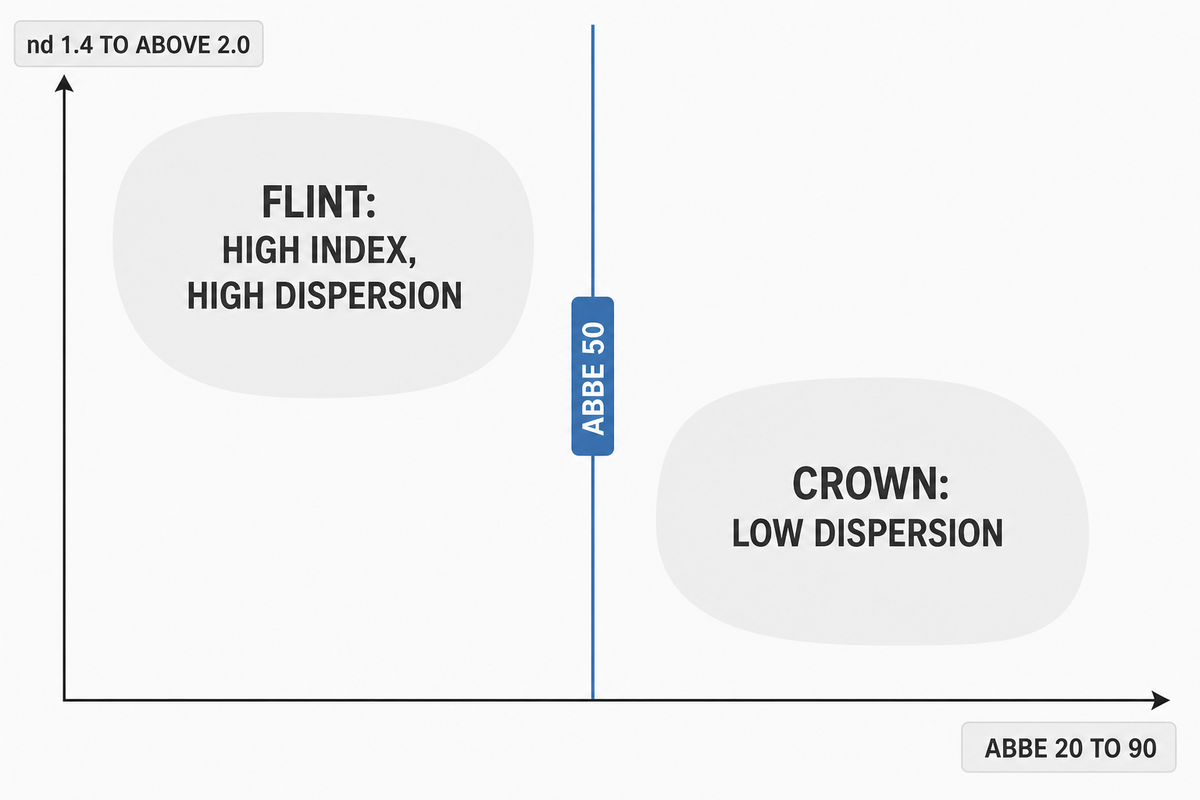
Two numbers organise the field. Refractive index, written nd, describes how strongly the material bends light by refraction as it crosses the surface. The Abbe number, written vd, describes how much that bending varies across different wavelengths of light. Oxide glasses span roughly nd 1.4 to above 2.0 with Abbe numbers of 20 to 90, and fluoride compositions push beyond 100. The crown and flint split falls near an Abbe number of 50: flint glass is denser than crown glass and pairs a high refractive index with strong chromatic dispersion, while crown types sit at a comparatively low refractive index with low dispersion. SUMITA’s published preform range shows the working span in one supplier’s catalogue, nd 1.43425 to 2.14400 against Abbe numbers of 17.8 to 95.0.
Composition is how those optical characteristics get engineered. Barium oxide, zinc oxide, boric oxide and fluoride additions each shift index and dispersion in known directions, and the specificity of those recipes is why they’re patented rather than published. JP6505793B2, an optical glass composition granted to Chengdu Guangming Optoelectronics, claims a composition window rather than a single formula. A melter’s recipe library is therefore its core asset. HOYA publishes more than 50,000 documented ways to manufacture glass. Glass production for optics also differs in process, not only in ingredients: melting, refining out bubbles, homogenising the melt, then an anneal that can run a hundred to a thousand hours. Ordinary glass production skips that last step almost entirely, which is why window glass can look identical and behave nothing alike.
A second family sits alongside the glasses. Crystalline materials such as calcium fluoride and sapphire aren’t glasses at all (each is grown as a single crystal rather than melted and cooled), yet they compete for the same designs, and the near-single-component silicon dioxide used for fused quartz behaves as its own category. In fused form it transmits from 160 nm, where oxide glass has long since gone opaque, which is why it dominates deep-ultraviolet lithography and high-power laser optics. Whether a crystalline route or a glass route wins is an optical design question, not a purchasing one, and it’s decided differently in each of the fields of optics these materials serve.
These types of glass materials reach buyers through an optical industry spanning research instruments and mass-produced devices. A microscope objective, a telescope mirror, a machine vision lens and a laser window are all optical products drawn from the same catalogues, yet the manufacture of optical components for each is judged against different criteria. Optical engineering decides which material used in a design is defensible; the glass industry decides whether it can be melted at volume. Advanced optical technologies (augmented-reality waveguides above nd 2.0, extreme-ultraviolet mask blanks, metasurface elements) are pushing new grades into catalogues that were stable for decades. What counts as high-quality optical glass in one of these optical applications is unremarkable in another, so a quality glass claim means little until the grade and its tolerance are named.
Optical glass spans nd 1.4 to above 2.0 with Abbe numbers from under 20 to over 100, and a single catalogue such as SUMITA’s covers nd 1.43425 to 2.14400 on its own, which is why “optical glass” names a specification discipline rather than a material.
Optical Tolerance Specifications Your Drawing Must Carry Before Any Quote
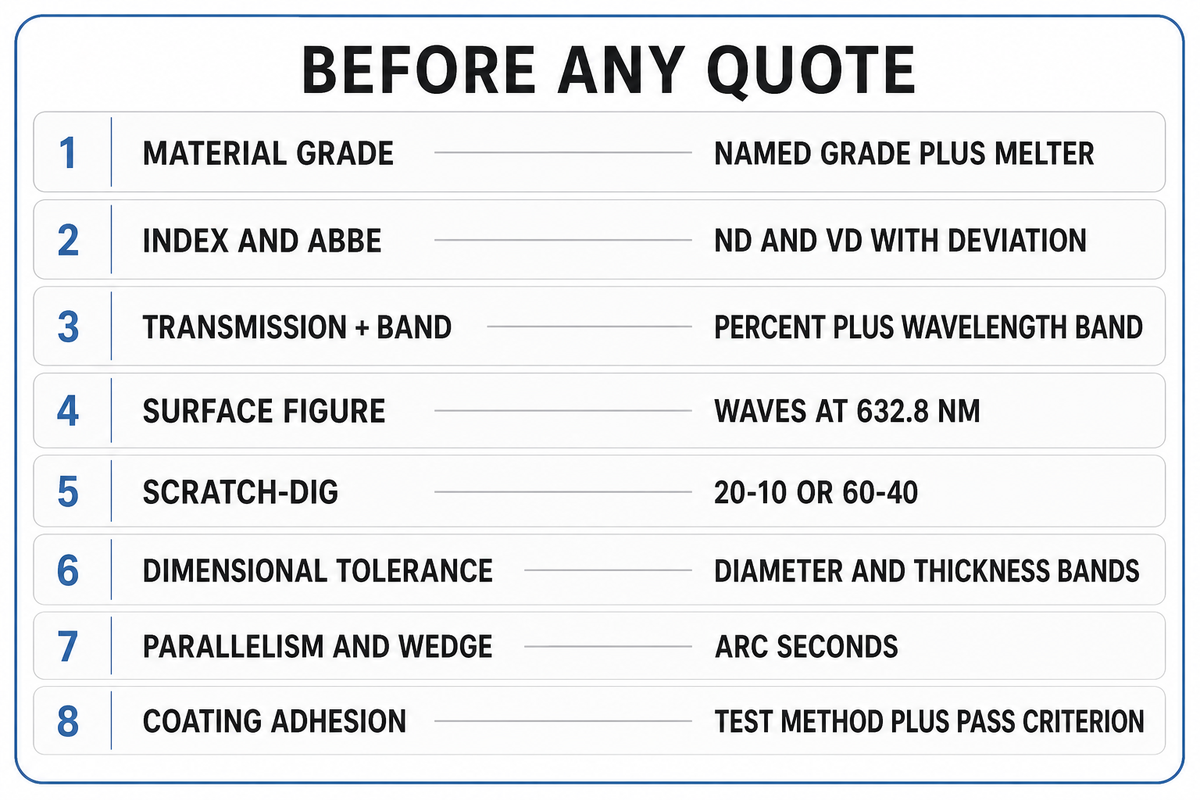
An optical drawing that omits surface figure, surface quality or material grade can’t be priced, only guessed at. Vendors will quote anyway, against their own default assumptions, which is how two quotations for the same part arrive a factor of three apart. Eight parameters decide almost all of that spread.
The ISO 10110 series governs how these indications are placed on optical element drawings, ISO 12123 covers raw optical glass specification, and ISO 9211 covers optical coatings. ISO 12123 is worth watching: it was confirmed in 2024 and has since been flagged for revision, with a committee draft in development, so a drawing that cites it should name the edition rather than the bare number. Check the current edition in the ISO standards catalogue before the drawing is released, not after the quotations come back. Surface quality is still most often quoted in the scratch-dig convention of MIL-PRF-13830B. Naming the standard on the drawing removes an entire category of ambiguity at no cost.
Drawing Completeness Sheet — copy these rows into your quote request
| Parameter | State it as | Why it matters | How to verify |
|---|---|---|---|
| Material grade | Named grade plus melter, e.g. N-BK7 or H-K9L | Index and dispersion follow the grade, not the family | Melt certificate quoting the melt number |
| Refractive index and Abbe number | nd and vd with the permitted deviation | Focal length shifts with index across a lot | Index measurement report per melt |
| Spectral transmission | Percentage with the wavelength band, e.g. above 94% at 450–650 nm | A transmission figure without a band is unusable | Spectrophotometer trace over the stated band |
| Surface figure | Waves at 632.8 nm over the clear aperture | Drives polishing time and therefore cost | Interferogram, as Knight Optical publishes at one-twentieth wave |
| Surface quality | Scratch-dig, e.g. 20-10 or 60-40 | Cosmetic grade separates laser optics from windows | Visual inspection to the stated convention |
| Dimensional tolerance | Diameter and thickness bands, e.g. ±0.05 mm | Decides whether the part fits the mount | First-article dimensional report |
| Parallelism and wedge | Arc seconds or arc minutes | Wedge steers the beam and ruins alignment | Autocollimator measurement per lot |
| Coating adhesion and durability | Test method plus pass criterion | Coating failure appears in service, not at goods-in | Tape, humidity and abrasion test report |
Two of these eight are the ones buyers most often leave out. A transmission percentage quoted without its wavelength band is the first, and a tolerance quoted without a measurement datum is the second. Both look like specifications and neither constrains anything.
If the part is a window, a cover lens or a coated flat rather than an imaging element, the same eight rows still apply but the supplier set changes; that work sits with fabricators such as the custom optical glass processing and coating route rather than with a catalogue melter.
A drawing carrying all eight rows above lets three vendors quote the same part on the same basis, which is what turns a three-fold price spread into a comparison. Add the grade’s melter by name and the ambiguity that remains is commercial, not technical.
The Grade Cross-Reference Trap: Tolerance, Homogeneity and Requalification
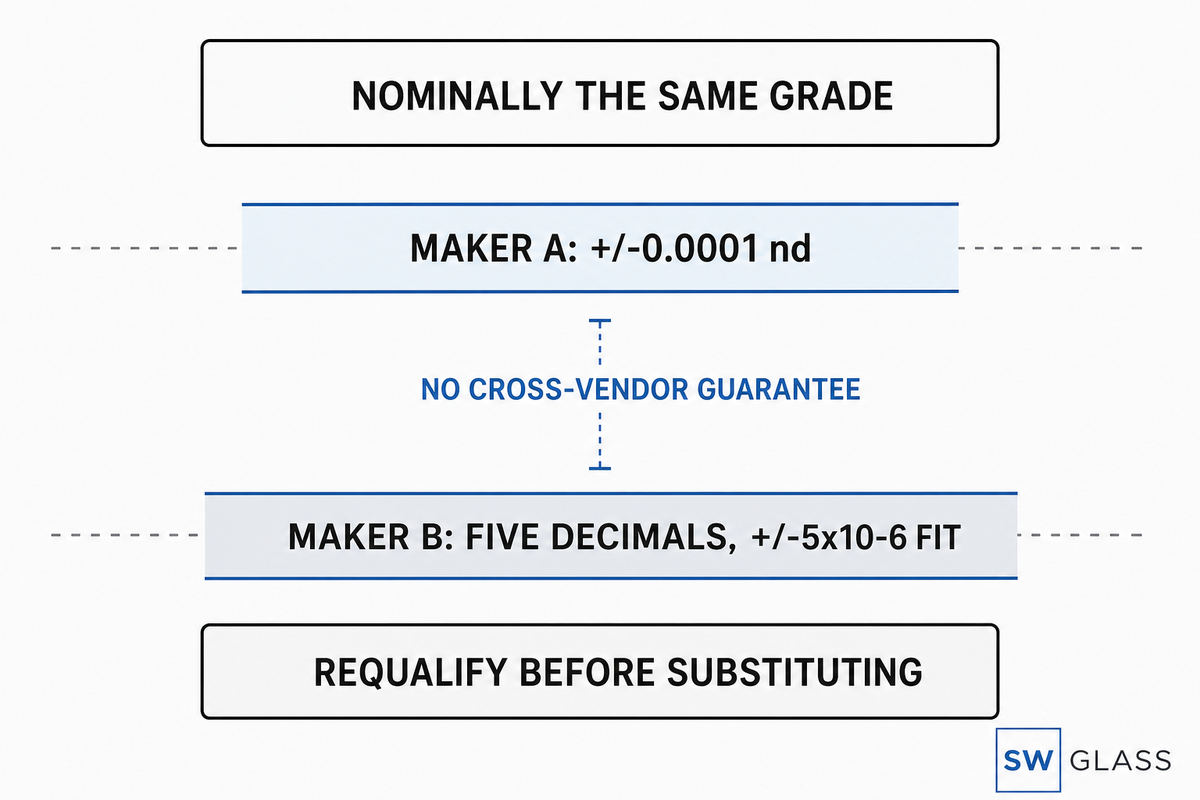
Cross-reference tables exist because designers need them, and HOYA publishes one mapping its grades against SCHOTT, OHARA, HIKARI, SUMITA and CDGM equivalents. What such a table promises is that two grades are nominally equivalent. What it doesn’t promise is that two different makers’ melts land inside the same tolerance window.
The reason equivalence is approximate rather than exact is visible in the patent record: composition claims such as JP7371722B2, granted to AGC for an optical glass, define a compositional range with its own oxide proportions. Two makers arriving at the same nominal nd and vd from different composition windows won’t necessarily match on chemical durability, transformation temperature or internal transmittance.
Look at what the melters publish about their own precision. SCHOTT controls refractive index to Step 0.5 with ±0.0001 nd. OHARA reports index to five decimal places, principal indices to six, with a dispersion formula accuracy of ±5×10⁻⁶. Those figures describe control within one company’s own melting and annealing regime. They aren’t a cross-vendor guarantee, and no melter publishes one.
The practical consequence is narrow but expensive. Swapping a grade changes the melter, the annealing schedule and the certification chain at the same time. For a window or a filter that’s usually immaterial. For a cemented doublet correcting chromatic aberration across a wide band, a small index and dispersion shift moves the correction, and the assembly that passed on the old grade can fail on the new one without anything being wrong with either glass.
What makes this a trap rather than a known risk is that the paperwork looks complete. The cross-reference table is real, the grades genuinely correspond, and the certificate arrives with the shipment. Requalification gets skipped because nothing looks like it changed.
⚠️ Before approving a grade substitution
Ask for the melt certificate of the specific lot, not the catalogue datasheet. Compare measured nd and vd against your design values, not against the nominal grade values. Re-run the tolerance analysis for any assembly correcting colour across more than one band. For a coated part, confirm the coating design was computed for the new substrate index rather than carried across unchanged.
A substitution that survives a melt-certificate comparison and a fresh tolerance analysis is a sound engineering decision, and often a large cost saving. One approved on the strength of a cross-reference table alone is a bet that two furnaces on two continents produced the same glass.
Spec-Sheet Numbers That Do Not Predict Delivered Performance
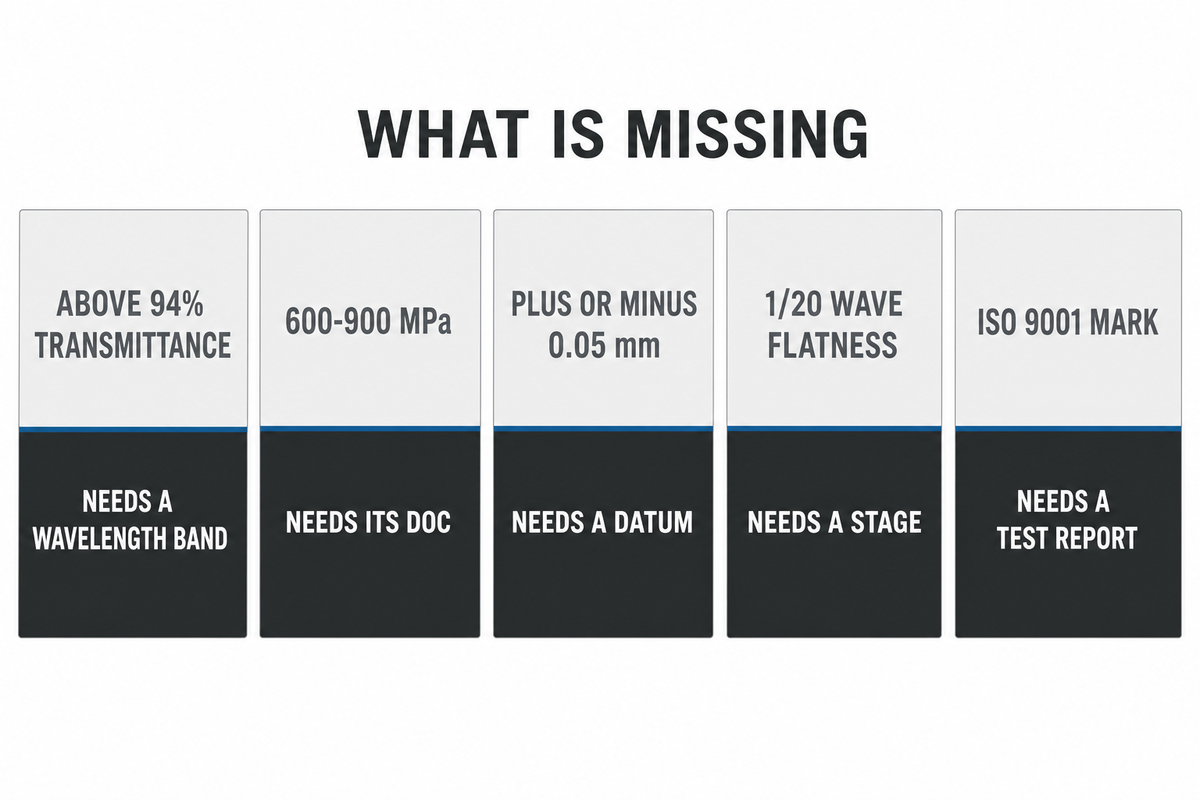
Five categories of published figure look decisive and predict very little. Each appears on reputable vendor pages, including several in this list. Recognising them saves a buyer from selecting on numbers that were never comparable in the first place.
A transmission figure with no wavelength band. “Above 94% transmittance” means one thing across 450–650 nm and something quite different at a single 550 nm peak. SW Glass publishes above 94% single-sided and above 98% double-sided for its anti-reflective coating; Heraeus publishes a transmission range of 160 nm to 4500 nm. The second figure is checkable and the first needs its band before it can be compared with anything.
A compressive stress number with no depth of compression. Chemically strengthened glass fails on the pairing, not on either value. SW Glass publishes 600–900 MPa against 30–60 µm on aluminosilicate, and 200–350 MPa against 10–20 µm on borosilicate. A high surface stress over a shallow layer resists scratching but not a deep flaw from an edge impact.
A tolerance with no measurement datum. “±0.05 mm” is meaningful once the drawing says from which face and over which aperture. Shanghai Optics publishes 100 µm, 25 µm and 6 µm diameter tiers and Edmund Optics publishes loose, medium and tight bands, which is how the number becomes comparable. A single unlabelled tolerance is a marketing figure.
A certification mark with no test report behind it. ISO 9001 says a quality system was audited against a specific edition, which you can confirm in the ISO standards catalogue. It says nothing about whether this lot met your drawing. Several companies in this list, including SW Glass, name certifications without publishing certificate numbers, which is normal practice, and exactly why certificates should be requested and checked at qualification rather than assumed from a logo.
A surface figure quoted for the wrong stage of manufacture. Practitioners who compare published mirror and window specifications report a recurring trap: some suppliers quote flatness or roughness for the bare substrate, measured before the dozens of layers that make up a dielectric coating are applied. The finished part is what goes into the instrument, so the drawing should say which stage the number describes. Field reports also describe components from lesser-known makers that, when flatness is actually measured on receipt, fall short of the published tolerance, which is why one measured first article is worth more than any datasheet.
Five figures that look like specifications turn out to constrain nothing until a band, a depth, a datum, a manufacturing stage or a test report is attached, which is why the eight-row drawing sheet above is the cheapest quality control available on an optical purchase.
Commercial Terms That Change the Landed Cost
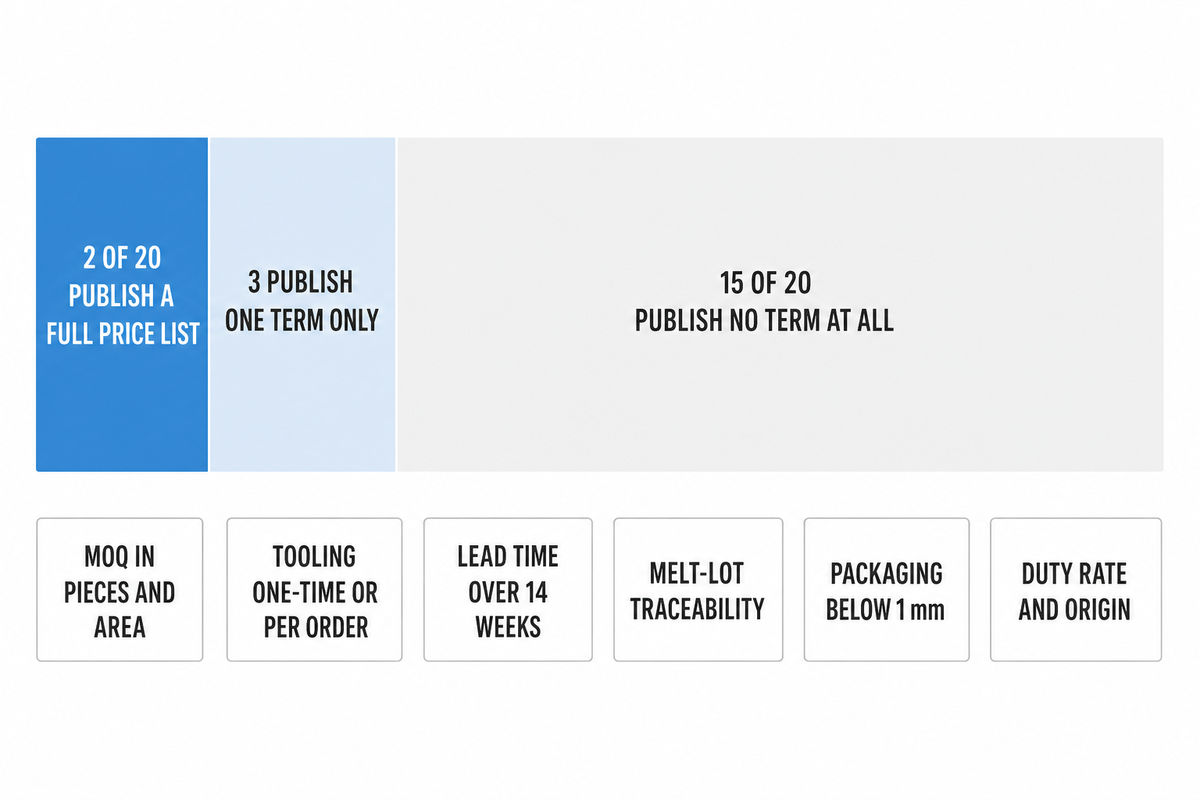
Published prices are almost absent from this market. Of the twenty companies profiled, only Edmund Optics and Thorlabs publish a full catalogue price list, and both run stock catalogue businesses. Three melters publish one commercial term in isolation: Isuzu Glass lists standard plate prices, SUMITA publishes a 100-piece minimum on cut bar, and Esco states a four-week standard lead time. No melter publishes price, minimum order quantity and lead time together. The commercial model, not company size, decides whether a number exists in public.
That absence has a structure worth understanding. For a melter, the governing constraint is melt frequency: a grade is available when its campaign runs, and OHARA’s melt frequency guide (the document that actually determines when a niche grade can ship) is contact-gated rather than published. A rarely melted type can therefore carry a wait measured in months that has nothing to do with machine capacity and can’t be shortened by paying more.
For a fabricator the constraint inverts. Machine time is bookable and substrate is usually in stock, so lead time responds to money and scheduling. What bites instead is tooling and engineering charges on a first order, which are invisible until the quotation arrives.
Six commercial terms are worth pinning before a first order, with thresholds attached so the answers are comparable:
- ✔Minimum order quantity: ask for it in pieces and in area. Below 50 pieces many fabricators price as a prototype run.
- ✔Tooling, fixture and engineering charges: ask whether they’re one-time or per order, and whether tooling is retained.
- ✔Lead time: quote it separately for the first article and for repeat orders. Above 14 weeks, ask whether melt scheduling is the cause.
- ✔Melt-lot traceability: ask whether certificates quote a melt number, and whether one order can span several melts.
- ✔Packaging and shipping: ask who specifies packaging for thin glass below 1 mm, where transit breakage concentrates.
- ✔Duty rate and country of manufacture: confirm the country where the part is finished, which may differ from the sales office, then check the rate for the heading your part actually falls under in the US Harmonized Tariff Schedule. Unmounted optical elements and mounted assemblies sit under different headings.
Geography deserves its own question, because searches for an optical glass manufacturer usa, or for one in California or Texas specifically, return regional directories rather than regional melters. There’s no United States catalogue optical glass melter in this list; Corning makes fused silica and ULE glass, not crown and flint types. What the United States does have is a dense fabrication and coating base: Valley Design, Swift Glass, Abrisa, Esco Optics, Edmund Optics and Thorlabs all operate domestic plants working on imported substrate. So the honest answer to who’s the best optical glass manufacturer for a US buyer is usually two companies, not one: a melter abroad and a finisher at home. Adjacent categories follow the same split: Corning ULE glass and Corning optical filters sit with the material makers, while optical communications companies form a third supply chain again.
Two of the twenty publish a full price list, three more publish a single commercial term and fifteen publish none, so any landed-cost comparison assembled from websites alone is built on a handful of data points and fifteen blanks. The six questions above turn that into a comparison in one enquiry round. Ask the sixth one alongside the inspection question: a supplier that publishes its optical and dimensional inspection capability is telling you what it can prove on receipt, which is the only part of a quotation that survives contact with the first shipment.
Integration and Inspection Requirements Buyers Underestimate
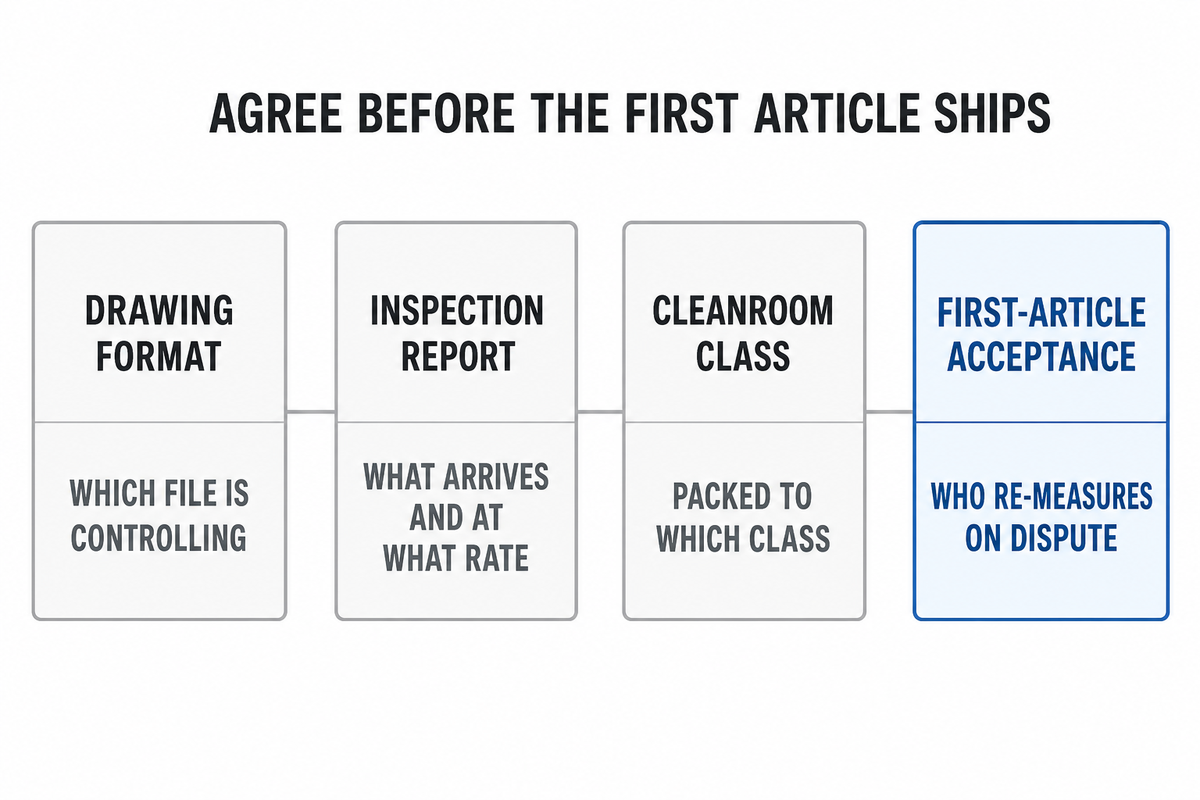
Qualification fails more often on interface details than on optical performance. The glass meets the drawing, the coating passes its tests, and the programme still stalls because the two organisations describe the same part differently. Four interfaces account for most of it.
Drawing format. Confirm which formats the vendor accepts and which it treats as controlling. A dimensioned PDF and a solid model that disagree by 0.05 mm will be resolved by whichever the shop opens first unless the drawing says otherwise.
Inspection report format. Ask what arrives with the shipment: a certificate of conformance, a dimensional report, an interferogram, a spectral trace, or a melt certificate, and at what sampling rate. OHARA publishes its own sampling rule for strip material at one 15 cm test piece every 5 metres, which is the kind of statement that makes incoming inspection designable rather than reactive.
Cleanroom class and handling. For coated and bonded parts, ask where the part is packed and to what class. OHARA states Class 100 clean-room inspection for its substrate work and SUMITA states Class 1000 for image-bundle manufacture. A part polished to one-twentieth wave and packed in an uncontrolled room arrives as a part with particles on it. Class numbers only mean something against a named standard edition, so agree which one applies: the ISO 14644 series governs cleanroom classification and its current parts are listed in the ISO standards catalogue.
First-article acceptance. Agree in writing what constitutes acceptance before the first article ships, including who re-measures, on what equipment, and what happens on a disputed reading. This is a five-minute conversation before the order and a six-week argument after it.
The one thing to settle first: establish whether each shortlisted vendor melts glass or buys it, before comparing anything else. That single fact determines what the vendor can quote, what it can be held responsible for, and whether “years in business” on its About page describes the company you are actually buying from.
Frequently Asked Questions
Q: Who are the largest manufacturers of optical lenses?
Lens manufacturing splits into two groups that rarely overlap. HOYA, OHARA, SUMITA and SCHOTT both melt their own glass and publish finished lenses, while Edmund Optics and Thorlabs buy glass and shape it into finished components to a drawing.
Lens manufacturing splits into two groups that rarely overlap, and the honest answer changes depending on which one you mean. The melters that also publish finished-lens production are HOYA, OHARA, SUMITA and SCHOTT. HOYA publishes more than 100 optical glass varieties drawn from a formulation library it describes as over 50,000 documented recipes. OHARA melts more than 300 tons of optical glass a month across over 130 environmentally safe types and publishes index measurement from 280 nm to 2400 nm to five decimal places. SCHOTT publishes more than 120 catalogue types and states it is the last remaining company in the Western Hemisphere that melts optical glass. Among component manufacturers that buy glass and shape it, Edmund Optics and Thorlabs are the largest by catalogue breadth. Edmund publishes spherical lenses from 5 mm to 200 mm diameter with three explicit tolerance grades, from +0.000/−0.100 mm loose to +0.000/−0.010 mm tight; Thorlabs publishes plano optics up to 10 inches. For a design specified in a named catalogue grade, start with the melter. For a finished lens to a drawing, start with the component manufacturer, and expect it to source the glass from one of the four melters above.
Q: Who manufactures fiber optic glass?
Optical fibre is a separate supply chain from the bulk optical glass covered in this article. Fibre is drawn from a synthesised preform rather than cut from a melted block, so it has different vendors, different plant and its own qualification cycle.
Optical fibre is a separate supply chain from the bulk optical glass covered here, because fibre is drawn from a synthesised preform rather than cut from a melted block. Corning and Heraeus both operate in fibre-adjacent materials, and Heraeus lists telecom optical fibre as one of its four served markets. For image guides rather than data fibre, SUMITA is the relevant name in this list.
Q: Who is the biggest glass manufacturer in the US?
Corning Incorporated is the largest United States glass manufacturer by revenue, reporting core sales of $16.41 billion in 2025 across more than 77 manufacturing sites, though it is not a catalogue optical glass supplier in the SCHOTT or OHARA sense.
Corning Incorporated is the largest United States glass manufacturer by revenue, reporting core sales of $16.41 billion in 2025 across more than 77 manufacturing sites with over 60,000 employees. It is not, however, a general optical glass supplier in the catalogue sense; it publishes no crown or flint glass catalogue, and buyers needing named lens grades must source from SCHOTT, OHARA, HOYA or CDGM instead. Among United States companies focused on optical fabrication rather than bulk glass, Abrisa Technologies, Valley Design, Swift Glass, Esco Optics, Edmund Optics and Thorlabs are the substantial names, and all six buy their glass rather than melting it.
Q: How is optical glass manufactured?
Optical glass is made by melting a weighed batch of raw materials, refining out gas bubbles, homogenising the melt so the index is uniform, then annealing very slowly so residual stress and index variation settle inside tolerance before the glass is formed.
Optical glass is made by melting a weighed batch of raw materials, refining out gas bubbles, homogenising the melt so the index is uniform, then annealing very slowly so residual stress and index variation settle inside tolerance. SCHOTT describes this as four phases (batch melting, refining, homogenisation and conditioning) and melts raw materials at up to 1,700 °C, using continuous tank melting it has run since 1911 alongside pot melting for small or specialised volumes. OHARA publishes strip-glass melting at 1,000–1,450 °C with drain casting above 1,500 °C, and has run continuous melting since 1961 and platinum pot melting since 1954. HOYA publishes a melting window of roughly 1,300–1,500 °C. Annealing is the slow step, running from a hundred to a thousand hours depending on how much glass is in the lehr, and it is where refractive index is finally brought onto target; SCHOTT holds index to ±0.0001 nd at its tightest step. Composition is what makes the result optical rather than ordinary: barium oxide, zinc oxide, boric oxide and fluoride additions shift index and dispersion deliberately, which is why melters guard their recipe libraries. Forming follows melting, by casting, pressing, rolling, down-draw or up-draw depending on the shape the customer needs.
Q: How does optical glass differ from regular glass?
Optical glass is specified on how it bends and transmits light, while ordinary glass is specified on being flat, clear and strong enough. The controlled properties are refractive index, dispersion, spectral transmission, homogeneity and freedom from striae.
Optical glass is specified on how it bends and transmits light; ordinary glass is specified on being flat, clear and strong enough. The controlled properties are refractive index, dispersion, spectral transmission, homogeneity and freedom from striae. Soda-lime window glass has none of them held to optical tolerance, which is why it cannot be substituted even when it looks identical to the eye.
Q: Is my glass material suitable for my application?
Start from the wavelengths of light the part must transmit, because that constraint eliminates whole material families before any other criterion applies. Then check the mechanical and thermal environment, and confirm the answer against a sample rather than a datasheet.
Start from the wavelengths of light the part must transmit, because that constraint eliminates whole material families before any other criterion applies. Below about 300 nm most oxide optical glass absorbs and fused silica becomes the practical choice; Heraeus publishes transmission from 160 nm across its grade portfolio, and a silica purity of at least 99.999% for its technical lamp fused silica grades. Above roughly 2500 nm, infrared materials or specialty infrared glass are needed; Hubei New Huaguang publishes 5 tonnes a year of infrared optical glass alongside its visible-band output. Within the visible band, choose on index and Abbe number against the optical design rather than on material name. Then check the mechanical and thermal environment: chemically strengthened aluminosilicate carries 600–900 MPa compressive stress over a 30–60 µm depth for impact resistance, while low-expansion materials such as Corning ULE 7972, with a coefficient near zero, matter where temperature swings would otherwise defocus the system. Confirm the answer against a sample or first-article inspection rather than against a datasheet alone.
How This List Was Built
Each of the twenty companies was profiled from its own published pages. Seventeen were then passed to an independent check that tried to disprove three things: the founding year, the headquarters and whether the company melts its own optical glass; the three that weren’t are flagged in their own entries.
That check overturned three published founding years, annotated seven more as lineage dates rather than entity ages, moved one quartz fabricator off the list entirely, and produced the finding that a published founding year in this industry frequently describes a predecessor business.
References & Sources
- Optical glass, definition, crown and flint classification, index and Abbe ranges
- US9018116B2, Optical glass, assigned to Schott AG, 2012 priority, now lapsed for non-payment of fees
- JP6505793B2, Optical glass, glass base material and optical element, assigned to Chengdu Guangming Optoelectronics, 2016 priority
- CN112159098B, Optical glass, optical components and optical instruments, assigned to Chengdu Guangming Optoelectronics, 2020 priority
- JP7371722B2, Optical glass and optical components, assigned to AGC Inc., 2018 international filing
- JP5729550B2, Optical glass, assigned to Nippon Electric Glass, 2011 priority
- JP6280015B2, Glass, glass material for press moulding and optical element, assigned to HOYA Corporation, 2014 priority
- CN116715435A, Optical glass, optical element blank and optical element, a published application assigned to HOYA Corporation and its Weihai subsidiary, 2022 priority, still pending rather than granted
- UK Companies House, Knight Optical (UK) Limited, company number 03755966
Standards referenced by designation: ISO 10110 (preparation of drawings for optical elements and systems), ISO 12123 (specification of raw optical glass), ISO 9211 (optical coatings), MIL-PRF-13830B (surface quality scratch-dig convention). Company specifications are cited from each manufacturer’s own published pages as listed in the profiles above.
Related Articles
- Aluminosilicate glass properties and where it outperforms soda-lime
- Borosilicate glass, thermal and chemical resistance for optical windows
- Low-iron ultra-clear glass and its transmittance advantage
- Anti-reflective and anti-fingerprint optical coating capability
- Optical and dimensional inspection for custom glass components
- Ultra-thin glass down to 0.4 mm for display and sensor windows