Get in Touch with Saiweiglass



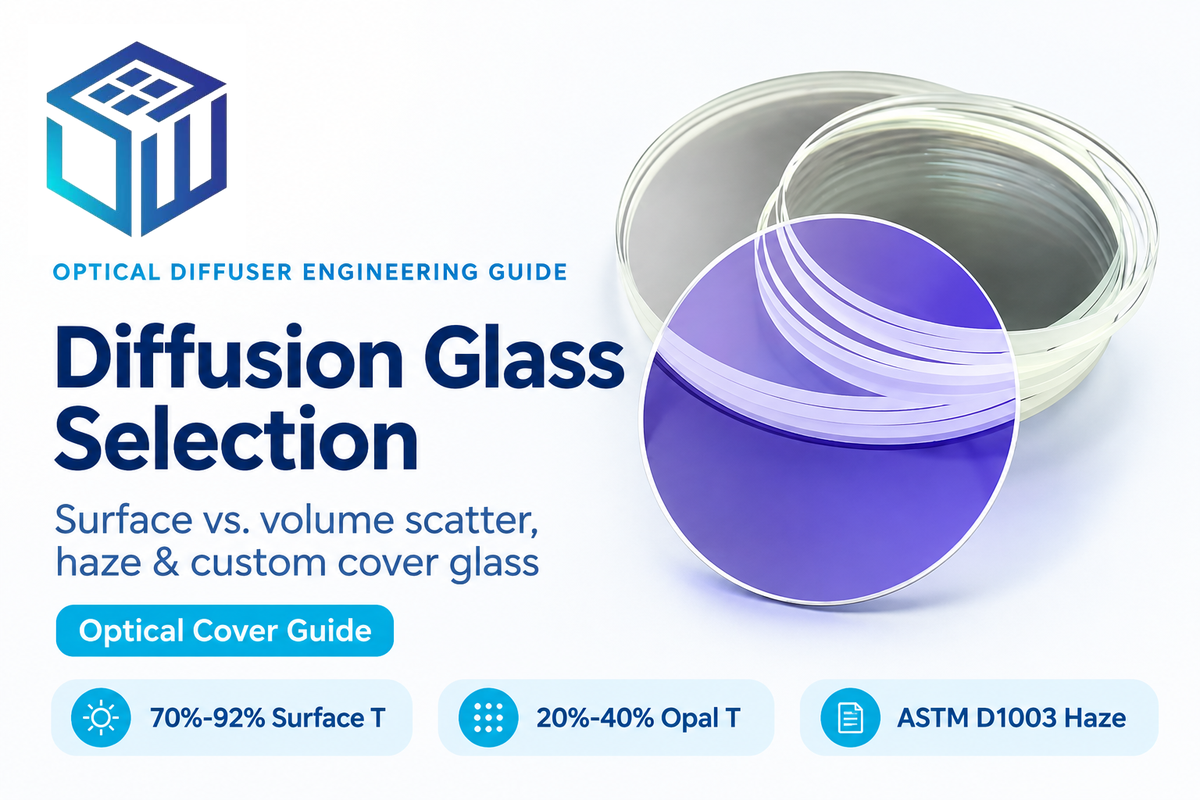
Choosing the wrong diffusion glass can strip roughly 60% of a luminaire’s lumen output or leave harsh diode hot spots. In laboratory integrating-sphere measurements reported by NIH PMC greenhouse glazing trials, double-AR low-iron diffuse glass reaches 91% hemispherical light transmission at 20% haze. Untreated reference float glass reaches only 84% at 0% haze under the same test. Meanwhile, two-layer flashed opal glass drops visible transmission to roughly 30% because internal scattering loss reflects photons backward.
Optical and lighting engineers avoid the transmission penalty by separating surface refraction from bulk volume scattering before releasing drawings. This report covers the six principal diffuser architectures, ASTM D1003-21 integrating-sphere haze metrology, LED setback geometry, and thermal tempering limits.
Quick Engineering Specifications Summary
- Surface-scattering ground and acid-etched glass reaches ~70%–92% total hemispherical transmittance (up to ~95%–97% with double-sided AR coatings) across an 8°, 55° FWHM Gaussian cone depending on grit and single- or double-sided etching.
- Volume-scattering colloidal white and flashed opal glass produces a near-Lambertian cosine hemisphere (120°, 180°), where backscattering keeps visible transmission near ~25%–45% for solid white glass and ~20%–40% for flashed opal glass.
- Engineered and holographic diffusers reported by Edmund Optics deliver over 90% transmission efficiency across a 325 nm to 1500 nm wavelength range.
- Monolithic acid-etched or patterned low-iron glass (≥3.0 mm) undergoes thermal safety tempering per ASTM C1048, whereas two-layer flashed opal glass fractures in tempering ovens.
What Is Diffusion Glass? Surface vs. Volume Scattering Physics in Optics
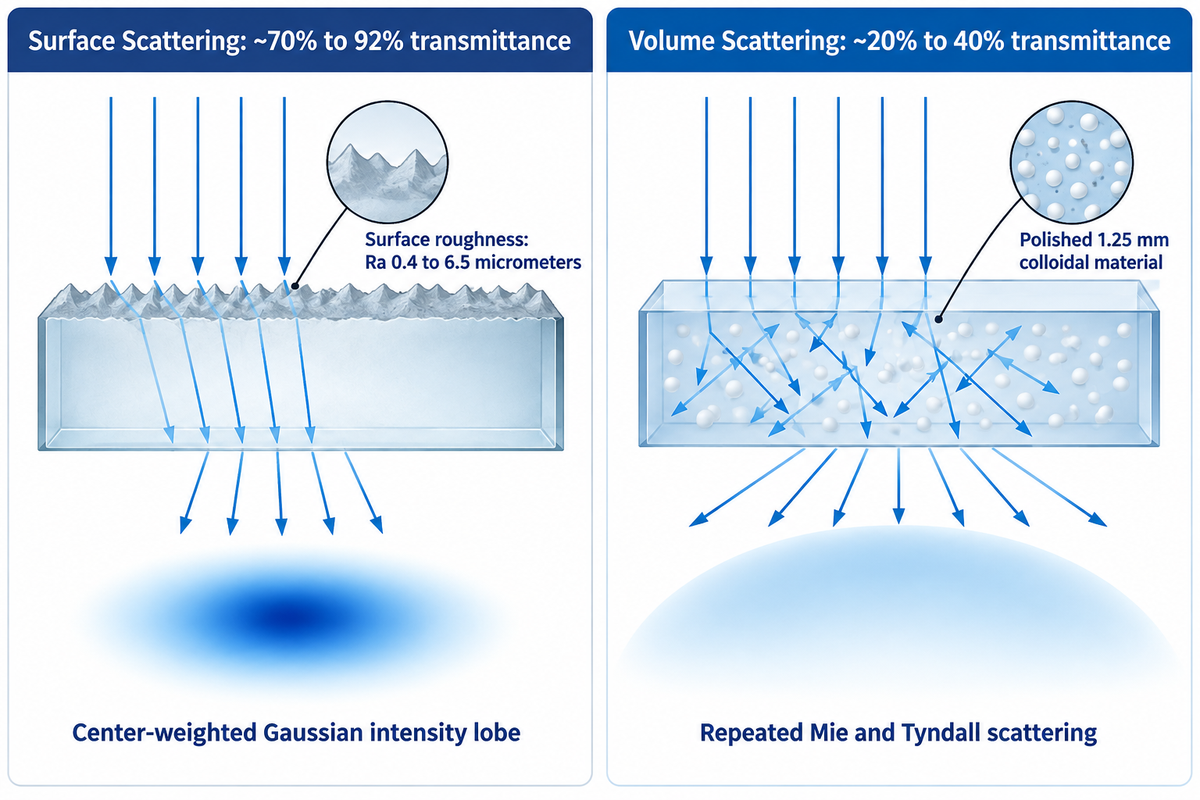
Diffusion glass, an engineered optical or architectural glass element, is designed to scatter light across a controlled angular cone. It eliminates specular reflections, filament shadows and LED hot spots. As reported in Edmund Optics diffuser selection data, surface-scattering ground or acid-etched glass achieves ~70% to 92% hemispherical transmittance with a forward Gaussian lobe, while volume-scattering opal glass achieves near-Lambertian uniformity at ~20% to 40% transmittance.
Think of the difference like rain hitting a textured windshield versus headlights shining into dense fog. On a textured windshield, every water droplet bends the ray once at the outer boundary. In dense fog, each ray bounces dozens of times off suspended droplets in all directions before exiting.
In geometrical optics, a surface diffuser alters the wavefront at a single air-glass boundary. When incident light strikes a sandblasted or acid-etched pane, each microscopic pit acts as a tiny tilted prism. The surface roughness profile (Ra 0.4 to 6.5 micrometers) is larger than the visible wavelength (0.4 to 0.7 micrometers). Consequently, light refracts according to Snell’s Law at randomized local surface normals. As documented in the University of Rochester statistical wavefront analysis, the emerging wavefront retains a center-weighted Gaussian intensity distribution along the optical axis.
Volume-scattering diffusing glass works through internal multiple scattering rather than surface roughness. According to Edmund Optics application notes on white diffusing glass, solid white diffusing glass is polished to a 1.25 mm thickness as a semi-opaque colloidal material. It uses the Tyndall effect to scatter light and achieve a near lambertian distribution. Microscopic fluoride, phosphate, or colloidal crystals within the glass melt have a distinct refractive index from the silicate matrix. Photons undergo repeated Mie and Tyndall scattering events throughout the bulk thickness and exit the material with equal radiance.
Engineers normally assume that any translucent pane can be substituted for another during prototype builds. When a team mounts a single-sided 600-grit ground glass window 8 mm above a COB LED, a bright central hot spot remains visible. Conversely, dropping a flashed opal pane into a battery-powered inspection lamp can cut usable illuminance by more than ~60%. Industrial optical and lighting diffusion glass are completely different from consumer reed diffuser fragrance bottles and camera mist filters. Camera mist filters only soften highlight halos while keeping the primary image sharp.
Six Types of Diffusing Glass: Ground, Acid-Etched, White, Opal Diffusing Glass, Patterned, and Engineered
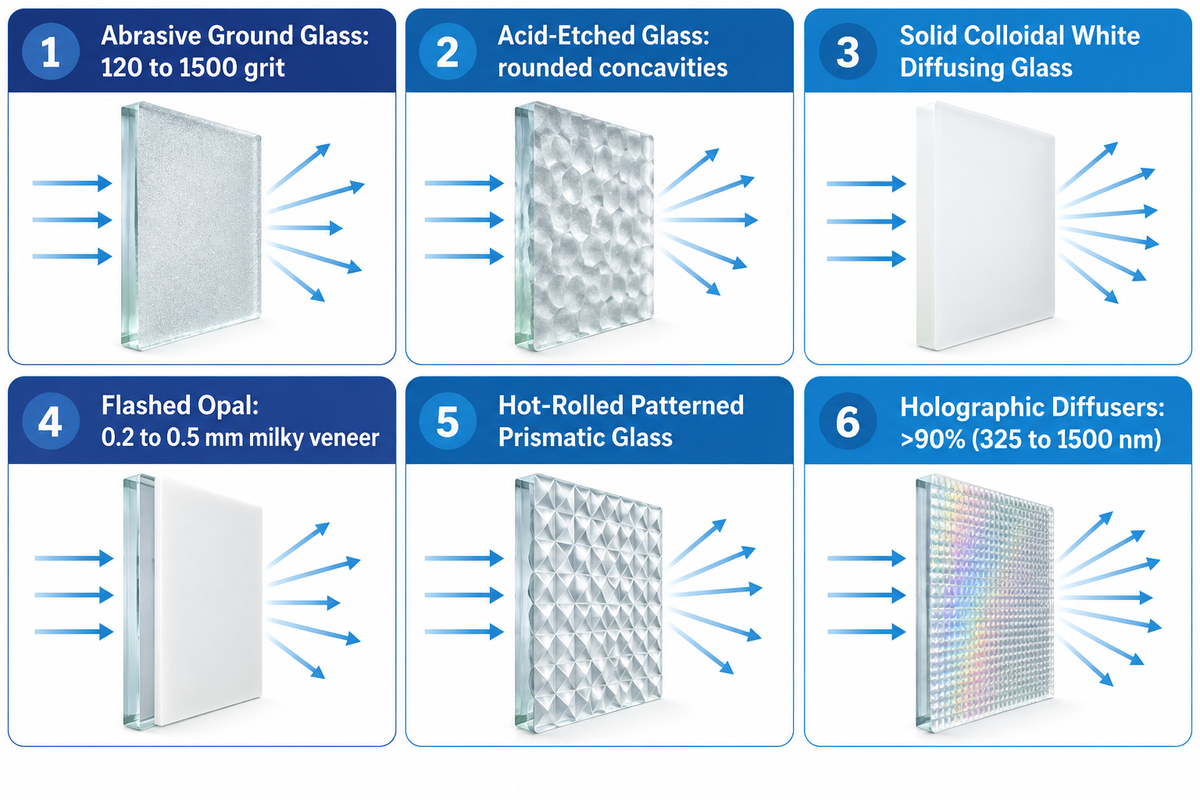
The six primary types of diffusing glass are abrasive ground glass (120 to 1500 grit), hydrofluoric acid-etched matte glass, and solid colloidal white diffusing glass. The remaining three types are two-layer flashed opal diffusing glass, hot-rolled patterned prismatic glass, and micro-structured engineered or holographic diffusers. According to Edmund Optics, holographic units exceed 90% transmission efficiency from 325 nm to 1500 nm.
Each architecture balances angular spread against forward photon efficiency. Based on Thorlabs UV Fused Silica and N-BK7 ground glass diffuser specifications, mechanical ground glass diffusers are lapped with 120, 220, 600, or 1500 grit abrasive slurries. Standard 1-inch (25.4 mm) UV fused silica discs list at $35.28 in current catalogs, built on a substrate that delivers greater than 90% transmission above 225 nm before abrasive lapping. Coarser 120-grit sandblast textures dig deeper micro-fractures (Ra 3.5 to 6.5 micrometers) for wider divergence. Finer 1500-grit polishing yields a narrow scatter cone with higher on-axis throughput. In Edmund Optics near-infrared testing, a 1064 nm beam transmitting through polished White Diffusing Glass is scattered across the hemisphere.
Chemical acid etching replaces brittle mechanical micro-cracks with smooth, rounded hexafluorosilicate concavities on one surface or both surfaces. As a comparison to diffusing glass, solid diffusing glass and opal diffusing glass shift the scattering mechanism inside the glass. Flashed opal diffusing glass bonds a thin 0.2 to 0.5 mm milky white veneer on top of clear silica so that scatter is maximized, though bulk backscattering limits total transmission. For ultraviolet or laser beam shaping, holographic diffusers, a precision diffractive diffuser, or a diffractive optical element etched in fused silica or photopolymers provide tight light control.
| Diffuser Glass Type | Scattering Mechanism | Typical Grit / Texture Grade | Typical Hemispherical Transmission | Angular Distribution | Thermal Tempering | Primary Industrial Application |
|---|---|---|---|---|---|---|
| Coarse Ground Glass (120–220 Grit) | Surface micro-facet refraction | 120 or 220 grit (Ra 2.5–6.5 μm) | ~70%–80% (uncoated) | Gaussian cone (20°–40° FWHM) | Yes (≥3.0 mm monolithic) | Wide-angle optical bench intermediate screens |
| Fine Ground Glass (600–1500 Grit) | Fine surface phase refraction | 600 or 1500 grit (Ra 0.4–1.2 μm) | ~80%–88% (uncoated) | Narrow Gaussian (8°–18° FWHM) | Yes (≥3.0 mm monolithic) | Laser speckle suppression and viewing screens |
| Single-Sided Acid-Etched Glass | Rounded chemical micro-concavities | Satin matte (Ra 0.5–2.2 μm) | ~86%–91% (up to ~95% with AR) | Smooth Gaussian (15°–35° FWHM) | Yes (≥3.0 mm monolithic) | LED luminaire covers and anti-glare display glass |
| Double-Sided Acid-Etched Glass | Dual-interface cascade refraction | Dual satin matte (~70%–88% haze) | ~84%–89% (up to ~94% with AR) | Broad Gaussian (30°–55° FWHM) | Yes (≥3.0 mm monolithic) | Shallow-cavity SMD LED architectural troffers |
| Colloidal White Diffusing Glass | Bulk Tyndall colloidal scattering | 1.25 mm polished both faces | ~25%–45% (thickness dependent) | Near-Lambertian (120°–160°) | No (~1.25 mm thin) | Bidirectional radiometric attenuators and sensors |
| Flashed Opal Diffusing Glass | Milky fluoride veneer Mie scatter | 0.2–0.5 mm opal layer on clear base | ~20%–40% (~30% visible) | Near-Lambertian (120°–180°) | No (two-layer CTE fracture) | Darkroom illumination, densitometers, calibration |
| Rolled Patterned / Prismatic Glass | Macro-periodic roller embossing | ~20%–75% NEN 2675 F-scatter | ~89%–91.5% (up to ~97% with AR) | Controlled forward cone | Yes (3.2–10 mm safety tempered) | Commercial greenhouse roofs and solar floodlights |
| Engineered Microlens Array Glass | Deterministic micro-lenslet refraction | Lithographic silica lenslet pitch | ~90%–92% (up to ~95% with AR) | Flat-top circle, square, or line | Substrate dependent | Excimer laser homogenization and machine vision |
| Holographic Diffuser on Glass | Diffractive surface phase relief | 0.5° to 80° engineered angles | ~>90% across 325–1500 nm | Circular or elliptical (e.g., 10°×60°) | No (polymer replication layer) | Spectrometers, HUDs, and barcode illuminators |
The engineering drawing that only states “Frosted or diffused glass, 4 mm thick” leaves the optical specification ambiguous. The fabricator has no way of knowing if the assembly requires the usual ~20% haze acid-etched pane or if it requires an ~88% haze double-etched diffuser. Procurement teams should always state the surface roughness Ra, grit grade or target ASTM D1003 haze range in conjunction with minimum hemispherical transmittance.
What is a diffuser lens in optical and LED lighting systems?
A diffuser lens is a micro-textured optical window that diffuses and spreads light rays into a uniform field. The translucent lens effectively eliminates hot spots and softens shadow edges. Diffusers are typically used in place of high-intensity laser diodes or LEDs to protect the eye and sensors from glare.
Unlike an imaging convex lens that focuses rays to a point, a diffuser lens scrambles spatial phase correlation. More info can be found in the RP Photonics Encyclopedia article on optical diffusers. Random surface and volume diffusers create a smooth Gaussian or Lambertian profile. On the other hand, engineered microlens diffuser lenses can concentrate or shape light into deterministic zones with a more structured rectangular, hexagonal or elliptical illumination.
Optical Diffuser Metrics: Haze, Total Hemispherical vs. Direct Transmittance, and FWHM Angles
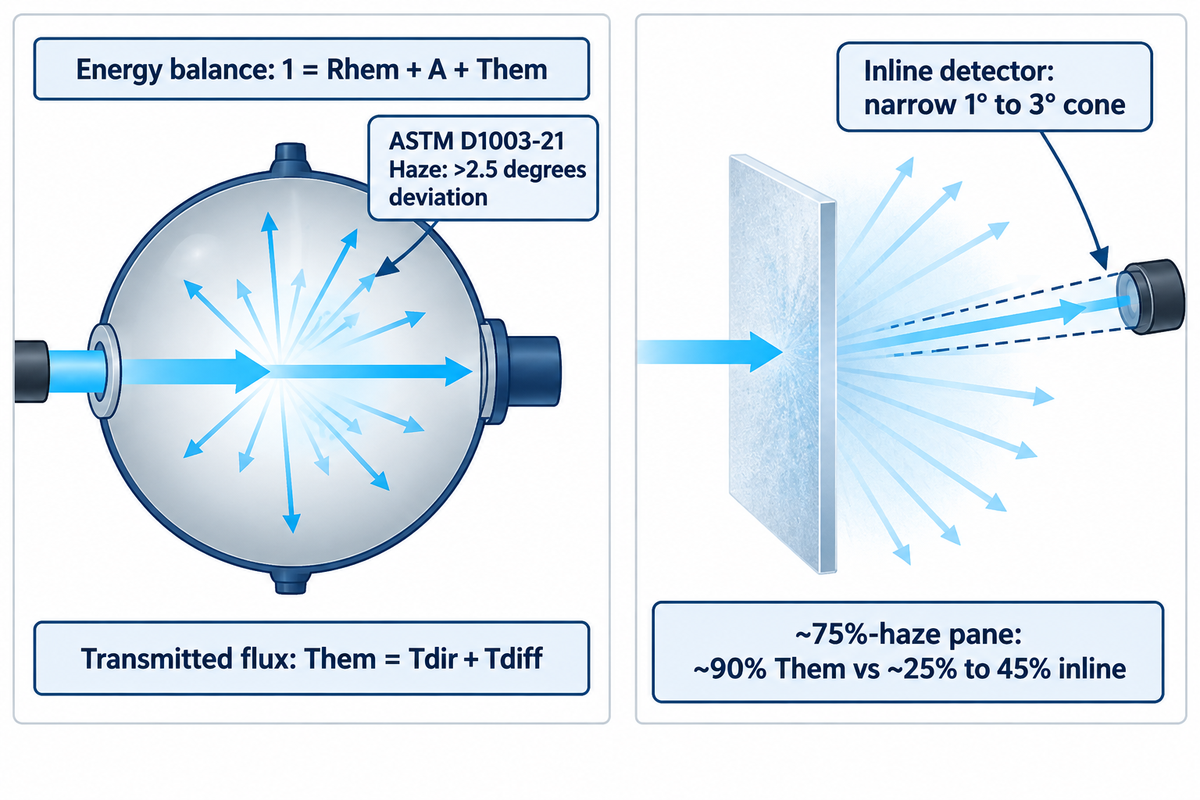
When specifying an optical diffuser, four parameters must be met: total hemispherical transmittance (Them), regular direct transmittance (Tdir), wide angle haze, and FWHM beam spread. In ASTM D1003-21, wide-angle haze is defined as the fraction of transmitted light that deviates more than 2.5 degrees from the incident beam.
Across all passive glass windows, the system’s total energy conserves radiant flux. Total incident energy equals reflected flux plus absorbed flux and transmitted flux (1 = Rhem + A + Them). Transmitted flux consists of two components: Them = Tdir + Tdiff, where Tdir is an unscattered narrow beam and Tdiff is scattered flux of the hemisphere. When bulk iron oxide absorption are minimized and backward scatter are minimized with broadband coatings, total forward transmission is maximized across each required level of diffusion.
Core Integrating-Sphere Metrology Equations (ASTM D1003-21 & NEN 2675)
1. Total Hemispherical Transmittance: Them = Tdir + Tdiff (collected across the full 2π steradian forward hemisphere).
ASTM D1003 Wide-Angle Haze (%): The standard definition of haze is equal to (Tdiff, >2.5° / Them) multiplied by 100%.
3. Full Width at Half Maximum (FWHM): θFWHM = 2 × θhalf, defined as the full angular cone width where scattered intensity drops to half (~50%) of its peak on-axis value.
A common quality control issue occurs during incoming inspection when testing diffusion glass with a standard two-beam spectrophotometer. Standard collimated detectors only collect rays within a narrow 1° to 3° acceptance cone. When light hits a typical ~75%-haze acid-etched diffuser, most photons scatter outside that narrow cone and miss the photodiode entirely. The instrument falsely reports roughly ~25% to 45% transmittance on a pane whose true hemispherical transmittance is around ~90%. For a deeper breakdown of how inline detectors differ from sphere photometers, review our engineering guide to glass absorption spectrum and transmittance measurements.
According to Caltech MMRC and Labsphere radiometry guidelines, placing a flat glass diffuser over a bare detector doesn’t always produce an accurate cosine collector. A hemispherical barium-sulfate or Spectralon integrating sphere is required. In commercial greenhouse glazing, European labs also test to Dutch standard NEN 2675 for greenhouse covering materials, which reports hemispherical PAR transmission alongside the F-scatter index. In the Antwerp 500-square-meter greenhouse trials, double-AR diffuse glass delivered 81.78% yearly mean PAR transmission inside the structure. Reference float glass delivered 79.11% mean PAR transmission, giving the diffuse cover a +2.66% yearly average light transmission gain (p < 0.0001).
Diffused Glass vs. Frosted Glass, Ground vs. Opal Glass, and Polymer Diffuser Sheets
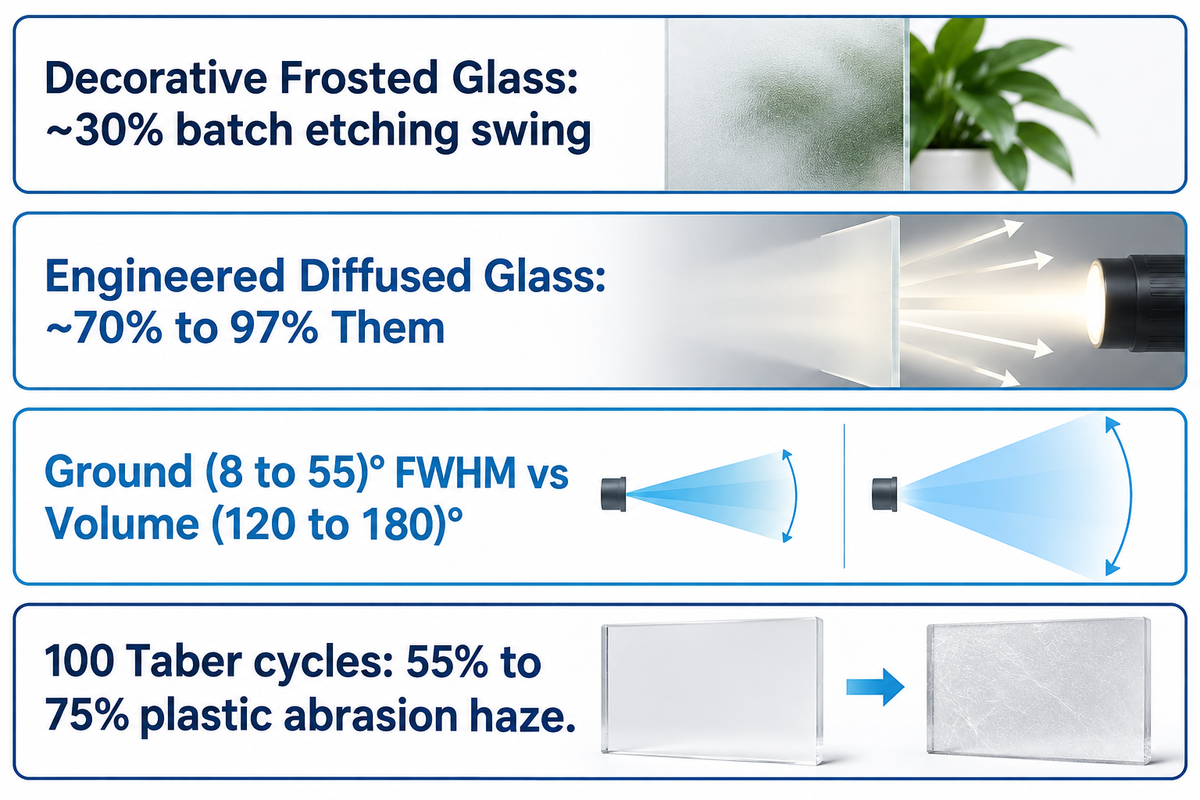
Frosted glass is used to describe sandblasted or acid etched glass for visual privacy. On the other hand, diffused glass is a quantified optical component artificially engineered to meet hemispherical transmittance (~70% to 97%), ASTM D1003 haze, and FWHM beam-spread tolerances. Inorganic glass avoids the 55% to 75% abrasion haze degradation measured on plastics in Holophane Taber abrasion testing.
Frosted decorative glass used in office partitions has different batches of etching depth that causes different brightness and visible shifts when adjacent LED luminaires are compared. Batch-to-batch etching depth can swing by ~30%, causing visible brightness shifts across adjacent LED luminaires. To ensure a repeatable intensity profile, an optical glass diffuser is manufactured with a controlled roughness (Ra) or colloidal density.
Datasheets for ground glass transmission frequently show conflicting values to readers. Some optical catalogs list roughly ~40% to 50% relative transmission, while architectural lighting datasheets report around ~80% to 90%. Both figures describe the exact same physical glass. Optical bench catalogs plot on-axis power collected by a finite lens aperture, whereas luminaire standards measure total hemispherical flux (Them) inside an integrating sphere. When comparing ground glass against opal glass and polymer sheets (acrylic PMMA and polycarbonate PC), engineers evaluate hemispherical efficiency alongside thermal and abrasion limits.
| Material / Diffuser Option | Typical Initial Them | Typical ASTM D1003 Haze | FWHM Beam Angle | Typical Backscatter Loss | 100-Cycle Taber Abrasion Haze | Max Continuous Service Temp |
|---|---|---|---|---|---|---|
| Low-Iron Acid-Etched + Double AR Glass | ~91%–97% | ~20%–88% (by grade) | 15°–55° Gaussian | Very Low (~<3%) | ~0% measurable change | 250°C (tempered) |
| Borosilicate Diffuser Glass (Uncoated) | 92% clear base (~82%–88% etched) | ~15%–85% | 12°–45° Gaussian | Low (~8% Fresnel) | ~0% measurable change | 450°C continuous |
| Coarse Sandblasted Ground Glass (120–220 Grit) | ~70%–80% | ~85%–95% | 20°–40° Gaussian | Moderate (~12%–18%) | ~0% measurable change | 250°C (tempered) |
| Fine Ground Optical Glass (600–1500 Grit) | ~80%–88% | ~45%–75% | 8°–18° Gaussian | Low (~8%–12%) | ~0% measurable change | 250°C–400°C |
| Colloidal White Diffusing Glass | ~25%–45% | ~>98% | 120°–160° Lambertian | High (~45%–60%) | ~0% measurable change | 150°C (untempered) |
| Flashed Opal Diffusing Glass | ~20%–40% (~30% typical) | ~>99% | 120°–180° Lambertian | Very High (~50%–65%) | ~0% measurable change | 120°C (non-temperable) |
| Engineered Fused Silica Microlens Diffuser | ~90%–92% (up to ~95% with AR) | Controlled phase spread | 10°–60° flat-top | Low (~<8%) | ~0% measurable change | 500°C+ (fused silica) |
| Acrylic (PMMA) Diffuser Sheet | 92% clear (~70%–85% doped) | ~30%–92% | 20°–110° | Moderate (~10%–25%) | 55% haze per Holophane report | 80°C–95°C softening |
| Polycarbonate (PC) Diffuser Sheet | 85% clear (~60%–78% doped) | ~40%–95% | 25°–120° | Moderate (~15%–30%) | 75% haze per Holophane report | 120°C–135°C (yellows) |
Using decorative frosted glass or cheap polycarbonate sheets in outdoor flood lights creates numerous field risks. As reported by Holophane luminaire testing, polycarbonate starts at only 85% base transmission and develops 75% surface abrasion haze after 100 Taber cycles. Low-iron glass keeps its optical transmission.
How do optical diffusers control angular beam spread and homogenize incident light?
Optical diffusers control angular beam spread by altering the bulk density of colloidal particles and the slope of surface facets or by utilizing microlens curvature. Random diffusers similar to ground glass generate a bell-shaped Gaussian cone with an FWHM of (8 to 55) degrees. Volume diffusers produce a wide (120 to 180) degree hemispherical beam spread. Sharp flat-top beams can be generated utilizing engineered diffusers.
As stated in the University of Arizona Wyant College of Optical Sciences diffuser thesis, ground glass diffusers (and light shaping diffusers) alter the coherence and incoherence of light to scatter into a Gaussian (or an angularly controlled distribution) to prevent peripheral energy spill. It also helps create even illumination across the target plane.
Glass Substrates and Anti-Reflective Coatings to Diffuse Light Without Reflection Loss
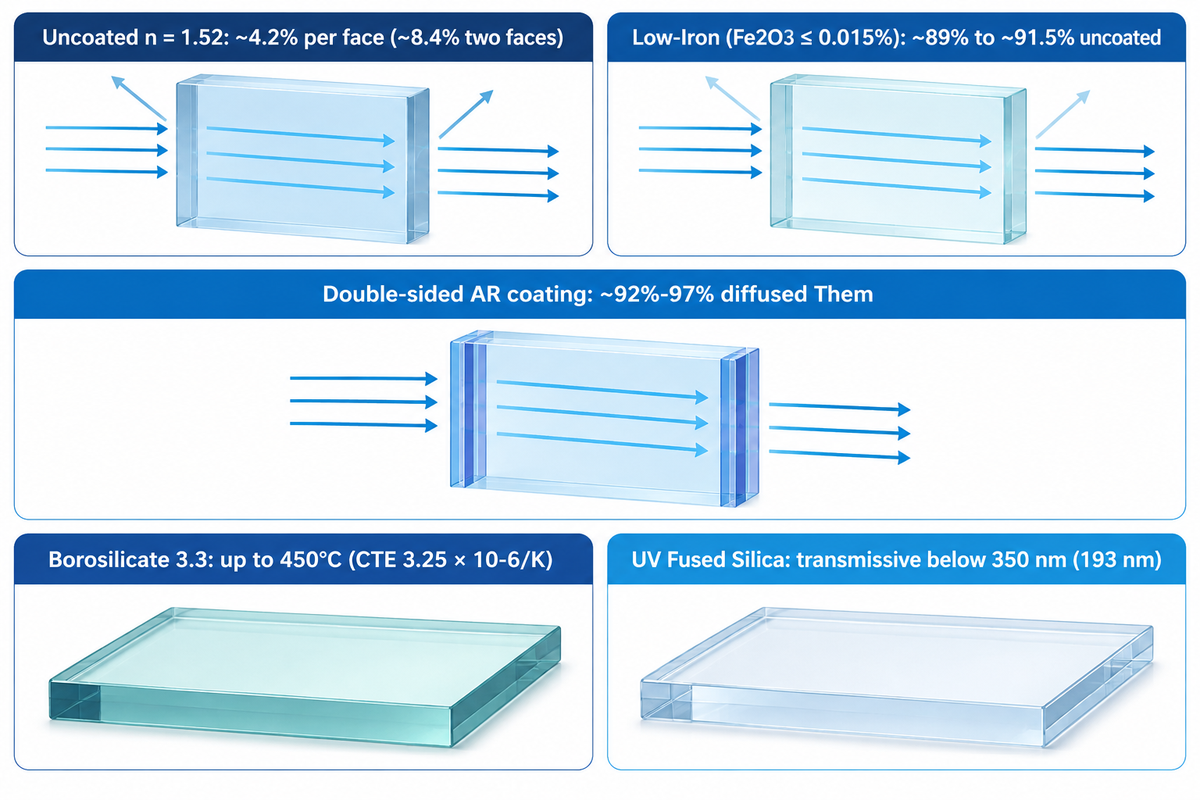
Pairing ultra-clear low-iron glass, borosilicate 3.3, N-BK7, or UV fused silica with double-sided anti-reflective (AR) coatings raises diffused hemispherical transmittance from ~84%–89% on uncoated standard float glass to ~92%–97%. The base substrate governs UV-to-IR spectral transmission and thermal shock resistance. Double-sided AR coatings recover roughly ~4% to 8% Fresnel reflection loss.
Every uncoated glass substrate with a refractive index near n = 1.52 reflects ~4.2% of incident light at the air-glass interfaces, calculated as R = [(n – 1) / (n + 1)]2. Across two surfaces, reflection is maximized at ~8.4% loss before any internal absorption is counted. Standard, green-edge, soda-lime float glass, loses ~1.5% to 3% to ferric oxide (Fe2O3 around ~0.1%), absorption in the visible and near-infrared band.
Upgrading to ultra-clear low-iron glass substrates (Fe2O3 ≤ 0.015%) lifts uncoated visible transmittance from ~89% to ~91.5%. When multi-layer or nano-porous silica anti-reflective coatings are deposited on both faces, residual reflection drops below ~1% per face. As verified in NIH PMC horticultural glazing measurements, choosing an AR coating in combination with low-haze diffuse glass yields higher hemispherical light transmission than standard 0% haze float glass (84%).
For high-heat halogen, HID, or densely packed COB LED fixtures operating up to 450°C, engineers specify borosilicate glass thermal properties (linear CTE 3.25 × 10⁻⁶/K). Borosilicate provides 92% initial transmittance per Holophane luminaire testing and resists thermal fracture under cold rain splash. In precision laboratory instruments and optical filters across the 350 nm to 2000 nm wavelength range, fabricators use BK7 optical glass transmission properties for bubble-free homogeneity. According to Thorlabs UV fused silica datasheet benchmarks, UV fused silica is highly transmissive below 350 nm and exhibits virtually no laser-induced fluorescence at 193 nm.
LED Luminaire Setback Rules, Architectural Glazing, and Outdoor Marine Lighting Glass
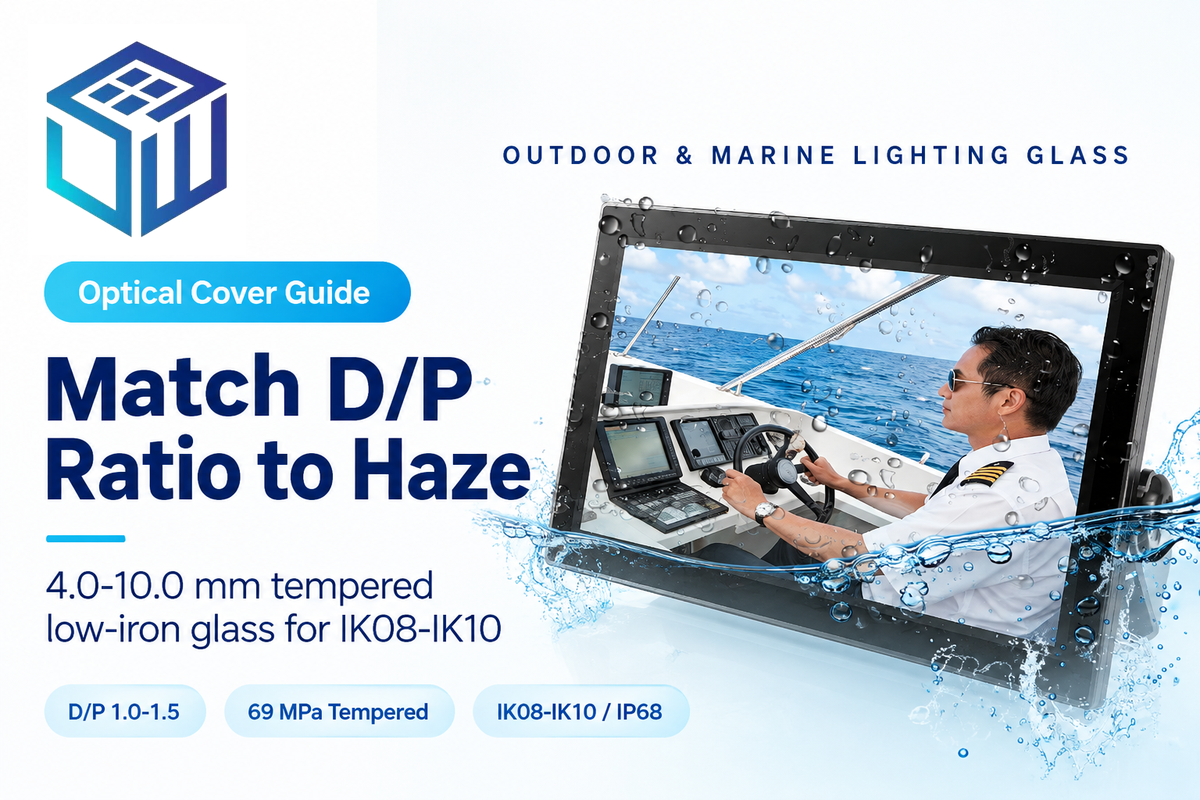
Eliminating discrete LED diode hot spots without wasting lumens requires matching the diffuser setback-to-pitch ratio (D/P) to the glass haze tier. Close-coupled arrays (D/P < 0.8) need ~85%–98% haze double-etched or solid colloidal white diffusing glass. Standard cavities (D/P = 1.0–1.5) achieve hotspot-free uniformity at ~89%–94% hemispherical transmittance using ~65%–85% haze acid-etched low-iron glass.
When a low-haze cover glass is placed too close to an SMD LED board, adjacent ray cones fail to overlap before impacting the inner surface of the cover glass. As demonstrated in Edmund Optics 1064 nm beam profiles, even a polished colloidal diffuser shows a residual central hot spot at 1064 nm when un-diffused rays pass straight through. Increasing glass thickness by itself can’t resolve a narrow air gap. Rather, luminaire designers adjust the setback distance (D) against the center-to-center pitch (P) of the diode and the emitter’s half-intensity angle of view (θ).
The 3-Ratio LED Setback & Haze Ladder
The 3-Ratio LED Setback & Haze Ladder pairs LED cavity setback-to-pitch ratios (D/P) with the lowest diffuser haze required to eliminate hotspots at high transmittance.
Assumed Inputs & Geometric Overlap Calculation (Worked Example Model)
- The assumed LED pitch (P) is 20.0 mm center-to-center spacing on a linear aluminum PCB.
- For Case A (standard SMD LED with θ = 120° FWHM viewing angle and tan 60° = 1.732), geometric half-power cone intersection occurs at dmin = P / [2 × tan(θ/2)] = 20 / (2 × 1.732) = 5.77 mm.
- For Case B (secondary-optic narrow LED with θ = 60° FWHM viewing angle and tan 30° = 0.577), geometric half-power cone intersection shifts out to dmin = 20 / (2 × 0.577) = 17.32 mm.
Scope note: dmin = 5.77 mm is only the geometric half-intensity ray intersection in air, not the final hotspot-free viewing distance. Without a reflective cavity or high-haze diffuser, human eyes still perceive peak luminance above each LED die until D ≥ 1.0 × P (20 mm to 30 mm).
| Setback Ratio Tier (D/P) | Setback D at P = 20 mm | Recommended Diffusion Glass Architecture | Target ASTM D1003 Haze / Grit | Typical Expected Them |
|---|---|---|---|---|
| Ratio Tier 1: Ultra-Slim (D/P < 0.8) | 6 mm – 15 mm | Double-sided acid-etched low-iron glass or colloidal white diffusing glass | ~85%–98% haze (120-grit equivalent) | ~35%–45% (white) / ~84%–89% (dual-etched) |
| Ratio Tier 2: Balanced Cavity (D/P = 1.0–1.5) | 20 mm – 30 mm | Single-sided medium-heavy acid-etched low-iron glass + AR coating | ~65%–85% haze (220–600 grit equivalent) | ~89%–94% hemispherical |
| Ratio Tier 3: Deep / Narrow-Beam (D/P ≥ 1.5–2.5) | 30 mm – 50 mm | Light acid-etched, rolled prismatic, or 40°–60° engineered microlens glass + double AR | ~20%–55% haze (600–1500 grit equivalent) | ~92%–96% hemispherical |
Structural impact ratings must be taken into consideration, in addition to optical setback requirements, for coastal floodlights, dock navigation beacons and deck luminaires. Specifiers of outdoor and marine display and lighting glass use 4.0 mm to 10.0 mm thermally tempered monolithic low-iron acid-etched glass. In accordance with Vitro Architectural Glass tempering specifications, fully tempered glass panels must have a minimum surface compression of 69 MPa (or edge compression of not less than 67 MPa / 9,700 psi) to meet the impact requirement of IK08 to IK10 and gasket loads of IP66 to IP68.
Optics and Photonics, Greenhouse Horticulture, and Display Cover Glass Applications
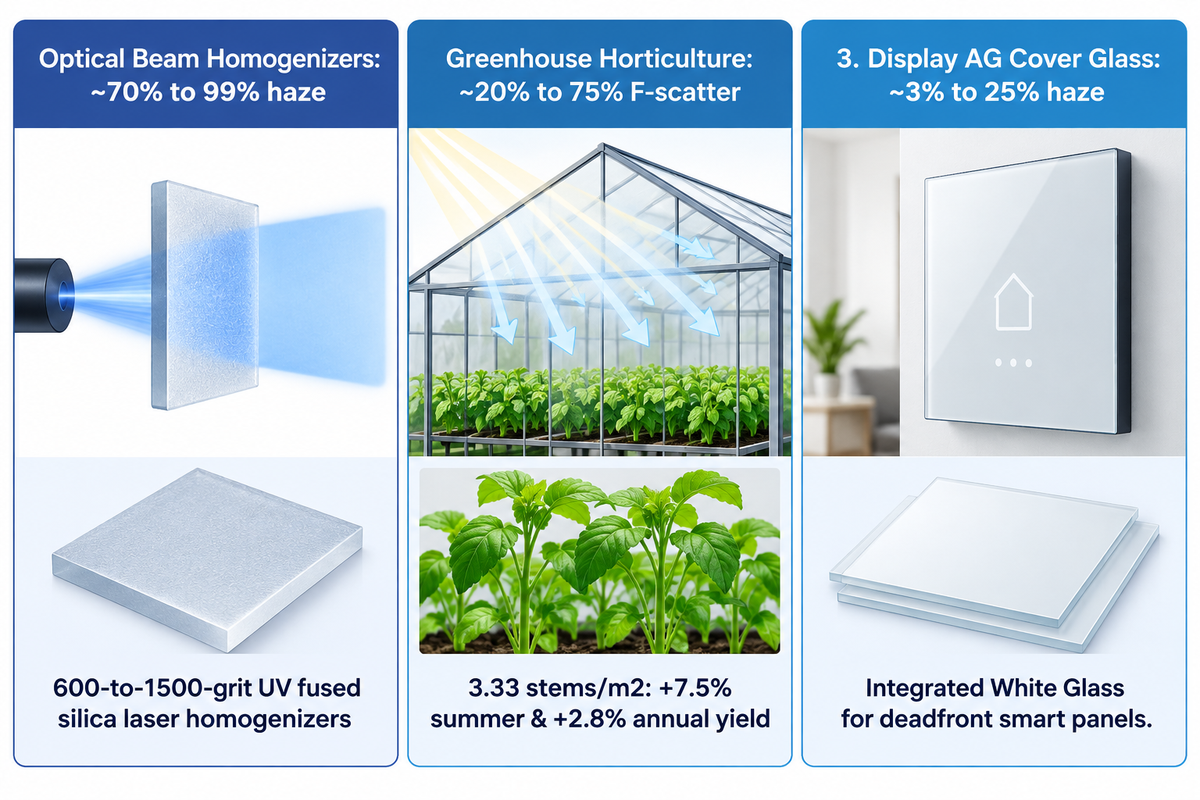
Target haze levels shift across specific application requirements. Display anti-glare (AG) cover glass uses ~3% to 25% haze to preserve pixel sharpness. Commercial horticultural greenhouses use ~20% to 75% F-scatter low-iron AR glass (+2.8% annual and +7.5% summer tomato yield reported in PMC7412570 trials), while optical beam homogenizers use ~70% to 99% haze.
1. Optics and Photonics Applications: Diffusing glass are used in optics and photonics as viewing screens, laser speckle reducers, interferometer alignment targets and integrating sphere ports. When phase uniformity of a coherent laser beam is required, designers combine 600-to-1500-grit UV fused silica ground glass diffusers with hexagonal light-mixing rods or UV Aluminum diffuse mirrors. Diffusers are ideal for homogenizing multi-wavelength illumination before a detector slit. Acid-etched substrates are also ideal for creating uniform backlights when the glass optical aperture captures the full scattered cone.
2. Commercial Greenhouse Horticulture: Controlled trials by Holsteens et al. (2020) in Plants (NIH PMC7412570) revealed an important physiological boundary condition. At a single-leaf level, net photosynthesis under diffuse light is lower than under direct light because upper sun-adapted leaves have thick mesophyll layers. However, at a whole-canopy level on sunny days (PAR > 600–750 μmol·m-2·s-1), low-iron double-AR diffuse glass (20 ± 10% haze) scatters light deeper into shaded lower leaves. According to the PMC7412570 harvest report, at a low tomato stem density of 3.33 stems per square meter, the diffuse compartment increased summer yield by 7.5% and annual production by 2.8% (with fruit weight +4–5 g heavier). Raising tomato stem density to 3.75 stems per square meter reduced average fruit weight by 8 g in the diffuse compartment (and 5 g in the reference compartment), while dense bell pepper canopies saw zero yield increase.
3. Display & Smart-Home Cover Glass: Applying a ~70%-haze luminaire diffuser over an IPS LCD or OLED screen ruins contrast and creates severe pixel sparkle. Display engineers restrict acid-etched anti-glare (AG) haze to ~3%–25% and evaluate mechanical durability under IEC 61747-40-1:2019 cover glass testing guidelines. Alongside diffusing glass used in optics, SW Glass fabricates Integrated White Glass (deadfront diffusing cover glass) for hidden-until-lit smart thermostats and appliance panels. It appears solid matte white when powered off and transmits crisp icon graphics when backlit. Compare these surface stacks in our guide to AR vs. AG vs. AF glass surface treatments.
Custom Fabrication Sequencing: CNC Machining, Thermal Tempering, and Strengthening Limits
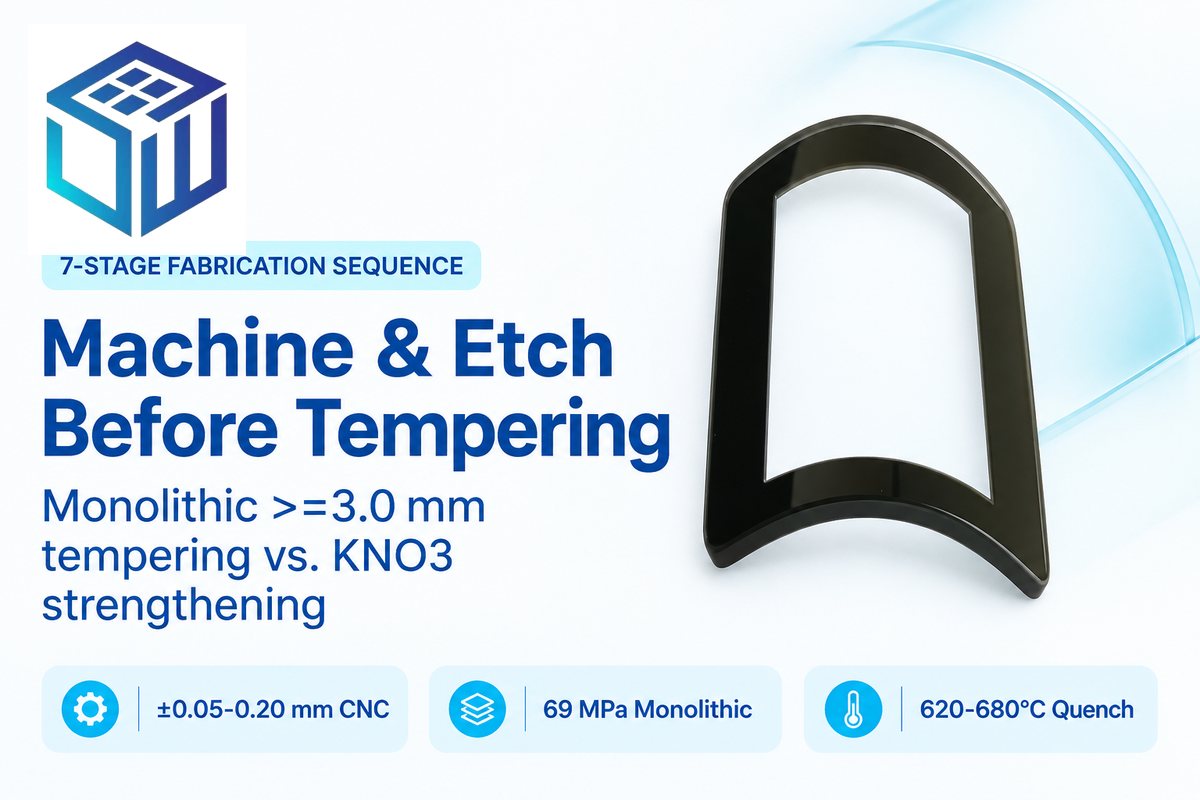
All mechanical cutting, CNC edging (±0.05 mm to ±0.20 mm tolerance), hole drilling, acid etching, and high-temperature ceramic screen printing must finish before thermal tempering or chemical strengthening. Monolithic panes (≥3.0 mm) temper to 69 MPa (10,000 psi) surface compression per Vitro Architectural Glass, whereas two-layer flashed opal diffusing glass can’t be thermally tempered.
A common mistake in engineering occurs when a customer orders “thermally tempered flashed opal glass” in an outdoor luminaire. Flashed opal glass consists of a 0.2 to 0.5 mm milky white fluoride-opal veneer fused onto a clear soda-lime base sheet. The two layers have different coefficients of thermal expansion (CTE) and softening viscosities. Shear stress along the fusion line can occur when the glass sheet is heated to 620°C to 680°C and blasted with cold quench air. It can also result in delamination or shattering of the glass pane in the tempering chiller. In contrast, monolithic heat-strengthened glass (3,500 to 7,500 psi surface compression) and fully tempered, monolithic low-iron glass, can undergo rapid air quenching without problem.
Mandatory 7-Stage Custom Diffusion Glass Fabrication Sequence
- Use a laser or waterjet to remove outside dimensions of monolithic low-iron, borosilicate, or colloidal white diffusing glass to create blanks.
- Machine mounting holes, counterbores, and C-edges or T-chamfers on CNC centers. As presented in a 2014 soda-lime cover-glass chemical-polishing study, edge polishing with ammonium fluoride and organic acids heals chamfer micro cracks, and increases the flexural strength by up to 20%, with no degradation to transmittance.
- Form the target Ra roughness or 120–1500 grit texture across the active optical aperture via selective acid etching or abrasive lapping.
- For instructions on opaque bezel borders and line marks, print using high temperature ceramic ink before furnace entry. Refer to our article on ceramic silk screen printing on glass.
- Execute air-quench tempering (≥3.0 mm, see thermal glass tempering process) or molten potassium nitrate (KNO3) ion exchange at 380°C, 450°C (≤2.0 mm). Cutting or drilling after strengthening shatters tempered glass or causes over ~50% local strength loss on chemically strengthened panels.
- Apply broadband vacuum AR and AF topcoats below the stress-relaxation temperature.
- Integrating-Sphere & Dimensional QA: Verify total hemispherical transmittance, ASTM D1003 Haze, and surface stress prior to placing in cleanroom packaging.
Light-diffusing and anti-reflective surface treatments can also be combined chemically. USPTO Patent US4944986A (citing US2966432A) discloses multi-stage etched glass surface treatments. Those chemical treatments scatter transmitted light while forming a graded-index anti-reflective surface layer on monolithic silicate glass.
Why Glass Diffusers Outlast Plastics and How to Prevent Oil or Moisture Index-Matching Failure
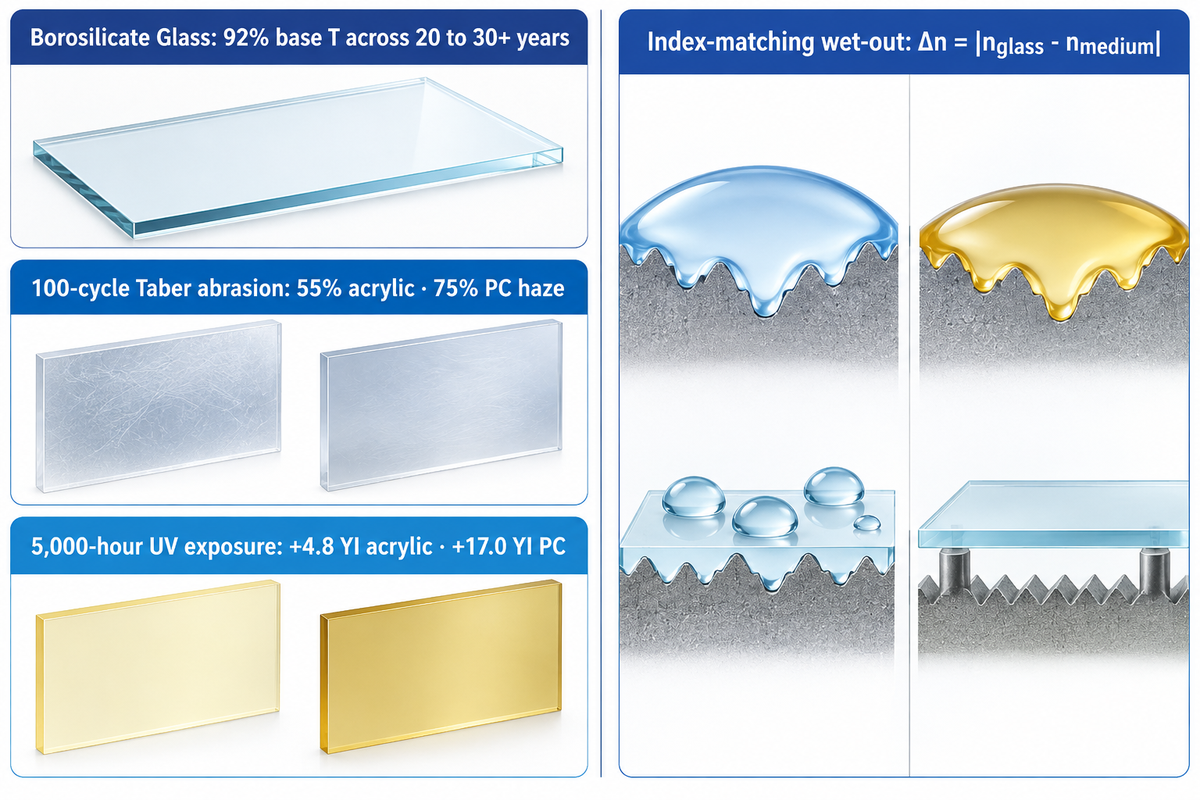
Inorganic glass diffusers maintain 92% base borosilicate transmittance across 20 to 30+ years of typical outdoor service at 250°C to 450°C without UV yellowing. By contrast, Holophane outdoor luminaire testing shows that polycarbonate starts at 85% transmittance and reaches prominent yellowing (YI = 35) in as little as nine months in high-heat HID luminaires. Without lamp heat, outdoor polycarbonate still develops nearly 20% haze after three years of weathering.
During a 100-cycle Taber abrasion test, an acrylic sample developed 55% abrasion haze and polycarbonate developed 75% haze.
As documented in Holophane’s luminaire materials evaluation by R.A. In luminaire aging tests reported by Donald A. Peterson, P.E., borosilicate glass and acrylic both begin at 92% initial transmittance. Polycarbonate starts lower at 85% because resin suppliers add blue toners to mask inherent amber tint. Under ASTM Yellowness Index testing, a YI of 22 is noticeable and a YI of 35 is prominent. In a 5,000-hour exposure test under a white mercury vapor lamp (roughly 15 months of dusk-to-dawn operation), the YI of acrylic increased by 4.8 points. Polycarbonate jumped by 17.0 points in the same 5,000-hour test, whereas inorganic silicate glass does not change with age.
Though glass doesn’t yellow, diffusion glass has a field failure mode known as refractive index-matching wet-out. Optical experts discuss surface scattering on physics and optics technical forums. Surface scattering obeys Snell’s Law (n1 sin θ1 = n2 sin θ2). The strength of scattering depends on the refractive index contrast (Δn = |nglass – nmedium|) at the boundary of the micro-facets:
| Interface Condition on Textured Glass (nglass ≈ 1.52) | Contact Medium n | Index Contrast (Δn) | Optical Scattering Behavior | Engineering Prevention Strategy |
|---|---|---|---|---|
| Clean Dry Air Interface (Design Baseline) | nair = 1.00 | Δn = 0.52 | Full micro-facet refraction; stable target FWHM and haze | Maintain clean dry cavity seal (IP66/IP67) |
| Condensation or Washdown Water Film | nwater = 1.33 | Δn = 0.19 (roughly ~63% drop) | Partial wet-out; FWHM angle collapses and local haze drops sharply | Orient textured surface inward toward dry LED cavity |
| Finger Oils, Cutting Fluid, or Silicone Grease | noil ≈ 1.47–1.50 | Δn ≈ 0.02–0.05 (over ~90% drop) | Complete wet-out failure; contaminated patch turns transparent and leaks glare | Specify closed-cell acid etch + AF oleophobic coating (>110° contact angle) or polished volume opal glass |
Do: Install Single-Sided Textured Face Inward
Mount single-sided ground or acid-etched glass with the textured surface facing the sealed internal light source. Facing the matte surface toward the emitter shields micro-pits from external oil and water. It also improves transmittance by ~1% to 3% due to reduced reflection.
Don’t: Leave Raw Sandblasted Glass Exposed
Never expose uncoated 120–220 grit sandblasted glass to bare hands or industrial oil mist. Open micro-fractures trap skin oils (n ≈ 1.48) permanently. Skin oils have a refractive index of about 1.48. If the outer face needs to be textured, specify anti-fingerprint (AF) coating along with chemical acid etching.
Technical Information for Sourcing: Diffusion Glass Cost Drivers, Suppliers, and RFQ Checklist
Sourcing diffusion glass breaks into two commercial pathways. Off-the-shelf 25.4 mm (1-inch) to 50.8 mm laboratory optical diffusers include stock items like Thorlabs 1-inch UV fused silica ground-glass discs at $35.28. Custom OEM deep-processed cover glass panels require a custom RFQ and are priced per drawing based on low-iron substrates, CNC machining, thermal tempering, and vacuum AR coatings.
Procurement teams compiling technical information for production programs should evaluate four primary cost multipliers before requesting quotes. First, upgrading from standard clear soda-lime float glass to ultra-clear low-iron float glass adds ~15% to 25% to raw material cost. That substrate upgrade recovers ~2% to 2.5% hemispherical transmission. Second, tight CNC dimensional tolerances (±0.05 mm vs. ±0.20 mm), step edges, and counterbored mounting holes add spindle cycle time. Third, thermal tempering (≥3.0 mm) or potassium-nitrate chemical strengthening (≤2.0 mm) adds furnace batch handling. Fourth, single- or double-sided vacuum anti-reflective (AR) and anti-fingerprint (AF) coatings amortize across the vacuum chamber load size.
Which Suppliers Provide Stock Laboratory Optical Diffusers Versus Custom Tempered and AR-Coated Diffusion Cover Glass?
Catalog photonics distributors such as Edmund Optics, Thorlabs, Newport (MKS), UQG Optics, Knight Optical, and Luminit offer 25.4 mm to 50.8 mm untempered optical discs. Their stock includes ground glass, colloidal white diffusing glass, flashed opal discs and holographic diffusers. Custom OEM glass fabricators such as Dongguan Saiwei Glass Co., Ltd. (SW Glass), Abrisa Technologies, and Swift Glass, can manufacture custom cut, CNC drilled, thermally tempered, screen-printed, and AR/AF coated diffusion cover glass panels to print.
Engineering teams purchase 1 to 10 catalog discs from Edmund Optics or Thorlabs to validate FWHM divergence on an optical bench. After housing geometry, gasket steps, ceramic spacers and IK08/IP66 ratings are established, production transitions to a direct OEM processor. Dongguan Saiwei Glass Co. Ltd. (SW Glass) was established in 2014 and operates over 100 units of fully automated CNC, tempering, silk-screen printing, and AG/AR/AF/ITO surface treatment equipment. With an annual capacity exceeding 1,000,000 pieces, SW Glass fabricates custom Tempered Lighting Glass, Low Iron Glass, and Integrated White Glass panels directly from CAD drawings. For more information on SW Glass, see our optical glass manufacturing capabilities for batch production tolerances.
8-Point Engineering RFQ Specification Checklist for Custom Diffusion Glass
| RFQ Parameter | Required Engineering Specification on Drawing | Verification Standard / Method | Defect Prevented |
|---|---|---|---|
| 1. Base Glass Substrate | Ultra-clear low-iron soda-lime, borosilicate 3.3, N-BK7, or UV fused silica | ISO 15368:2021 / substrate melt cert | Green iron edge loss or UV cutoff |
| 2. Diffusion Architecture | Single/double acid-etched, 120–1500 grit ground, patterned, or Integrated White Glass | Profilometer Ra (μm) & visual master | Ambiguous “frosted glass” substitution |
| 3. Hemispherical Them (%) | Minimum total hemispherical transmittance (~≥90%–95% with double AR) | 150 mm integrating sphere (ASTM D1003-21) | False low readings from inline sensors |
| 4. Haze % or FWHM Angle | Target wide-angle haze (>2.5°) or NEN 2675 F-scatter / FWHM beam angle | ASTM D1003-21 / goniophotometer | Uncontrolled LED diode hot spots |
| 5. Thickness & CNC Tolerances | Nominal thickness (0.5–12 mm), outer L×W (±0.05 to ±0.20 mm), edge chamfer | Optical CMM inspection | Housing interference or edge chipping |
| 6. Strengthening Method | Thermal tempering (≥3.0 mm monolithic, 69 MPa) or KNO3 ion exchange (≤2.0 mm) | ASTM C1048 / surface polarimeter | Flashed-opal furnace shatter or field breakage |
| 7. Functional Coatings | Single or double-sided AR coating, AF oleophobic topcoat (>110° contact angle) | Spectrophotometer & water drop gauge | ~8% Fresnel loss or oil wet-out spots |
| 8. Orientation & Bezel Print | Designate Surface 1 (outer) vs. Surface 2 (inner light-facing) for texture and ceramic ink | First-article drawing sign-off | Backward assembly in luminaire production |
Need Custom Tempered or AR-Coated Diffusion Glass Samples?
We will evaluate DXF/STEP drawings of your ASTM D1003 haze, hemispherical transmittance, LED setback geometry, edge tolerances. Our optical fabrication engineers will perform a review of your submitted data stack and provide a formal quote.
Frequently Asked Questions
How is diffusion glass made for optical and lighting applications?
Diffusion Glass is created by grit blasting, hydrofluoric acid etching, hot-roller embossing, and precipitating fluoride and phosphate crystals within the glass melt.
Surface-scattering diffusers use 120 to 1500 grit alumina lapping, chemical etching, or patterned rollers on low-iron float glass. White and opal diffusers create sub micron colloidal crystals that scatter throughout the entire thickness of the glass.
What is diffusion fabric, and when should you use diffusion glass instead?
Stretched across portable studio lighting frames, Diffusion fabric is a woven strip of nylon, polyester or silk textile sheet that softens beam edge shadows.
Use rigid diffusion glass in all cases where the diffuser is used to form a structural enclosure window. Some examples include outdoor IP66 to IP68 LED flood lights, marine instrument displays, greenhouses, and optical instruments (high temperature instruments) where textiles burn or degrade under UV radiation.
How do you use a glass diffuser, and which side should face the light source?
Mount a single-sided ground or acid-etched glass diffuser at a setback distance of 1.0 to 1.5 times the LED pitch with the textured matte surface facing the light source.
Facing the textured side inward increases total forward hemispherical transmission by ~1% to 3%. Additionally, the textured side encapsulates and protects the open micro-pits from external finger oils, industrial dust and washdown, which cause refractive index-matching wet-out.
Can diffusion glass be thermally tempered for outdoor IK08, IK10 impact resistance?
Monolithic acid-etched, sandblasted, and patterned low-iron glass (≥3 mm thick) can be thermally tempered to 69 MPa surface compression, while two-layer flashed opal panels crack from thermal expansion mismatch.
Does anti-reflective (AR) coating reduce the haze of diffusion glass?
No, broadband anti-reflective coatings suppress ~4% to 8% surface Fresnel reflection to boost hemispherical light transmission up to ~95%–97% without altering the wide-angle scatter haze percentage.
Has opal diffusion glass been discontinued, and what replaces traditional flashed opal?
Production of several historic grades of hand-blown or heavy fluoride-flashed opal glass has been restricted as a result of the potential environmental impact of fluorine emission and high melting costs.
Engineers substitute traditional flashed opal with solid colloidal white diffusing glass for modern high-volume optical and luminaire designs. Higher total transmission can also be achieved with double-sided multi-stage acid-etched low-iron glass and engineered microlens diffusers, which also allows for thermal tempering.
References & Sources
- Holsteens, K., et al. (2020). Mildly Diffuse Glass Cover Enhances PAR Transmission and Tomato Yield in Commercial Greenhouse Compartments Plants (NIH PubMed Central PMC7412570).
- TIAC Division of the ICC / ASTM International Digital Codes
- International Organization for Standardization. ISO 15368:2021, Optics and Photonics: Measurement of Reflectance of Plane Surfaces and Transmittance of Plane Parallel Elements.
- Wageningen University & Research (WUR eDepot). NEN 2675 Hemispherical Light Transmission and F-Scatter Evaluation of Greenhouse Covering Materials.
- Caltech Materials and Process Simulation Center / Labsphere. A Guide to Integrating Sphere Radiometry and Photometry.
- University of Rochester Institute of Optics. Statistical Properties and Scalar Transmission Characteristics of Random Ground-Glass Phase Screens.
- University of Arizona Wyant College of Optical Sciences. Characterization of Ground Glass and Light-Shaping Optical Diffusers.
- Paschotta, Dr. Rüdiger. RP Photonics Encyclopedia, Optical Diffusers: Surface vs. Volume Scattering and Beam Homogenization.
- Edmund Optics Inc. Understanding White Diffusing Glass, Flashed Opal Glass, and Ground Glass Diffusers & Diffuser Selection Guide.
- Peterson, R. A., P.E. Holophane (Acuity Brands) Technical Paper, Refractor Materials Used in Outdoor Luminaires (Borosilicate Glass vs. Acrylic and Polycarbonate).
- Thorlabs Inc. UV Fused Silica and N-BK7 Ground Glass Diffusers (120 to 1500 Grit Specifications).
- Vitro Architectural Glass. Heat-Strengthened vs. Tempered Glass Surface Compression Specifications (ASTM C1048).
- United States Patent and Trademark Office (USPTO). US Patent 4,944,986A, Light Diffusing Glass and Anti-Reflective Etched Glass Surface Treatments.
Editorial Transparency & Manufacturing Scope
This technical document describes the engineering perspective on custom glass deep-processing. We include CNC cutting, edge profiling, drilling, chemical acid etching, ceramic frit screen printing, thermal tempering, chemical strengthening, and vacuum coating AG/AR/AF technologies. Dongguan Saiwei Glass Co. Ltd. (SW Glass) is a custom OEM optical and cover-glass fabricator rather than a raw float-glass melting furnace or photopolymer holographic master vendor. The optical benchmarks for transmittance, ASTM D1003-21 haze, and NEN 2675 referenced above are derived from peer reviewed literature, standards, and published optical datasheets. Please confirm the performance of the final luminaire or device within the physical first article samples of your target optical cavity.
Reviewed by the Dongguan Saiwei Glass Co. Ltd. (SW Glass) technical team.