Get in Touch with Saiweiglass



Updated November 2026 · Reviewed by the Dongguan Saiwei Glass Co., Ltd. technical team
An industrial sight glass is a pressure-retaining window, typically DIN 7080:2025-05 thermally toughened borosilicate 3.3 rated up to 280 °C, with fused quartz or sapphire used for hotter or harsher duty. Mounted on boilers, pipelines, and chemical vessels, it gives operators direct visual observation of liquid level, flow, phase separation, or foam. DIN 7080:2025-05 covers circular panes at least 6.5 mm thick, DIN 7081 governs oblong gauge strips, and DIN 7079 standardizes metal-fused rings.
Choosing the wrong port geometry or substrate causes gasket leaks, caustic clouding, or brittle fracture during startup. Safe specification rests on four engineering checks: match substrate thermal shock limits, scale thickness with a 1.6× pressure margin, fit flat mica or FEP shields in corrosive steam or alkali, and control bolt torque during installation. Technicians also cross-tighten bolts within a 1.5 ft-lb spread, never retighten hot or operating ports, and replace gasketed discs on disassembly.
What Is a Sight Glass and How Pipeline, Vessel, and Liquid Level Gauge Designs Differ
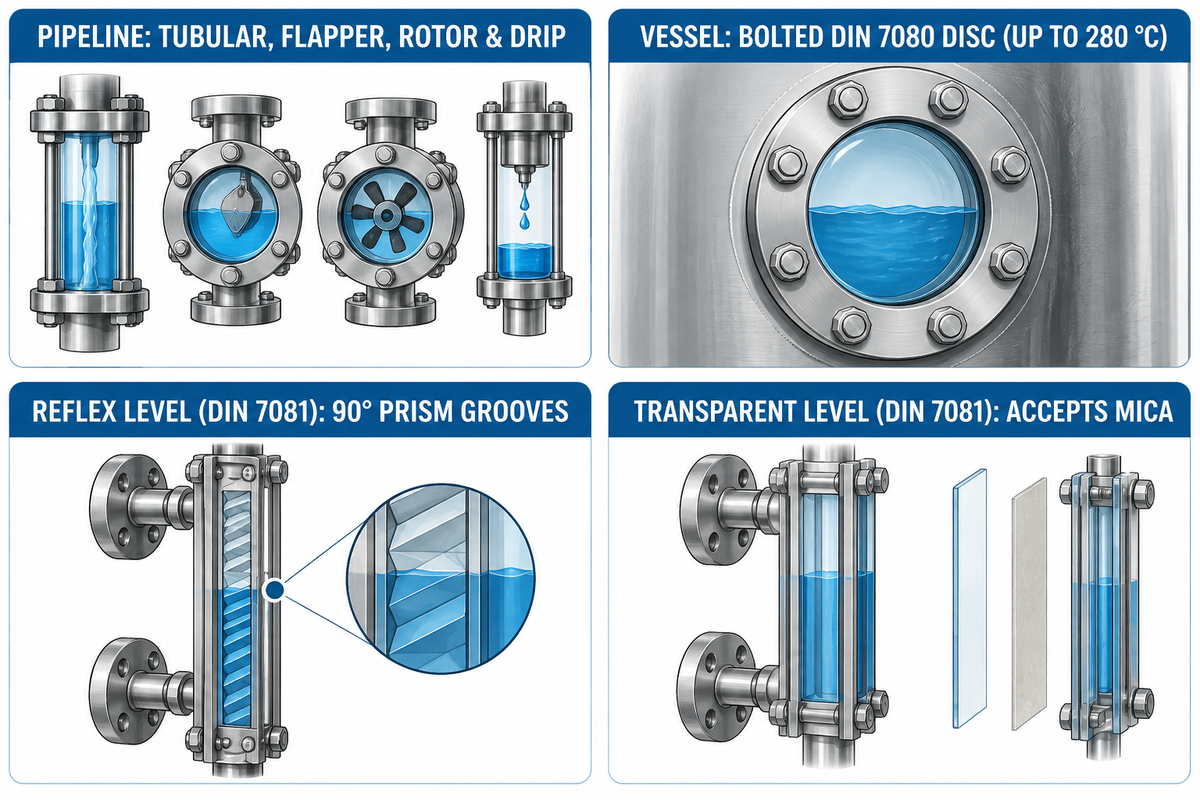
Industrial plants divide visual ports into three distinct mechanical families based on where process fluid travels. Pipeline indicators confirm motion or entrained vapor inside a pipe run. Circular tank windows expose agitator vortexes, spray balls or headspace foam in a reactor. Vertical column assemblies act as a direct liquid level gauge along boilers, receivers, and knock-out drums.
Catalogs often lump brass oil plugs, inline flappers, and high-pressure reactor flanges under one label. To prevent misordering, run a 3-zone sight port triage before checking dimensions or gaskets. The triage first asks whether operators track bulk flow velocity, vessel interior state, or hydrostatic column height.
Quarter-turn isolation valves are mounted on steam drums with the handles inverted, so the lever is down when open. In this orientation, plant vibration cannot drop the lever closed and trap a false water-column reading while the drum runs dry. In process vessel fitting practice, circular DIN 7080 plates are paired with round fittings, flanges, and retainers, and oblong DIN 7081 plates are paired with level gauges, which are mounted horizontally or vertically.
| Triage Zone & Configuration | Glass Element Geometry | Primary Visual Task | Typical Duty Boundary |
|---|---|---|---|
| 1. Pipeline: Full-View Tubular Indicator | Full-circumference borosilicate cylinder | Color, clarity, and low-pressure gravity drain check | Low-pressure lines protected against pipe-bending loads |
| 2. Pipeline: Flapper Sight Indicator | Dual flat round discs + hinged vane | Bidirectional or upward clear-liquid flow confirmation | Clean liquids; solids can jam the internal hinge pin |
| 3. Pipeline: Rotor / Spinner Indicator | Flat round window + PTFE/metal impeller | Opaque or dark fluid motion verification | Moderate flow rates free of stringy slurry fibers |
| 4. Pipeline: Drip-Tube Flow Indicator | Opposed flat discs + internal nozzle lip | Intermittent condensate trap drainage or trickle dosing | Vertical downward piping runs |
| 5. Vessel: Threaded Bull’s-Eye Plug | Small circular disc or fused plug | Gearbox, compressor crankcase, and hydraulic oil check | Compact NPT/BSPP ports on machinery sumps |
| 6. Vessel: Bolted Circular Window (DIN 7080) | Toughened round borosilicate 3.3 plate (≥6.5 mm) | Reactor agitation, foam, spray-ball CIP, and illumination | Up to 280 °C under DIN 7080:2025-05; pressures by d/t table |
| 7. Vessel: Metal-Fused Ring (DIN 7079) | Borosilicate core shrunk inside steel ring | High-hazard chemical, vacuum, or impact-prone vessel ports | Compressive ring preload holds cracked glass in place; Herberts METAGLAS reports surface cracking without failure |
| 8. Level Column: Reflex Prismatic Gauge (DIN 7081) | Elongated strip with 90° molded prism grooves | High-contrast dark-liquid vs. silver-vapor level reading | Clean single-liquid media; cannot accept flat mica shields |
| 9. Level Column: Transparent Dual-Plate Gauge (DIN 7081) | Two flat smooth oblong plates + rear illuminator | Oil-water interfaces, colored fluids, and high-pressure steam | Accepts flat mica or FEP shields on both wetted faces |
What Is the Difference Between Reflex and Transparent Sight Glass Level Gauges?
A reflex level gauge uses one oblong plate molded with 90-degree internal prism grooves facing the fluid. A transparent gauge instead sandwiches the fluid column between two smooth flat plates with a rear backlight. In a reflex unit, vapor spaces reflect light like a silver mirror while wetted grooves look black. Transparent dual-plate units cost more and need rear illumination, yet they are mandatory for oil-water interfaces, colored fluids, or steam needing flat mica shields.
DIN 7080 vs. DIN 7081 vs. Metal-Fused Sight Glass Standards
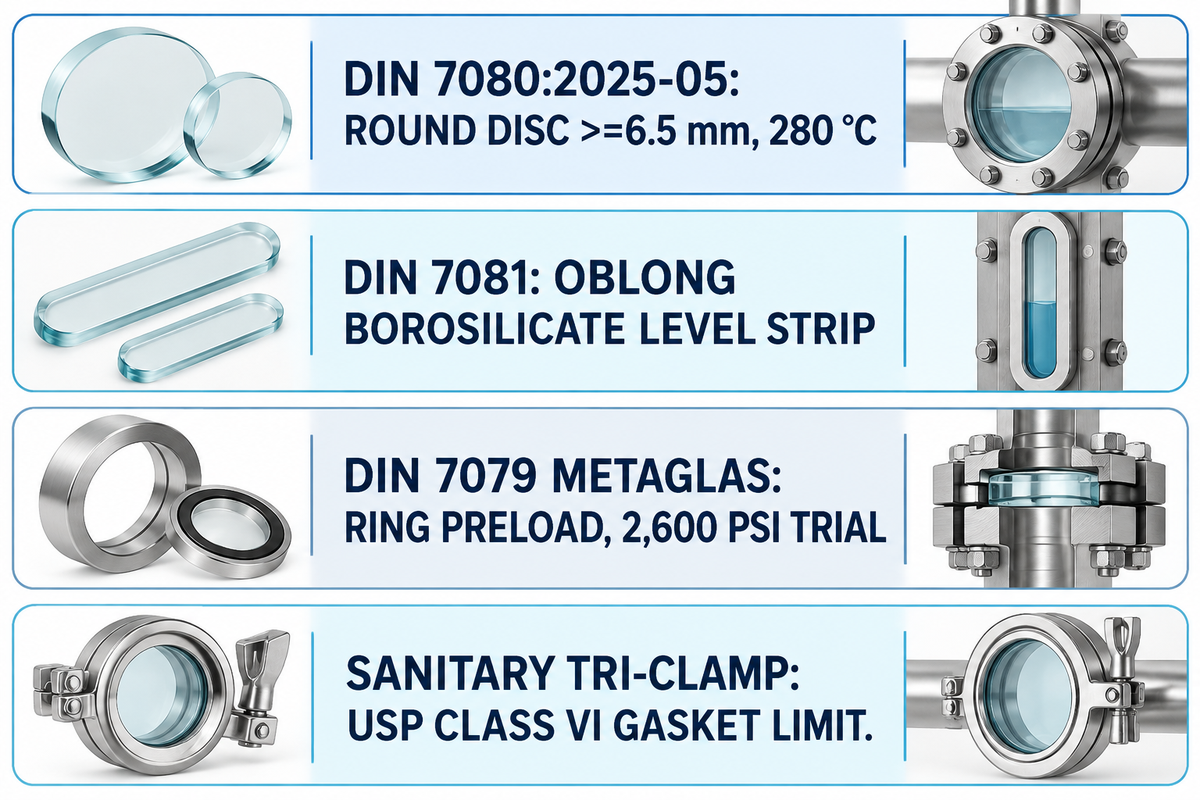
DIN 7080:2025-05 governs thermally toughened circular borosilicate sight panes at least 6.5 mm thick up to 280 °C, DIN 7081 covers oblong borosilicate strips for level gauges, and DIN 7079 standardizes metal-fused safety rings. In vessel engineering practice, circular DIN 7080 plates pair with round fittings, flanges, retainers, and seals, whereas elongated DIN 7081 plates suit vertical or horizontal level observation.
Many supplier catalogs still cite the superseded 2005 edition of DIN 7080. In May 2025, DIN published DIN 7080:2025-05 to replace DIN 7080:2005-05, covering panes up to 280 °C under permanent or cyclic one-sided pressure without setting a low-temperature pane limit (suppliers such as Lumiglas rate standard discs from −100 °C to +280 °C). The standard also addresses hydrogen service for the pane component.
“Sight glasses according to this document are suitable for use with hydrogen. This is independent of the respective aggregate state of the hydrogen.”
Keep component scope separate from whole-fitting qualification. DIN 7080:2025-05 confirms hydrogen suitability for the compliant borosilicate pane itself as a pressure-equipment part, whereas metal flanges, bolting, and elastomer or PTFE seals require separate hydrogen permeation and vessel-code verification. For PED and GMP audits in Europe, suppliers like Lumiglas provide batch EN 10204-3.1 material traceability certificates.
| Standard / Design Class | Glass Geometry & Construction | Published Scope & Temperature Limit | Primary Equipment Match |
|---|---|---|---|
| DIN 7080:2025-05 (replaces 2005-05) | Round thermally toughened borosilicate disc (≥6.5 mm) | Up to +280 °C; pane suitable for gaseous/liquid H2 | Bolted circular reactor nozzles, weld-pads, pipeline sight tees |
| DIN 7081 | Oblong / elongated toughened borosilicate plate (reflex or smooth) | Sized by slot width and thickness for pressure level columns | Vertical boiler drums, condensate receivers, tank level gauges |
| DIN 7079 (Metal-Fused / METAGLAS) | Glass core thermally fused inside pre-stressed metal ring | Ring-dependent by alloy pairing (tempered borosilicate rated up to 280 °C) | Toxic, lethal, high-pressure, or mechanical-impact zones |
| Sanitary Tri-Clamp Viewport | Round borosilicate disc or fused sanitary ferrule unit | Limited by clamp pressure rating and temperature rating of the USP Class VI / FDA-compliant gasket material | Bioreactors, sterile WFI loops, hygienic CIP/SIP skids |
When Should Engineers Specify Metal-Fused Sight Glass Over Gasketed Discs?
Specify a DIN 7079 metal-fused sight window when flange distortion, pipe vibration, impact, or toxic media rule out sudden glass blowout. Pioneered as METAGLAS by Herberts Industrieglas with Bayer, Hoechst, and BASF in the early 1980s, a heated steel ring shrinks onto the glass core. That ring locks the pane under uniform radial compression. In destructive trials at 2,600 psi reported by Chemical Processing, U.S. Navy test hardware failed before the metal-fused sight glass blew out. Fused borosilicate also delivered 2.8× the ring compression and 4.5× the maximum operating pressure of fused soda-lime.
Sight Glass Materials Compared: Soda-Lime, Borosilicate 3.3, Fused Quartz, and Sapphire
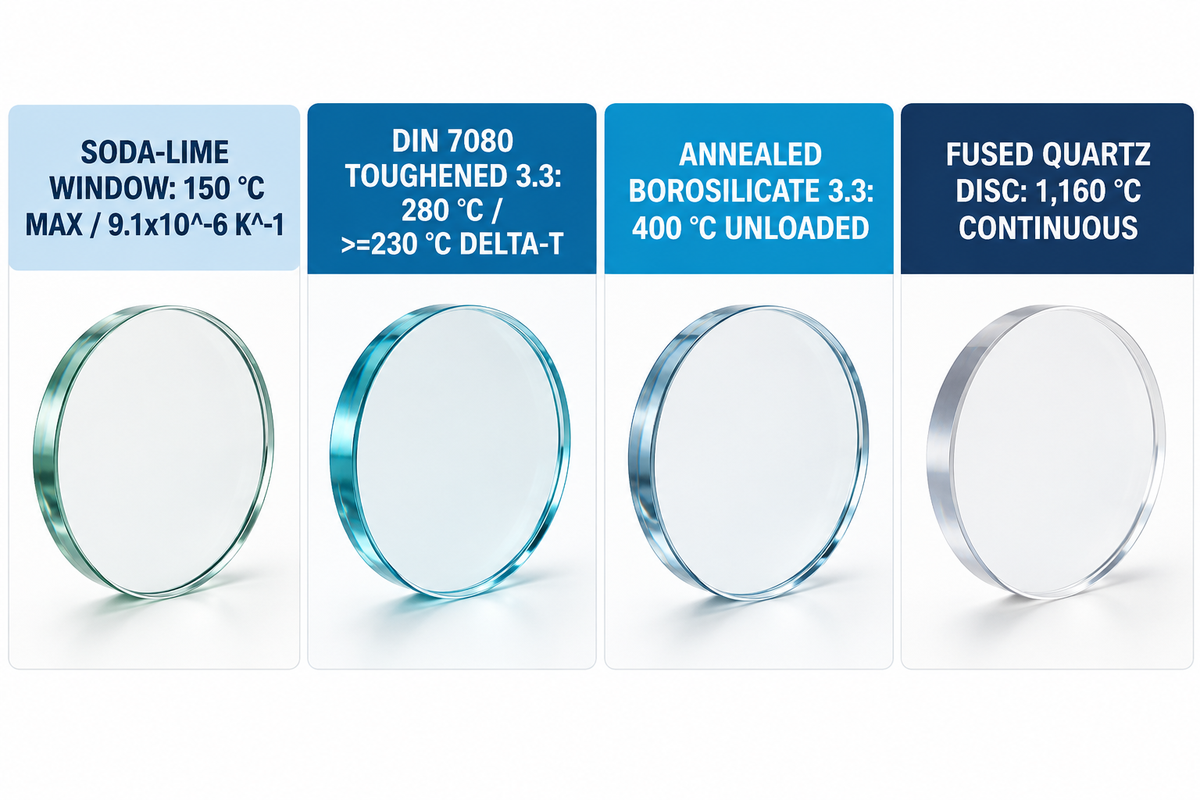
Thermally toughened ISO 3585:1998 borosilicate glass 3.3 serves up to 280 °C under DIN 7080:2025-05, with a ≥230 °C thermal shock differential reported by Lumiglas. Spectraglass rates circular quartz sight glasses up to 1,160 °C continuous, single-crystal sapphire handles extreme wear and pressure, and soda-lime suits moderate-duty enclosure covers.
Material datasheets harbor two classic engineering traps when moving from raw glass sheets to clamped pressure assemblies. Spectraglass lists annealed borosilicate sight glass up to 400 °C continuous, yet DIN 7080:2025-05 caps toughened pressure panes at 280 °C because prolonged exposure above 300 °C relaxes tempering stresses. In addition, Spectraglass notes that quartz glass can’t be toughened, so careful handling and thicker plates are required to maintain integrity.
Reviewing custom borosilicate 3.3 glass sheet thicknesses and machining specifications early keeps substrate grades aligned with real duty cycles. Per DWK Life Sciences, 3.3 borosilicate (80.60% SiO2, 13.00% B2O3, 4.00% Na2O, 2.30% Al2O3) has a 3.3 × 10⁻⁶ K-1 expansion rate (20–300 °C). Its density is 2.23 g/cm3 with ISO 719 Class HGB 1 hydrolytic durability. Compare those metrics against soda-lime glass thermal and mechanical property limits (9.1 × 10⁻⁶ K-1, Class HGB 3) or fused quartz glass grades and high-temperature operating limits.
| Substrate / Assembly State | Linear CTE / Chemistry | Service Temp Ceiling | Strengthening State | Disqualification Boundary |
|---|---|---|---|---|
| 1. Soda-Lime Enclosure Window | 9.1 × 10⁻⁶ K-1 | 150 °C max (tempered sight use) | Annealed or air-tempered | Outside DIN 7080, which covers borosilicate panes only; cracks under cold washdown quench |
| 2. Unloaded Borosilicate 3.3 Sheet | 3.3 × 10⁻⁶ K-1 | 400 °C continuous annealed (Spectraglass) | Fine annealed solid | Not rated for one-sided vessel pressure without thermal toughening |
| 3. SW Glass Roller-Tempered Glass (3–19 mm) | 3.3 × 10⁻⁶ K-1 | 250–300 °C continuous cap | 80–150 MPa surface compression | Prolonged exposure >300 °C relaxes tempering stresses; ≥3 mm thickness required |
| 4. DIN 7080:2025-05 Round Disc (≥6.5 mm) | 3.3 × 10⁻⁶ K-1 | 280 °C standard scope (≥230 °C ΔT) | Thermally toughened (>160 N/mm2) | Disqualify bare glass in HF, hot H3PO4, or high-pH steam |
| 5. Mica-Shielded Borosilicate 3.3 Port | 3.3 × 10⁻⁶ K-1 | Governed by disc & gasket ceiling | Toughened disc + split mica liner | Cannot fit over grooved reflex prism strips |
| 6. FEP-Shielded Borosilicate 3.3 Port | 3.3 × 10⁻⁶ K-1 | Governed by fluoropolymer liner rating | Toughened disc + clear FEP shield | Liner blocks chemical dissolution only; never raises backing disc bar or °C ceiling |
| 7. Chemically Strengthened Thin Cover (≥0.1 mm) | Aluminosilicate or soda-lime | Below 380–450 °C KNO3 bath temperature | 600–1,000 MPa CS; 20–100 μm DOC | Unpressurized camera/sensor covers only; outside DIN 7080 ≥6.5 mm borosilicate scope |
| 8. High-Purity Quartz Glass Sight Disc | High-purity SiO2 (ultra-low CTE) | 1,160 °C continuous; 1,300 °C short-term | Annealed only (cannot be toughened) | Requires thicker plate for equal bar rating; attacked by HF and hot alkali |
| 9. Single-Crystal Sapphire Sight Window | Monocrystalline Al2O3 | Extreme heat & wear (seal-limited) | Uncoated monocrystalline crystal | Higher blank cost and smaller diameters than borosilicate float discs |
Why Is Standard Soda-Lime Glass Outside DIN 7080 Pressurized Sight Glass Scope?
Standard soda-lime glass falls outside DIN 7080 scope because its thermal expansion rate is nearly triple that of borosilicate 3.3 (9.1 × 10⁻⁶ K-1 vs. 3.3 × 10⁻⁶ K-1). DIN 7080 covers thermally toughened ISO 3585 borosilicate 3.3 round discs only, while a manufacturer guide notes standard soda-lime is excluded for safety in pressurized vessels and Chemical Processing caps tempered soda-lime at 150 °C versus 280 °C for tempered borosilicate. Cold washdown water hitting a hot soda-lime pane creates severe tensile skin stress and abrupt fracture.
Pressure Rating, Viewing Aperture, and Unstayed Disc Thickness Sizing
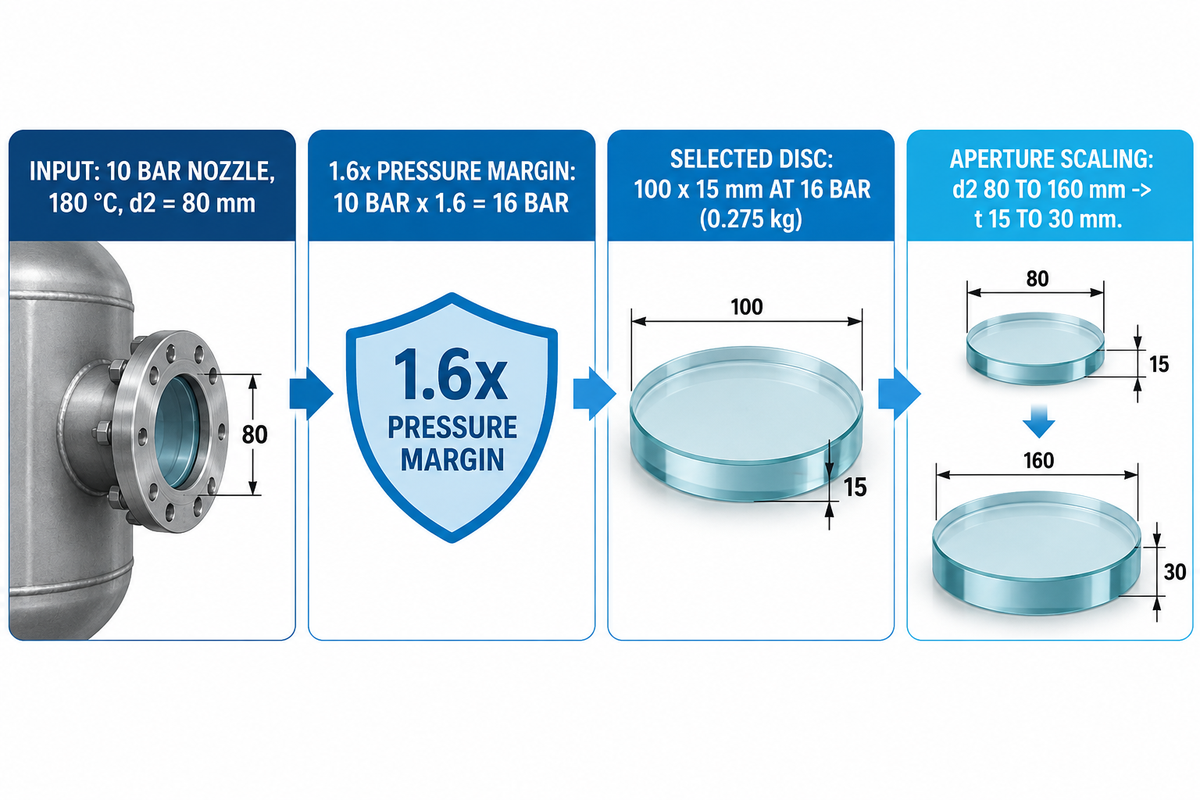
Allowable working pressure depends on the ratio of unsupported viewing diameter to disc thickness, never glass chemistry alone. Peak bending tensile stress on the dry face scales with (d / t)2, so doubling free viewing size at constant pressure doubles required thickness. Full-vacuum service (−1 bar) depends on gasket sealing tightness.
Sound pressure sizing applies published DIN 7080 size-pressure tables rather than rough guesses. Published DIN 7080 sizing rules specify a 1.6× nominal pressure margin between maximum vessel pressure and the DIN 7080 disc rating. Excess thickness under severe thermal cycling should be avoided, as it can decrease the shock survivability of the system.
Worked Sizing Example: Selecting a Round DIN 7080 Disc for a 10 bar Vessel Port
Design inputs: A chemical reactor nozzle operates at Pop = 10 bar (1.0 MPa) and 180 °C. The flange holds a Ø100 mm outer disc with d2 = 80 mm unsupported gasket viewing diameter.
1. Apply the 1.6× DIN 7080 pressure margin: Pdisc,min = 10 bar × 1.6 = 16 bar minimum rated sight disc per Lumiglas DIN 7080 sizing rules.
2. Select standard DIN 7080 geometry: Matching Ø100 mm at 16 bar selects the standard Ø100 × 15 mm toughened borosilicate 3.3 disc rated at 16 bar, listed at 0.275 kg by NieRuf.
3. Check aperture scaling sensitivity: Unstayed thickness follows t = d2 · √(C · P / σallow). Widening d2 from 80 mm to 160 mm at 16 bar doubles required thickness from 15 mm to 30 mm.
Steam Corrosion, High-pH Chemical Applications, and When to Add Mica or FEP Shields
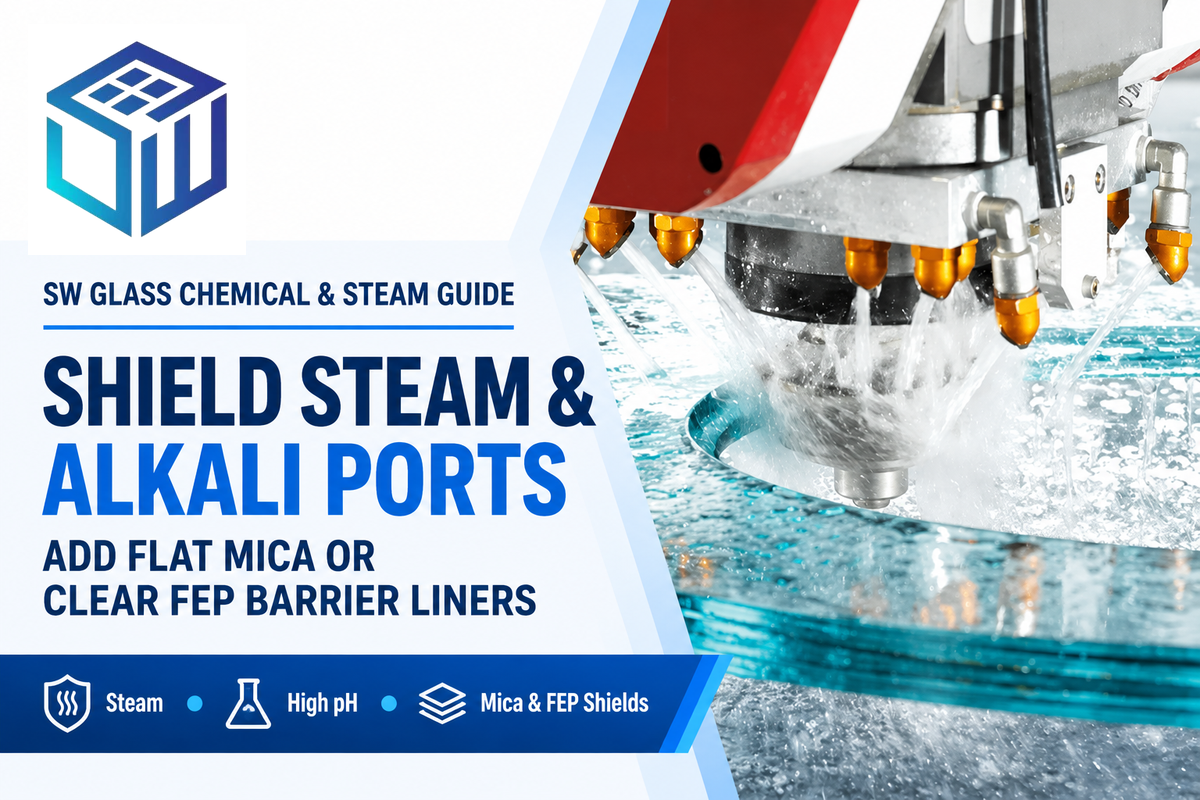
Bare borosilicate 3.3 sight windows corrode rapidly in high-pressure saturated steam, any hot alkaline solution above pH 9–10, hot concentrated phosphoric acid, and trace hydrofluoric acid. That attack occurs well below 280 °C. A split natural mica shield protects flat windows in steam and boiler water, while clear FEP fluoropolymer shields guard chemical reactors within liner temperature limits.
Why do steam ports fail below their dry thermal rating? Hydroxide ions and hot condensing steam cleave silicon-oxygen network bridges on the wetted face. Surface corrosion is often invisible to operators while continuously eating away at the burst margin, as sight glass guides warn. In a practitioner failure report on Eng-Tips, a 200 psi locomotive boiler was breaking unverified 4 mm wall water-level gauge glasses every two to three weeks. Boiler water pH had drifted to 12.4 against a 10.5 ceiling, and cracked tube walls measured roughly 1 mm thick.
Every time steam or an aggressive chemical is used, the glass disc should be protected with a sacrificial barrier liner. A mica or FEP liner shields only against direct chemical dissolution and never elevates the pressure rating or prestress temperature ceiling of the backing glass disc. Split mica fits only flat transparent plates and not grooved reflex strips.
Should a Sight Glass Be Full During Normal Operation, or Do Bubbles Signal Trouble?
Indicators attached to liquid-line HVAC refrigerant lines and suction ports of pressurized pumps must remain bubble-free and full at steady state. Boiler and tank level gauges are designed to display a part-full meniscus. Continuous bubbles in a refrigerant liquid line signal low subcooling, filter-drier pressure drop, or refrigerant undercharge. Brief bubble bursts during compressor startup are normal while system pressures stabilize, whereas steady rhythmic bubbling indicates expansion-valve hunting.
Mounting Connection Styles, Gasket Materials, and Bolt-Torque Rules That Prevent Cracking
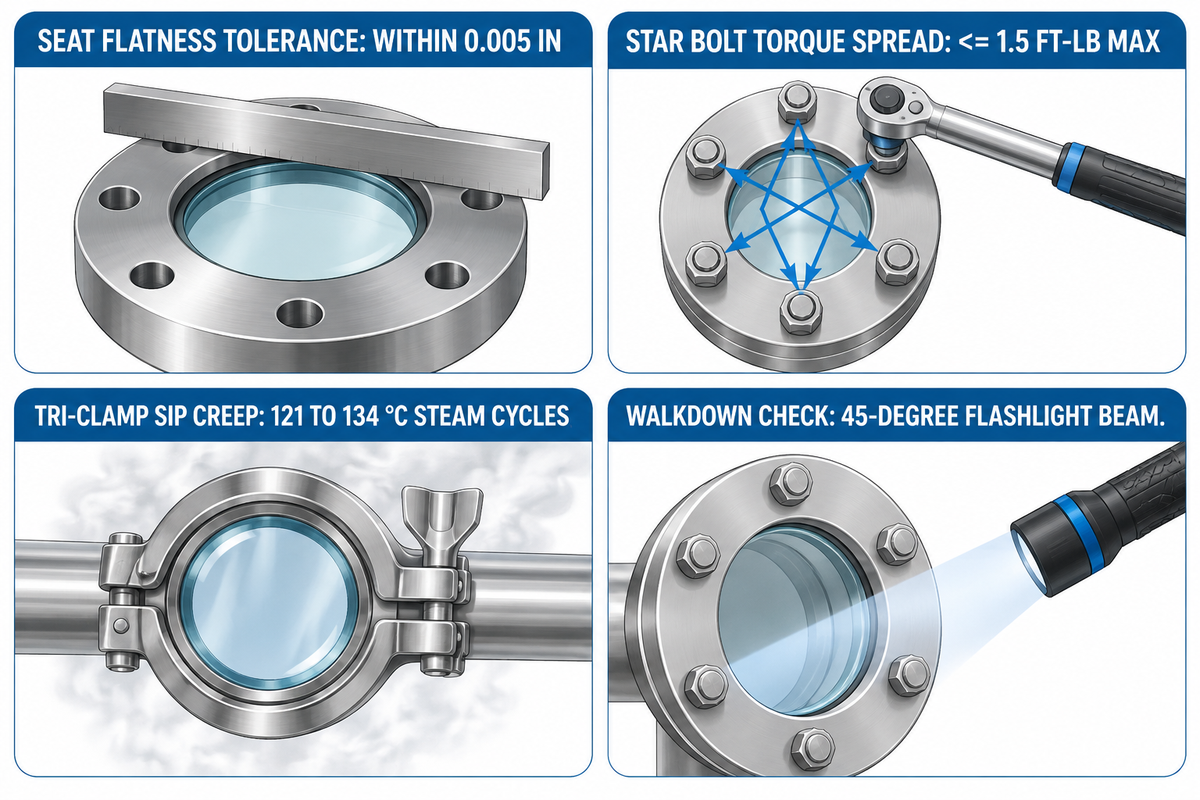
The glass disc must be protected by a cover-side cushion gasket and a fresh product-side seal to prevent fracture during installation. Per Manufacturing.net maintenance guidance, glass seating surfaces must stay flat within 0.005 in, and technicians must follow a cross-tightening sequence with no more than 1.5 ft/lbs difference between bolts. The same guidance prohibits tightening bolts while process equipment is operating or hot.
ANSI or DIN bolted nozzle flanges best alleviate piping stress, and sanitary tri-clamp ferrules provide quick, hygienic ease of installation. Contoured weld-pads minimize dead-legs on a reactor. Holding glass flatness tolerance and seating parallelism spreads clamping loads across the gasket evenly, instead of pinching one corner.
Turnaround discipline requires replacing dismounted glass and seals at every opening. Techmatic high-pressure guidance requires replacing all gaskets and seals with a fresh genuine kit during maintenance. During depressurized walkdowns, Manufacturing.net recommends shining a bright concentrated light at a 45-degree angle across the window so glistening scratches or chips stand out immediately.
| Connection Style | Typical Gasket Stack | Primary Engineering Advantage | Critical Cracking / Leak Trap |
|---|---|---|---|
| 1. Bolted Nozzle Flange (ANSI / DIN) | PTFE, FKM, or graphite seal + aramid/graphite cushion | Uniform multi-bolt star clamping isolated from shell weld distortion | Clockwise tightening or >1.5 ft-lb bolt-to-bolt torque spread |
| 2. Direct Vessel Weld-Pad | Confined-groove PTFE or flexible graphite pair | Low profile with minimal internal product holdup | Welding pad with glass installed warps seat past 0.005 in flatness |
| 3. Sanitary Tri-Clamp Ferrule | USP Class VI / FDA EPDM, FKM, or PTFE envelope | Fast tool-free CIP/SIP hygienics and ease of installation | PTFE cold-flow creep after repeated 121–134 °C steam sterilization cycles |
| 4. Threaded Bull’s-Eye Plug (NPT / BSPP) | O-ring face seal or metal-fused glass core | Compact single-port oil level check on gearboxes and sumps | Tapered NPT wrench over-torque twists non-fused glass housings |
| 5. Gland-Packed Tubular Column | Elastomer or graphite stuffing-box packing rings | Full-circumference meniscus visibility on low-pressure tanks | Misaligned gauge cocks bind tube ends during thermal expansion |
Can You Reuse a Sight Glass Disc During Vessel Maintenance?
No, conventional gasketed borosilicate and quartz sight glass discs are single-use safety components and must be replaced whenever a housing is unbolted. Corning and Chemical Processing failure guidelines show that re-clamping a used disc shifts microscopic gasket scars into peak tensile bending zones. Only undamaged DIN 7079 metal-fused units inspected per manufacturer protocol qualify for return to service.
Custom Sight Glass Disc Fabrication: Edge Grinding, Thermal Tempering, and Optical Coatings

Custom OEM sight windows require diamond-bonded CNC grinding, safety chamfers, thickness-matched strengthening, and durable markings or optical films. At SW Glass in Dongguan, coolant-flooded CNC centers hold 0.05 mm positional accuracy for hole-drilling and milling with edge-profiling and chamfering. Our vacuum-sputtered anti-reflective coatings boost visible light transmittance to 95% and cut two-sided reflectance to below 1%.
Perimeter finish directly governs burst reliability under flange load. NIST SRM 731L2 borosilicate reference notes stress keeping cutting, grinding, and polishing flooded with coolant to prevent subsurface thermal micro-checks. Specifying precision CNC glass edge grinding, beveling, and stepped profiles removes raw score fissures and forms flush rabbet shoulders inside mixers.
Pressurized vessel discs (≥6.5 mm under DIN 7080) are thermally toughened, and horizontal roller thermal tempering handles glass 3 mm to 19 mm thick by heating panels to 620–700 °C before rapid air quenching to 80–150 MPa surface compression. Thin unpressurized aluminosilicate or soda-lime covers down to 0.1 mm use 380–450 °C molten KNO3 ion exchange instead. Modern bioreactors also run non-contact Raman laser probes through planar BK7 borosilicate or sapphire sight glasses, where patent filing US20250122463A1 cites 0.5 mm X/Y and 0.1 mm Z alignment. Pairing custom optical viewports with SW Glass anti-reflective optical coatings cuts glare across camera and sensor beams.
| Fabrication Process | Thickness / Process Window | Published Tolerance / Metric | Target Sight Glass Application |
|---|---|---|---|
| 1. Coolant-Flooded CNC Machining | DXF / DWG / STEP / IGES custom blanks | Within 0.05 mm positional accuracy (drilling, edge profiling, chamfering) | Non-standard round discs, oblong gauge strips, flush stepped shoulders |
| 2. Horizontal Roller Thermal Tempering | 3 mm to 19 mm thick (4–8 min cycle) | Heat to 620–700 °C + air quench; 80–150 MPa CS; ≤0.10 mm/300 mm wave | Pressurized vessel sight discs (≤280 °C DIN 7080; stress relaxes >300 °C) |
| 3. Molten KNO3 Ion Exchange | From 0.1 mm thin covers (380–450 °C, 4–16 h) | 600–1,000 MPa CS; 20–100 μm DOC on compatible alkali glasses | Thin unpressurized camera, LiDAR, and analyzer protective covers |
| 4. High-Temp Ceramic Silk-Screen Printing | Tempered panels and level gauge strips | 0.15 mm line-width resolution; ceramic ink fired during tempering | Permanent min/max liquid level lines and opaque perimeter bezels |
| 5. Vacuum-Sputtered AR / AF Coating | Tempered and optical sight blanks | 95% transmittance; <1% reflectance; 5H hardness (500 abrasion cycles) | Machine-vision foam inspection, Raman spectroscopy, laser ports |
Flanged Assembly Suppliers vs. OEM Glass Fabricators, Pricing Drivers, and RFQ Checklist
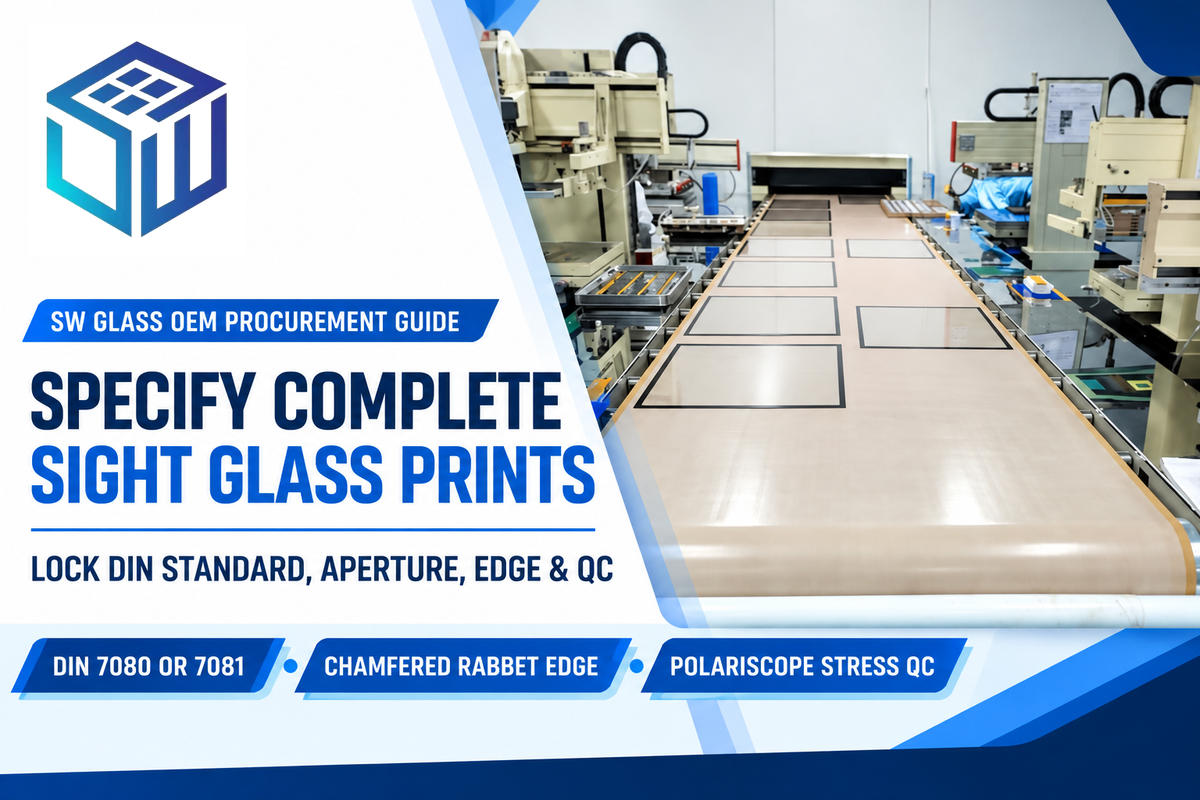
Low-cost replacement catalog discs sell for less than complete flanged stainless steel sight fittings. Custom OEM glass blanks are quoted based on engineering drawings. On NieRuf’s European catalog page, a bare round DIN 7080 SG01 borosilicate disc (Ø100 × 15 mm, 16 bar, d2 = 80 mm) lists at €32.10 excluding VAT. Including VAT, that stock pane lists at €38.20 with a 3–5 working days lead time. At SW Glass, custom prototypes (1–50 pieces) ship in 5–7 business days, depending on complexity and coatings used. Production orders ship in 15–25 business days under the same complexity and coating terms.
There are three primary tiers of industrial glass procurement within the supply chain. SCHOTT and Corning are major silica-borate melt houses who supply stock float sheets. Full assembly manufacturers, like Lumiglas, supply pressure-rated housings and certified panes. Lumiglas backs its DIN 7080 glass discs with batch EN 10204-3.1 inspection certificates alongside complete sight fittings, while Herberts Industrieglas produces DIN 7079 METAGLAS metal-fused rings. Precision OEM glass fabricators like SW Glass machine compliant sheets into custom discs, level strips, and coated viewports.
Clear role boundaries save weeks during vendor qualification: our 5,000 m2 ISO 9001 plant in Dongguan neither melts raw glass batch nor casts pressure-stamped steel flanges. Instead, SW Glass supplies custom-machined, tempered, printed, and coated glass elements directly to instrument builders and skid OEMs, backed by polarimeter surface-stress checks and optical flatness inspection. Because Lumiglas identifies conflating circular DIN 7080 discs with oblong DIN 7081 level strips as the most frequent field error, verify every item on the RFQ checklist below.
| RFQ Specification Field | Recommended Drawing Callout | Failure or Cost Trap Prevented |
|---|---|---|
| 1. Governing Glass Standard | DIN 7080:2025-05 (round ≥6.5 mm) or DIN 7081 (oblong strip) + ISO 3585 | Conflating round vs. slot standards or receiving soda-lime glass |
| 2. Substrate Chemistry | Borosilicate 3.3 (≤280 °C DIN 7080), Quartz Glass (≤1,160 °C), or Sapphire | Prestress loss above 280–300 °C or overpaying for unnecessary quartz |
| 3. Outer Size & Unsupported Aperture | Outer diameter d1, free gasket inner diameter d2, and thickness t (0.05 mm CNC accuracy) | Undersizing thickness when gasket ID is wider than catalog nominal |
| 4. Operating Pressure & Vacuum | Max working bar (×1.6 safety factor), cyclic pulses, and vacuum duty | Encroaching on burst margin during pressure surges or hydrotesting |
| 5. Thermal & Quench Envelope | Continuous °C, peak SIP °C, and cold washdown ΔT step | Thermal-gradient fracture on overly thick plates during cold spray |
| 6. Wetted Media & Shield Liner | Steam pressure, pH range, fluoride/caustic trace, mica or FEP shield need | Rapid alkaline silica thinning or trying to put mica on grooved reflex glass |
| 7. Edge Profile & Chamfer | Coolant-ground C-edge, safety chamfer, or flush stepped rabbet shoulder | Edge-chip crack initiation under flange clamping compression |
| 8. Scales & Optical Coatings | High-temp ceramic silk-screen marks (0.15 mm lines); dry-side AR coating (95% T) | Peeling organic inks in steam or glare saturating vision cameras |
| 9. Certificates & Batch Lot QC | EN 10204-3.1 inspection certificate, polarimeter stress report, dimensional sheet, MOQ | Stalled PED/GMP documentation audits at vessel handover |
Industrial Sight Glass Outlook: DIN 7080:2025-05 Hydrogen Readiness and Pharmaceutical Requalification
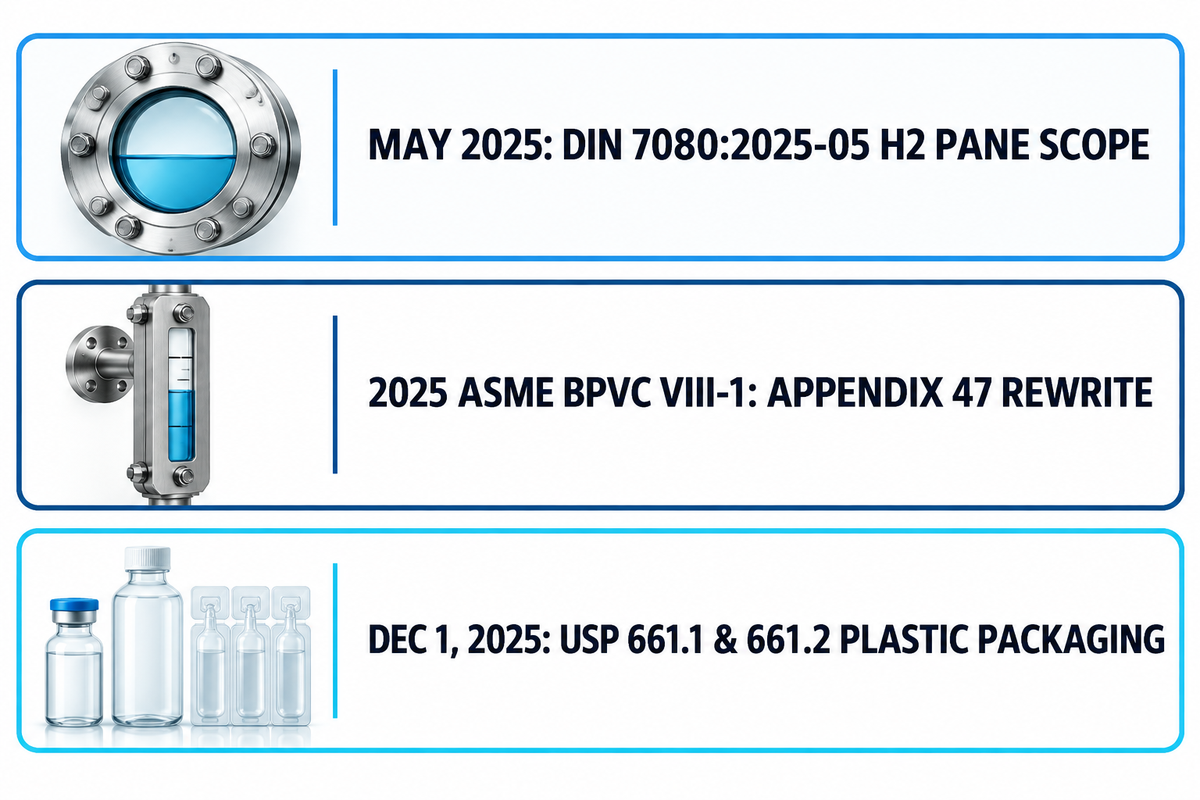
Various industry standards and market shifts from 2025 to 2026 affect how EPC contractors and OEMs document industrial sight windows. In May 2025, DIN published DIN 7080:2025-05 to replace the twenty-year-old 2005-05 edition. The updated standard confirms hydrogen suitability across gaseous and cryogenic states for compliant ≥6.5 mm toughened borosilicate panes. Electrolyzer and H2 skid builders gain a clear pane component baseline.
Pressure-vessel documentation and supplier audits continue to tighten in parallel. According to Hedderman Consulting, the 2025 ASME BPVC Section VIII Division 1 rewrote Mandatory Appendix 47, removing specific legacy designer stipulations and leaving minimum designer qualifications to the Manufacturer’s Quality Control System. A February 2026 Specialist Glass Products outlook adds that specifiers in specialist glass, construction, and premium segments favor manufacturers delivering clear origin, testing, and compliance data. Answering questions on process energy efficiency and supply-chain locality creates a direct commercial advantage.
Biopharma engineering teams increasingly pair EN 10204-3.1 glass lot certificates with seal extractables files, even though USP <661.1> and <661.2> govern pharmaceutical plastic packaging qualification rather than metal-and-glass sight housings. A pharmaceutical testing lab stated that USP 661.1 and 661.2 became official on December 1, 2025, requiring all packaging materials and plastic packaging systems previously qualified under USP 661 to meet these chapters and be requalified under expanded, more stringent test methods. Avient stated that with legacy grandfathering, whenever there is a change in the polymeric packaging materials, the grandfathering is also removed.
Frequently Asked Questions
How do you read moisture-indicator colors in an HVAC or refrigeration sight glass?
A deep green moisture-indicator ring inside a liquid-line HVAC sight glass confirms dry refrigerant, whereas chartreuse or yellow warns of excess moisture requiring filter-drier replacement. Wait to take a reading on the ring until refrigerant circulates for at least an hour or two, so that the indicator ring equilibrates to the system moisture. Always compare the observed shade against the color chart printed on the housing cap, because indicator dyes shift trigger points across R-410A, R-134a, and transcritical CO2 blends.
What edge-chip or scratch defects require immediate sight glass replacement during inspection?
Replace a sight glass disc immediately if a 45-degree flashlight check shows any glistening face scratch that catches a fingernail, rim chip, crescent mark, or cloudy steam frosting. These blemishes break the protective, compressive, prestressed skin of thermally toughened borosilicate 3.3 glass. Once the compressive skin is breached, internal pressure concentrates tensile bending fracture stress at the flaw and can result in sudden brittle failure during thermal cycling.
How can incoming quality control verify that a sight glass disc is thermally toughened borosilicate 3.3?
Incoming quality control verifies thermally toughened borosilicate 3.3 sight discs by auditing the batch EN 10204-3.1 inspection certificate, measuring Archimedes density, and checking prestress fringes under a polariscope. First, confirm the EN 10204-3.1 material certificate references ISO 3585 property values for borosilicate 3.3, such as its 3.3 × 10⁻⁶ K-1 linear thermal expansion rate. Second, verify bulk density at 2.23 g/cm3 versus 2.50 g/cm3 for soda-lime float glass, and confirm a symmetric birefringence halo across the tempered disc.
Can a sight glass handle cryogenic liquid nitrogen or LNG temperatures below −100 °C?
Yes, DIN 7080:2025-05 covers compliant toughened borosilicate panes without limitation in the low-temperature range, though that scope applies to the glass pane itself rather than surrounding flanges, bolts, or seals. Frost-free viewing below −100 °C pairs cryogenic-rated PTFE or graphite seals with vacuum double-glazing or dry nitrogen purging.
Is it spelled “sight glass” or “site glass,” and is it one word or two?
English editions of DIN 7080 and DIN 7081 spell the term as two words, sight glass, while ASME boiler codes call a boiler water-level glass a gage glass. “Site glass” is a phonetic misspelling, and one-word “sightglass” is non-standard.
When is a magnetic level gauge safer than a direct glass sight gauge?
Choose a metallic-chamber magnetic level indicator over direct glass for hydrofluoric acid, lethal phosgene or H2S, flashing hydrocarbons, or steam above the 280 °C toughened borosilicate ceiling. Removing the glass containment eliminates the window blowout risk for extreme duties.
What happens during vessel hydrotesting if a sight glass rated for operating pressure is left installed?
Leaving a sight glass installed during a 1.3× to 1.5× vessel hydrotest consumes most of the 1.6× design safety factor, risks overloading any disc sized without hydrotest margin, and can crush virgin PTFE or graphite gaskets. An assembly without hydrotest overpressure certification must be bolted with a steel blind flange and a test gasket, and the fresh glass disc installed later.
Custom OEM Sight Glass Engineering & Direct Factory Quotation
Prepared by the Dongguan Saiwei Glass Co., Ltd. (SW Glass) optical and thermal processing team. Need a custom CNC-machined, stepped, thermal tempered, silk screened or AR coated borosilicate 3.3 or quartz viewport solution built to your DXF or STEP drawing? Check out our borosilicate 3.3 glass material and custom fabrication hub to request a DFM review and production quote.
References & Sources
- DIN Media (Deutsches Institut für Normung): DIN 7080:2025-05 Pressure resistant circular sight glasses made of borosilicate glass
- International Organization for Standardization: ISO 3585:1998 Borosilicate glass 3.3, Properties
- National Institute of Standards and Technology (NIST): SRM 731L2 Borosilicate Glass for Thermal Expansion
- Chemical Processing: Forestall Sight Glass Failure in Chemical Processing
- Manufacturing.net: Five Tips for Improving Sight-Glass Maintenance
- United States Patent Application Publication: US20250122463A1 Bioreactor Non-Contact Sensing Alignment Systems and Methods