Get in Touch with Saiweiglass



Jasonxue
I write about sourcing custom glass and preparing manufacturing requirements, from drawings to supplier comparisons. My focus is helping readers organise dimensions, processing details, and inspection expectations into a clearer enquiry, so quotations and sample reviews can be considered against the same set of needs.
How Light Behaviors Shape Optical Performance in Engineered Cover Glass
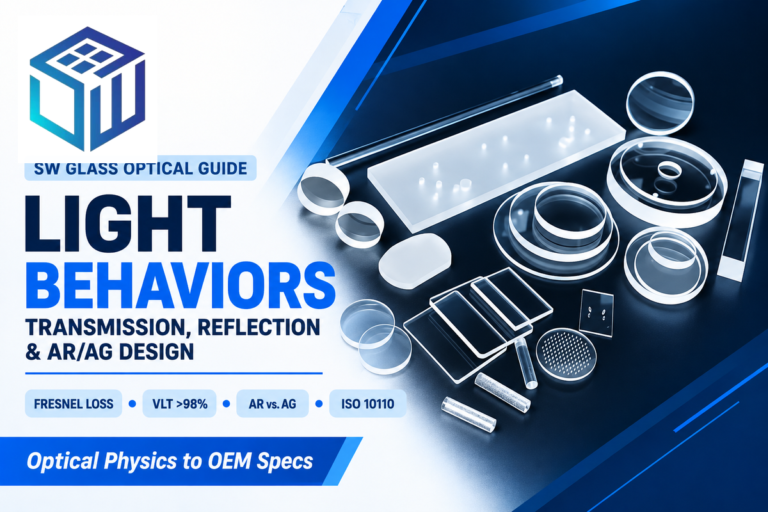
Updated November 2026 | Reviewed by the Dongguan Saiwei Glass Co., Ltd. technical team Light behaviors distribute total incident optical power across transmission (T), reflection (R), and absorption (A), where T + R + A = 100% by conservation of…
Industrial Sight Glass Guide: Liquid Level Gauge Types, DIN 7080 Standard, and Custom Sizing
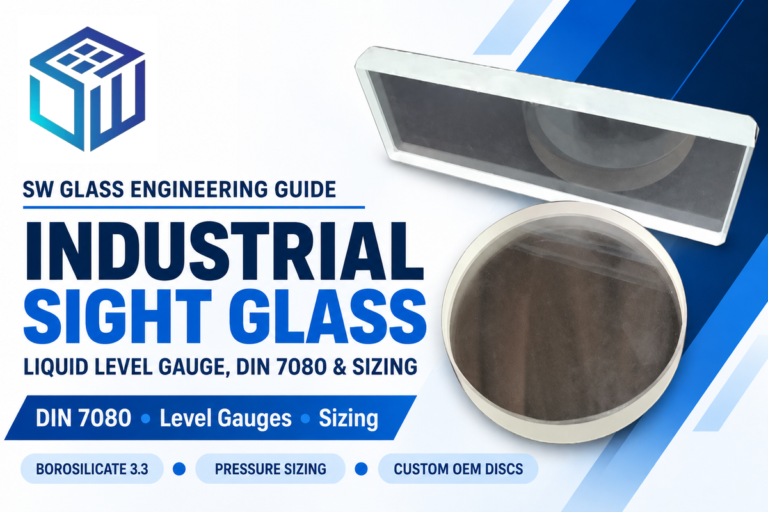
Updated November 2026 · Reviewed by the Dongguan Saiwei Glass Co., Ltd. technical team An industrial sight glass is a pressure-retaining window, typically DIN 7080:2025-05 thermally toughened borosilicate 3.3 rated up to 280 °C, with fused quartz or sapphire used…
Magnification of Ocular Lens: 10x Standard, Focal-Length Math, Field Number, and Useful NA Limits
Updated November 2026 The standard magnification of ocular lens assemblies on modern optical stands is 10x. That 10× rating corresponds to a 25 mm focal length at the 250 mm viewing reference (OpenStax College Physics 2e). Active commercial eyepiece lines…
Borosilicate Glass Melting Point, Viscosity Thresholds, and Operating Limits vs. Soda-Lime Glass
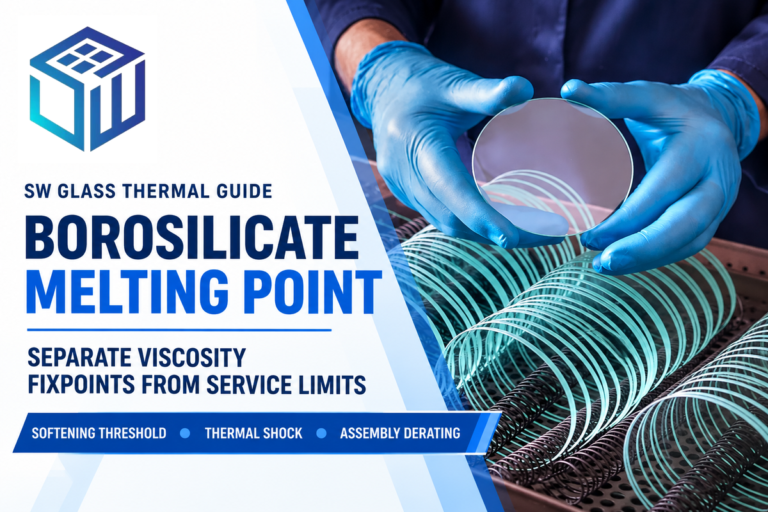
Updated November 2026 · Reviewed by the Dongguan Saiwei Glass Co., Ltd. technical team A crystalline metal melts at one fixed temperature, whereas the borosilicate glass melting point is tracked across four standardized viscosity points plus tank melting. Standard ISO…
Transmittance in Optics: Formula, Absorbance Conversion, and Light Transmission in Glass
By Jasonxue | Reviewed by the Dongguan Saiwei Glass Co., Ltd. technical team | Updated November 2026 Transmittance is the dimensionless ratio of transmitted radiant flux to incident radiant flux across an optical sample. Engineers write it as T =…
Refractive Index of Glass: Substrate Values, Dispersion Formulas, and AR Coating Matching for Optical Cover Glass
Written by: Jasonxue, Optical & Cover Glass Engineering Team at Dongguan Saiwei Glass Co., Ltd. (SW Glass) | Updated: November 2, 2026 For standard soda-lime and optical crown sheet glasses, the refractive index of glass sits around 1.52 at 587.6…
Dichroic Glass and Optical Filters: Thin-Film Interference Physics, Cutoff Specifications, and Custom Sourcing
Dichroic optical glass is a specialty vacuum-coated optical glass component that can split light into two spectra using the phenomenon of thin-film interference. When engineered on precise custom optical glass substrates, the stack reflects targeted wavelength spectra with mirror-like efficiency.…
Glass Material Explained: From Composition to Selection
Glass material is typically an amorphous solid. For a cover panel, the options include soda-lime for conventional substrates, borosilicate for low thermal expansion, and an aluminosilicate grade designed for chemical strengthening. A material name alone doesn’t set the part’s thickness,…
Quartz Glass Explained: From Material Grades to Finished Parts
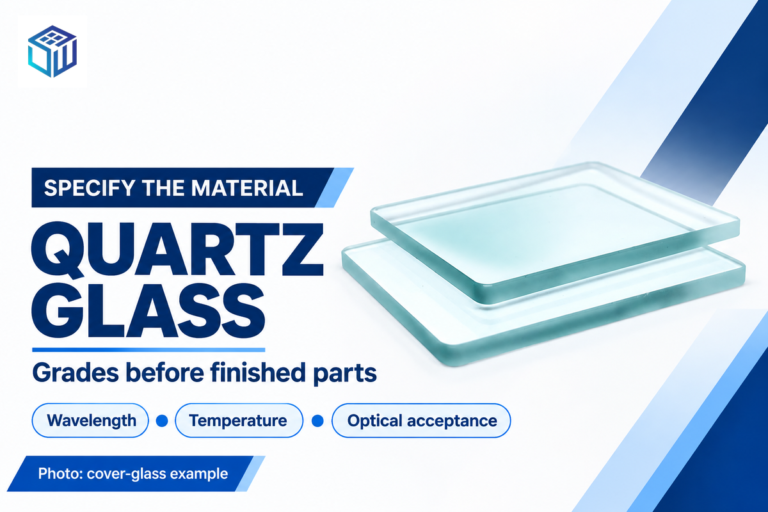
Quartz glass is a high-purity, amorphous form of silicon dioxide used where ordinary glass can’t meet a client’s optical and thermal requirements. This glass must have the right optical and thermal characteristics to handle the requirements of the application. Then…
Choosing cover glass flatness tolerance for bonding and seals
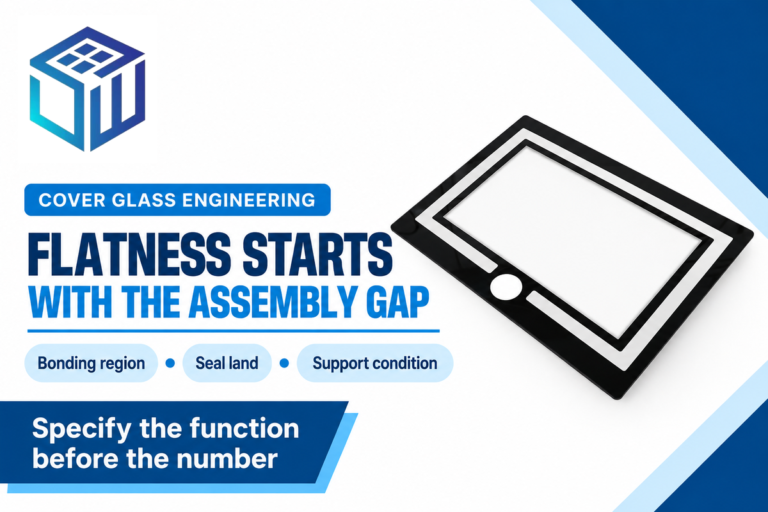
Cover glass flatness tolerance limits how far a surface can deviate from a plane over a defined area. Take a limit from the assembly’s functional gap, then specify how the finished glass will be measured. A thickness tolerance or optical…
Trending now