Get in Touch with Saiweiglass

Glass material is typically an amorphous solid. For a cover panel, the options include soda-lime for conventional substrates, borosilicate for low thermal expansion, and an aluminosilicate grade designed for chemical strengthening. A material name leaves much of the part undetermined.
Updated October 2026
Quick selection points
- Tempering changes the stress profile; it isn’t a separate chemical family.
- Low expansion helps with temperature changes. Impact resistance also depends on edges, thickness and mounting.
- Anti-glare and anti-reflective surfaces solve different reflection problems.
- A useful order specifies a grade, a drawing and acceptance tests for the finished part.
Glass material selection starts with composition, then strengthening or lamination, then the surface finish. Match each choice to heat exposure, mechanical loads and the required view through the panel.
Composition of glass: what the raw materials do
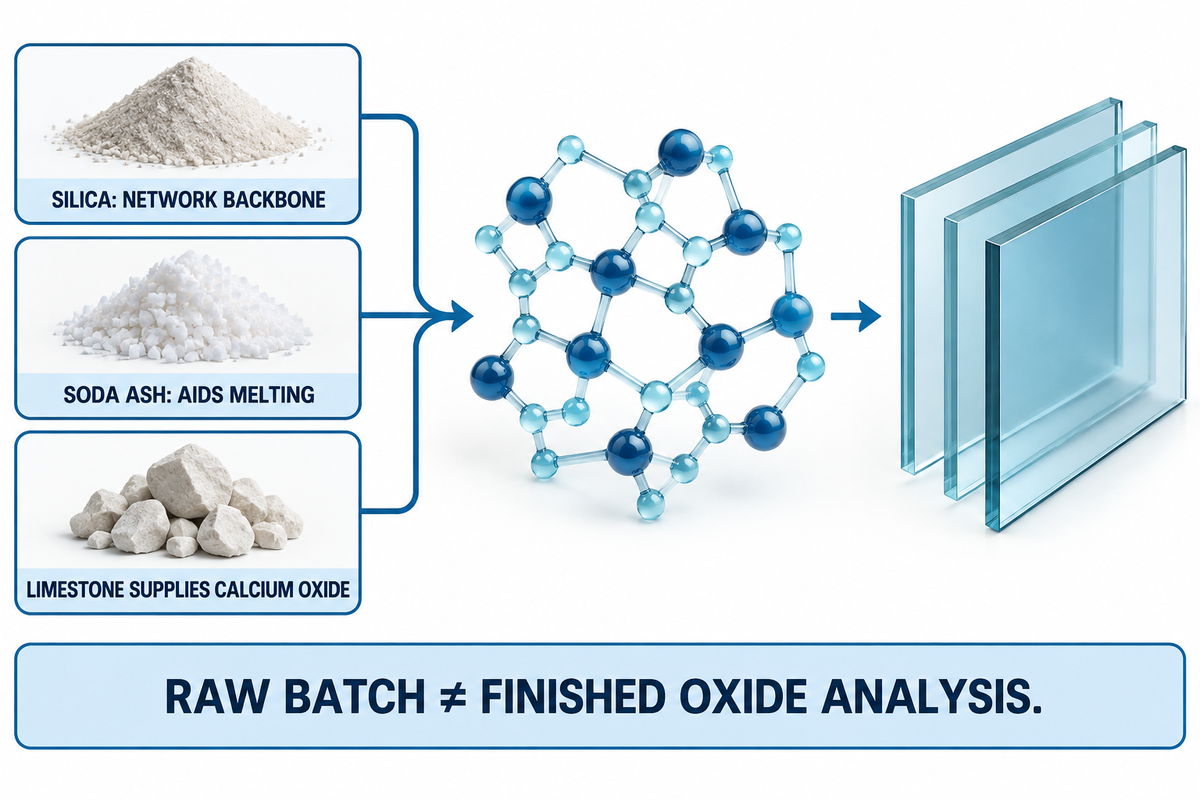
A connected network of silica forms the backbone of ordinary soda-lime glass. Soda ash aids batch melting and limestone provides calcium oxide. Raw material recipes identify batch compositions; oxide analyses identify finished glass compositions. In procurement, specifications for final glass compositions or grades should be provided rather than batch ingredient recipes.
What is the main material to make glass?
Silica sand is a principal virgin raw material for ordinary soda-lime glass. Silicon dioxide forms a connected network as the melt becomes solid. Other ingredients can also dictate behavior and control the duration of the melting process, as well as chemical stability and color. Silica is therefore a major component of glass, while the rest of the ingredients dictate the grade and its usage.
The Corning Museum of Glass demonstrates the roles of soda ash and limestone in its melting demonstration. Carbonate ingredients release gas during batch melting; weighing the raw ingredients and analyzing the finished oxide composition therefore gives different percentages.
Consider the glass network as a connected framework within which links can be rearranged by added oxides. Boron- and aluminum-containing formulations modify that network in distinct ways. A drawing marked only “clear glass” leaves those options open. For a repeat order, place the selected grade on the material requirement line alongside the drawing revision.
Glass types: soda-lime, borosilicate and aluminosilicate
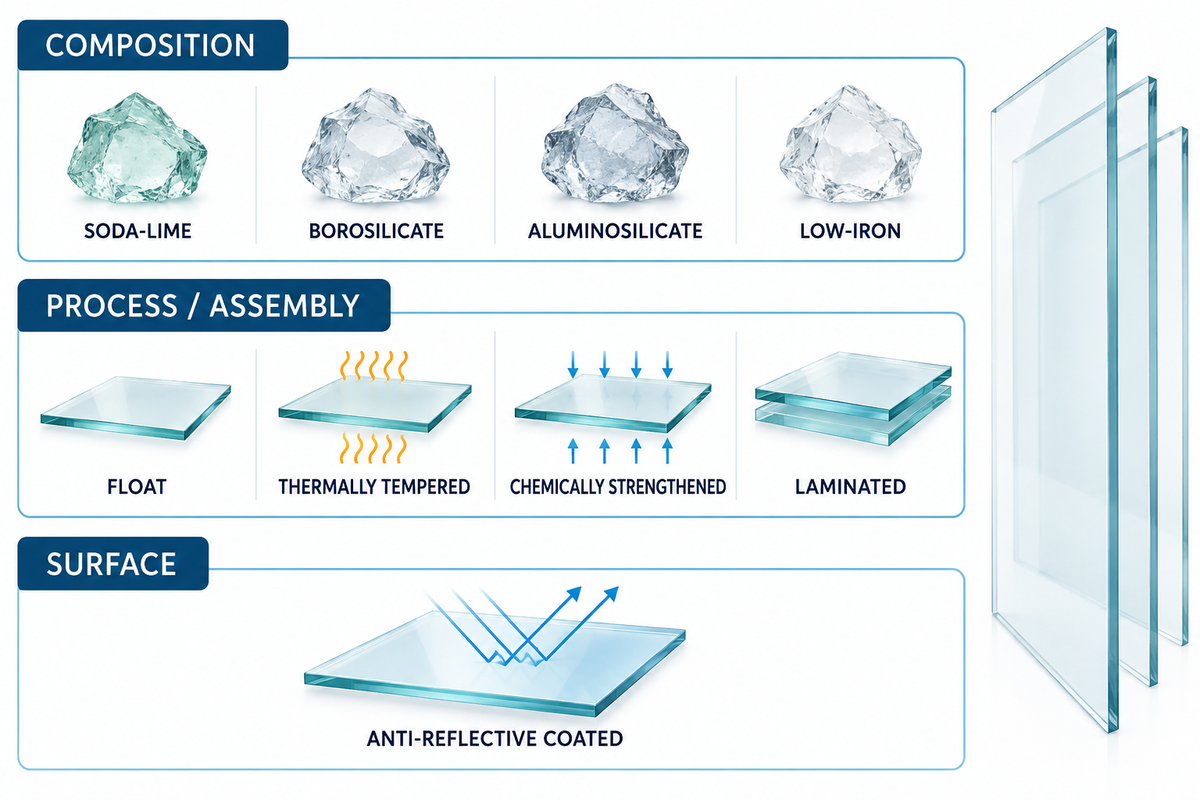
Soda-lime, borosilicate, and aluminosilicate define composition families. Use soda-lime for routine glazing. Use a borosilicate grade for thermal movement control. Use an aluminosilicate grade designed for chemical strengthening for a thin cover. Different glass grades within these families differ in properties. Float glass defines a forming method and can overlap with a chemical-family description.
Soda-lime is a common type of glass for window glass and glass containers. For equipment exposed to repeated temperature changes, borosilicate material options deserve comparison because low expansion reduces free dimensional movement. Thin display covers often lead designers toward aluminosilicate glass grades selected for ion exchange.
These families are not mutually exclusive recipes. A Corning-authored paper on boro-aluminosilicate glass discusses a composition containing both boron and aluminum. Use the grade designation when the family label is too broad.
The 3-Layer Glass Choice
The 3-Layer Glass Choice differentiates substrate, strengthening (if any) or assembly, and surface finish for each layer of the selection.
| Name | Selection layer | What to compare next |
|---|---|---|
| Soda-lime | Composition | Grade, thickness and optical quality |
| Borosilicate | Composition | Expansion coefficient and temperature interval |
| Aluminosilicate | Composition | Grade-specific strengthening route |
| Low-iron | Composition variant | Color and transmission at ordered thickness |
| Float | Sheet-forming process | Flatness and surface quality |
| Thermally tempered | Strengthening process | Heat-treatment suitability and finished geometry |
| Chemically strengthened | Strengthening process | Surface compression and compression depth |
| Laminated | Assembly | Glass plies and interlayer construction |
| Anti-reflective coated | Surface treatment | Reflection spectrum and coating durability |
SCHOTT BOROFLOAT 33 lists a mean expansion coefficient of 3.25 × 10⁻⁶/K over 20–300 °C. Pilkington Microfloat lists 9 × 10⁻⁶/K over 50–350 °C. Gorilla Glass Victus 2 lists 5.88 × 10⁻⁶/K over 0–300 °C. These are three named grades with different averaging intervals.
Imagine we have an inspection window that has a closing gap during warm-up. First, consider the temperature distribution and the expansion across the window. Substituting a strengthened display grade because it can withstand more handling damage may not solve the thermal problem. A low expansion substrate can still get chipped at a drilled hole. Keep the finished part mechanical test and thermal calculation as separate decisions.
Glass production: from molten glass to flat glass
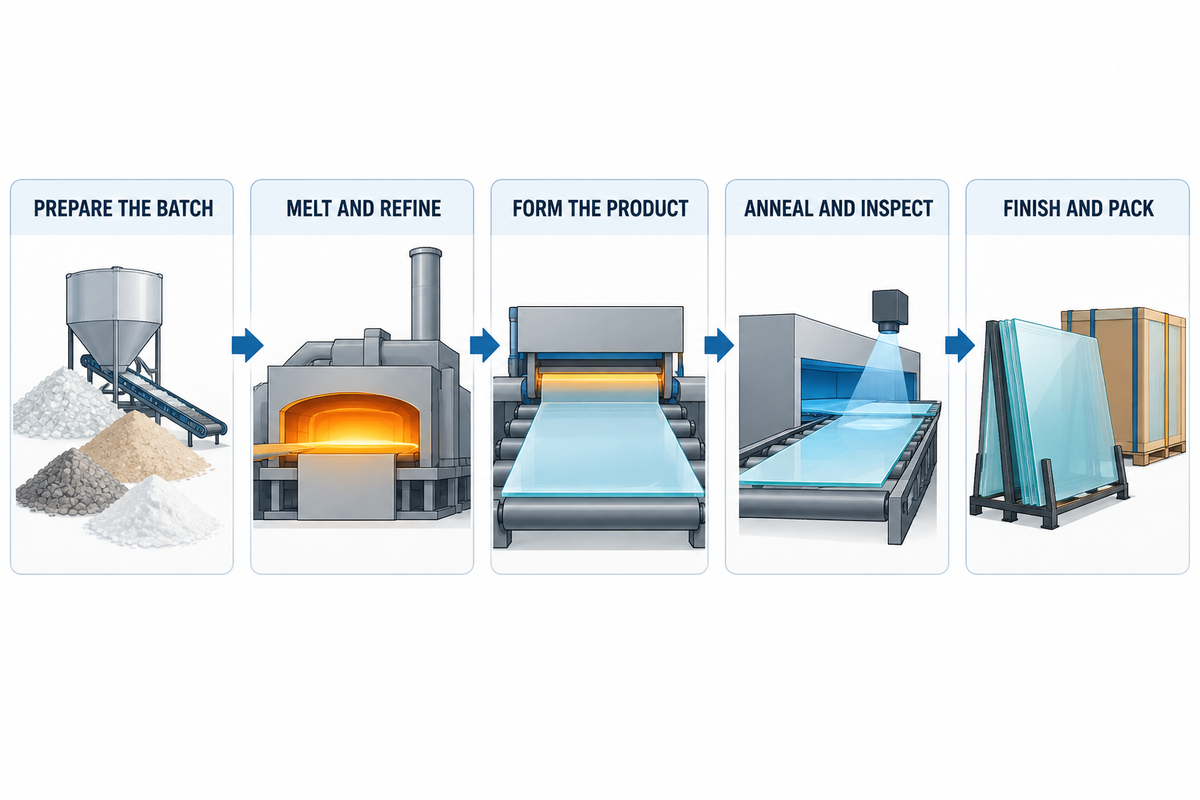
In industrial glassmaking, a batch of material is melted, and before forming, bubbles are removed. The material is then formed and cools. Flat glass passes through a series of operations such as cutting and finishing, and finally it’s put to its end use. A glass factory that does primary glass manufacturing and a workshop that machines the finished part do different jobs.
The German glass industry association describes the production stages, including refining at roughly 1,450–1,650 °C according to composition. That furnace interval is a process condition, not a service-temperature rating for a cover panel.
- Prepare the batch. Weigh raw materials from silo storage in the batch house; a conveyor carries the mix before it is fed into the furnace.
- Melt and refine. Heat combines the ingredients. Refining removes gas bubbles from the molten glass; agents such as sodium chloride assist this stage.
- Form the product. A float line forms sheet glass on molten tin; other forming machines shape bottles or glasswork. Production methods follow the required shape.
- Anneal and inspect. Controlled cooling reduces residual stress before dimensional and visual checks.
- Finish and pack. Glass cutting, printing and other specified operations produce parts ready for protective packing on a pallet.
As molten glass cools, its viscosity rises as it starts to solidify and form a solid without the long-range crystalline order of many ceramics. An annealing oven determines how the glass cools through the stress-sensitive region. Thickness impacts the cooling time; a thin sheet and a bulky glass object don’t undergo the same cooling cycle.
Properties of glass: heat, strength and optical performance
Compare the properties of glass in different groups: thermal movement, mechanical failure, optical behavior and chemical exposure. A scratch result describes the surface of the glass in a given test. A bending result describes the specimen and the loading method. Neither of them describes how the mounted window reacts to repeated heating and how it responds to the sustained load.
“Loading rate plays a large role in strength values.”
Load duration and peak force are related to slow crack growth. Continuously clamped panels require a different loading history from the ones that are struck once. Edge chips, holes and contact points can concentrate stress even when the broad glass surfaces seem undamaged.
A thermal expansion example
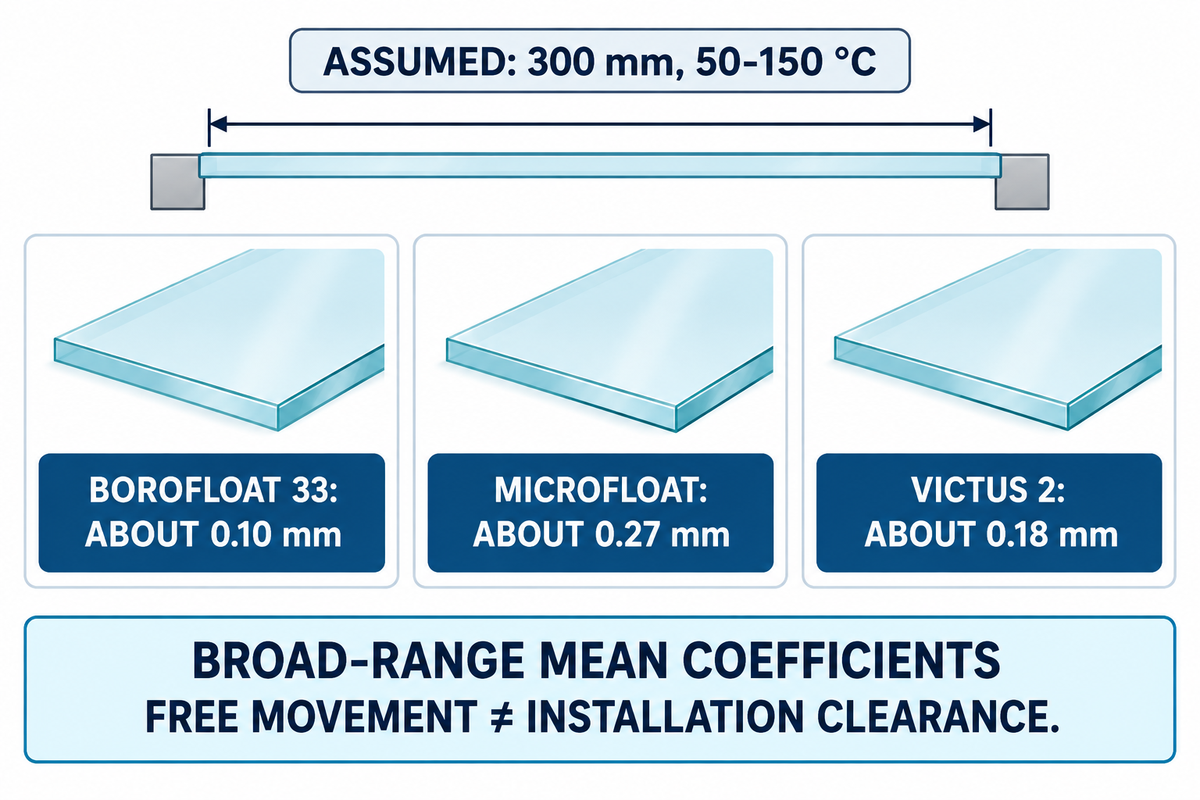
Assumed inputs: an unconstrained 300 mm strip, heated uniformly from 50 °C to 150 °C, with each grade’s published broad-range mean coefficient used as a constant. The linear expansion relation is ΔL = α × L × ΔT. For BOROFLOAT 33, the substitution is 3.25 × 10⁻⁶/K × 300 mm × 100 K ≈ 0.10 mm.
| Named grade | Estimated length increase |
|---|---|
| BOROFLOAT 33 | About 0.10 mm |
| Microfloat | About 0.27 mm |
| Gorilla Glass Victus 2 | About 0.18 mm |
The estimate refers to the free movement of the glass, not thermal shock survival or an installation clearance. A temperature gradient or a rigid mount changes the stress state. NIST’s engineering metrology guidance explains that expansion coefficients vary with temperature; a broad-range average adds uncertainty at the target interval.
What is the melting point of glass?
Glass has no single sharp melting point; BOROFLOAT 33, for example, softens at 820 °C. Its transformation temperature is 525 °C and its annealing point is 560 °C. Each of these temperatures defines a different physical condition, and none of them indicates an operating limit of an assembled and finished product.
High temperatures also affect seals, inks and coatings. For a clear inspection panel, consider transmission at the working wavelength and thickness. Energy efficiency and thermal insulation require a separate heat-transfer assessment of the full assembly; low thermal expansion alone says little about heat loss through it.
Tempered glass, lamination and coatings
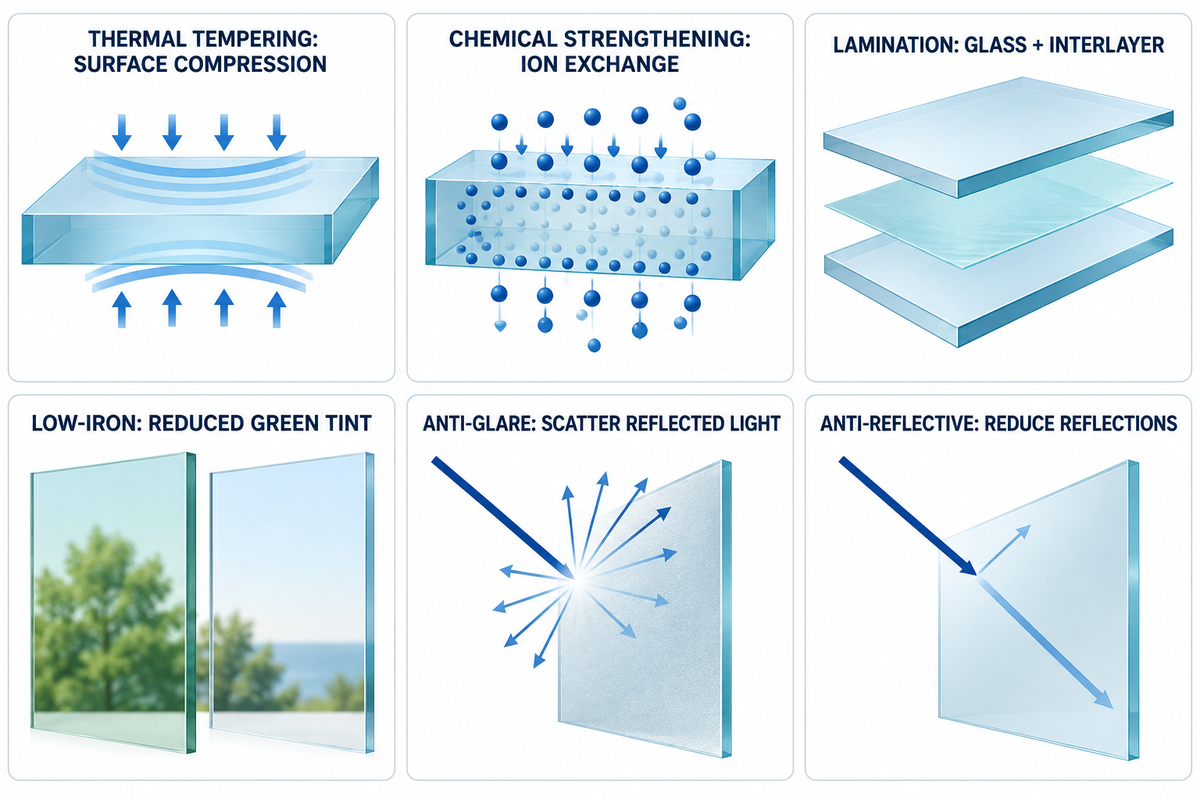
Tempered glass receives a strengthening treatment and laminated glass combines glass plies with an interlayer. A surface coating also changes a material property. These can be done in combination with an appropriate substrate; ordering “tempered” or “coated” still requires specification of a grade, thickness and some other defined performance of the completed part.
Thermal tempering achieves surface compression by rapid cooling. Chemical strengthening is possible in compatible glasses by means of ion exchange. ASTM C1422/C1422M-26 classifies chemically strengthened glasses by surface compression and depth of compression. These measures of compression should be distinguished from the bending strength.
Not all thermal toughening processes exclude borosilicate: for example, BOROFLOAT 33 provides that option. Suitability still follows the actual grade and part geometry. Finish the final machining and drilling before selecting the heat treatment that locks in those dimensions.
A laminate may use annealed plies or strengthened plies with a plastic layer, and fragment retention may be achieved with the interlayer and supports. The laminated and tempered glass comparison touches on this construction method in more detail.
Reducing the iron content in the glass also reduces its green tint. Anti-reflective coatings on the glass surface help reduce reflections, and anti-glare treatments help scatter reflected light. Anti-fingerprint treatments address fingerprint marks on the glass. A low-iron glass with an unsuitable surface treatment can still adversely affect the display.
Glass for industrial touch-screen covers

Chemically strengthened aluminosilicate is a candidate for thin covers exposed to handling. A wet operation requires the sensor and readout electronics to discern between a finger and water.
A 2019 study by Zhong and colleagues improved that distinction through electrical-field shaping. Designing such a readout circuit requires consideration for the parasitic capacitance the design introduces. Solving the sensing issue requires a different approach from choosing an easy-to-clean coating.
Example: A 300 × 200 mm indoor control panel must remain readable when illuminated from above and be operable after cleaning. Starting with a clear prototype, compare anti-glare and anti-reflective samples over a powered display. Inspect small text at the intended viewing distance and exercise the sensor through the full cover and adhesive stack rather than a loose sample held against a window. Keep the mounting and cleaning liquid the same for all samples. A cover that reduces sharp reflections may alter the image, so decide from the display assembly rather than a loose sample.
What are some applications of glass?
Display covers, inspection windows, partition walls, laboratory equipment and containers are made of glass. Each use demands different properties: a jar needs a suitable container composition, while a machine interface needs readable optics and reliable touch operation. Optical glass and glass fibers add further requirements for light transmission and shape.
In industrial applications, industrial HMI cover requirements should include the cover, sensor, bezel and adhesive in the sample build. Sharp metal contacts should be kept away from vulnerable edges. Evaluation should duplicate the intended clamping condition.
Custom glass cost: where the quote changes

The cost of custom glass includes the materials as well as the work to machine it to the final shape and dimension. This includes various edge finishes, hole drilling, strengthening, and coating. When structuring quotes, the lowest sheet price doesn’t always reflect the lowest part price. Compare quotes using the same drawing revision and acceptance plan.
The University of Georgia scientific glass shop separates labor from materials and parts in its pricing. The shop does scientific glassblowing and repair, but its separation of costs is useful for a cover glass request: identify materials, fabrication and one-time work rather than lump them together in a total.
Assuming two suppliers quote the same panel outline, one includes polished edges, drilled mounting holes, and optical inspection; the other just does the cutting. First adjust for those operations. Then ask for the same prototype and production quantities, coating spec, and packing. If an appearance limit can be relaxed outside the visible window, mark those areas of glass on the drawing. Avoid relaxing the whole surface merely to reduce a quote when part of it sits directly over the display.
After tooling or sample approval, a revision can add another fabrication cycle. Freeze the functional opening and hole locations and compare production prices.
Glass suppliers: material makers and precision fabricators
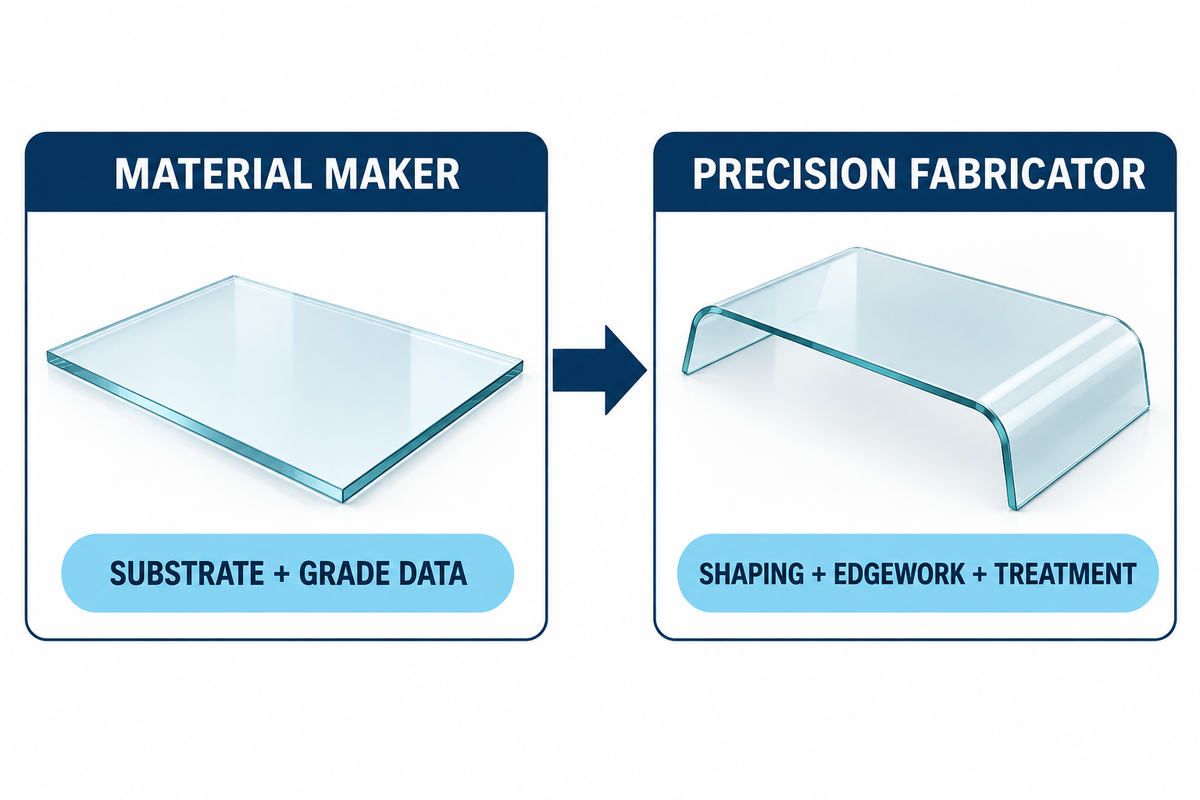
The primary role of glass works is producing the substrate; precision fabricators turn selected stock into finished parts. A buyer sourcing a composition needs grade data. A buyer sourcing a finished cover also needs shaping, edgework and treatment capability. Base the request on the work that’s required after the sheet is made.
The glass production and finishing stages described by BV Glas help distinguish the roles. At SW Glass, custom cover glass processing includes CNC shaping, strengthening options and surface treatments. Send the material choice and part drawing to SW Glass so the processing proposal addresses the finished part.
Procurement summary: match the grade to the drawing
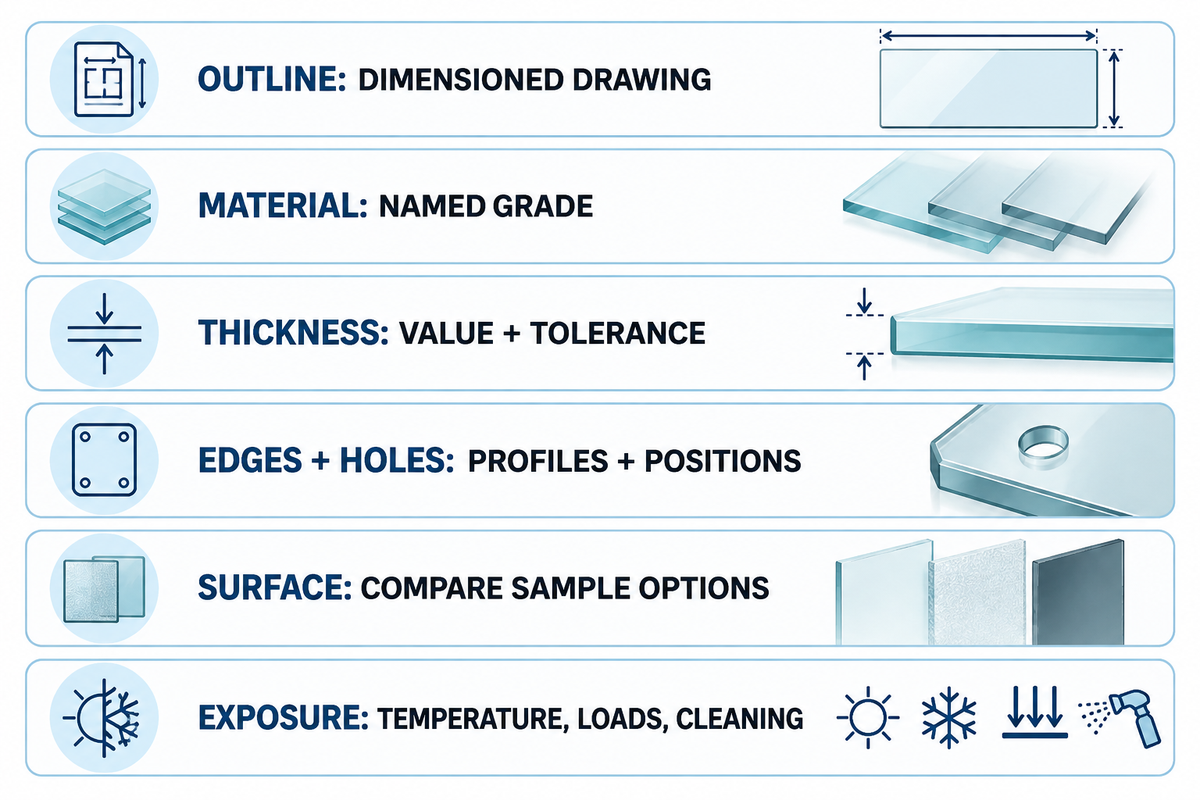
Material specifications should travel with the drawings, sample plan, and functional acceptance criteria. Define the treatment and how the finished product will be measured. Engineering handles fit and function. Procurement aligns the quoted scope. Quality inspection verifies the approved characteristics on the shipped parts.
ASTM C1036-25 provides a basic flat glass specification. Include the appropriate material and product requirements alongside it. Copy the example specifications below and adjust the geometry to your design.
Hypothetical cover-panel enquiry
| Parameter | Recommended range | Why it matters | How to verify |
|---|---|---|---|
| Outline | Example: 300 × 200 mm | Defines bezel fit | Dimensioned drawing and sample measurement |
| Material | One named grade per quotation option | Keeps composition comparable | Grade identification and material documentation |
| Thickness | Drawing value and tolerance | Controls fit and touch stack | Thickness measurements at agreed locations |
| Edges and holes | Drawing-defined profiles and positions | Controls contact and assembly | Finished-part inspection |
| Surface finish | Clear, anti-glare or anti-reflective sample option | Changes display appearance | Powered-display sample comparison |
| Operating exposure | Specified temperature cycle, loads and cleaning liquid | Defines qualification conditions | Assembly tests with duration and acceptance limits |
In obtaining the purchase order approvals, confirm the grade of the material, the possible processes and acceptance methods. Keep the purchase order with the signed sample and drawing revision.
Frequently asked questions
Can glass be recycled easily?
Glass bottles and jars often fit established recycling streams; other glass products may require separate handling.
Heat-resistant cookware, mirrors and laminated panels shouldn’t be mixed indiscriminately with container glass. UCRRA’s local recycling guidance, for example, excludes window glass and heat-resistant glassware from its bottle-and-jar collection. Recyclable material still needs a compatible collection and processing route.
Is glass a ceramic material?
Glass is often included in the broad ceramics category because it’s inorganic and nonmetallic, although its usual amorphous structure differs from crystalline ceramics.
Glass-ceramics form a distinct case: controlled crystallization creates crystals in a glass-derived material. The word vitreous describes a glassy state. For engineering selection, the composition and structure give more useful information than a broad ceramic label alone.
What material is similar to glass?
Clear acrylic and polycarbonate can replace glass in some transparent covers.
Compare stiffness, scratching, heat exposure, cleaning chemicals and weight before making that substitution. A polymer cover that survives an impact may still scratch or react to a cleaner. Keep the optical viewing requirement and mounting design in the comparison, rather than choosing solely from how clear a loose sample looks.
What is toughened glass known as?
Toughened glass is commonly called tempered glass.
The name describes strengthening treatment rather than a chemical family. A finished part still needs a specified substrate, thickness, edge condition and applicable performance requirements.
Why is glass transparent?
Many glasses transmit visible light because they absorb little energy in that wavelength range and contain few features that scatter it strongly.
Transparency changes with composition, thickness and wavelength. Colorants absorb selected wavelengths; bubbles or surface texture scatter light. A glass made for a clear visible view may behave differently in ultraviolet or infrared light. For a sensor window, specify the working wavelength rather than treating every visually clear sheet as optically equivalent.
Is glass a natural material?
Glass can occur naturally, as volcanic obsidian does.
Most commercial glass is manufactured by melting selected ingredients and cooling them under controlled conditions. Natural raw materials don’t make the finished industrial product an unprocessed natural object.
Can laminated glass break into small fragments?
Yes. A laminated panel can break, and fragment size depends partly on whether its glass plies are annealed, heat-strengthened or fully tempered.
The interlayer helps retain broken glass, while the glass construction and supports affect post-breakage behavior. A panel made of glass with a plastic interlayer isn’t automatically unbreakable. Fire-resistant glazing and safety glass for a particular application need the relevant finished-assembly performance, including the required retention behavior after damage.
Key takeaway
Send the selected substrate, drawing revision and surface requirement together. SW Glass can use that package to review processing options for the cover you intend to build.
References & Sources
- Frequently Asked Questions Corning Museum of Glass.
- Boro-aluminosilicate glass for architectural applications J. Gregory Couillard, Corning; published by Glass on Web.
- Glass is a multitalented material Bundesverband Glasindustrie.
- The development of test methodology for testing glassy materials Dennis S. Tucker, NASA research report, 1987.
- Thermal Expansion of Solids and Liquids university-hosted introductory physics text.
- Engineering Metrology Frequently Asked Questions National Institute of Standards and Technology.
- ASTM C1422/C1422M-26: Chemically Strengthened Flat Glass ASTM International, public scope.
- Capacitive Touch Panel with Low Sensitivity to Water Drop employing Mutual-coupling Electrical Field Shaping Technique Zhong et al., 2019; Teesside University research record.
- Scientific Glass Shop University of Georgia, Center for Applied Isotope Studies.
- ASTM C1036-25: Flat Glass ASTM International, public scope.
- Let’s Be Clear! Not All Glass Belongs in the Recycling Bin Ulster County Resource Recovery Agency.