Get in Touch with Saiweiglass

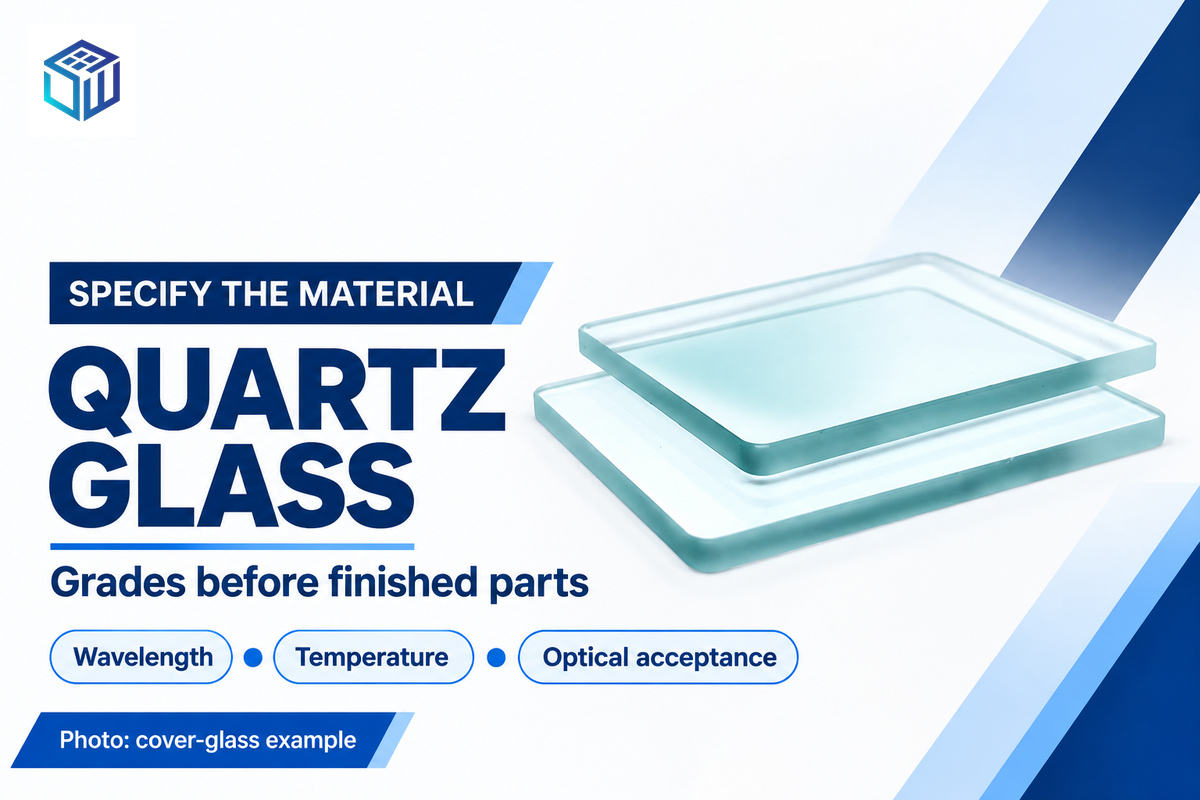
Quartz glass is a high-purity, amorphous form of silicon dioxide used where ordinary glass can’t meet a client’s optical and thermal requirements. This glass must have the right optical and thermal characteristics to handle the requirements of the application. Then select the grade and specify the size and surface quality of the glass. Two ‘clear’ windows can be very different, and have different properties.
Updated October 2026
Quick material facts
- Structure: amorphous silica, unlike crystalline quartz.
- Production: natural quartz feedstock or a synthetic chemical route.
- Optical choice: match the grade to wavelength, thickness and exposure.
- Finished-part choice: separate dimensional tolerances from optical acceptance.
Quartz glass is an amorphous silica glass with low thermal expansion and grade-dependent optical transmission. Natural fused quartz and synthetic fused silica suit different duties. Select the material by wavelength and heat exposure before specifying the finished part.
Key points
- A synthetic grade doesn’t automatically have the highest continuous-use temperature.
- Hydroxyl content affects infrared absorption; visible clarity alone tells you little about that behavior.
- A polished window and a dimensionally correct plate need different acceptance checks.
- Compare quotes against the same material grade, drawing and optical requirements.
Quartz glass, fused quartz and fused silica
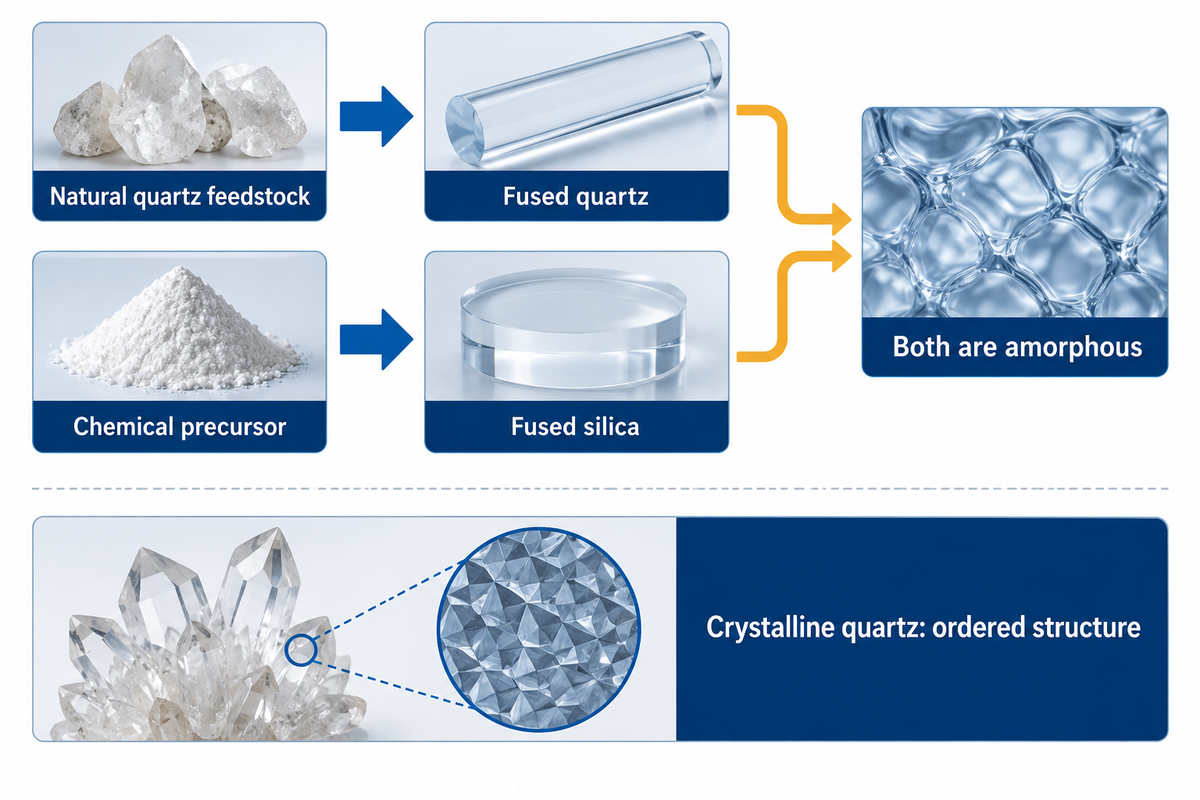
Quartz glass describes a glassy silica material. Natural quartz when melted produces a glass referred to as fused quartz, and a synthetic chemical precursor produces fused silica. Both are amorphous. In a crystal structure, such as Quartz, there’s an ordered structure, and certain properties are orientation dependent. These orientation dependent properties of Quartz shouldn’t be applicable to a glass plate.
What is quartz glass made of?
Quartz glass is mainly composed of silicon dioxide, SiO₂. Manufacturers either fuse (pure) natural quartz feedstock or make synthetic silica from chemical precursors. The resulting glass doesn’t have a repeating crystal structure like quartz mineral. Grades differ from one another based on the amount of trace metals and defects as well as hydroxyl groups.
Think of the composition as the ingredients of a dish, and structure as their arrangement. The ingredients can be the same, but the finished product can have very different optical properties. Lisa Moore and Charlene Smith explain these differences in their review of fused silica properties. Both authors were affiliated with Corning.
Natural fused quartz
- Starts with natural quartz feedstock.
- Includes electrically fused and flame-fused routes.
- Grade selection still requires an impurity and optical specification.
Synthetic fused silica
- Starts with a chemical precursor.
- Offers grades designed around optical purity and defects.
- Hydroxyl content varies with the production process.
High purity quartz glass still requires the producer’s grade on a purchasing specification. Names like JGS1 and JGS2 also require a corresponding supplier datasheet. A grade name, its optical curve and the required certificate belong together on the order.
Which properties change the material choice?
Thermal expansion, heat resistance and optical behavior determine whether quartz glass warrants its additional processing. Low expansion enables a part to maintain its dimensions as it encounters changes in temperature. Operating limits, however, differ for the various production routes. The temperature at which a part softens is a different property from the maximum service temperature.
Is quartz glass heat resistant?
Yes, quartz glass offers high temperature resistance, but the usable temperature is grade-specific. Heraeus lists maximum continuous working temperatures of 1160°C for electrically fused quartz, 1110°C for flame-fused quartz and 950°C for synthetic fused silica. Those representative material values need to be read alongside the load, geometry and exposure duration.
| Material route | Short-term working temperature | Softening temperature |
|---|---|---|
| Electrically fused quartz | 1300°C | 1710°C |
| Flame-fused quartz | 1250°C | 1660°C |
| Synthetic fused silica | 1200°C | 1600°C |
Source: Heraeus material-property tables. These are the manufacturer’s representative route values. A thin unloaded piece and a loaded furnace component don’t share an automatic service limit.
Free-expansion example
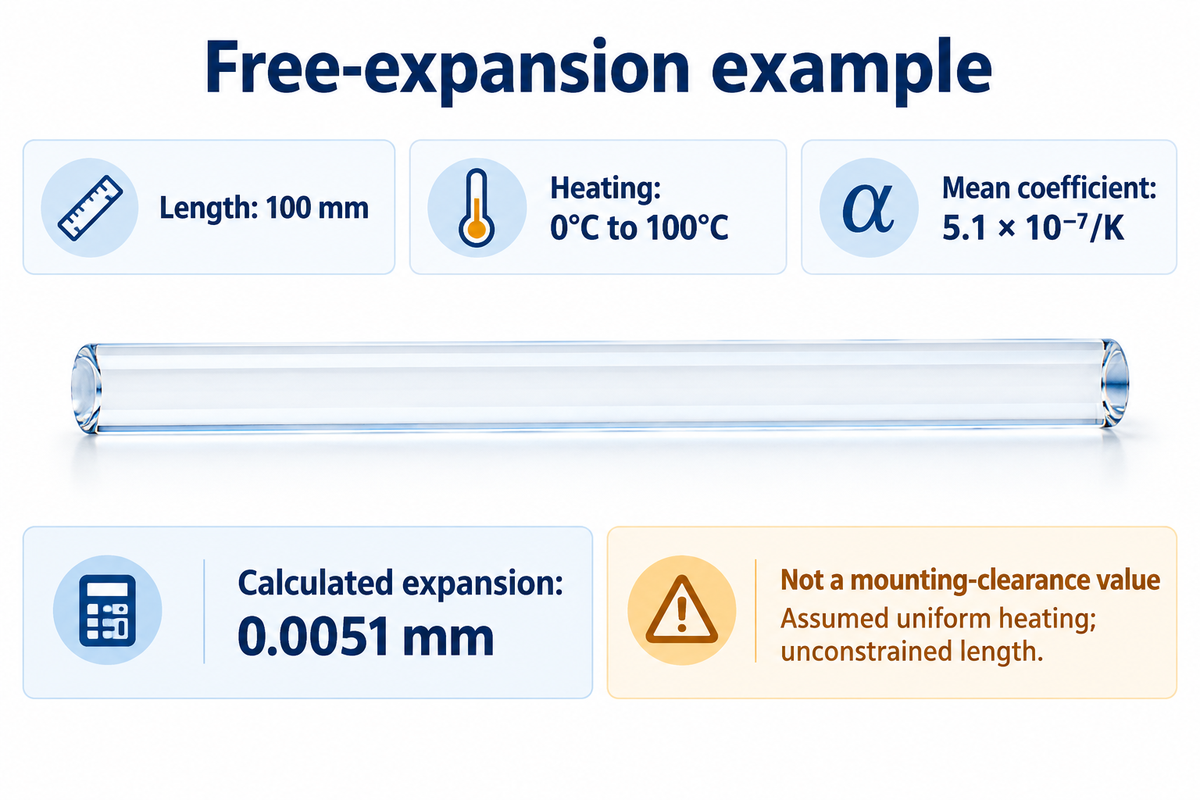
Assumed inputs: an unconstrained straight length, uniform heating and the mean coefficient published by Heraeus for the stated interval. For a free 100 mm length heated from 0°C to 100°C, a mean coefficient of 5.1 × 10⁻⁷/K gives a calculated expansion of 0.0051 mm, or 5.1 µm.
ΔL = L × α × ΔT = 100 mm × 5.1 × 10⁻⁷/K × 100 K = 0.0051 mm
That’s the free expansion of the part; it doesn’t address the clearance required for mounting. Other factors such as the presence of a metal holder, non-uniform heating and the force of a clamp can also affect the result. In its 2024 expansion study, the National Institute of Standards and Technology found, while examining three silica samples, differences larger than the uncertainty in measuring a single sample.
For an insulating component, specify the dielectric requirement and the optical grade separately. The hot-use durability is also affected by how the component is handled. Momentive Technologies’ guidance indicates that surface alkalis, including deposits from perspiration, cause devitrification. For manufacturing a furnace tube, it’s essential that handling is clean and the components are protected from contamination.
Choose quartz glass by wavelength, not transparency
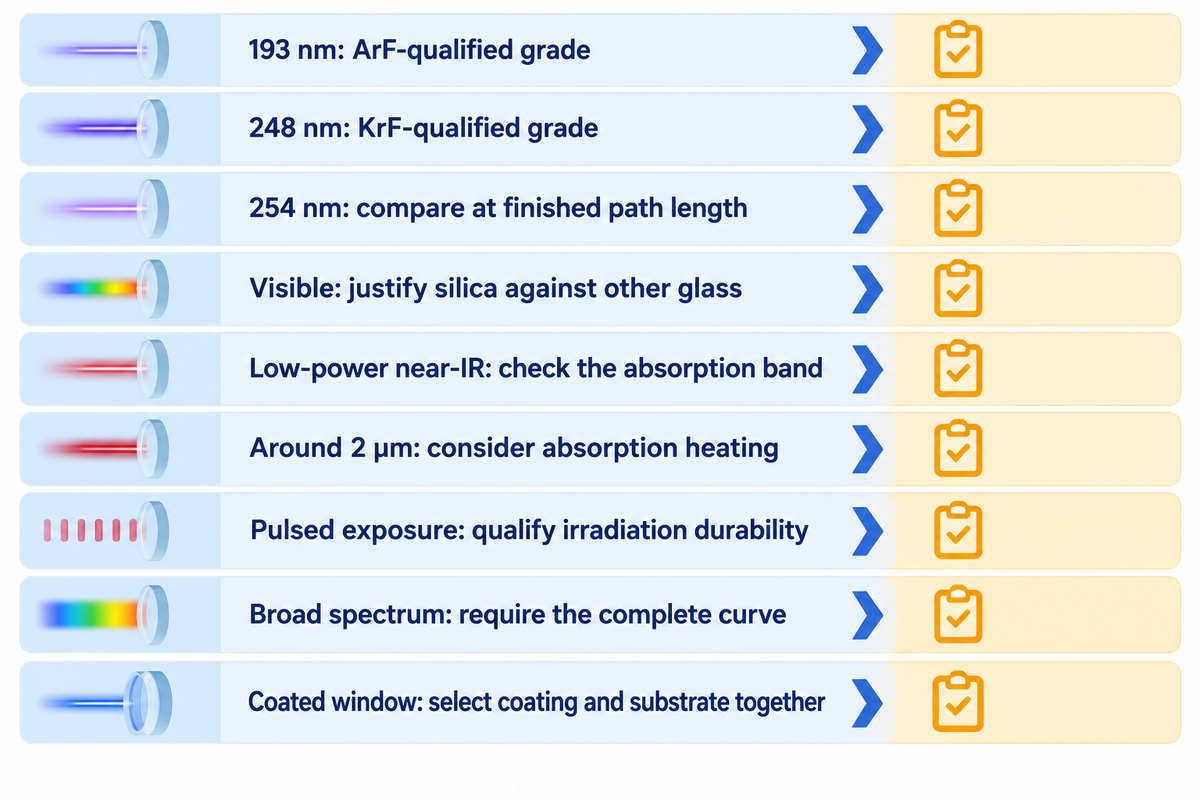
From a transmission curve, select quartz glass at the operating wavelength and part thickness. A clear appearance in visible light does not show absorption in ultraviolet or infrared bands. This doesn’t indicate absorption in the UV and IR regions. The choice between fused quartz and synthetic grades is affected by hydroxyl content, type and level of defects and irradiation.
Does quartz glass block UV?
Many grades of quartz glass transmit UV light, and, therefore, find application in optical components and UV windows. Transmission is wavelength, thickness and grade dependent. Corning lists KrF at 248 nm and ArF at 193 nm among the lithography applications for its HPFS materials. Not all optical grades can be replaced by a clear plate.
For infrared service, hydroxyl absorption deserves attention. The Moore and Smith review describes an OH fundamental band near 2.73 µm, with overtones near 2.24 µm and 1.37 µm. Dry synthetic grades exist, so “synthetic” alone doesn’t tell you the OH level.
Heraeus identifies Infrasil as natural fused quartz with an OH content of 8 ppm or less, and positions it for near-IR applications with lower power levels. This statement provides a useful named-grade starting point for a low-intensity near-IR window.
Wavelength Fit Check
Be sure to match the light source, optical path, and exposure to a material family before comparing prices of finished windows.
| Application condition | Starting choice | Decision that changes the order |
|---|---|---|
| 193 nm lithography | A grade designed for ArF exposure | Exposure stability joins initial transmittance in acceptance. |
| 248 nm lithography | A grade designed for KrF exposure | Use the optical producer’s application-specific grade. |
| 254 nm low-power sensing | A UV-transmitting grade | Compare curves at the finished optical path length. |
| Visible inspection window | Compare silica with other optical glass | Pay for silica when thermal or spectral requirements justify it. |
| Low-power near-infrared window | Consider low-OH natural quartz such as Infrasil | Check the actual absorption band against the source. |
| Light source around 2 µm | Compare low-OH infrared grades | Absorbed light can heat the optic. |
| Strong pulsed irradiation | An irradiation-qualified optical grade | Pulse conditions and surface preparation affect durability. |
| Broad spectral measurement | A grade with a curve across the complete measurement band | A single visible-light percentage is insufficient. |
| Coated optical window | Substrate and coating selected together | Use finished-component transmission at the required incidence angle. |
Edmund Optics’ UV/IR comparison shows curves for a 5 mm thickness without Fresnel reflection losses. Internal transmission and transmission through an uncoated finished window differ and answer different questions. For a coated part, the coating adds another wavelength-dependent response.
For higher intensities of light, structural changes may occur. The optical review describes irradiation-induced absorption and structural changes. A precision instrument with pulsed illumination needs its exposure conditions included in the material specification, even when the initial light transmittance looks adequate.
Quartz glass versus borosilicate and other optical materials
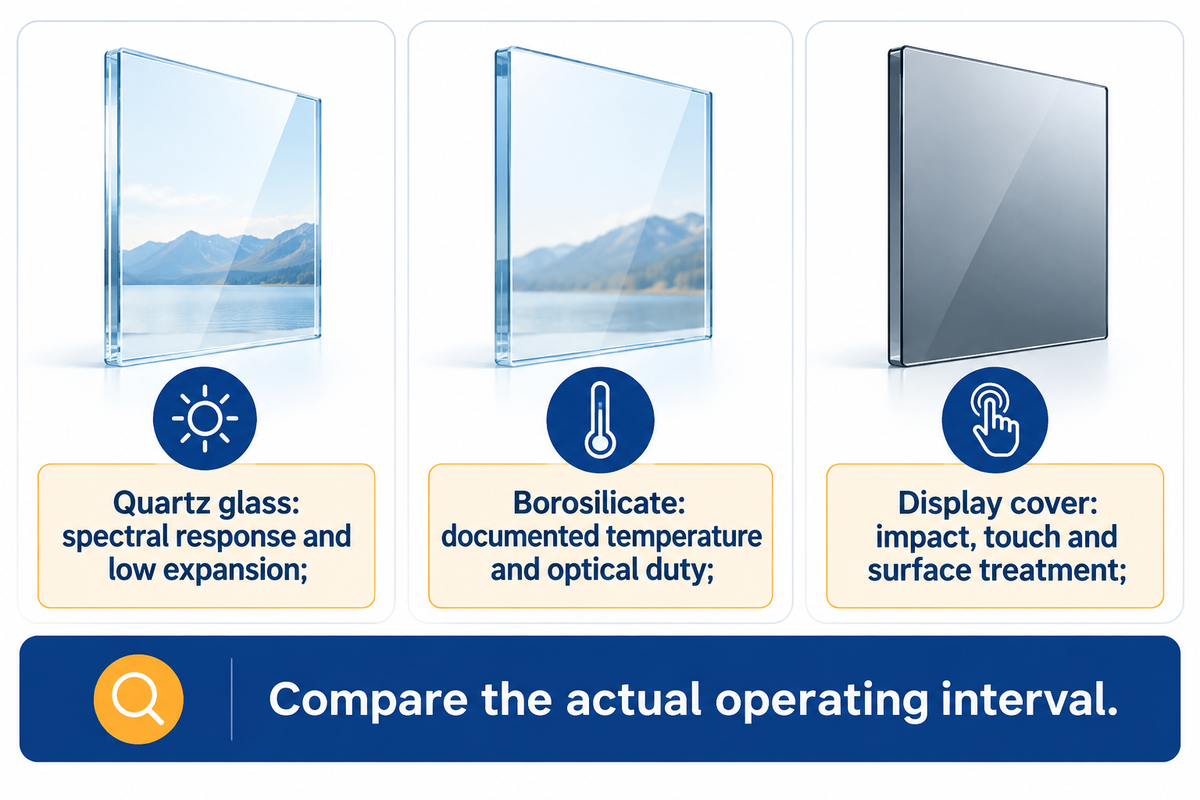
Quartz glass offers a solution when its spectral response or low coefficient of thermal expansion meets the application requirements. Choose a named borosilicate product when its documented temperature range and optical performance meet the duty. For ordinary display protection, consider the established cover-glass substrate before paying for a silica optical part.
SCHOTT lists a mean thermal expansion coefficient of 3.25 × 10⁻⁶/K over 20–300°C for BOROFLOAT 33. Its thermal datasheet gives maximum operating temperatures of 450°C for long-term use of at least 10 hours and 500°C for shorter exposure. Those figures describe BOROFLOAT 33, not every borosilicate vessel or window.
The interval of expansion may not be the same as that of quartz. Using the two constants as an exact ratio may hide the difference. For a heated sight window, compare the named materials across the actual operating interval, including the frame and the heating cycle.
There may be a different set of priorities when a display cover is considered. These may include the behavior of the cover when impacted, how the cover reacts when touched, and the treatment of the cover’s surface. Our soda-lime glass guide describes these priorities. A harder optical crystal, such as sapphire, is another material class rather than a stronger version of fused silica; its optical and mechanical specifications need a separate comparison.
Quartz glass is an optical material with grade-dependent spectral response. Homogeneity and surface finish of the glass may play a more important role than the maximum allowable temperature in the lens or viewing system. Use the optical glass selection guide to select optical glass for the function the part is intended to serve.
Quartz tubes, plates and finished parts
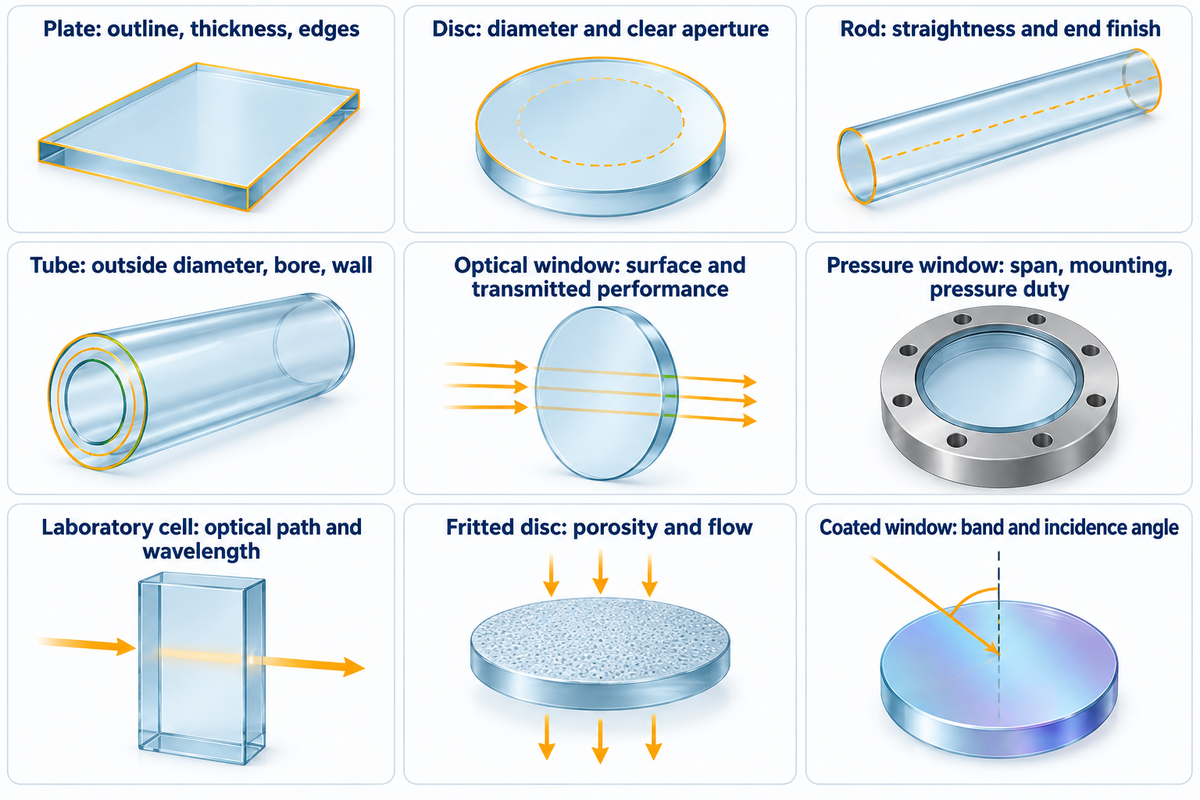
Specify the finished shape and working surfaces separately. A quartz plate requires limits for length, width and thickness and a tube requires bore and wall dimensions. Optical windows require surface and wavefront conditions. A component that’s pressure-loaded requires evaluation of the supported geometry and the duration of the load as part of the assembly.
Can quartz glass be cut?
Yes, quartz glass is cut and machined to the required surfaces and then ground and polished. Trimming to the outline is a single step. Other edge conditions, holes and optical faces may require additional operations. Fused quartz ground to size still requires optical polishing when it’s used in a measurement beam.
MGS lists standard fused-quartz window examples with ±0.005 inch dimensional tolerances, 60/40 scratch-dig and flatness of 2–4 wavelengths per inch. These are MGS’s published fabrication specifications, not a universal prescription for an imaging optic. Its pressure-rating instructions also request the unsupported working diameter.
ISO 10110-7:2017 describes how to indicate acceptable surface imperfections within a test region on optical elements and assemblies.
“These include localized surface imperfections, edge chips and long scratches.”
| Form | Main use or feature | Specification to separate from material identity |
|---|---|---|
| Quartz plate | Flat blank or support | Outline, thickness and edge condition |
| Quartz discs | Round windows or blanks | Diameter, thickness and clear aperture |
| Quartz rod | Solid cylindrical stock | Diameter, straightness and end finish |
| Quartz tube | Hollow process component | Outside diameter, bore and wall thickness |
| Polished optical window | Beam transmission | Surface quality, flatness and transmitted performance |
| Pressure window | A sealed, loaded opening | Unsupported span, mounting and pressure duty |
| Laboratory cell | Defined light path through a sample | Optical path length and wavelength band |
| Fritted discs | Porous laboratory components | Porosity and flow requirement rather than window polish |
| Coated window | Spectral or reflection control | Coating band, incidence angle and substrate compatibility |
Life science lab-ware and optical windows share a material family and don’t have the same acceptance criteria. A microscopy coverslip requires an optical specification and a thickness. A laboratory UV-vis grade cell is ordered for its measurement path. A large size furnace plate is ordered for its geometry and thermal duty. Porous components shouldn’t have the clear fused window specification.
NASA research on space-station window materials reports substantial variation in published slow-crack-growth parameters between test methods. The study’s comparison is a reason to treat sustained loading separately from a low-expansion claim. An O-ring seal also has its own temperature and compatibility limits.
Before providing dimensional constraints on all features, determine which surfaces are for mounting and identify the optical aperture. Our glass assembly tolerance guide describes the trade-offs that drawing constraints place on the surrounding components.
What affects quartz glass price and lead time?
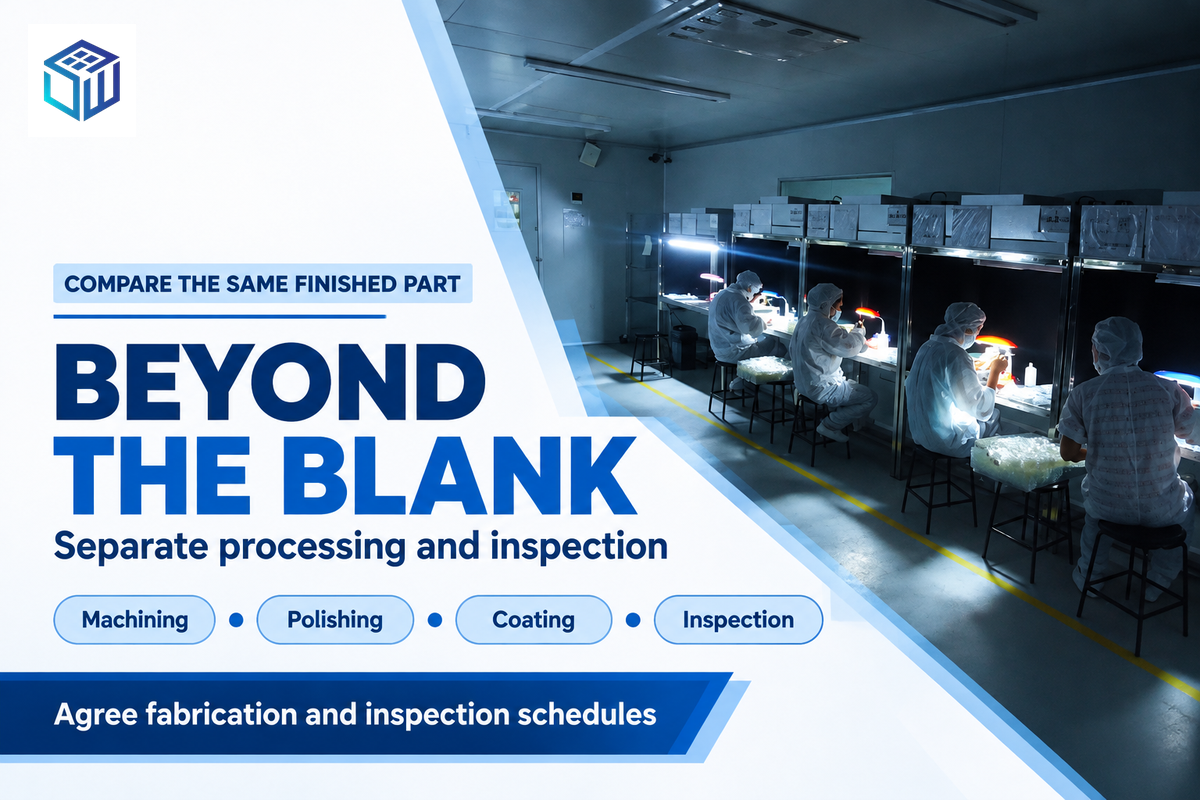
Quartz glass lead time and price vary with grade, finished blank dimensions and the finishing process. Optical polishing, coating and inspection require additional effort beyond cutting a shape. Stock availability may reduce the lead time for material, but the fabrication and inspection of a custom part still require their schedules to be agreed to separately.
Valley Design’s rotating stock list warns that dimensions and materials listed aren’t always available.
According to Lawrence Livermore National Laboratory, convergent polishing reduces the cost of metrology and labor, resulting in lower unit costs. The laboratory’s optical-finishing work shows that the processing route affects cost. That technology belongs to LLNL; it isn’t a claim about the production equipment of SW Glass.
For two comparable quotes, break out the charges for the blank, machining, polishing, coating, and inspection. Procurement can then see whether a lower price omits a required operation. Before adding a tighter tolerance, quality engineering should agree on an acceptance method, so the added cost provides a measurable requirement.
Material makers and quartz glass fabricators
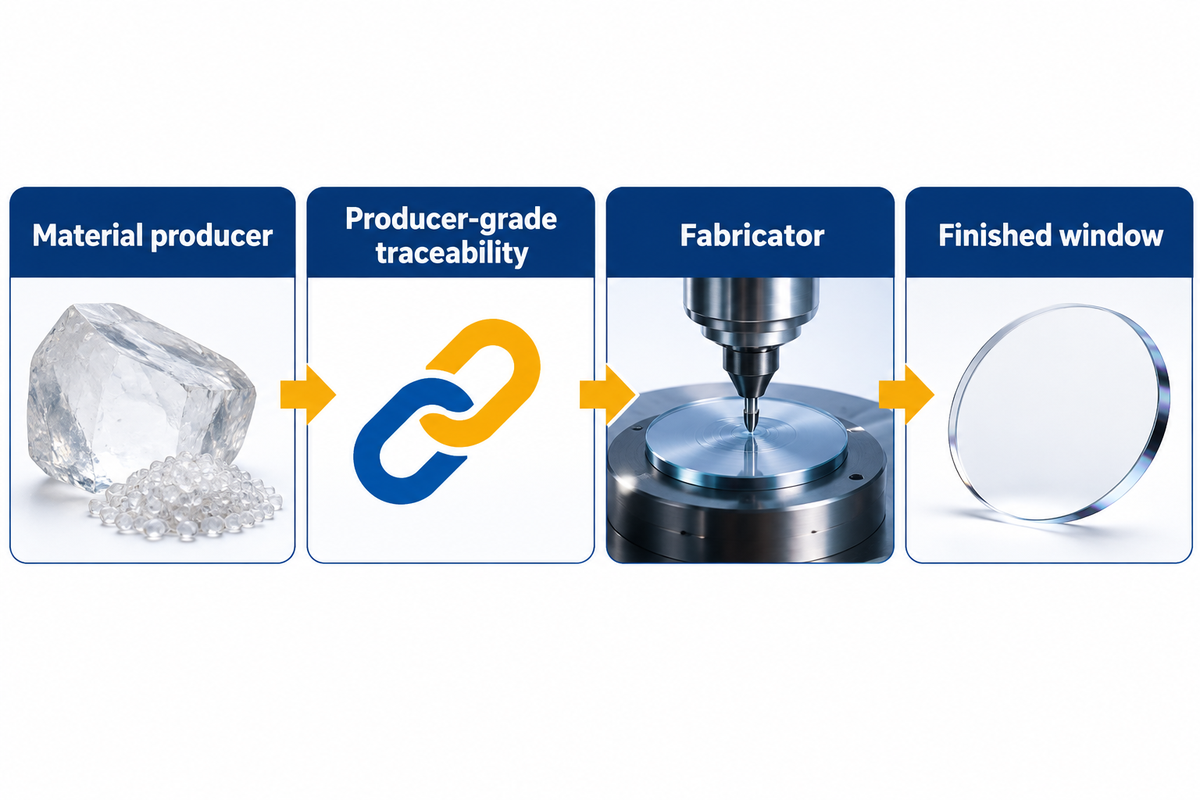
One producer supplies silica grade material. A fabricator transforms that material to the finished part. Heraeus offers Infrasil natural fused quartz, while Corning offers HPFS synthetic materials. Swift Glass provides a description of fabrication using materials from some of the established glass producers. These functions may be distributed among different organizations.
Corning’s HPFS page identifies its material families. Swift Glass’s material comparison describes the natural and synthetic distinction in a fabrication context. Producer-grade traceability should stay attached to the blank as it becomes a finished window.
SW Glass’s custom cover glass guide offers the next step in drawing-led design for equipment covers and displays. Keep the required substrate on that drawing; general glass-fabrication discussions shouldn’t silently substitute the specified silica grade.
Turn your application into a comparable quotation
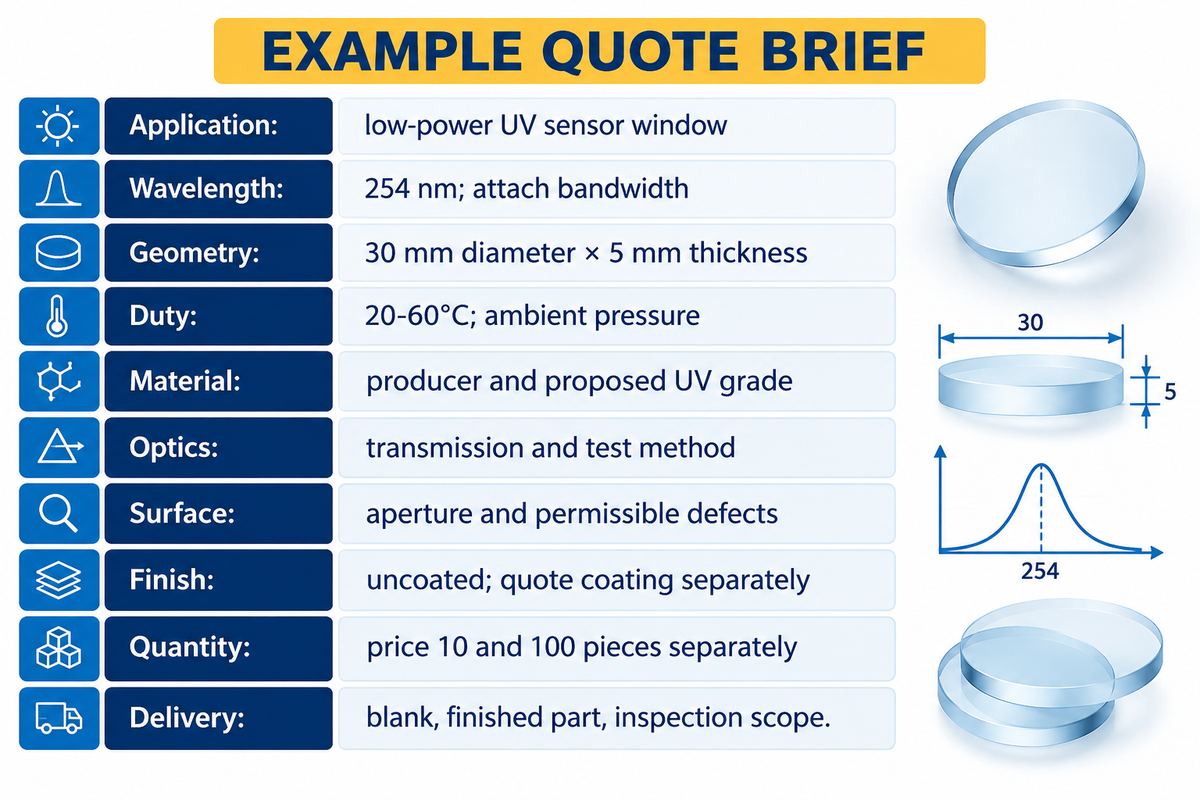
Ask each supplier to respond to the same application brief to ensure quotations represent the same finished part. Engineering defines the wavelength and operating conditions; Quality specifies the inspection method; and Procurement sets the quantity and the basis of delivery. Both optical specifications and a drawing must accompany the requirement, even for simple-looking disc-shaped parts.
Example: a low-power 254 nm sensor window, 30 mm in diameter and 5 mm thick, operating at 20–60°C at ambient pressure. Complete the fields below with the approved project requirements.
| Field | Example entry or required response | Owner |
|---|---|---|
| Application | Low-power UV sensor window | Engineering |
| Operating wavelength | 254 nm, with source bandwidth attached | Engineering |
| Blank dimensions | 30 mm diameter × 5 mm thickness; tolerances on drawing | Engineering |
| Temperature and load | 20–60°C; ambient pressure; mounting drawing attached | Engineering |
| Material identity | Producer and exact proposed UV grade | Supplier response |
| Optical acceptance | Proposed transmission at finished thickness, with test method | Quality |
| Surface acceptance | Clear aperture and permissible defects on optical drawing | Quality |
| Finish and coating | Quote uncoated polished faces; price a coating separately if needed | Engineering |
| Order quantities | Separate prices for 10 pieces and 100 pieces | Procurement |
| Delivery scope | State blank availability, finished-part completion and inspection scope | Procurement |
Suppliers need to provide both the finished part inspection report and the grade datasheet. Confirm whether a transmission figure includes surface reflection. Confirm if a quoted delivery date includes the coating. Place the drawing revision on the quotation so a later change does not leave two suppliers pricing different parts.
Do
- State the producer and grade.
- Define the finished optical path.
- Separate dimensions from optical acceptance.
Don’t
- Approve a material by visible clarity alone.
- Use softening temperature as a service limit.
- Treat a stock blank as a finished-window quote.
The cover glass drawing checklist offers a way to capture design and processing requirements. For optical surfaces, an anti-reflection coating is different from an anti-glare coating. Our comparison of the two terms explains the difference.
Frequently asked questions
Does quartz glass scratch?
Yes. Abrasive contact can scratch quartz glass.
Surface flaws matter because they can scatter light and weaken a brittle part. The familiar hardness number for crystalline quartz shouldn’t be transferred directly to fused quartz glass. Protect both optical faces during handling and packing, and use the agreed surface-quality inspection when accepting a window. Scratch resistance and optical cleanliness describe different requirements, even on the same piece.
Is quartz glass a mineral?
No. Quartz is a mineral; quartz glass is an amorphous glass.
Both contain silicon dioxide, but their atomic arrangements differ. A quartz crystal has an ordered structure, while fused silica lacks that repeating arrangement. Crystal orientation and birefringence therefore shouldn’t be carried into a glass-window specification. The purchase description should identify the glass grade and production route, rather than relying on the single word quartz to describe the material.
Does quartz glass break easily?
Quartz glass is brittle and can fracture from impact or unsuitable loading.
Its thermal behavior doesn’t make it unbreakable. Surface damage, edge condition and the way a component is mounted affect its response to load. A plate supported around its edge also behaves differently from one clamped at a few points. Pressure windows need a part-specific assessment of the glass and its support, including sustained service rather than only a short initial test.
Can quartz glass be tempered?
Conventional safety-glass tempering should not be assumed to apply to quartz glass.
Its low expansion changes the thermal-strengthening problem. Select a substrate and strengthening process together when impact resistance is the main requirement.
Is quartz glass a composite?
Ordinary fused quartz glass is a silica glass, not a composite.
A coated window or bonded assembly can contain additional materials. Specify those layers separately from the bulk glass grade.
Prepare the drawing before requesting a quote
For a display or equipment cover, send SW Glass the substrate requirement, drawing revision and operating conditions through its optical glass solutions page. Include the optical function so the material discussion starts with the application.
The values shown for materials are from named producers or research sources. The free-expansion calculation is an engineering example and not a SW Glass test result.
References & Sources
- Fused silica properties review, Lisa A. Moore and Charlene M. Smith, Optical Materials Express, 2022; Corning-affiliated authors.
- Expansivity of fused quartz glass measured within 6 × 10⁻¹⁰ K⁻¹, National Institute of Standards and Technology, 2024.
- ISO 10110-7:2017 public scope and current status, International Organization for Standardization.
- Fracture Mechanics Properties of Fused Silicas Used for International Space Station Windowpanes, NASA Technical Reports Server.
- Optical finishing research, Lawrence Livermore National Laboratory.