Get in Touch with Saiweiglass



IEC 60601 Certification for Medical Touch Screen Displays: What You Need to Know
Quick Specs
| Standard | IEC 60601-1 Edition 3.2 (2020 amendment) |
| Governing Body | International Electrotechnical Commission (IEC) |
| Scope | Basic safety + essential performance of medical electrical equipment |
| Key Sub-standard | IEC 60601-1-2 (EMC, Edition 4.1) |
| Applied Part Classes | Type B, BF, CF |
What Is IEC 60601-1 and Why Does It Apply to Touch Screen Displays?

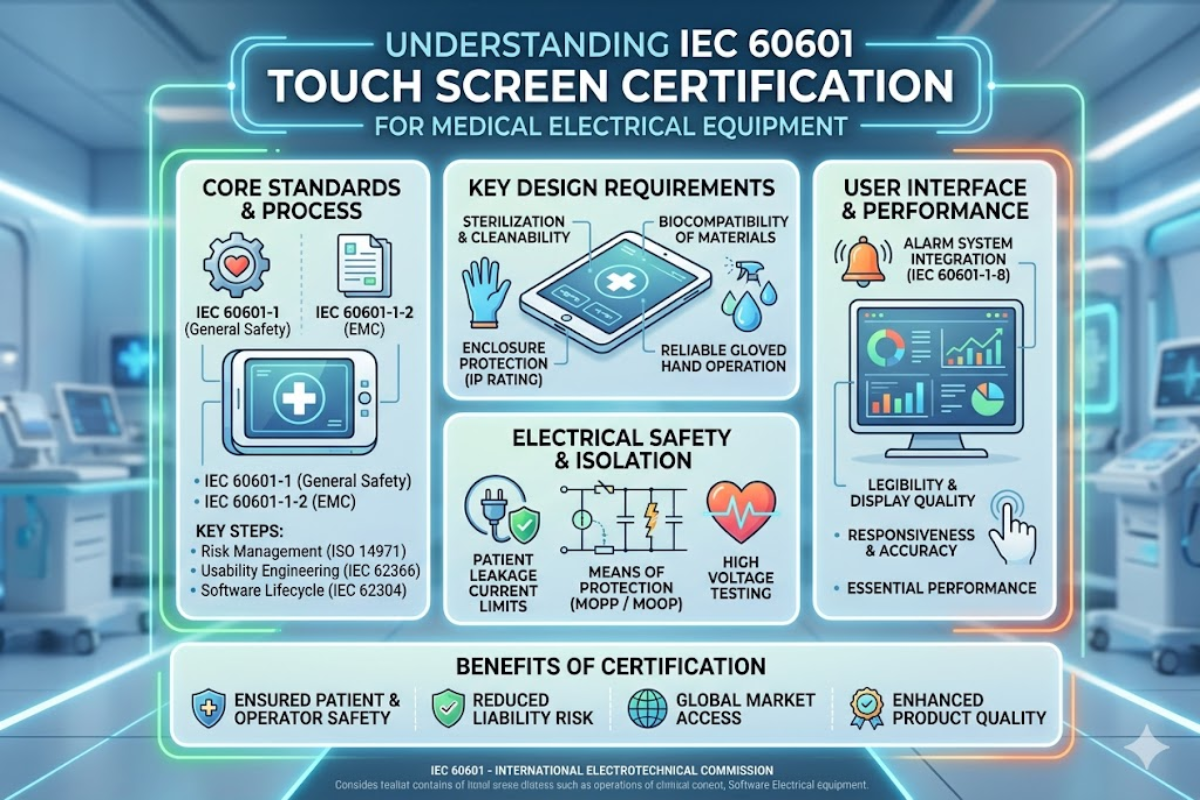
IEC 60601-1 is the foremost of the international standards for safety published by the IEC that describes essential performance specifications, as well as the basic safety provisions, for medical electrical equipment. This would include various touch screen displays used in patient monitoring, surgical visualization, and diagnostics imaging, as well as other forms of medical electrical equipment.
Standard 60601-1 has been through several significant revisions since its initial release. Originally, the 1st edition was issued in 1977 which set the basic electrical safety rules for medical devices, followed by the 2nd edition in 1988 with scaling test procedures. Edition 3 in 2005 introduced the risk management structure used for the current version. Currently, the “Edition 3.2” of IEC 60601-1, with 2020 amendment, is what manufacturers must meet for medical touch screen display modules and other medical electrical equipment.
According to the U.S. Food and Drug Administration, the latest IEC 60601-1:Edition 3.2 standard is to be recognized by December 17, 2023. Any new 510(k) submissions after this date are required to reference this newer process. This resolution date is relevant for manufacturers using touch screen monitors as part of a medical device – whether these are patient monitors at the bedside, high-brightness surgical displays in the operating room, diagnostic imaging workstations in radiology, or bedside terminals allowing access to EHRs.
Touch screen monitors bring additional certification considerations that passive displays do not need. Specifically, the capacitive sensing layer introduces additional electronics, the touch controller element superimposes high frequency signals, and the user interface element is accessible for physically contacting, and sometimes even directly with, the patient. Each of these aspects remains within the scope of IEC 60601-1 certification, which assesses mechanical problems, electrical hazard risks, thermal constraints, and radiation dangers in any device identified as medical electrical equipment.
Since these touch based interfaces are part of the clinical flow – and because practitioners depend upon them to deliver precise patient information – the IEC 60601-1 standard views them as components whose defect could impact patient safety.
Electrical Safety Requirements for Medical Touch Displays
Electrical safety underpins the IEC 60601-1 rule set. It details stringent limits for leakage current, insulation resistance, and dielectric strength that must be met by each certified medical device – across normal operation as well as a single fail condition where one protective feature is no longer effective.
| Test Category | Parameter | Normal Condition | Single Fault Condition |
|---|---|---|---|
| Earth Leakage Current | Max allowed | 500 µA | 1,000 µA |
| Patient Leakage (Type B/BF) | Max allowed | 100 µA | 500 µA |
| Patient Leakage (Type CF) | Max allowed | 10 µA | 50 µA |
| Dielectric Strength | Test voltage | 1,500 VAC (MOOP) | 4,000 VAC (MOPP) |
| Insulation Resistance | Minimum | 2 MΩ (basic) | 7 MΩ (reinforced) |
📐 Engineering Note — MOOP vs. MOPP
Two protection means (MOP) are expected. MOP (Means Of Operator Protection) defends the operator from electrical hazards. MOPP (Means Of Patient Protection) safeguards the patient that is electrically connectable, and possibly directly connected, to the device. For “applied part” classification, the standard allows 10 A of leakage current at the cardiac connection point in the maximum normal situation – reaching the IEC 60601-1 clause 8.7 standard. This difference affects how types of insulation coordination is selected across the entire touch screen module design.
Applied parts category guides the strain of leakage current your device needs to abide by. Type B builds up contact with the body but is not isolated from ground. Type BF, also called “Body Floating”, isolates from the ground. Type CF (Cardiac Floating) provides the highest level of isolation, and is applicable to intracardiac catheters for example.
Getting a PCB Design Right for Medical Touch Display Modules
One of the most common fails encountered during lab testing of medical touch display modules is too little creepage and clearance gaps on the PCB surrounding the touch controller IC. Remember that capacitive touch controllers are often located near the display connector. If the PCB layout does not allow for the 8 mm creepage distance on the underside of the PCB (expected working voltage of 250 VAC + reinforced insulation), the test device will fail dielectric strength testing. Identifying this in pre-compliance labs can save weeks of costly rework.
Authors Note: The ability to withstand these electrical safety tests is not a matter of choice. A medical electrical device that cannot pass leakage current or dielectric strength cannot go into any regulated market period.
EMC Testing — IEC 60601-1-2 for Touch Screen Monitors
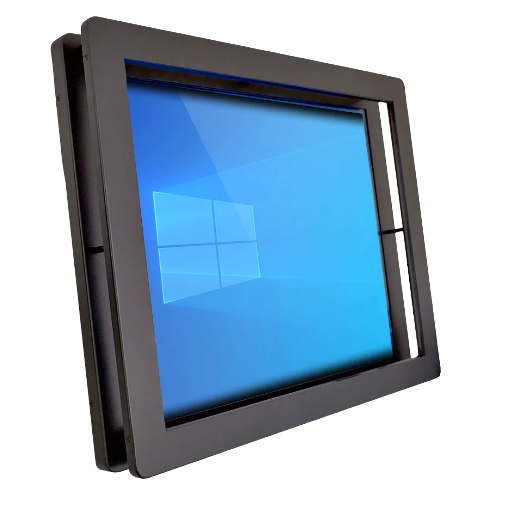
Electromagnetic compatibility (EMC) testing per IEC 60601-1-2 confirms that a medical touch screen monitor does not produce harmful electromagnetic emissions or malfunction in a high electromagnetic environment. The most recent version (Edition 4.1, 2020) contains a few new requirements that are pertinent to medical environments where wireless electronic devices are becoming more common than ever.
| Test | Non-Life-Supporting | Life-Supporting | Standard |
|---|---|---|---|
| Radiated RF Immunity | 3 V/m (80 MHz–2.7 GHz) | 10 V/m | IEC 61000-4-3 |
| ESD (Air Discharge) | ±8 kV | ±15 kV | IEC 61000-4-2 |
| ESD (Contact) | ±6 kV | ±8 kV | IEC 61000-4-2 |
| Electrical Fast Transient | ±2 kV (AC/DC power) | ±2 kV | IEC 61000-4-4 |
| Conducted RF | 3 V (150 kHz–80 MHz) | 6 V | IEC 61000-4-6 |
| Surge | ±1 kV diff / ±2 kV common | Same | IEC 61000-4-5 |
Edition 4.1 introduced proximity field testing for RF wireless devices in the vicinity of the medical monitor – smartphones, WiFi routers, Bluetooth gloves, etc.. This test ensures that the medical monitor maintains its critical performance when a wireless transmitter is located near the display (e.g. nurse holding a phone near a patient monitoring touch screen).
⚠️ Touch-Specific EMC Risk
Capacitive touch controllers use high frequency (60-250 kHz) scanning to locate touches. That high frequency couples some noise into circuitry radiated emissions a non-compliant pass will likely have. Make sure the touch FPC cable is shielded with a grounded copper foil layer, and avoid crossing the scanning frequency bands over the usual medical signal frequencies used by EEG/ECG at approximately 70kHz.
Electromagnetic interference within healthcare environments is measured according to whether clinical personnel use the device at home or in a professional healthcare facility. Class A limits are about 10 dB more lenient than Class B limits, because the customer is in a more controlled environment. Consider designing the touch screen monitor to meet Class B requirements if your market division plans to win both market segments with the same product line, after all it is generally easier to fulfill a more demanding requirement than to fix it later.
Translation: EMC can be complex. How the PCB is designed and assembled in combination with the touch screen assembly mounting points influence whether the final product passes its full IEC 60601-1-2 test suite in one shot.
IP Rating, Ingress Protection, and Infection Control
Protection from solids and liquids ingress relates to why a common touch screen display that is designed for medical use must have the reliability to keep water, fluids, and dust away from internal circuits, near and during cleaning procedures.
| IP Rating | Dust Protection | Water Protection | Typical Clinical Area |
|---|---|---|---|
| IP54 | Protected (limited ingress) | Splash-proof (any direction) | General ward, consultation room |
| IP65 | Dust-tight (complete seal) | Water jet protected (6.3 mm nozzle) | OR prep area, procedure room |
| IP67 | Dust-tight | Temporary submersion (1 m / 30 min) | Sterilization room, decontam area |
Pro tip – PCAP vs. Resistive: Infection Control
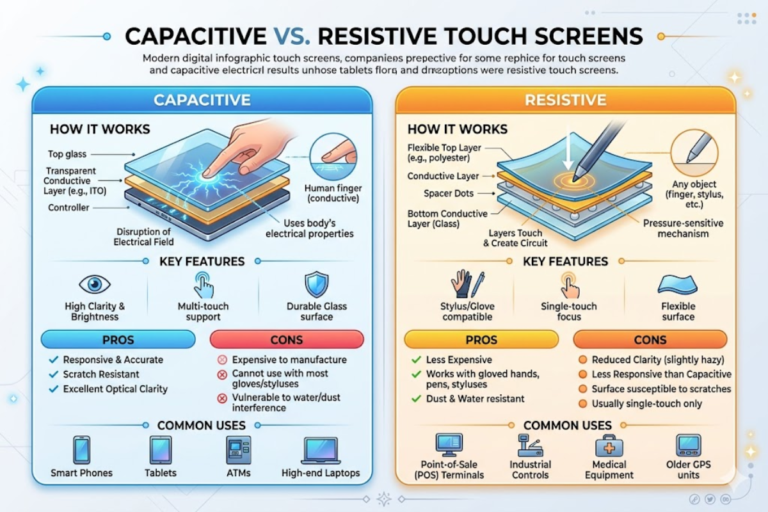
The sealed PCAP (projected capacitive) touch surfaces allow chemical wipe-down with hospital-grade disinfectants – quaternary ammonium compounds, accelerated hydrogen peroxide, and sodium hypochlorite cleaners. Repeated chemical contact damages resistive touch films which develop delamination and yellowing issues 6-12 months post-application of daily disinfectants. Select PCAP in any area subject to routine disinfection per CDC disinfection guidelines.
In addition to an IP rating, silver-ion or copper-based antimicrobial coated on the cover glass helps fight healthcare-associated infections. Data from JIS Z 2801 certified testing shows bacterial populations reduced by 99.9% within 24 hours of contact. Additional bacterial load reduction does require hospital disinfection prior to use.
Mismatching the IP rating to the level of clinical risk can result in a false assurance of protection. Here an IP54 touch display module in a high fluid splash environment gives staff false confidence that the display is protected, while an IP67 monitor in a low risk clinical use area adds cost.
Global Market Access — CE Marking, FDA 510(k), and UL

UN Standard IEC 60601-1 is a family of standards, adopted regionally as UL 60601-1 (US), EN 60601-1 (EU), CAN/CSA-C22.2 Nos 60601-1 (Canada). Each market version of the standard has adapted to local government regulations, which include national deviations manufacturers must meet. Differences can be significant.
| Market | Standard | Regulatory Body | Pathway | Typical Review Time |
|---|---|---|---|---|
| United States | UL 60601-1 | FDA (510(k)) | 510(k) + NRTL testing | 90–180 days |
| European Union | EN 60601-1 | Notified Body (BSI, TÜV, etc.) | CE marking under MDR 2017/745 | 6–12 months |
| Canada | CAN/CSA-C22.2 No. 60601-1 | Health Canada (MDEL) | Medical Device Licence | 60–120 days |
| Japan | JIS T 0601-1 | PMDA | Shonin approval | 12–18 months |
Third-party testing through TSE (Third-Party certification) such asUL or Intertek provides important distinctions in risk. Acceptance of EN standards by the US FDA is made more straightforward through NRTL accredited testing, although the cost of Redtick_Kzaze is higher. In $10,000-$24,000+, an international test report that regulators quickly accept can be built into the project.
In the EU, the full requirements of MDR 2017/745 expects a Notified Body audit of most active medical displays in Class IIa. Self certification as was recently announced for a switch to NIB market will no longer suffice. This added step extended certification pipelines by an additional 3-6 months.
Multi-market manufacturers should use the IECEE CB Scheme using a IEC 60601-1 certified CB-Test Certificate. Recognition by 54 countries will mean national regulators can accept the results and limit testing to local documents granting local-to-market approval in 12-18 months rather than 36+ months.
Providers using IEC 60601-compliant touch display assemblies in medical PCs and system solutions should verify that the display module carries its own CB report, simplifying certification of the entire system.
The IEC 60601 Certification Process — Steps, Timeline, and Cost
IEC 60601 certification takes 6-18 months through each step, from risk investigation to local regulator approval against all applicable requirements. Anticipating each step saves money and engineering cost.
1
Risk Management File (ISO 14971)
Identify all hazards concerning the touch display – electrical shock, backlight thermal burn, glass fracture, EMI with other equipment. For every hazard analyze probability and severity, then define mitigations. This document will be living until a regulator reviews it.
2
Design for Compliance
Engineer creepage/clearance distances, insulation coordination, and applied part classification into the hardware design. Ensure the touch controller PCB layout meets the regulatory requirements for the desired MOP level. Far less expensive to address at the schematic level than after prototyping.
3
Pre-Compliance Testing
Carve out in-house or consultant pre-scans and measure leakage current. A pre-scan radiated emissions check costs $1,500-$3,000 and can reveal problems not unearthed until testing – saving 4-6 weeks of iteration time.
4
Formal Laboratory Testing
Send the design to a 60601-1-certified test lab for IEC 60601-1 safety testing and IEC 60601-1-2 EMC testing. A low-voltage IEC 60601-1 test for certified touch displays takes 8-10 weeks in the lab. All test labs publish a report documenting the received compliance or noncompliance for every clause tested.
5
CB Scheme Report
Get an IECEE CB Test Certificate, allowing multi-market recognition without the same tests in each country. Its report card details all the national deviations than have been tested, allowing parallel filings across standards bodies.
6
Market-Specific Filing
Once ready for market: 510(k) in the US with UL test report, CE technical file with EN 60601-1 report, Health Canada MDEL application. Each market has different documentation requirements and approval time.
Timeline
6–18 months (end-to-end)
Testing Cost
$10,000–$24,000+
Total Budget
$25,000–$80,000
✔ Pre-Submission Readiness Checklist
- Risk management file complete per ISO 14971
- EMC pre-scan passed with 6 dB margin on radiated emissions
- Applied part classification documented (Type B, BF, or CF)
- Insulation coordination verified — creepage/clearance meets target MOP level
- Biocompatibility assessment completed if the touch surface will come in contact with patients (ISO 10993)
Our Role in Medical Display Glass
SaiWeiGlass supplies chemically-strengthened cover glass and optical bonding assemblies for medical touch display modules. The ingress and insulation parameters presented here are based on the qualification data we gather through cover glass qualification including dielectric strength of laminated glass stacks and IP-rated front panel sealing of OR-grade monitors. IEC 60601-1 certification of the entire system must be performed by the device manufacturer.
Using a medical-grade cover glass or optical bonding for your IEC 60601-certified touch display?
Frequently Asked Questions

What is IEC 60601-1 certification?
IEC 60601-1 is the global safety standard applied to medical electrical equipment. It addresses basic safety and essential performance of the design as a whole, including mechanisms to prevent electric shock, mechanical injury, and excessive radiation. IEC 60601-1 regulatory compliance is required before medical touch display displays go to market if they contact or are used near patients.
Is IEC 60601 certification required for all medical touch screens?
Any touch display incorporated into any medical electrical device or otherwise used in a patient environment must be IEC 60601-1 compliant. Owner-operated, non-patient-use consumer monitors may be excluded from this rule – but only after a formal risk assessment.
How much does IEC 60601 certification cost?
Lab testing for IEC 60601-1 and IEC 60601-1-2 combined has historically varied from $10,000 to $24,000 for a low-voltage device, with highly complex devices with additional parts or particular standards variation reaching $30,000. Additional costs come from pre-compliance consulting $3,000-$8,000, and creation of a risk management file and regulatory filings such as FDA 510(k) or CE technical documentation after the certification. The end-to-end cost of one product can often range from $25,000 to $80,000 depending on number of devices, device complexity and markets served.
What is the difference between IEC 60601-1 and IEC 60601-1-2?
IEC 60601-1 serves as a base standard and covers electrical safety, regarding leakage current, insulation, mechanical strength and thermal protection. The IEC 60601-1-2 standard is a collateral standard, used specifically for the purpose of addressing electromagnetic compatibility, electromagnet emission limits and immunity levels. Both are required by the IEC 60601-1 standard before a device can receive certification; one must first pass all 60601-1 safety protocols, then go on to pass the 60601-1-2 due to the additional EMC testing.
Do IEC 60601 certifications expire?
IEC certification does not expire, but it does become invalid once the IEC editions are updated and the transition period requires up-to-date implementations. When a new edition of a standard goes into effect, companies are required to comply with all of the new updates.
Can a consumer-grade touch monitor be used in medical settings?
Consumer monitors are not tested to IEC 60601-1 and do not have the patient leakage current limits, electromagnetic immunity standards and IP ratings required to be used in patient care areas. Utilising them in such areas introduces safety and performance risks along with regulatory complications; electromagnetic interference with life-support equipment is a risk, and any monitor that is used within 1.5 meters of a patient requires IEC 60601-1 certification or integration into a medical system that is IEC 60601-1 compliant and provides the necessary switch isolation.
References & Sources
- IEC 60601-1:2005+AMD2:2020 — International Electrotechnical Commission (iec.ch)
- Overview of IEC 60601-1 Standards — Intertek (intertek.com)
- IEC 60601 Testing and Certification — UL Solutions (ul.com)
- Premarket Notification 510(k) — U.S. FDA (fda.gov)
- Electrical Safety in Medical Devices — VDE (vde.com)
- IEC 60601-1-2 EMC Testing Guide — Keystone Compliance (keystonecompliance.com)
- Leakage Current Standards Simplified — MD+DI (mddionline.com)