Get in Touch with Saiweiglass



Updated June 2026 Reviewed by the Dongguan Saiwei Glass technical team.
An anti-fingerprint coating types comparison is a choice between oil-repelling, water-repelling, and hybrid chemistries, and it usually starts with the wrong question.
Buyers ask “which brand?” when the real fork is chemical: are you repelling oil, water, or both?
A fingerprint deposit is not pure oil – it’s mostly water plus eccrine salts and a sebaceous lipid film . But the water flashes off in minutes; the greasy lipid fraction is what smears, stays, and shows. That’s why oleophobicity, not water-repellency alone, is the lever that decides how a coated screen look after a day of swiping.
This guide compares the anti-fingerprint coating types by chemistry and process so you can specify the right one – not the AG-vs-AR-vs-AF family choice, which we cover separately.
Answer first: Anti-fingerprint coatings split into three repellency types — oleophobic (fluoropolymer/PFPE, oil-first, the touchscreen standard), hydrophobic/silicone (water-first, often fluorine-free), and hybrid/amphiphobic (repels oil and water, including PVD and sol-gel routes). Because fingerprints are oily, an oleophobic or hybrid layer with a water contact angle of roughly 105–115° and an oil contact angle above 90° resists smudging; a water-only hydrophobic film does not. Match the type to oil load, abrasion, optical demand, and — increasingly — PFAS compliance.
Quick Specs: Anti-Fingerprint Coating Types
| Repellency types | Oleophobic · Hydrophobic/silicone · Hybrid (amphiphobic) |
| Water contact angle (AF target) | ~105–115° (SW Glass AF: 105 ±5°) |
| Oil contact angle | >90° oleophobic (SW Glass AF: >90°) |
| Surface energy after coating | ~12–20 mN/m (bare glass ~72 mN/m) |
| Transmittance impact | <0.5% loss; haze <0.5% (ASTM D1003) |
| Abrasion durability | ~2,000–5,000 steel-wool cycles by type |
| Deposition methods | Wet dip/spray · PVD vacuum · CVD / fluorosilane SAM |
| 2026 spec watch | PFAS / fluorine status (EU REACH + US TSCA) |
What “Anti-Fingerprint” Actually Repels: Oil, Water, or Both?
Start with the physics, because it explains every spec sheet you’ll read.
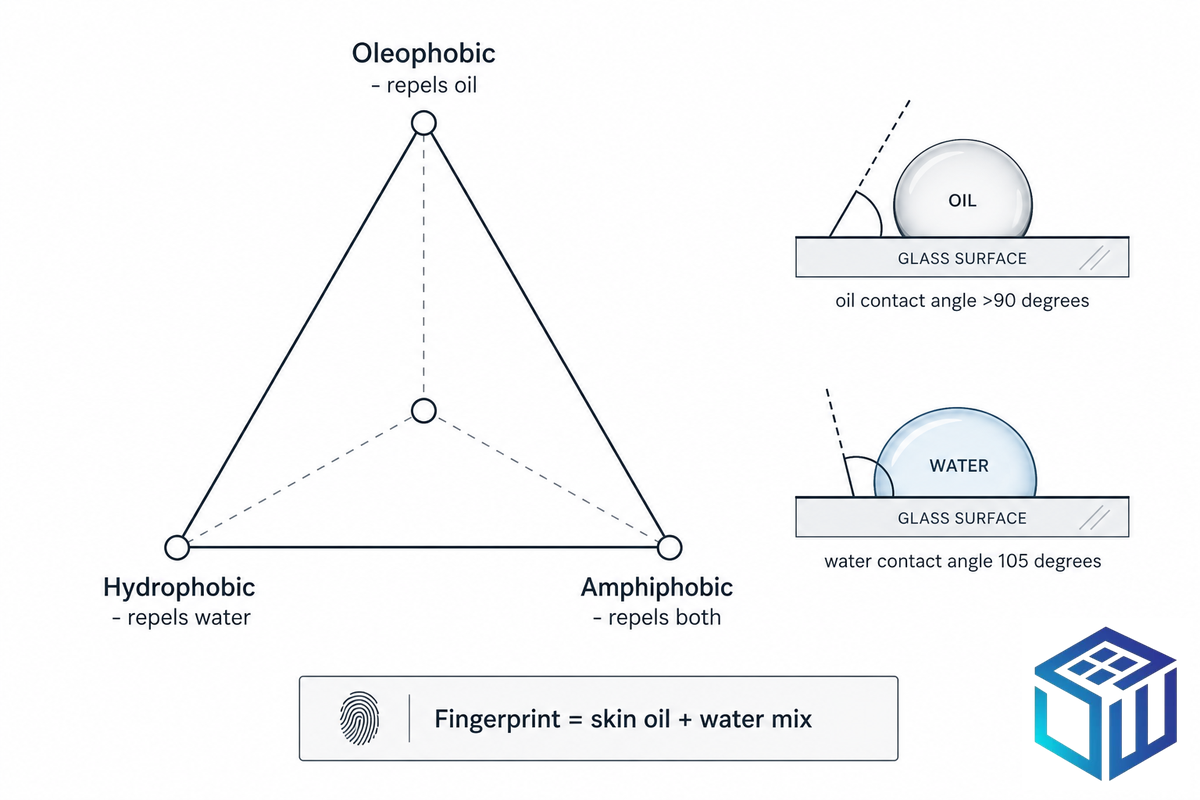
When a droplet sit on glass, it either spreads (wets) or beads. That balance is described by Young’s relation, and the measurable output is the contact angle. Below 90° the liquid wets the surface; between 90° and 180° it doesn’t.
A surface that beads water past 90° is hydrophobic; one that also beads oils, tested with a short-chain alkane such as n-hexadecane, is oleophobic.
Here’s the point most guides blur: oil has roughly one-third the surface energy of water, so repelling oil is harder than repelling water.
As a result, every oleophobic surface is also hydrophobic, but many hydrophobic surfaces aren’t oleophobic. Tuned only to bead water, a coating can still let skin oil spread and smear. Since the visible, persistent part of a fingerprint is that lipid film, oleophobicity, pushing the glass surface energy from about 72 mN/m down to 12–20 mN/m, is what actually keeps a screen looking clean.
The 3-Type Oil-vs-Water Repellency Triangle
A one-look map of the three anti-fingerprint repellency classes against the numbers that decide cleanability – water and oil contact angle, surface energy, and the fingerprint job each one does.
| Property | Oleophobic (fluoro/PFPE) | Hydrophobic (silicone/silane) | Hybrid / amphiphobic |
|---|---|---|---|
| Primary repellency | Oil first (also water) | Water first | Oil and water |
| Water contact angle | 105–115° | 95–110° | 110–120°+ |
| Oil contact angle | >90° (high) | Low–moderate | >90° (high) |
| Fingerprint smear control | Strong | Weak–moderate | Strongest |
| Fluorine status | Usually fluorinated | Often fluorine-free | Either (PVD/sol-gel can be PFAS-free) |
| Best for | Touchscreens, cover glass | Architectural, PFAS-restricted | Premium / high-wear displays |
Contact-angle bands compiled from contact-angle practice (ASTM D7334) and published coating data; verify against your supplier’s measured values.
⚠️ Important: the headline angle is necessary, not sufficient
A static contact angle tells you the surface beads liquid – it does not tell you how easily a smear wipes away.
Two other numbers matter as much: contact-angle hysteresis (the gap between advancing and receding angles) and the related sliding angle, which govern whether oil rolls off or clings. And a higher number is not automatically better: superhydrophobic textures above 150° can trap low-surface-tension oils and are not always repellent once contaminated. For glass displays you want a durable, moderate oleophobic angle with low hysteresis, not the maximum angle. Specify cleanability and abrasion, not just the bead. Top anti-fingerprint surfaces are both hydrophobic and oleophobic, and that pairing is what gives the ease of cleaning that helps them resist fingerprints day to day.
Oleophobic Coatings: The Fluoropolymer & PFPE Standard
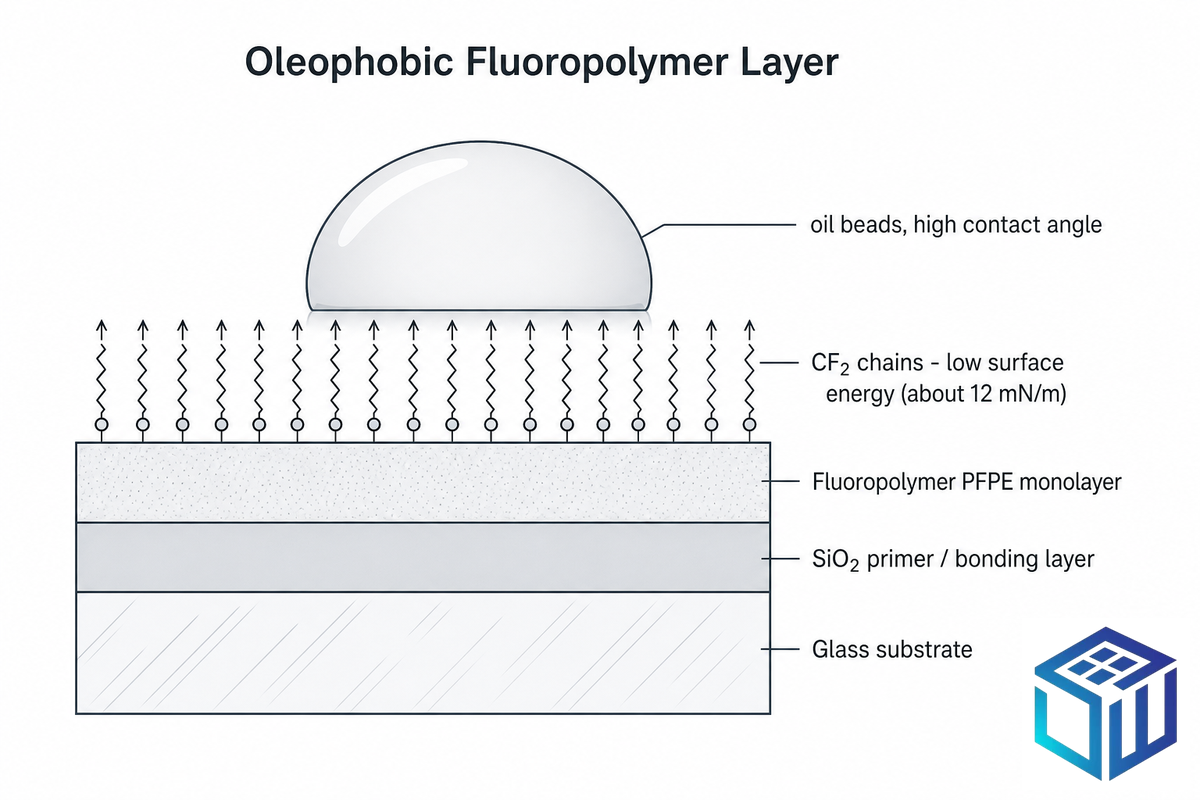
Oleophobic coatings are the de facto standard on phones, tablets, and industrial touch screen glass because they directly address the oil portion of contamination. Its chemistry is a thin, extremely non-polar, nm-scale layer: typically some version of a fluorinated silane (like a perfluorodecyltrichlorosilane), a perfluoropolyether (PFPE), or an amorphous fluoropolymer such as Teflon AF. A wet fluorosilane coating and a vapor PFPE film reach similar oil angles by different routes. Because the film carries almost no charge, skin oil simply doesn’t adhere well-it beads up and lifts off with a dry swipe, instead of spreading. On personal electronic devices and other handheld screens, that low surface energy lets fingerprints wipe away with a dry cloth, no screen cleaner needed. It also keeps the coated surface easier to clean by stopping fingerprints and smudges from building up, which is why oleophobic films dominate electronic devices and screen protector markets.
Thickness can vary widely, depending on the application and fabrication. A self-assembled monolayer (SAM) of fluorosilane can be only 5-20 nm; wet-deposited or vaporized PFPE can be 50-200 nm thick. Much of the fluorosilane chemistries are cured with heat at 100-150 C, add well under 0.5% haze, keeping the optical value safely under the 1% loss many display specifications permit. They’re all optically transparent, so a properly formed oleophobic anti-fingerprint (AF) glass adds less than 0.5% light transmittance loss. The trade-off is durability: because the chemistry sit on the outermost layer, it wears under daily abrasion. One patent for super-non-wetting AF coatings on glass frames it well, super-oleophobicity is described as “the key in preventing fingerprint oil transfer from a human finger onto a rigid substrate.”
“On our production AF cover glass we target a water contact angle of 105 ±5° and an oil contact angle above 90°, then confirm it with a 5-point per-panel transmittance and haze check before the glass ships. The number on the datasheet only counts if every panel actually hits it.”
Coating team, Dongguan Saiwei Glass Co., Ltd.
✔ Advantages
- Highest oil repellency (>90° OCA)
- Near-zero optical penalty (<0.5% loss)
- Low-friction “glide” feel for touch
⚠ Limitations
- Wears with abrasion; needs durable deposition
- Usually fluorinated (PFAS exposure)
- See our AF coating durability breakdown
Hydrophobic & Silicone Coatings: Water-First and Fluorine-Free
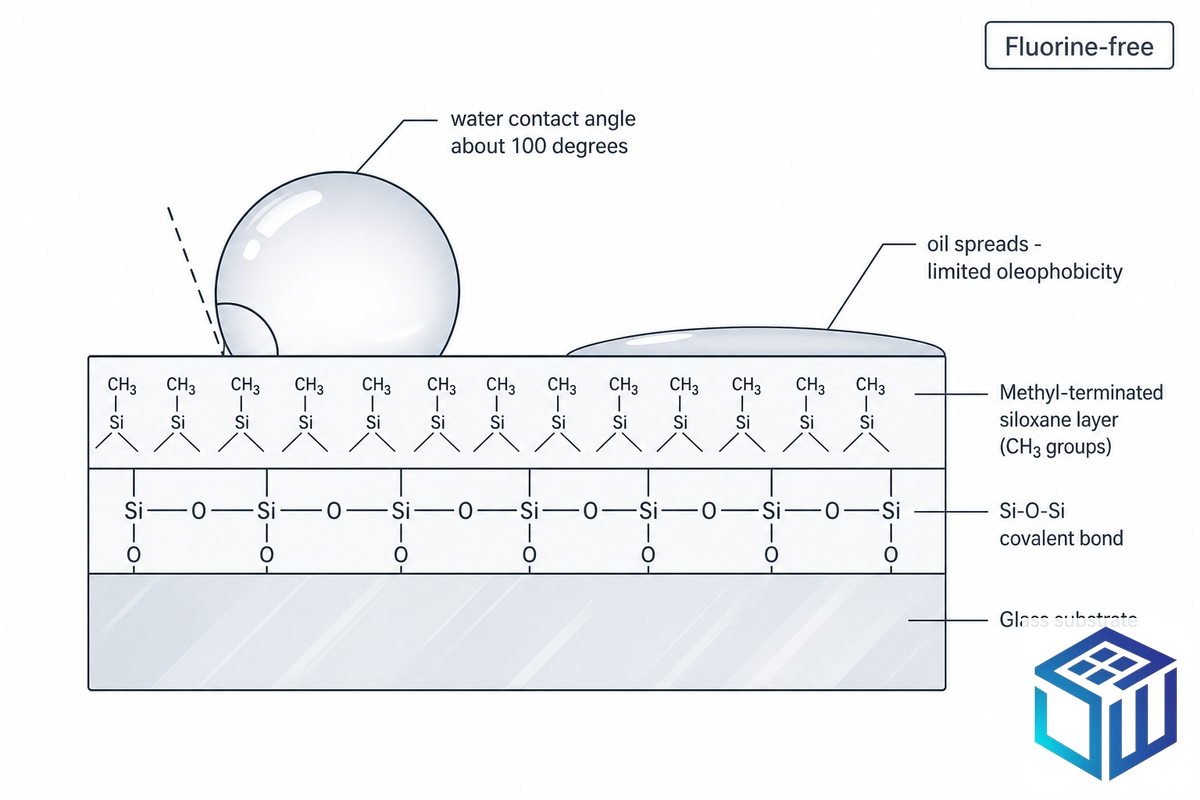
Hydrophobic and silicone-based treatments repel water well but treat oil only as a second-order effect. They’re built on a silicone or silane backbone rather than a fluorocarbon, which gives them two strengths over their oleophobic relatives: stronger abrasion and UV durability, and a route to the fluorine-free formulation that 2026 display programs increasingly call for. That weakness follows from the surface-energy gap: a silicone film that beads water past 100° can still let skin oil wet and smear, leaving a hazier fingerprint than a top-class oleophobic layer. Silicone and silane films typically run 100–300 nm thick and resist UV for 3–5 years outdoors, longer than most fluorinated oleophobic top coats.
It’s worth separating these from superhydrophobic treatments (water angle > 150°). That class relies on a micro- or nano-texture of peaks and valleys to hold an air layer, giving an easy-to-wear, light-scattering surface not typically used on optical display glass (which needs clarity and a smooth feel) and, more to the point, only conditionally resistant to oily contaminants. For glass that must stay optically clear, a smooth hydrophobic or hybrid film is the right family, not a textured superhydrophobic one.
💡 Pro Tip
When a coating is sold on a high water contact angle, ask for the oil contact angle too. A water-bead demo proves hydrophobicity, not fingerprint resistance — the two are not the same number.
Hybrid & Amphiphobic Coatings: Repelling Oil AND Water
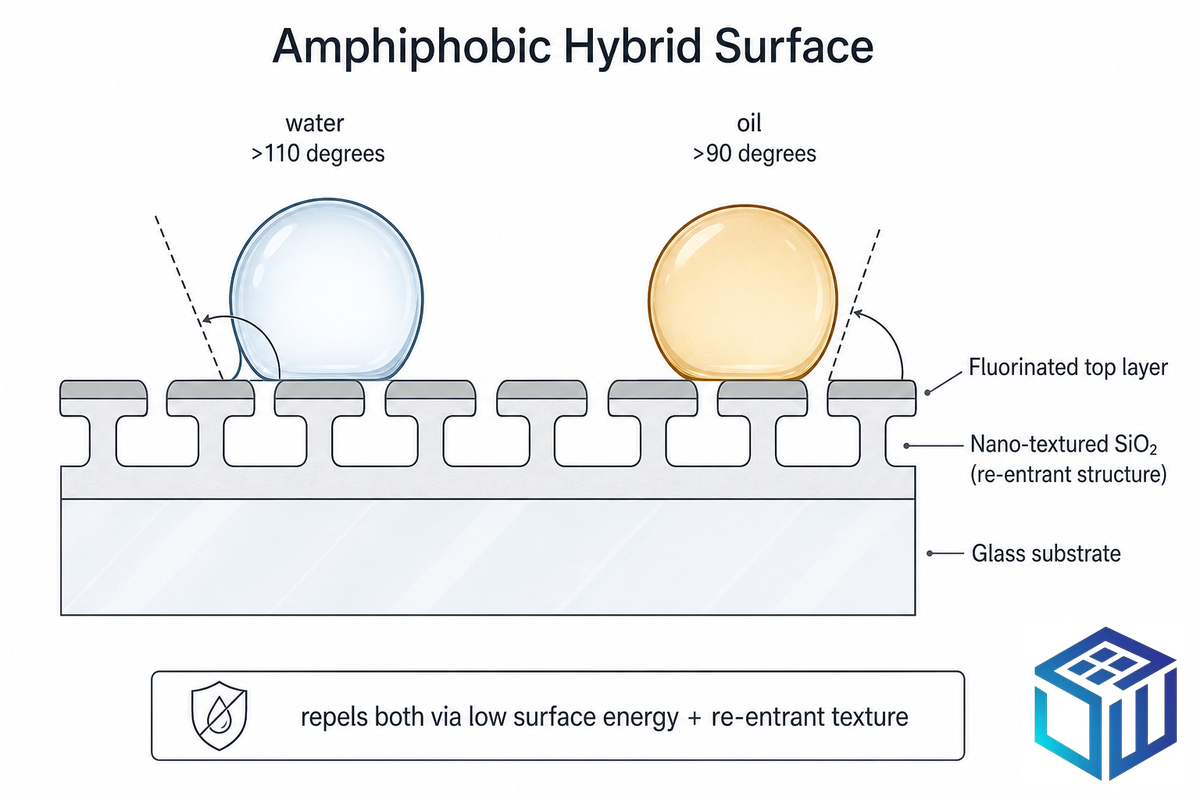
Four key approaches that address high water and high oil angles in this category currently address four ways to reach a hybrid, “clear the whole bar” result for glass:
The 4-Route AF Chemistry Decoder
Four ways to achieve amphiphobic (oil-and-water) anti-fingerprint performance – decoded by chemistry and what each one buy you.
- Sol-gel hybrids – perfluoropolyether-silica or fluoroalkylsilane networks that bond chemically to glass for easy-clean, anti-stick surfaces
- PVD/ceramic amphiphobic – vacuum-deposited, scratch- and wear-resistant, and available PFAS-free for stainless and glass
- Plasma + SiO₂ amphiphobic stacks — an oxygen-plasma-treated surface plus a silicon-dioxide layer delivers combined oil-and-water repellency
- Optical dispersal — an outlier that hides smudges optically (reported up to ~10× better fingerprint hiding) instead of repelling them; useful where repellency wears too fast
Hybrids also overlap with optics. A multifunctional anti-reflective (AR) glass can carry an oleophobic top layer so one stack delivers clarity and smudge resistance – the approach behind an oleophobic anti-reflective coating on cover glass for professional touch displays. If you’re still choosing between surface-treatment families rather than chemistry types, start with our AG vs AR vs AF coating guide, then return here to pick the AF chemistry. Combined AR plus AF is handled in our AR/AF coating capability. These anti-fingerprint coating technologies keep both oils and dirt off the glass, so smudges and fingerprints stay easy to clean; the right coating material and coating chemistry depend on the substrate and the wear it will see.
How Each Type Is Applied: Wet Dip/Spray vs PVD vs Vapor Deposition
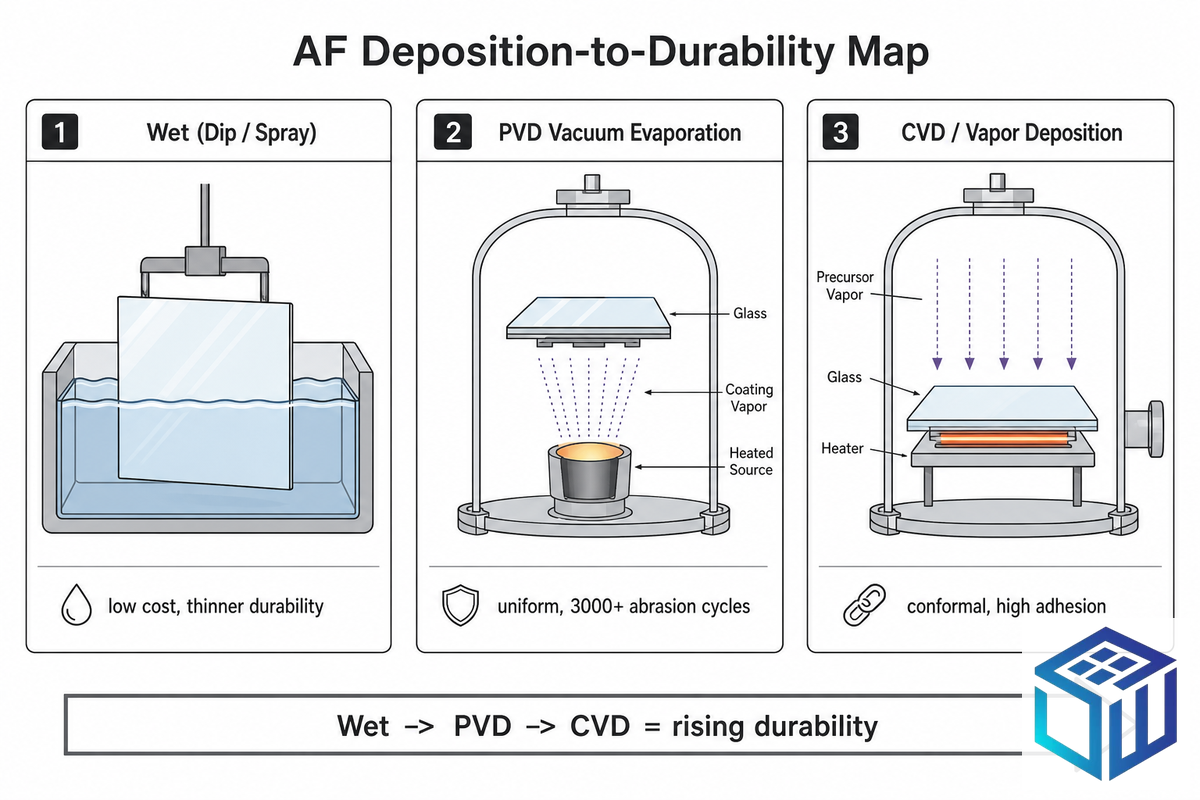
Chemistry sets the ceiling; the deposition method decides how close you get to it and how long it lasts. Wet dip or spray is the cheapest route, a bonded fluorosilane SAM sits in the middle, and PVD vacuum or CVD gives the most durable film on the same chemistry.
One fluorosilane can be a weak spray coat or a durable bonded monolayer depending on process and surface prep. Wet coats carry the chemistry in a solvent that must flash off cleanly; a bonded SAM or CVD layer can hold its contact angle past 2,000-5,000 abrasion cycles and reach 6H-9H pencil hardness, where a thin spray may fade within 6-12 months. So how is each type applied, and how does that change durability and cost? Wet spray coating is the simplest coating application; vacuum deposition (PVD coatings) and chemical vapor deposition bond the film far more durably. An oxygen-plasma surface modification before applying the coating improves adhesion to the glass substrate.
The 4-Method Deposition-to-Durability Map
How the main application methods stack up against the durability tier and relative cost they tend to deliver.
| Method | How it works | Durability tier | Relative cost |
|---|---|---|---|
| Wet dip / spray / flow | Liquid coat then cure | Entry–mid | $ |
| Fluorosilane SAM | Molecule bonds to glass (5–20 nm) | Mid–high | $$ |
| CVD / PECVD | Gas-phase bonded nanofilm | High | $$$ |
| PVD vacuum | Atom-by-atom deposition | Highest (scratch + wear) | $$$$ |
durability tiers are directional and depend on chemistry and substrate; confirm with the supplier’s abrasion-cycle data.
📐 Engineering Note
Adhesion is the quiet failure point. Skin oils, cutting fluids, or greases left on glass before coating cause dewetting – the film pulls back and life drops sharply. Specify a plasma or chemical-etch pre-treatment, then verify adhesion with an ASTM D3359 cross-hatch test and bond integrity before sign-off. A clean surface, not just a good coating, decides whether the layer lasts.
Performance Compared: Contact Angle, Durability & Optical Clarity
There is no single anti-fingerprint pass/fail standard. ASTM D7334 is a general advancing-contact-angle wettability method, not an AF performance spec, and ASTM D1003 covers haze. Real anti-fingerprint performance is specified as a bundle: contact angle (water and oil), abrasion-cycle durability, and transmittance. Compare quotes on all three, not the headline angle alone. On a 0.7 mm cover glass, a well-made AF layer is only 5-20 nm thick, holds 92-95% transmittance, and should survive 12-24 months of daily touch before a measurable drop. Abrasion resistance is the real differentiator: an abrasive wipe or a harsh cleaner makes the coating degrade faster, and the surface roughness left by wear scatters light and dulls the finish. Across anti-fingerprint coating applications, a good surface coating cuts the appearance of fingerprints without changing how the glass reads in normal light.
| Metric | What good looks like | How to read it |
|---|---|---|
| Water / oil contact angle | ~105–115° / >90° | Oil angle proves fingerprint resistance |
| Abrasion durability | ~2,000–5,000 steel-wool cycles; >110° retained | Ask cycles AND angle retained after |
| Transmittance / haze | <0.5% loss; haze <0.5% | AF should be optically invisible |
| Friction coefficient | Low (~0.03–0.4) | Lower = better glide and wipe |
2 Points to Get You Honest. First, practical numbers are small. Real-world measurement of typical consumer-grade oleophobic coatings tends to hover between 90° and 100° on water and 60° and 70° on oil, better than nothing, and nowhere near the hyperbolic angles of marketing collateral. Second, any oleophobic top layer wears, and oleophobic coating wearing off is the single most common field complaint. Even reports from those pushing the boundaries of mobile display hardware indicate a flagship coating can drop to, say, zero within three or four months of heavy usage; others maintain they’ve around 70% still left after a few months. The real-world implications make the deposition method and a solid plan for re-application just as critical as the specification sheet at product inception. We go into more detail on our test method and lifespan in the AF performance and durability test methods guides.
Which Anti-Fingerprint Coating Type Should You Specify?
Match the type to the job. Residue load, abrasion, optical demand, and PFAS exposure vary by end use, so a “highest possible angle” solution is rarely best — the specific coating that fits depends on the surface and how hard it is touched.
Whether you are specifying an anti-fingerprint coating for glass, an anti-fingerprint coating for metal trim, or an anti-fingerprint coating for stainless steel appliances, use the Fit-Finder below as a starting point and adjust it to your own operating environment.
The 9-Application AF Type Fit-Finder
Application to recommended anti-fingerprint coating type and the driving factors.
| Application | Recommended type | Why |
|---|---|---|
| Industrial touchscreen / HMI | Durable oleophobic (SAM/CVD) | High oil load + long service life |
| Public kiosk / POS | Hybrid (AR+AF) | Constant touch + glare + cleanability |
| Medical (autoclave/clean) | PVD or thermally stable oleophobic | Survives aggressive cleaning cycles |
| Automotive display | Hybrid AR+AF | Cuts windshield reflection + smudge |
| Stainless appliance trim | PFAS-free PVD / silicone | Wear resistance + fluorine-free |
| Architectural / outdoor glass | Hydrophobic / silicone | Water-shedding + UV durability |
| Wearable / smartwatch glass | Durable oleophobic (SAM) | Small, high-touch, sweat-exposed |
| Tablet / e-reader | Oleophobic (low-friction) | Frequent swipe; glide matters |
| Outdoor digital signage | Hybrid AG+AF / AR+AF | Glare + grime + cleanability |
⚠️ Common Mistake: specifying “anti-fingerprint” and nothing else
Far and away the most common procurement mistake is vagueness. “Anti-fingerprint” is a category, not a specification. For the order forms, you need to provide four things: the water and oil contact angles, the specific abrasion test to run including cycle count and % retention at specific angle, transmittance and haze, and fluorine content (PFAS free or not). A company that can address all four items can develop an anti-fingerprint that will actually do its job for you; anyone that can’t is selling a category. To frame the request, use our glass material selector and surface treatment comparison; for gloved or stylus use, see our glove-compatible touch screen notes.
The Fluorine-Free Future: How PFAS Rules Are Reshaping AF Specs

Perhaps the largest change occurring now in the area of anti-fingerprint is regulation rather than a push for new technologies to offer extreme contact angles. Most high angle oleophobic coatings contain fluorine and chemistries incorporating that element are being identified with the group of substances that go by the common umbrella of “per- and polyfluoroalkyl substances (PFAS) and other fluorinated chemicals,” which are subject to current and proposed regulations globally. Going forward, it makes prudent sense to ask if a solution is PFAS-free today, and if not, begin planning for substitution at the earliest opportunity, rather than be forced to react later to regulations that are becoming effective globally in different ways and across various timescales.
These changes will take place on a staged, not instantaneous, basis and will be jurisdiction-specific. On the European side, the European Chemicals Agency (ECHA) has proposed to restrict more than 10,000 substances under the new universal REACH restriction on PFAS that would be proposed for consultation during 2025 and 2026, with its scientific committees (RAC and SEAC) preparing their opinions and use-specific exemptions still subject to examination. In the United States, PFAS disclosure requirements for materials imported into the United States are subject to a separate schedule beginning in 2026.
Industry is already outrunning the deadlines. Henkel launched fluorine-free, silicone-based anti-fingerprint coatings in April 2026, and patented non-fluorinated anti-fingerprint coatings and other new anti-fingerprint chemistries, including peer-reviewed non-fluorinated superomniphobic surfaces, are maturing as a means of delivering PFAS-free repellency . There’s also a health story that’s helping to galvanise the push for substitution: one 2024 review concludes that PFAS contained in anti-smudge coatings can transfer to fingers that make contact with the coating – another pathway adding momentum to this argument. For context only, industry analysts reckon anti-fingerprint coatings to be around $1.25-2.8 billion with low single-digit annual growth -directional but not the driver.
💡 PFAS Compliance Checkpoint
Before putting an AF coating order on line in 2026, however, send your vendor these three queries, and insist on their being answered in writing: (1) Are your coatings free of fluorine, and if not, which PFAS do they contain? (2) Can you provide a fluorine / RoHS / REACH declaration for the coated part? (3) Have you qualified a fluorine-free alternative, and at what performance trade-off? Getting these in writing now protects both compliance and supply continuity.
Frequently Asked Questions
Q: Is an oleophobic coating the same as an anti-fingerprint coating?
View Answer
Mostly, but not exactly. Oleophobicity — repelling oil — is the core mechanism behind anti-fingerprint performance, because the part of a fingerprint that smears and stays is the oily lipid film. So most anti-fingerprint coatings are oleophobic. “Anti-fingerprint,” however, is the broader outcome and can also be achieved with hybrid amphiphobic layers or even optical-dispersal coatings that hide smudges rather than repel them. In short: oleophobic is the main route to anti-fingerprint, not a synonym for it.
Q: What’s the actual difference between oleophobic and hydrophobic coatings?
View Answer
Hydrophobic means it repels water (water contact angle above 90°); oleophobic means it also repels oil (high oil contact angle). Because oil has about one-third the surface energy of water, oil repellency is harder to achieve — so every oleophobic surface is hydrophobic, but many hydrophobic surfaces are not oleophobic. For fingerprints, which are oily, you need oleophobic or hybrid (amphiphobic) performance; a water-only coating can still smear.
Q: Are anti-fingerprint coatings PFAS-free and RoHS/REACH compliant?
View Answer
It depends on the chemistry. Classic high-performance oleophobic coatings use fluorinated silanes or PFPE, which are PFAS, so they are not inherently fluorine-free. Fluorine-free alternatives based on silicone, silane, or PVD chemistries now exist and are being qualified as EU REACH and US TSCA PFAS rules phase in through 2026. Always request a PFAS, RoHS, and REACH declaration for the specific coated part rather than assuming — compliance is now a procurement line item, not an afterthought.
Q: How long does an anti-fingerprint coating last?
View Answer
Typically 6 months to 3+ years, depending on chemistry, deposition method, and how hard the surface is touched. See our dedicated AF glass coating lifespan guide for the full breakdown.
Q: Can an AF coating be combined with anti-reflective (AR)?
View Answer
Yes — an oleophobic anti-fingerprint layer is commonly applied over an anti-reflective stack so one piece of glass delivers both clarity and smudge resistance. Order matters: the AF layer goes on top as the touch surface. This AR+AF combination is standard for medical, automotive, and high-end industrial displays.
Q: Which AF type is best for a stylus or gloved touchscreen?
View Answer
For stylus and gloved use, prioritize a low-friction, durable oleophobic or hybrid layer applied by a bonded method (SAM, CVD, or PVD) rather than a soft wet spray, because the repeated mechanical contact of a stylus tip or glove wears a surface film faster. The coating’s glide (friction coefficient) also affects how smoothly a stylus tracks. Touch sensitivity is set mainly by the glass and sensor stack, not the AF layer — see our glove-compatible touch screen guide for the interaction between coating, glass thickness, and capacitive response.
You require an anti-fingerprint glass product that meets your target contact angle, abrasion, and specific requirements regarding its fluorine/PFAS content?
About This Comparison
Dongguan Saiwei Glass offers internally applied, custom Anti-fingerprint coating with 105 degrees water contact angle as measured with 5 point optical verification and will also perform AG, AR and ITO application for your industrial or medical displays. This type-by-type guide has been designed to equip engineers and buyers in choosing the right AF chemical systems rather than advocating for any single brand; as such performance criteria derived from international standards, peer-reviewed articles and our quality testing should be verified by measurement data obtained for your particular intended application.
References & Sources
- ASTM D7334-08(2022): Standard Practice for Surface Wettability of Coatings, Substrates and Pigments by Advancing Contact AngleASTM International
- ASTM D1003: Standard Test Method for Haze and Luminous Transmittance of Transparent PlasticsASTM International
- Durable, Photostable Omniphobic Surfaces via Fluorine-Functionalized Nano-SilicaPubMed Central, U.S. National Library of Medicine
- Superhydrophobic Surfaces for Extreme Environmental ConditionsPubMed Central, U.S. National Library of Medicine
- Non-Fluorinated Superomniphobic Surfaces (2025 review)Progress in Materials Science / ScienceDirect
- Fluoropolymers and Nanomaterials as Anti-Smudge Coatings: Exposure Hazards (2024)Environmental Chemistry Letters, Springer
- Universal PFAS Restriction under REACHEuropean Chemicals Agency (ECHA)
- Next Milestone in the Universal PFAS Restriction ProcessRIVM, Netherlands National Institute for Public Health
- WO2010147738A1: Super Non-Wetting, Anti-Fingerprint Coatings for GlassGoogle Patents
- WO2024206607A1: Non-Fluorinated Anti-Fingerprint CoatingsGoogle Patents