Get in Touch with Saiweiglass

Updated November 2026 · Reviewed by the Dongguan Saiwei Glass Co., Ltd. technical team
A crystalline metal melts at one fixed temperature, whereas the borosilicate glass melting point is tracked across four standardized viscosity points plus tank melting. Standard ISO 3585 Type 3.3 borosilicate glass transitions at 525 °C (977 °F) and reaches its Littleton softening point at 820 °C (1,508 °F). Working points are 1,252 °C for DWK 3.3 and 1,270 °C for BOROFLOAT 33; reported batch melting examples for borosilicate 3.3 reach ~1,648–1,680 °C (3,000–3,056 °F).
Forming viscosity benchmarks never equal safe operating temperatures in finished equipment. For unloaded BOROFLOAT 33 sheet, SCHOTT lists maximum operating limits of 450 °C for at least 10 hours and 500 °C for exposures under 10 hours. Fused quartz handles 900–1,100 °C continuously and 1,400 °C briefly, depending on part size and shape (McDanel). Mounted assemblies instead follow the lowest cap across stress relaxation (300 °C on SW Glass ≥3 mm flat tempered panels) or DIN 7080:2025-05 (280 °C continuous on circular prestressed 3.3 sight discs ≥6.5 mm under one-sided fluid or gas pressure). Steam corrosion and optical adhesives impose even lower caps, while ASTM E438 Type I Class B glasses work at 1,160–1,165 °C.
| Thermal Benchmark | Temperature (°C / °F) | Viscosity (dPa·s) | Engineering Significance & Reference |
|---|---|---|---|
| Unloaded Sheet Service (BOROFLOAT 33) | 450 °C (≥10 h) / 500 °C (<10 h) | Rigid elastic solid | SCHOTT reference operating limits for unmounted flat BOROFLOAT 33 |
| Strain Point | 510–518 °C (950–964 °F) | 1014.5 | Viscosity and stress-relaxation reference point (~4 hours per ASTM C336); not a structural load limit |
| Transformation Temperature (Tg) | 525 °C (977 °F) | ~1013.3 | Glass network shifts from brittle solid to viscoelastic state (ISO 3585) |
| Annealing Point | 560 °C (BOROFLOAT 33) / 565 °C (DWK 3.3) | 1013.0 | Residual forming stress relaxes within minutes per ASTM C336 |
| Littleton Softening Point | 820–821 °C (1,508–1,510 °F) | 107.6 | Glass fiber deforms under its own weight per ASTM C338-24 |
| Working Point / Reported Melt | 1,252–1,270 °C / ~1,648–1,680 °C | 104.0 (working) / furnace-dependent | DWK (1,252 °C) & SCHOTT (1,270 °C) working points; reported 3.3 melt example |
Why Borosilicate Glass Has Five Viscosity Thresholds Instead of a Single Melting Point
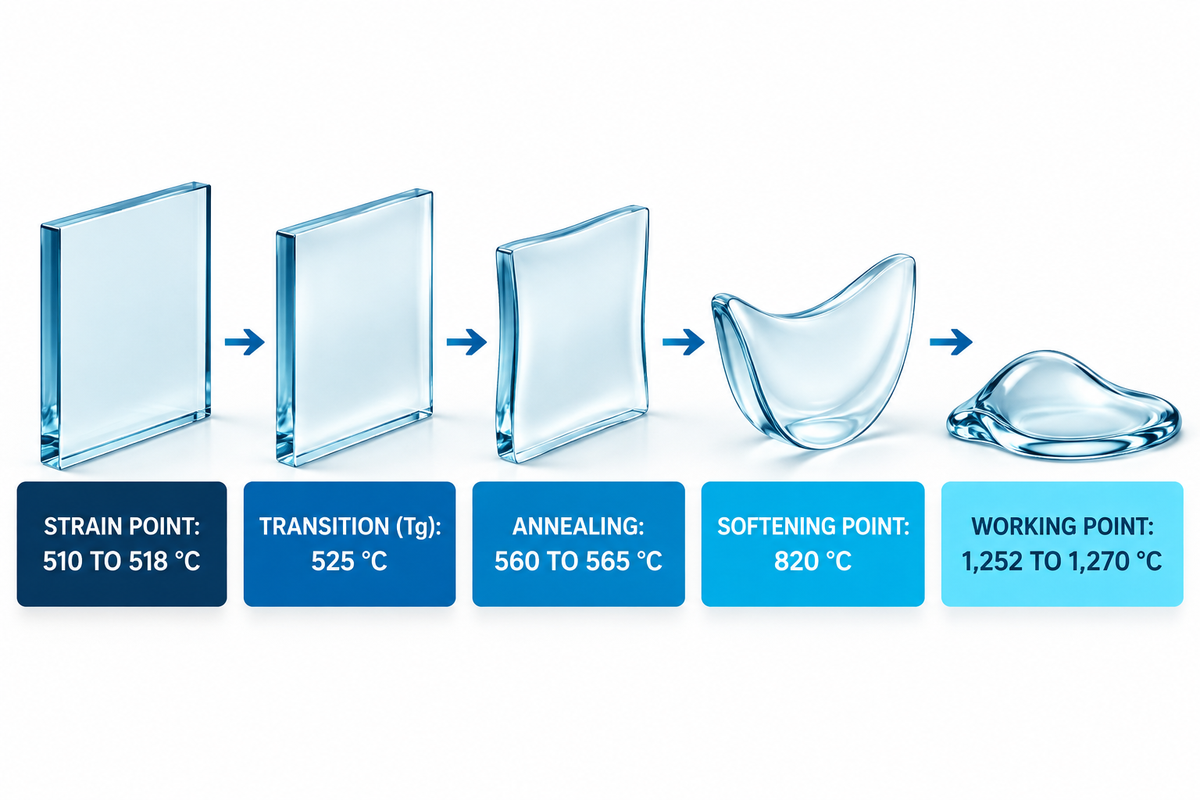
Borosilicate 3.3 is an amorphous solid with no abrupt crystal-to-liquid phase boundary. Instead of quoting a single melting point of borosilicate glass, engineers track four standardized viscosity fixpoints plus furnace batch fining. Under ISO 3585:1998 Borosilicate glass 3.3 and manufacturer datasheets, 3.3 grades transition at 525 °C and soften at 820–821 °C. Working points sit at 1,252 °C (DWK Life Sciences 3.3) to 1,270 °C (SCHOTT BOROFLOAT 33), while reported 3.3 tank-melting examples reach ~1,648–1,680 °C to fine a homogeneous glass melt.
Mechanical drawings often stall in compliance review when engineers enter 820 °C as an enclosure housing rating. Inside the disordered glass matrix, silicon-oxygen and boron-oxygen bonds gradually begin to weaken as heat increases. Viscosity drops across twelve orders of magnitude without latent-heat arrest. Grouping the 4 viscosity fixpoints along with tank fining ensures design, kiln, and procurement teams are looking at the same physical state.
ASTM E438 Type I Class A is a material classification met by DWK’s 3.3-expansion borosilicate laboratory glassware. Strain, annealing, softening, and working points are temperatures at specified viscosities expressed in decipascal-seconds (dPa·s, equal to poise), while industrial melting and fining temperatures describe processing conditions. Fiber elongation tests, under ASTM C336, provide the strain point at 1014.5 dPa·s and the annealing point at 1013.0 dPa·s. ASTM C338-24 defines the softening point of borosilicate glass by self-weight fiber elongation at around 107.6 dPa·s (106.6 Pa·s). In the range of commercial glass densities, that Littleton window spans 107.5-108.0 dPa·s.
Reviewing borosilicate glass material specifications and custom sheet thicknesses early prevents costly drawing revisions. Engineers planning curved viewports slump sheets over ceramic molds between 650 °C and 780 °C during precision hot-bent glass forming. That forming window sits above the 560 °C annealing point yet stays below the 820 °C Littleton softening point.
| Benchmark Stage | Log10 Viscosity (dPa·s) | BOROFLOAT 33 / DWK 3.3 | Physical Glass Network Behavior | Shop-Floor Process Window |
|---|---|---|---|---|
| 1. Strain Point | 14.5 (1013.5 Pa·s) | 510–518 °C (950–964 °F) | Viscous relaxation reference (~4 h stress decay per ASTM C336) | Lower bound of controlled annealing cool-down; cooling rate still depends on thickness |
| Tg Reference | ~13.3 | 525 °C (977 °F) | Thermal expansion slope steepens sharply on dilatometer curve | Dilatometric quality check per ISO 3585 & DIN 12217 |
| 2. Annealing Point | 13.0 (1012.0 Pa·s) | 560 °C (BOROFLOAT) / 565 °C (DWK) | Internal birefringence clears in ~15 minutes | Stress-relief soak plateau after lampworking or kiln slumping |
| 3. Softening Point | 7.6 (106.6 Pa·s) | 820–821 °C (1,508–1,510 °F) | Unsupported fiber or sheet sags under self-weight | Ceiling above gravity mold slumping (650–780 °C) and roller temper |
| 4. Working Point | 4.0 (103.0 Pa·s) | 1,252 °C (DWK) / 1,270 °C (BOROFLOAT) | Reference hot-forming viscosity for blowing, drawing, and sealing | Scientific oxygen-fuel torch work and rotary tube forming |
| Batch Melting Reference | Furnace-dependent (not a fixed test point) | ~1,648–1,680 °C (reported 3.3 example) | Silica sand and borate raw batch dissolve; gas seeds escape | Reported high-temperature 3.3 batch melting and fining example |
At What Temperature Does Borosilicate Glass Melt on a Torch vs. in a Furnace?
On an oxygen-fuel benchtop torch, 3.3 borosilicate tubing bends near its 820 °C softening point, while 1,252–1,270 °C marks the 104 dPa·s working-point reference (actual forming spans broader viscosities). In reported 3.3 furnace examples, borosilicate glass melting and bubble fining in molten glass reach ~1,648–1,680 °C. Routine laboratory heating stays far lower. Corning Life Sciences states that PYREX beakers and boiling flasks tolerate repeated heating on hot plates, flames, or ovens up to 230 °C. Volumetric labware must stay below 150 °C to preserve calibration accuracy.
How Boron Trioxide Composition Shifts Melting Temperature Across 3.3, 5.1, and Pyrex Grades
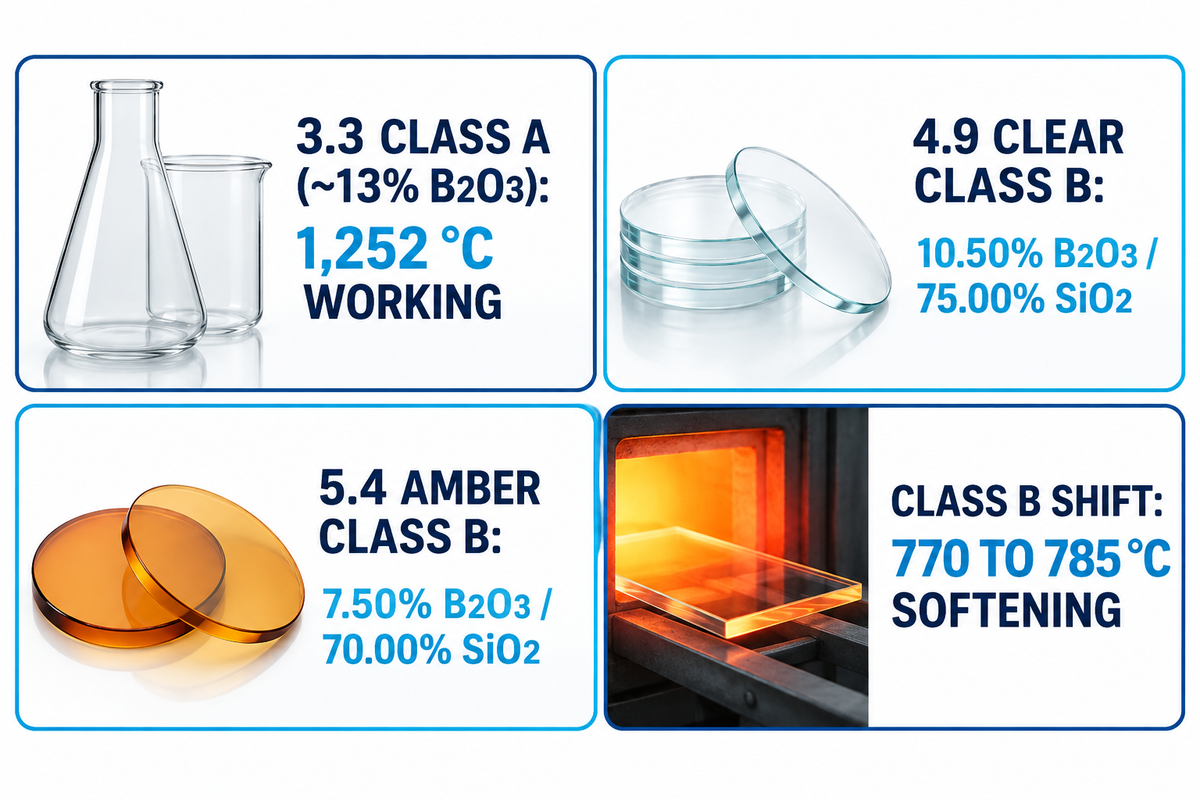
Commercial types of borosilicate glass do not share one fixed softening or working temperature. Per DWK Life Sciences, 3.3-expansion laboratory borosilicate glass contains ~13% B2O3, meets ASTM E438 Type I Class A, and works at 1,252 °C. DWK’s 4.9 clear (10.50% B2O3, 75.00% SiO2) and 5.4 amber (7.50% B2O3, 70.00% SiO2) ASTM E438 Class B glasses contain alumina and alkaline earths. Per DWK data, those Class B formulations shift Tg to 550–565 °C, lower softening points to 770–785 °C, and drop working points to 1,160–1,165 °C.
“In contrast, the organization found that the borosilicate glassware is more resilient and did not shatter until removed from a 500°F oven.”
The American Ceramic Society (ACerS), Ceramic Tech Today
Otto Schott pioneered technical borosilicate in Jena in 1887, and Corning Glass Works later commercialized low-expansion laboratory ware. Per structural research cited by SCHOTT AG and GlassOnWeb, classical 3.3 glass composition holds roughly 80.6% SiO2, 12.5–13.0% B2O3, 4.0% Na2O/K2O, and 2.3% Al2O3. Roughly 94% of the network consists of strong [SiO4], [BO3], and [BO4] formers, with under 2% non-bridging oxygens. That tight network defines the signature properties of borosilicate and sets its core glass properties apart from alkali-rich window sheets.
Procurement teams must also separate USP <660> hydrolytic testing on pharmaceutical glass containers from ASTM E438 material expansion classes rather than assuming a single point of borosilicate glass thermal expansion guarantees container compliance. Non-container specialty melts such as alkali borosilicate or phosphate glasses serve optical components rather than pharmaceutical vials. Always specify ISO 3585 or ASTM E438 Type I Class A plus target softening temperature on flat-panel purchase orders.
| Commercial Grade / Reference | Typical B2O3 / SiO2 | Linear CTE (20–300 °C) | Tg / Softening Point | Working Point | Primary Form & Use |
|---|---|---|---|---|---|
| SCHOTT BOROFLOAT 33 (ISO 3585) | ~13% / ~81% | 3.25 × 10⁻⁶ K-1 | 525 °C / 820 °C | 1,270 °C | Micro-float optical & industrial flat sheet |
| Rolled 3.3 Block (SUPREMAX 33) | ~13% / ~81% | 3.25 × 10⁻⁶ K-1 | 525 °C / 820 °C | 1,270 °C | Thick ground/polished sight blocks (>25 mm) |
| DWK / Corning 3.3 Labware (Class A) | ~13% / ~80.6% | 3.3 × 10⁻⁶ K-1 | 525 °C / 820–821 °C | 1,252 °C | Chemical labware, flasks, reactor vessels |
| ISO 4803:2021 3.3 Tubing (DURAN) | 12.5–13.5% / ~81% | 3.3 × 10⁻⁶ K-1 | 525 °C / 820 °C | 1,252 °C | Scientific lampworking & gauge glass tubes |
| DWK 4.9 Clear Pharma (Class B Ref) | 9.5–11.5% / ~73% | 4.9 × 10⁻⁶ K-1 | 565 °C / 785 °C | 1,160 °C | Clear injectable vials & ampoules |
| DWK 5.4 Amber Pharma (Class B Ref) | 8.5–10.5% / ~70% | 5.4 × 10⁻⁶ K-1 | 550 °C / 770 °C | 1,165 °C | UV-blocking pharmaceutical parenteral vials |
| Patented Medium-Boro (CN112694254A) | 7.0–8.5% / ~72% | ~5.0–5.5 × 10⁻⁶ K-1 | ~545 °C / <800 °C | ≤1,190 °C | Lower-temperature vial melt patent example |
| Pyrex Europe Borosilicate Bakeware | ~12–13% / ~80% | ~3.3 × 10⁻⁶ K-1 | ~525 °C / ~820 °C | ~1,250 °C | Consumer ovenware rated to 240 °C ΔT (Pyrex Europe) |
| US Tempered Soda-Lime Bakeware | 0% B2O3 / ~72% SiO2 | ~9.0 × 10⁻⁶ K-1 | ~530 °C / ~720 °C | 1,040 °C | Tempered kitchen bakeware (~56 °C / 100 °F ΔT) |
Why Did Consumer Pyrex Stop Using Borosilicate Glass in the United States?
Lower batch-melting energy costs and higher air-tempered drop resistance led US consumer bakeware makers to shift to soda-lime glass after Corning exited cookware manufacturing in 1998. Corning licensed US consumer cookware to World Kitchen LLC while keeping PYREX laboratory glassware in Type I Class A borosilicate. Meanwhile, European licensee International Cookware still produces borosilicate ovenware rated up to 240 °C thermal shock. American Ceramic Society researchers Richard Bradt and Reese Martens calculated that soda-lime cuts theoretical thermal shock resistance from ~183 °C (330 °F) to ~56 °C (100 °F). In Consumer Reports trials cited by ACerS, borosilicate dishes didn’t shatter until leaving a 500 °F (260 °C) oven.
Maximum Safe Operating Temperature vs. Softening Point in Real Assemblies
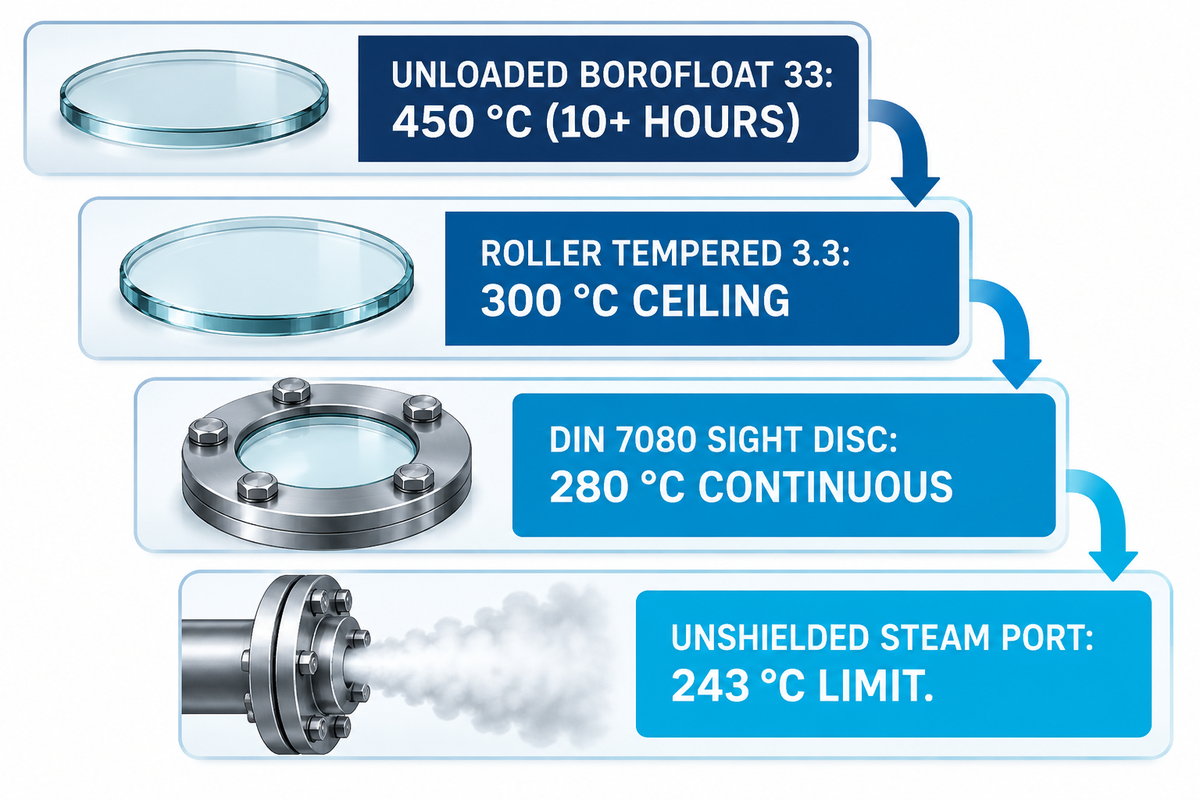
For unloaded flat BOROFLOAT 33, SCHOTT lists maximum operating temperatures of 450 °C (≥10 hours) and 500 °C (<10 hours). Both limits sit below its 510–518 °C strain point and well below its 820 °C Littleton softening point. Fiber-elongation strain and annealing benchmarks follow ASTM C336 laboratory procedures on unmounted specimens. Sustained heat and load near the strain regime can cause time-dependent viscous deformation, while uneven cooling or rigid clamping introduces residual stress unless properly annealed. Mounted industrial assemblies hit lower limits set by temper relaxation, gasket creep, steam attack, or adhesive breakdown.
We use the 4-Ceiling Assembly Derating Rule on prototype housings to avoid failing thermal qualification. Each viewport has four independent thermal ceilings: the base glass strain margin, surface compression relaxation threshold, the mechanical seal limit, and the media boundary. The lowest of the four determines the assembly’s rating, which is listed on the nameplate.
Consider thermally prestressed sight glasses governed by DIN 7080:2025-05, which superseded DIN 7080:2005-05. That standard caps continuous operating heat at +280 °C (300 °C temporarily) for circular toughened borosilicate 3.3 discs (≥6.5 mm thick) under one-sided pressure. On flat panels (≥3 mm) tempered on SW Glass rollers, sustained high temperature or higher temperature spikes above 300 °C relax the glass surface compressive layer. An April 2008 study developed electronic borosilicate glasses (900 °C to 1,000 °C softening points) with tailored properties of glass for multilayer copper substrates. Even those high-softening formulations operate strictly below Tg in finished service.
| Assembly Configuration | Max Service Temp | Governing Limiting Mechanism | Choose When | Disqualification Boundary |
|---|---|---|---|---|
| Unloaded BOROFLOAT 33 (<10 h) | 500 °C (932 °F) | SCHOTT short-cycle limit below 518 °C strain point | Unclamped furnace setter plates, flash-cure shields | Disqualify if clamped under pressure or held ≥10 hours |
| Unloaded BOROFLOAT 33 (≥10 h) | 450 °C (842 °F) | Long-term viscoelastic stability of thermal properties | Dry laboratory tube furnaces, floating ceramic-fiber frames | Disqualify where impact safety or one-sided vessel pressure exists |
| SW Glass Ceramic-Frit Printed 3.3 | 300 °C aging verified | Inorganic frit fired at 500 °C (SW Glass spec) | High-heat oven bezels and instrument graduation scales | Disqualify organic epoxy/silicone inks above 150–200 °C |
| SW Glass Roller Tempered 3.3 (≥3 mm) | 300 °C (572 °F) | Gradual decay of 80–150 MPa quench compressive stress | High-wattage floodlights, industrial oven doors, machine guards | Disqualify panels <3.0 mm thick or sustained service >300 °C |
| DIN 7080:2025-05 Sight Disc (≥6.5 mm) | 280 °C (536 °F) continuous | Prestress retention + PTFE/graphite flange gasket creep | Pressurized chemical reactors and dry gas pipework sight ports | Disqualify unshielded above 280 °C or in >243 °C saturated steam |
| Mica-Shielded DIN 7080 Sight Disc | Subject to DIN 7080 disc & seal ratings (≤280 °C continuous) | Mica reduces direct steam attack; disc prestress and seal limits still govern | Steam-exposed sight ports requiring a protective liner | Mica does not raise disc prestress, gasket, or flange pressure limits |
| Unshielded Saturated Steam Gauge | 243 °C (469 °F) | Rapid hydrothermal dissolution of silicate network | Moderate steam condensate sight ports below 243 °C | Disqualify bare glass above 243 °C steam without mica liner |
| PYREX Lab Beakers & Boiling Flasks | 230 °C (150 °C volumetric) | Corning direct-heat limit & volumetric calibration lock | Routine bench wet-chemistry heating and autoclave cycles | Disqualify volumetric flasks above 150 °C |
| Optically Bonded HMI / Sensor Cover | 120–180 °C | Yellowing and delamination of UV-acrylic or silicone OCA/LOCA | Outdoor medical, industrial, or analytical touch displays | Disqualify adhesive bonding above 180 °C; use mechanical bezel |
Thermal Expansion, Wall Thickness, and Thermal Shock Cracking Limits
Borosilicate 3.3 achieves strong thermal shock resistance through its low coefficient of thermal expansion of 3.3 × 10⁻⁶ K-1 (20–300 °C). That linear expansion baseline is specified in ISO 3585 for low-expansion borosilicate glass. That expansion rate is roughly one-third that of soda-lime float glass (~9.0 × 10⁻⁶ K-1). Per Corning data, a 3.2 mm annealed PYREX sample tolerates a 160 °C temperature differential. BOROFLOAT thermal shock resistance (RTS) drops from 175 K (≤3.8 mm) and 160 K (5.0–5.5 mm) to 150 K (6.5–15.0 mm) and 125 K (>15.0 mm).
When cold washdown water hits a hot viewport, the outer skin contracts instantly while the insulated interior stays expanded. Thus a biaxial tension, approximately E · α · ΔT / (1 − ν), is set up in the cooled skin. Since borosilicate pairs a low thermal expansion coefficient with a moderate Young’s modulus (~64 GPa compared to ~70–72 GPa in soda-lime), tensile stress drops by almost 70% for the same temperature step. Thin Type 3.3 plates retain reliable resistance to thermal shock across repeated industrial washdowns.
Another mechanical problem arises from coefficient of thermal expansion mismatch between metal housings and borosilicate 3.3. During heating, stainless steel and aluminum housings expand five to seven times faster than borosilicate 3.3 and contract faster during cooling; at cold temperatures, an undersized metal bezel can constrain the borosilicate 3.3 perimeter, which can lead to edge crushing and failure.
Worked Example: Unrestrained Thermal Expansion (ΔL = α · L0 · ΔT)
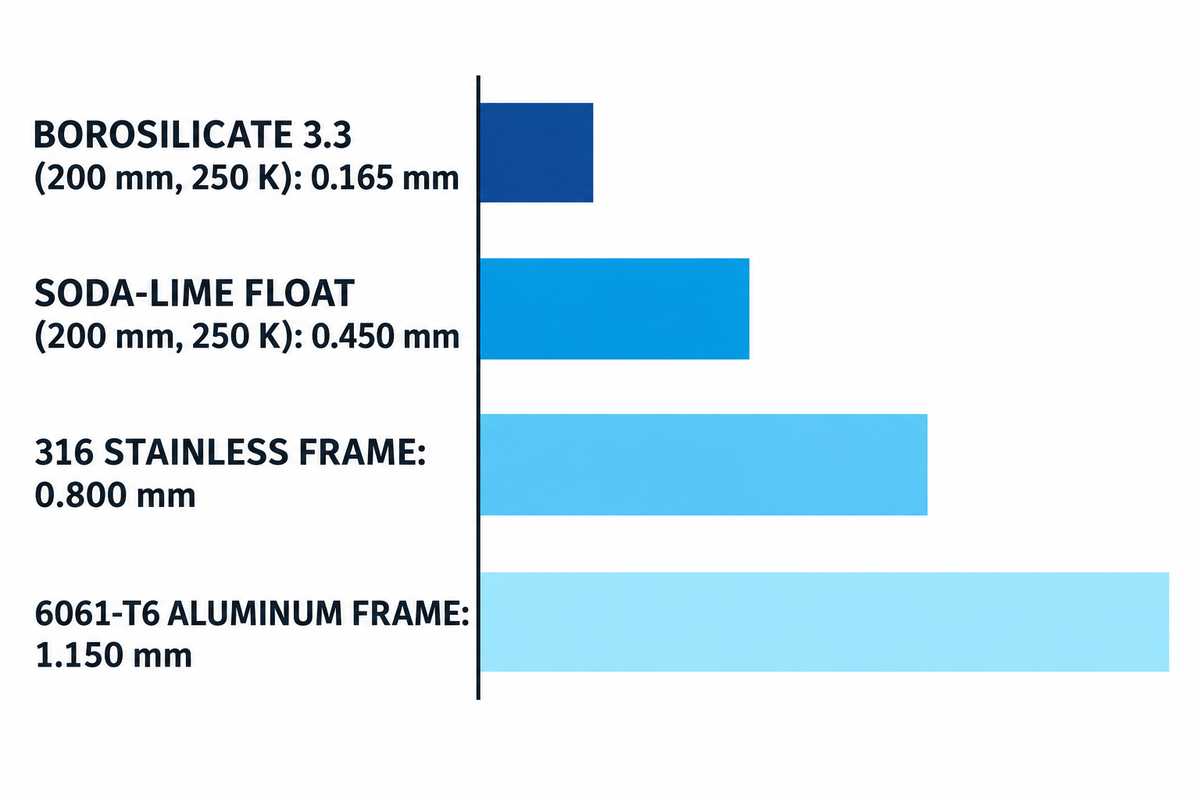
Assumed inputs: Square sight window width L0 = 200 mm. Uniform temperature rise ΔT = 250 K (from 20 °C assembly to 270 °C oven dwell). Linear CTE values are αboro = 3.3 × 10⁻⁶ K-1, αsoda-lime = 9.0 × 10⁻⁶ K-1, α316SS = 16.0 × 10⁻⁶ K-1, and α6061-Al = 23.0 × 10⁻⁶ K-1.
1. Borosilicate 3.3 free growth across 200 mm: 3.3 × 10-6 × 200 mm × 250 K = 0.165 mm.
2. Soda-lime float free growth across 200 mm: 9.0 × 10-6 × 200 mm × 250 K = 0.450 mm.
3. 316 stainless steel frame free growth: 16.0 × 10-6 × 200 mm × 250 K = 0.800 mm (0.635 mm total differential vs. borosilicate).
4. 6061-T6 aluminum frame free growth: 23.0 × 10-6 × 200 mm × 250 K = 1.150 mm (0.985 mm total differential vs. borosilicate).
Finally, flexible gaskets sized for thermal expansion can separate the glass edges from the metal in order to relieve the strain.
| Plate Thickness Band | Annealed BOROFLOAT 33 RTS | Thermally Prestressed 3.3 ΔT | Annealed Soda-Lime Float ΔT |
|---|---|---|---|
| ≤3.8 mm (3.2 mm Corning: 160 °C) | 160–175 K | 220–250 K (≥3.0 mm floor) | ~37–45 K |
| 3.8–6.5 mm | 140–160 K | 230–265 K | ~30–38 K |
| 6.5–15.0 mm | 125–140 K | 230–265 K (DIN 7080 disc) | ~22–30 K |
| >15.0 mm heavy block | 100–125 K | ≥230 K (custom quench) | <22 K |
Can Borosilicate Glass Crack from Heat Even Below Its Softening Point?
Yes, thermal fracture can occur hundreds of degrees below the softening limit at 820 °C when localized temperature gradients develop excessive tensile stress. Corning states a 160 °C differential limit for a 3.2 mm annealed PYREX sample, but thicker plates retain core heat longer because of the low thermal conductivity (~1.14–1.2 W/m·K). Unpolished CNC saw kerfs, stone chips, or uneven flange bolt torque further concentrate high thermal stress at edge micro-flaws during rapid cooling.
Borosilicate Glass Melting Point vs. Soda-Lime, Aluminosilicate, and Fused Quartz
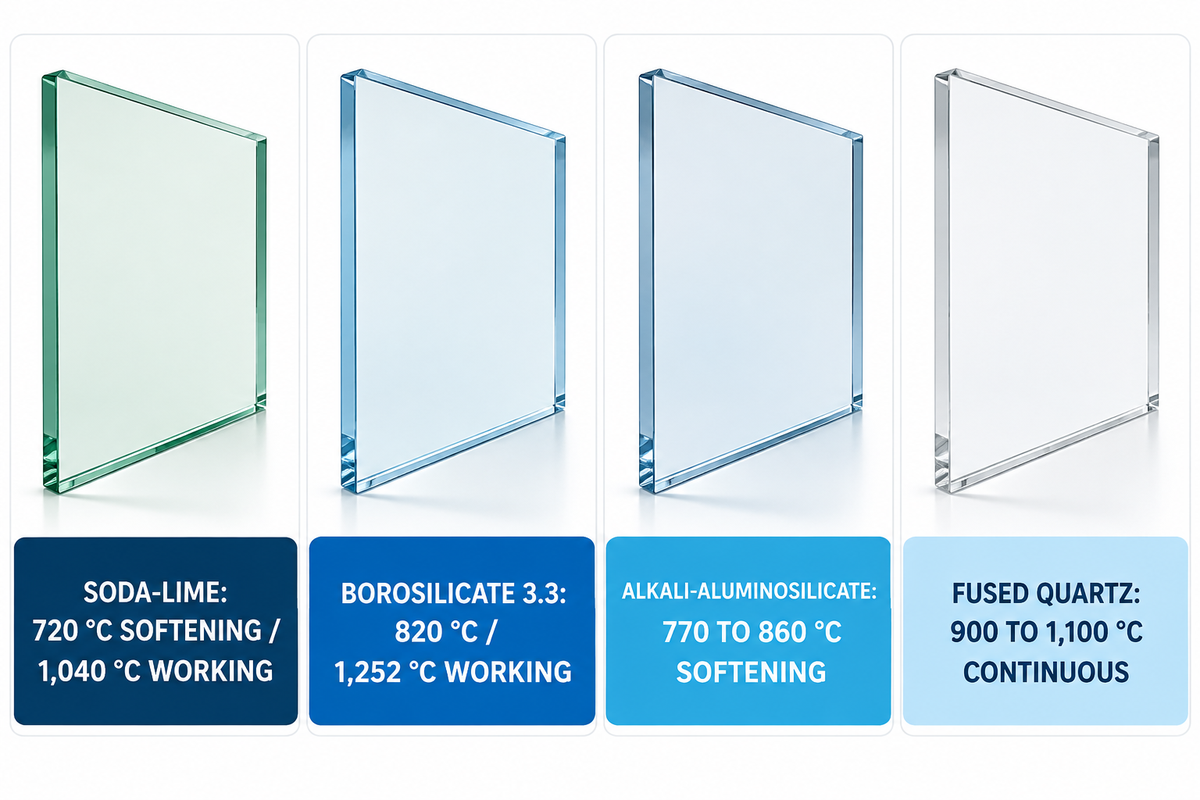
Across industrial optical substrates, borosilicate 3.3 sits between low-cost soda-lime glass and ultra-refractory fused silica. According to DWK Life Sciences, 3.3-expansion borosilicate glass softens at 820–821 °C and works at 1,252 °C. Standard soda-lime glass instead softens near 720 °C and works at 1,040 °C. Borosilicate 3.3 operates in a higher melting point regime than soda-lime while staying resistant to thermal shock, whereas fused quartz softens at 1,585–1,683 °C and works above 1,900 °C.
Comparing different glass types solely by glass melting point leads to expensive over-specification. Pure silica glass (quartz glass) delivers the highest softening point among transparent amorphous substrates. According to McDanel Advanced Ceramic Technologies, fused quartz can withstand continuous service up to 900-1,100 °C (depending on part size and shape). It can also withstand brief exposure to temperatures up to 1,400 °C with a ~0.55 × 10⁻⁶ K-1 CTE. McDanel notes borosilicate is typically 2 to 3 times more expensive than soda-lime material, and fused quartz is substantially more expensive than borosilicate.
Alkali-aluminosilicate cover glass is another silicate glass frequently compared with borosilicate. Touch-cover alkali-aluminosilicate exhibits a higher melting temperature and softening threshold (~770–860 °C) than soda-lime, with thermal expansion that differs from that of 3.3 borosilicate and low-expansion alkaline-earth aluminosilicates. Engineers specify alkali-aluminosilicate for thin handheld drop impact, as opposed to thick washdown viewports. Reviewing soda-lime float glass composition and thermal limits alongside the matrix below clarifies trade-offs across different glass families.
| Glass Type | Softening / Working Point | Max Service Temp & CTE | Choose When | Disqualification Boundary |
|---|---|---|---|---|
| Soda-Lime Float (Common Glass) | ~720 °C / 1,040 °C | ~56 °C (100 °F) cookware ΔT · ~9.0 × 10⁻⁶ K-1 | Indoor HMI displays, ambient guards, tight BOM cost | Disqualify where steep thermal shock or high-temperature process duty occurs |
| Borosilicate 3.3 (BOROFLOAT / DWK) | 820 °C / 1,252–1,270 °C | 450 °C unloaded (280 °C DIN 7080 continuous) · 3.3 × 10⁻⁶ K-1 | Process sight windows, 150–450 °C ovens, acid/washdown optics | Disqualify above 500 °C or when ≤1.1 mm cover needs >600 MPa CS |
| Alkali-Aluminosilicate Cover Glass | ~770–860 °C / ~1,180 °C | ~300–350 °C chemically strengthened · 7.5–8.5 × 10⁻⁶ K-1 | 0.55–2.0 mm handheld touchscreens needing 700–900 MPa CS | Disqualify touch-cover grades for >150 K quench on thick viewports |
| Fused Quartz / Fused Silica | 1,585–1,683 °C / >1,900 °C | 900–1,100 °C continuous (1,400 °C short) · 0.55 × 10⁻⁶ K-1 | Semiconductor RTP chambers, deep-UV optics, >500 °C ports | Higher substrate and machining cost when deep-UV, high purity, optical homogeneity, or sub-ppm CTE are not required |
| Zero-CTE Glass-Ceramic | Controlled crystalline phase | 700–850 °C · ~0.0 ± 0.15 × 10⁻⁶ K-1 | Wood-stove doors, burner sight ports, extreme thermal shock | Tinted cooktop grades disqualify when colorless optical clarity is required |
What Are the Key Differences Between Soft Glass and Borosilicate Glass?
Soda-lime “soft glass” works at 1,040 °C versus 1,252–1,270 °C for listed borosilicate 3.3 grades and expands nearly three times faster (~9.0 vs. 3.3 × 10⁻⁶ K-1). According to McDanel, borosilicate raw material costs roughly two to three times as much as standard soda-lime raw material. In lampworking and industrial glasswork, soft glass is the most common for window and bottle making. Sodium oxide lowers the processing temperatures, giving a relatively low melting point and lower melting viscosity, while calcium oxide improves durability. Because the working point of soda-lime glass sits lower, this lower melting point composition shapes at cooler working temperatures. Conversely, higher-melting borosilicate 3.3 tolerates steeper thermal gradients, while annealing schedules still depend on thickness, geometry, and temperature uniformity.
How Thermal Tempering, Ion Exchange, and 500 °C Frit Firing Interact with Thermal Limits
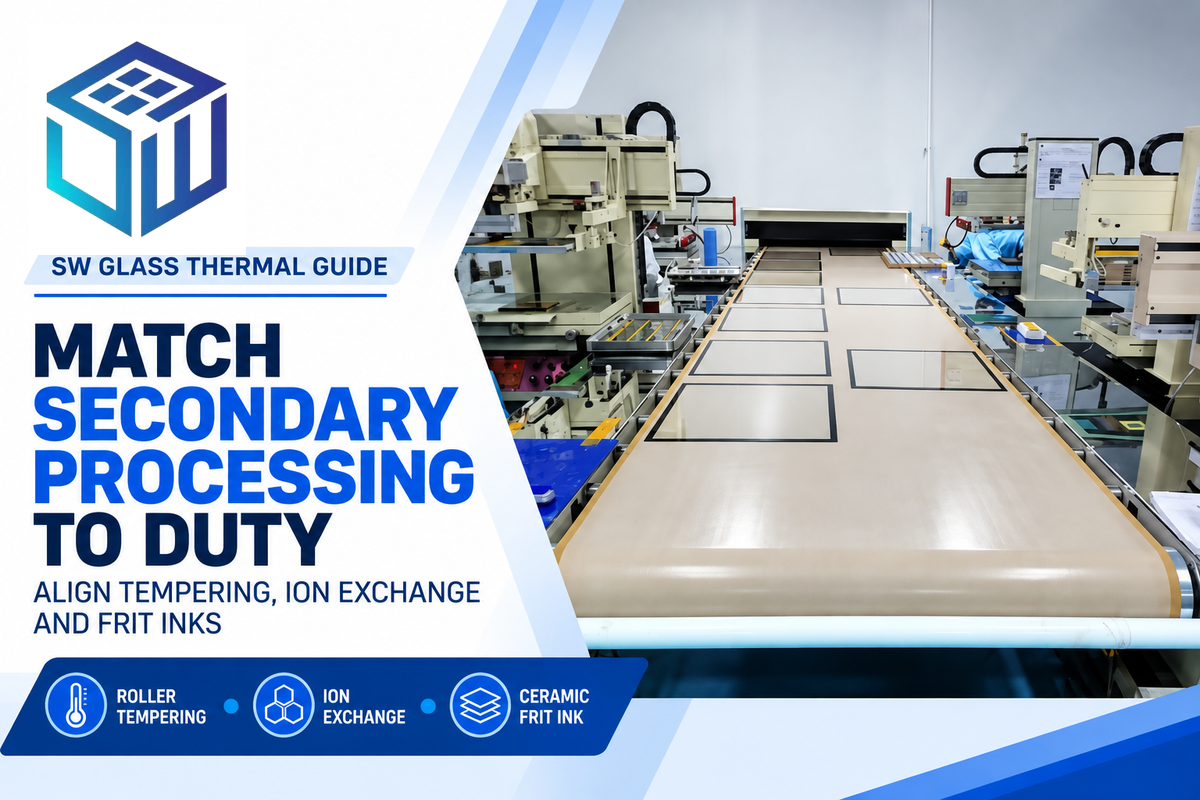
Both physical tempering and chemical ion exchange strengthen custom borosilicate glass products, yet low expansion and ~4% alkali narrow both process windows. On SW Glass production lines, horizontal roller tempering heats sheets ≥3.0 mm thick to 620–700 °C to lock in 80–150 MPa compression. For compatible ion-exchangeable borosilicate grades (rather than low-alkali 3.3), SW Glass KNO3 baths at 380–450 °C reach 200–350 MPa compression at 10–20 μm depth.
Why is air-quench tempering difficult for thin 1.1 mm or 2.0 mm borosilicate? Air-quench tempering relies on thermal contraction between the chilled skin and hot core as sheets exit the 620–700 °C furnace. Because borosilicate’s 3.3 × 10⁻⁶ K-1 CTE generates one-third the contraction strain of soda-lime, thin sheets cool uniformly without sufficient core-to-surface differential. At SW Glass in Dongguan, horizontal roller thermal tempering for glass panels 3 mm and thicker runs 4 to 8 minutes per furnace load across 3–19 mm stock. SW Glass reports roller-wave flatness within ≤0.10 mm per 300 mm and polarimeter surface-compression verification of ≥69 MPa on tempered lots.
For thin 0.7–3.0 mm instrument covers, potassium ion-exchange chemical strengthening immerses CNC-edged parts in ≥99% molten KNO3 at 380–450 °C (±2 °C) for 4 to 16 hours. Low-alkali 3.3 glass material offers far fewer mobile Na+ host sites than alkali-rich aluminosilicate. SW Glass fabrication data report 700–900 MPa surface compression (700 MPa typical on 0.55–1.1 mm covers) and 30–60 μm depth on aluminosilicate. Standard 3.3 responds minimally, whereas compatible ion-exchangeable borosilicate grades reach 200–350 MPa at 10–20 μm depth per SW Glass specifications.
Surface graphics and optical films must also match assembly heat. Organic epoxy or silicone screen inks yellow and peel above 150–200 °C. For oven windows, high-temperature ceramic frit silk-screen printing on industrial glass panels fires inorganic pigment into the sheet at 500 °C prior to final quench or annealing. According to SW Glass fabrication data, fired ceramic frit borders survive 300 °C thermal aging intact. When engineers form glass assemblies with sputtered anti-reflective (AR) coatings, operating heat must stay below the coating stack’s 250–350 °C film-crazing threshold.
| Secondary Process | Process Temp & Cycle | Thickness Window | SW Glass Borosilicate Benchmark | Post-Process Service Ceiling |
|---|---|---|---|---|
| Horizontal Roller Tempering | 620–700 °C · 4–8 min | 3.0–19.0 mm (≥3 mm min) | 80–150 MPa CS; ≤0.10 mm/300 mm wave | ≤300 °C (prevents stress relaxation) |
| Molten KNO3 Ion Exchange | 380–450 °C (±2 °C) · 4–16 h | 0.7–4.0 mm | SW Glass reports surface compression of 200–350 MPa and a depth of compression of 10–20 μm for its borosilicate ion-exchange process. On ion-exchangeable grades (SW Glass spec) | ≤250–280 °C (prevents K+ diffusion loss) |
| Ceramic Frit Silk-Screen | 500 °C+ kiln fuse | ≥2.0 mm (fired before quench or on annealed) | Permanent vitrified opaque bezel/scale | Survives 300 °C thermal aging (SW Glass spec) |
| Organic Epoxy / Silicone Ink | 150–180 °C bake | 0.5–25.0 mm | Crisp multi-color Pantone graphics | ≤150–200 °C (discolors at higher heat) |
| Multi-Layer Sputtered AR Coating | Vacuum PVD (<250 °C) | 0.5–15.0 mm | Boosts visible transmission from ~91% to 97% | ≤250–350 °C (CTE film-crazing threshold) |
Industrial Sight Windows, Lampworking Flames, and Steam Corrosion Boundaries
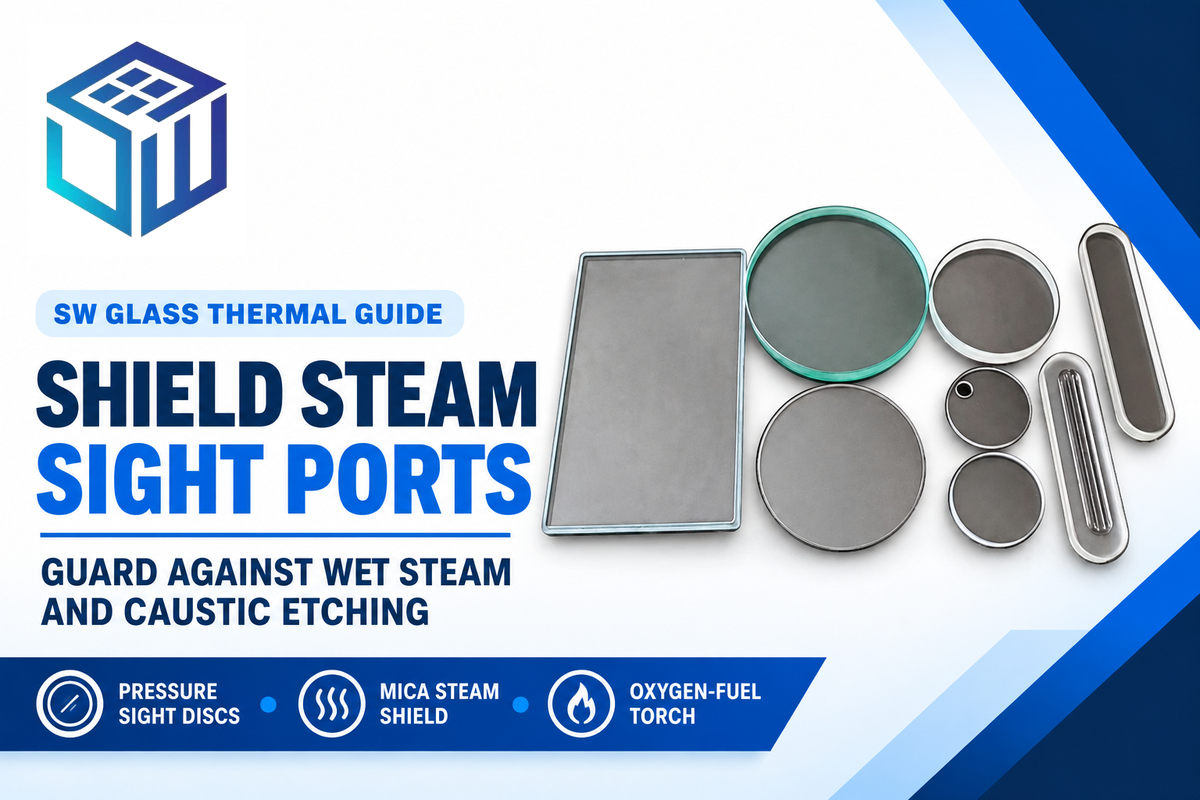
Pressurized sight windows, boiler gauges, and lampworking setups hit the wet-chemical and heat-flux limitations before dry thermal softening. DIN 7080:2025-05 governs borosilicate 3.3 sight glass discs in process vessels and pipework, capping continuous service at 280 °C. According to Precision Glass, pressure ratings depend on the disc’s diameter-to-thickness ratio, not on material grade alone. Wet saturated steam above 243 °C requires protective mica shields, and thick-wall 3.3 lampworking uses oxygen-fuel flames.
Across industrial applications of borosilicate glass, engineers pair dry heat stability with high optical clarity. Evaluating optical light transmittance across glass thickness helps optical teams match uncoated 3.3 windows (~91–92% visible transmittance) or AR-coated windows (up to 97%) to pyrometers and cameras. In pharmaceutical and chemical applications of borosilicate, glass-grain hydrolytic testing follows BS ISO 719:2020 at 98 °C alongside ISO 720 grain testing at 121 °C. BS ISO 719:2020 harmonized sample and mesh parameters with European Pharmacopoeia chapter 3.2.1 and USP chapter 660, while finished containers require separate pharmacopoeial surface qualification.
On the lampworking bench, high melting borosilicate 3.3 tubing (governed by ISO 4803:2021) behaves very differently from low melting soft-glass cane. Because Type 3.3 combines a high melting point regime with stiff working viscosity, flame heat flux governs joint quality. Hardware-store air-propane torches reach an adiabatic peak near 1,995 °C, yet low convective heat transfer struggles to bring 5–15 mm walls into the 1,252–1,270 °C working-point range before radiation bleeds heat away. Prolonged underheating promotes surface cristobalite devitrification and cold-seal cracks, whereas oxygen-fuel torches (~2,500 °C) supply higher heat flux.
What Are the Downsides of Borosilicate Glass in Caustic Steam or Thin Impact Designs?
In hot concentrated alkaline solutions, hydroxide ions cleave Si–O–Si bonds in the glass. Despite top-class water and acid resistance, the chemical resistance of borosilicate glass drops to moderate Class A2 alkali durability (per DWK Life Sciences) in hot concentrated caustic solutions. Inside unshielded boiler drums carrying >243 °C wet saturated steam or hot alkaline wash lines, hydroxide ions cleave Si–O–Si bonds. Rapid alkaline etching pits the glass and thins the disc. A mica shield can help protect the glass from rapid etching. Weighing the chemical resistance of borosilicate alongside low-alkali 3.3 strengthening limits clarifies substrate selection. Thin 0.8 mm drop covers favor alkali-aluminosilicate, while designs whose glass body exceeds BOROFLOAT 33’s 500 °C short-cycle rating evaluate fused quartz or glass-ceramic.
Specifying Custom Borosilicate Components: Raw Melters vs. OEM Fabricators, Cost Drivers, and RFQ Checklist
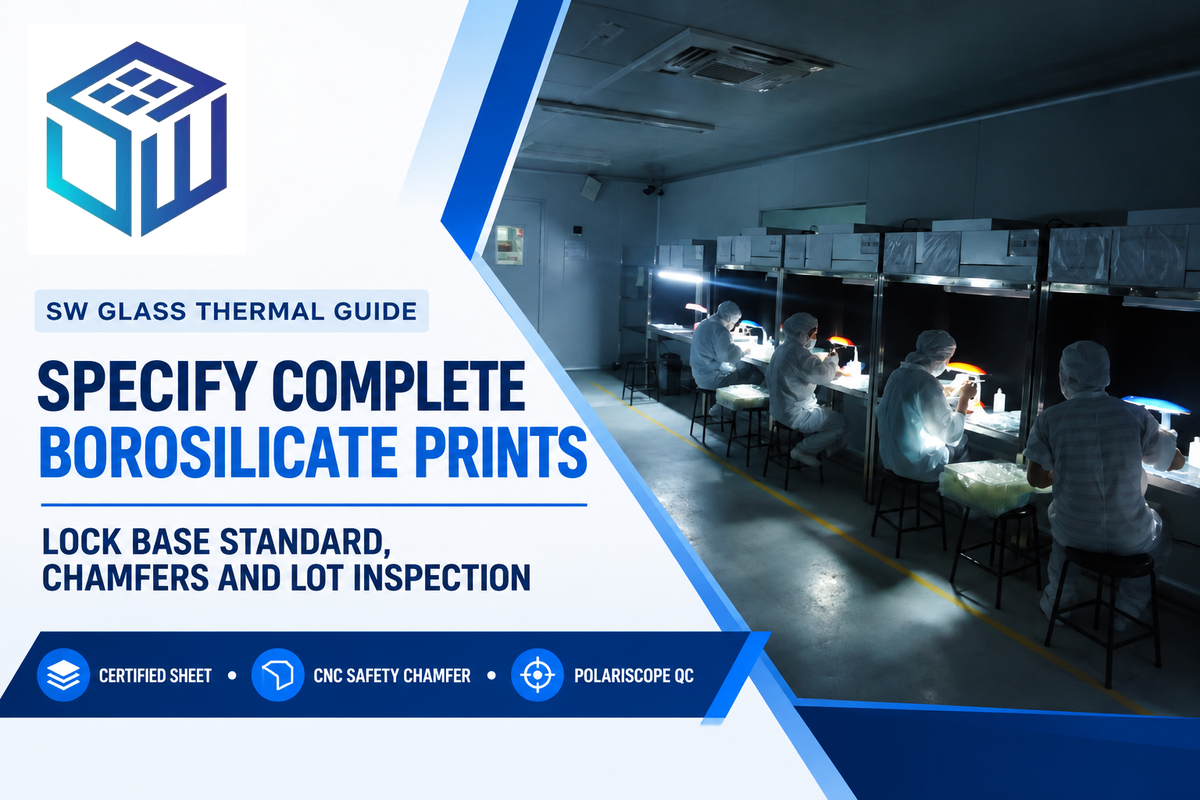
Primary float melters and high-end CNC machine shops are on different tiers of the glass manufacturing industry. Upstream specialty glass producers melt batches in high-temperature tanks and ship stock sheets or tubing. OEM fabricators like SW Glass machine purchased ISO 3585 / ASTM E438 sheets to ±0.05 mm CNC contour tolerances across 0.5–25 mm thicknesses. Batch lead times depend on the geometry and are quoted upon request.
What causes the higher cost of borosilicate over soda lime? In primary glass manufacturing, standard float furnaces flux silica sand with sodium carbonate (soda ash) for lower-temperature melting. Increasing the melting temperature of the glass for low-alkali 3.3 glass production demands refractory electrodes, specialized tank linings, and purified borates as opposed to low-cost soda ash. Harder borosilicate networks also require slower diamond CNC feeds, so custom parts are quoted per drawing by holes, polish, strengthening, and MOQ.
Supply-chain roles stay distinct: Dongguan Saiwei Glass Co., Ltd. (SW Glass) does not operate raw glass melting tanks. Instead, our 5,000 m2 ISO 9001 facility converts certified 0.5–25 mm float sheets up to 1,500 × 1,000 mm. In-house lines handle CNC edging, drilling, strengthening, 500 °C ceramic frit printing, and cleanroom optical coating. Every lot undergoes in-house scattered-light polariscope and dimensional quality inspection across 20+ instruments, including ±2 μm video metrology, haze meters, 1.2-meter ball-drop, and 500-hour salt-spray tests.
| RFQ Drawing Field | Recommended Callout on Print | Defect Prevented if Omitted |
|---|---|---|
| 1. Base Glass Standard | ISO 3585 / ASTM E438 Type I Class A (CTE 3.3 × 10⁻⁶ K-1) + mill cert | Substitution of higher-expansion medium-borosilicate or soda-lime glass |
| 2. Sheet Formation Route | Micro-float optical sheet (0.5–25 mm) vs. ground/polished rolled block | Striation distortion in camera, laser, or pyrometer sight paths |
| 3. Dimensional & Thickness Tol. | Supplier-specified stock thickness tolerance; SW Glass reports ±0.05 mm CNC contour tolerance | Unnecessary double-sided lapping charges on non-optical faces |
| 4. Edge & Chamfer Finish | CNC fine ground or polished C-edge / safety chamfer (0.2–0.5 mm × 45°) | Thermal-shock crack initiation from raw score-and-break micro-fissures |
| 5. Strengthening Method | Annealed (>300 °C) vs. roller tempered (≥3 mm, 80–150 MPa) vs. KNO3 (ion-exchangeable grades only) | Ordering impossible air-temper on <3 mm parts or losing stress >300 °C |
| 6. Thermal & Chemical Duty | Continuous/peak °C, quench ΔT, pressure differential, steam or caustic exposure | Missing mica shield in >243 °C steam or PTFE gasket creep under pressure |
| 7. Ink & Optical Coating Stack | 500 °C ceramic frit vs. organic ink (≤180 °C); uncoated vs. sputtered AR/AF | Peeling bezel graphics or crazed AR layers after first oven cycle |
| 8. Inspection & Lot Traceability | Lot-linked polariscope stress report, CMM dimensional report, scratch-dig grade, MOQ | Residual birefringence in optical paths or unplanned small-lot fixture fees |
Borosilicate Supply Chain Outlook: High-Temp Melting Capex, Boron Feedstock Concentration, and Packaging Substrates
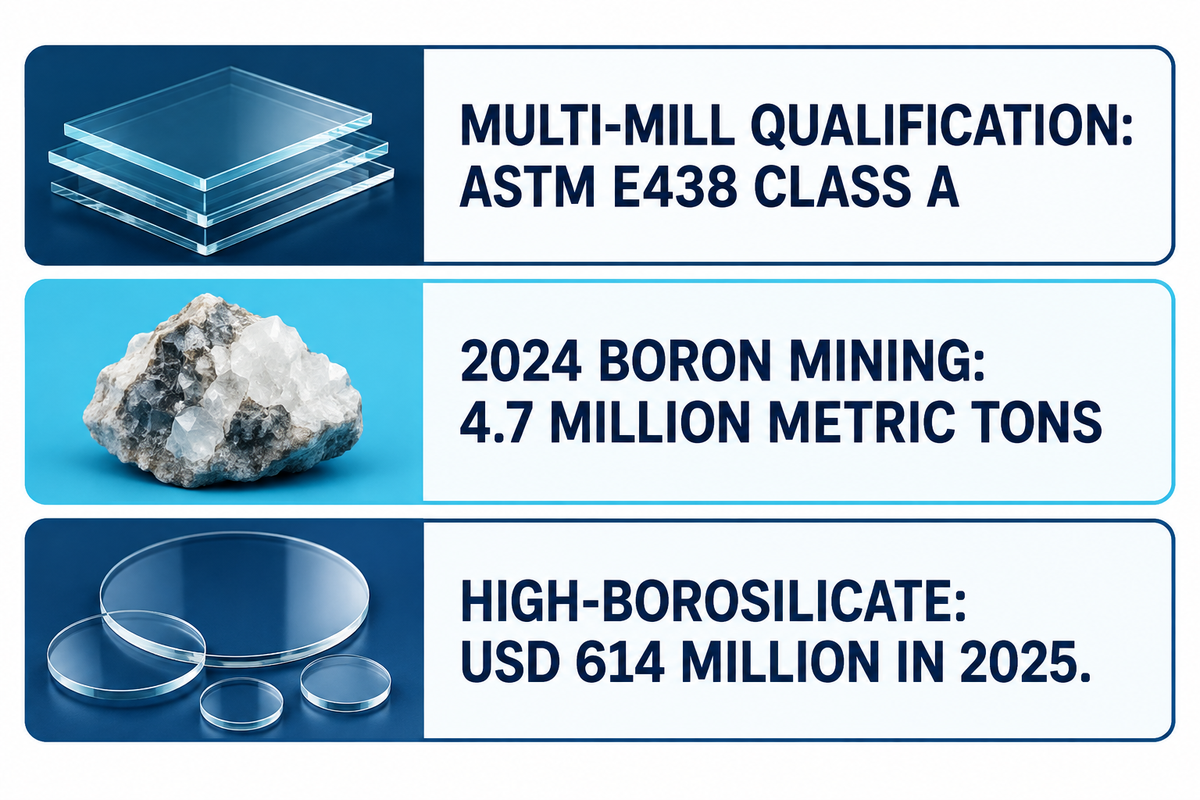
Dual-sourcing qualified European and Asian ISO 3585 float mills has become standard procurement practice. Cross-regional pharmaceutical and industrial buyers can qualify multi-mill supply against ASTM E438 Type I Class A specifications. Newer melting lines in Asia have expanded the baseline sheet supply, but the upstream boron mining and cleanroom float capacity remain concentrated. According to Procurement Resource, global borosilicate glass markets remained stable to firm in H1’26 as pharmaceutical packaging demand strengthened while ongoing capacity additions prevented severe supply tightness.
Upstream feedstock geography explains why baseline pricing stays firm despite furnace additions. Market Reports World notes that over 14 new Chinese plants built in 2023 and early 2024 added more than 740,000 metric tons of annual capacity. In the same 2024 baseline, global boron mining output was 4.7 million metric tons, which was primarily from Turkey and the U.S.
Published market valuations reflect product boundary definitions. As reported by Grand Research Store, the global high-borosilicate glass market was valued at USD 614 million in 2025 and is projected to reach USD 997 million by 2034 at a CAGR of 7.3% (averaging USD 3,200 per ton in 2025). Broader scope definitions led IG Transformation Partners to value the global borosilicate market at USD 2.7 billion in 2025 (projecting USD 4.3 billion by 2034). In advanced semiconductor packaging, 36Kr reported TSMC began 5.5-reticle CoWoS production in 2026, ahead of planned 14-reticle generation in 2028.
Frequently Asked Questions
Can a standard propane or MAPP gas plumbing torch melt borosilicate glass?
For standard 3.3 rods and tubing, no, a hardware air-propane or MAP-Pro plumbing torch lacks sufficient convective heat flux. Plumbing flames can barely sag hair-thin borosilicate stringers or capillary walls. Lampworkers generally use higher-heat-flux oxygen-fuel torches to reach the 1,252–1,270 °C working-point range of ISO 3585 borosilicate tubing, while seal quality still depends on flame chemistry and heating control.
Why is borosilicate glass more expensive than standard soda-lime float glass?
Low-alkali borosilicate 3.3 melts hotter than standard soda-lime float glass and requires refractory electrodes, specialized zirconia or platinum tank linings, and purified boron trioxide feedstocks instead of inexpensive soda ash. Downstream CNC grinding, edge polishing, setup, and strengthening add fabrication costs to finished parts. Thus, custom parts are quoted per engineering drawing.
Can you pour boiling water directly into borosilicate glass without cracking it?
Yes, pouring 100 °C boiling water into room-temperature (20 °C) borosilicate 3.3 creates an 80 K temperature step, sitting below the 160 °C differential limit Corning specifies for a 3.2 mm annealed PYREX sample. Cracking risk still depends on wall thickness, local thermal gradients, surface or rim micro-flaws, freezer pre-chilling, wet cold countertops, and rigid mechanical flange restraint.
How can incoming quality control verify whether an unmarked glass sheet is true borosilicate 3.3?
Incoming metrology teams run two rapid non-destructive checks alongside the mill certificate: Archimedes density and refractive index. True ISO 3585 borosilicate 3.3 measures 2.23 g/cm3 in density and nd = 1.474 in refractive index. Those two readings cleanly separate 3.3 sheet from soda-lime float glass (2.50 g/cm3, nd = 1.52) without cutting dilatometer bars.
Does borosilicate glass leach BPA, lead, or microplastics when heated?
Uncoated ISO 3585 borosilicate 3.3 is an inorganic silicate-borate solid with zero organic polymers, so the base glass contains no BPA and sheds no polymer microplastics. Trace heavy-metal extractables such as lead or cadmium are not automatically zero from base glass classification alone and require finished-product migration testing, especially on printed or rim-decorated ware.
At what kiln temperature does flat borosilicate 3.3 glass slump or hot-bend?
Gravity mold slumping and precision hot-bending of flat borosilicate 3.3 run between 650 °C and 780 °C. That window sits above the 560 °C annealing point yet stays safely below the 820 °C Littleton softening point where glass sticks to molds. After forming, parts soak near 560 °C and cool at thickness-controlled rates past 510 °C.
Can borosilicate glass be recycled in standard municipal glass streams?
No, keep borosilicate cullet separate from curbside bottle and jar recycling streams. Borosilicate’s ~1,648 to 1,680 °C tank melting and fining range is well above the operating temperature of standard municipal soda-lime container-glass furnaces. Undissolved borosilicate fragments are refractory and solid within bottle tanks, and alter local viscosity and thermal expansion in newly made beverage containers. Industrial borosilicate 3.3 offcuts can instead be sorted by grade at the fabricator and diverted to dedicated technical cullet processors or fiberglass insulation melt streams where accepted.
Engineering Review & Test Boundary Disclosure
Reviewed by the Dongguan Saiwei Glass Co., Ltd. (SW Glass) optical and thermal processing engineering team. Listed viscosity benchmarks reflect ISO 3585, ASTM E438, ASTM C336, and ASTM C338 laboratory tests on unmounted specimens. Assembly pressure and temperature ratings follow part thickness, edge finish, gasket compliance, and media chemistry.
Do you need CNC-machined, thermally tempered, chemically strengthened, or ceramic-frit printed Type 3.3 viewports built to your STEP/DXF prints? See our custom borosilicate 3.3 sheets and fabrication tolerances for thickness options, then submit an engineering drawing for batch feasibility review.
References & Sources
- International Organization for Standardization ISO 3585:1998 Borosilicate glass 3.3, Properties
- ASTM International – ASTM E438 Standard Specification for Glasses in Laboratory Apparatus
- ASTM International (via iTeh Standards) – ASTM C336-71(2020) Standard Test Method for Annealing Point and Strain Point of Glass by Fiber Elongation
- BSI Knowledge BS ISO 719:2020 Glass: Hydrolytic Resistance of Glass Grains at 98 °C, Method of Test and Classification
- The American Ceramic Society (ACerS) – Hell’s Kitchen: Thermal Stress and Glass Cookware That Shatters
- Corning Incorporated (Life Sciences) – PYREX vs. pyrex: What’s the Difference?
- SCHOTT AG – Borosilicate Glass Material Science & Technical Properties