Get in Touch with Saiweiglass
Physical Properties of Glass: Mechanical, Thermal, Optical & Chemical Engineering Guide

Executive Summary: The physical properties of glass are governed by its disordered silicate network and its post-forming surface treatment. According to standard silicate glass property datasets, glass is an amorphous solid with a density of 2.20 to 2.54 g/cm³ and a Young’s modulus of 64 to 85 GPa. It exhibits a Knoop hardness of 480 to 619 kg/mm², a refractive index of 1.458 to 1.520, and a visible light transmittance of 89% to 98% as reported by optical glass benchmarks. Bulk constants such as density, elastic modulus, and the coefficient of thermal expansion depend strictly on chemical composition. These constants vary predictably across soda-lime, borosilicate 3.3, aluminosilicate, and fused silica families. Conversely, practical flexural strength shifts from 40–70 MPa in annealed glass to 600–900 MPa after molten potassium nitrate chemical strengthening.
- Composition locks bulk constants: Neither thermal tempering nor chemical ion exchange affects density, Young’s modulus (64-85 GPa) or thermal expansion.
- Thermal shock follows expansion: Fused silica (0.55 × 10⁻⁶ /K) and borosilicate 3.3 (3.25 × 10⁻⁶ /K) survive severe thermal gradients. Standard soda-lime float glass (8.6–9.0 × 10⁻⁶ /K) fractures at a 40–50 °C quench.
- Optical clarity requires surface engineering: According to optical inspection data from SW Glass, low-iron glass paired with multi-layer anti-reflective vacuum coatings raises visible light transmission from 89%–90% to 95%–98%.
- Touch sensitivity tracks permittivity: Aluminosilicate (εr = 7.25 at 1 MHz) and soda lime glass (εr = 7.5) provide more capacitive coupling. Both perform better than borosilicate 3.3 (εr = 4.6) for thick touch panels.
What Are the Core Physical Properties of Glass Across Major Substrate Families?
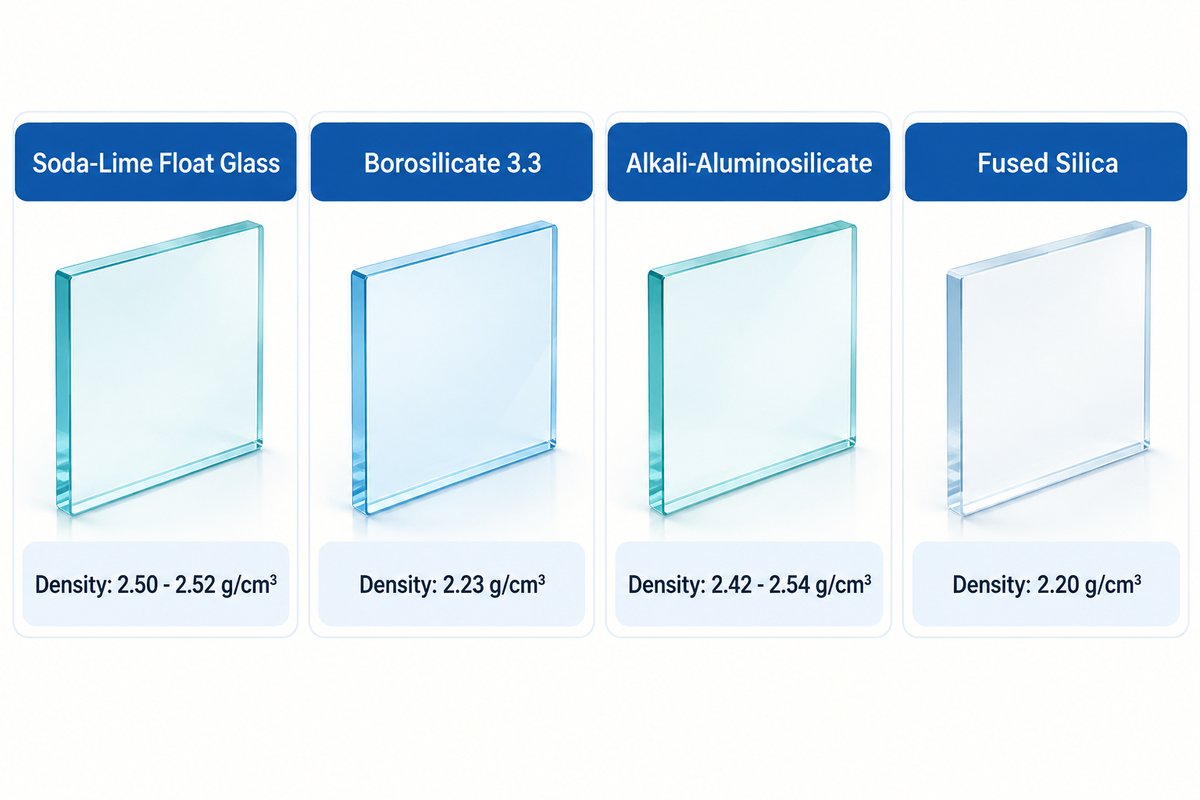
The core physical properties of glass span four industrial substrate families: soda-lime float glass, borosilicate 3.3, alkali-aluminosilicate, and fused silica. Bulk density ranges from 2.20 to 2.52 g/cm³, and Young’s modulus is between 64 and 73 GPa for standard grades. Linear thermal expansion is between 0.55 × 10⁻⁶ to 9.0 × 10⁻⁶ /K, and refractive index is between 1.458 and 1.520. For mechanical load, thermal gradient, and optical wavelength requirements, hardware engineers evaluate and select a specific type of glass.
In industrial glass manufacturing, silicon dioxide (SiO2) forms the primary tetrahedral network. Pure silica has a high melting temperature and softens at 1,683 °C (see reference glass tables). Working viscosity is reduced with the addition of network modifiers such as sodium oxide (Na₂O), calcium oxide (CaO), boron trioxide (B₂O₃) and aluminum oxide (Al₂O₃). These additives create the different glass families with versatility. Whether the engineers request glass as a building material or as a precision optical viewport, modifier ions fill the interstitial voids of the silica lattice. Atomic packing of this structure controls density, refractive index, thermal expansion and electrical conductivity (see U.S. Department of Energy OSTI silicate glass property records).
While evaluating our glass material composition and selection guide, engineering teams evaluate twelve inter-related parameters before finalizing an enclosure drawing. The information in the matrix below is a consolidation of vetted benchmark data from Abrisa Technologies’ Physical property Tables and international glass testing standards.
| Physical Property (Unit & Standard) | Soda-Lime Float Glass | Borosilicate 3.3 (Borofloat 33) | Alkali-Aluminosilicate (Gorilla / Industrial) | Fused Silica (Pure SiO₂) |
|---|---|---|---|---|
| Density, ρ (g/cm³) | 2.50 – 2.52 | 2.23 | 2.42 – 2.54 | 2.20 |
| Young’s Modulus, E (GPa) | 70 – 72 | 64 | 71 – 85 | 72 – 73 |
| Poisson’s Ratio, ν (dimensionless) | 0.22 | 0.20 | 0.21 – 0.24 | 0.16 – 0.17 |
| Knoop Hardness, HK (kg/mm², ISO 9385) | 585 | 480 | 619 | 500 |
| Annealed Flexural Strength (MPa, ASTM C158) | 40 – 55 | 50 – 65 | 60 – 70 | 50 – 65 |
| Strengthened Surface Compression (MPa) | 90 – 150 (Thermal) / 300 – 500 (Chem) | 90 – 120 (Thermal) | 600 – 900 (KNO₃ Chemical) | Not ion-exchangeable |
| Linear CTE, α (× 10⁻⁶ /K, 0–300 °C, ISO 7991) | 8.6 – 9.0 | 3.25 – 3.30 | 7.5 – 8.8 | 0.55 |
| Strain Point / Softening Point (°C) | 523 / 724 | 518 / 820 | 600 / 850 | 1070 / 1683 |
| Thermal Shock Survival, ΔT (°C, 3 mm sheet) | 40 – 50 | 160 | 100 – 120 (Annealed) | > 800 |
| Refractive Index, n_d (587.6 nm) | 1.517 – 1.520 | 1.472 – 1.473 | 1.500 – 1.510 | 1.458 |
| Hydrolytic Durability (ISO 719 Class) | Class HGB 3 | Class HGB 1 | Class HGB 1 – HGB 2 | Class HGB 1 |
| Dielectric Constant, ε_r (at 1 MHz) | 7.5 | 4.6 | 7.25 | 3.8 |
Density, Specific Gravity, and Panel Weight Calculation (2.20 to 2.54 g/cm³)
Density measures mass per unit volume. It directly dictates assembly weight in portable medical tablets, avionics cockpits, and marine bridge consoles. According to EAG Laboratories glass physical property benchmarks, fused silica has a density of 2.20 g/cm³ and borosilicate 3.3 sits at 2.23 g/cm³. Their open tetrahedral frameworks contain fewer heavy interstitial modifier ions. Consequently, they’re 11% to 12% lighter than standard soda-lime float glass (2.50–2.52 g/cm³) and aluminosilicate glass (2.42–2.54 g/cm³).
Mechanical engineers calculate cover lens mass using a straightforward dimensional equation: Panel Mass (kg) = Area (m²) × Thickness (mm) × Density (g/cm³). Consider a 1.0 m² marine glazing panel at 6.0 mm thickness. It weighs 15.12 kg in soda-lime glass (2.52 g/cm³), but only 13.38 kg in borosilicate 3.3 (2.23 g/cm³).
Is Glass an Amorphous Solid or a Supercooled Liquid at Room Temperature?
Glass is an amorphous solid at room temperature, not a flowing supercooled liquid. Below its glass transition temperature (518 °C to 600 °C for commercial silicate glasses), viscosity exceeds 10¹² Pa·s. This extreme viscosity locks every silicon and oxygen atom into a rigid non-crystalline network with zero measurable flow over human timescales.
It’s a myth that antique cathedral windows are thicker at the bottom because glass flows over time. Hand made crown and cylinder glass is heavier at the edge and lighter in the center. Structural integrity of the window demanded that the heavier edge be installed at the bottom of the frame. According to a peer-reviewed Materials (Basel) solid dielectric research, glass behaves as a true elastic solid when it cools through its transformation range. Once this occurs, thermal expansion no longer happens.
Mechanical Properties of Glass: Elasticity, Surface Hardness, and Fracture Strength
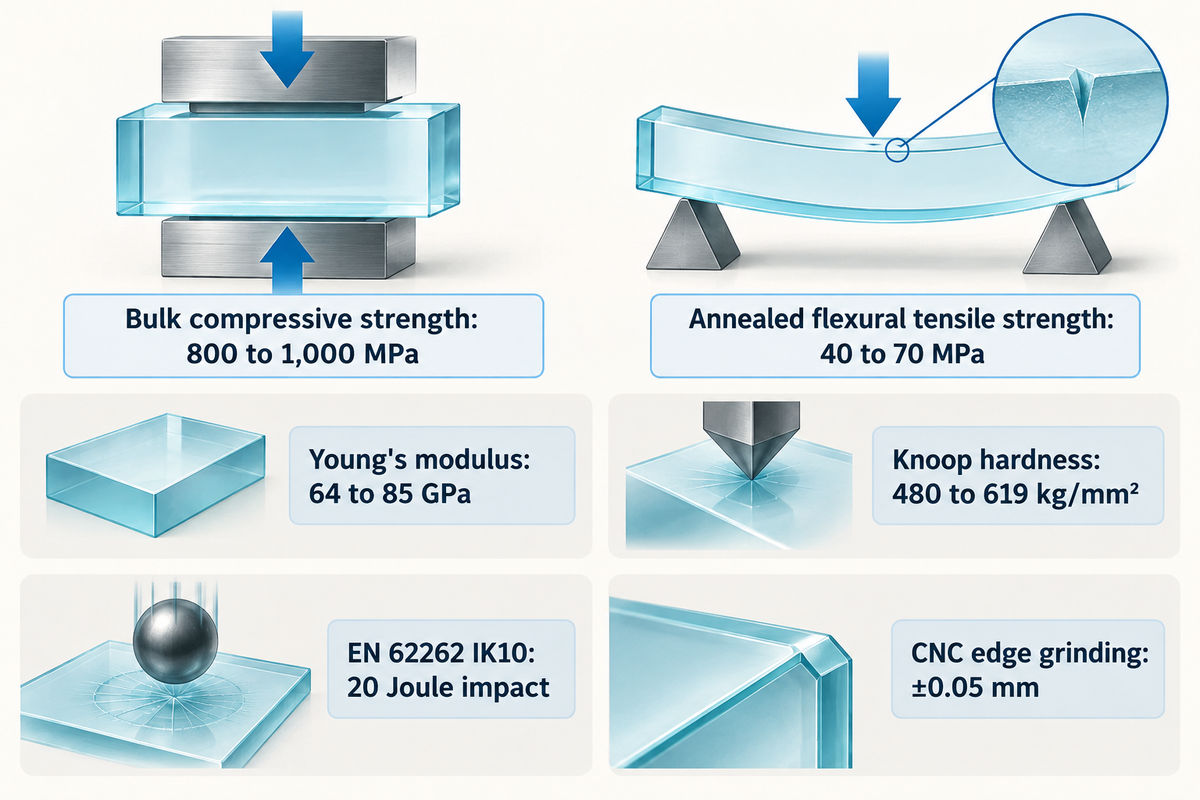
Glass exhibits extreme mechanical asymmetry. Its intrinsic bulk compressive strength reaches 800 to 1,000 MPa, but annealed flexural tensile strength sits at only 40 to 70 MPa under ASTM C158 bending tests. Because glass is a brittle, non-crystalline material with zero dislocation plasticity, microscopic Griffith surface flaws concentrate tensile stress and trigger brittle fracture. Meanwhile, elastic stiffness (Young’s modulus) spans 64 GPa in borosilicate 3.3 to 72 GPa in float glass and 71–85 GPa in aluminosilicate substrates.
Study of these main characteristics of glass has revealed the reasons for structural failures in pressurized sight windows and outdoor touchscreens. Though glass has a high surface hardness (hard material), surface tension cracks (brittleness) propagate rapidly when the glass is bent, even with a minor edge nick. Thus the bulk compressive strength (800-1,000 MPa) of glass is never used to support cantilevered or flexing panels in practice. It’s assumed that surface cracks (micro-cracks) govern the strength and failure of such structures.
Young’s Modulus (63–85 GPa), Poisson’s Ratio, and Compressive vs. Tensile Asymmetry
Young’s modulus of elasticity (E) defines how much a glass panel deflects elastically under an applied load before returning to its flat state. Standard soda-lime float glass has a modulus of 72 GPa and a Poisson’s ratio of 0.22. Borosilicate 3.3 is slightly more compliant at 64 GPa (ν = 0.20). In contrast, fused silica measures 73 GPa (ν = 0.16), and alkali-aluminosilicate glass reaches 71 to 85 GPa (ν = 0.21–0.24).
Poisson’s ratio (ν) is the measure of transverse contraction strain relative to longitudinal extension strain. When an operator presses a 1.1 mm industrial touchscreen lens, a higher modulus reduces center deflection. This stiffness protects the underlying liquid crystal display from pooling distortion. If the display panel shows excessive elastic flex during stylus input, engineers need to increase the thickness of the substrate (since stiffness scales with t³) or use a higher modulus aluminosilicate glass.
Mohs, Vickers (HV), and Knoop (HK) Hardness Scales Compared
Surface hardness determines scratch and abrasion resistance against windblown quartz sand, metal keys, and industrial cleaning tools. Field technicians often cite the qualitative Mohs scale (5.5 Mohs for standard soda-lime versus 6.0–6.5 Mohs for aluminosilicate). However, laboratory quality control relies on ISO 9385 Knoop microhardness (HK) and Vickers hardness (HV).
In Knoop indentation testing, a rhombic diamond indenter presses into the glass surface under a defined load. Standard float glass measures 585 kg/mm² Knoop hardness, while borosilicate 3.3 records 480 kg/mm² and fused silica reaches 500 kg/mm². Chemically strengthened aluminosilicate glass achieves 619 kg/mm² (approximately 530 to 750 HV across commercial grades). Airborne silica dust sits at 7.0 Mohs. Therefore, un-strengthened soda-lime lenses scratch easily in desert or marine environments unless protected by ion exchange or hard oxide coatings.
Impact Energy and EN 62262 IK10 Ball-Drop Survival
High impact resistance against applied load imposes both elevated surface compression and flawless edge geometry. Under EN 62262 IK10 testing, a cover glass assembly must withstand a 20 Joule kinetic impact, which is equal to a 5.0 kg steel mass dropped from 400 mm. In our analysis of IK10 impact testing for HMI cover glass assemblies, we illustrate how impact waves travel outward and reflect off the perimeter edges.
If the perimeter contains score-and-break micro-fissures, edge tensile stress shatters the panel well below 20 J. Precision computer numerical control (CNC) edge grinding to a ±0.05 mm dimensional tolerance with a polished C-chamfer removes these sub-surface flaws prior to strengthening.
Thermal Properties of Glass: Thermal Expansion (CTE), Conductivity, and Thermal Shock
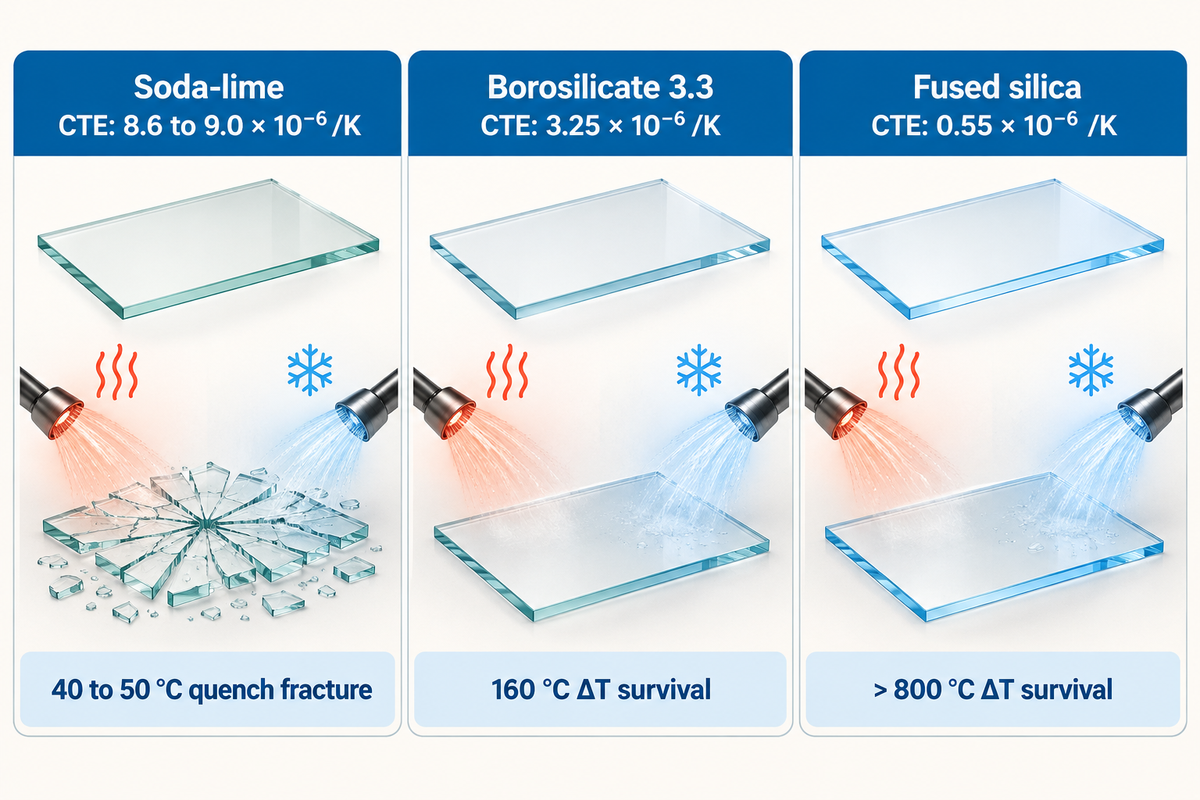
Thermal shock survival in glass is governed primarily by its linear coefficient of thermal expansion (CTE, α over 0–300 °C per ISO 7991). Standard soda-lime float glass (α = 8.6 to 9.0 × 10⁻⁶ /K) fractures under a sudden 40 to 50 °C cold-water quench. Conversely, borosilicate 3.3 (α = 3.25 × 10⁻⁶ /K) withstands 160 °C differentials. Fused silica (α = 0.55 × 10⁻⁶ /K) survives rapid thermal shock exceeding 800 °C.
Different from metals, glass is a poor conductor of heat, with thermal conductivity between 0.80 and 1.38 W/(m·K) at room temperature. Low conductivity results in good insulating behavior of glass in architectural glazing. It, however, results in steep temperature gradients during rapid cooling. This is especially true for IG Units with thicker spacers. In practice, thermal shock ΔT ratings decline as panel thickness increases. A 6 mm sight glass allows for a smaller ΔT than a 3 mm test coupon.
| Substrate Family | Linear CTE, α (0–300 °C, × 10⁻⁶ /K) | Strain Point (°C) | Softening Point (°C) | 3 mm Cold Quench ΔT Survival (°C) |
|---|---|---|---|---|
| Soda-Lime Float Glass | 8.60 – 9.00 | 523 | 724 | 40 – 50 (Annealed) / 150 – 180 (Tempered) |
| Alkali-Aluminosilicate | 7.50 – 8.80 | 600 | 850 | 100 – 120 (Annealed) / 250+ (Strengthened) |
| Borosilicate 3.3 | 3.25 – 3.30 | 518 | 820 | 160 (Annealed) / 260 (Tempered) |
| Fused Silica (SiO₂) | 0.55 | 1070 | 1683 | > 800 |
Why Does Coefficient of Thermal Expansion (CTE) Control Thermal Shock Failure?
The coefficient of thermal expansion controls thermal shock failure, since transient surface tensile stress is directly proportional to the CTE. This relationship is described by the thermo-elastic equation, σ = (E · α · ΔT) / (1 − ν). When cold water hits a hot glass lens, the chilled outer skin attempts to shrink while the hot core resists contraction, generating destructive surface tension.
As documented in Glass Technology Services thermal breakage failure analysis, when heated, the top surface of glass panels goes into compressive stress, which glass can easily withstand. Rapid cooling puts glass in tensile stress, which glass can’t handle and results in breakage. Soda-lime glass expands nearly three times more per degree Celsius than borosilicate glass (8.6 × 10⁻⁶ /K versus 3.25 × 10⁻⁶ /K). Therefore, a 50 °C cold spray produces tensile stress that exceeds the 40–55 MPa strength limit of annealed glass. Selecting borosilicate 3.3 or fused silica provides excellent thermal stability for outdoor LED floodlights and autoclave sight windows.
Viscosity Reference Temperatures: Strain Point, Tg, Annealing Point, and Softening Point
Since non-crystalline silicate materials don’t have a sharp phase-change melting point, standards define four viscosity reference temperatures to bound safe heat resistance:
- Strain Point (viscosity ≈ 10¹³·⁵ Pa·s): 523 °C for float glass, 518 °C for borosilicate 3.3, and 1,070 °C for fused silica. Internal stress relaxes in several hours; maximum continuous mechanical service must stay well below this threshold.
- Glass Transition Temperature, Tg (≈ 10¹² Pa·s): The temperature where the solid network starts to transition to a viscoelastic supercooled melt.
- – Annealing Point (≈ 10¹² Pa·s): Internal stresses relieve within minutes during kiln cooling.
- Softening Point (≈ 10⁶·⁶ Pa·s): 724 °C for float glass, 820 °C for borosilicate 3.3, 850 °C for Gorilla aluminosilicate, and 1,683 °C for fused silica. At this temperature, glass deforms rapidly under its own weight or inside a forming mould.
Optical Properties of Glass: Refractive Index, Transmittance, Dispersion, and Coatings
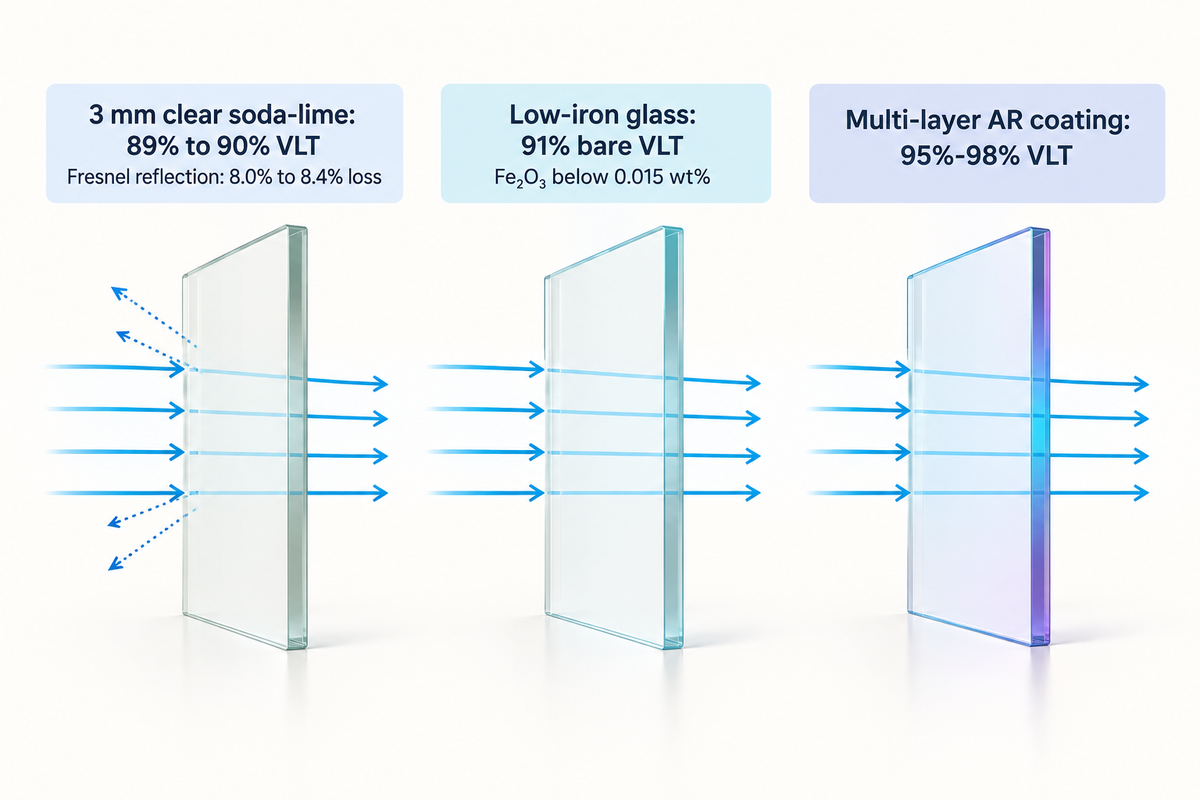
The optical properties of glass determine how efficiently a substrate can transmit light across ultraviolet, visible, and infrared wavelengths without distortion. According to spectrophotometer testing data from SW Glass, standard 3 mm clear soda-lime glass achieves 89% to 90% visible light transmittance (VLT) due to a refractive index of 1.52 and trace iron oxide absorption. Switching to low-iron glass raises bare transparency to 91%, and applying multi-layer anti-reflective coatings elevates total light transmission to 95%–98%.
Window glass is typically transparent to human vision (380 to 780 nm). However, machine sensors also use diffusion or absorption patterns such as translucent etched diffusers or opaque black ceramic bezels to cover their internal components. In addition, when photon beams hit an air-glass interface, the change in the phase velocity of light causes refraction, which is governed by Snell’s law. You can explore the underlying wave mechanics in our technical guide on the refractive index of glass and AR coating matching.
Visible Light Transmittance (VLT), Iron Oxide Content, and Fresnel Reflection Loss
Many engineers assume a 3 mm clear glass sheet absorbs 10% of incoming light inside its bulk thickness. In reality, Fresnel surface reflection accounts for the majority of the loss. At normal incidence in air, each untreated glass face reflects roughly 4.0% to 4.2% of incoming visible light according to R = ((n − 1) / (n + 1))². Across two surfaces, reflection alone removes ~8.0% to 8.4% of the total amount of light.
The remaining 1% to 2% loss stems from ferric and ferrous oxide impurities (Fe₂O₃ at 0.08–0.12 wt%) in standard float glass. These impurities impart a characteristic green edge tint. Ultra-clear low-iron glass restricts Fe₂O₃ below 0.015 wt%, lifting bare VLT to 91% as measured by factory optical inspection. To reduce reflection for sunlight-readable marine chartplotters, SW Glass deposits multi-layer vacuum coatings that boost visible transmittance to 95%–98%. We detail this stack design in our article on anti-reflective coating physics on glass. Note that this 95%–98% transmittance applies to the target design band at near-normal incidence; extreme off-axis viewing angles still increase surface reflectance. Conversely, in building construction, architectural glazing frequently uses solar-control low-e coatings to reflect near-infrared heat while preserving daylight transparency.
Refractive Index (nd), Abbe Number (Vd), and UV-to-IR Spectral Windows
Refractive index (n_d at 587.6 nm) and chromatic dispersion must be considered together in design of precision optical glasses. According to Materials (Basel) optical glass dispersion datasets, commercial optical glasses cover a range of refractive indices from ~1.46 to ~1.95 and Abbe numbers (V_d) from ~20 to ~85. Generally, a higher Abbe number means lower chromatic dispersion. The following show examples from these datasets:
- Fused Silica: n_d = 1.458, V_d = 67.8. According to the specs of optical substrates, it provides ultra-violet transmission down to 185 nm (useful for 254 nm UV-C disinfection lamps) and infrared transmission up to 3,500 nm.
- Borosilicate 3.3: n_d = 1.472, V_d = 65.4. Solarization-resistant optical window for analytical instruments.
- Aluminosilicate Glass: n_d = 1.500 – 1.510, V_d ≈ 64.5. Excellent optical clarity for thin cover lenses for display.
- Soda-Lime Float Glass: n_d = 1.520, V_d = 64.2. Blocks deep UV below 310 nm while transmitting visible and near-infrared spectra.
To prevent wavelength focus shift, check out our optical dispersion and Abbe number tolerance guide for camera viewports and laser barcode scanners.
Chemical Durability and Electrical Insulation Properties of Glass
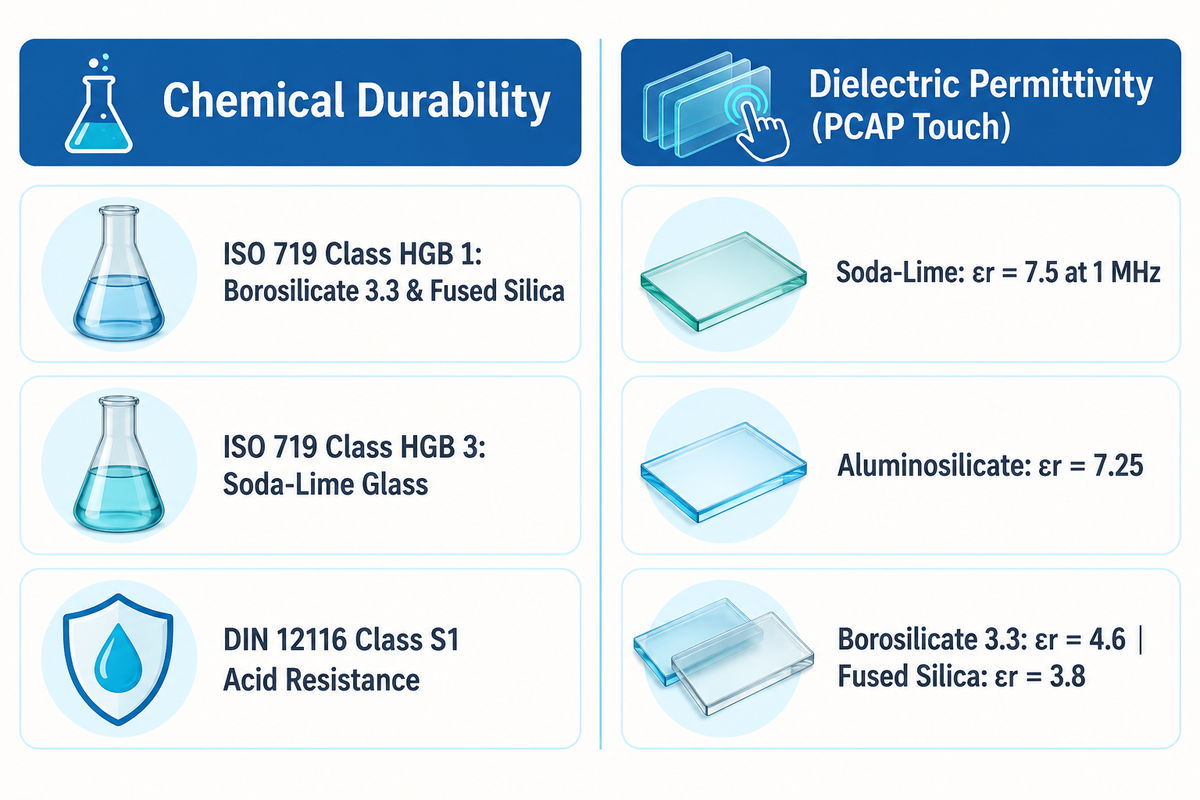
Chemical properties of glass and its electrical insulation ratings reflect long term reliability in washdowns and touch interfaces. Borosilicate 3.3 and fused silica achieve top-tier ISO 719 Class HGB 1, while standard soda-lime glass is in Class HGB 3. Silicate glass, in general, is a good insulator (10¹¹ to 10¹⁸ Ω·cm volume resistivity). At the same time, the higher dielectric constant of soda-lime (7.5) and aluminosilicate (7.25) enhances projected capacitive touch sensitivity.
Because the silicon-oxygen covalent bond is exceptionally strong, glass is resistant to most organic solvents, salt spray and oxidizing acids. However, in field conditions, one should evaluate alkaline corrosion and acidic mechanisms along with dielectric coupling.
Hydrolytic (ISO 719), Acid (DIN 12116), and Alkali (ISO 695) Resistance Grades
International standards categorize chemical resistance into three attack regimes:
- Hydrolytic Resistance (ISO 719 at 98 °C): Measures alkali ion leaching in hot water. Fused silica and borosilicate 3.3 earn Class HGB 1, releasing virtually zero sodium. Soda-lime float glass falls into Class HGB 3. In unsealed marine humidity, water vapor exchanges hydrogen ions for sodium (Na⁺) ions, leaving a hazy carbonate residue known as weathering bloom.
- Acid Resistance (DIN 12116): Per the standard DIN 12116 classification, most silicate glasses achieve Class S1 high resistance against acidic solutions. The primary exception is hydrofluoric acid (HF) and hot concentrated phosphoric acid, which dissolve the SiO₂ network directly. Factory lines control this mechanism during chemical etching to produce 30–110 GU anti-glare (AG) matte surfaces.
- Alkali Resistance (ISO 695): Per the standard ISO 695 test method, hot alkaline solutions (pH > 10) attack the silicon-oxygen backbone via hydroxide (OH⁻) ions. Caustic food-processing washdowns therefore require protective barrier coatings or frequent rinsing.
How Does Dielectric Constant (εr) Affect Capacitive Touch (PCAP) Cover Glass?
The relative permittivity (εr at 1 MHz) of a substrate determines how close an electric field is coupled between the projected capacitive (PCAP) sensor grid and a finger. This, in turn, affects the signal-to-noise ratio of the capacitive touch sensing. Hence, for a given thickness, a substrate with high εr would support thicker cover glass without affecting touch signal-to-noise ratio.
Mobile alkali modifiers increase electronic polarizability in the silicate network. Because of this, soda-lime (ε r = 7.5 at 1 MHz) and alkali-aluminosilicate glass (ε r = 7.25) exhibit almost double the coupling of fused silica (ε r = 3.8). They also display nearly 55% higher coupling than borosilicate 3.3 (ε r = 4.6). When using glass at 4.0 mm to 6.0 mm, touch controllers used in outdoor electric vehicle (EV) chargers and marine helm displays reliably detect gloved fingers due to the high capacitive coupling of the glass. The glass also provides electrical insulation for the high voltage used in EV charging.
How Thermal Tempering and Chemical Strengthening Shift Glass Properties
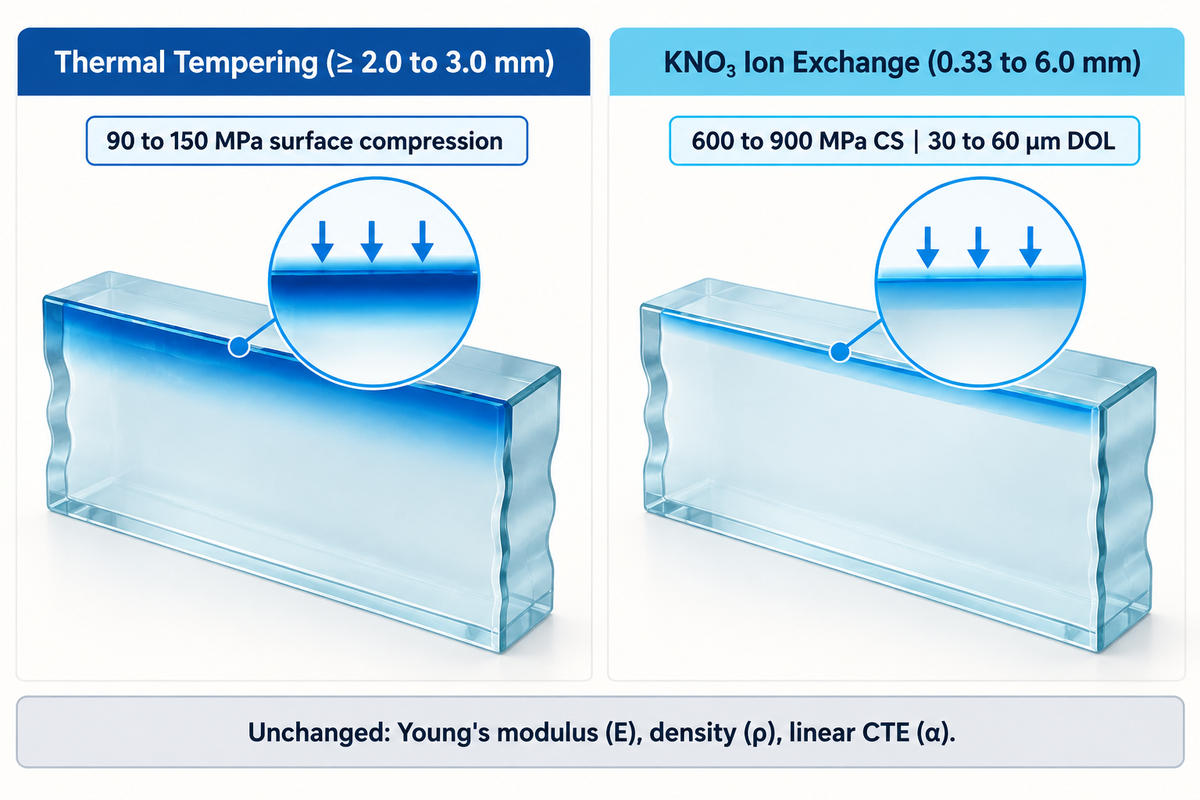
Both thermal tempering and potassium nitrate (KNO₃) chemical strengthening increase thermal shock tolerance and surface flexural strength. Thermal tempering traps 90 to 150 MPa of surface compressive stress in panels ≥ 2.0 to 3.0 mm. Chemical ion exchange on aluminosilicate glass (0.33 to 6.0 mm) produces 600 to 900 MPa of surface compressive stress in a layer 30 to 60 μm deep.
People often wonder if strengthened glass is stiffer and harder to bend than annealed glass. According to Abrisa Technologies heat tempering vs. strengthening engineering notes, tempered glass keeps the exact elastic deflection, bulk hardness, and expansion coefficient of annealed glass. Strengthening simply creates a protective compressive shield on the outer surfaces. The sheet bends a lot further before the outer surfaces reach the fracture threshold.
| Property / Parameter | Annealed Float Glass | Thermally Tempered Glass (ASTM C1048) | KNO₃ Chemically Strengthened Soda-Lime | KNO₃ Chemically Strengthened Aluminosilicate |
|---|---|---|---|---|
| Surface Compressive Stress, CS (MPa) | 0 – 5 (Residual) | 90 – 150 (≥ 69 MPa per ASTM C1048) | 300 – 500 | 600 – 900 (Typical 650 – 850) |
| Depth of Layer, DOL (μm) | N/A | ~20% of panel thickness (DOC) | 15 – 30 | 30 – 60 (Typical 35 – 50) |
| Practical Thickness Range (mm) | 0.33 – 19.0+ | 2.0 – 19.0 | 0.40 – 6.0 | 0.33 – 6.0 |
| Optical Distortion / Roller Wave | Zero (Flat float quality) | Moderate roller wave & anisotropy | Zero optical distortion | Zero optical distortion |
| Young’s Modulus & CTE Shift | Baseline (72 GPa / 8.6 × 10⁻⁶ /K) | Unchanged (no shift in E or α) | Unchanged (no shift in E or α) | Unchanged (71–85 GPa / 7.5–8.8 × 10⁻⁶ /K) |
| Breakage Fragmentation Pattern | Large sharp shards | Small blunt dice (per the standard EN 12150 safety pattern) | Large splinters (dices only if laminated) | Medium-to-small fragments depending on CT |
Which Physical Properties Change After Strengthening, and Which Stay Identical?
After thermal tempering or chemical ion exchange, the only functional properties that are transformed are surface compressive stress (CS), depth of layer (DOL), flexural impact strength, and thermal shock ΔT resistance. Every bulk physical property—including Young’s modulus (E), density (ρ), linear CTE (α), thermal conductivity, and core refractive index—remains unchanged.
In our thermal tempering process for safety glass, panels are heated to ~620–650 °C and rapidly air-quenched. Thin cover lenses (0.33 to 2.0 mm) can’t establish a sufficient thermal gradient during air quenching. Instead, SW Glass chemical strengthening capabilities submerge thin sheets in a molten potassium nitrate (KNO₃) salt bath at 380–450 °C. Larger potassium ions (K⁺) replace smaller sodium ions (Na⁺) in the surface lattice. As Patsnap chemical strengthening engineering reports and USPTO Patent US9567254B2 demonstrate, aluminosilicate glass achieves 600–900 MPa CS and 30–60 μm DOL. Note that when DOL ≥ 0.1·t on ultra-thin sheets, the true depth of compression (DOC) is slightly shallower than the chemical DOL.
For overhead glazing or marine windshields where human impact safety is mandatory, engineers bond tempered glass with polyvinyl butyral (PVB) interlayers to form laminated glass. Additionally, Glass Magazine heat soak testing guidelines explain how EN 14179 heat soak testing at 290 °C eliminates spontaneous breakage from nickel sulfide (NiS) inclusions. When decorative bezels are required, review our guide on silk screen printing on glass before tempering to coordinate ceramic frit firing with strengthening schedules.
Engineering Selection Framework: Specifying Glass Physical Properties on OEM Drawings
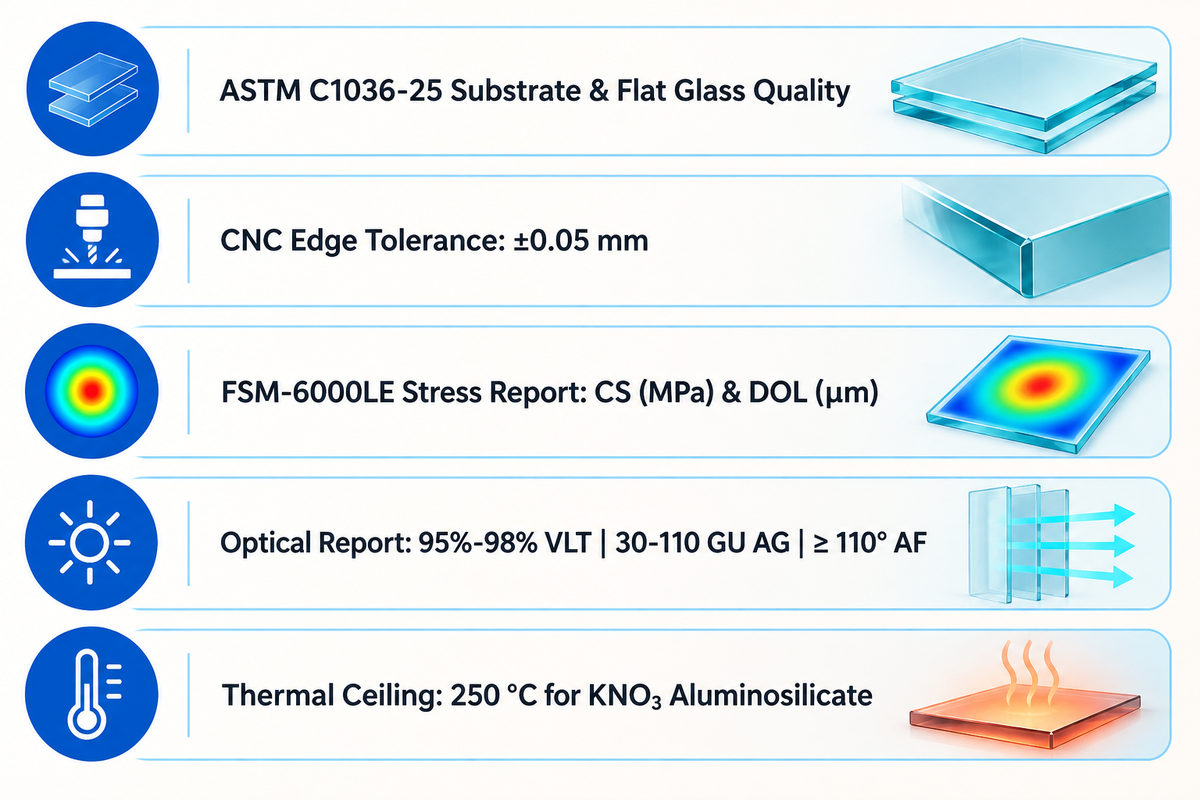
In order to prevent material substitution for custom cover glass drawings, hardware engineers must lock five parameters. These are the substrate family, dimensional thickness (with CNC edge tolerance of ±0.05 mm), and post strengthening surface compression (CS in MPa) with depth of layer (DOL in μm). Drawings must also specify optical coating metrics (VLT, AG gloss and AF contact angle) and inspection standards (ASTM C1036-25 and ASTM C1048-25).
The global aluminosilicate glass market reached USD 17.11 billion in 2025 (Polaris Market Research), while screen cover glass reached USD 22 billion (WiseGuy Reports). Across these sectors, OEM buyers increasingly demand lot-traceable physical verification. LearnGlazing spontaneous breakage studies confirm that tempered glass is strong on the face but vulnerable at damaged edges. Locking edge chamfer geometry on the drawing is therefore just as critical as choosing the glass composition.
Application-to-Substrate Decision Matrix (Marine HMI, Medical Optical, High-Temp & Architectural)
Use the engineering selection matrix below to select the best substrate and surface treatment package for your operating environment:
| Application Category & Environment Type | Recommended Substrate Class | Strengthening Method & Tier | Optical & Surface Coating Option | Governing Test Standards |
|---|---|---|---|---|
| Outdoor Marine Chartplotters & Bridge HMIs | Aluminosilicate or Low-Iron Soda-Lime (3.0 – 6.0 mm) | KNO₃ Chem Strengthened (CS 650–850 MPa, DOL 35–50 μm) | Etched AG (30–110 GU) + AR (95%–98% VLT per data from SW Glass) + AF (≥ 110°) | EN 62262 IK10 (20 J), ASTM C1048, ISO 719 |
| Public EV Charging Kiosks & Ticketing Terminals | Tempered Low-Iron Soda-Lime (4.0 – 6.0 mm) | Full Thermal Tempering (CS 90–150 MPa) or Laminated | Anti-Glare Etched + UV-Stable Ceramic Frit Border | EN 62262 IK10, EN 12150, ASTM C1036-25 |
| Portable Medical Monitors & Diagnostic Tablets | Alkali-Aluminosilicate (0.55 – 2.0 mm) | KNO₃ Ion Exchange (CS ≥ 700 MPa, DOL ≥ 40 μm) | AF Oleophobic (≥ 110°) + Rear Surface 2 Epoxy Ink Bezel | ASTM C158, ISO 9385, ε_r = 7.25 (1 MHz PCAP) |
| Industrial Factory Automation Touch Panels | Soda-Lime Float or Aluminosilicate (1.8 – 4.0 mm) | KNO₃ Chem Strengthened (CS 380–750 MPa, DOL 20–45 μm) | Chemical Etched AG (60–90 GU) + Anti-Scratch Coating | ASTM C1422, ASTM C158, DIN 12116 Class S1 |
| Automotive Center Console & Curved Cockpit Lenses | Alkali-Aluminosilicate (1.1 – 2.0 mm, 3D Curved) | 12-Hour Deep KNO₃ Ion Exchange (CS ≥ 700 MPa, DOC ≥ 40 μm) | Dual-Side Vacuum AR + AF Hydrophobic Topcoat | ASTM C158, ISO 9385, Automotive Head-Impact Spec |
| High-Temp Industrial Sight Windows & Floodlights | Borosilicate 3.3 (3.3 – 15.0 mm) | Annealed or Thermally Tempered (No KNO₃ above 250 °C) | Uncoated Pitch Polished or High-Temp Dielectric AR | ISO 7991 (CTE 3.25 × 10⁻⁶ /K), ISO 719 Class HGB 1 |
| UV-C Disinfection Reactors & Laser Barcodes | Synthetic Fused Silica (1.0 – 6.0 mm) | Precision Kiln Annealed & Optical Pitch Polished | 185–254 nm Deep-UV Transmission (n_d = 1.458, V_d = 67.8) | ISO 7991 (CTE 0.55 × 10⁻⁶ /K), ISO 719 Class HGB 1 |
| Architectural Curtain Walls & Overhead Canopies | Heat-Soaked Tempered + PVB Laminated Float (6.0 – 19.0 mm) | Thermally Tempered (≥ 69 MPa per ASTM C1048) + Heat Soaked | Solar-Control Low-E Coating + Ceramic Frit Edge Band | ASTM C1048-25, EN 12150, EN 14179 (290 °C Heat Soak) |
Drawing Callout Checklist and Factory Verification Protocols (FSM-6000LE, ASTM C1036, ISO 7991)
Verify the title block locks the five key properties and inspection callouts before releasing a custom cover glass drawing for production quoting.
- Substrate & Flat Glass Quality: Call out ASTM C1036-25 type I Class 1 (clear) or Low-Iron Quality Q1/Q2. Alternatively, Borosilicate 3.3 or Aluminosilicate by composition family, can also be used.
- CNC Dimensional & Edge Profile Tolerance: Specify ±0.05 mm outer contour accuracy with a 220–400 grit diamond-polished C-edge or 45° chamfer to eliminate Griffith edge flaws.
- Non-Destructive Stress Verification: Requires batch reports for the FSM-6000LE optical surface stress meter indicating both compressive stress (CS in MPa) and depth of layer (DOL in μm).
- Spectrophotometer Optical Reports: According to optical inspection standards, lock visible light transmittance (95%–98% with AR coating), 60° gloss units (30–110 GU for etched AG), and water contact angle (≥ 110° for AF).
- Thermal Service Ceiling: Chemically strengthened aluminosilicate glass exhibits stress relaxation above 250 °C. Use borosilicate 3.3 or fused silica for high-temperature zones.
Looking to check substrate properties, IK10 impact thickness, or optical coatings for your next enclosure? Request a custom cover glass engineering review and DFM quote from SW Glass. As per our factory production schedule, our Dongguan facility can provide complete FSM-6000LE stress certification, spectrophotometer logs, and CNC prototyping within 7 – 10 days.
Frequently Asked Questions
Why does annealed glass shatter under sudden temperature drops more easily than under rapid heating?
Annealed glass shatters far more easily during sudden cooling because glass is roughly fifteen times stronger in compression (800–1,000 MPa) than in tension (40–70 MPa). A hot glass sheet is splashed with cold water to create an effect similar to quenching. The cold water quickly chills the outer glass surface, causing the outer skin to shrink while the core of the glass remains hot and expanded. The cold outer skin goes into a tensile stress condition, opening microscopic Griffith surface flaws that lead to the rapid propagation of cracks.
Does chemical strengthening reduce panel deflection when a thin cover glass is pressed?
No, chemical strengthening doesn’t reduce elastic deflection of a panel loaded by a given force. The elastic deflection of a panel is determined solely by the geometry of the panel, and by Young’s Modulus of the material (E = 64–85 GPa), which doesn’t change during the molten potassium nitrate (KNO₃) ion exchange process. Chemical strengthening raises the maximum bending stress and total deflection distance the glass can survive before breaking (boosting flexural strength from ~50 MPa to 600–900 MPa). If the goal is to eliminate physical flex under finger pressure, then the thickness of the glass can be increased, or a higher modulus aluminosilicate substrate can be used.
How do you prevent ceramic silk-screen printed bezels from weakening the mechanical strength of cover glass?
High-temperature ceramic frit inks fuse into the glass surface at 580–640 °C during thermal tempering. This fusing creates localized thermal expansion mismatches and microscopic stress concentrators along the ink boundary that can reduce flexural strength by 20% to 35% as reported by tempering studies. To preserve full impact resistance on thin 0.5 to 2.0 mm display lenses, engineers specify KNO₃ chemical strengthening first. They then apply low-temperature (150–180 °C) UV-curable or two-component epoxy organic ink on the rear surface (Surface 2). This sequence retains the full 650–850 MPa compressive stress layer and 35–50 μm depth of layer without thermal degradation. It also keeps the decorative bezel shielded inside the sealed housing.
Why does standard soda-lime float glass exhibit a greenish tint on polished edges, and does it alter physical durability?
The greenish edge tint in standard soda-lime float glass comes from trace ferric and ferrous iron oxide impurities (Fe₂O₃ at 0.08–0.12 wt%) inherited from natural silica sand. According to optical glass measurements, this iron content slightly lowers visible light transmittance (89%–90% at 3 mm) and absorbs near-infrared energy. However, it has zero negative impact on bulk density (2.50–2.52 g/cm³), Young’s modulus (72 GPa), Knoop hardness (585 kg/mm²), or chemical durability. When true color neutrality or >91% bare transmittance is needed for optical sensors or white-bezel displays, engineers specify low-iron ultra-clear glass (Fe₂O₃ < 0.015 wt%).
What is the maximum continuous operating temperature for chemically strengthened aluminosilicate glass before stress relaxation occurs?
The strain point of alkali-aluminosilicate glass sits near 600 °C. However, the potassium-sodium (K⁺/Na⁺) ion-exchanged surface layer undergoes thermally activated sub-Tg ion diffusion and stress relaxation if held continuously above 250–280 °C for hundreds of hours. Consequently, hardware engineers cap continuous operating temperatures for chemically strengthened cover glass at 200–230 °C. For high-temperature furnace sight windows or luminaires operating above 250 °C, engineers switch to annealed or thermally tempered borosilicate 3.3 (up to 450 °C) or fused silica (up to 950–1,050 °C).
References & Sources
- Abrisa Technologies Glass Physical Properties Reference Chart (Float, Borosilicate, Fused Silica & Gorilla Glass; ISO 9385, ISO 7991)
- EAG Laboratories (Eurofins) Application Note: Physical Properties of Glass (Density, Viscosity, Refractive Index & Resistivity)
- U.S. Department of Energy OSTI Physical Properties of Silicate Glasses and Atomic Network Modifiers (OSTI Biblio 7130678)
- Materials (Basel) / PMC – Refractive Index, Abbe Number, and Thermo-Optic Coefficients of Oxide Glasses (PMC6728498)
- ASTM International — ASTM C1036-25 Standard Specification for Flat Glass, ASTM C158 Flexural Testing, and ASTM C1422 Chemically Strengthened Glass
- ASTM International & European Standards ASTM C1048-25 Heat-Strengthened and Fully Tempered Flat Glass, EN 12150 Fragmentation, EN 14179 Heat Soak, ISO 719, DIN 12116, and ISO 695
- USPTO Patent — US9567254B2 Glass Articles with Deep Depth of Layer (DOL) and Compressive Stress Profiles
- Glass Technology Services — 6 Glass Breakage Patterns: Thermal Shock and Edge Tensile Failure Analysis (EN 62262 IK10)

Trending now