Get in Touch with Saiweiglass


Thermal Tempering Process: From Annealed Glass to Safety Glass

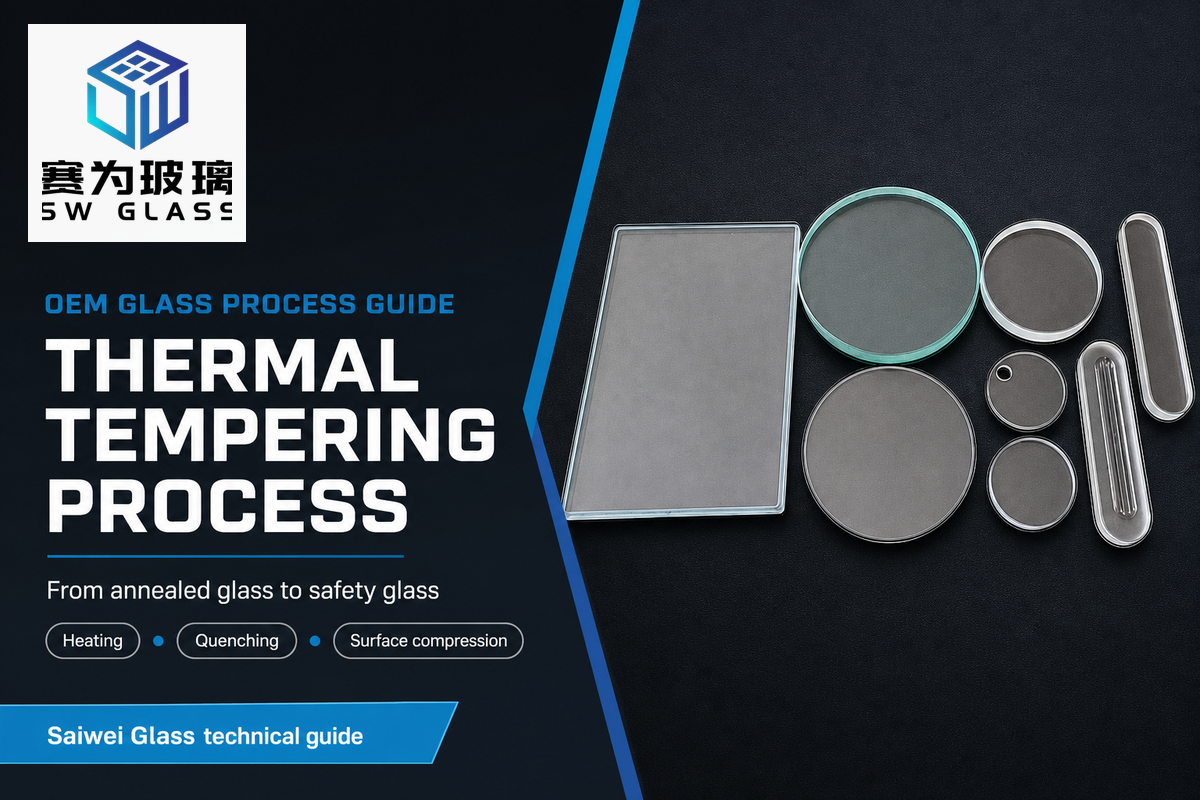
The thermal tempering process is a controlled glass heat treatment method that turns annealed glass into tempered safety glass by heating the glass, rapidly quenching it, and locking the outer surface into compression. This article covers glass thermal tempering, not steel heat treatment, food tempering, or general furnace hardening.
Updated August 2026. Reviewed by the Saiwei Glass technical team.
What the Thermal Tempering Process Does to Glass
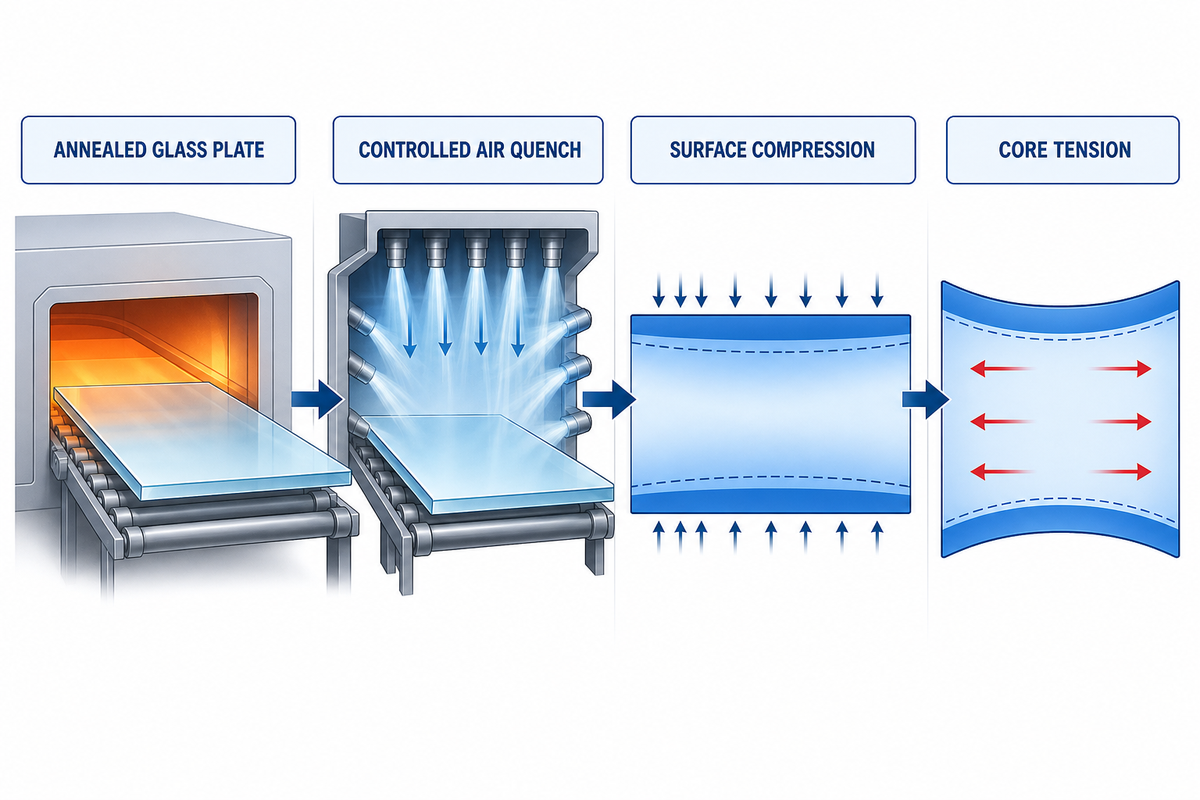
Thermal tempering is a glass heat treatment process that heats an annealed glass plate near its softening range and then rapidly cools it with controlled air. During quench, the surface of the glass cools first and becomes compressed. Hotter inner core glass cools later and remains in balanced tensile stress. That stress pattern is the reason tempered glass behaves differently from annealed glass.
What is thermal tempering?
Thermal tempering is a controlled glass tempering process that creates surface compression and internal tension, so the finished glass resists impact and thermal stress better than ordinary annealed glass. It isn’t a coating, adhesive layer, or surface polish. This change is locked into the glass sheet by the heating and quenching process.
For OEM buyers, production drawings can’t stay flexible after tempering. Discuss thickness, holes, notches, polished edges, screen printing, coating sequence, inspection method, and safety target before furnace loading.
“Freeze every cutout, edge, coating, and inspection criterion before the panel enters the tempering furnace.”
Answer-first rule
Tempering changes the stress profile of the glass, not just its surface appearance. Specify the finished geometry first, then choose the tempering route.
Annealed Glass vs Tempered Safety Glass: The Change Buyers Actually Need
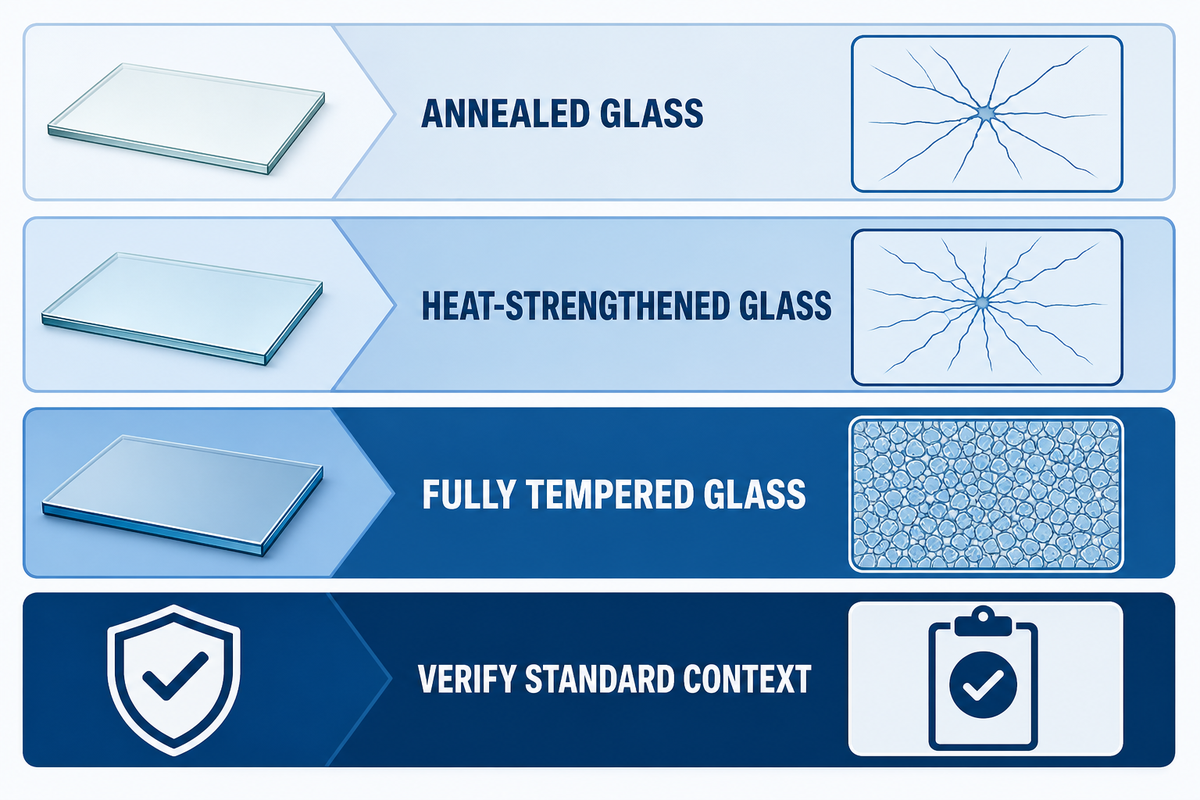
Annealed glass is the starting material. It can be cut, drilled, edged, and shaped, but it breaks into sharper shards and has no intentional surface-compression profile. Tempered glass is the finished safety-oriented form. It’s commonly stronger than annealed glass, but the actual strength multiplier depends on glass type, thickness, edge quality, prestress level, loading condition, and test method.
Some industry education describes fully tempered glass as about four times stronger than annealed glass of the same thickness and configuration. In 2025, an architectural-glass study reported a lower fully tempered strength factor in its own test context. MPa figures are standard- and source-scoped, so examples such as 24-52 MPa, >67 MPa, or Saiwei’s 69 MPa capability framing should be verified against the applicable standard or supplier test report. That’s why an engineering RFQ should ask for the standard, surface compression target, and inspection evidence instead of using one universal multiplier.
| Glass state | Stress condition | Buyer-visible behavior | RFQ implication |
|---|---|---|---|
| Annealed glass | No intentional tempering stress profile | Easier to fabricate, but breakage can create sharp shards | Use before final cutting, drilling, edging, and shape approval |
| Heat-strengthened glass | Partial compressive stress compared with fully tempered glass | More resistant than annealed glass, but not the same safety break pattern | Consider when extra strength is needed without full tempered fragmentation |
| Fully tempered glass | Higher surface compression with core tension | Greater resistance and a safer dice-like break pattern in the right standard context | Confirm standard scope, stress target, edge quality, and post-temper inspection |
Step by Step: Heating, Quenching, Surface Compression, and Core Tension
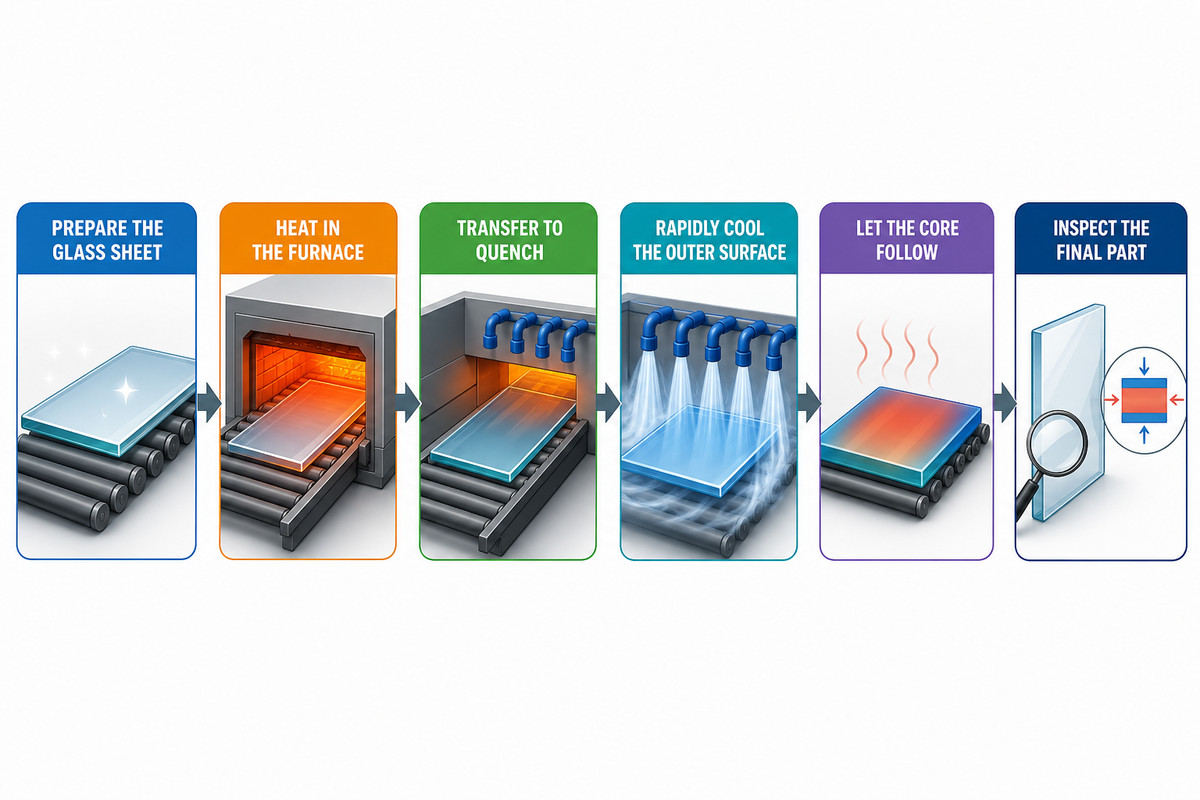
The glass tempering process is simple to describe and demanding to control. Saiwei describes a thermal glass tempering route that heats glass in the 620-700 C process range, then uses rapid air quenching. External technical sources also describe heating above the strain-relief range and rapid cooling as the mechanism that builds residual stress.
- Prepare the glass sheet – confirm size, thickness, edge shape, holes, slots, print, and coating sequence before heat treatment.
- Heat in the furnace – the temperature of the glass rises toward the tempering window so the glass can respond to stress without being treated like molten glass.
- Transfer to quench – hot glass moves from the tempering oven to controlled air nozzles, and transfer timing affects uniformity.
- Rapidly cool the outer surface – convective cooling makes the outer surface set first, which creates compressive stress.
- Let the core follow – inner glass cools later and balances the outer compression with internal tension.
- Inspect the final part – check dimensions, bow, edge quality, fragmentation or stress evidence, and optical acceptance criteria as required.
How does the glass tempering process work?
Glass tempering works by using a controlled heating and quenching process to create a permanent stress profile. As the outer surface cools faster than the inner core, finished thermally tempered glass carries compression at the surface and tension inside. That stress pattern helps the glass resist breakage and changes how it fragments.
Quench control isn’t a cosmetic detail. Air pressure, nozzle layout, glass thickness, material composition, coefficient of thermal expansion, furnace uniformity, and transfer time can influence residual stress, optical quality, and the cooling process. Higher temperature doesn’t automatically produce better tempered glass; one open-access air-cooling study used 650 C, while Saiwei states 620-700 C for its capability context. Thermal tempering of glass can therefore mean different settings for soda-lime glass, borosilicate glass, thick panels, or thinner cover glass.
Architectural glass standards, heat treating vocabulary, thermal expansion, and glass transition behavior help explain boundaries, but product scope still controls every claim. The glass transition temperature is useful background, not a supplier setpoint for a finished OEM quote.
Why Cutting, Edging, and Drilling Must Happen Before Tempering
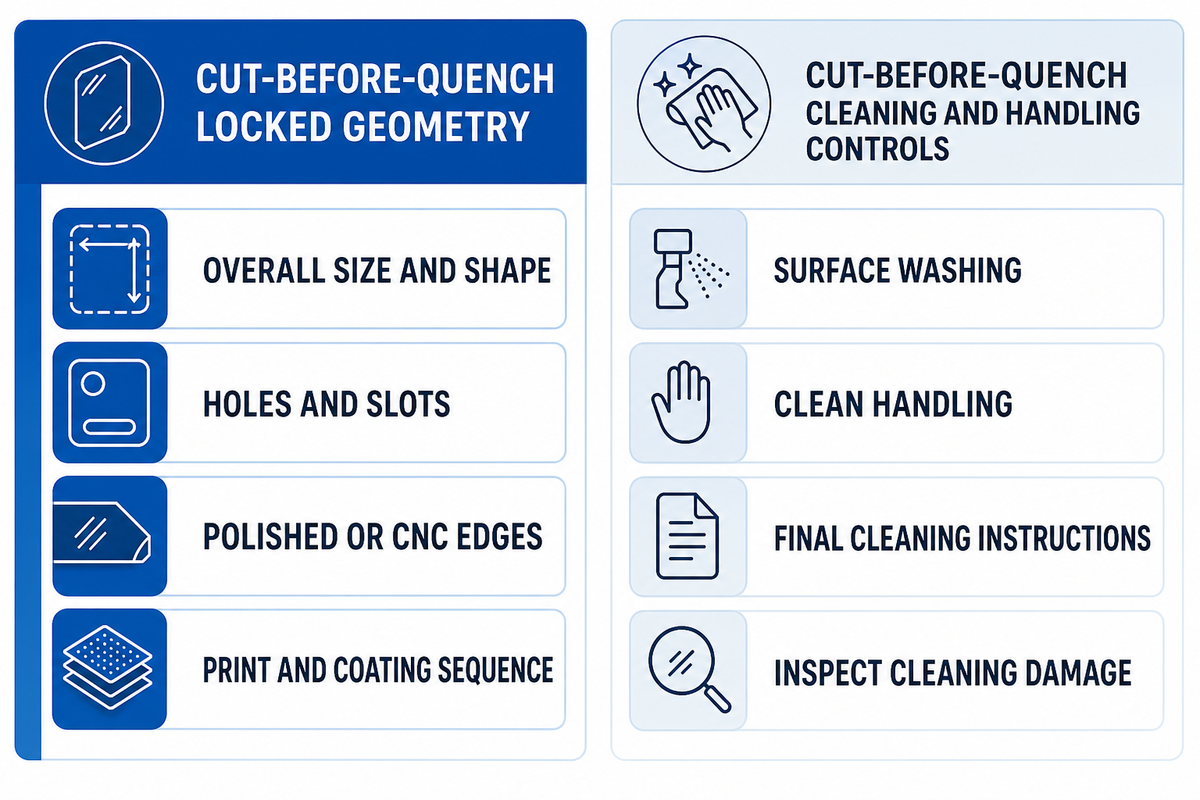
The Cut-Before-Quench Rule is the most expensive fabrication mistake to miss: cutting, drilling, notching, grinding, polishing, edgework, and dimensional changes must be completed before thermal tempering. Once the glass is tempered, attempting to cut or drill it can release the stress balance and make the glass shatter.
Cleaning belongs in a different category. Glass must be clean enough for processing, and heat-treated surfaces still need correct cleaning procedures after production and installation. Washing is a surface-care and process-control requirement. It isn’t the same as a forbidden post-temper dimensional operation.
Lock before tempering
- Overall length, width, and shape
- Holes, slots, notches, and cutouts
- Ground, polished, chamfered, or CNC edges
- Screen printing or coating sequence when heat exposure matters
Control during and after handling
- Surface washing and drying before furnace loading
- Clean handling after tempering and packaging
- Final cleaning instructions for heat-treated glass surfaces
- Inspection for scratches, chips, stains, or cleaning damage
For procurement, send a production drawing with tolerances, edge notes, print layers, and inspection level before asking for final tempered glass pricing.
What Makes Tempered Glass Safer When It Breaks?
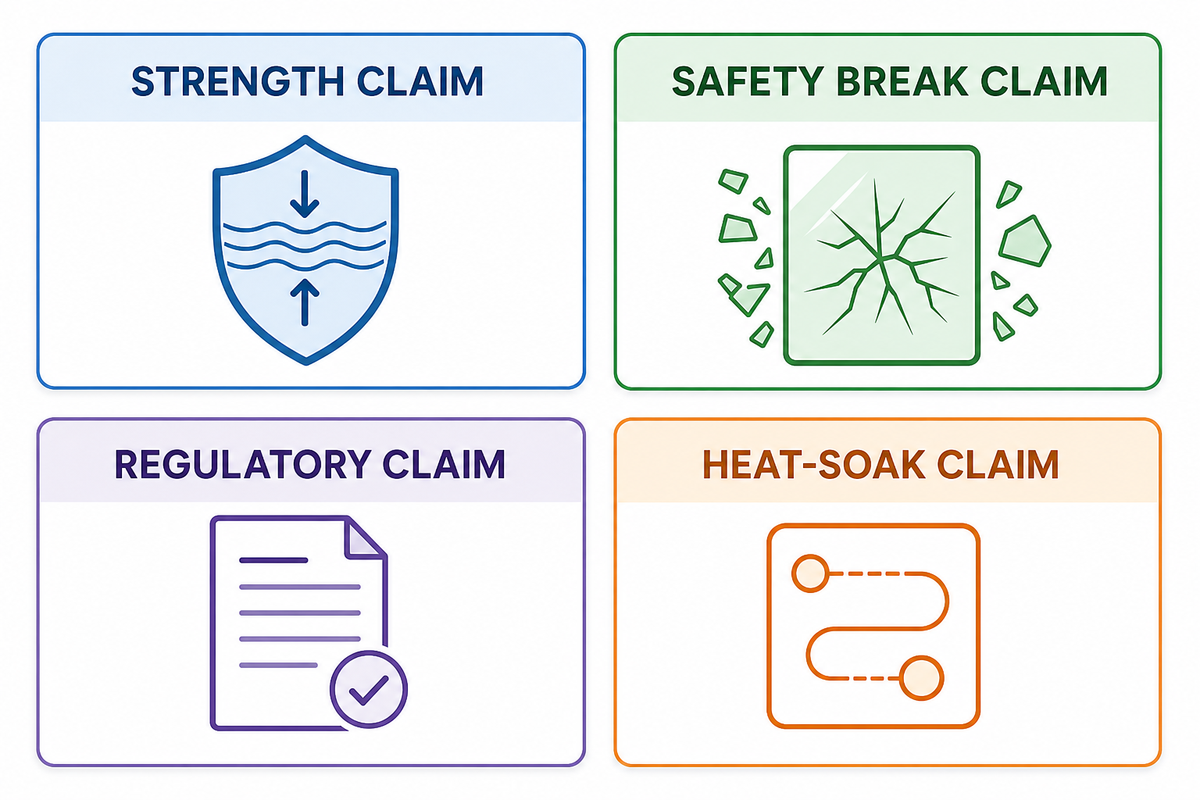
Tempered glass is safer because its stored stress makes it break into smaller fragments in the right safety-glass context, rather than the long sharp shards associated with annealed glass. Strength and break pattern are related, but they aren’t the same claim. One part can be stronger, safer in breakage, or compliant with a defined rule only when the scope and evidence match.
Scope is where many vague tempered safety glass claims go wrong. 16 CFR Part 1201 addresses architectural glazing materials. 49 CFR 571.205 addresses motor-vehicle glazing materials. Electronics, medical-device covers, industrial controls, and smart cockpit display glass may instead rely on customer drawings, optical criteria, internal tests, or sector-specific rules.
| Claim type | What it means | Evidence to request |
|---|---|---|
| Strength claim | The panel resists higher stress than annealed glass in a stated test context | Surface compression target, test method, material, thickness, and edge condition |
| Safety break claim | The glass breaks into a safer fragment pattern under the relevant standard | Fragmentation or impact-test evidence tied to the product use |
| Regulatory claim | The part is assessed under a specific jurisdiction and product category | Named standard, revision, scope statement, markings, and records |
| Heat-soak claim | Heat-soaked thermally toughened glass was specified to reduce nickel-sulfide-related risk | Heat-soak records, traceability, conformity marking, documentation, and scope |
Discuss heat soak and nickel sulfide when the project needs heat-soaked thermally toughened glass or formal construction/safety documentation. Don’t paste that requirement into every OEM cover-glass order.
Thermal Tempering vs Chemical Strengthening vs Heat-Strengthened Glass
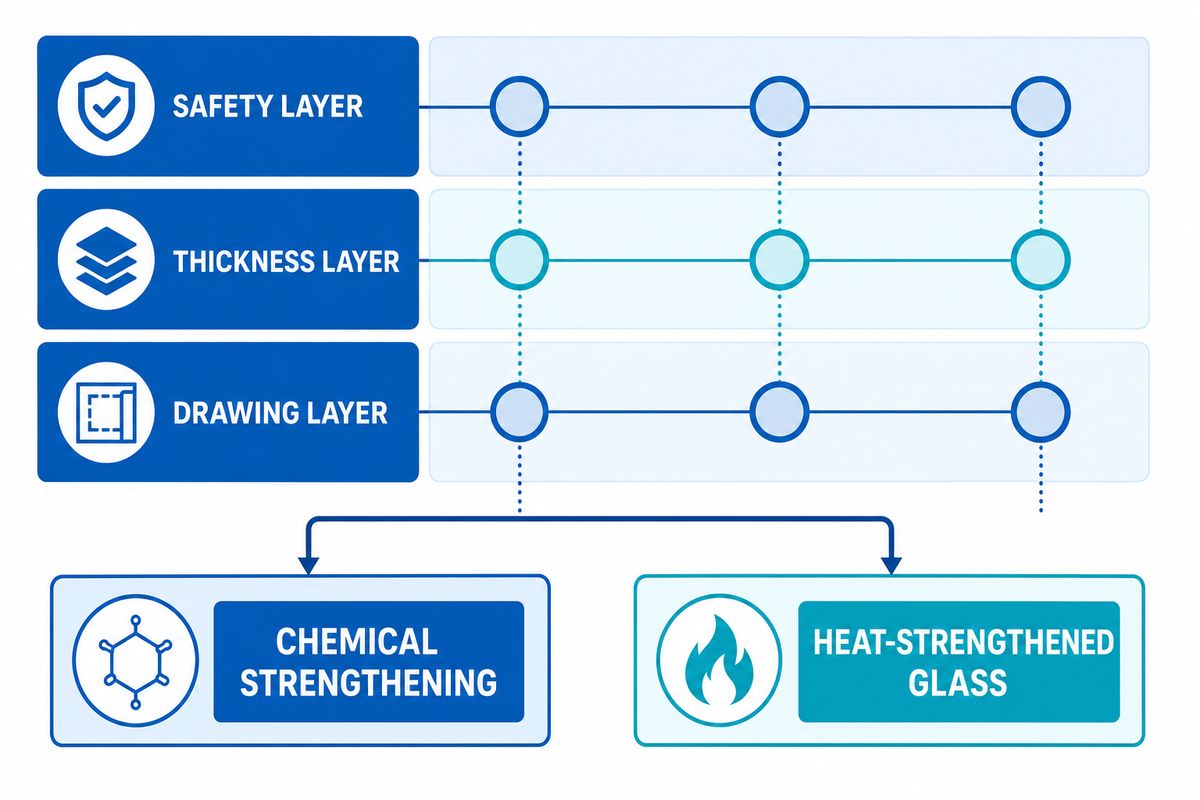
Thermal tempering isn’t always the right answer just because the buyer wants stronger glass. Route selection depends on thickness, material, safety break requirement, optical surface needs, cost target, and quench tolerance.
Chemical strengthening, sometimes called chemical tempering in buyer language, is often the route to review for thinner display cover glass, complex cover shapes, or parts that need a high-quality surface finish without the same thermal-quench limits. Chemically strengthened glass can be useful where thin glass and surface compression are both important. Heat-strengthened glass sits between annealed and fully tempered behavior when full safety fragmentation isn’t required. Thermally strengthened glass is a broad phrase, so confirm whether the supplier means heat-strengthened, fully tempered, or another documented route.
The 3-Layer Tempering Fit Matrix
3 Layer Tempering Fit Matrix
- Safety layer: Does the glass need a tempered safety break pattern, heat-strengthened behavior, or only surface durability?
- Thickness layer: Is the panel thick enough for practical thermal tempering, or is it a thin cover-glass candidate for chemical strengthening?
- Drawing layer: Are holes, edges, print, coatings, dimensions, and inspection criteria frozen before heat treatment?
What is the thinnest glass that can be tempered?
Minimum glass thickness for thermal tempering is supplier-, equipment-, composition-, and geometry-dependent. Saiwei’s thermal tempering page gives 3 mm as a practical lower limit in its stated capability context. For thinner glass, especially display or sensor cover glass, ask whether chemical strengthening is the better process before committing to thermal tempering.
How to Choose Thermal Tempering for OEM Cover Glass, Control Panels, and Displays
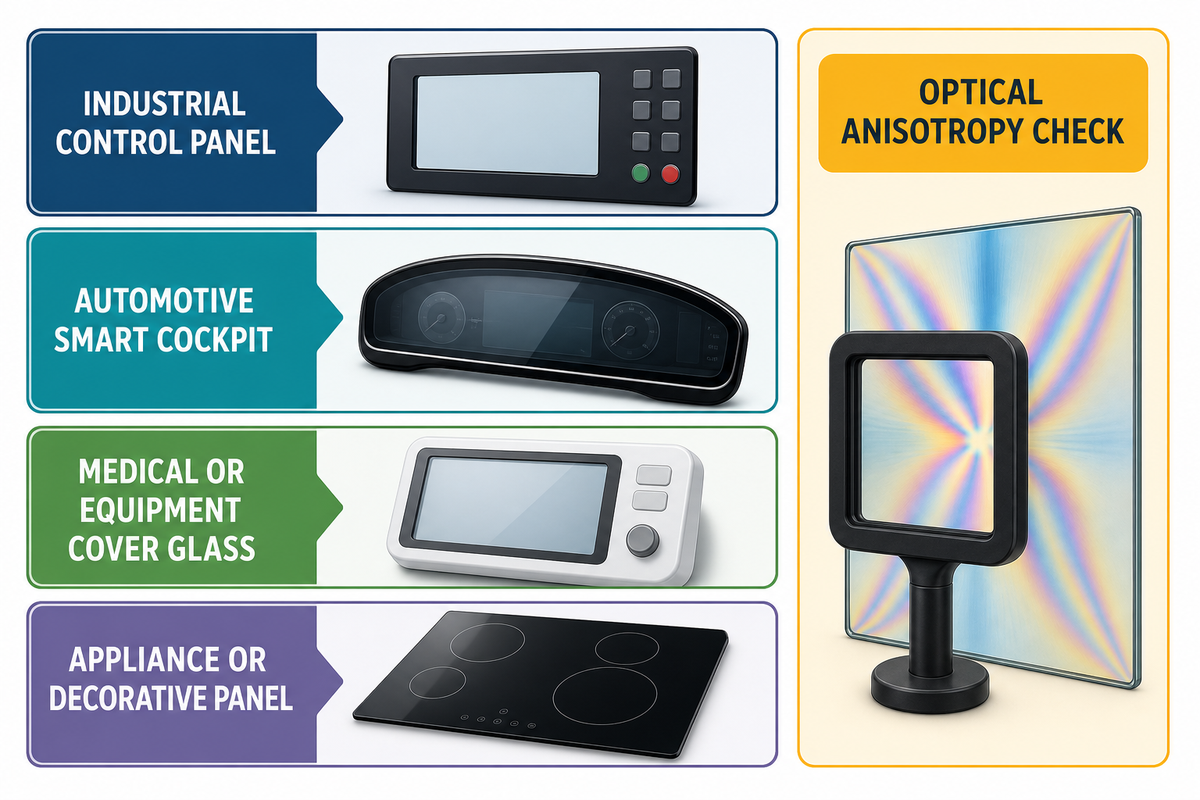
Thermal tempering is a strong candidate when OEM glass products need safety behavior, economical processing, and fixed geometry. Saiwei positions the process for electronics, medical-device glass, industrial controls, automotive smart cockpits, appliances, and custom tempered glass uses. Material and inspection boundaries still decide fit.
For custom cover glass, the route depends on what the user sees through the pane. Dark appliance covers may tolerate more optical variation than inspection-facing display windows. Soda-lime glass panels may fit a different process window than borosilicate glass or a thin chemically strengthened cover.
| Use case | Thermal tempering fits when | Extra acceptance checks |
|---|---|---|
| Industrial control panel | Panel thickness, holes, and edge design are already fixed | Dimension, edge chips, print alignment, surface compression, and bow |
| Automotive smart cockpit or display cover | The glass needs safety behavior and the display stack can tolerate thermal route limits | Optical anisotropy, iridescence, roller wave, transmitted-image distortion, and viewing angle |
| Medical or equipment cover glass | The panel needs safety behavior plus cleanable surface and stable dimensions | Cleaning compatibility, coating durability, edge quality, packaging cleanliness, and traceability if required |
| Appliance or decorative panel | Heat resistance, safety behavior, and fixed size matter more than ultra-thin design | Print color, coating sequence, bow, surface defects, and sample approval |
Optical anisotropy and iridescence deserve special attention for display-facing tempered glass. Tempering stress can create visible patterns under certain lighting or polarization conditions. If the glass sits in front of a screen, camera, sensor, or inspection zone, define the inspection method instead of relying on a general surface-quality phrase.
Quality, Standards, Cost, and Lead Time Factors to Check Before RFQ
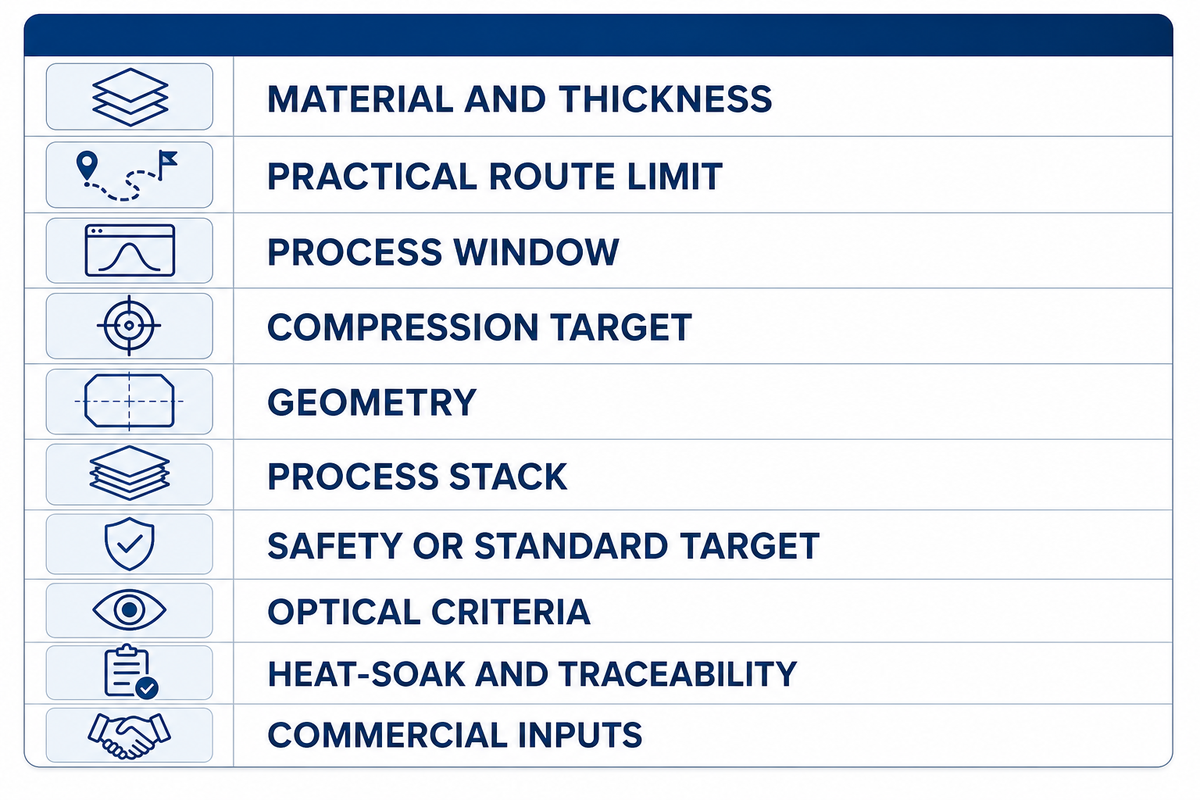
Tempered-glass cost and lead time depend on thickness, size, material, holes, notches, edge finish, coating, printing, quantity, inspection level, packaging, and certification evidence. Public price ranges are weak because a 3 mm cover, a thick machinery window, and a printed control panel don’t consume the same process time.
Saiwei’s own search data shows spec-heavy buyer language around industrial control glass, clearance, acid resistance, and surface compression. Query phrases such as 0.5 mm clearance or 700 MPa surface compression should be treated as buyer questions, not automatic thermal-tempering promises. RFQs work best when they define function.
RFQ checklist – copy these fields into your tempered glass quote request:
| RFQ category | What to state | Why it matters |
|---|---|---|
| Material and thickness | Soda-lime, borosilicate, low-iron, clear float glass, and exact thickness | Controls heat response, weight, optical behavior, and route choice |
| Practical route limit | 3 mm thermal tempering context from Saiwei, with thinner glass reviewed separately | Prevents thin cover glass from being forced into the wrong process |
| Process window | 620-700 C Saiwei capability context, not a universal temperature promise | Turns tempering temperature into a supplier-specific process discussion |
| Compression target | State the MPa target or standard context, such as 69 MPa or >67 MPa where applicable | Makes stress in the glass measurable instead of vague |
| Geometry | Final size, holes, slots, radius, notches, CNC profile, and edge finish | These details must be locked before tempering |
| Process stack | Tempering, printing, AG/AR/AF coating, ITO coating, lamination, or chemical strengthening | Sequence affects yield, surface quality, and cost |
| Safety or standard target | Named standard, product category, jurisdiction, and revision when applicable | Prevents architectural, vehicle, and OEM internal requirements from being mixed |
| Optical criteria | Anisotropy, iridescence, bow, roller wave, transmitted-image distortion, and inspection lighting | Needed for display-facing or inspection-facing glass |
| Heat-soak and traceability | Required only when the project calls for heat-soaked thermally toughened glass or formal construction records | Supports documentation, marking, nickel-sulfide risk control, and audit records |
| Commercial inputs | Quantity, delivery target, packaging, sampling plan, and approval sample | Determines lead time and quote accuracy |
If the project is still early, use Saiwei’s tempered glass price estimator as a planning route, then send final drawings and inspection criteria for a supplier quote.
Summary: When Thermal Tempering Is the Right Safety-Glass Route
Thermal tempering is the right route when a finished glass part needs tempered safety behavior, the geometry can be frozen before heat treatment, and the panel thickness and material fit the supplier’s thermal process. It’s less suitable when the glass is too thin, the shape is still changing, or the application needs chemical strengthening instead.
For drawings that are ready for production review, Saiwei’s thermal tempering glass services page is the right commercial next step. For thin cover glass, compare thermal tempering with chemical strengthening before choosing a route.
Discuss a Tempered Glass Project
FAQ
The questions below come from SERP/PAA, NEURONwriter, and Saiwei buyer-search patterns. They’re answered for glass buyers who need a specification, not for metal tempering or food tempering searches.
Q: What is the thermal tempering process for glass?
Glass thermal tempering heats annealed glass near its softening range, then rapidly quenches it so the surface enters compression and the core balances in tension.
In practice, thermal tempering changes the stress profile of the glass. Glass is heated near the softening range, then rapidly cooled so the surface sets first and the core cools later. Finished tempered glass carries surface compression and internal tension. It does not add a film or coating, so the process route must be chosen before final geometry is locked.
Q: What temperature is used to temper glass?
Glass tempering temperature is a supplier-controlled process window, not one universal setpoint, because material, thickness, furnace transfer, and quench pressure all change the target range.
Saiwei states a 620-700 C heating range for its thermal tempering capability, while external technical references often describe glass tempering above 600 C or around the soda-lime softening range. Correct value depends on glass composition, thickness, furnace setup, transfer timing, quench pressure, and the final stress target. Thicker plates and thin display covers should not be treated as the same furnace problem.
Q: Can tempered glass be cut after tempering?
Tempered glass should not be cut, drilled, ground, or reshaped after tempering because post-temper machining can release the locked stress balance and shatter the part.
Cutting, drilling, grinding, and reshaping can release the stress balance and cause the glass to fracture or shatter. Complete edgework, holes, slots, notches, and final size before heat treatment. Cleaning is different: heat-treated glass can still require proper cleaning and handling after production, packaging, installation, field service, or safe transport.
Q: Is thermal tempering better than chemical strengthening?
Thermal tempering is not automatically better than chemical strengthening; choose between them by glass thickness, final geometry, safety-break requirement, optical tolerance, and surface-compression target as well.
Thermal tempering usually fits thicker panels with fixed geometry. Chemical strengthening is worth reviewing for thinner display cover glass or complex shapes.
Q: How much does it cost to temper glass?
Tempered glass cost depends on drawing complexity, thickness, holes, edges, coatings, inspection needs, quantity, packaging, approval sampling, and lead time rather than a public formula.
No stable public formula covers custom tempered glass. Send the drawing, process stack, quantity, packaging, and inspection target.
Q: Does tempered glass always meet safety-glass requirements?
Tempered glass meets a safety requirement only when the finished part is tested, documented, and marked under the correct product scope, jurisdiction, revision, and evidence.
Architectural glazing, vehicle glazing, electronics covers, industrial control panels, and medical-device glass can have different rules. Ask for the named standard, revision, jurisdiction, product category, test report, marking, and traceability record when safety compliance is part of the purchase requirement. Display-facing panels also need optical-quality evidence.
References & Sources
The article uses source-context statements and avoids universal guarantees. Confirm values for the exact glass material, thickness, processing route, standard scope, and inspection method.
- Saiwei Glass thermal tempering capability page
- Saiwei Glass about page
- ASTM C1048-25 standard listing
- 16 CFR Part 1201, Safety Standard for Architectural Glazing Materials
- 49 CFR 571.205, Glazing materials
- Fluid-Thermal-Structure Coupled Analysis on the Tempering Characteristics of Glassware During Air Cooling
- ScienceDirect Topics: Thermal Tempering
- High-Performance Glass Solutions, sponsored by National Glass Association
- Optical anisotropy effects in laminated tempered glass
- National Glass Association: Heat-Treated Glass Surfaces Are Different
- UK OPSS Heat Soaked Thermally Toughened Glass Sector Regulatory Report
- GlassOnWeb: glass tempering and glass quenching energy-saving possibilities
- Google Patents: thermally tempered glass process example