Get in Touch with Saiweiglass




Updated June 2026. Reviewed by the Dongguan Saiwei Glass Co., Ltd. (SW Glass) technical team.
A sunlight readable display is a screen built to stay legible in bright ambient light and direct sun; achieving that is not a single specification but an optical budget. When your screen or phone transforms into a shiny black mirror in direct sun, it isn’t some malfunction – it’s just physics: so much ambient light reflects off the screen’s surfaces that you can’t distinguish that reflection from the screen light you’re actually trying to see. Beating the reflected sun in this competition require four forces interacting: display brightness, surface reflectance, removing the air gap with optical bonding, and managing ambient conditions. This document details the glass side of the optical equation, because those surfaces account for most of the reflectance you can influence on a display stack.
The shortcut answer: The device must sustain a sufficient ambient contrast ratio (ACR) so you can see your content in the sun, usually accomplished by combining a brightly backlit display (most phones/tablets are 800-1,000 nits or higher), and optical bonding to eliminate the air space between your cover glass and the panel, topped off with anti-reflective coatings (AR) that minimize reflection (typically around 4%) at the surface of the display. You won’t find a legally binding “X-nit” threshold that officially defines “sunlight readable”; it’s determined by ACR which depends upon viewing conditions.
Quick Specs, Sunlight-Readable Optical Stack
| Backlight luminance (sunlight-readable) | 800–1,000+ nits (vs 250–450 nits standard) |
| Reflection per uncoated glass surface | ~4–4.25% (Fresnel) |
| Air gap after optical bonding | 0 (index-matched, n≈1.5) |
| SW Glass AR transmittance | >94% single-side, >98% double-side |
| SW Glass AG haze range | 4.7–11 |
| Cover glass (chemically strengthened) | CS >450 MPa, DOL >8 µm, 0.4–3.9 mm |
Why Displays Wash Out in Sunlight: The Ambient Contrast Ratio Problem
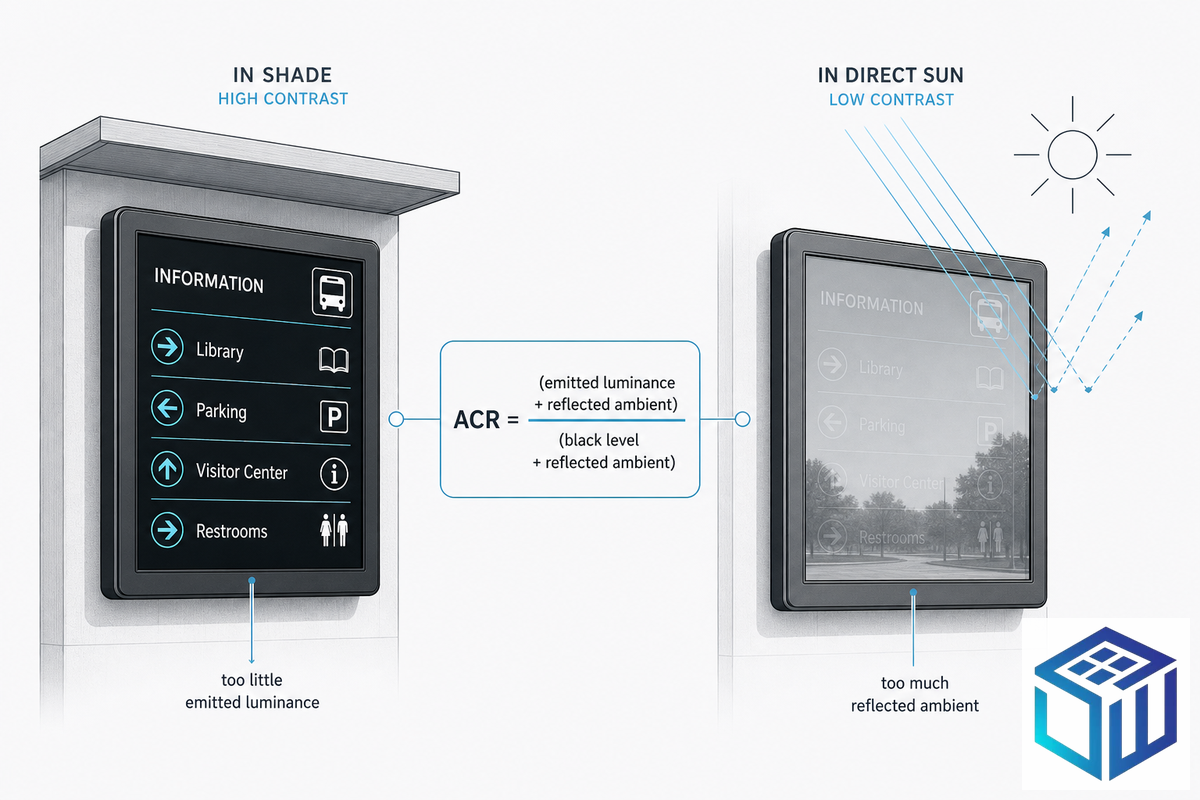
On the exterior, a display battles the sun. Sunlight-readable display technology spans industrial monitors, outdoor digital signage, and vehicle dashboards built for harsh outdoor environments. Direct daylight can be on the order of 50,000-100,000 lux, and the conventional 300-nit LCD panel simply can’t fight through that amount of ambient illumination to show you crisp black levels.
Instead, display light becomes drowned out by reflections and appears gray and indistinct – you can hardly see the image at all. It’s ambient contrast ratio (ACR), not luminosity, that dictates legibility outside.
📐 The Ambient Contrast Ratio (ACR) Equation
Peer-reviewed display research expresses it as ACR = (Lon + LAM·RL) / (Loff + LAM·RL), where Lon/Loff are the white/black luminance, LAM is ambient illumination, and RL is the luminous reflectance of the screen surface. The equation show the two ways to raise ACR: boost Lon (brightness) or shrink RL (reflectance) — and reflectance is set by the display glass and coatings.
What is a good ambient contrast ratio for sunlight?
Generally, an ACR of approximately 5:1 will do in a pinch, and 10:1 is a very good level of comfortable legibility, though remember this is a rough rule of thumb; a precise ACR depends on your precise lighting setup. As the US NIST daylight ambient-contrast measurement methods note, display legibility is variable and depends on viewing angle, lighting position, and source geometry. “Sunlight readable” doesn’t guarantee a specific nit value but rather a target performance measured by ACR.
Bottom line: to engineer for direct sunlight viewing, measure ACR under those conditions rather than chasing the highest possible nit number on a specification sheet.
The 4 Levers of a Sunlight-Readable Stack: Contrast-Loss Map

Ultimately, any lost contrast can be restored by one of the four factors and knowing where to target will provide optimization with the glass. We call these collectively the Contrast Loss Map. Two losses are driven by glass surface physics and two others are related to the system as a whole — the same split that display-engineering patents for sunlight-readable LCD devices organize around.
| Lever | What it fixes | Typical effect | Trade-off |
|---|---|---|---|
| 1. Backlight luminance (nits) | Raises Lon | 250–450 → 800–1,000+ nits | Power, heat, LED life, eye strain |
| 2. AR / AG coating (surface) | Cuts surface RL | ~4%/surface → <1% (AR) | AG trades a little sharpness for diffusion |
| 3. Optical bonding (internal) | Removes air-gap reflections | Eliminates 2 internal interfaces | Adds a lamination process step |
| 4. Ambient management | Polarizer / transflective / auto-dim | Reflects or reuses ambient light | Cost, color in low light |
This is the tried and true, outside perspective few spec sheets share: Bigger and brighter aren’t always the solution. Outdoor display engineers at outdoor display message boards have seen displays washed out with backlight cranked all the way up, but still remain unreadable due to reflective loss. “It’s a buyer’s blunder thinking brighter is best,” one trade publication warns directly. Levers 2 and 3 target reflectance directly while giving you an advantage in striking your targeted ACR level with the backlight at a more gentle setting.
Optical Bonding: Closing the Air Gap
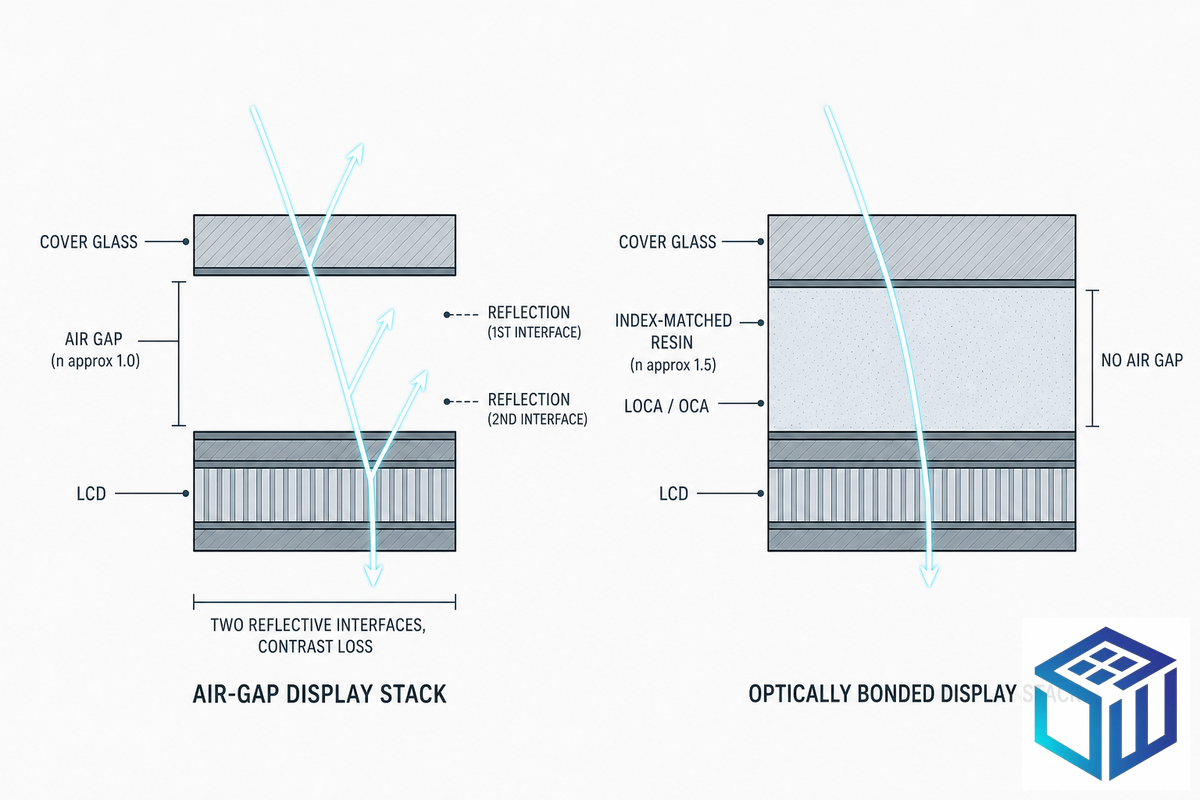
In a non-bonded display, there’s an air space between the touch sensor/cover glass and the LCD. As light moves from the glass to air to LCD interfaces, it encounters step changes in refractive index from low to high and reflects from each. Those are your reflections that cause glare inside.
Optical bonding eliminates the air gap, using an index-matched, optical-grade clear resin with a refractive index that matches glass (n≈1.5).
Is optical bonding worth it for sunlight readability?
For the most part yes, in high-ambient or touch-enabled applications: this eliminates reflections internally directly to address the RL, and to help boost ambient contrast in cases where a stronger backlight won’t. In one instance, an industrial integrator reported up to a 400% increase in sunlight contrast when optical bonding is combined with AR.
Though this figure should be considered the peak achieved by one vendor, actual improvements in your display stack will vary.
This improvement doesn’t come at the exclusion of additional advantages – the bonding step prevent condensation and fogging, enhances touch screen accuracy due to removal of parallax, and holds broken cover glass shards in place. More detailed information on the advantages of and options between LOCA/OCA and the complete process for optical bonding can be found in our article on our optical bonding service. This article concentrates specifically on what can be achieved through bonding from the readability budget point of view; and of course, we offer bonding as an after-process on our touch display module assembly process.
How Many Nits Do You Need? Brightness & Backlight Engineering
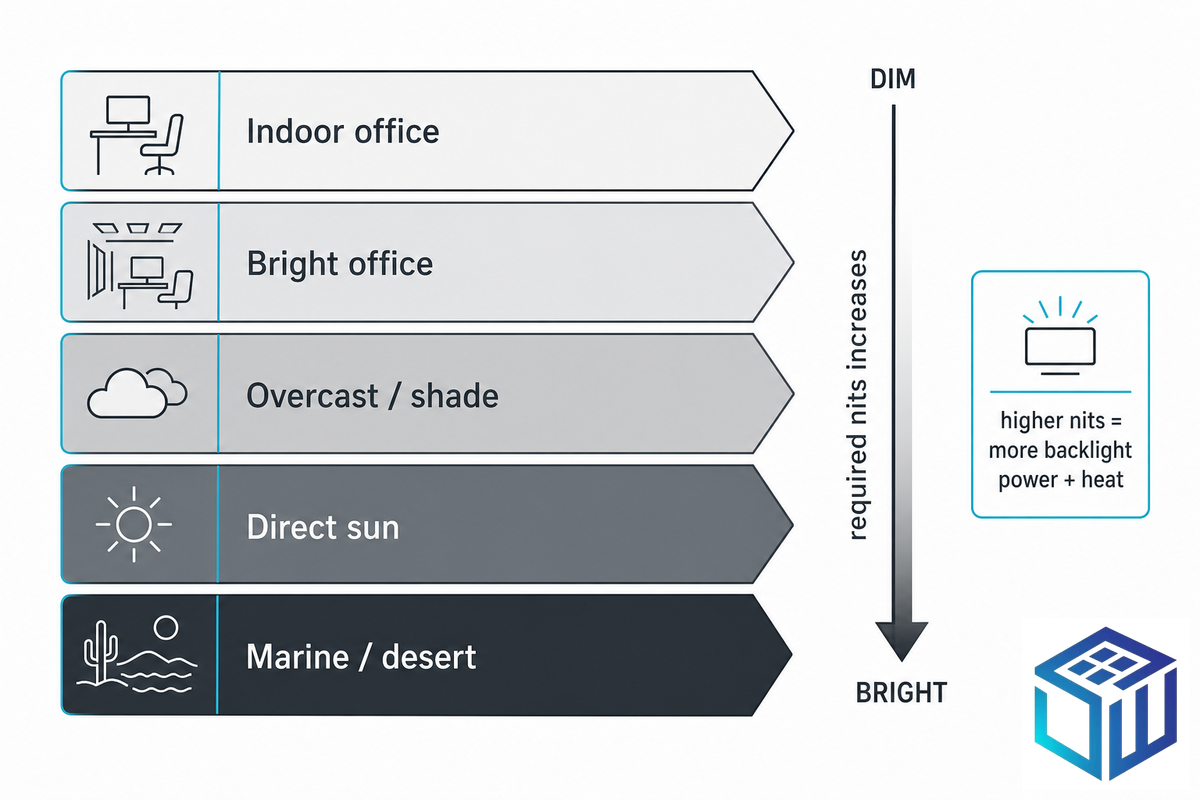
Brightness continues to be important – it defines the Lon. A conventional TFT LCD panel runs 250-450 nits, but 800 nits is the industry norm for sunlight readability and 1,000 nits is the target for most OEMs; tough outdoor and marine units operate at 1,500-2,500+ nits, so choose appropriately for your operating environment.
U.S. FAA human-factors display standards similarly tie readability to sufficient luminance and contrast under bright sunlight, not to a fixed nit number. Whether a vendor calls the result a sunlight readable monitor, a sunlight readable LCD, a daylight viewable LCD, or a high brightness TFT display, the goal is the same. That goal is keeping the LCD display legible in high ambient light and bright sunlight, including use in direct sunlight.
| Environment | Ambient (approx.) | Recommended luminance |
|---|---|---|
| Indoor office | 300–500 lux | 250–350 nits |
| Bright interior / near window | ~1,000 lux | ~500 nits |
| Overcast / shaded outdoor | ~10,000–25,000 lux | 700–1,000 nits |
| Direct sun | ~50,000 lux | 1,000–1,500 nits |
| Marine / desert glare | 75,000–100,000 lux | 1,500–2,500+ nits |
How many nits is considered sunlight-readable?
800 nits being the well-established entry limit and 1,000 nits the usual benchmark – but those are conventions, not a standard. Going after nits alone has its drawback: increase the backlight drive, and you’ll get a bigger power consumption, more heat, a shorter LED half-life, and sore eyes to your viewers.
That’s precisely why a modest brightness increase combined with bonding and AR normally beats brute force.
An ambient-light sensor with auto-dimming keeps the panel readable at noon and comfortable at night.
Anti-Reflective & Anti-Glare Coatings: Cutting Surface Reflectance
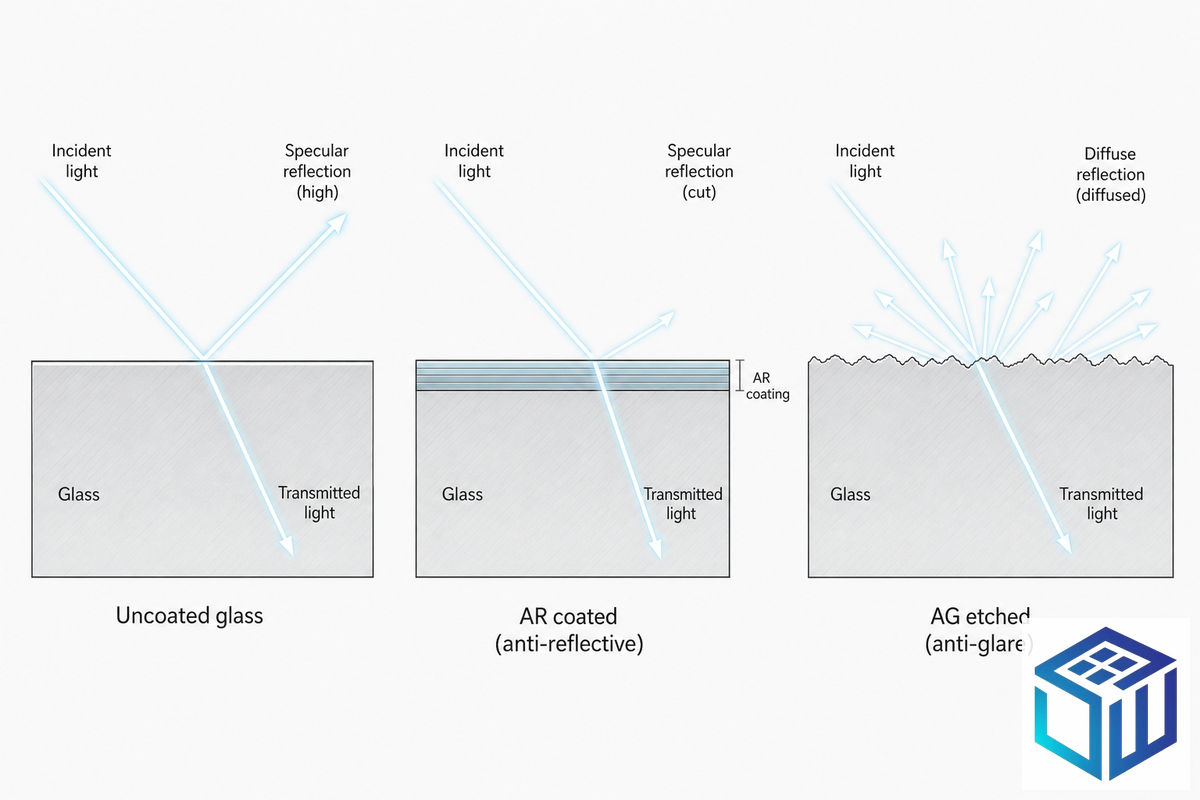
There’s the leverage that the glass supplier has. Using Fresnel equations, approximately 4% light reflects at each glass-air interface, or for un-coated glass, 4.25% per interface. So you lose roughly 8-9% in bare cover-glass-over-air-gap stack before they’re adhered, and each per cent of sunlight that reflects, goes straight back up to contribute to higher RL and lower ACR.
✔ Anti-Reflective (AR)
Anti-reflective (AR) and anti-glare (AG) coatings can dial down reflected wavelengths to drop surface reflection from ~4% towards <1% and lift transmittance. SW Glass AR yields >94% transmittance single-side, and >98% double-side. Best where image sharpness counts (instrumentation, medical, automotive).
⚠ Anti-Glare (AG)
A micro-roughened surface scatters specular reflection into diffuse haze. SW Glass AG haze runs 4.7-11. Best for wide-angle glare (kiosks, outdoor signage); sacrifices some sharpness. AR and AG are often combined.
Since AR/AG coatings act on the surface and bonding influences the internal gap, they stack: a bonded, AR-coated, chemically strengthened cover from our anti-reflective AR glass range can mitigate both reflective loss pathways simultaneously.
When Brightness Isn’t the Answer: Transflective & Reflective Displays
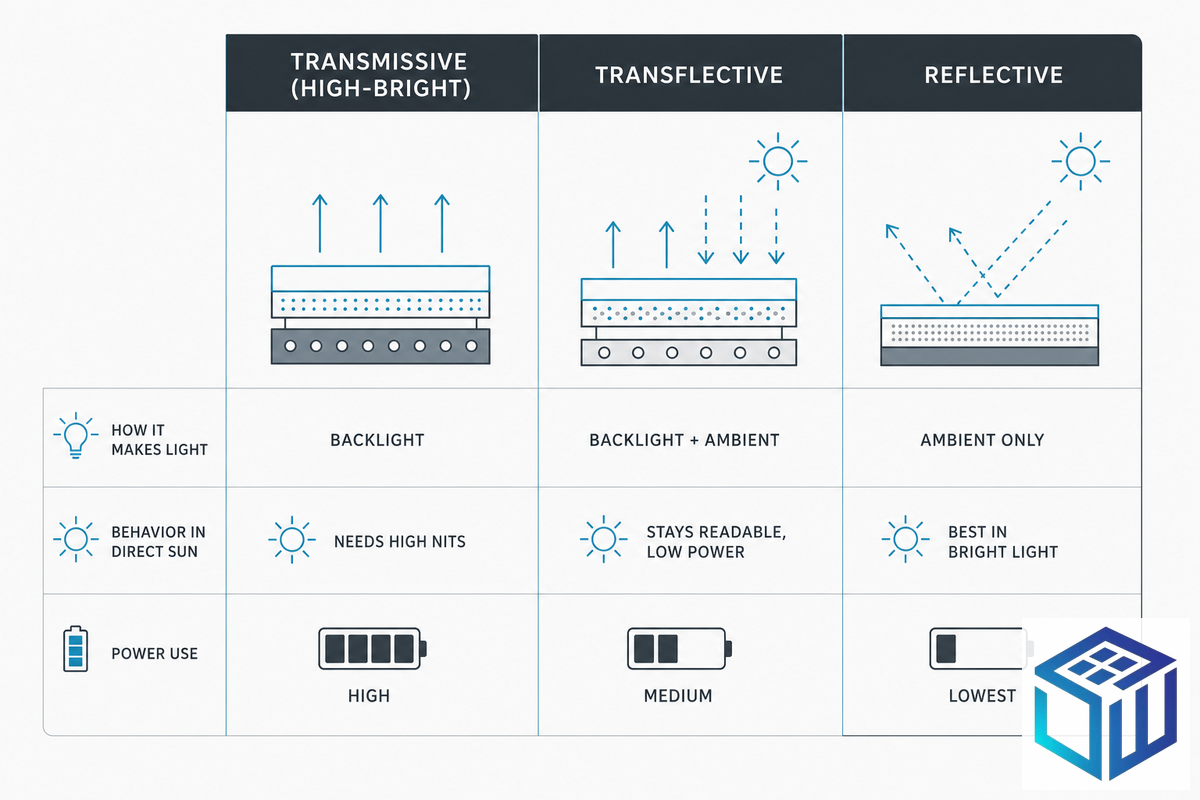
Sometimes the best course of action is to use the sun instead of fighting it. Using a transflective LCD replaces the diffuser with a semi-reflective layer (a transflector) that redirects ambient light back through the pixels – “like reflective sunglasses,” in the words of a display engineer.
IEEE work on sunlight-readable transmissive LCDs describes the same transflective film: high transmission to the backlight, high reflection to the ambient light. In bright sun the reflected component carries the image with much less backlight power, which is why a transflective TFT LCD can beat a high-brightness LCD monitor for use in direct sunlight on a tight battery budget; the compromise is a dimmer image in low light and a higher panel cost (often several times a standard transmissive panel).
Recent increases in search popularity for transflective displays and decreases for generic “high-brightness” topics indicate that designers are opting for power-efficient readability in battery-powered, always-on, wearable, and marine handheld products. Keep in mind that these choices of panel architecture (transmissive, transflective, reflective, and emissive OLED/micro-LED) affect readability within the panel itself, well beyond what cover glass and coatings manage, a theme revisited below.
Choosing the Cover Glass for a Bonded Sunlight-Readable Stack
The cover glass is the base on which the optical levers rest. For a bonded, sunlight-readable stack, specify four factors in unison:
- Strengthening: chemically strengthened glass with CS >450 MPa and DOL >8 µm withstands outdoor impact and thermal cycling.
- Thickness: 0.4-3.9 mm, thinner for handhelds, thicker for vandal-resistant kiosks.
- Coatings: AR on both sides to preserve transmittance; AG where wide-angle glare is a concern.
- Touch compatibility: a projected-capacitive (PCAP) capacitive touchscreen is preferable for bonding over resistive, since resistive layers can absorb up to 5% of the transmitted light.
Low-iron glass presents color-neutral on large panels. Hesitant to choose your substrate? Our glass material selector correlates aluminosilicate, soda-lime, and chemically strengthened cover glass to application needs.
Matching the Stack to Your Application
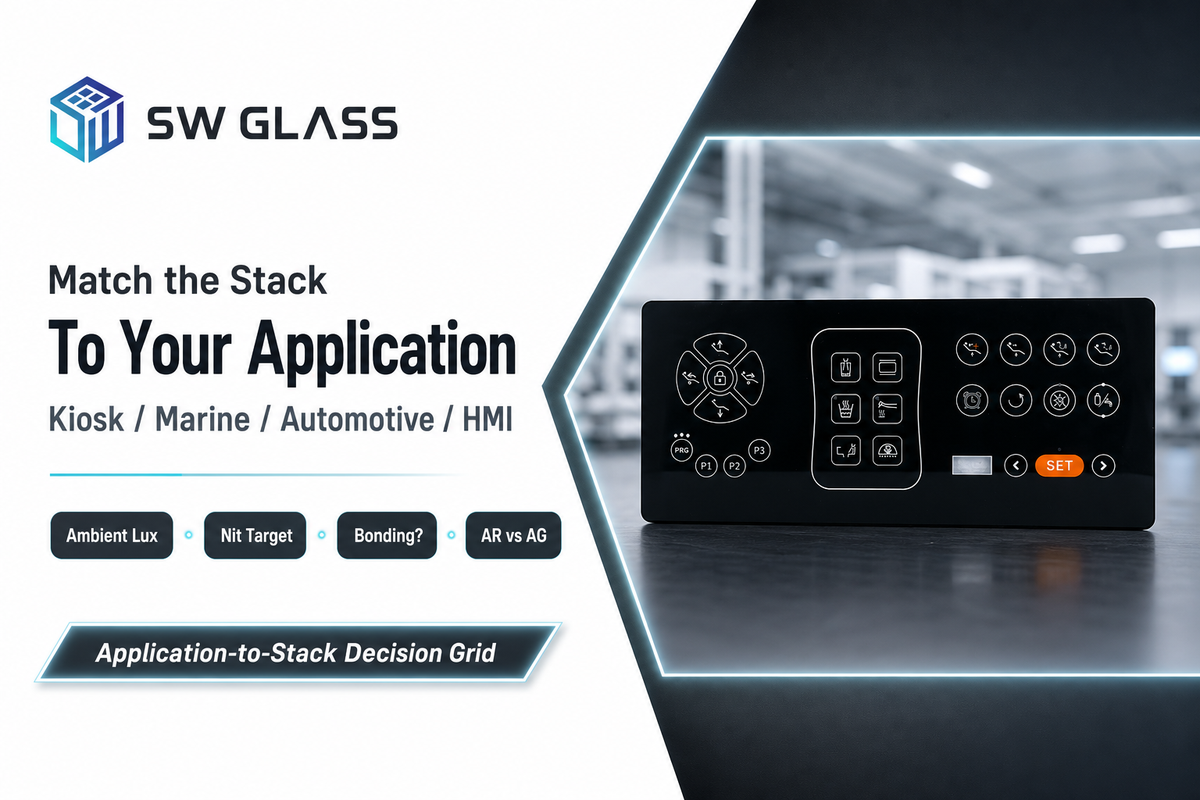
Leverage the Application-to-Stack Decision Grid to select a combination of levers rather than excess nits. A bonded, AR-coated cover with an appropriately sized backlight defeats a 2,500-nit panel with a reflective air gap nearly all of the time.
| Application class | Target luminance | Bonding | AR / AG | Notes |
|---|---|---|---|---|
| Outdoor kiosk / signage | 1,000–1,500 nits | Yes | AG + AR | Vandal-resistant thick cover |
| Marine bridge / deck | 1,500–2,500 nits | Yes | AR | Salt-fog sealing, auto-dim |
| Automotive / EV-charging | 1,000–1,500 nits | Yes | AR (+AF) | Wide temp range, PCAP touch |
| Industrial HMI | 800–1,000 nits | Yes | AG + AR | Glove use, chemical-resistant |
| Handheld / wearable | 700–1,000 nits or transflective | Yes | AR | Power budget favors transflective |
| Agriculture machinery | 1,000–1,500 nits | Yes | AG + AR | Dust sealing, vibration, glove use |
| Aviation / ATC console | 1,000–1,500 nits | Yes | AR | Near-window glare, color accuracy |
| Rail / transit | 1,000–1,500 nits | Yes | AG + AR | Wide temp, anti-vandal |
| Retail POS / self-checkout | 700–1,000 nits | Yes | AG | Mixed indoor/window light, AF |
| Defense / field | 1,000–1,500 nits | Yes | AR | Shock; NVIS (MIL-STD-3009) handled separately |
Many of these applications involve outdoor and marine display environments or automotive display systems, where a bonded glass-plus-coating assembly on a touch display module serves as the standard platform.
“LCD brightness of 800 nits or higher is generally considered sunlight readable, but most sunlight readable displays are 1,000 nits. Increasing the backlight is the most common method, but optical bonding fixes the contrast itself.”
Surviving the Field: Thermal, UV & Durability

The requirement is of a display that work in sunlight not that can be read in it! The high-nit backlights combined with ambient Solar Heating results in high temperatures and a bonded stack can be a life saver, firstly it removes the internal trapped air and running cooler will naturally prolong its life and secondly the bonding resin offer physical shock and vibration protection. However, in the real world UV radiation will take its toll: it’s generally considered that direct constant-sunlight exposure will cause failure of even the better of touch technology (PCAP is better than resistive) in around one year. Peer-reviewed LCD and OLED lifetime and power-efficiency analysis likewise treats backlight drive as a primary lifetime and thermal factor.
Specify a UV-stable resin, look for a wider operating-temperature range, and for fixed installs add a shade hood plus an ambient-light sensor to dim the display and cut power and heat.
📐 Engineering Note
As it’s for continual outdoor use, the cover should be a disposable interface – a UV resistant bonded chemical strengthened glass (CS>450 MPa), with replaceable AR/AG front can double or more life compared to just using an unprotected panel. Confirm to destination profile/ thermal regime / salt-fog if used before putting it into a build.
What’s Changing in Sunlight-Readable Display Design
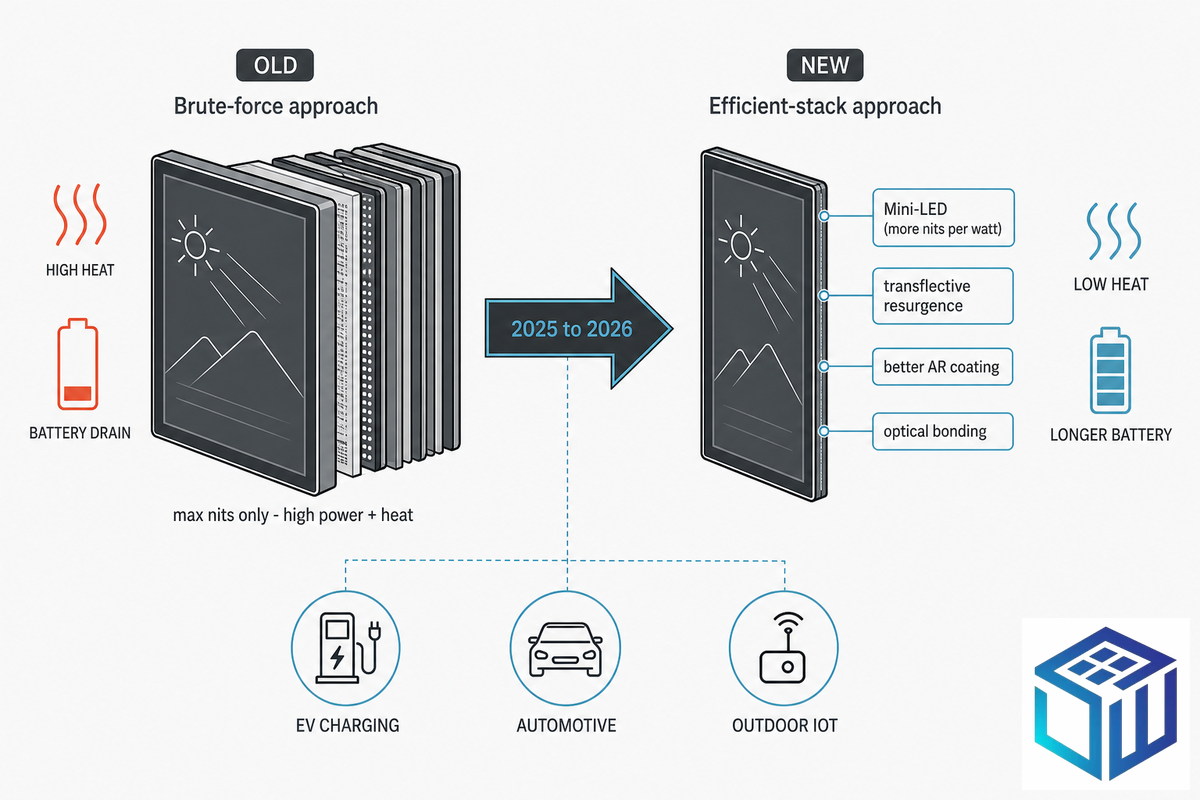
The design center of gravity is shifting from cramming on more nits toward achieving brightness optically and efficiently, and two approaches are rising for 2025-2026: Mini-LED backlights and a transflective comeback for low-power outdoor products — a shift pulled by automotive, EV-charging, marine, and outdoor-IoT display demand rather than by raw brightness alone.
Mini-LED backlights deliver more nits per watt, letting engineers get more sunlight-rated output at the power and heat levels designers expect (mini LED display revenues estimated to jump to $2.47 billion in 2031 from $0.58 billion in 2025; see, for example, LED-backlight stacked-optical-film patents). Transflective, reflective designs for low-power, “always-on” outdoor applications also will find new appeal.
Standards even support these needs, such as Ambient Performance Measurements for Light-Emitting Panel Modules, IEC 62341-6-x. Though only covering OLED, this gives an indication of what future standards may include, as the days of chasing brute-force nits as the sole approach are fading.
What it means for buyers: If you’re scoping a 2026 outdoor or vehicle program, request that you define the stack-bond plus AR, plus a right-sized (many times Mini-LED) backlight, not just “one bright number”. Context: Analysts value the total market for sunlight-readable displays growing at high-single digit CAGR. This market growth serves as context, not a design parameter for you.
Frequently Asked Questions
What makes a display sunlight-readable?
View Answer
A display is sunlight-readable when its ambient contrast ratio stays high enough to read in bright light. That comes from combining four levers: a high-brightness backlight (commonly 800–1,000+ nits), optical bonding to remove the internal air gap, anti-reflective coatings that cut the ~4% reflection at each glass surface, and ambient management such as a transflector or auto-dimming. No single one of them is enough on its own.
How many nits do you need for a sunlight-readable display?
View Answer
The industry convention is 800 nits as the entry point and 1,000 nits as the common target, versus 250–450 nits for a standard panel. Direct-sun and marine applications often call for 1,500–2,500+ nits. But match the figure to your real ambient lux, and combine it with bonding and AR — those let you hit the same readability at lower power, heat, and cost.
What is optical bonding and how does it improve sunlight readability?
View Answer
Optical bonding fills the air gap between the cover glass (or touch sensor) and the LCD with an index-matched clear resin (n≈1.5). That removes the internal air interfaces that reflect light back at the viewer, so it cuts the reflectance term in the ambient contrast ratio — improving sunlight readability in a way a brighter backlight cannot, while also stopping internal fogging and reducing touch parallax.
Optical bonding vs anti-reflective coating, which matters more?
View Answer
They fix different reflections, so the answer is usually “both,” not “either.” Anti-reflective coatings attack the ~4% reflection at each exposed glass surface; optical bonding attacks the reflections at the internal air gap between glass and LCD. A bonded panel with no AR still has a reflective front surface; an AR front with an unbonded air gap still leaks internal glare. The strongest sunlight-readable stacks combine both, which is why high-end outdoor and marine displays are almost always bonded and AR-coated. If budget forces a choice, start with bonding for touch panels (it also fixes parallax and fogging) and AR for non-touch instrument glass.
Can a sunlight-readable display be dimmed at night?
View Answer
Yes. A 1000 nit panel is painful at night, so most sunlight-readable units add an ambient-light sensor on the front bezel that auto-dims the backlight to match conditions — readable at noon, comfortable at midnight.
Transflective vs high-brightness, which is better outdoors?
View Answer
High-brightness transmissive panels give the best all-around image and the widest indoor/outdoor range, so they dominate most builds. Transflective panels win when battery life or always-on operation is critical, because they reuse sunlight instead of fighting it — at the cost of a dimmer low-light image and a higher panel price. Choose transflective for handhelds and marine portables; high-brightness-plus-bonding for fixed kiosks, vehicles, and HMIs.
Does optical bonding work with capacitive touch screens?
View Answer
Yes — a projected-capacitive (PCAP) touchscreen is the preferred partner for bonding. It bonds cleanly, improves touch accuracy by removing parallax, and handles UV better than resistive touch.
Will an optically bonded display survive high temperatures and UV?
View Answer
With the right materials, yes. Bonded stacks actually run cooler because there is no air gap to trap heat, but UV is the limiter: full direct-sun exposure can damage many touch screens within about a year. Specify a UV-stable resin, a rated operating-temperature range, and a shade hood for fixed outdoor installs.
Specifying a sunlight-readable cover glass stack
SW Glass offer a chemically strengthened cover glass with AR/AG coatings and optical bonding for your outdoor, marine, automotive, industrial HMI displays – sized to your ambient contrast target.
About This Analysis
This guide reflects SW Glass’s first-party cover-glass and coating data, AR transmittance >94–98%, AG haze 4.7–11, and chemically strengthened glass at CS >450 MPa, cross-checked against NIST daylight ambient-contrast methods and peer-reviewed ambient-contrast-ratio research. We engineer the optical-surface and bonding layers of the display stack; panel-level brightness and architecture are specified with the display maker. Reviewed by the Dongguan Saiwei Glass Co., Ltd. technical team.
References & Sources
- Display Daylight Ambient Contrast Measurement Methods and Daylight ReadabilityU.S. National Institute of Standards and Technology (NIST)
- Human Factors Design Standard, Ch. 5: DisplaysU.S. Federal Aviation Administration (FAA)
- Ambient contrast ratio of quantum-dot color-converted micro-LED displaysResults in Physics (peer-reviewed)
- Ambient contrast ratio of LCDs and OLED displaysOptica (Optics Express)
- IEC 62341-6-1, OLED display modules: optical and electro-optical measurementInternational Electrotechnical Commission