Get in Touch with Saiweiglass



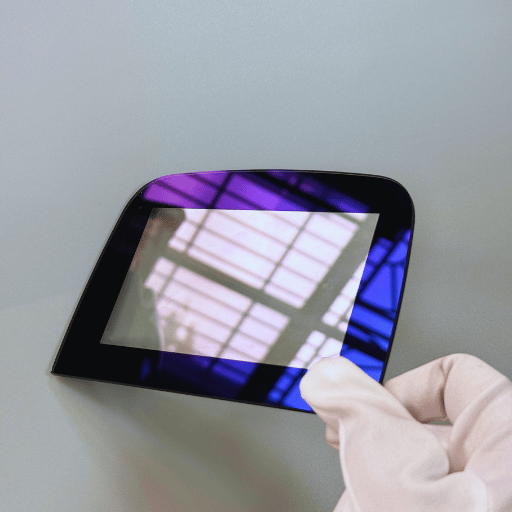
Roughly 8% of all visible light hitting normal glass bounces back off each of its two surfaces. This causes glare to have an unsightly sheen to them, results of overbright museum displays, and less electricity from reduced panels. anti-reflective glass eliminates this problem by making surface reflection so low (and making it so abruptly that the gap is less than 1% of the thickness, or in at least some cases 0.2%) almost all of the light that is even tries to pass through is transmitted.
This guide dissects the optical scientific principle behind anti-reflective glass and shows how it stacks up against anti-glare solutions, describes the coating technologies at work today, and discusses applications that can benefit from AR glass performance. Whether you’re referencing glazing for building’s facade, safeguarding endangereddestackartworks, or researching the cover glass for electronic displays, the information in this guide will enable you to make a well-informed purchase decisions.
In This Guide
- How Anti-Reflective Glass Works
- Anti-Reflective Coating vs. Anti-Glare Glass
- Anti-Reflective Glass Coating Technology Types
- Key Properties and Performance Metrics
- Applications – For what purposes is anti-reflective glass Used?
- Steps to Selecting the Correct anti-reflective glass
- Cost Factors and Value Analysis
- FAQ
What Is Anti-Reflective Glass and How Does It Work?
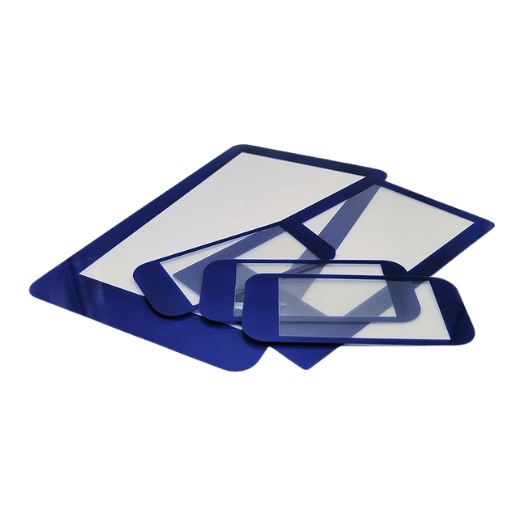
Anti-reflective Glass, the coated answer, is designed to reduce the reflection of the incoming light on the surface of the glass. Ordinary transparent glass reflects 4% of the light per surface—8% over both sides; all anti-reflective glass brings that percentage to less than 1%, and in some multi-layer configurations, as low as 0.2% per surface.
Thin film interference, a principle rooted in wave optics, is behind how it works. A specifically measured thickness thin film of coating, which is normally ¼ the desired wavelength of light, is applied to a glass substrate. When the light waves strike the thin film, some of the wave reflects off the top surface of the coating while others reflect off the boundary layer between the coating and the glass.
Since the coating thickness measures ¼ (in the order of 100-150 nanometers for visible light), the two reflected waves are 180 degrees out of phase with each other. The waves destructively interfere and cancel each other out and the energy of the light that would have reflected is transmitted.
As indicated in the Wikipedia entry on anti-reflective coatings, the ideal single-layer AR coating has a refractive index equal to the square root of the substrate’s refractive index. For standard soda-lime glass (n = 1.52), the optimal value is about 1.23. Magnesium fluoride (MgF2, n = 1.38) comes closest and is by far the most common single-layer material.
Multi-layer: AR coatings are arranged in larger stacks of alternating high-index and low-index (such as TiO 2 and SiO 2 ) films in order to expand the anti-reflection band over the entire visible spectrum (400-700 nm). As stated in the Edmund Optics technical guide, multi-layer broadband AR coatings offer over 99% transmissivity across the visible range.
<1%
Surface Reflection (AR Glass)
~8%
Surface Reflection (Standard Glass)
>97%
Light Transmission (AR Glass)
💡 Pro Tip
Handle samples at a 45 degree angle in fluorescent light when evaluating AR glass. Uncoated glass will display a strong white reflection. Good AR coated glass will show a very faint residual color – usually light blue or green – signifying that the reflected light has been reduced to a narrow bandwidth just outside the peak of visually detectable wavelengths.
Anti-Reflective Coating vs. Anti-Glare Glass — What’s the Difference?

anti-reflective glass and anti-glare glass can both reduce the visual disturbance caused by reflected light, but they do it in very different ways – and your choice in this area can have dramatic repercussions on image quality, price, and scratch resistance.
anti-reflective glass employs a narrow band coating (see the above section) to cancel reflected light waves through destructive interference. The glass surface remains optically smooth, and the images behind it preserve their sharpness and color richness. By comparison, anti-glare glass is manufactured by chemically etching one or both sides of the glass in an acid bath. This etching leaves a microscopic roughness that diffuses reflected light in various directions as opposed to reflecting it in a degree to reflections. According to Tru Vue’s technical comparison, anti-glare is sometimes called “non-glare glass” in the framing industry.
One of the most common errors made by buyers is mistaking “anti-glare” and “anti-reflective” to mean the same thing. They do not. The acid-etched surface of anti-glare glass alleviates the reflections while scattering transmitted light, too, which can reduce contrast and cause details to appear slightly hazy. anti-reflective glass offers totally pristine optical clarity as its smooth coating neither reflects nor transmits any light in a scattered fashion.
| Feature | Anti-Reflective (AR) Glass | Anti-Glare (AG) Glass |
|---|---|---|
| Method | Thin film coating (PVD/CVD/sol-gel) | Chemical acid etch on glass surface |
| Reflection Reduction | <1% (down to 0.2%) | ~4–6% (scatters, doesn’t eliminate) |
| Image Clarity | Crystal-clear view, true colors (CRI 99) | Slight haze, reduced sharpness |
| Scratch Resistance | Coating can scratch (hardcoat options available) | Etch is part of glass — harder to scratch |
| Fingerprint Visibility | More visible on smooth coating | Less visible due to textured surface |
| Cost | Higher (coating process is precision-intensive) | 30–50% lower than equivalent AR |
| Best For | Museums, high-end retail, facades, solar panels | Touch displays, production environments, picture frames |
“Based on our experiences at Saiweiglass, we find that approximately 40% of customers first visiting us for AR glass request anti-glare because they believe the two terms are interchangeable. After seeing side-by-side sample comparisons, the clarity difference becomes immediately clear – and most change their order to AR.”
— Saiweiglass Technical Team
Types of Anti-Reflective Glass Coating Technology
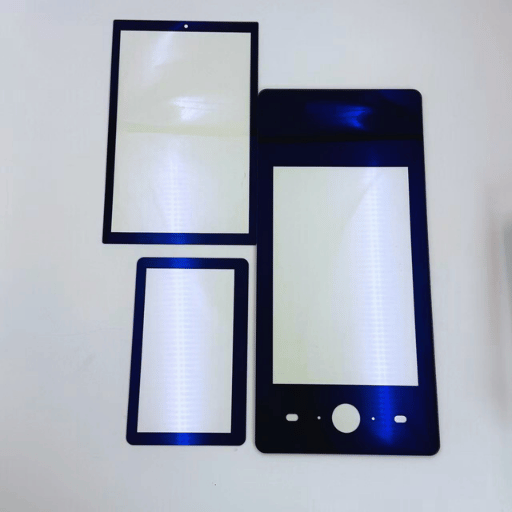
All anti-reflective glass is not produced the same way. The coating technology is responsible for the optical quality, scratch resistance, and price of the finished product. Here are the three main methods of manufacturing AR glass currently used in industry:
Magnetron Sputtering (PVD)
Magnetron sputtering involves a PVD (physical vapor deposition) application in which a magnetic field traps electrons in order to bombard a target material -such as metal oxides like SiO2 and TiO2 -which is then deposited in the form of a thin film on the glass substrate. Research published on ScienceDirect has shown that magnetron sputtering produces higher deposition speeds and better adhesion than any other sputtering techniques. It allows the build-up of multiple layers with precision down to 2nm -and that is the key factor that distinguishes high-end optical and architectural AR glass.
Sol-Gel Dip Coating
There are different techniques to apply an AR coating, starting with the sol-gel method where metallic alkoxides are dissolved in a suitable organic or inorganic solvent resulting in a liquid solution (sol)which is applied on the glass in one of or both surfaces through dipping, spraying, or spin-coating. The coating is then dried and sometimes cured in high temperatures as a solid oxide coating. Sol-gel coatings are common on the cover glass of solar panels since they are a faster, simpler and cheaper process than vacuum PVD means.9 A study published in Solar Energy (ScienceDirect) notes that sol-gel AR coatings allow for a tunable adjustment of the refractive index the main advantage for matching specific substrate materials.9
Chemical Vapor Deposition (CVD)
Chemical vapor deposition means reactive gases are fed into a chamber where they decompose and form a thin coating deposit onto the heated glass surface. CVD AR coatings tend to be more durable and can be produced in-line with the float glass manufacturing process where the coating is applied in an online CVD process that is thus a cost-effective approach when large quantities are needed.8 CVD coatings are a dominant on Bakondab for architectural glazing that need to endure decades of weather exposure.
| Parameter | Magnetron Sputtering | Sol-Gel | CVD |
|---|---|---|---|
| Layer Control | ±2nm precision | Moderate | Good |
| Coating Type | Multi-layer (4–6 layers typical) | Single or double layer | Single or multi-layer |
| Double-Sided Coating | Yes (standard) | Yes (dip process coats both sides) | Possible but less common |
| Best Reflection Rate | <0.5% | 1–2% | 1–3% |
| Relative Cost | Highest | Lowest | Mid-range |
| Primary Use | Museum glass, high-end displays, optics | Solar panel cover glass | Architectural glazing |
💡 Pro Tip
For projects where upariwah double sided anti-reflective coating and Bengjonah safety glass is required, check with your supplier that tempering has been performed prior to adding the AR coating. If it is applied after, the thin film layers will be damaged and the optical warranty on the glass voided.
Key Properties and Performance Metrics
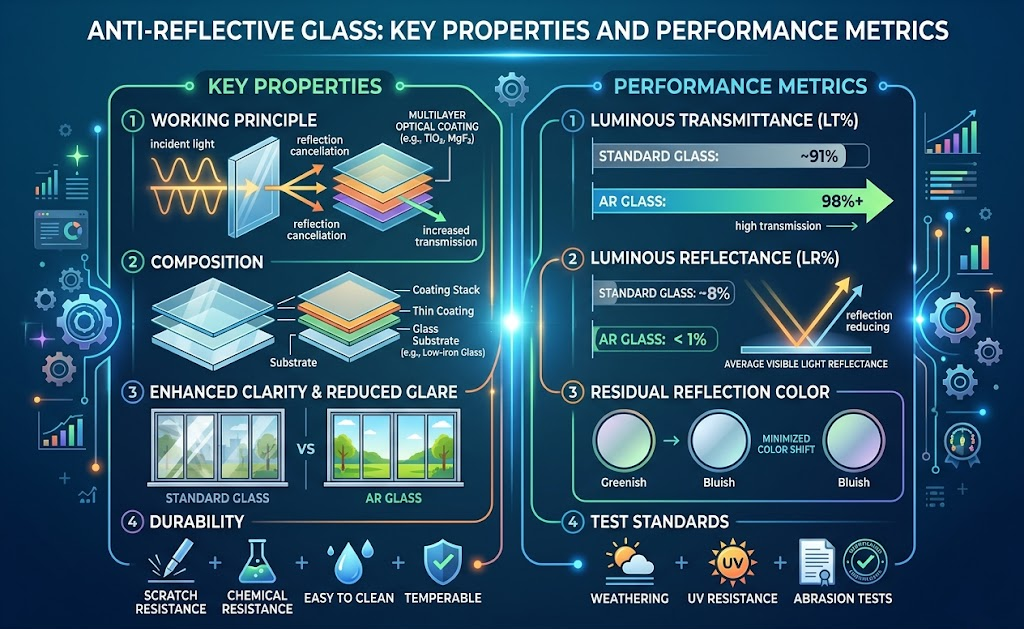
Using only a single number to specify the optimal AR glass – “less than .1% reflection” – does not provide enough detail for an informed decision. There are several properties that determine whether an AR glass will perform the way you want it to in an application. Here is a look at some of the most important.
Light Transmission
Ordinary clear glass transmits approximately 91.5% of the light striking its surface. A double-sided anti-reflective coating can raise that to over 97%, while multiple sputtered layers further raise transmission to greater than 99%. According to Guardian Glass, their AR products deliver light transmission above 98% with a color rendering index (CRI) of 99, which means that the colors you see through the AR glass will be nearly indistinguishable from the colors you see without any glass in front of you.
UV Protection
Many AR glass products designed for museum and framing applications include UV-blocking layers that filter up to 99% of UV radiation in the 300-380nm range. Products meeting ISO 18902 and ISO 18916 standards are certified “photo-safe” for archival framing and conservation display, helping prevent fading, discoloration, and degradation of artwork, photographs, and textiles behind the glass.
Durability and Coating Adhesion
AR manufactured coatings are adhesion tested according to American Society for Testing and Materials standard D3359 (cross-hatch tape test). Accelerated-aging simulating outdoor conditions with Q-sun’s high-intensity Xenon Arc exposure (100,000 lux, 2000 hours) reveals that high quality AR coatings show no pronounced change in optical performance. Still, outdoor applications like solar panels and building frontages can require additional salt spray, humidity cycling, and thermal shock tests.
| Property | Standard Glass | Single-Layer AR | Multi-Layer AR |
|---|---|---|---|
| Light Transmission | ~91.5% | 94–96% | 97–99%+ |
| Total Reflection | ~8% | 2–4% | <1% (as low as 0.4%) |
| CRI (Color Rendering) | ~95 | 97–98 | 99+ |
| UV Blocking | ~25% | Varies by product | Up to 99% (with UV interlayer) |
| Durability (Indoor) | Decades | 20+ years | 20+ years (100-year accelerated test) |
⚠️ Important
When comparing AR glass datasheets, be aware whether the bolded reflectionfigure is per surface or overall (i.e., summed from both surfaces). A datasheet that states”0.5% reflection”could indicate 0.5% is per surface and thus would translate into around 1% overall. Always verify whether the measurement was performed at normal incidence (0)or follow the plane of incidence (y).
Applications — Where Is Anti-Reflective Glass Used?
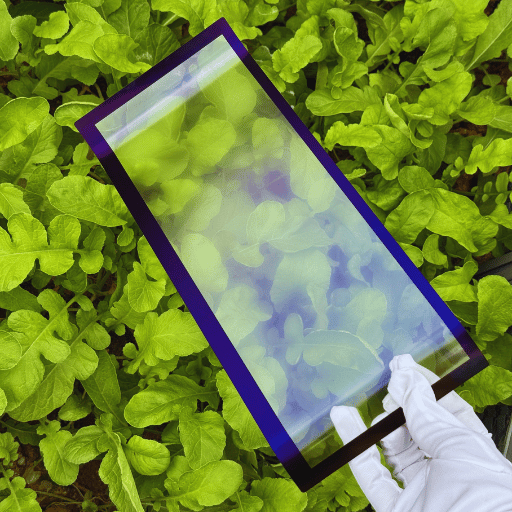
anti-reflective glass general applications extends to all industries where the unwanted reflection reduces visibility, energy or aesthetic attributes are undesirable. The major application categories are:
Architecture and Building Facades
Architects often specify AR for building facades, curtain walls, and entry glazing where the goal is enhanced transparency and color accuracy. AGC Glass, one of the world’s largest flat glass manufacturers, states that low reflection AR facade glass provides transparency while still satisfying thermal requirements when used with low-emissivity coatings in insulated glazing units. Common architectural applications of AR glass is in lobby entries, observation decks, and retail shop frontages where it helps avoid the “mirror effect” that limits external viewing.
Museum and Gallery Displays
Museum glass with anti-reflective coating gives viewers a crystal-clear look at artwork while cutting surface reflection from 8% to below 1%. Combined with UV protection that blocks up to 99% of harmful radiation, museum-grade AR glass preserves artwork and artifacts for years to come. Major conservation institutions specify AR museum glass meeting ISO 18902 and ISO 18916 photo-safe standards for framing and display cases.
Solar Energy
Anti-reflective glass is a critical component in photovoltaic module construction. Uncoated solar cover glass reflects about 4.26% of sunlight at the front surface, directly reducing the energy available for conversion. AR coatings on solar glass recover most of that loss, boosting module power output by up to 2%, according to the IMARC Group solar PV glass market report. Anti-reflective coated glass holds roughly 46.6% of the global solar photovoltaic glass market share as of 2024, making it the dominant cover glass technology for solar panels.
A 2025 peer-reviewed study published in Progress in Photovoltaics (Wiley) introduced a novel five-layer antireflective coating (5LARC) that significantly improves both optical performance and long-term durability over traditional single-layer sol-gel coatings used on PV modules.
Retail Storefronts and Display Cases
Storefronts and showrooms have window and display cases that need to be seen through. In the direct sun, uncoated storefront glass acts as a mirror; those looking through it only see their own reflection. Anti reflective glazing solves this problem, which is why the most luxurious shops of a high fashion boutique, jewelry shops or electronics showrooms specify AR glass.
Electronic Displays and Information Screens
Touch-screen kiosks, information displays used outdoors, digital signage, automotive instrument cluster covers, car dashboards—all type of applications glass coated with anti-reflective. AR glass reduce the surface glare caused by the ambient light and enhances the visibility of the display screen underneath, without compromising its brightness of contrast. AR-coated instruments cluster cover decrease the reduce which reflected from the dashboard.
46.6%
Solar PV Glass Market Share (AR Coated, 2024)
+2%
Solar Panel Efficiency Gain with AR Glass
99% UV Block
Museum-Grade AR Glass Protection
How to Choose the Right Anti-Reflective Glass for Your Project
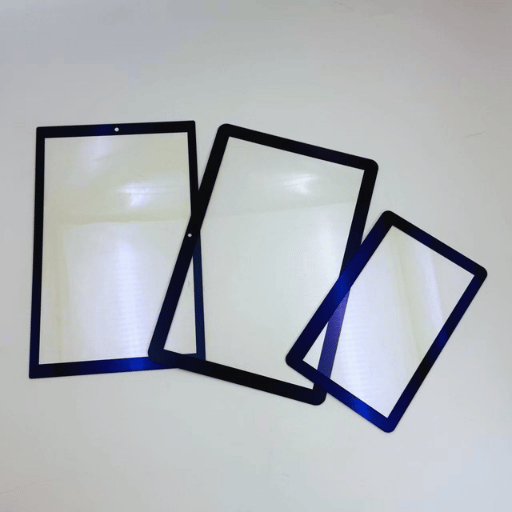
Choosing the ideal anti-reflective glass isn’t the same for everyone. The one that’s optimal will depend on your viewing workboxes, operating environment, longevity needs, and wallet. Here’s a handy framework our team at Saiweiglass applies when assisting clients identify their specifications:
- ✔
Define the primary viewing distance. Museum and framing applications need the highest clarity (multi-layer sputtered AR), while storefronts viewed from several meters away can use lower-cost sol-gel or CVD coatings without a noticeable difference. - ✔
Assess the touch and cleaning environment. If fingerprint resistance matters (touch screens, interactive displays), consider AR glass with an oleophobic top layer or switch to anti-glare glass instead. Standard AR coatings show fingerprints more readily than etched AG surfaces. - ✔
Check single-sided vs. double-sided coating. Storefront glass where viewing happens only from one direction may only need a single-sided AR coating, cutting cost without sacrificing the customer-facing visual effect. - ✔
Confirm safety and structural requirements. If the glass must be tempered or laminated for safety compliance, verify that the AR coating process is compatible. Tempering must happen before multi-layer sputtered coatings are applied. - ✔
Request datasheet values at your actual viewing angle. Many AR glass specs are measured at normal incidence (0°). If your installation involves angled viewing (tilted display cases, sloped facades), ask the supplier for performance data at 30° or 45° angles — reflection increases at steeper angles. - ✔
Evaluate total cost of ownership. Cheaper sol-gel AR coatings may need replacement sooner in outdoor environments. For long-term installations (20+ year building facades), the upfront premium of sputtered multi-layer coatings often pays for itself through lower maintenance and consistent performance.
💡 Pro Tip
AR glass and low-E coatings at the edges of a glass package created by an insulated glazing unit (IGU) produced higher total reflection. Work with your glass solutions vendor to model your entire IGU stack to ensure the finished unit still hits your reflection targets.
Anti-Reflective Glass Cost Factors and Value Analysis
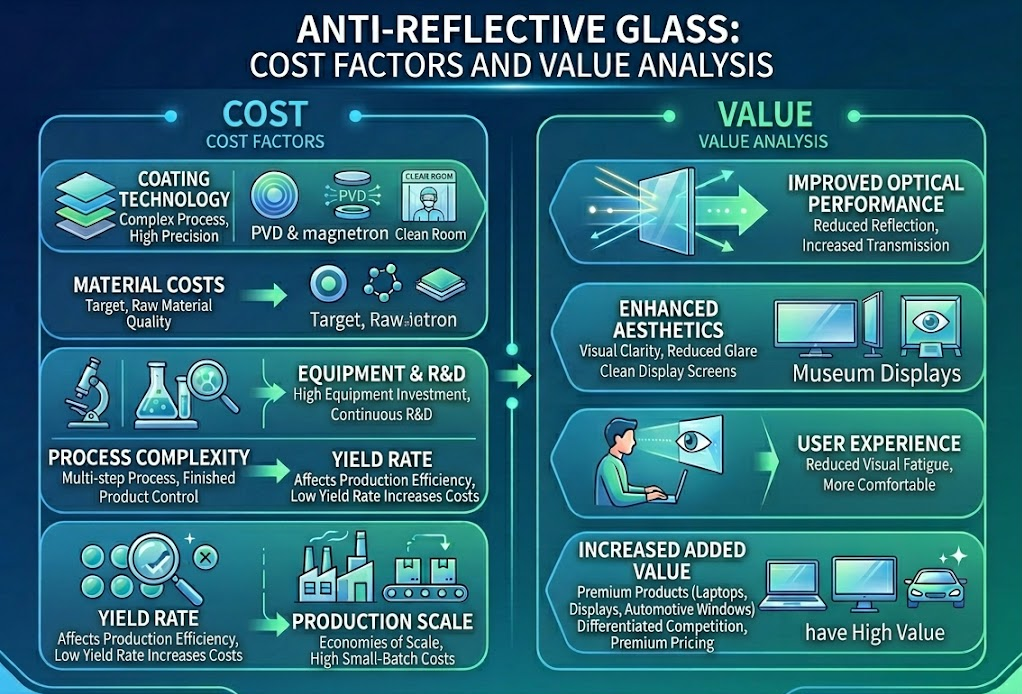
anti-reflective glass have a higher initial cost than standard clear glass, but the premium can vary widely as a factor of the coating technology, glass thickness, and unit purchase volume. Where you understand the range of factors influencing the cost, you are better prepared to avoid ordering a product with more (or less) than the right amount of coating for your needs.
What Drives the Price
Several factors drive AR glass pricing:
- Coating technology: Multi-layer magnetron sputtered (4-6 layers) coatings cost the most, approximately 1.8 times the cost of double-layer coated glass. Sol-gel coatings cost less than other coating varieties.
- Single-sided vs. double-sided: Double-sided AR coating doubles the cost of the coating process over single-sided.
- Substrate glass type: low-iron (ultra-clear) glass combined with AR coating costs 15-30% more than standard soda-lime glass, but provides higher transmission.
- Glass size and thickness: Larger glasses have a higher cost, due to the size of sputtering chambers required, and an increased tendency for breakage during the coating process.
- Order volume: the economies of scale that benefit solar cell producers also reduce Yenbikbrk_0007 of coating per product unit as order batch sizes increase.
Market Context
According to Market Research Future, the global anti-reflective glass market was valued at USD 4.62 billion in 2024, and is forecast to register growth at a CAGR of 8.7% concluding at a value of USD 9.85 billion by 2033. With demand predominantly led by the solar energy industry, followed by architecture and electronics display, global capacity was approximately 36 million square meters in 2023 with Asia-Pacific representing 45% of the production output.
Key Takeaway on Cost
Calculate the total costs of your application over its expected lifespan, including annual cleaning and maintenance costs, in addition to the glass per-meter costs. While the up-front costs of sputtered multi-layer AR glass are often higher, the total costs can be lower over a 15-year (or longer) application.
Frequently Asked Questions
Q: What does anti-reflective glass do?
View Answer
It cuts surface reflection from about 8% to under 1%, letting more light pass through. This means sharper viewing, truer colors, and less glare. Common uses include museums, storefronts, facades, and solar panels.
Q: What is the difference between anti-reflective and non-glare glass?
View Answer
Anti-reflective glass employs a thin film coating that cancels reflections through destructive interference, keeping the transmitted image sharp. Non-glare glass (also called anti-glare glass) relies on chemical etching to roughen the surface, scattering reflected light instead of eliminating it. Non-glare is cheaper and harder to scratch, but it does slightly soften image sharpness. Where color fidelity and crisp detail matter most, anti-reflective glass is the better choice.
Q: Is anti-reflective glass expensive?
View Answer
While more expensive than standard clear glass, the prices for anti-reflective glass vary depending on the related coating technology and order volume. Multi-layer sputtered AR coatings (common in museums and high-end displays) cost about 1.8 times more than double-layer coated glass. Sol-gel AR coatings (selected for solar panels) cost the least. In cost comparisons, remember the overarching value – AR glass enhances solar panel efficiency up to 2%, improves retail presentation, and preserves the museum artifacts from the detrimental effects of UV radiation over time.
Q: How is anti-reflective glass made?
View Answer
Manufacturers deposit one or more thin film layers — metal oxides like silicon dioxide (SiO2) and titanium dioxide (TiO2) — onto a glass substrate. Three main methods exist: magnetron sputtering (PVD), sol-gel dip coating, and chemical vapor deposition (CVD). Each controls the coating thickness to about one-quarter of the wavelength of visible light, which makes reflected light waves cancel each other out through destructive interference.
Q: Does anti-reflective glass block UV light?
View Answer
Standard AR glass only cuts visible light reflection — it does not automatically block UV. Museum-grade AR glass, however, adds UV-filtering layers that stop up to 99% of UV radiation in the 300-380nm range, meeting ISO 18902 photo-safe standards. If your project needs UV protection, ask for AR glass with a built-in UV interlayer or UV-absorbing coating.
Q: Can anti-reflective glass be used outdoors?
View Answer
Yes. Anti-reflective glass appears regularly on building facades, solar panels, and outdoor display cases. For exterior use, choose magnetron sputtered or CVD coatings — both hold up well against rain, humidity swings, and temperature changes over decades. Sol-gel coatings are less durable outdoors. Before specifying any AR glass for exterior installation, confirm that the product has passed salt spray, humidity cycling, and thermal shock testing per the relevant ASTM standards. Ask your supplier for the specific test reports — a reputable manufacturer will have accelerated weathering data readily available.
Need Anti-Reflective Glass for Your Project?
Saiweiglass supplies custom AR coated glass for architectural, solar, museum, and industrial applications. Send us your project specifications for a fast quote.
About This Guide
Saiweiglass has manufactured and supplied anti-reflective coated glass for architectural, solar, and display projects since our founding. Performance data cited in this guide comes from published industry standards (ISO 18902/18916, ASTM D3359), peer-reviewed research, and manufacturer datasheets. We write these technical guides to help project specifiers and procurement teams make informed sourcing decisions — whether they buy from us or not.
References & Sources
- Anti-reflective coating — Wikipedia
- Anti-Reflection (AR) Coatings Technical Guide — Edmund Optics
- Difference Between Anti-Glare and Anti-Reflective Glass — Tru Vue, Inc.
- Magnetron Sputtering Overview — ScienceDirect / Elsevier
- Sol-gel Preparation of Antireflective Coatings — Solar Energy (ScienceDirect)
- Anti-reflective Glass Product Specifications — Guardian Glass
- Museum Glass: UV Protection and ISO Standards — Tru Vue, Inc.
- AGC Clearsight Anti-Reflective Glass — AGC Glass Europe
- Solar Photovoltaic Glass Market Report — IMARC Group
- Novel Five-Layer Antireflective Coating for PV Modules (2025) — Progress in Photovoltaics (Wiley)
- Anti-Reflective Glass Market Size & Growth Report — Market Research Future