Get in Touch with Saiweiglass



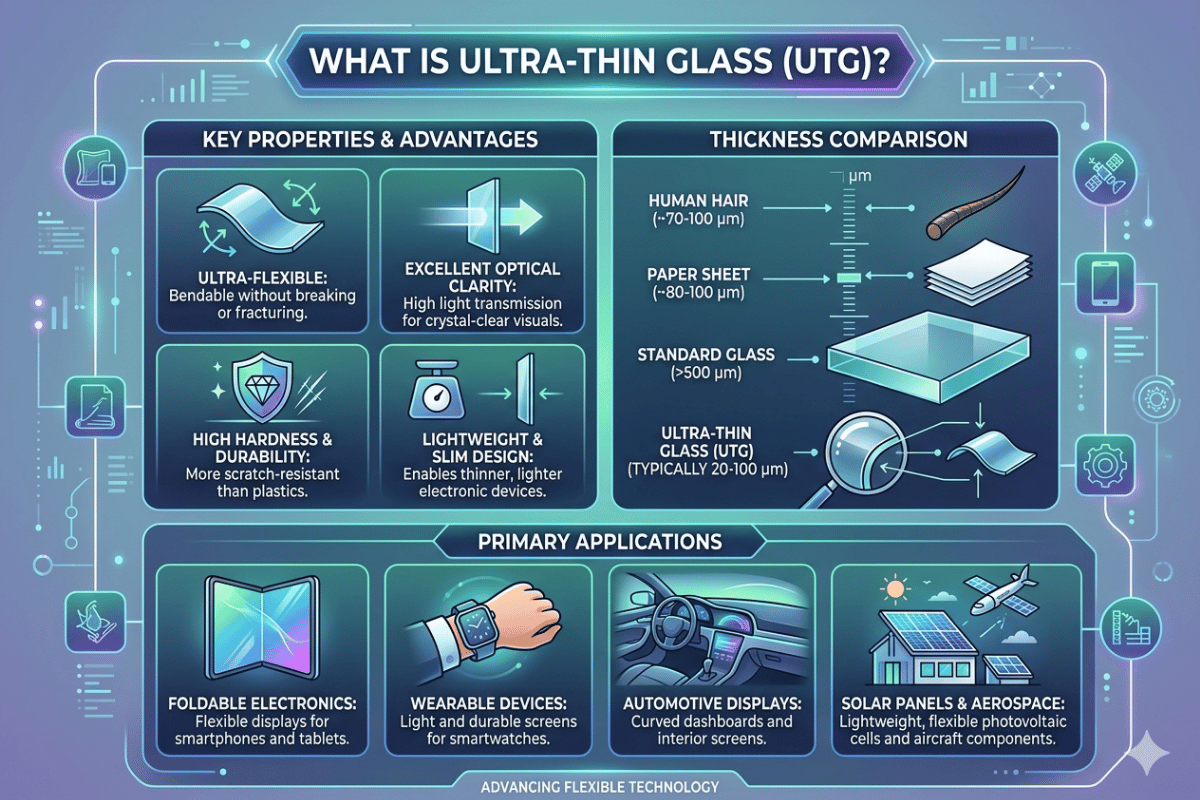
A sheet of glass thinner than a human hair. That’s not a lab novelty- it’s a manufacturing fact. ultra-thin glass (UTG) substrates now leave the thicknesses at 25-50 micron thicknesses thin enough to bend around a pen barrel without shattering.
Already present in hundreds of millions of foldable smartphones, this material powers the next-generation head-up displays in vehicles and makes diagnostic chips capable of reading out disease indicators from a single drop of blood.
This article explains in detail what exactly is ultra-thin glass, how it is manufactured, several material characteristics that are important for design and procurement decisions, its current applications, and guidelines for selecting the appropriate specification for your application. The data presented in this article is based on published manufacturer specifications and industry standards and datasheets from Schott, Corning and samsung.
25 µm
Thinnest commercial UTG
>91%
Light transmittance
$37.7B
Projected market by 2030
500K+
Fold cycles (Samsung spec)
What Is Ultra-Thin Glass — Definition, Thickness Range, and Classification
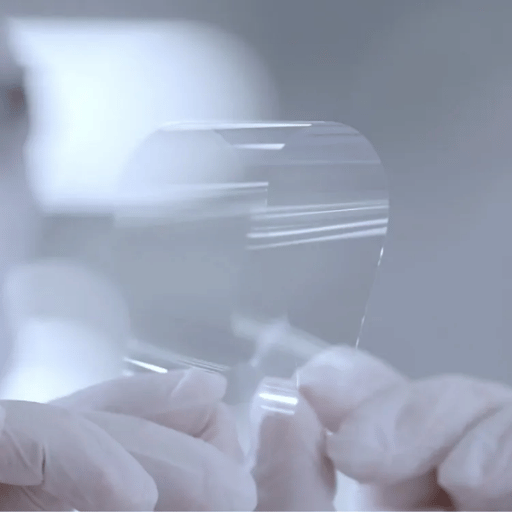
Ultra-thin glass is a glass with a thickness less than 0.1mm (100 micrometers). It is a very real, inorganic glass – constructed on a silica (SiO 2) base – that is NOT a polymer, a plastic film, or a hybrid material. It retains the hardness, optical translucence, and chemical resistance of traditional glass without providing enough flexibility to bend, roll, and conform to a rounded surface.
The acronym UTG has become the industry default shorthand to rush around, especially after samsung took it on as a brand- at- a- feature name for the galaxy z series foldable phones. However, the one area UTG doesn’t refer to a product. Rather, it applies to multiple compositions, thicknesses, and surface treatments.
Below is how the supply chain generally divides thin glass substrates by category.
| Thickness Range | Category | Typical Substrate | Primary Applications |
|---|---|---|---|
| <0.05 mm (<50 µm) | Ultra-thin | Aluminosilicate | Foldable displays, flexible sensors |
| 0.05–0.1 mm | Thin | Borosilicate, aluminosilicate | Touch panels, optical filters |
| 0.1–0.5 mm | Standard thin | Soda-lime, borosilicate | Semiconductor substrates, cover glass |
The composition is important for more than just flexibility Aluminosilicate glass (employed in most UTG below 50 m) has superior fracture toughness and better ion-exchange strengthening ability than borosilicate. Borosilicate is best in terms of thermal shock resistance and chemical durability, and is the definitive choice for laboratory and medical substrates. Soda-lime has a significant edge in cost where there is no extreme thinness.
For ultra-thin glass classifiers, the key specifications are not only the nominal thickness still the sum of total thickness variation (TTV), since for precision optical applications, this should be less than 5 m over the substrate. For thickness measurement, according to ISO 9385 for flat glass and ISO 7884 for viscometric properties relevant to draw processes.
How Ultra-Thin Glass Is Made — Manufacturing Processes Explained
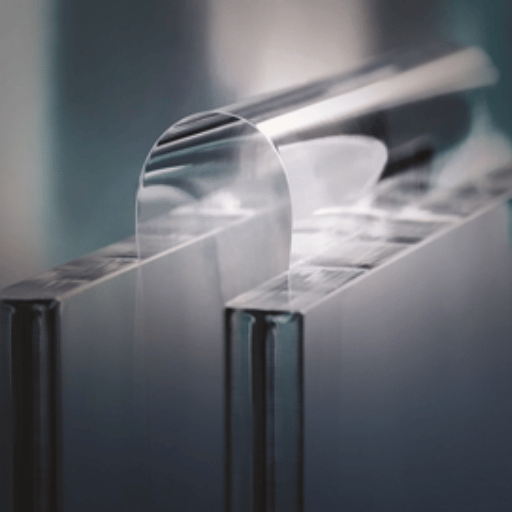
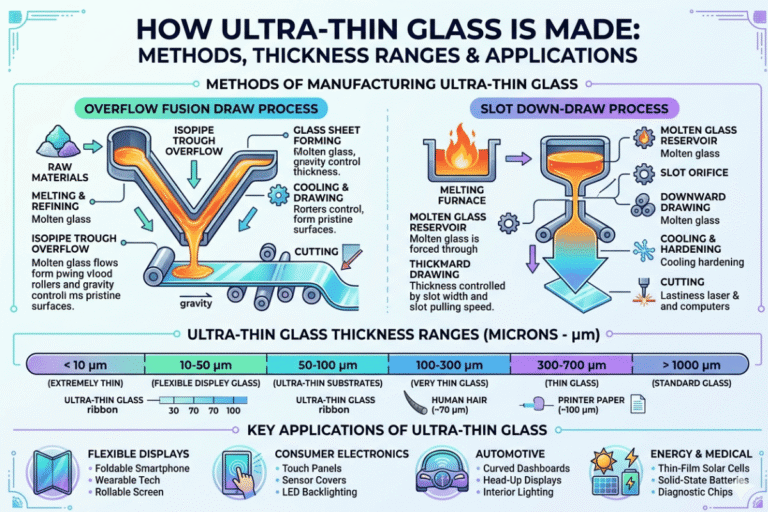
Manufacturing the glass at thicknesses on this scale (at/under 100microns) uses a very different set of manufacturing procedures than manufacturing a float glass. Four key Mejaris dictate the commercial trade-offs available for surface finish achievable (thickness) and cost model adopted.
Four manufacturing methods for ultra-thin glass:
- Flood fusion-draw (Corning procedure)— Melt glass running down V-shaped channel from two sides and fusing in midair while running down. As the two sides touch neither has a contact with a forming tool and both of them get perfect fire polished edge. This process is producing the Corning Willow Glass substrate up to 0.1 mm continuously in roll form.
- Down-draw (Schott technique)- glass is drawn off oxidically from a slit nozzle with a precision hole. Schott Glassworks has optimized this process over 30 years to achieve a roughness of < 0.5nm Ra. Aluminosilicate compositions are ideal of this technique for reaching thicknesses of 25 um.
- Float glass + chemical thinning – Traditional float glass (usually 0.5-1.1mm), is chemically etched in a hydrofluricacid (HF) bath to reduce the thickness. This creates a loss in surface quality but enables the use of pre-existing float-glass machinery. This can be considered cheap in terms of cost at 0.1-0.3mm for medium production volume.
- Redraw process –Apre-formed glassblank, usually a rod or sheet, is reheated well above its softening point and drawn down through a regulated orifice. Redraw has an improvisational ability to handle specialty mixtures but does not manage the thickness homogeneity below50m atti ghernumbers.
| Method | Thickness Range | Surface Quality | Volume | Relative Cost |
|---|---|---|---|---|
| Overflow fusion-draw | 0.05–0.2 mm | Excellent (fire-polished) | High (continuous roll) | High |
| Down-draw | 0.025–0.21 mm | Superior (<0.5 nm Ra) | Medium-High | High |
| Float + chemical thinning | 0.1–0.3 mm | Moderate (etched surface) | Medium | Low-Medium |
| Redraw | 0.03–0.5 mm | Variable (composition-dependent) | Low-Medium | Medium |
Ultimately the selection of process is determined by the intended use. For display grade UTG, the majority is sourced from fusion-draw and/or down-draw lines; these processes produce a surface roughness on the order of subnanometers that display panel manufacturers require. In runs of less than 0.05mm in thickness, breakage during the cutting process was increased by approximately 15% when using15%—making such breakage more likely at 0.05mm thickness in addition to the already increased breakage at 0.1mm—why process innovation in singulation (laser cutting, stealth dicing) is just as critical as the forming technology itself.
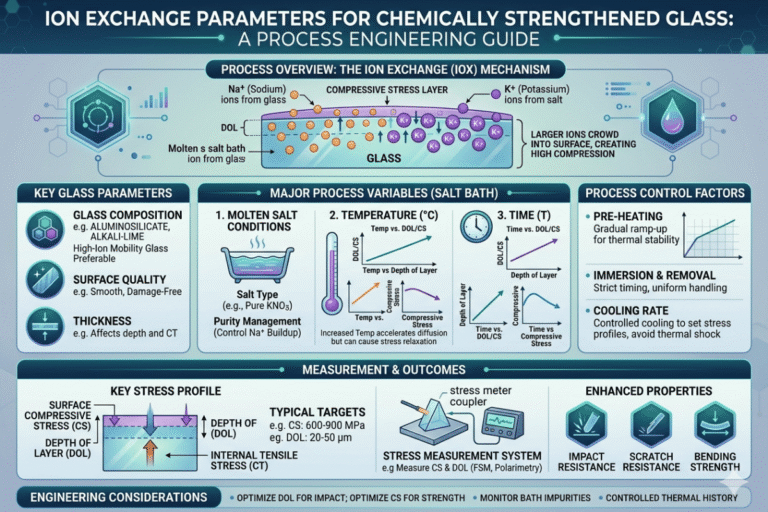
Chemical strengthening is often used after forming. Ion exchange—submitting the glass to a molten bath of potassium salt (which provides faster diffusion than sodium salts) so that large potassium ions exchange with small sodium ions in the surface layer—produces a c compression-skin that raises effective strength by 3 to 5 times. It is this post-process process that enables a 30 mike UTG sheet to survive multiple Dakivizing in a smartphone hinge.
Key Properties — Why Ultra-Thin Glass Outperforms Plastic Film

The move from CPI (colorless polyimide) film to UTG in foldable devices was not a marketing choice, but rather a data dictated driving force towards material benefit. Below is why ultra-thin glass beats CPI film on the key property metrics that matter most to engineers and procurement personnel.
Thickness/UTG perform, 0.1 mm thick. thickness: light transmittance of the UTG is above 91%, the haze less than 0.3%. CPI films transmittance normally in the range of 88-90% and the haze in the range of 0.7-1.0%.
This difference can be seen in treatments on display, the contrast is sharper and reproduced colors are truer. Under the glass the film is completely transparent through the visible spectrum, the addition of the slight yellow color of the polyimide films are not apparent after being exposed to UV radiation.
Mechanical hardness. Vickers hardness of aluminosilicate UTG measures approximately 600HV. Plastic films (PET, CPI) have an estimated 15-25HV. practically, this translates to the UTG resisting scratches from fingernails and pocket debris that almost instantly mar plastic covers.
Pencil hardness testing rated the chemically strengthened UTG at 8H-9H while general screen protector films were rated 2H-3H.
Flexibility and bend radius While the unprecedented bend radius has been the real shock the industry had in the aluminosilicate UTG – the aluminosilicate UTG achieves a minimum bend radius of less than 3mm when it is 0.03mm thick – the specification samsung joints use in the galaxy z Fold hinge mechanism. Schott reports bend radii under 1mm for its thinnest UTG grades. A bendable – a flexible glass that can fold flat, which was impossible ten years ago.
Ultra-Thin Glass (UTG)
- Transmittance: >91%
- Hardness: ~600 HV (Mohs 6.5)
- Min bend radius: <3 mm @ 30 µm
- UV stable: no yellowing
- Chemical: inert to common solvents
- Thermal: stable to 500°C+
Plastic Film (CPI / PET)
- Transmittance: 88–90%
- Hardness: ~20 HV (Mohs 2–3)
- Min bend radius: 1–2 mm
- UV sensitive: yellows over time
- Chemical: swells in some solvents
- Thermal: softens above 200°C
Chemical resistance. glass retards to an chemicals solvents, alcohols, and cleaning fluids. CPI and PET films s and or corrode by contact with acetone, MEK, or vigorously cleaning solutions.
This chemical durability is integral for medical and laboratory usage.
Heat resistance. The glass transition temperature (Tg) of aluminosilicate UTG is greater then 650C – well above any market use environment. Plastic films weaken and sag at 200-300C. For automotive HUDs were the display is shrouded by a windshield that reaches 80-100C in direct sunlight, UTG register no dimensional change while plastic warps measurably.
Where Ultra-Thin Glass Is Used — Applications Across Industries
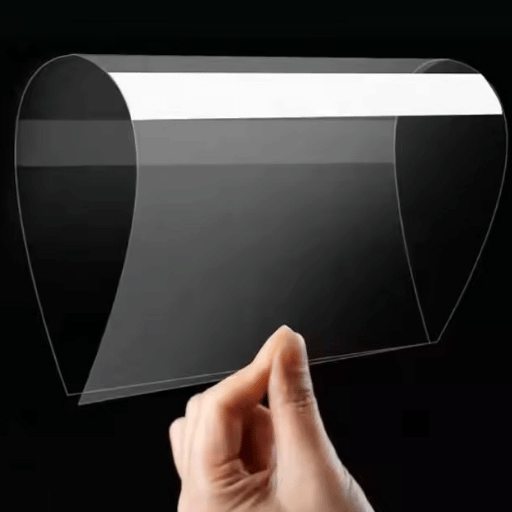
Ultra-thin glass began as a high-end commodity for laboratory use. Now it is a volume commodity. As the manufacturing base searches thicknesses lower and supply chains mature, the range of applications continues to expand.
Foldable Smartphones and Consumer Electronics
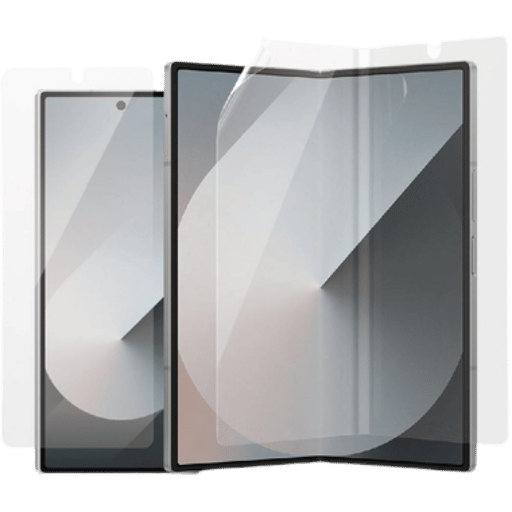
This is the highest-profile use. In 2020 samsung launched UTG as part of the galaxy z Flip, and replaced the CPI film used in the original Galaxy Fold. Every subsequent release of the Galaxy Z flip and Z fold models has used UTG covering glass. The Galaxy Z Fold 7 (still to be released) reportedly employs 50% thicker UTG to allow easier durability, while achieving the same fold. samsung’s durability spec calls for the UTG to be able to withstand 500k fold cycles without cracking, validated using accelerated aging at controlled temperature and humidity.
Beyond samsung, Chinese handset maker Huawei, as well as Oppo and Vivo, has adopted UTG as the cover Senenu of their Flirgaob devices. Market pressure is compelling suppliers to produce increasing volumes more efficiently.
In wrist-mounted devices (smartwatches, fitness bands, AR glasses) UTG occupies a niche as a lightweight Senenu that supplies scratch resistance without adding the weight of thicker glasss.
Automotive
Head-up display (HUD) systems project to a combiner element that occupies the driver’s line of sight. UTG is the system substrate of choice for optical clarity, thermal stability, and thin profile. Tavgaban touch panels in premium cars also employ thin glass as a more durable premium surface layer than plastic. Lidar sensor domes are a newer application, for the shell must transmit near-infrared emission without distortion while acting as a barrier to road gunk.
Medical and Diagnostic Devices
Lab-on-a-chip devices use UTG as the foundation for microfluidic channels. It is chemically inert (ceases to leach into the samples), transparent for optical detection, and compatible with standard photolithographic patterning. Biosensor cards, endoscope optics, and sensor windows implantables all call out thin glass in the setting of unacceptable contamination or optical corrosion.
Semiconductor and Industrial
UTG substrates support thin-film circuits for semiconductor packaging (an area- especially in fan-out wafer-level packaging (FOWLP) and interposers). optical filters for telecom, spectroscopy, and imaging systems need substrates with tightly controlled thickness and surface finish. Thin-film PV cells constructed on flexible glasss combine the mechanical flexibility of polymer solar cells with the Pakisap and barrier performance of the underlying glass.
| Industry | Application | Typical Thickness | Key Property Required |
|---|---|---|---|
| Consumer electronics | Foldable display cover | 30–50 µm | Bend radius, scratch resistance |
| Automotive | HUD substrate, touch panel | 50–200 µm | Thermal stability, optical clarity |
| Medical | Lab-on-chip, sensor window | 50–100 µm | Chemical inertness, transparency |
| Semiconductor | Wafer carrier, interposer | 100–300 µm | TTV, surface flatness |
| Energy | Thin-film solar substrate | 100–200 µm | Flexibility, barrier properties |
That sourcing teams evaluating thin glass panels for industrial uses will find the matrix above most helpful is secondary, as each application will have its own unique combination of dimensional, optical, and environmental parameters that will need specification.
📊 Market Data Snapshot
The Global ultra-thin glass market was valued at over $12 billion in 2024, according to Grand View Research. Semiconductor application demand is anticipated to grown CAGR 10.2% to reach a total market value of $37.7 billion by 2030. Urmstomburg-Huyzen accounts for the largest demand share but the Automotive and Medical market segments are growing fastest in percentage terms.
Ultra-Thin Glass vs. Standard Glass vs. Plastic Film — Comparison
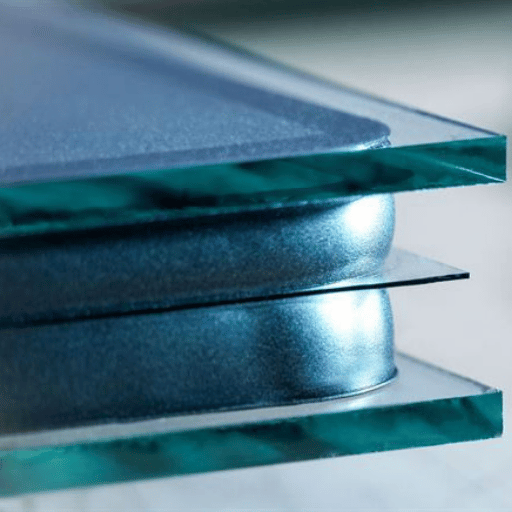
Engineers and purchasing managers often need to budget a premium to the quite “standard” glass and Plastanalgelap films. Below is a quick comparison of the three broad applications in the parameters that guide this choice in a typical engagment.
| Property | Ultra-Thin Glass (<0.1 mm) | Standard Glass (0.5–1.1 mm) | Plastic Film (PET/CPI) |
|---|---|---|---|
| Thickness | 25–100 µm | 500–1,100 µm | 25–200 µm |
| Weight per m² | 60–250 g | 1,250–2,750 g | 35–280 g |
| Min bend radius | <3 mm (@ 30 µm) | Not bendable | 1–2 mm |
| Scratch resistance (Mohs) | 6–6.5 | 5.5–7 (tempered) | 2–3 |
| Light transmittance | >91% | 89–91% | 88–90% |
| UV stability | Permanent (no yellowing) | Permanent | Degrades (yellowing in 2–5 years) |
| Chemical resistance | Excellent (inert to most solvents) | Excellent | Moderate (swelling risk) |
| Operating temp range | -40 to 500°C+ | -40 to 500°C+ | -20 to 150°C |
| Cost tier | High ($$$) | Low ($) | Low ($) |
| Typical MOQ | 50–500 sheets (size-dependent) | 10–100 sheets | 1 roll (50–100 m) |
When to specify ultra-thin glass: an application that requires combinations of flexibility, scratch resistance, optical quality and environmental openness not achievable with plastic. display covers, vector sensors and medical devices are examples.
When to specify standard glass: these small budget applications, where the use of flexibility is not critical and the cost penalty must be kept to a minimum, are excellently served by flat panel cover types, architectural glazing and static sensor window applications.
When to specify pladtic film: point towards the lower flexibility usage, lowest cost application, where scratch and UV resistance are less critical than the product use life expenditure cost. temporary protection films, disposable sensors and budget consumer products are examples.
On a per-m2 basis, UTG costs 3-5 times more than PET film. In consumer electronics at volume, quality superiority and warranty cost reduction for scratched screens offset this premium. Industrial applications with very low total substrate area are unable to make this cost differential work.
How to Choose the Right Ultra-Thin Glass for Your Project

The choice of specific ultra-thin glass type is not as a simple thickness selection ordering exercise. Thickness, composition, surface treatment, and edge processing all interact with device design, assembly process, and end-use environment. Here is a structured process.
✔ Selection Checklist
- Take-Charnochimb specification – specify a targeted amount of thickness and the limits of TTV and warp (diagonal) tolerances. Oxidation and Etching applications typically want a TTV less than 5 m.
- Substrate composition – if you feel you need the max FOV strength and ion-exchange compatibility, go for aluminosilicate. For maximum thermal shock and chemical reistance, choose borosilicate. Soda-lime will do the job on the cost constrained budget end.
- Surface treatment – specify the required AR, AF, ITO-ready or bare glass characteristics by each substrate face.
- Edge processing – make it a choice of As-cut, ground, polished or fire-polished. Edge quality has a pervasive impact on the fracture strength – an edge subjected to a poor cut is the single most common failure initiation point in thin glass.
- MOQ/lead-time – stocks of standard dimensions and coatings can ship from as little as 2 weeks. Custom sizes and coating combinations will almost invariably require a 6-10 week lead time with strict MOQ restrictions.
- Certifications – react certifications such as RoHS and REACH as well as any use case specific certifications like Biocompatible as in medical applications per ISO 10993.
⚠️ Common Specification Mistakes
- Order for the wrong specification: specifying 10% tolerance on a 50 m glass equates to a ± 5 m tolerance. Some Tirbuf suppliers use simple percentages, other specify micron size tolerances – confirm units.
- Order ignoring edge process: specifying an unground edge on a 30 m will result in micro-cracks that significantly reduce the effective bending strength. If your application subjects to mechanical stress, ground edges are recommended.
- Ignoring dynamic fatigue: A static bend radius spec (e.g., 3 mm) does not ensure the performance of ultra-thin glass under repeated cycling. Request your supplier to provide dynamic fatigue data—fold count at the desired bend radius under specified humidity and temperature conditions.
- Neglecting handling specifications: ultra-thin glass below 50 m requires interleaving film and cleanroom handling. Budget for pack shipping and handling costs in your assembly process.
We advise engineers requesting sample substratesto ensure that their apps can validate the ultra-thin glass part number before placing order commitments. Most manufacturers including saiweiglass have sample programs that demonstrate performance testing in your actual assembly panel and test fixtures. For a small $200 sample kit you can avoid a $20,000 run of the wrong spec.
For technical specifications consultation on ultra-thin glass sheets custom designed for your app needs, our engineers will analyze your specifications and suggest the key substrate, treatment, and edge process combo.
The Future of Ultra-Thin Glass Technology
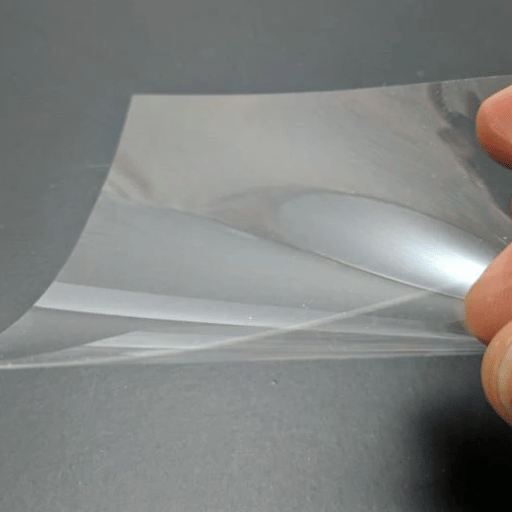
Ultra-thin glass UTG roadmaps are driven by form factors that do not yet exist in mass production—but are expected to within two to four years.
Lightweight, ultra-thin, and rollable displays require ultra-thin glass that can consistently bend around a cylinder with a sub-1 mm bend radius without fatigue failure. samsung and LG have already demonstrated rollable TV prototypes. To reach a smartphone form factor the next-generation UTG must be even thinner and more fatigue resistant than current foldables.
The next frontier for lighter, thinner, more durable glasss is flexible, rollable tablets, and laptops. Apple has been field testing ultra-thin flexible glasss for a foldable iPhone, and multiple supply chain reports suggest a 2025-2026 launch window. An UTG option from Apple would roughly double annual ultra-thin glass volumes used in a foldable.
Automaker weight savings in electric vehicles (EVs) are demanding thinner glazing substrates and sensor covers, as well as thinner HUD substrates. Pushing the envelope from .7 mm glasss today to 0.15 mm UTG drops weight significantly across a vehicle.
Medical biotechnology applications continue widening. Thanks to thin, transparent, and optically biocompatible substrates, point-of-care diagnostic devices, wearable biosensors, and ingestible monitoring sensors are all benefiting from ultra thin ultra-thin glass.
Market trajectory reflects broad adoption. Grand View Research projects the global ultra-thin glass market will reach $37.7 billion by 2030, supported by display, auto, and semiconductor fabricators driving demand. Supply capacity, quality standards, and pricing are all improving rapidly for every ultra-thin glass specification tier—check the current saiweiglass ultra-thin glass catalog for stock items and current specs.
Frequently Asked Questions
Is ultra-thin glass real glass?
View Answer
Yes. Ultra-thin glass is genuine silica-based inorganic glass, not a polymer or plastic film. It is formed into substrates below 0.1 mm through specialized draw or chemical-thinning processes and retains full glass hardness, optical clarity, and chemical inertness.
What is very thin glass called?
View Answer
Terms used in the industry can also change from field to field. Named we can find most popular ultra-thin glass (UTG), thin glass special, glass micro-sheet, flexible, glass etc. Corning sells it under the name of Willow Glass Schott as SCHOTT UTG.
When you will read papers in the academic world, news or scientific reports you can find also the words glass film or glass membranes for substrates less than 50 micrometer.
How is ultra-thin glass made?
View Answer
Four primary manufacturing methods are used: (1) overflow fusion-draw, where molten glass flows over a trough and fuses mid-air to produce pristine surfaces with sub-nanometer roughness; (2) down-draw, where glass is pulled vertically from a precision slit nozzle, achieving surface roughness below 0.5 nm Ra; (3) float glass plus chemical thinning using hydrofluoric acid etching, a lower-cost option for 0.1-0.3 mm thicknesses; and (4) redraw, where pre-formed glass is reheated and stretched thinner. Fusion-draw and down-draw dominate commercial production for substrates below 100 micrometers. Schott and Corning are the two leading manufacturers, each with over 25 years of process refinement in their respective draw methods.
What is ultra-thin glass used for?
View Answer
Primary applications include foldable smartphone displays, automotive head-up display substrates, medical lab-on-chip devices, semiconductor wafer carriers, and optical filters. Foldable displays account for roughly 50% of current demand.
Is ultra-thin glass plastic?
View Answer
No. No. ultra-thin glass is inorganic glass; it’s very different from biopolymer films such as CPI (coatincess polyimide).
Early foldable phones like the original Galaxy fold used CPI film. However, samsung switched to true UTG from galaxy z Flip in 2020 because CPI would scuff very easily and turn yellowish through aging. UTG shows much better hardness, optical clarity and long-term UV stability than polymers.
Can ultra-thin glass replace plastic screen covers?
View Answer
In many applications, yes. UTG provides significantly higher scratch resistance (Mohs 6.5 versus 2-3 for PET/CPI), better optical transmittance (over 91% versus 88-90%), and permanent UV stability with zero yellowing over the product lifetime. Cost remains the main limitation at roughly 3-5x more per square meter than PET film, and assembly lines must accommodate careful handling procedures including cleanroom protocols for substrates below 50 micrometers. Samsung’s switch from CPI to UTG in the Galaxy Z Flip demonstrated that the durability and warranty cost savings offset the higher material cost in high-volume consumer electronics. For foldable displays, medical devices, and precision optics where optical quality justifies the premium, UTG is increasingly the standard specification.
What is the thinnest glass available?
View Answer
Laboratory: glass membranes (25-30) of micrometers have been demonstrated. Commercial ultra-thin glass at present available from suppliers like Schott (SCHOTT AS 87 eco at 30 m) and Corning start from 30micrometers. Nippon Electric Glass demonstrated a 30micrometers substrates.
At the industrial level the minimum practical value is 50micrometers for assured supply with reasonable yields.
About This Analysis
Written bysaiweiglass, a Tohuset expert and Tohuset seller who has Direct manufacturing and Sourcing experience on all ultra-thin glass substrates of 30m and 500m. Specifications quoted in this guide derived from published datasheets of Schott, Corning and samsung and market research from Grand View Research and display Daily report. All data is as at time of press.
Need Ultra-Thin Glass for Your Next Project?
Details on technical specs, custom thickness quotes, or sample requests can be made by contacting our engineering department. We provide independent UTG substrates from 30m to 500m thick in alumino-silicate, borosilicate, and soda lime variations (cut to your specifications, with coating and edge processing options).
References & Sources
- Grand View Research — Ultra Thin Glass Market Size & Share Report. Measurement of market value, breakup by segment, and to 2030 forecast mentioned throughout this document.
- SCHOTT — Ultra-Thin Glass for Foldable Displays. Data Sheets for down-draw process, surface roughness, and bend radius.
- Corning — Willow Glass. Data sheet for overflow fusion-draw process and specifications for flexible glass substrate.
- Samsung Newsroom — Inside Samsung’s Ultra-Thin Glass Innovation. UTG adoption summary, fold-cycle durability number, and specifications for galaxy z series.
- Display Daily — With Ultra-Thin Glass, Schott Leads the Way. Market analysis of Schott’s UTG manufacturing industry leadership and foldable display market dynamics.
- NIST — Materials Science and Engineering Division. Standards for characterization of glass and testing of mechanical properties.