Get in Touch with Saiweiglass



Updated November 2026
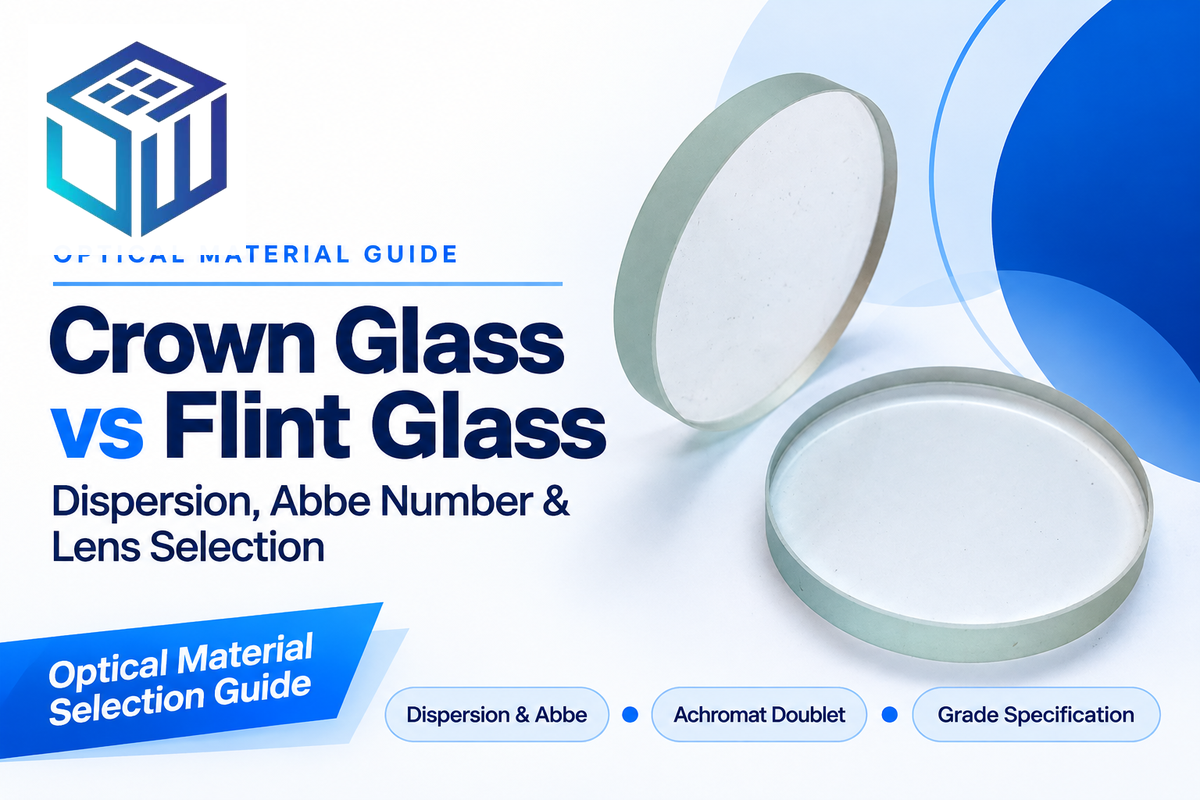
Comparing crown glass vs flint glass optical properties starts with dispersion. Crown glasses generally have lower dispersion and higher Abbe numbers; flint glasses have higher dispersion and lower Abbe numbers. Designers manipulate this difference to focus each color in a lens in a specific way, sharing a positive crown element with a negative flint element.
Refractive index adds another dimension. A high-index crown can bend light more strongly than a particular flint, so choosing by family name alone can send a design in the wrong direction. The useful comparison is between named grades at the same wavelengths, followed by checks on transmission, manufacturing and the intended optical performance. For processing scope and quotation, see our optical glass solutions.
Crown and Flint Glass: Differences at a Glance
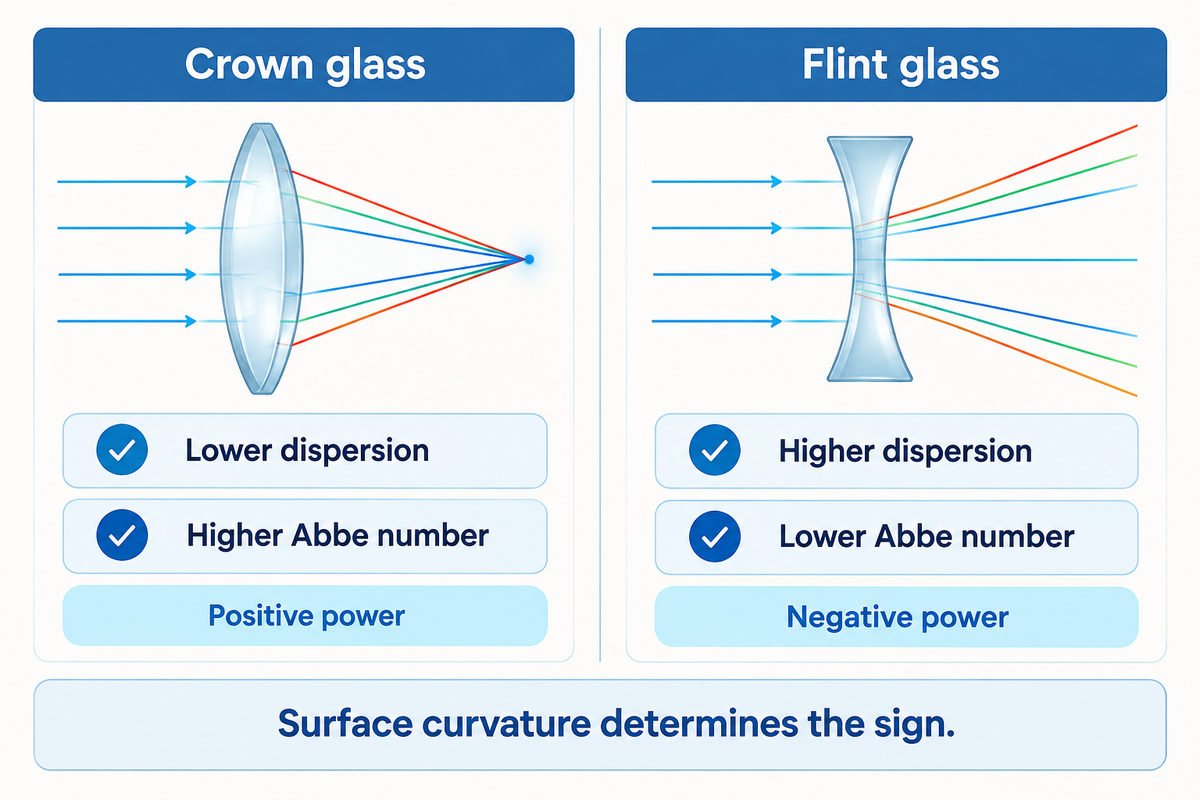
Crown and flint glass differ most usefully in their dispersion, the change in refractive index with wavelength. A higher Abbe number means weaker color dispersion in a given pair of wavelengths. Crown glass is often a starting point for a low-dispersion lens, while flint can supply the stronger dispersive correction needed in a lens pair.
Crown glass
- Lower dispersion within the traditional comparison.
- Higher Abbe number.
- Often provides positive power in a conventional positive achromat.
Flint glass
- Higher dispersion within the traditional comparison.
- Lower Abbe number.
- Often provides negative power to balance chromatic error.
No one position is mandatory. For example, a crown lens can be negative, and a lens of flint glass can be positive; surface curvature determines the sign of its optical power. In an achromat, the designer decides what quantity of power and dispersion will be used to achieve the correction target.
For a visible-light camera, the practical question is how much focus shift the complete objective can tolerate. For a dispersing prism, separating wavelengths may be the purpose. Treat these as different optical applications, even when they use the same type of glass. Our broader optical glass types and properties guide covers the different types of glass that sit outside this comparison.
Refractive Index and Abbe Number: Compare the Actual Grade
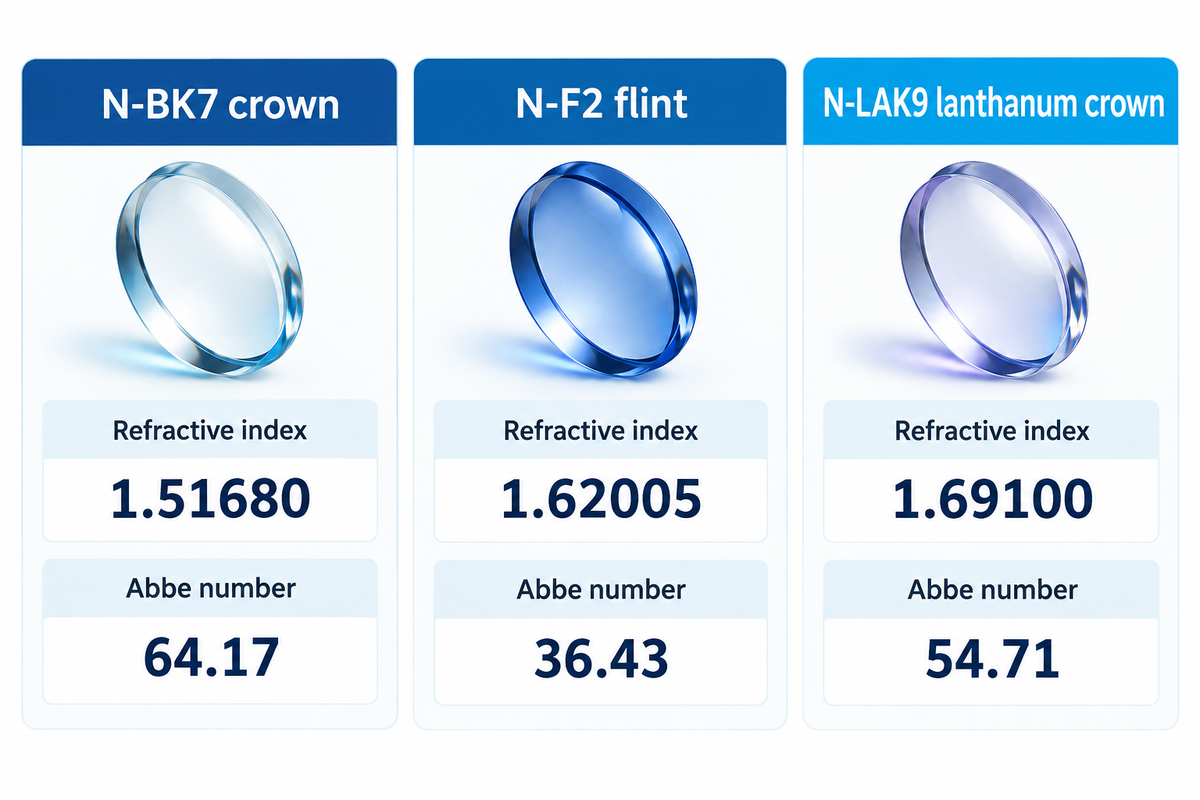
SCHOTT catalogue N-BK7 has a d-line refractive index of 1.51680 and an Abbe number of 64.17, compared with 1.62005 and 36.43 for N-F2. These catalogue values refer to two distinct grades. Refractive index measures light bending; the Abbe number describes dispersion relative to that refractive power.
What is the refractive index of crown glass and flint glass?
N-BK7 crown is 1.51680 and N-F2 flint is 1.62005 at 587.6 nm in SCHOTT’s catalogues. Now, there’s no single index of refraction for either family. Use the full designation when ordering: N-F2 and traditional F2 have different dispersion values, despite their similar names.
| Property and condition | N-BK7 crown | N-F2 flint | Selection consequence |
|---|---|---|---|
| Refractive index nd, 587.6 nm | 1.51680 | 1.62005 | Different power at the same curvatures |
| Abbe number Vd, dimensionless | 64.17 | 36.43 | Different chromatic contribution per unit power |
| Refractive index nF, 486.1 nm | 1.52238 | 1.63208 | Blue reference for dispersion |
| Refractive index nC, 656.3 nm | 1.51432 | 1.61506 | Red reference for dispersion |
| Density, g/cm³ | 2.51 | 2.65 | Mass depends on both material and finished volume |
| Mean CTE, −30 to +70 °C, ×10−6/K | 7.1 | 7.8 | Compare expansion with the mount |
| Glass transition temperature Tg, °C | 557 | 569 | Material processing property |
| Internal transmission, 350 nm through 10 mm | 0.967 | 0.10 | Near-UV throughput differs sharply |
| Internal transmission, 1060 nm through 10 mm | 0.999 | 0.998 | Both transmit well at this particular near-IR wavelength |
Sources: SCHOTT N-BK7 datasheet, dated December 2023, and SCHOTT N-F2 datasheet, dated February 2014, accessed November 2026. February 2014.
November 2026. Values are catalogue data, under the stated conditions; internal transmission isn’t inclusive of surface-reflection losses.
Look no longer than N-LAK9 lanthanum crown, another easy witness. SCHOTT TIE-19 Table 1 nd = 1.69100, Vd = 54.71. That crown has a higher refractive index than the N-F2 flint in the table. “Low refractive index crown versus high refractive index flint” is an easy introduction to some traditional optical glasses, but an unreliable buying rule.
Abbe number uses Vd = (nd − 1)/(nF − nC). Keep the lowercase d reference separate from the uppercase D sodium line at 589.3 nm. For grade-specific transmission and thermal detail, see BK7 properties and applications.
Composition, Lead Oxide and Modern Flint Glass
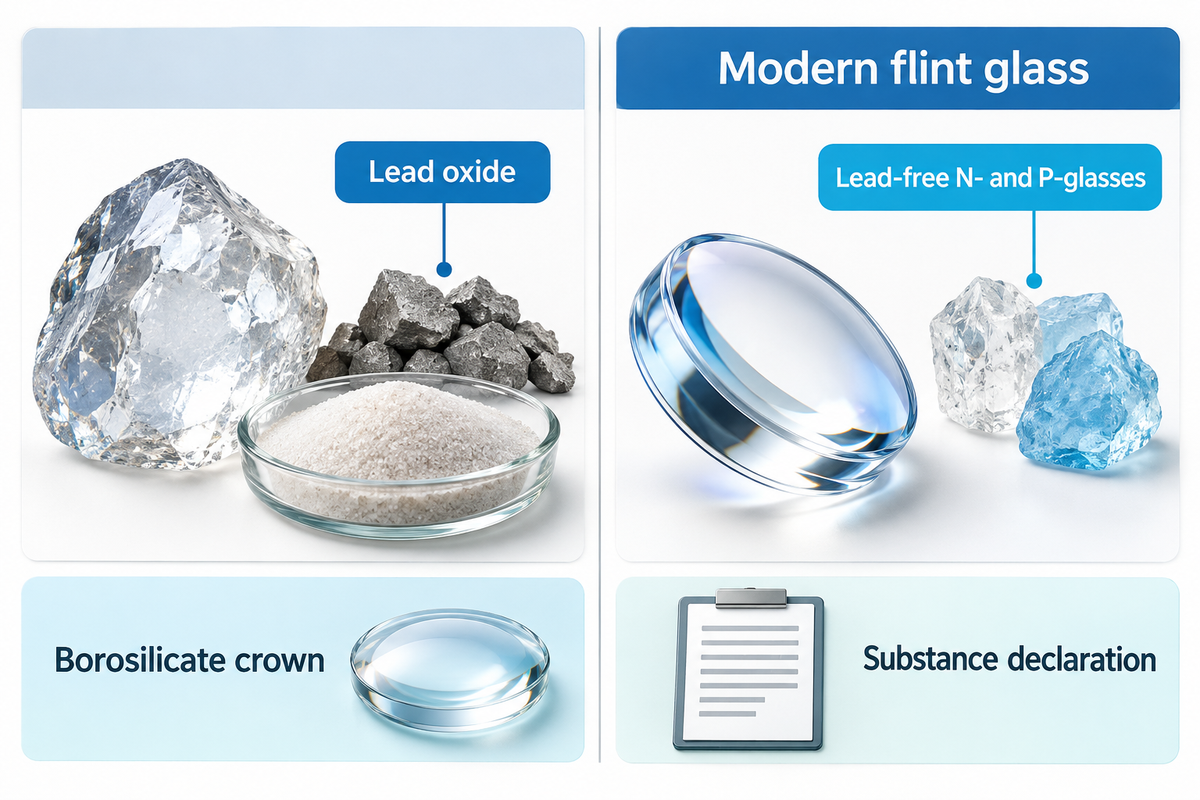
Modern flint glass can be lead-free. Traditional flints often used lead oxide to obtain their optical properties, while modern glass composition can use other oxides. Crown glasses also include several chemistries, including borosilicate glasses and lanthanum-containing families.
Include real material and substance declaration when composition is relevant to the project.
Silica is one of the glass formers used in optical silicate glass. Other constituents change refractive index, dispersion, chemical resistance and processing behavior. N-BK7 is a borosilicate crown, but “borosilicate” doesn’t describe every crown. Likewise, labels such as heavy flint and dense flint glass identify families rather than one universal recipe.
Why is it called flint glass?
The name comes from flint used as a silica source in historical glass made by George Ravenscroft. George Ravenscroft. The Corning Museum of Glass attributes use of the term to 1674.
The current optical classification is based on the material’s light-refraction and dispersive properties; a modern flint grade need not contain the original raw ingredient.
N-F2 is among the lead-free N- and P-glasses in SCHOTT’s January 2026 positive list. For a finished optical component, purchasing should request the declaration for the specified substrate and any coating or cement.
How Crown and Flint Control Chromatic Aberration
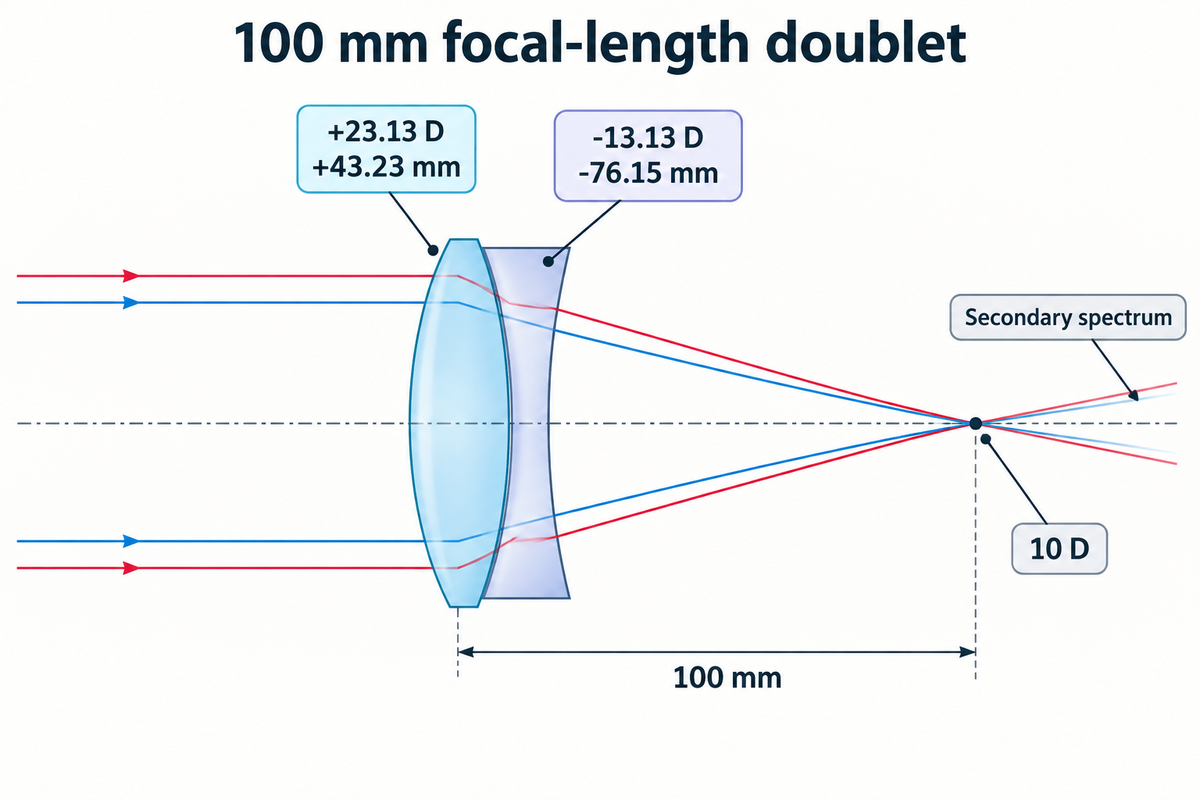
A conventional positive achromatic doublet combines a stronger positive, lower-dispersion element with a weaker negative, higher-dispersion element. Their chromatic contributions cancel at two selected wavelengths while their powers add to a positive total. This diminishes longitudinal chromatic aberration, which otherwise puts dissimilar colors at dissimilar axial focus positions.
“Only two wavelengths can have the same focus”
Blue and red focus can coincide while intermediate wavelengths retain a focus error called secondary spectrum. Somewhat more demanding optical systems require not only spherical aberration control and field performance, but also the variation of aberrations with wavelength.
100 mm Achromat Worksheet
Thin-contact calculation uses the Abbe numbers of the two named glasses to split a target focal power between them.
Sample a positive 100 mm focal-length doublet in air, idealized as two thin refracting lenses in contact, using N-BK7 and N-F2. (Φ) is the optical power 1/f if the focal length f is quoted in metres: target is 1/0.100 m = 10 D.
Two conditions:
Φc + Φf = Φ;
Φc/Vc + Φf/Vf = 0
Solve for the powers:
Φc = Φ × Vc/(Vc − Vf);
Φf = −Φ × Vf/(Vc − Vf)
Substitute the catalogue values:
Φc = 10 × 64.17/(64.17 − 36.43) = +23.13 D;
Φf = −10 × 36.43/(64.17 − 36.43) = −13.13 D
Element focal lengths: approximately +43.23 mm for the crown and −76.15 mm for the flint. The unrounded powers sum to 10 D; their Abbe-weighted chromatic contributions cancel.
The University of Arizona’s OPTI-502 chromatic-effects notes derive these conditions. The positive element carries excess power, which the negative element removes. If the two Abbe numbers approach one another, the denominator becomes small and the required element powers grow; choosing two different glass names alone doesn’t ensure a useful pair.
Design boundary: this is an early paraxial build-up calculation and doesn’t represent a lens prescription. Finite thickness, air spacing, curvatures and higher-order aberrations require optical optimization. Acquire aperture, field, wavelength band and image-quality acceptance criteria before final comparison of completed designs; Rayces and Rosete-Aguilar’s glass-pair study demonstrates the inadequacy of secondary spectrum alone.
One-material correction is possible through other mechanisms. A refractive/diffractive hybrid uses the opposite dispersion behavior of diffraction, as described in Laser Focus World’s hybrid-lens analysis. That’s a different design approach from the two ordinary refractive elements calculated here.
Optical Glass Properties Beyond Dispersion
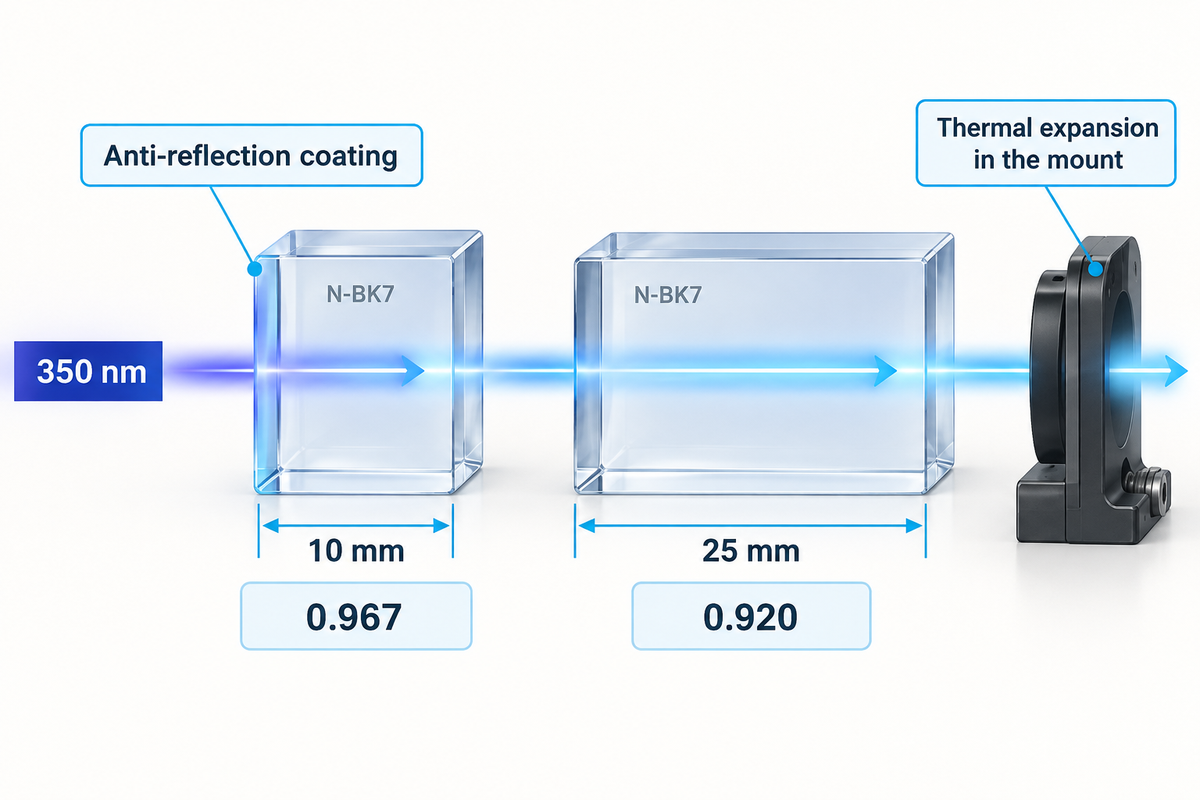
Transmission, temperature response and material quality can eliminate a candidate that looks suitable on an Abbe diagram. Examine transmission at the proposed wavelength and path length, thermal expansion in the mount, and the refractive uniformity in relation to image-quality requirements.
Compare the near-UV entries in the comparison table – clear appearance doesn’t mean similar transmission: the same thickness can transmit many fractions at the same wavelength. Increasing the path length increases bulk absorption losses. In SCHOTT’s N-BK7 data, internal transmission at 350 nm changes from 0.967 through 10 mm to 0.920 through 25 mm.
Do
- Match transmission data to wavelength and thickness.
- Specify finished-surface and coating performance separately.
- Evaluate temperature with the mount and adhesive.
Avoid these mistakes
- Do not select UV material just because it looks clear.
- Do not treat internal transmission as finished-part throughput.
- Do not use a family name as a durability rating.
Reflections at the glass surfaces introduce additional losses other than bulk absorption. An anti-reflection coating deals with those surfaces; it doesn’t eliminate absorption within the glass material. Learn how anti-reflective coatings work when distinguishing between substrate and coating needs.
Temperature changes both dimensions and refractive index. The coefficient of thermal expansion provides data of mechanical fit. The thermo-optic level provides data for index drift.
Glass transition temperature belongs to material processing behavior; it is not the operating-temperature rating of an optic bonded into a housing. Surface quality, striae, bubbles and high optical uniformity belong in the acceptance specification where they affect performance.
Which Glass Type Fits Your Optical Application?
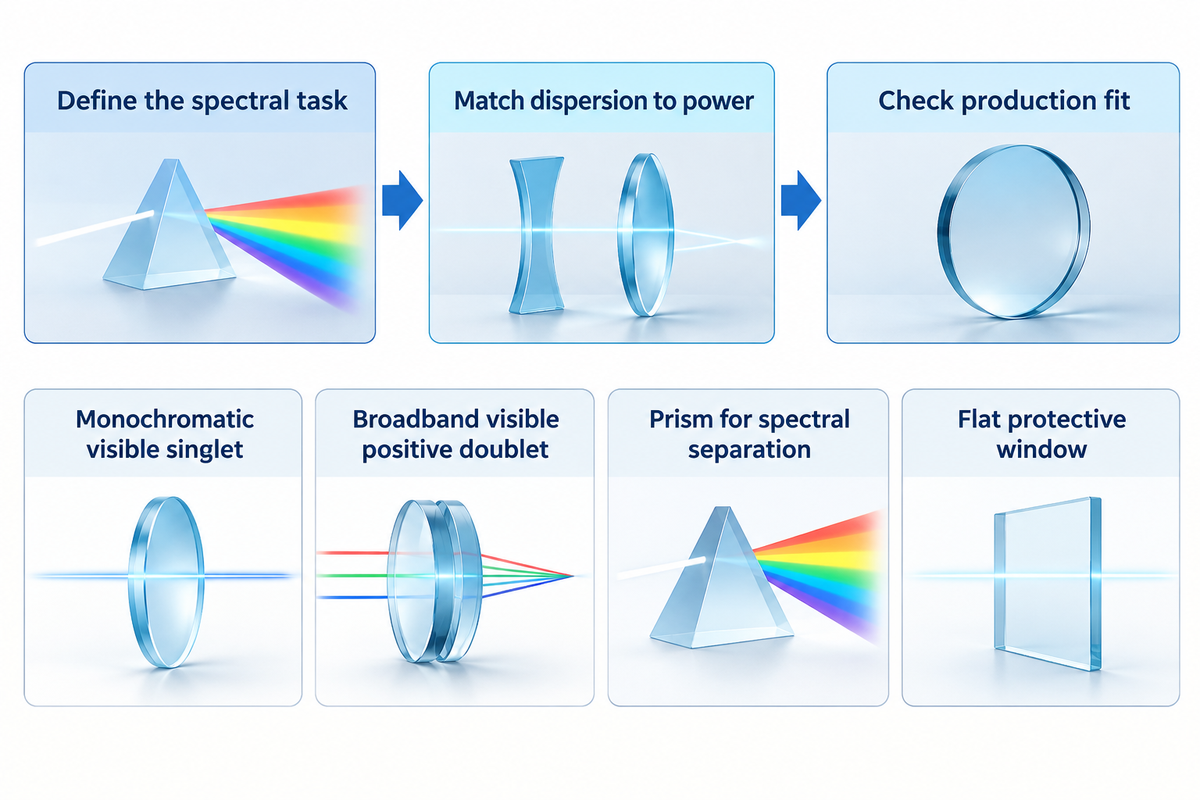
A monochromatic singlet may favor a readily available crown; a broadband doublet needs complementary dispersion and power. A dispersing prism can use a flint; a flat protective window is usually dictated by transmission and mechanicals.
Which optical glass is best?
A readily available crown is a practical starting point for a monochromatic singlet; higher-dispersion flint may suit a dispersing prism. A high index of refraction decreases the curvature needed for a given lens force, but a higher index of refraction doesn’t necessarily produce a better overall system. Weight depends on the geometry of the completed system as well as the mass density.
3-Check Glass-Pair Test
Check the spectral task, match dispersion to power, then test the material and production constraints.
- Define the spectral task. Specify whether colors must share a focus, remain separated or simply pass through a window.
- Match dispersion to power. Use named-grade optical properties and the appropriate model for the component.
- Check production fit. Compare transmission, thermal behavior, material availability and inspection against the drawing.
The following table makes the checks different beginning decisions.
| Task | Starting direction | Constraint that can change the choice |
|---|---|---|
| Monochromatic visible singlet | Common crown such as N-BK7 | Curvature, aperture and monochromatic aberrations |
| Broadband visible positive doublet | Lower-dispersion positive element plus higher-dispersion negative element | Secondary spectrum and full image-quality target |
| Compact high-power lens | Evaluate high-index crown and flint candidates | Dispersion, manufacturable curvature and density |
| Prism for spectral separation | Evaluate higher-dispersion glass | Transmission across the separated band |
| Prism for beam steering | Select index with the geometry | Unwanted wavelength-dependent deviation |
| Flat protective window | Transmission and mechanical fit first | Wedge, wavefront error, coating and mounting |
| Ultraviolet window or lens | Compare suitable UV-grade silica glass | Absorption at the actual wavelength and thickness |
| Near-infrared optic | Check the exact grade’s transmission curve | Band edge, bulk absorption and coating |
| Thermal-infrared imaging | Evaluate materials designed for that IR band | Visible-light Abbe number is an unsuitable sole selection metric |
| Replacement in an existing assembly | Start with the specified grade and traceable documentation | Reoptimization and qualification after substitution |
For optical filters that separate colors by coating interference, the coating design is central. Our guide to dichroic optical filters explains that route. For a substitute lens, keep the assembly diagram: crown and flint labels don’t indicate part placement, contour sequence or separator pattern.
Comparing Cost on the Same Component Drawing
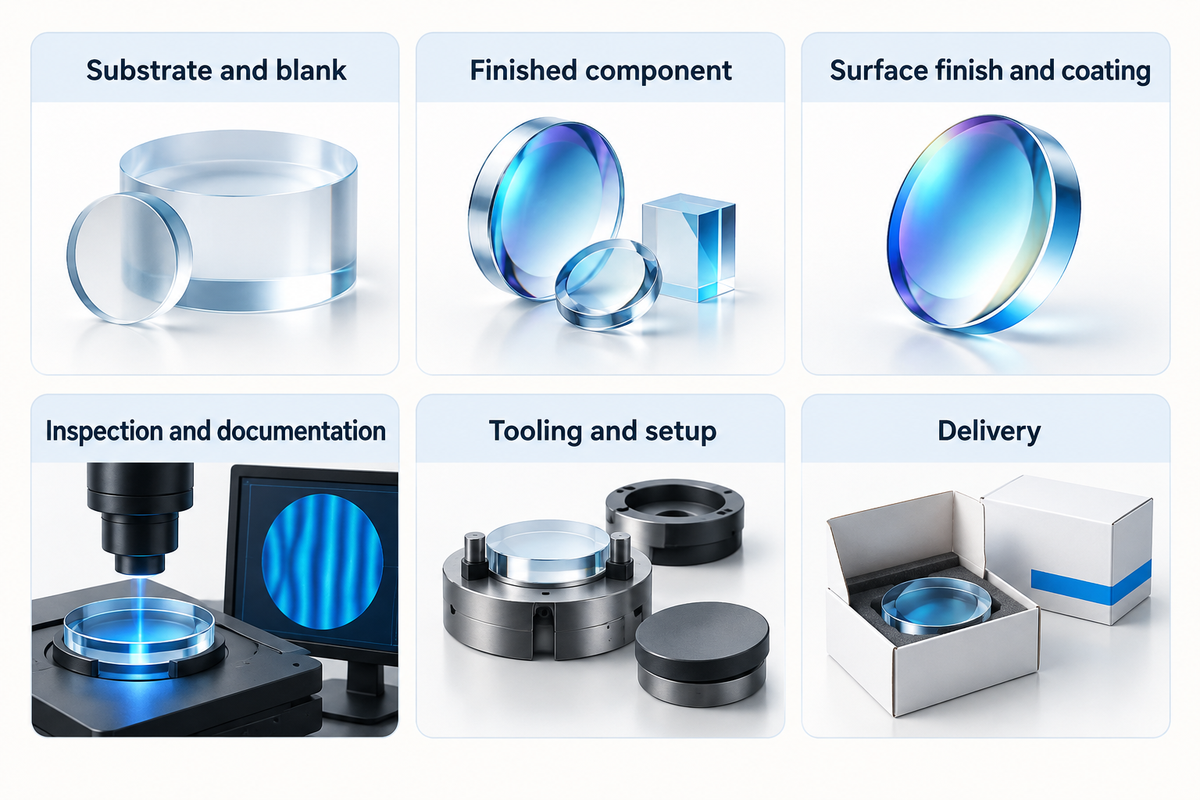
Compare quotations after fixing the component drawing, material grade, quantity, surface requirements and inspection scope. Raw glass price is only one cost input. Tightened material tolerances, blank preparation and manufacturing difficulty can change both cost and lead time, as Bill Thames explains in Photonics Spectra’s glass-selection guidance.
Decide the comparison criteria first. Same-geometry quotes for different glass grades are compared for total material and processing cost; changing the refractive index of a powered lens produces a different focal length. Equivalent-performance substitutes must be separately designed and costed before they can be compared.
The buying team should specify which comparison it demands.
| Cost or scope field | Record for each offer | Buyer check |
|---|---|---|
| Substrate and blank | Exact grade, blank form and charge | Keep raw material separate from processing |
| Finished component | Drawing revision, quantity and unit price | Identify same-geometry or equal-performance basis |
| Surface finish and coating | Specified quality, coating band and price inclusion | Compare the same acceptance requirement |
| Inspection and documentation | Tests, sampling and certificates included | Identify any separately priced verification |
| Tooling and setup | One-time charges and repeat-order treatment | Separate initial from recurring cost |
| Delivery | Confirmed lead time, packing and freight terms | Use the same delivery destination and basis |
Demand supplier quotes for the filled-out fields, rather than doing one general flint premium. Finance can then compare unit price plus allocated setup, inspection and delivery charges at the stated order quantity. For coated parts, include the required wavelength band in the AR coating service request; specifying coating after a substrate-only quote shifts what that quote includes.
Specifying a Crown or Flint Optical Component
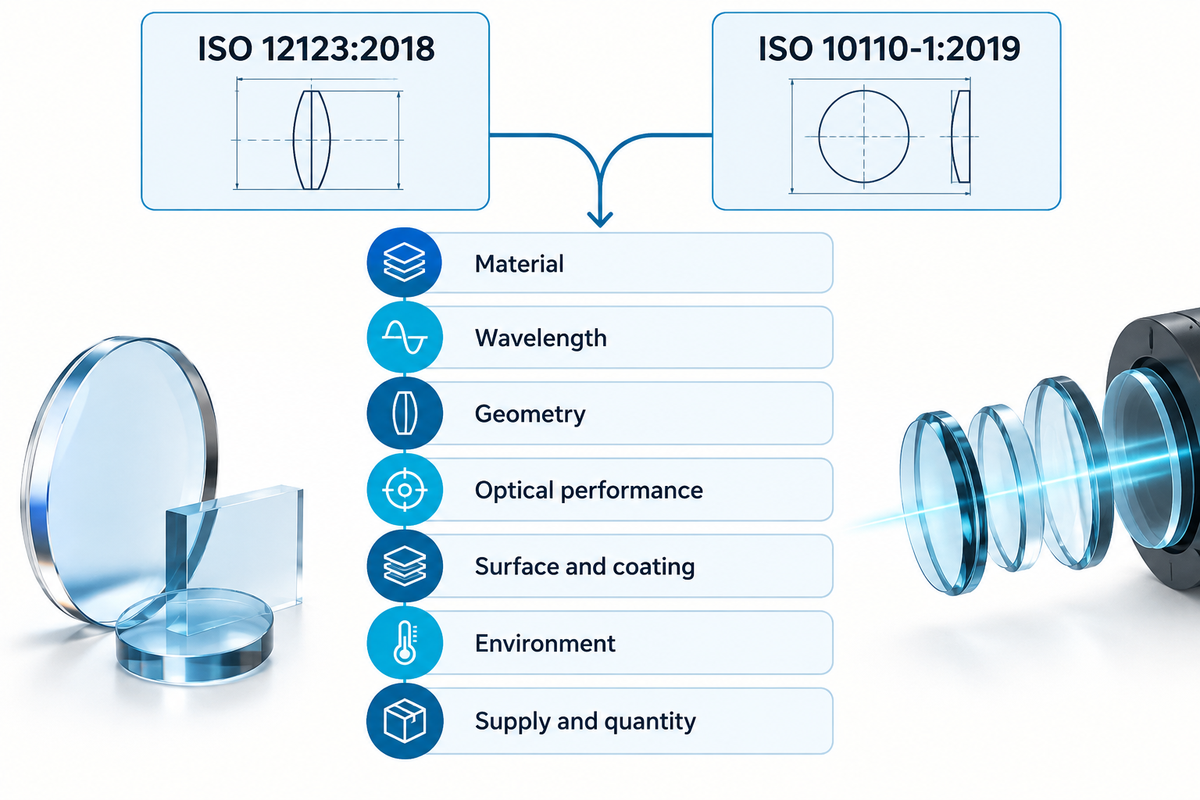
A useful RFQ names the glass grade and turns the optical design into measurable acceptance requirements. Consider adding: the wavelength band, geometry, optical tolerances, coating requirements, and the documentation needed. Designers define performance, QA defines how it is accepted, and procurement obtains comparable offers against the same revision.
ISO 12123:2018, reconfirmed in 2024, addresses raw optical glass. ISO 10110-1:2019, reconfirmed in 2025, addresses drawing indications for optical elements and systems. Use the applicable drawing conventions to communicate requirements instead of requesting unspecified “high-quality optical glass.”
Copy these fields into the inquiry and change the example model values with the verified design specifications.
| Parameter | Information to specify | Why it matters | How to verify |
|---|---|---|---|
| Material | Exact grade; for example N-BK7 or N-F2 | Fixes the material basis | Manufacturer designation and traceable documentation |
| Wavelength | Design band in nm or µm | Sets transmission and correction requirements | Grade data and optical model |
| Geometry | Drawing dimensions and tolerances in mm | Controls fit and optical power | Approved drawing and dimensional inspection |
| Optical performance | Design target; worksheet example 100 mm focal length | Separates teaching values from acceptance limits | Agreed optical test and conditions |
| Surface and coating | Drawing-defined quality and coating band | Controls scatter and surface losses | Inspection method and coating specification |
| Environment | Assembly temperature range in °C | Includes mounting and bonding behavior | Defined environmental qualification |
| Supply and quantity | Requested piece count and delivery date | Fixes quotation scale and scheduling | Supplier offer, stock and lead-time confirmation |
Glass manufacturers will keep providing certain glass types whenever a fabricator doesn’t currently have the blanks needed. Confirm both when lead time matters. Also explicitly specify which substitutes are permitted; a similar catalogue index isn’t enough to approve a change to a material.
SW GLASS provides custom glass processing and glass quality inspection. Send the grade, drawing and acceptance requirements with your inquiry so the proposed processing route can be reviewed against the component’s purpose.
Frequently Asked Questions
How can I distinguish between flint glass and crown glass?
Use the manufacturer designation and traceable material documentation, then compare refractive index and dispersion at the specified wavelengths. Appearance alone is unreliable. A density measurement can narrow possibilities, but it doesn’t establish a unique grade. An unidentified clear piece of glass needs suitable optical characterization before replacing material in a controlled design, especially when the original lens depends on a specific dispersion curve.
What are the differences between crown glass and float glass?
Crown describes an optical family; float describes a glass manufacturing process for flat sheet. The labels answer different questions. Ordinary soda-lime glass used for window glass or glass bottles can be transparent without meeting a precision lens’s requirements for homogeneity, index tolerance or dispersion. Specify the material and optical quality instead of assuming that standard glass with a clear appearance is a qualified optical crown.
Why is fused silica a common choice for ultraviolet optics?
Suitable fused silica grades offer useful ultraviolet transmission and low thermal expansion, making them candidates when conventional crown or flint grades can’t meet a spectral or thermal requirement. The selection depends on wavelength, path length, purity and operating conditions. Fused silica glass is made primarily from silicon dioxide; choosing it changes more than the trade name, so a lens design also needs the appropriate refractive and thermal data.
What is an Abbe diagram used for?
An Abbe diagram helps compare glass types and identify candidate pairs with complementary dispersions by plotting refractive index against Abbe number. It helps compare different glass types and identify candidate pairs with complementary dispersions. Glasses used in optics occupy overlapping families, rather than two isolated crown/flint groups.
Which glasses are suitable for infrared optics?
N-BK7 and N-F2 can suit near-infrared optics at 1060 nm, as the grade comparison above shows for a 10 mm path. Some common optical glasses serve portions of the near infrared, while thermal-infrared systems require materials with suitable longer-wave transmission. Read the exact grade’s transmission curve and separate internal absorption from finished-surface losses. Evaluate the coating, temperature response and imaging requirement together. A grade that transmits at one infrared wavelength can absorb strongly elsewhere, so a visible-light Abbe number is a poor substitute for band-specific data. For an existing assembly, retain the optical design and geometry in the comparison.
Discuss your optical glass component
Send SW GLASS the material grade, component drawing, wavelength band and order quantity. Start with our optical glass processing solutions to connect the design requirements with a processing inquiry.
Method note: the grade comparison uses cited manufacturer catalogue data. The filled achromat worksheet is an educational calculation; no SW GLASS prototype test or measured lens performance is claimed.
References & Sources
- Flint Glass Corning Museum of Glass.
- Chromatic Aberration Florida State University, Molecular Expressions.
- OPTI-502: Chromatic Effects John E. Greivenkamp, University of Arizona, 2019.
- Selection of glasses for achromatic doublets with reduced secondary spectrum J. L. Rayces and M. Rosete-Aguilar, Applied Optics, 2001.
- Hybrid lenses offer high performance at low cost Laser Focus World.
- Optical Glass Selection Is Not Always So Transparent a Choice Bill Thames, Photonics Spectra.
- ISO 12123:2018: Specification of raw optical glass International Organization for Standardization.
- ISO 10110-1:2019: Drawing indications for optical elements and systems International Organization for Standardization.