Get in Touch with Saiweiglass



Gorilla Glass vs Custom Aluminosilicate Glass — An OEM Procurement Comparison
Quick Specs: Gorilla Glass vs Custom Aluminosilicate
| Parameter | Corning Gorilla Glass (Victus 2) | Custom Aluminosilicate |
| Glass Family | Alkali-aluminosilicate (proprietary) | Alkali-aluminosilicate (open formulation) |
| Vickers Hardness | 595–670 HV (strengthened) | 500–650 HV (formulation-dependent) |
| CS (Compressive Stress) | 800–900 MPa | 500–850 MPa (process-dependent) |
| DOL (Depth of Layer) | 80–100 μm | 40–120 μm (bath time-dependent) |
| Min Thickness | 0.4 mm | 0.3–0.5 mm |
| Licensing | Corning brand license required | No licensing — open-spec material |
| Typical MOQ | 10,000+ pcs (via authorized fabricators) | 500–5,000 pcs (direct from manufacturer) |
An OEM hardware team requests “Gorilla Glass” on their cover glass RFQ because they heard of the brand. Six weeks later Corning’s authorized fabricator quotes a 10,000 piece MOQ with a licensing surcharge. The team’s actual 2,000 piece production run on a rugged handheld scanner. They needed aluminosilicate glass with equivalent CS/DOL specs – not a brand name. That name-brand versus name-brand differentiation in a glass material versus a glass product changes procurement lead times, unit costs, and source choices.
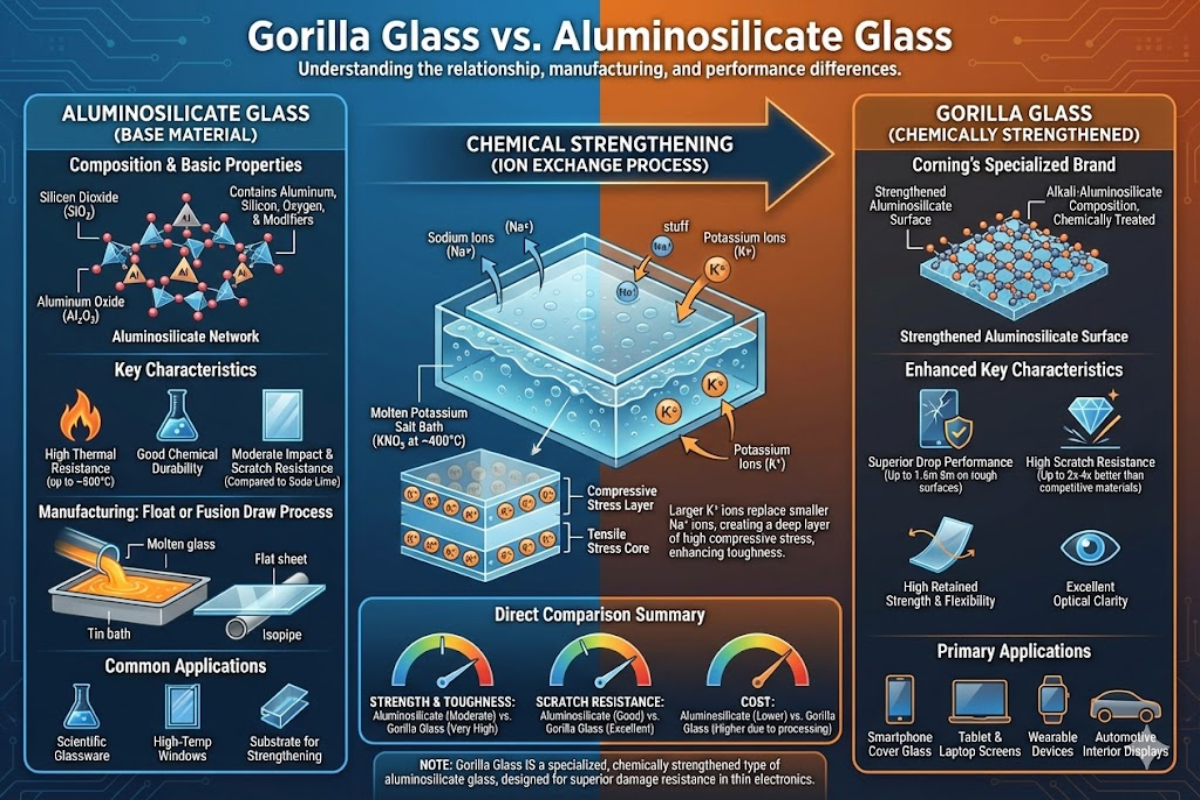
When OEM customers compare aluminosilicate glass vs Gorilla Glass they are comparing a glass material to a branded glass product. Not all aluminosilicate glass is Gorilla Glass. Here we break down the material science, map measurable specs, and explain when branded glass earns its premium — and when custom aluminosilicate from an independent manufacturer delivers the same durability at lower MOQ and shorter lead times.
What Is Aluminosilicate Glass?
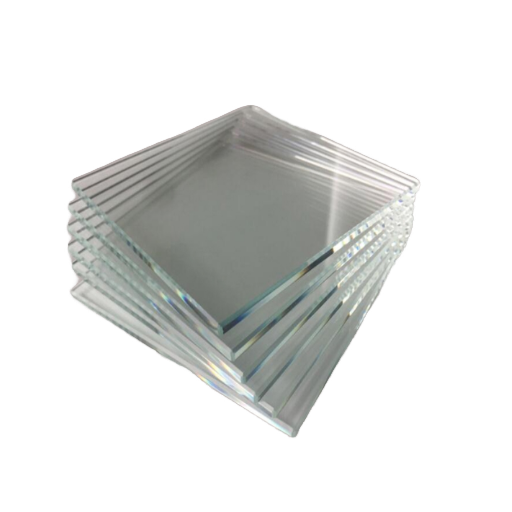
Aluminosilicate is a class of glass wherein aluminum oxide (Al₂O₃) replaces part of the silicon dioxide (SiO₂) found in standard glass like soda-lime. A generic alkali aluminosilicate formulation has approximately 57% (by weight) SiO, 15% by weight AlO, and 15% by weight NaO with small quantities of MgO and KO. Aluminum content in the 10–25% range is what makes this glass material suitable for chemical strengthening via ion exchange.
Ion exchange works like this: aluminosilicate glass sheets are submerged in a molten potassium salt bath at 400–500 °C, with an annealing temperature of up to 800°C, for 0.5 to 3 hours. During this manufacturing process, larger potassium ions (K⁺) replace smaller sodium ions (Na⁺) in the glass surface. Because the potassium ions in the glass are physically larger than the sodium they displace, a compressive stress (CS) layer forms across the surface that resists cracks or scratches. Depth of Layer (DOL) and CS value together define how well the chemically strengthened glass withstands drops and impacts. Well-tuned ion exchange on aluminosilicate routinely yields CS of 600–900 MPa.
In comparison, annealed traditional impact resistant glass or tempered glass which is toughened in a stationary furnace averaging 600C or higher takes on CS of 100 – 150 MPa. Chemically strengthened aluminosilicate can routinely reach 600 -900 MPa. This is approximately 8 times stronger than tempered or annealed impact resistant glass. Consider this in the context of the above sell sheet. Tempered glass screen protectors serve as a sacrificial layer on a phone screen, but the actual phone requires chemically strengthened aluminosilicate as its primary display glass. Aluminosilicate base glass with higher AlO moisture usually produces stiffer material with a more cohesive Na strength bond between atoms. In that context, greater AlO content in surface layer produces more CS per processing session.
Every branded cover glass on the market — Corning Gorilla Glass, AGC Dragontrail glass, Schott Xensation, NEG Dinorex — starts as an aluminosilicate base. Differences lie in proprietary formulation ratios, ion-exchange recipes, and post-processing treatments. Aluminosilicate glass is also used in glass products beyond smartphone screen protection: industrial glass panels, automotive touch displays, medical device screens, and even Gorilla Glass camera lens covers. Custom aluminosilicate from independent manufacturers uses the same chemistry without brand licensing constraints.
What Is Corning Gorilla Glass? — The Branded Aluminosilicate
Gorilla Glass is Corning’s proprietary alkali-aluminosilicate product line, which became available in 2008 for handsets and tablets. By fine-tuning their proprietary fusion-draw technology process Corning produces thin, flat, high performance very flat glass sheets that are ready for immersion in a patented ion-exchange group process to make them extra tough and durable; they can be formatted into flatter stronger applications than most glass. Gorilla Glass is simply a Corning proprietary formulation within the aluminosilicate family, exclusively manufactured there and not pre-made elsewhere, thus creating an expensive licensing agreement for partners.
When a mobile brand promotes “Gorilla Glass protected,” they are licensing the material as well as the name, which is an important performance consideration for OEM buyers. Corning Gorilla Glass offers exceptional durability and resistance to scratches, but other aluminosilicate glasses on offer from other sources often with a much lower price tag, can match or exceed it for many industrial and B2B uses.
Corning has recently launched subsequent versions of Gorilla Glass sheet-s including improvements in drop durability and scratch resistance. Corning Gorilla Glass Victus 2 (November 2022 publication date) has a Vickers hardness value of between 595 and 670 when strengthened, and the scratch resistance will resist up to 6H rating (pencil hardness). When Gorilla Glass Victus 2 is dropped on a concrete-like surface, it withstands the impact from a height of 1-meter, a benchmark which ‘replicates’ the failure rate of screens on the most solid surfaces with only a small fraction of the impact failure rate. The latest iteration: Gorilla Glass Armor 2 (published Ja 2025) survived 2.2-meters drops to concrete in the engine room of Corning’s laboratory.
💡 Pro Tip
Don’t mistake glass’s hardness reading on the Mohs scale as equivalent to the pencil-hardness (p rating) on a H scale. While claims are made that Gorilla Glass is rated at Mohs 9, similar to Sapphire, this is wrong. Most other aluminosilicate cover glasses form this high-performance family are testing at the Mohs 6.5-7 range, with sand (quartz, Mohs 7) still capable of scratching the surface. A screen protector helps shield the durable glass underneath from fine abrasive particles in pockets and bags.
Tempered Glass vs Aluminosilicate Glass vs Gorilla Glass — How They Differ
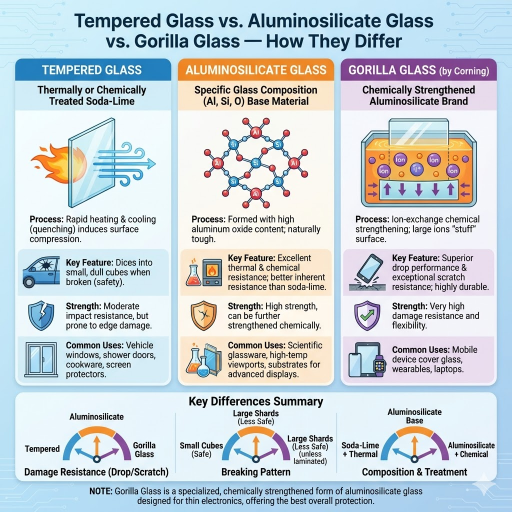
There are literally three types of glass an OEM buyer can find in spec sheets: tempered glass, generic aluminosilicate, and popular licensed formulae like Gorilla Glass. All three types of course have obvious similarities, transparent, all “strengthened,” and all used in mobile device applications. But each has very different defining differences in method of strengthening, technical claims, and intended use.
Tempered (toughened) glass is common soda-lime glass that has been brought to 620 C and cooled rapidly to induce surface compression of 100-150 MPa. Heat treatment produces a much cheaper glass compared to aluminosilicate and is commonly used as safety glass in buildings, along with auto side window and screen protectors on top of the phone screen. Tempered glass was not designed to be laminated down at these thicknesses for primary cover glass applications, most screens will be at least 0.33 mm, where the primary cover glass on a cell phone is 0.5-0.8 mm that is adhered directly to the LCD.
Aluminosilicate glass is a different beast altogether. It is prepared by a formulation where alumina replaces some of the silica and is chemically (rather than thermally) strengthened. Ion exchange yields CS values of 500–900 MPa – some six times stronger than tempered glass.
Due to its ability to withstand impact and contain flaws at very thin profiles (0.3-1.1mm), aluminosilicate glass is now used as the primary screen protection for virtually all smart phones, tablets and mobiles sold today. AGC Dragontrail or custom aluminosilicate from an independent manufacturer are another way of achieving the same chemically strengthened Glas.
Gorilla Glass is another product of that aluminosilicate family – a particular glass with a particular formulation (proprietary to Corning) and process control, but not a separate “material science” category. Appreciating this hierarchy assists OEM buyers in selecting the right glass to use: tempered glass protectors as sacrificial screen overlays, aluminosilicate for the primary cover glass and branded Gorilla™ when the marketing activity merits the licensing premium.
Gorilla Glass vs Custom Aluminosilicate — Side-by-Side Comparison
These come from the same aluminosilicate glass family. Both aluminosilicate glass and Gorilla Glass undergo ion-exchange strengthening. Compared to traditional soda-lime, both deliver specialized glass performance. Differences show up in formulation control, supply chain structure, and commercial terms.
| Dimension | Corning Gorilla Glass | Custom Aluminosilicate |
|---|---|---|
| Formulation | Proprietary (undisclosed ratios) | Open-spec; typical 57% SiO₂, 15% Al₂O₃, 15% Na₂O |
| CS (Compressive Stress) | 800–900 MPa (Victus 2) | 500–850 MPa (bath temp/time dependent) |
| DOL (Depth of Layer) | 80–100 μm | 40–120 μm (adjustable via process) |
| Vickers Hardness | 595–670 HV | 500–650 HV |
| Surface Treatments | DX/DX+ (Corning proprietary AR) | Multi-stack AR + AF coating, AG etching, silk screen |
| Licensing | Brand license + per-unit royalty | None — material cost only |
| MOQ | 10,000+ pcs (authorized fabricator) | 500–5,000 pcs (direct) |
| Lead Time | 4–8 weeks | 2–4 weeks |
⚠️ Common Spec Mistake
OEM teams sometimes think custom aluminosilicate is whatever “lower performance” is. It is not. CS and DOL values depend upon the parameters of the ion exchange process that is performed (bath temperature, immersion time, potassium salt concentration) and not upon whether the glass has a Corning logo in the corner.
A well optimized custom process on high alumina aluminosilicate glass frequently attains CS 750-850 MPa – inside of 5-10% of Gorilla Glass Victus 2. Where it differs is formulation consistency: Corning manages their glass from melt to end-use with rigorous quality control; custom glass quality varies with the process discipline of the glass manufacturer and incoming materials inspection.
✔ Gorilla Glass — Strengths
- Highest CS consistency (800—900 MPa) resulted from the self-centered designed fabrication process.
- Pricebuyers – it is a feature of the Smartphone being associated with consumer brands. E.g. “Protected by Gorilla Glass” The Smartphone may be viewed by customer as “brand” Smartphone.
- Benchmarks of drop-test published versus concrete (1 m Victus 2, 2.2 m Armor 2)
- Gorilla Glass SR+ and DX+ for wearable touchability and optical clarity
⚠ Gorilla Glass — Limitations
- 10,000+ piece production MOQ (excludes small-batch industrial/medical/manufacturing/plastics prototypes)
- Adding a dollar amount of brand licensing leads to the addition of zero engineering value to B2B glass product
- Proprietary coating options (DX/DX+) limit custom AR/AF/AG stack flexibility
- 4-8 uger leveringstid af custom glas direkte fra fabrikken, versus 2-4 uger direct from fabrikken.
When Gorilla Glass Makes Sense — and When It Doesn’t
Designation by brand name alone should not be the defining factor for a cover glass. Regardless of owning the brand name, consumers will choose what they trust and find durable in their smartphones. Gorilla Glass may be accepted for consumer cell phones where branding influences perceived impact resistance, but for industrial HMI glass panels, medical monitors, rugged handheld devices; the end-user does not see the glass brand- drop resistance, scratch performance, thermal insensitivity speaks more to a material’s quality than a name etched into the product.
The market Premium pays for itself as the branding on B2C cell phone screens can be marketed as the “Gorilla Glass protection” feature. For B2B applications, where branding counts for little- instead specify custom cover glass by CS value, cell factors, DOL, hardness, and optical qualities- the same protective qualities can be obtained without the brand tax attached. With AGC’s Dragontrail glass and several other independently-branded glasses available, OEM buyers now can choose by spec sheet, not brand.
⚠️ Licensing Cost Surprise
Some OEMs unearth as little as halfway through a project that the “Gorilla Glass” line item was priced for not only the material but also a brand royalty for each one produced. Customer dropping the shoe at 5,000 units in a medical display might add 15-25% to the unit FOB cost- unfelt by the customer and hidden in package. It pays to ask questions as to the presence of a feature surcharge in the quotation- prior to commitment.
How to Evaluate Custom Aluminosilicate for Your Product

If the “Gorilla Glass” brand name feature is not required in your product, custom chemically strengthened glass from an independent manufacturer can match the performance. Six parameters separate a reliable supplier from a risky one.
📐 Engineering Note — CS/DOL Thresholds for Common Applications
| Smartphone (1 m drop spec) | CS ≥ 700 MPa, DOL ≥ 80 μm |
| Wearable (0.5 m drop spec) | CS ≥ 500 MPa, DOL ≥ 40 μm |
| Industrial HMI (IK06 per IEC 62262) | CS ≥ 600 MPa, DOL ≥ 60 μm, thickness ≥ 1.1 mm |
| Automotive display glass | CS ≥ 750 MPa, DOL ≥ 80 μm, per OEM-specific shock/vibration spec |
- ✔
Confirm CS/DOL on incoming reports. Ask the supplier for ion-exchange process data. A scatter range wider than ±50 MPa on CS signals inconsistent bath control. - ✔
Verify Al₂O₃ content in the base glass. Formulations below 12% Al₂O₃ cannot achieve CS above 600 MPa regardless of process tuning. - ✔
Check thickness tolerance. Cover glass designed to be thin for smartphones and wearables requires ±0.02–0.05 mm. Wider tolerances signal non-display-grade glass. - ✔
Evaluate coating capabilities. A cover glass material comparison should include scratch-resistant AR, AF, and AG options from the same facility. - ✔
Request certifications. ISO 9001 quality control + RoHS 3 + REACH SVHC documentation. Custom glass without proper certification cannot pass incoming QC at major OEMs. - ✔
Run a pilot batch (100–500 pcs). Measure CS/DOL on 5% sample using a surface stress meter (FSM-6000). Reject if CS drops below your application threshold.
💡 Pro Tip
Use the glass material selector to choose the right glass before engaging suppliers. Entering your target CS, thickness, and application type filters the aluminosilicate catalog to 2–3 candidates — saving weeks of quoting.
Frequently Asked Questions

Q: Is Gorilla Glass aluminosilicate?
View Answer
Yes. Gorilla Glass is Corning’s branded alkali-aluminosilicate glass — same glass family as Dragontrail (AGC) and Xensation (Schott).
Q: Which is better, aluminosilicate glass or Gorilla Glass?
View Answer
It is name versus category or vehicle versus model number. In this case, Corning’s branded “Gorilla Glass” may be manufactured from within the aluminosilicate category, but there are many other brands and source producers to choose from. The newest member of the G2 fusion family, “Gorilla Glass Victus 2″ hits CS of 800 -900 MPa”. The production-level aluminosilicate covering glass from other prestigious manufacturers can similarly achieve 750 -850 MPa. This places the efficiency of the performance difference at only 5-10% yield and price differences in bulk pricing from 20-40%. Choose if the product needs the brand badge or performance specifications.
Q: What is the strongest glass for phone screens?
View Answer
2.2 meters (7.2 feet) is now the best published drop-resistance test achieved by the fused glass-ceramic composite “Gorilla Glass Armor 2” from Corning in 2025. On the glass alone, the best commercial aluminosilicate produced for mobile coverings is either Schott’s xensation or AGC’s Victus 2, both of which achieve the highest drop-test results today.
Q: Why don’t watches use Gorilla Glass?
View Answer
Based on the test results from the smart-watch manufacturers, such as Samsung’s use of Ion-X (Corning aluminosilicate” for Samsung Galaxy Watch, upgraded versions of sapphire glass (Moh’s 9) are favored by classical Rolex-style watches-the consumer is willing to trade off the increased cost for diamonds against drop-insensitivity with a more convenient scratch resistant material. 2,200 HV is the Vickers hardness for sapphire, compared to aluminosilicate which ranges from 500-670 HV. but aluminosilicates are much less brittle. Ceramics range from $8 -$50+ per unit; aluminosilicates cost between $0.50 – $5 each.
Q: What is an alternative to Gorilla Glass?
View Answer
Other branded screens are AGC Dragontrail, Schott Xensation, and NEG Dinorex. For OEM customers that don’t require a consumer facing brand, custom aluminosilicate from stand alone suppliers such as SaiweiGlass provides comparable impact performance with a lower minimum order quantity and and shorter delivery Lead time.
Q: Is aluminosilicate glass heat resistant?
View Answer
Yes. Aluminosilicate glass has an annealing point of up to 800 C and a softening point around 1,010 C – a lot higher than soda-lime. This makes aluminosilicate glass ideal for when it is likely to be exposed to heat, but in no way is it the same as borosilicate glass which is designed specifically for thermal shock.
Need Custom Aluminosilicate Cover Glass?
produces chemically strengthening aluminosilicate glass with CS as high as 850 MPa, from 500 PC pilot runs to 50K PC batches. Offers AR/AF/AG coating, CNC machining, silk-screen printing all at their facility.
Our Perspective
SaiweiGlass is a custom cover glass producer— we compete with Gorilla Glass based on performance specs, not brand name. The Comparison-Shots/DOL benchmarks referenced in this article are derived from Corning’s published product data sheets, contrasted with data derived from our incoming material inspection on aluminosilicate substrates from multiple glass sheet sources. We authored this comparison because OEM purchasing teams routinely ask us why they should use a custom glass versus the Gorilla Glass name—they get their answer on the spec sheet, not the label.
References & Sources
- Gorilla Glass — History, Versions, and Applications — Wikipedia
- Gorilla Glass Victus 2 — Product Overview — Corning Incorporated
- Chemically Strengthened Glass — Ion Exchange Process — Wikipedia
- Aluminosilicate — Material Science — Wikipedia
- Dragontrail Cover Glass — AGC Inc.
- EN 62262 — IK Impact Protection Ratings — Wikipedia (IEC standard)
- Towards a Glass New World: The Role of Ion-Exchange in Modern Technology — MDPI Applied Sciences (peer-reviewed)
Related Articles