Get in Touch with Saiweiglass



Smartwatch Sapphire Glass vs. Aluminosilicate: Engineering the Right Cover Glass Trade-Off
By saiweiglass · Published March 25, 2026 · 12 min read
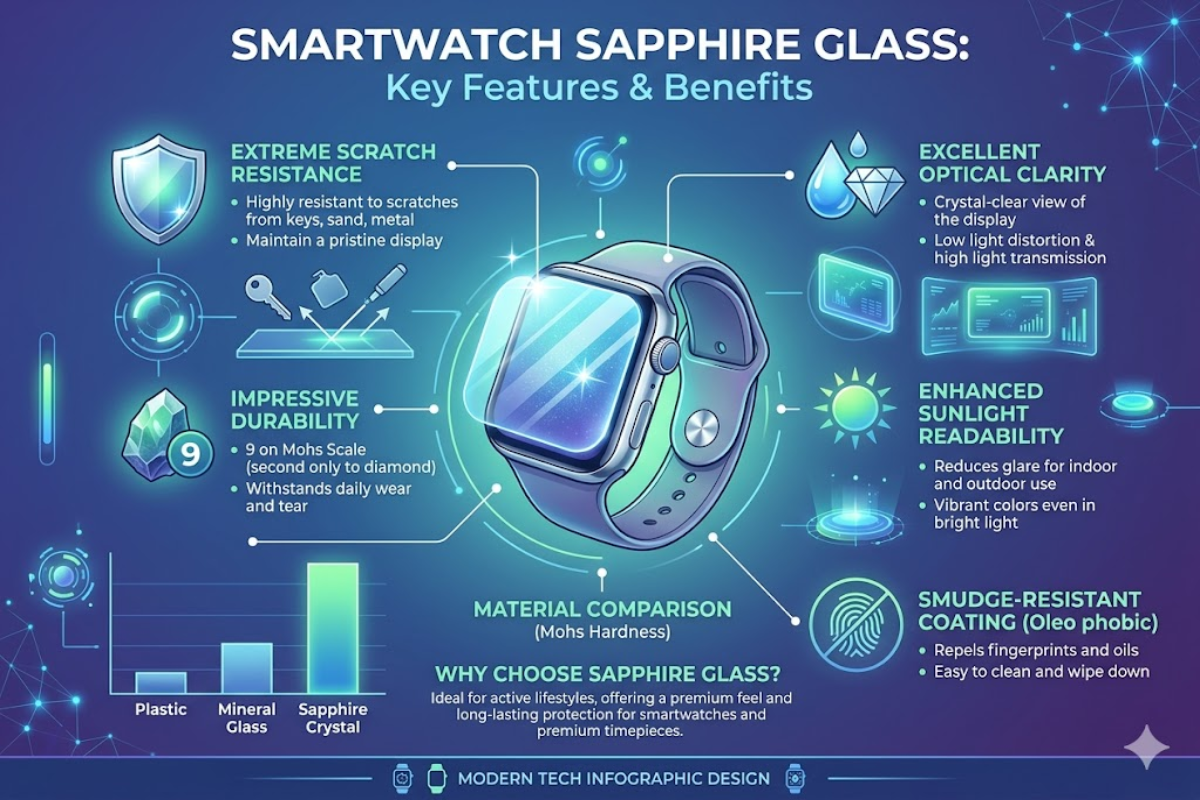
Sapphire scores a 9 on the Mohs hardness scale, making it practically scratchproof in regular wear. Yet drop a sapphire-covered smartwatch onto concrete, and you may find its sapphire glass screen shattered into fragments – something an aluminosilicate glass like Gorilla Glass would have survived. This contradiction is at the core of every cover glass decision in wearable design. Hardness and toughness are not the same property, and confusing the two leads to poor material choices.
This article breaks down the real engineering trade-offs between sapphire crystal and chemically strengthened aluminosilicate glass for smartwatch cover glass – comparing scratch resistance, impact behavior, optical performance, cost, weight, and brand-level adoption – with actual numbers rather than marketing generalizations.
⚡ Quick Specs Comparison
| Property | Sapphire (Al₂O₃) | Aluminosilicate (Ion-Exchanged) |
|---|---|---|
| Mohs Hardness | 9 | 6.5–7 |
| Vickers Hardness | ~2,000 HV | 600–700 HV |
| Fracture Toughness (KIc) | ~2 MPa√m | ~0.7 MPa√m + compressive layer |
| Refractive Index | 1.76 | 1.50 |
| Light Transmittance | 92% (98%+ with AR) | 91% (97%+ with AR) |
| Density | 3.98 g/cm³ | 2.54 g/cm³ |
| OEM Cost (42 mm) | $3–$8/pc | $0.50–$2/pc |
| Key Advantage | Scratch-proof for outdoor use | Drop-proof for active lifestyles |
What Makes Sapphire and Aluminosilicate Glass Different?
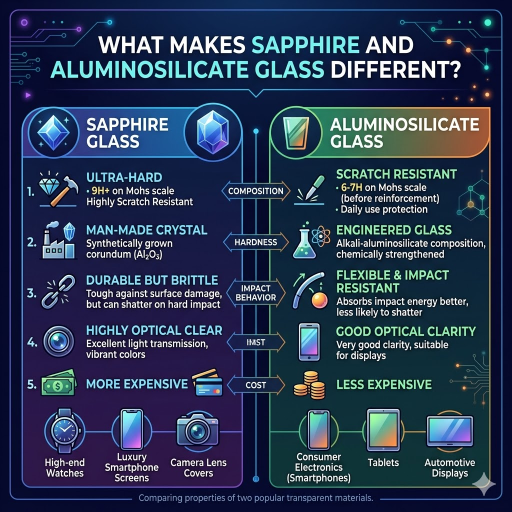
Sapphire glass used in watches is synthetic corundum – single-crystal aluminum oxide (Al₂O₃) grown in industrial furnaces through the Verneuil flame-fusion or Edge-defined Film-fed Growth (EFG) method. Because it forms a single crystal lattice with no grain boundaries, sapphire reaches a Mohs hardness of 9. Only diamond (Mohs 10) and moissanite (Mohs 9.25) sit above it. This is what makes sapphire crystal watches so resistant to scratches from sand, keys, and other everyday wear and tear.
Aluminosilicate glass takes a fundamentally different approach. It starts as an amorphous matrix of SiO₂ and Al₂O₃ – no crystal structure like standard glass. The real engineering happens after forming, during a chemical strengthening process called ion exchange. In a molten potassium salt bath at roughly 400°C, larger K⁺ ions replace smaller Na⁺ ions in the glass surface. Because the potassium ions are about 30% larger, they create a compressive stress layer of 400-800 MPa in the outer 40-100 µm of the glass. This compressive armor is what gives products like Corning’s Gorilla Glass and AGC’s Dragontrail their remarkable impact resistance.
The distinction matters because crystal structure determines failure behavior. A single crystal like sapphire cannot redistribute stress across grain boundaries – when it breaks, it fractures along crystallographic planes into sharp, irregular fragments. An amorphous glass has no preferred fracture planes and, with that compressive stress layer, absorbs far more energy before cracking. Apple’s Ceramic Shield takes this further by crystallizing nano-ceramic particles within an aluminosilicate matrix, combining some hardness gains with amorphous toughness.
Engineering Note: Sapphire for smartwatch cover glass requires ≥99.9% alumina content and ±0.01 mm machining accuracy. All cutting, shaping, and polishing operations demand diamond tooling because no other abrasive is hard enough to work the material efficiently.
For OEMs evaluating wearable cover glass solutions, the choice between these two families is rarely about one being “better.” It is about matching the material to the product’s target user, price point, and environment.
Scratch Resistance — Where Sapphire Wins
In scratch resistance, sapphire glass dominates by a wide margin. The numbers tell the story clearly:
| Metric | Sapphire | Aluminosilicate |
|---|---|---|
| Mohs Hardness | 9 | 6.5–7 |
| Vickers Hardness | ~2,000 HV | 600–700 HV (Victus 2: 670 HV) |
| Scratched by keys (steel, Mohs 5.5)? | No | No |
| Scratched by quartz sand (Mohs 7)? | No | Yes — micro-scratches |
| Scratched by diamond dust (Mohs 10)? | Yes | Yes |
With a Vickers hardness near 2,000 HV, sapphire resists scratching from virtually everything you encounter in daily life. Keys, coins (Mohs 3.5), belt buckles, countertops – none of them leave a mark. Even quartz sand particles, which sit at Mohs 7 and are the most common environmental scratch source, cannot damage a sapphire watch face.
Aluminosilicate glass tells a different story. At 600-700 HV and Mohs 6.5-7, it sits right at the threshold where quartz sand becomes a problem. Beach environments, construction sites, hiking trails with sandy terrain – these settings generate micro-scratches on aluminosilicate glass screens over time. After six or more months of daily outdoor wear, you will typically notice a haze of fine scratches on Gorilla Glass that simply does not appear on sapphire.
The scratch-resistant surface of sapphire also maintains optical clarity far longer. Micro-scratches scatter light across the screen material, reducing contrast and making AMOLED displays look washed out under bright conditions. A pristine durable sapphire crystal surface avoids this entirely.
Pro Tip: For outdoor workers, construction professionals, and adventure athletes who wear their smartwatch daily in abrasive environments, sapphire watch glass is worth every dollar of the premium. The scratch resistance gap between sapphire and aluminosilicate is not incremental – it is a different category entirely.
Impact Resistance and Shatter Behavior — Where Aluminosilicate Wins
If sapphire owns scratch resistance, aluminosilicate owns impact protection. And for a device worn on the wrist – constantly exposed to doorframes, countertops, and accidental drops – impact toughness matters just as much as hardness.
| Property | Sapphire | Aluminosilicate |
|---|---|---|
| Fracture Toughness (KIc) | ~2 MPa√m | ~0.7 MPa√m + 400–800 MPa compressive layer |
| Drop Test (1.5 m onto granite) | Fractures at sharp point loads | Survives 80%+ of drops |
| Shatter Pattern | Sharp, irregular crystalline fragments | Web cracking, stays bonded to laminate |
| 4-Point Bend Strength | ~400 MPa | ~1,000 MPa (2.5× sapphire) |
Sapphire’s fracture toughness of ~2 MPa√m is respectable on paper, but it has no compressive stress layer to stop cracks from propagating. Once a crack initiates – from a point impact against a doorknob or tile floor – it travels through the crystal along cleavage planes with nothing to slow it down. The result is catastrophic failure: sharp fragments that can damage the AMOLED display underneath.
Ion-exchanged aluminosilicate glass has a lower raw fracture toughness (~0.7 MPa√m), but that compressive stress layer changes the equation entirely. A crack must first overcome 400-800 MPa of compressive stress before it can propagate inward. In four-point bend testing, this gives chemically strengthened aluminosilicate roughly 2.5 times the flexural strength of sapphire. For a durable smartwatch screen that handles accidental drops and wrist impacts, this is the defining advantage.
Common Mistake: “Harder means more durable” is wrong. Hardness measures resistance to scratching. Toughness measures resistance to shattering. These are completely different mechanical properties, and conflating them leads to bad material decisions. A sapphire crystal is far harder than Gorilla Glass, but Gorilla Glass is far tougher against drops.
✔ Sapphire Advantages
- Scratch-proof in nearly all environments
- Maintains optical clarity for years
- Premium feel and luxury watch positioning
⚠️ Sapphire Limitations
- Shatters on point impacts without warning
- Sharp fragment failure mode
- No stress redistribution mechanism
✔ Aluminosilicate Advantages
- Better impact resistance and drop survival
- Web-crack failure: screen stays intact
- 2.5× bend strength vs. sapphire
⚠️ Aluminosilicate Limitations
- Micro-scratches from quartz sand over time
- Haze buildup reduces display clarity
- Screen protector recommended for outdoor use
Whether you are designing a fitness tracker for gym-goers or a rugged field watch, understanding this hardness-vs-toughness trade-off is essential. Explore smartwatch glass options that match your product’s drop and scratch requirements.
Optical Clarity, Display Compatibility, and Anti-Reflective Performance
A single cover glass must do more than shield – it must pass light so that the AMOLED display below looks its best. This is where the refractive index and anti-reflective (AR) coating become relevant.
Sapphire has a refractive index of 1.76, aluminosilicate 1.50. Higher index means greater reflection of light at each surface. Without an AR coating, this puts sapphire at a slight disadvantage in the raw reflectance number – comparatively higher lighting glare under overhead indoor lighting or bright sun.
Sapphire — No AR
~92% transmittance
Sapphire — With AR
98%+ transmittance
Aluminosilicate — No AR
~91% transmittance
Aluminosilicate — With AR
97%+ transmittance
Modern AR coatings use PVD (Physical Vapor Deposition) to deposit multi-layer thin films – typically alternating layers of MgF₂ (refractive index 1.38) and TiO₂ (refractive index 2.35). This stack reduces surface reflection to below 1% per interface, which brings both materials into near-identical transmittance territory. After AR coating, the difference narrows to only about 1 percentage point.
For AMOLED display compatibility, both sapphire and aluminosilicate work well. AMOLED panels in current smartwatches produce 1,000-2,000 nits peak brightness. Under direct sunlight at 10,000+ lux, every percentage point of transmittance counts. AR coating on either material improves perceived brightness by 20-25% in outdoor conditions, which is significant for fitness tracking during runs and cycling.
Engineering Note: For outdoor AMOLED smartwatches that must deliver a clear sapphire crystal display at 1,000-2,000 nits under harsh sunlight, AR-coated sapphire is the preferred combination. The sapphire keeps the surface scratch-free (preserving transmittance over time), while the AR coating neutralizes its higher native reflectivity.
Explore sapphire display glass with integrated AR coating options for wearable applications.
Cost, Weight, and Manufacturing Complexity
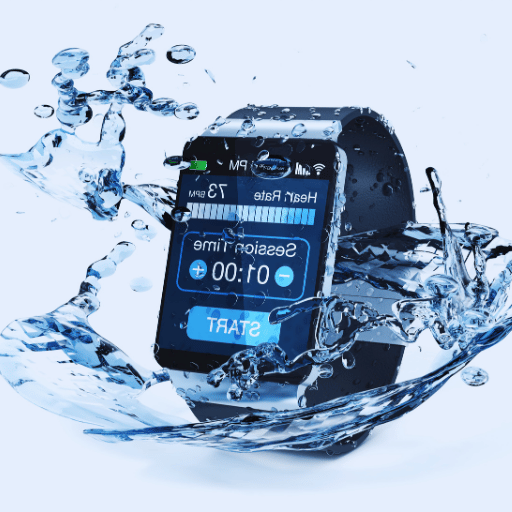
Material properties are merely the first issue. For smartwatch OEMs aiming to ship hundreds of thousands or millions of units, the cost per piece and assembly difficulty can be the deciding factor in which cover glass gets selected.
| Factor | Sapphire | Aluminosilicate |
|---|---|---|
| OEM Cost (42 mm piece) | $3–$8 | $0.50–$2 |
| Tooling Requirements | Diamond saw + CNC polish | Float/fusion draw + chemical bath |
| Density | 3.98 g/cm³ | 2.54 g/cm³ |
| Weight (42 mm × 0.8 mm disc) | ~4.4 g | ~2.8 g |
| Retail Price Premium | +$100–$200 per watch | Baseline |
| Machining Tolerance | ±0.01 mm | ±0.05 mm typical |
Sapphire crystal production is inherently expensive. Growing a single-crystal boule takes days in a high-temperature furnace. Slicing that boule into 0.8 mm wafers requires diamond-blade saws because nothing else can cut it efficiently. Then each wafer must be CNC-ground and polished to ±0.01 mm accuracy, demanding ≥99.9% alumina purity throughout. Every step consumes premium tooling that wears quickly against the hardest oxide material on Earth.
Aluminosilicate, comparatively, benefits from more traditional float glass or fusion-draw manufacturing processes. Sheets are produced in a continuous flow, cut to shape with standard tooling, then batch-run through a potassium salt bath for chemical strengthening. Overall this process takes less time, costs less money, and scales more naturally to high volumes.
Retail Premium
$100–$200 per watch
Weight Difference
57% heavier (sapphire)
Sapphire Glass Market (2033)
$5,195M — CAGR 14.43%
Weight is another factor that gets overlooked. At 3.98 g/cm³, sapphire is 57% denser than aluminosilicate at 2.54 g/cm³. For a 42 mm disc at 0.8 mm thickness, that translates to roughly 4.4 g vs. 2.8 g. On a device designed for all-day wear, fitness tracking, and exceptional battery life, that 1.6 g difference matters – particularly for long-distance runners and endurance athletes who notice every gram on their wrist.
The sapphire glass market itself reflects growing demand despite these costs. Valued at $1,455 million in 2024, it is projected to reach $5,195 million by 2033 at a CAGR of 14.43%, driven by premium, durable smartwatches, medical wearables, and industrial sensors. As production methods improve, the cost gap will narrow, but sapphire will remain a premium material for the foreseeable future.
Learn more about watch cover glass manufacturing for both sapphire and aluminosilicate at scale.
Real-World Smartwatch Applications — Which Brands Use What?
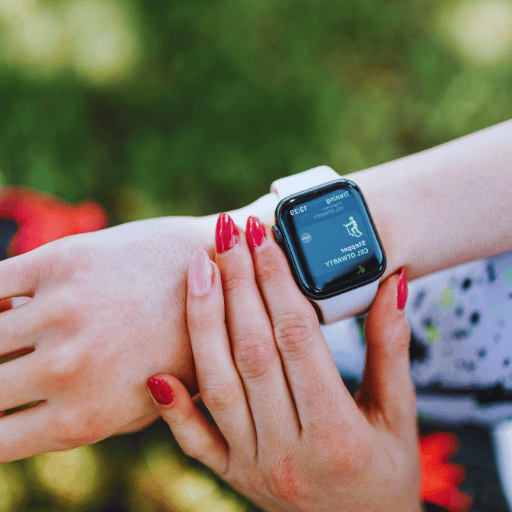
Theory is useful, but seeing which glass appears in actual products reveals how OEMs weigh these trade-offs. Here is a cross-section of current smartwatches and their cover glass choices:
| Brand / Model | Glass Type | Case | Battery Life | Why This Glass |
|---|---|---|---|---|
| Apple Watch Ultra 2 | Sapphire crystal | Titanium | 36 hrs | Adventure/dive, water resistance + scratch-proof |
| Garmin Fenix 8 AMOLED | Sapphire option (+$100) | Titanium | 16–29 days | Advanced GPS, outdoor multisport |
| Garmin Epix Pro Sapphire | Sapphire lens | Titanium | 16 days | AMOLED + scratch protection, carbon gray DLC titanium finish |
| Samsung Galaxy Watch Ultra | Sapphire crystal | Titanium | 60 hrs | Outdoor rugged |
| Samsung Galaxy Watch 5 | Sapphire crystal glass | Aluminum | 40 hrs | Everyday premium, sleep tracking |
| Amazfit T-Rex 3 | Sapphire glass | Titanium alloy | 30 days | Budget outdoor, durable design |
| Apple Watch SE | Ion-X (aluminosilicate) | Aluminum | 18 hrs | Cost-effective daily wear |
| Garmin Fenix 8 (base) | Gorilla Glass | Steel | 16–29 days | Budget entry to Fenix |
A clear pattern emerges. Sapphire pairs with titanium cases in premium, outdoor-oriented watches with sapphire designed to take punishment in wild environments. Aluminosilicate (branded as Ion-X or Gorilla Glass) appears in cost-conscious or everyday wear models where drop resistance and weight savings matter more than absolute scratch immunity.
Garmin offers both options within the same product line – the Fenix 8 comes with Gorilla Glass on the base model and sapphire on the Sapphire edition, with a $100 price difference. This gives buyers an explicit choice rather than a one-size-fits-all decision. Understanding the full range of saiweiglass wearable solutions can help OEMs plan similar tiered product strategies.
5-Step Selection Checklist
- Define your primary use. Desk or office everyday wear points toward aluminosilicate. Outdoor, trades, or adventure use points toward sapphire.
- Set your budget tolerance. Can you absorb a $100-$200 retail premium per unit? If margins are tight, aluminosilicate delivers strong protection at a fraction of the cost.
- Assess real drop risk. Users with high drop frequency (gym, manual labor, children) actually benefit more from aluminosilicate’s superior impact resistance.
- Consider weight sensitivity. Every gram matters for marathon runners and endurance athletes who wear their watch 10+ hours straight. Sapphire adds ~1.6 g over aluminosilicate for a 42 mm cover glass.
- Plan your AR coating. If choosing sapphire for an AMOLED smartwatch, AR coating is not optional – it is mandatory for acceptable outdoor readability.
Common Mistake: Paying the sapphire premium for a smartwatch that lives at a desk. Also: choosing sapphire for an AMOLED display but skipping the AR coating, which makes the screen harder to read outdoors than a cheaper aluminosilicate alternative. Match the material to the actual use case.
Browse wearable glass products from saiweiglass, or reach out for cover glass selection support tailored to your smartwatch project.
Frequently Asked Questions
Is sapphire glass on a smartwatch worth the extra cost?
It depends on your lifestyle. If you work outdoors, hike frequently, or do anything involving sand, dirt, and rough surfaces, sapphire is worth the $100-$200 premium because it stays scratch-free for years. For desk-based daily wear, aluminosilicate with a $5 screen protector gives you comparable protection at much lower cost. The premium only pays off when you actually expose your watch to Mohs 7+ abrasives regularly. Consider the environments you spend time in before deciding whether the upgrade makes financial sense for your situation.
Can sapphire glass on a watch be scratched?
Only by materials at Mohs 9 or above — diamond (10), moissanite (9.25), or another piece of sapphire. Common items like keys (steel, Mohs 5.5), coins (Mohs 3.5), and even quartz sand (Mohs 7) will not scratch sapphire crystal.
What does it mean if a watch has a sapphire crystal?
It means this part of the watch is made from synthetic corundum (Al₂O₃), grown in an industrial furnace and polished into a disc. It is the same material as a natural gemstone sapphire but lab-grown for purity and consistency. With a Mohs hardness of 9, it is the second-hardest transparent material after diamond — making it extremely resistant to scratches from everyday contact. Learn more about sapphire crystal watches and their applications.
How does sapphire compare to Gorilla Glass for smartwatches?
Sapphire wins scratch resistance by a wide margin — roughly 2,000 HV vs. 670 HV for Gorilla Glass Victus 2. But Gorilla Glass wins impact toughness thanks to its ion-exchange compressive stress layer, surviving drops that would shatter sapphire. Gorilla Glass also costs 4-8 times less per piece at OEM level. Neither is universally “better”; they solve different problems for different user profiles.
What watch brands use sapphire glass?
Apple (Watch Ultra), Garmin (Fenix/Epix Pro Sapphire), Samsung (Galaxy Watch Ultra), Amazfit (T-Rex 3), and Huawei (Watch Ultimate).
Does sapphire glass affect AMOLED display readability?
Yes, but it is solvable. Sapphire’s higher refractive index (1.76 vs. 1.50 for aluminosilicate) causes more surface reflections, which can reduce readability under bright sunlight. An AR coating eliminates this problem, pushing transmittance above 98% and improving perceived brightness by 20-25%. For any sapphire + AMOLED combination, AR coating should be considered mandatory.
Is aluminosilicate glass the same as Gorilla Glass?
Not exactly. Gorilla Glass is Corning’s proprietary brand of chemically strengthened aluminosilicate glass. Other manufacturers produce their own versions: AGC makes Dragontrail, NEG makes Dinorex. They all belong to the sapphire and aluminosilicate glass family but use different formulations, ion-exchange processes, and resulting mechanical properties.
Need Sapphire or Aluminosilicate Cover Glass for Your Wearable?
We manufacture both sapphire and aluminosilicate cover glass for smartwatches, fitness bands, and medical wearables — from prototype to volume production.
Our Perspective
saiweiglass manufactures both sapphire and aluminosilicate cover glass for wearable devices. We work with smartwatch OEMs daily and see firsthand how the scratch-vs-impact trade-off plays out across different product lines. This article reflects our engineering experience with both materials – from sapphire boule slicing to aluminosilicate ion-exchange processing – and is intended to help product teams make better-informed cover glass decisions.
References & Sources
- IMARC Group — Sapphire Glass Market Report
- Shinkosha — Mechanical Properties of Sapphire
- Scientific Reports — Crack-resistant Al₂O₃-SiO₂ Glasses
- Gorilla Glass — Wikipedia (Corning Specifications)
- Sinoptix — Optical Sapphire Glass: A Complete Guide
- NotebookCheck — Apple Watch Ultra Sapphire Display Test