Get in Touch with Saiweiglass

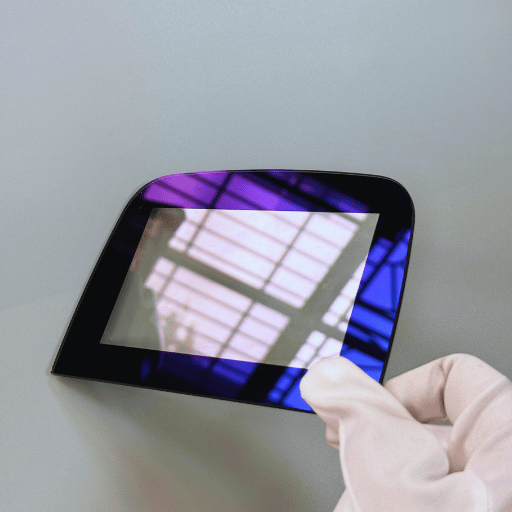
Ordinary uncoated glass reflects about 4% of incident light at each air-glass surface, or roughly 8% across both surfaces, near normal incidence. These reflections can reduce the effectiveness of displays and photovoltaic panels. Anti-reflective glass reduces reflection. Its reflectance and transmission vary for each product and are dependent on the conditions of the measurement. Reflectance percentages express the amount of light reflected; they do not relate to the thickness of the glass.
This guide explains the optical principle behind anti-reflective glass, compares it with anti-glare solutions, describes coating technologies, and discusses applications that can benefit from AR glass performance. Whether you are specifying facade glazing, artwork protection, or electronic display cover glass, use the selected product’s performance data to inform your purchase.
In This Guide
- How Anti-Reflective Glass Works
- Anti-Reflective Coating vs. Anti-Glare Glass
- Anti-Reflective Glass Coating Technology Types
- Key Properties and Performance Metrics
- Applications – For what purposes is anti-reflective glass Used?
- Steps to Selecting the Correct anti-reflective glass
- Cost Factors and Value Analysis
- FAQ
What Is Anti-Reflective Glass and How Does It Work?
Anti-reflective glass is designed to reduce reflection as much as possible. Ordinary uncoated glass reflects about 4% per air–glass surface near normal incidence. AR performance depends on the product; less than 1% total reflection is not a universal specification.
These coatings work with thin-film interference. In this case, light reflects from the interfaces of the coatings and the interference of the reflected waves is made destructive.
In the case of a simple quarter-wave layer at normal incidence, optical thickness is λ/4. Physical thickness, therefore, is not always λ/4. It depends on the refractive index of the coating. If we are working with a multilayer design, we can use different thicknesses.
The ideal single-layer case cited in the Wikipedia article on anti-reflective coatings defines coating index as √(n₀ × nₛ), where n₀ and nₛ are the indices of the incident medium and the substrate respectively. For air, approximately equal to 1, and a substrate index of 1.52, the coating index would be approximately 1.23.
Multilayer coatings use materials with different refractive indices to manage reflection over a specified wavelength band. The Edmund Optics technical guide details these designs. Request transmission and reflection data for the required wavelengths and viewing angles.
<1%
Total Reflection (Tru Vue Museum Glass, Double-Sided AR)
~8%
Total Reflection (Uncoated Glass, Near Normal Incidence)
>97%
Total Light Transmission (Tru Vue Museum Glass)
💡 Pro Tip
Compare coated and uncoated samples under the same lighting and viewing conditions. Residual blue or green reflection can be part of the coating design; color alone does not establish its reflectance or transmission. Request data that has been measured optically.
Anti-Reflective Coating vs. Anti-Glare Glass, What’s the Difference?

Anti-reflective glass and anti-glare glass can both reduce the visual disturbance caused by reflected light, but they work differently.
Anti-reflective coatings reduce reflection through thin-film interference over their design wavelength range. They are not necessarily narrowband. Anti-glare glass commonly uses an etched surface to diffuse reflected light in different directions. According to Tru Vue’s technical comparison, this surface texture creates a trade-off between glare reduction and image resolution. Non-glare is also a term used in picture framing.
Anti glare texture can soften transmitted detail, especially if the glass is separated from the object being displayed. AR coatings help provide a clearer image, but can not eliminate all reflections or scattering. They can not ensure perfect color reproduction. Compare samples at the working distance and ask to see product specific optical data.
| Feature | Anti-Reflective (AR) Glass | Anti-Glare (AG) Glass |
|---|---|---|
| Method | Thin film coating (PVD/CVD/sol-gel) | Chemical acid etch on glass surface |
| Reflection Reduction | Product-specific; confirm total or per-surface reflectance | Diffuses reflection; confirm total reflectance |
| Image Clarity | Low-reflection view; color performance depends on product | Slight haze, reduced sharpness |
| Scratch Resistance | Coating can scratch (hardcoat options available) | Etched surface; confirm abrasion resistance |
| Fingerprint Visibility | More visible on smooth coating | Less visible due to textured surface |
| Cost | Higher (coating process is precision-intensive) | Request a quote for equivalent specifications |
| Best For | Museums, high-end retail, facades, solar panels | Touch displays, production environments, picture frames |
Compare anti-glare and anti-reflective samples under the intended lighting before specifying either treatment. Evaluate reflected images, haze and the visibility of fine display detail.
Sample comparison checklist
Types of Anti-Reflective Glass Coating Technology
There are differences in the methods used to make every type of anti-reflective glass. The coating technology affects the optical quality and scratch resistance of the glass and ultimately the price. Here are the main methods used to manufacture AR glass:
Magnetron Sputtering (PVD)
Magnetron sputtering is a PVD (physical vapor deposition) process. Magnets confine electrons near the target, while energetic ions bombard the target and eject material that deposits as a thin film on the substrate. Multilayer coatings can be built using controlled deposition. VON ARDENNE describes the magnetron-sputtering process; check the specific process and comparison conditions; request the proposed coating’s thickness tolerances and adhesion results rather than assuming a universal 2 nm precision or superiority over every other sputtering method.
Sol-Gel Dip Coating
Sol-gel dip coating applies a liquid coating formulation to glass. The deposited film is dried and cured, according to the formulation. This method can produce multilayer AR coatings, in which the refractive index is controlled through the coating composition. A 2025 study in Progress in Photovoltaics described a five-layer sol-gel coating for photovoltaic cover glass. Request the proposed layer design, curing requirements and quotation. Sol-gel may not always be the cheapest or fastest option compared to a sputtered PVD stack.
Chemical Vapor Deposition (CVD)
In chemical vapor deposition (CVD), a coating is synthesized on a substrate from precursor gases. In the manufacture of float glass, online CVD is used to produce certain types of glass coatings. For an architectural AR product, determine if the manufacturer has obtained exterior suitability, approved processing, and relevant durability test data.
| Parameter | Magnetron Sputtering | Sol-Gel | CVD |
|---|---|---|---|
| Layer Control | Confirm layer-thickness tolerance | Confirm layer-thickness tolerance | Confirm layer-thickness tolerance |
| Coating Type | Multilayer designs; confirm layer count | Single-layer or multilayer designs | Single or multi-layer |
| Double-Sided Coating | Available; confirm coated surfaces | Yes (dip process coats both sides) | Confirm the finished glazing’s coated surfaces |
| Reflectance Specification | Confirm measured reflectance and test conditions | Confirm measured reflectance and test conditions | Confirm measured reflectance and test conditions |
| Relative Cost | Quote required | Quote required | Quote required |
| Primary Use | Museum glass, high-end displays, optics | Solar panel cover glass | Architectural glazing |
💡 Pro Tip
Does the proposed AR glass meet your project’s safety requirements? What tempering or laminating sequence does the coating manufacturer approve? Confirm the coated surfaces and the applicable warranty conditions prior to ordering.
Key Properties and Performance Metrics
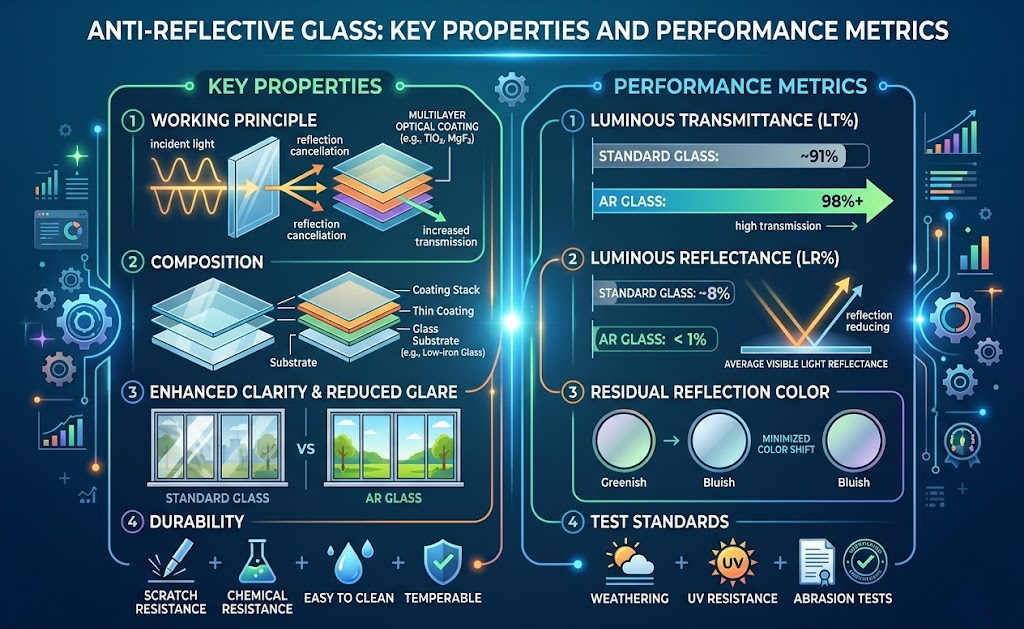
A reflectance value alone does not give enough detail to select AR glass for an application. There are several important properties that impact AR glass performance in an application. Here are some examples.
Light Transmission
Light transmission depends on the substrate, thickness, coating and configuration. For one product example, Guardian Glass reports a light transmission of above 98% for their latest anti-reflective glass. Request the transmission and color-performance data for the configuration of interest rather than assuming that a higher number of layers guarantees above 99% transmission or CRI 99.
UV Protection
Some AR framing products also provide UV filtering. For example, Tru Vue specifies up to 99% blocking from 300 to 380 nm for Museum Glass. Confirm the selected product’s UV spectrum separately from its visible-light reflectance. ISO 18902 and ISO 18916 concern photographic enclosure requirements and photographic activity testing; these references alone do not establish a general conservation certification for all artworks or textiles.
Durability and Coating Adhesion
Obtain test reports for AR coating and substrate. ASTM D3359 was developed to be used on relatively ductile coating films on metallic substrates, and its applicability to a particular thin-film coating on glass should be established. Agree on relevant exposure tests and define optical acceptance for outdoor use. Accelerated weathering test hours do not provide a conversion to years of service.
| Property | Standard Glass | Single-Layer AR | Multi-Layer AR |
|---|---|---|---|
| Light Transmission | Confirm transmission for the selected substrate and thickness | Confirm transmission for the selected coated configuration | Confirm transmission for the selected coated configuration |
| Total Reflection | ~8% | Confirm total reflectance for the selected product | Confirm total reflectance for the selected product |
| CRI (Color Rendering) | Request measured CRI and calculation conditions | Request measured CRI and calculation conditions | Request measured CRI and calculation conditions |
| UV Blocking | Confirm blocking percentage and wavelength range | Varies by product | Confirm UV-filtering coating or interlayer, blocking percentage and wavelength range |
| Durability (Indoor) | Confirm service-life evidence and conditions | Confirm service-life evidence and warranty | Confirm service-life evidence and test conditions |
⚠️ Important
When evaluating AR glass datasheets, determine whether reflectance is stated as a value for each surface, or for the total glazing. Two surfaces each reflecting 0.5% would give approximately 1% total reflection in a simple low-loss pane. Also evaluate the wavelength range, angle of incidence measured from surface normal, and the polarization state. Normal incidence is 0°; the plane of incidence is not an alternative measurement angle.
Applications, Where Is Anti-Reflective Glass Used?

AR coating is used on glass to reduce unwanted reflections. In what applications does your project require AR Coating? What is the required Optical Performance?
Architecture and Building Facades
Architects specify AR coatings on building facades and curtain walls where enhanced transparency and color fidelity are required. Guardian Glass states the additional surfaces in insulating glass increase reflection. Select the glass and coatings to achieve the required optical and thermal performance. Common architectural applications include lobbies, retail shop frontages, and other areas where AR Coating provides clarity and reduces the “mirror effect” to improve exterior viewing.
Museum and Gallery Displays
AR glazing can reduce reflections in museum and gallery displays. UV protection is a separate specification: request the blocking percentage and wavelength range for the selected product. For photographic displays, check the applicable requirements of ISO 18902 and ISO 18916. Do not treat an AR coating or a photographic activity test result as a guarantee against fading or as proof of suitability for every artifact.
Solar Energy
AR coatings on solar cover glass reduce reflection and can increase the light reaching photovoltaic cells. The output gain depends on several factors, including the module and the environmental conditions. Industry data presented in the IMARC Group solar PV glass market report, by itself, does not confirm the performance of a particular module. To evaluate the suitability of the product, request comparative module data against the proposed glass.
In the five-layer AR coating presented in Progress in Photovoltaics (Wiley), optical measurements and abrasion test results are reported. The results should not be viewed as field service life results from a long-term study.
Retail Storefronts and Display Cases
Showrooms and storefronts contain glass that needs to be seen through. Reflections on uncoated storefront glass can obscure the view through it, depending on lighting and viewing angle. Anti-reflective glass can reduce this effect. This is the reason the AR glass is used in high end stores like jewelry or electronics showrooms.
Electronic Displays and Information Screens
AR cover glass reduces reflection and improves contrast in public, industrial and automotive displays. For touch screens and outdoor installations, confirm the proposed product’s optical performance, cleaning requirements and suitability for the operating environment.
Confirm Solar Transmission
Solar PV Cover Glass: Product Test Data Required
Product-Specific
Solar Panel Output Gain: Confirm Module Test Data
UV Blocking Depends on Product
Museum-Grade AR Glass Protection
How to Choose the Right Anti-Reflective Glass for Your Project
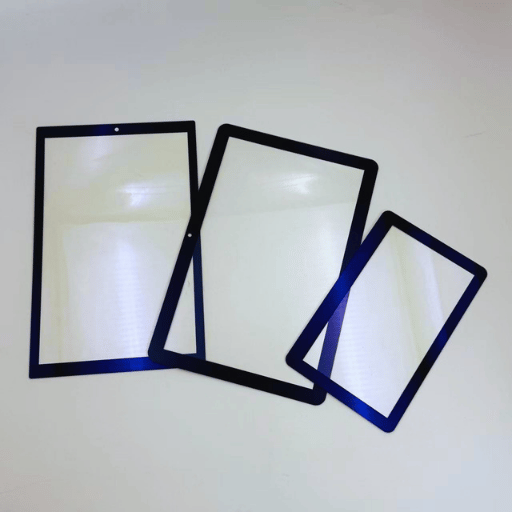
Not everyone requires the same anti-reflective glass. According to your project, what kind of viewing conditions can your design accommodate? What about the operating environment, service-life requirements and budget? Below is a useful set of questions that our team at Saiweiglass employs when attempting to elicit our clients’ requirements:
- ✔
Define the primary viewing distance. Compare samples at the intended distance and lighting. Request reflection, transmission and haze data rather than selecting a coating process on the assumption that it guarantees the highest clarity or an imperceptible difference. - ✔
Assess the touch and cleaning environment. If fingerprint resistance matters (touch screens, interactive displays), consider AR glass with an oleophobic top layer or switch to anti-glare glass instead. Standard AR coatings show fingerprints more readily than etched AG surfaces. - ✔
Check single-sided vs. double-sided coating. Viewing from one direction does not remove reflection from the other glass surface. Compare the total reflectance of the proposed single-sided and double-sided configurations before choosing. - ✔
Confirm safety and structural requirements. If the glass must be tempered or laminated for safety compliance, verify that the AR coating process is compatible. Follow the coating manufacturer’s approved processing sequence; some sputtered AR products can be heat-treated after coating. - ✔
Request datasheet values at your actual viewing angle. Many AR glass specs are measured at normal incidence (0°). If your installation involves angled viewing (tilted display cases, sloped facades), ask the supplier for performance data at 30° or 45° angles. Reflectance can vary with angle, wavelength and polarization. - ✔
Evaluate total cost of ownership. Compare purchase, cleaning, maintenance and replacement costs using the proposed product’s exterior-use evidence and warranty. Request a project-specific comparison before assuming that one coating process will last longer or repay its premium.
💡 Pro Tip
Model the entire Insulated Glazing Unit (IGU) with your supplier, including all panes and the position of AR and low-E coatings. Check the finished unit’s reflection and transmission. Do not use the specifications of one pane to assess the entire IGU.
Anti-Reflective Glass Cost Factors and Value Analysis
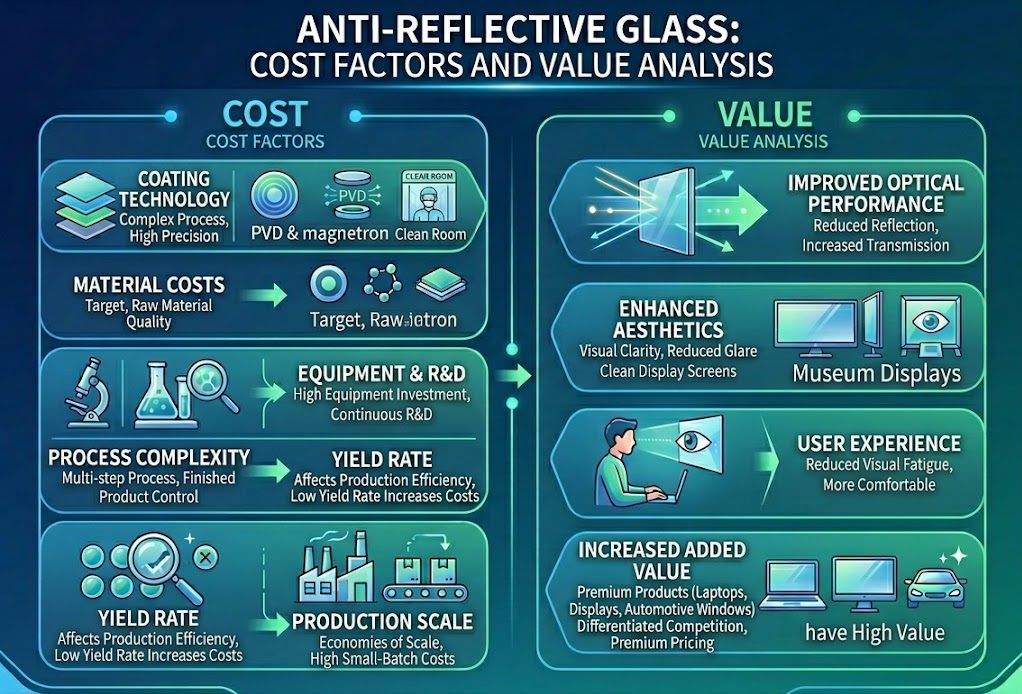
Prices for anti-reflective glass are higher than standard glass because of the more advanced coating techniques required. The variation in costs is due to the coating process, how thick the glass is, and the number of units purchased. It is good to understand the variables that affect cost, to be able to determine if you are ordering the right amount of coating for your particular application.
What Drives the Price
Several factors drive AR glass pricing:
- Coating technology: Request comparable quotes for the required optical performance, coated surfaces and durability. Ask suppliers to identify the coating process and layer design.
- Single-sided vs. double-sided: Request quotes for each coating configuration and compare their total reflectance.
- Substrate glass type: Compare low-iron and standard clear substrates at the same thickness and coating specification. Request transmission data and prices for each.
- Thickness and size of glass: Request a quotation for the required panel dimensions and thickness, and confirm the supplier’s coating-size and handling limits.
- Order volume: Confirm the unit prices for the batch quantity required and the minimum order quantity.
Market Context
Market Forecasts from Market Research Future do not set glass prices or availability for your project. Ask suppliers to verify product name, available sizes, the quantity they will sell you, and the validity of their quote.
Key Takeaway on Cost
Add up the costs you will incur during your project’s lifespan including purchase, cleaning, maintenance, and replacement costs. Compare glass quotes on a per area basis. Use documented product assumptions in lifecycle cost calculations.
Frequently Asked Questions
Q: What does anti-reflective glass do?
View Answer
Anti-reflective glass reduces surface reflection and can improve visibility through the glass. The reduction depends on the product and glazing configuration; less than 1% total reflection is not a universal specification. Confirm the selected product’s reflection and transmission data.
Q: What is the difference between anti-reflective and non-glare glass?
View Answer
Anti-reflective glass uses a coating to reduce reflection through thin-film interference. Non-glare glass commonly uses an etched surface to diffuse reflected light, which can soften transmitted detail. Compare samples and product data for image clarity, abrasion resistance and price; neither term alone establishes those properties.
Q: Is anti-reflective glass expensive?
View Answer
Request comparable quotations for the required glass size, thickness, substrate, coated surfaces, optical performance and order quantity. Compare maintenance and replacement costs as well as purchase price. Confirm any UV protection or solar-module output benefit separately for the selected product.
Q: How is anti-reflective glass made?
View Answer
Manufacturers form thin-film layers on glass using processes such as magnetron sputtering, sol-gel coating or chemical vapor deposition. Materials, layer thicknesses and the complete stack are designed for the required wavelength range and viewing angles. Not every layer has a physical thickness equal to one-quarter of a visible-light wavelength.
Q: Does anti-reflective glass block UV light?
View Answer
An AR coating does not automatically provide UV protection. Request the selected product’s UV-blocking percentage, wavelength range and test data. Some conservation glazing combines AR performance with a UV-filtering coating or interlayer; the description ‘museum-grade’ alone does not establish its UV performance or compliance with ISO 18902.
Q: Can anti-reflective glass be used outdoors?
View Answer
Yes, if the selected AR product is approved for the intended exterior application. Ask for environmental test reports relevant to the installation, optical acceptance criteria, approved cleaning methods and warranty conditions. Deposition method alone does not establish decades of durability or a universal ranking between sputtered, CVD and sol-gel coatings.
Need Anti-Reflective Glass for Your Project?
Saiweiglass makes custom AR coated glass for architecture, solar, museum, and industry. For a quick quote, send us your project requirements.
About This Guide
Saiweiglass has made and supplied Anti-Reflective coated glass for architecture, solar, and display since we started. The references include standards, peer-reviewed research and manufacturer datasheets. Check product performance with the test reports and datasheet of the configuration you want; the cited standards do not set universal performance of AR glass. We write these guides to assist project specifiers/procurers to make an informed decision and we do not require that our potential customers purchase from us.
References & Sources
- Anti-reflective coating Wikipedia
- Anti-Reflection (AR) Coatings Technical Guide Edmund Optics
- Difference Between Anti-Glare and Anti-Reflective Glass Tru Vue, Inc.
- Magnetron Sputtering Process VON ARDENNE
- Dense Sol–Gel Antireflection Coating Design Progress in Photovoltaics (2025)
- Anti-reflective Glass Product Specifications Guardian Glass
- Museum Glass: UV Protection and ISO Standards Tru Vue, Inc.
- AGC Clearsight Anti-Reflective Glass AGC Glass Europe
- Solar Photovoltaic Glass Market Report IMARC Group
- Novel Five-Layer Antireflective Coating for PV Modules (2025) Progress in Photovoltaics (Wiley)
- Anti-Reflective Glass Market Size & Growth Report Market Research Future