Get in Touch with Saiweiglass



Karry
I cover cover glass materials and the terminology used across displays, watches, and other products. My articles explain material distinctions and application requirements, helping readers avoid treating similar product names as interchangeable when comparing specifications, discussing samples, or choosing questions for a glass supplier.
Hot Bending vs Cold Bending Glass: When to Use Each Process
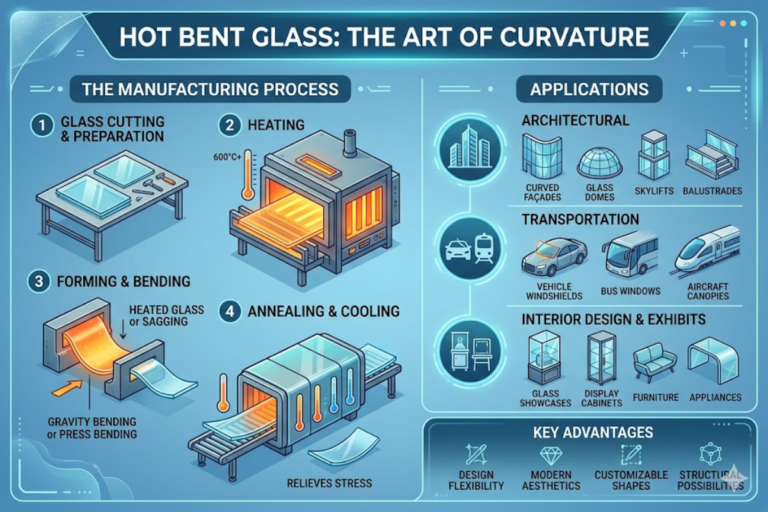
Hot Bending vs Cold Bending Glass — Which Process Fits Your Project? hot bending glass and cold bending glass both create curvilinear glazing panels, but dramatically different methodologies—and the process you choose has a tremendous impact on everything from achievable…
PCAP Cover Glass Design Rules for Industrial HMI Integration

PCAP Cover Glass Design Rules That Keep Industrial HMI Touch Screens Reliable PCAP cover glass is the first thing an operator touches – and the last thing most design engineers dwell on. Of all the touch technologies in an industrial…
Glass Fabrication Process: 6 Steps From Raw Sheet to Finished

How Glass Fabrication Turns Raw Materials Into Finished Glass Products Like a thousand other architectural facades, storefront curtain walls, and interior glass partitions, each panel we make begins as a pile of sand soda ash and limestone. The path from…
Anti-Reflective (AR) Coating on Glass: Types, Benefits & How It Works

How Anti-Reflective Coating Transforms Glass Performance Across Industries What Is Anti-Reflective Coating on Glass? anti-reflective coating on glass (an optical coating applied) is a thin-film device placed on glass surfaces that reduces glare through destructive interference, increasing transmission through the…
laminated vs tempered glass comparison visual: Differences Engineers Need to Know

Laminated Glass vs Tempered Glass: A Side-by-Side Comparison for Building Professionals Both laminated glass and tempered glass carry the label “safety glass,” yet they protect buildings and people in markedly different ways. One crumbles on impact; the other cracks but…
Anti-Glare vs Anti-Reflective Glass for Industrial Displays
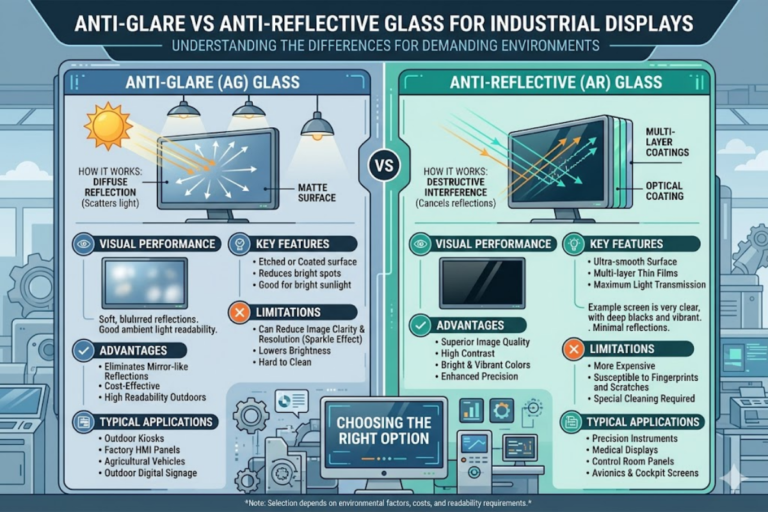
Anti-Glare or Anti-Reflective Glass: Which Surface Treatment Works Best for Your Industrial Display? Top industrial surface treatments for display cover glass fall into two categories – anti-glare (AG) etching and anti-reflective (AR) coating. Both deliver some degree of glare reduction…
What IK10 Really Means for HMI Cover Glass Assemblies [Guide]

Understanding IK10 Protection: A Glass Manufacturer’s Guide to HMI Cover Glass Assemblies Before you buy cover glass for an industrial HMI display, you have most definitely encountered the term “IK10” in datasheets and RFQ specifications. But what does IK10 really…
Chemically Strengthened Glass vs Tempered Glass for Industrial HMIs

Chemical Strengthening vs Thermal Tempering: Which Glass Process Fits Your HMI Project? Two main processes are used to strengthen glass for industrial HMI cover lenses – chemical strengthening (via ion exchange) and thermal tempering (via rapid cooling). Each process produces…
Industrial Touch Screen Glass OEM Projects: Design Guide

Industrial Touch Screen Glass Design Guide for OEM Projects Industrial touch screen glass looks simple from the outside. Most of the difficulty sits underneath the surface. Working OEM designs have to balance touch performance, cover glass strength, readability, controller tuning,…