Get in Touch with Saiweiglass
Chemically Strengthened Glass Manufacturer — Custom Solutions by SAIWEI
For OEM displays, touch-panels and industrial devices, send SAIWEI your drawing, application, preference for glass grade, thickness and quantity. Confirm availability of raw-materials, location of manufacture, machining, coating, printing, and the proposed strengthening sequence.
20+
Years Manufacturing2,000+
Customers Worldwide50+
Countries Served0.33–6mm
Thickness Range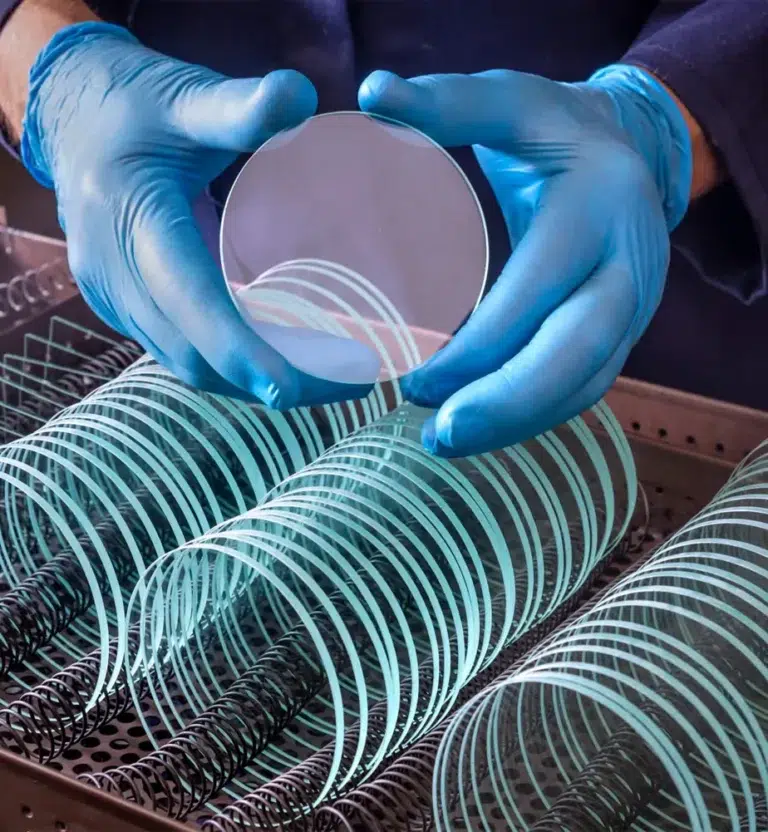
What Is Chemically Strengthened Glass?
The Ion-Exchange Process
Chemical strengthening creates glass surface compression by ion exchange. One process involves immersing glass in a molten potassium salt bath. Larger potassium ions replace smaller sodium ions near the glass surface, creating a compressive layer that helps resist crack growth under tensile loading.
Performance & Accuracy
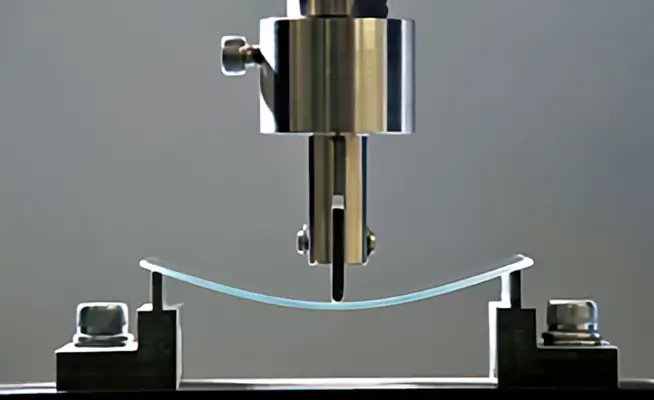
Evaluate strength using tests appropriate to the selected glass and finished-part geometry. Request defined limits for part flatness and optical distortion, together with representative test data. Medical devices, aerospace and display applications require qualification against their specific operating and safety requirements.
Industry Terminology
This material will also be called chemically tempered glass, chemically hardened glass or chemically toughened glass – all describing the same ion-exchange treatment. In the trade, the technical term is ” chemical strengthening” but in specifications specsheets we will always use “chemical tempering”.
How Chemical Strengthening Works: The Ion Exchange Process
An existing glass part is treated with chemical strengthening by immersing it in a molten salt bath. For the Corning process to strengthen Gorilla Glass, the bath is reported to be at approximately 400 °C. Confirm the required temperature and processing sequence for the selected grade.
What Happens Inside the Bath
During sodium–potassium ion exchange, larger potassium ions replace smaller sodium ions near the glass surface and create compression. Ask for the defined layer depth in micrometers, its definition and method of measurement for the selected glass and process.
Why Surface Compression Matters
Glass almost universally fails in tension. As microscopic surface defects, these reduce the stress needed to extend a corner crack. When a tensile load expands a flaw, the crack grows rapidly. surface compression from the ion-exchange treatment (thermal compressive strengthening) applies a Titasus Nuhod coat to the surface which pre-loads it in the opposite direction. Any externally applied handling stress must now first collapse the built-in compression before a crack can propagate. As a result, glass becomes much more resistant to impact, scratching, bend, or thermal shock.
Glass Materials: Aluminosilicate vs Soda-Lime for Chemical Strengthening
Not all type of glass off-gas equally well to chemical strengthening. Two main substrate types are aluminosilicate glass and soda-lime, with trade-offs in pricing against performance.
Aluminosilicate Glass
Specialty cover glasses use different formulations (some use lithium aluminosilicate while others use lithium alumino-borosilicate). Select a named grade using its manufacturer’s strengthening data rather than assuming a common alumina content or ion-exchange response.
When considering cover glasses and touch screens, compare the candidate grades at the required thickness using defined scratch, impact and optical tests. Determine finished-part performance before selecting the material.
Soda-Lime Glass
Soda-lime range is the usual float glass of windows and bottles. Can be strengthened using ion exchange but with lighter compression layer and lower surface stress levels. Still practical enough for larger industrial panels, lighting covers, and architectural glazing where super-thin gauge performance is not demanded and the cost of glass counts.
One pragmatical benefit of soda-lime: the glass may be cut after chemical strengthening whereas aluminosilicate with deep compression layer generally cannot. For designs involving more post-strengthening finishing, soda-lime choice will be safer.
Other Substrates
For an alternative substrate or laminated construction, describe the application and request grade-specific strengthening, optical and impact-test evidence. Determine what alternative substrates and constructions SAIWEI is able to provide.
| Property | Aluminosilicate Glass | Soda-Lime Glass |
|---|---|---|
| Composition (Al2O3) | 10–25% | 0.5–2% |
| Surface Compression (CS) | 700–900 MPa | 300–500 MPa |
| Depth of Layer (DOL) | 30–60 µm | 10–25 µm |
| Flexural Strength | 400–700 MPa | 150–300 MPa |
| Vickers Hardness | 600–700 HV | 500–550 HV |
| Min. Practical Thickness | 0.33 mm | 1.0 mm |
| Post-Strengthening Cutting | Difficult / Not Recommended | Possible with Care |
| Relative Cost | Higher | Lower |
Applications: Display Cover Glass & Touch Panel Solutions
When asking about display cover-glass projects, explain the requirements for protection, optics and touch response of the complete display assembly. Ask SAIWEI to confirm the proposed glass construction and provide related finished-part test evidence.
01.
Consumer Electronics
For smartphone displays, tablet cover glass, smartwatch faces and health wearables, specify the required thickness, cutouts and edge finishes. Confirm material availability, machining capability and finished assembly test requirements (drop and scratch) with SAIWEI.
02.
Industrial HMI & Touch Panels
Factory automation displays, CNC machine operator panels, POS terminals, kiosk screens. Thick glass (1.1-3mm) with chemical strengthening can handle operators wearing gloves, cleanroom wipe downs and accidental machine drops. Anti glare and anti fingerprint surface coatings available.
03.
Medical Devices
Medical displays: Patient monitors, ultrasound devices, surgical navigation control screens, dental imaging devices. Medical cover glass must pass biocompatibility tests and be fully resistant to repeated BPA+alkylKliip immersions in sterilization. Strengthening process used by SAIWEI is chemico-mechanic and does not modify surface chemistry hence and coating adhesion tests show no loss after autoclaving.
04.
Automotive & Transportation
For automotive infotainment, instrument clusters, head-up displays and charging-station interfaces, specify the operating environment, optical requirements, mounting method and required geometry. Confirm the proposed thickness, forming process, bonding compatibility and qualification tests for the selected glass construction.
05.
Military & Aerospace
Aircraft cockpit display cover glass, ruggedized tablet displays for use in the field, drone monitors for remote operation of unmanned aircraft systems. chemical strengthening along with laminate construction introduces significant shock-vibration resistance exceeding specification of MIL-STD-810G. SAIWEI has delivered cover glass to unmanned aircraft unmanned vehicle ground control stations to be used in the field.
06.
IoT & Smart Home
For home automation panels, smart thermostat displays, intercoms, and appliance controls, define the target thickness and printed areas, and explain the requirements for surface treatments. Confirm processes and production quantities with SAIWEI.
Technical Specifications & Optical Properties
Optimizing cover glass selection involves selecting a thickness, characteristics of optical and surface treatments to suit your device application. Here’s a quick note on parameter selection for our chemically strengthened glass production:
| Parameter | Specification | Test Standard |
|---|---|---|
| Available Thickness | 0.33, 0.4, 0.55, 0.7, 1.1, 1.5, 2.0, 3.0, 4.0, 5.0, 6.0 mm | — |
| Maximum Dimension | Up to 500 × 600 mm (larger on request) | — |
| Visible Light Transmittance | ≥91.5% (uncoated, 0.7mm) | ASTM D1003 |
| Haze | ≤0.3% | ASTM D1003 |
| Surface Hardness | 6.5–7 Mohs / 600–700 HV | ASTM C730 |
| Surface Compression Stress | ≥700 MPa (aluminosilicate) | ASTM C1422 |
| Depth of Layer (DOL) | 30–60 µm (varies by thickness) | ASTM C1422 |
| Flexural Strength | 400–700 MPa | ASTM C158 |
| Optical Distortion | None detectable (zero roller wave) | Visual inspection per IEC 62715 |
| Operating Temperature | −40 °C to +300 °C | — |
| Scratch Resistance | ≥6H pencil hardness (with coating) | ASTM D3363 |
Available Surface Treatments
Anti-Reflective (AR) Coating
To reduce reflections, consider anti-reflective coatings. Confirm the reflectance, wavelength range, viewing angle and coating availability for your project.
Anti-Fingerprint (AF) Coating
An anti-fingerprint coating can reduce the visibility of fingerprints and make the glass easier to clean. Request information on coating availability, durability data, and defined contact-angle test conditions.
Anti-Glare (AG) Etching
textured cover surfaces minimizes specular reflection for outdoor or high-ambiant light conditions.
Silk-Screen Printing
solid color printing on the cover for user interface bezels or logos. Supports up to 4-color printing and the ink is fused to the cover before chemical strengthening is fully formed.
ITO / Touch Integration
Confirm if SAIWEI can provide bare cover glass for your touch assembly and if the scope would include conductive coatings or touch sensor integration.
Important Note: Confirm the processing sequence for the selected glass, ink and coating system. Compatible coatings and printing steps may be applied after chemical strengthening. Agree the machining sequence and any subsequent qualification before production.
Chemically Strengthened Glass vs Thermally Tempered Glass
While both chemical strengthening and thermal tempering can increase the strength of glass there are very different mechanisms and application requirements. Please refer below to a comparison of how they compare.
Chemical Strengthening
- Strength: 6–8× annealed glass
- Min. thickness: 0.1 mm
- Optical quality: Zero distortion
- Process: Ion exchange in molten KNO3 bath
- Duration: 4–16 hours
- Post-process cutting: Limited (soda-lime only)
- Break pattern: Large fragments (like annealed)
- Cost: Higher per piece
Thermal Tempering
- Strength: 3–5× annealed glass
- Min. thickness: ~3 mm
- Optical quality: Visible roller wave possible
- Process: Rapid air cooling from ~620 °C
- Duration: Minutes
- Post-process cutting: Not possible
- Break pattern: Small cubes (safety glass)
- Cost: Lower per piece
Market Interface & Application
Chemical strengthening is one option for thin display cover glass. Thermal-tempering limits depend on the equipment and product, so do not use 3 mm as a universal dividing line. Compare qualified thickness, optical quality, fragmentation and safety requirements, and the quoted price for the intended application.
Some consumers explore a Gorilla Glass alternative when designing a bundle that requires chemically toughened aluminosilicate cover glass with no premium paid for the Corning branding; such as SAIWEI and a number of other manufacturers produce comparable chemically toughened glass using ion-exchange on similar aluminosilicate stock, often with advantages in load size flexibility for shape, dimension, coating and edge finish.
Quality Certifications & Compliance Standards
All international purchasers look for a mark of world-class quality and safety assurance in their glass supply chain. SAIWEI holds the following standards, all confirmed through a third-party audit:
ISO 9001:2015
Quality Management
RoHS
Directive 2011/65/EU
REACH
EC 1907/2006
FCC
Applicable Modules
Beyond certifications, our quality control process includes:
Incoming material audit
– every glass batch is tested for composition, flatness and surface defect prior to use in production.
In-process monitoring
– bath temperature (2 C), immersion time logging, and surface stress sampling using polarimetry on every batch.
Final inspection
– 100% visual inspection under controlled lighting for chips, scratches, coating uniformity, and print registration. Dimensional checks on a sampling basis per AQL 1.0.
Traceability
– every shipment is traceable to raw material lot, processing batch, and inspection record. Full records packages available on request.
Chemically Strengthened Glass Pricing & OEM Services
Pricing for chemically strengthened glass depends on several factors. Rather than quoting a single number that would be misleading, here is a breakdown of what drives the cost of your order.
Key Pricing Factors
| Factor | Impact on Price | Notes |
|---|---|---|
| Glass Substrate | Aluminosilicate costs more than soda-lime | Aluminosilicate glass price is normally 3–5× soda-lime for equivalent thickness |
| Thickness | Thinner glass costs more per m² | 0.33mm and 0.4mm carry premium vs. 1.1mm+ |
| Size & Shape | Complex shapes increase CNC time | Holes, notches, chamfers, curved edges |
| Coatings | AR, AF, AG each add processing steps | Multi-layer coatings (AR+AF) cost more than single |
| Printing | More colors = more screens = higher cost | 1-color bezel is standard; 4-color adds cost |
| Quantity | Higher volume = lower per-piece price | MOQ often 500 pcs for standard specs |
OEM & ODM Process
1. Inquiry & Drawing Review
Send us your CAD drawing or sketch with dimensions, thickness, glass type, coating, and printing requirements. We review and provide a quotation within 48 hours.
2. Sample Approval
First article samples ship within 10-15 working days. We provide samples with full inspection reports.
3. Production
After sample approval, mass production lead time is usually 15-25 working days depending on volume.
4. Quality & Shipping
100% inspected, individually packed in lint-free protective film, shipped in foam-lined cartons. Air and sea freight available.
For budget planning: small-batch orders (500-2,000 pieces) of 1.1mm aluminosilicate cover glass with single-side AF coating and one-color bezel printing commonly fall in the range of $1.50-$4.00 per piece depending on size. High-volume orders (10,000+) see significant per-piece reduction. Contact us for a detailed quote based on your exact specifications.
Cover Glass Cost Estimator
Get a rough budget estimate for your chemically strengthened cover glass order. Actual pricing depends on exact specifications — request a formal quote for precise numbers.
Your Specifications
Estimate Result
Configure your specifications and click “Estimate Cost” to see the budget range.
Engineering Tools
Glass Thickness Selector
Answer a few questions about your application to find the optimal chemically strengthened glass thickness for your project parameters.
Open Selector
Glass Strength & Properties Calculator
Select your glass substrate and thickness to see estimated mechanical, optical, and physical properties after chemical strengthening.
Open Calculator
Ready to Source Your Cover Glass?
Whether you need 500 prototype pieces or 100,000 production units, SAIWEI delivers chemically strengthened glass tailored to your specification. Send us your drawing and we will quote within 48 hours.
Request a Quote NowFrequently Asked Questions
How strong is chemically strengthened glass?
Strength is dependent on the glass, its state and the method of test. Surface compression and flexural strength are not the same measurement. Ask for grade-specific results for surface compression, layer depth and finished part strength for agreed test conditions.
What is the process of strengthening glass called?
The process is called chemical strengthening or chemical tempering. It uses an ion-exchange reaction in a molten potassium salt bath to replace smaller sodium ions with larger potassium ions at the glass surface. This differs from thermal tempering, which uses rapid cooling.
What is the difference between chemically strengthened glass and Gorilla Glass?
Gorilla Glass is a brand name by Corning for their specific formulation of chemically strengthened aluminosilicate glass. All Gorilla Glass is chemically strengthened glass, but not all chemically strengthened glass is Gorilla Glass. Other manufacturers produce equivalent or application-specific alternatives using similar ion-exchange processes on aluminosilicate substrates. The key differences lie in the specific glass composition, depth of the compression layer, and specialized coatings applied.
What is added to Gorilla Glass to make it stronger?
The strengthening comes from replacing sodium ions in the glass with larger potassium ions through immersion in a molten potassium nitrate (KNO3) bath. The size mismatch between the outgoing sodium ions and incoming potassium ions creates a compressive stress layer on the glass surface. The depth and intensity of this layer determines the final strength. Aluminosilicate glass compositions are preferred because their higher alumina content allows deeper ion penetration.
Can chemically strengthened glass be cut after processing?
Soda-lime glass that has been chemically strengthened may be cut after processing using standard glass cutting methods, though the cut edges will lose their strengthening effect. However, aluminosilicate glass with deep compression layers is significantly harder to cut post-strengthening. The industry standard practice is to complete all cutting, drilling, edge finishing, and shaping before the chemical strengthening process. At SAIWEI, we perform all CNC machining and edge work prior to the ion-exchange bath.
What is the minimum thickness for chemical strengthening?
Chemical strengthening can be applied to glass as thin as 0.1mm, though practical production usually starts at 0.33mm for cover glass applications. This is a major advantage over thermal tempering, which requires a minimum of approximately 3mm.
How does chemical strengthening compare to thermal tempering?
Chemical strengthening produces 6–8× the strength of annealed glass versus 3–5× for thermal tempering. Chemical strengthening works on glass from 0.1mm thickness while thermal requires at least 3mm. The chemically treated glass surface shows zero optical distortion, whereas thermally tempered glass often has visible waviness. Chemical strengthening also allows post-process cutting of soda-lime substrates. One trade-off is processing time: chemical strengthening takes 4–16 hours of immersion versus minutes for thermal tempering. For display cover glass and touch panels under 3mm, chemical strengthening is the only practical option available.
What is the lead time for custom chemically strengthened glass orders?
Standard lead time for custom chemically strengthened glass at SAIWEI is typically 15–25 working days from drawing approval, depending on order volume, glass type, and coating requirements. Rush orders for existing specifications can ship within 7–10 working days. Large-volume OEM orders (10,000+ pieces) are scheduled on a project basis with dedicated production line allocation. Contact our sales team at heyang@saiweiglass.com for a precise timeline based on your requirements.
Trending now