Póngase en contacto con Saiweiglass


Low Iron Glass vs Clear Glass: Transmittance, Color & B2B Use Cases

Contenidos
mostrar
Low iron glass vs clear glass is a material-selection question, not just a visual preference. For color-critical panes, low iron glass gives maximum clarity and a more neutral pane, while standard clear glass is still the practical glass type for many framed, non-color-critical, and budget-driven B2B parts.
Quick Answer: Low Iron Glass vs Clear Glass
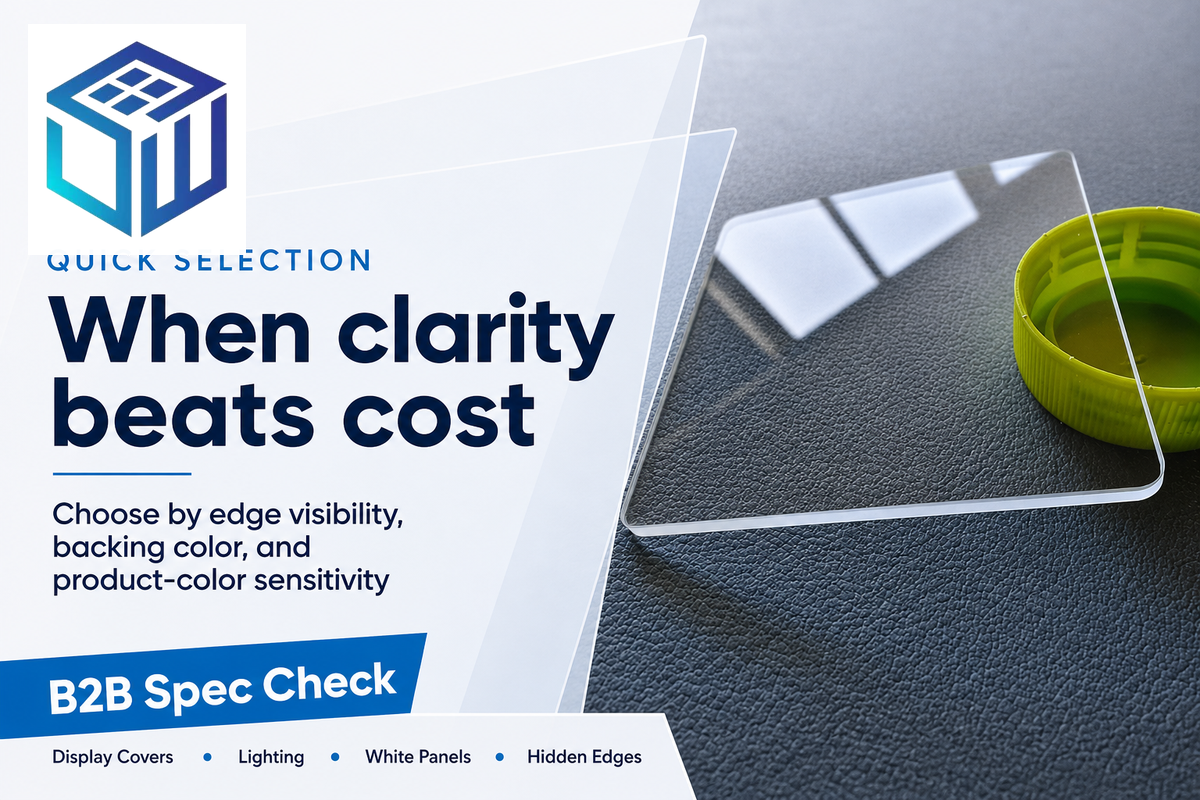
Because low-iron glass is manufactured with reduced iron, it shows less green tint and usually keeps higher visible light transmission than standard clear glass. With clear and low-iron glass, the best uses depend on whether the buyer sees edge color, white backing, or product color through the pane. Choose it for display covers, lighting, solar cover glass, white-backed appliance panels, and high-end partitions. Choose clear glass when hidden edges, cost, or ordinary glazing performance matter more. In flat-glass RFQs, keep the quality-scope language tied to ASTM C1036 rather than marketing names alone.
>91%low iron VLT example
89%clear VLT example
<0,015%Saiwei Fe2O3 limit
0.7-19 mmSaiwei thickness range
In production, the practical difference between clear glass and low-iron glass is easier to see when the glass thickness increases, when a polished edge is exposed, or when a white, light, printed, or color-critical object sits behind the glass. That is why low-iron glass is worth evaluating early in an OEM specification.
Low iron glass
- More transparent look with a lower green cast
- Better true color representation on white, printed, or illuminated products
- Often selected for high-end display, lighting, solar, and architectural feature glass
- Usually needs tighter purchasing and sample approval because cost is higher
Clear glass
- Common type of glass used for standard float glass and regular glass parts
- May show a faint green tint from the natural presence of iron oxide
- Often adequate for hidden-edge, tinted, framed, or non-color-critical panes
- Usually easier to source for cost-sensitive commercial glass programs
Transmittance and Color: What Actually Changes
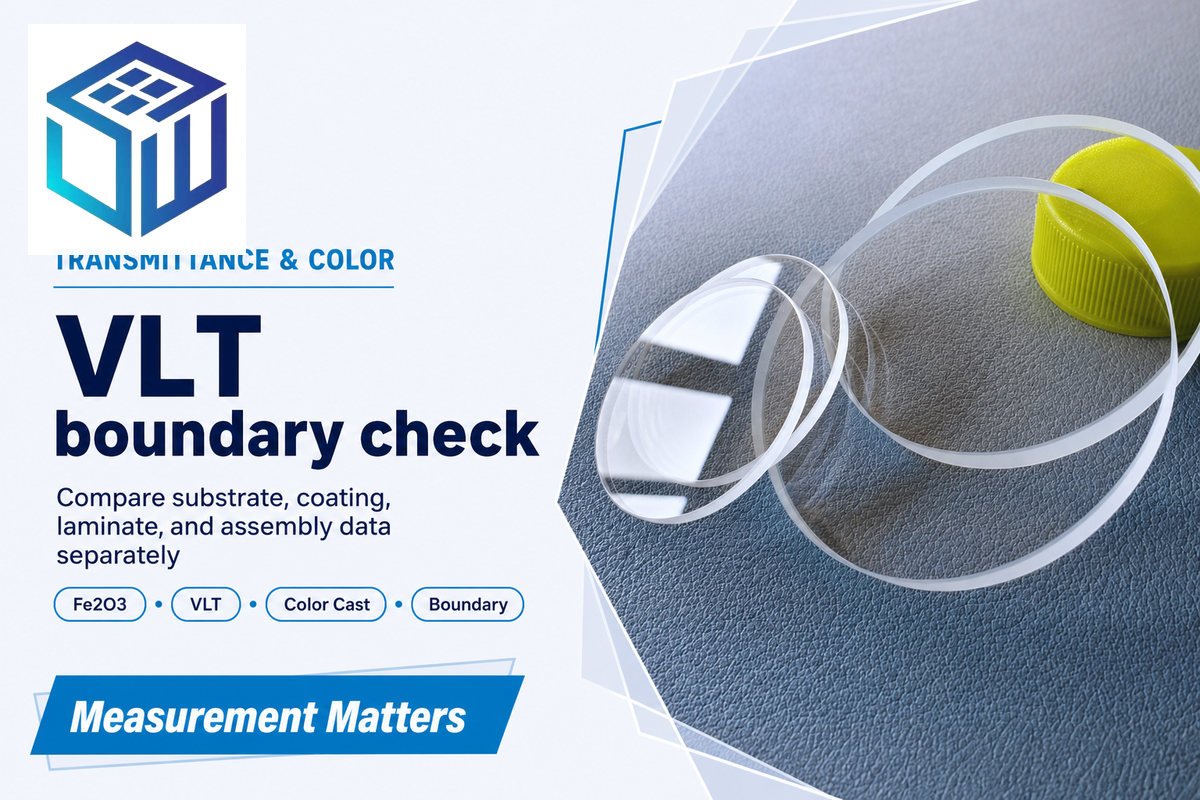
Color difference comes from iron oxide from elements in the float glass batch, especially sand used to make float glass. Standard clear glass is made with enough residual iron that, when glass was melted in a molten glass formula, the edge tint reads as a subtle green or blue-green cast.
Saiwei’s low iron glass page lists visible light transmittance above 91% and Fe2O3 below 0.015%. Guardian’s UltraClear page also describes visible light transmission over 91% and average iron content of 0.01%, while Guardian Clear gives a clear-glass transmittance example around 89% for the referenced configuration. Use the open ANSI ASTM C1036 overview for flat-glass scope, then request product-specific optical data from the supplier.
Keep the measurement boundary explicit. Berkeley Lab’s WINDOW documentation separates complete-window visible transmittance from center-of-glass values, while its Óptica documentation treats films, laminates, and substrates as layered spectral data. A bare low-iron lite, a coated sheet, a laminated panel, and a framed assembly should not be compared as if the VLT number came from the same test boundary.
| Glass option | Typical optical signal | Color behavior | Source context |
|---|---|---|---|
| Vidrio bajo en hierro | Often above 91% VLT in cited product data | Reduced green tint; colors appear closer to their true shade and tone | Saiwei, Guardian UltraClear, Pilkington Optiwhite |
| Standard clear glass | Example values range lower and depend on thickness/product | Faint green or greenish tint can be noticeable in thicker panes and exposed edges | Saiwei comparison, Guardian Clear |
| Ultra clear glass or extra clear glass | Usually a market synonym family for low-iron glass | Used when maximum clarity and color neutrality are selling points | Vitro Starphire, Guardian UltraClear, Pilkington Optiwhite |
For RFQ review, keep the cited values in source context: Saiwei’s low-iron page gives >91% VLT, <0.015% Fe2O3, and 0.7-19 mm availability, while the same first-party comparison cites standard clear glass at about 83-84% VLT and about 0.1% Fe2O3. Guardian UltraClear cites >91% VLT and 0.01% average iron, Guardian Clear gives about 89% VLT for its referenced monolithic clear-glass configuration, and Pilkington Optiwhite lists about 91% VLT for 3-10 mm and about 90% VLT for 12-19 mm.
Do not treat one visible light value as a universal promise. Coatings, lamination, tint, glass thickness, testing method, and final assembly all affect the clarity of the glass. For RFQ work, ask the glass manufacturer to state material type, thickness, measured transmittance, color target, and any protective coating in the same data sheet.
Engineering note: For B2B sourcing, the useful question is not whether one glass name sounds clearer. Ask whether the final assembly will be judged for color neutrality, edge tint, and measured visible light transmission.
Thickness-to-Tint Escalation Ladder
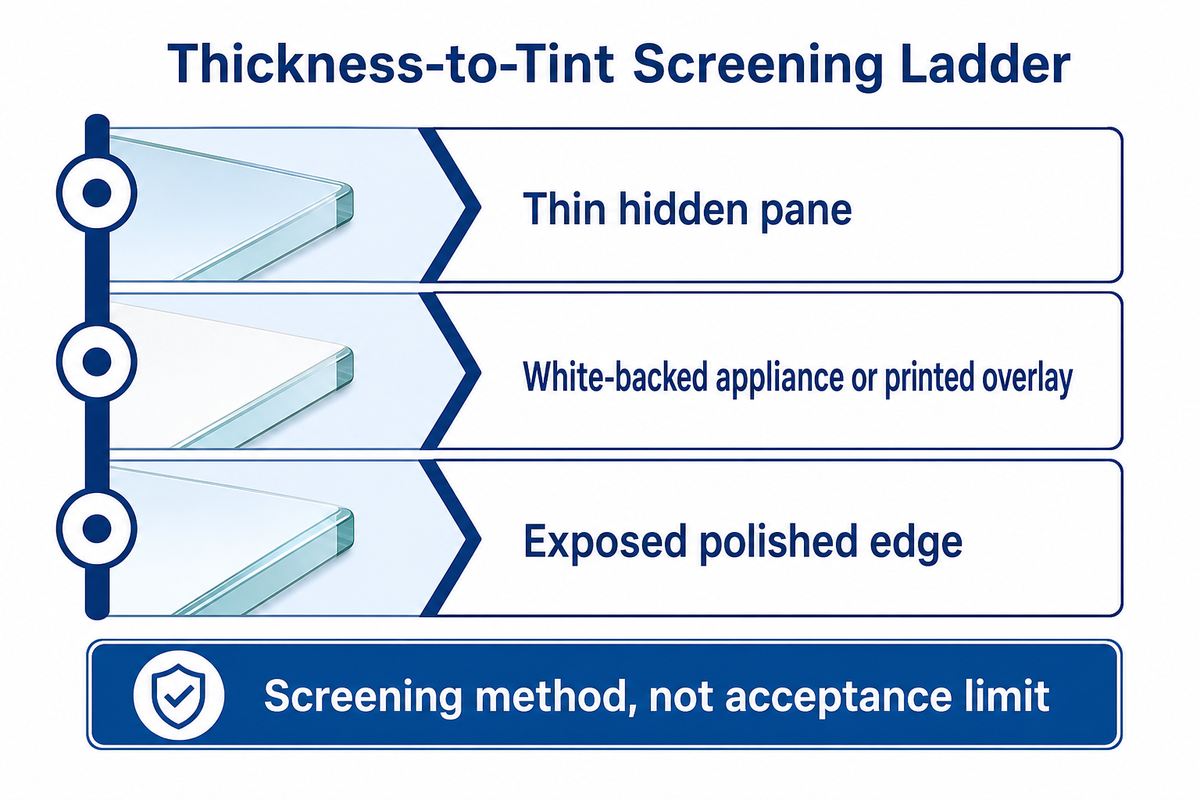
The main distinctions between low-iron and clear glass become stronger as the pane gets thicker, the edge becomes visible, and the object behind the glass needs accurate color. A thin hidden pane may look acceptable in clear glass. A thick polished edge, display cover, or illuminated panel can make the greenish tint much more visible. Pair this visual ladder with the current ASTM C1036-25 listing when the drawing also needs flat-glass quality wording.
The ladder is a screening method, not a color-acceptance limit. When transmitted color has to be controlled, ASTM C1649 frames acceptance around the end-use color range and agreed supplier-buyer criteria, so the drawing should name the acceptance method instead of relying on thickness alone.
| Design condition | What the buyer sees | Better default | Reason |
|---|---|---|---|
| Thin framed pane | Edge is hidden and the view is not color-critical | Clear glass | The tint found in standard clear glass may not be visible enough to justify a premium. |
| White-backed appliance or printed overlay | Green cast can shift whites, graphics, and brand colors | Low iron glass | True color and cleaner appearance matter more than commodity cost. |
| Thick pane or exposed polished edge | Subtle green tint reads as a stronger band on the edge | Low iron glass | The tint is more visible as optical path length increases. |
| Retail case, museum case, or display window | The object behind the glass must look natural | Low iron glass | Low-iron glass is more transparent and supports true color representation. |
| Tinted, patterned, or opaque assembly | Substrate color is partly hidden by design | Conditional | Choose clear or low-iron glass after viewing production samples. |
This ladder is also useful when comparing low-iron and clear glass with protective coating options. A coating can improve glare, reflection, fingerprint resistance, conductivity, or surface function, but it does not erase the substrate color behind the glass. Start with the substrate, then add the coating stack.
Why the SERP Talks About Shower Doors
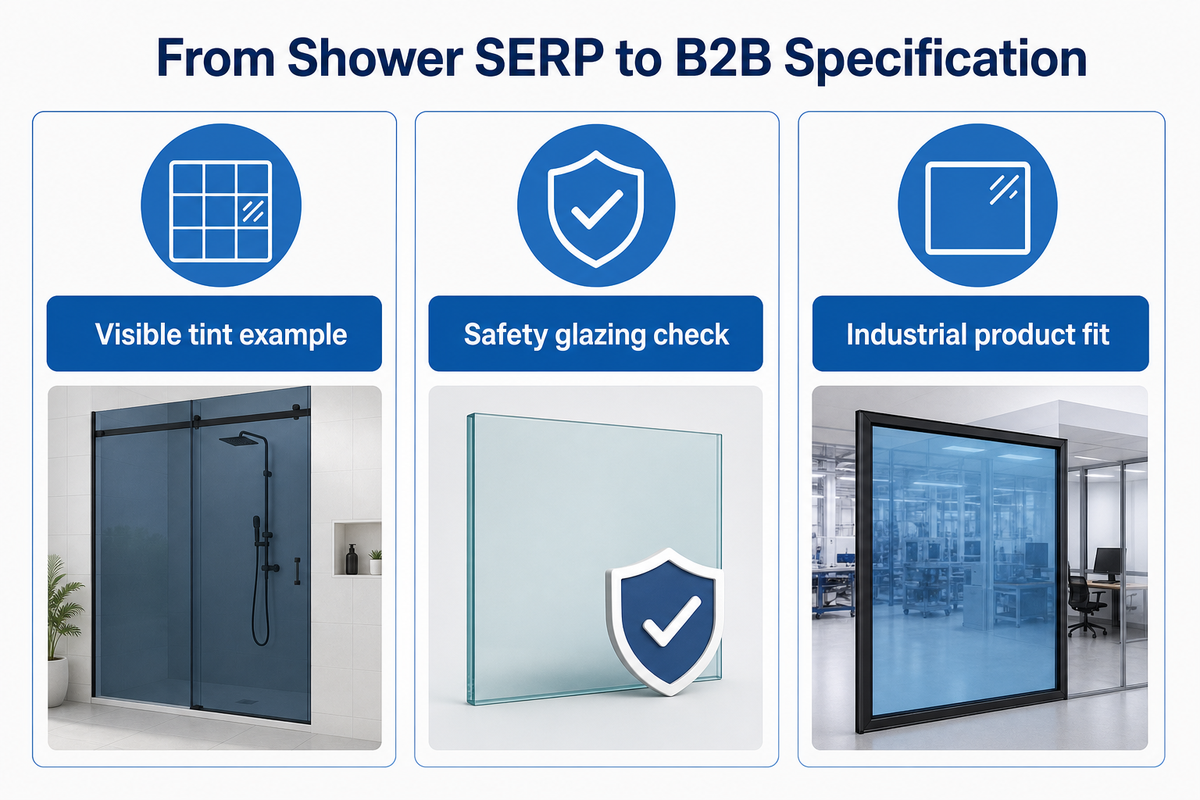
Many ranking pages discuss shower doors, shower glass, frameless shower panels, frameless enclosures, tile, bathroom walls, and shower enclosures because consumers can see the green tint next to white tile. That shift from shower doors to commercial glass is useful context, but it is only one visible example, not the whole B2B decision. In commercial procurement, the ANSI ASTM C1036 overview is a better boundary than shower-only copy.
If the real product is a shower door or enclosure, safety glazing becomes a separate requirement. The current 16 CFR Parte 1201 scope includes shower doors and enclosures, so low iron vs clear glass does not replace impact, labeling, or local code checks.
For a glass used in commercial products, the same visual principle applies to a display case, HMI cover, LED lighting lens, appliance door, partition, facade mockup, or solar module cover. Buyers should compare low-iron glass with clear glass by performance requirement, inspection condition, and lifecycle cost rather than by a single consumer example.
A competitor gap is clear: shower-door articles answer whether low-iron shower glass is worth it, but industrial buyers also need to know when the difference between low-iron glass and clear glass affects color distortion, natural light, printed graphics, sensor windows, and the right glass for high-volume production.
9-Use-Case B2B Fit Matrix
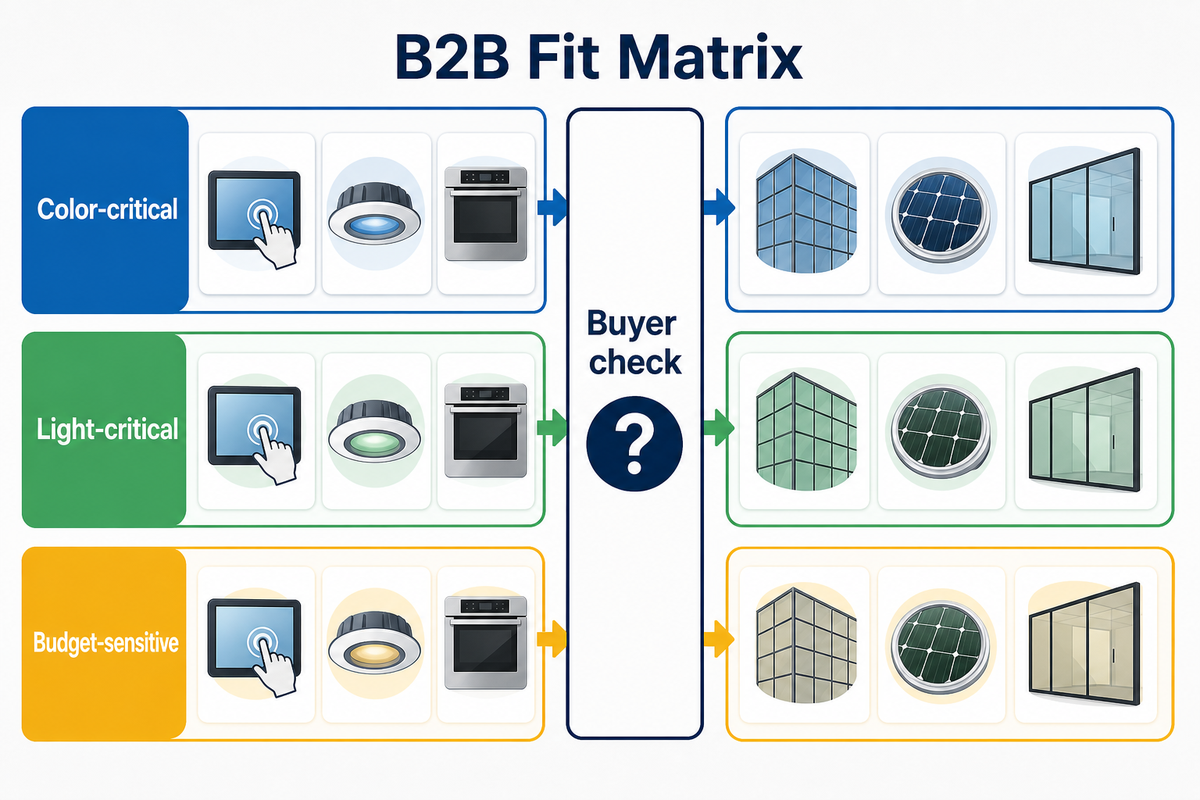
For optical surfaces, low iron glass fits best when the pane becomes part of the product’s viewing experience. Clear glass fits best when the pane is mainly a protective or structural cover and the customer will not judge color through it. This table turns that distinction into a quote-ready application decision. Treat ASTM C1036 as the flat-glass reference frame, then let the application decide whether low iron adds visible value.
| Application type / category | Choose low iron when | Choose clear when | Buyer check |
|---|---|---|---|
| Touch screen glass and HMI covers | White UI, color display, optical bonding, or premium control panel appearance matters | The interface is low-cost, dark-backed, or not color-sensitive | Inspect display brightness, color shift, and edge color under production lighting |
| LED and architectural lighting | The lens or cover must preserve color temperature and avoid greenish output | The glass is hidden behind a diffuser or tinted cover | Test luminous appearance with final LED bin and cover thickness |
| Vidrio para cubierta de paneles solares | High transmission and low absorption support module output targets | The project is not transmission-limited or uses a different glass stack | Request optical data, tempering route, and durability tests |
| Appliance and smart home panels | Printed icons, white backing, or premium fascia color must stay neutral | Dark backing or opaque print hides substrate color | Approve samples against brand color chips |
| Partitions, facades, and display cases | Edges are exposed or objects behind the glass need natural color | Frames hide edges and color fidelity is secondary | View mockups from the final inspection distance |
| Retail display and museum cases | Product color, jewelry, artwork, or collectibles must look natural | Lighting, frame color, or distance hides a faint tint | Compare a full-size sample against the displayed object |
| Medical or lab instrument windows | White plastics, labels, or readouts must stay visually neutral | The window is small, dark-backed, or non-display-facing | Validate under the same inspection light used in assembly |
| White-backed control panels | Brand color and icon print must stay clean through the glass | Opaque printing hides the substrate color | Approve print color on the production glass stack |
For exterior facades or window-like assemblies, do not treat low iron as an energy-performance choice by itself. Berkeley Lab WINDOW documentation calculates U-value, SHGC, and visible transmittance for complete windows and center-of-glass systems, so pair any low-iron visual requirement with low-e coatings, framing, glare control, and structural criteria.
Saiwei’s first-party material range makes this matrix practical because the same low-iron panel can be discussed with thickness, CNC shape, surface quality, print, coating, and strengthening requirements in one RFQ. That is the B2B difference between a general comparison article and a supplier-ready specification.
Spec-Stack Compatibility Map
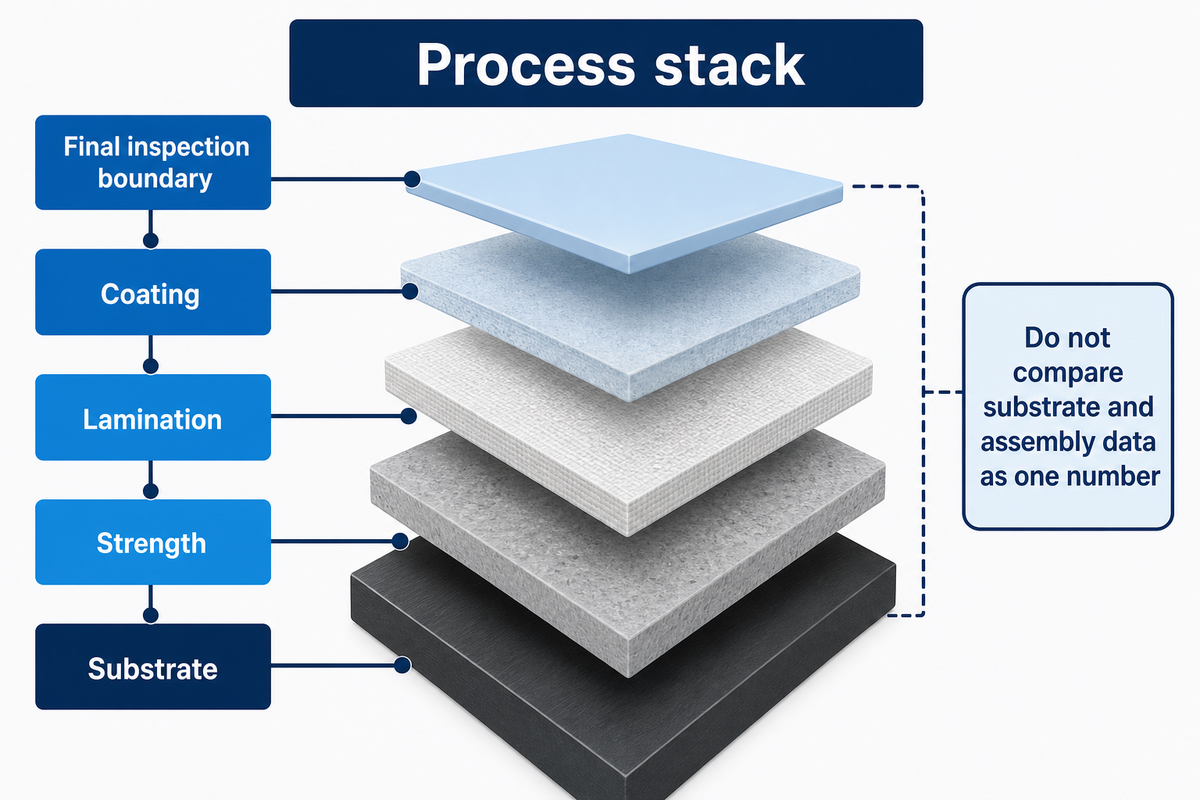
As a substrate, low iron glass changes optical clarity; it does not automatically make the pane tempered, laminated, conductive, anti-glare, anti-reflective, or fingerprint-resistant. Tempered glass, laminated safety glass, and coated custom glass are process choices layered on top of the substrate. Treat low iron as the substrate choice, then specify the process stack: tempering, lamination, chemical strengthening, CNC profiling, screen printing, and coating in the correct order. The ASTM C1036-25 listing belongs to flat-glass quality scope, not to strength or coating performance by itself.
For coated, laminated, or framed products, ask whether the supplier is reporting substrate data, center-of-glass data, or complete assembly data. This is why the RFQ should keep substrate, process route, coating stack, and final inspection boundary as separate lines.
| Specification layer | Question to answer | Saiwei-relevant option | Common risk |
|---|---|---|---|
| Sustrato | Clear glass or low-iron glass? | Low iron float glass, low iron panel, or standard clear glass | Choosing the glass type after artwork or coating has already been approved |
| Fuerza | Does the part need heat tempering or chemical strengthening? | Templado térmico, chemical strengthening | Assuming low iron means stronger; strength is a separate process |
| Safety and structure | Does the assembly need laminated glass? | Low iron laminated glass or tempered laminated glass | Ignoring interlayer color and edge appearance |
| Surface function | Does the glass need anti-glare, anti-reflective, anti-fingerprint, or conductive coating? | AG, AR, AF, and ITO coating | Testing coating performance on a different substrate than production |
| Decoration | Does print color need to stay accurate? | Screen printing on low iron or clear substrate | Approving print on regular glass and then switching substrate late |
- Lock the viewing condition – define backing color, edge exposure, lighting, and inspection distance before selecting glass.
- Choose the substrate – compare low-iron and clear glass samples at the planned glass thickness.
- Add processing requirements – specify tempering, lamination, CNC edges, holes, printing, and coating after the substrate decision.
- Approve the final stack – validate a production-equivalent sample, not a bare coupon, before mass production.
When Clear Glass Is the Better B2B Choice
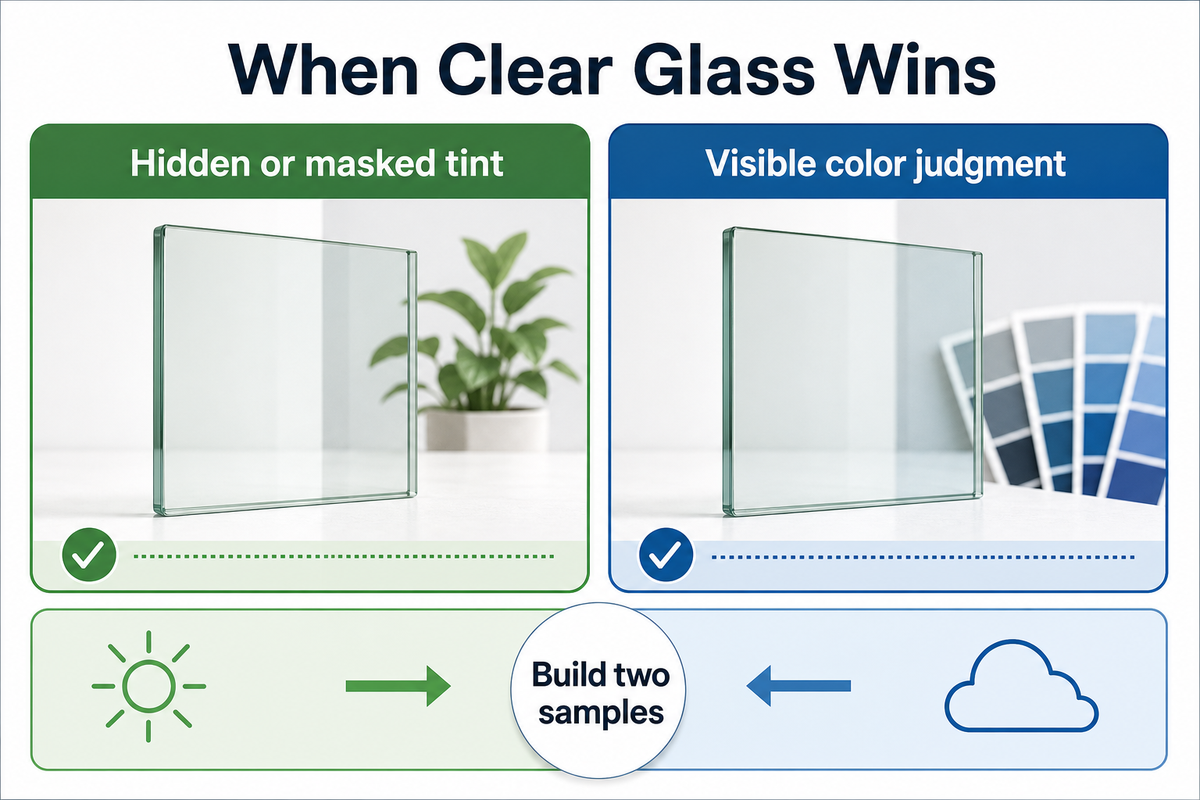
Clear vs low-iron is not a moral ranking. Clear glass is widely used because it works, costs less, and can be the right glass when the slight green tint is hidden or irrelevant. Still, the common assumption that every premium project needs low iron glass is not always true. Keep the base flat-glass specification anchored to ASTM C1036, then decide whether color neutrality deserves a separate low-iron requirement.
Choose clear glass when
- Hide edges inside a frame or opaque gasket
- Use dark backing, tint, pattern, or print that masks substrate color
- Build a cost-sensitive part where color fidelity is not a purchase criterion
- Need broad availability for a standard glass replacement program
Do not choose clear glass when
- Expose thick polished edges next to white or light materials
- Place color-critical graphics, displays, products, or LEDs behind the glass
- Sell a high-end visual surface where greenish tint will be judged directly
- Need the cleanest possible optical path before adding coatings
A safer B2B route is not to argue low-iron vs regular glass in the abstract. Build two samples with the actual glass thickness, backing color, edge treatment, and coating. If the low-iron and clear glass samples look identical in the final assembly, clear may be the better commercial choice.
Cost, Lead Time, and RFQ Tradeoffs
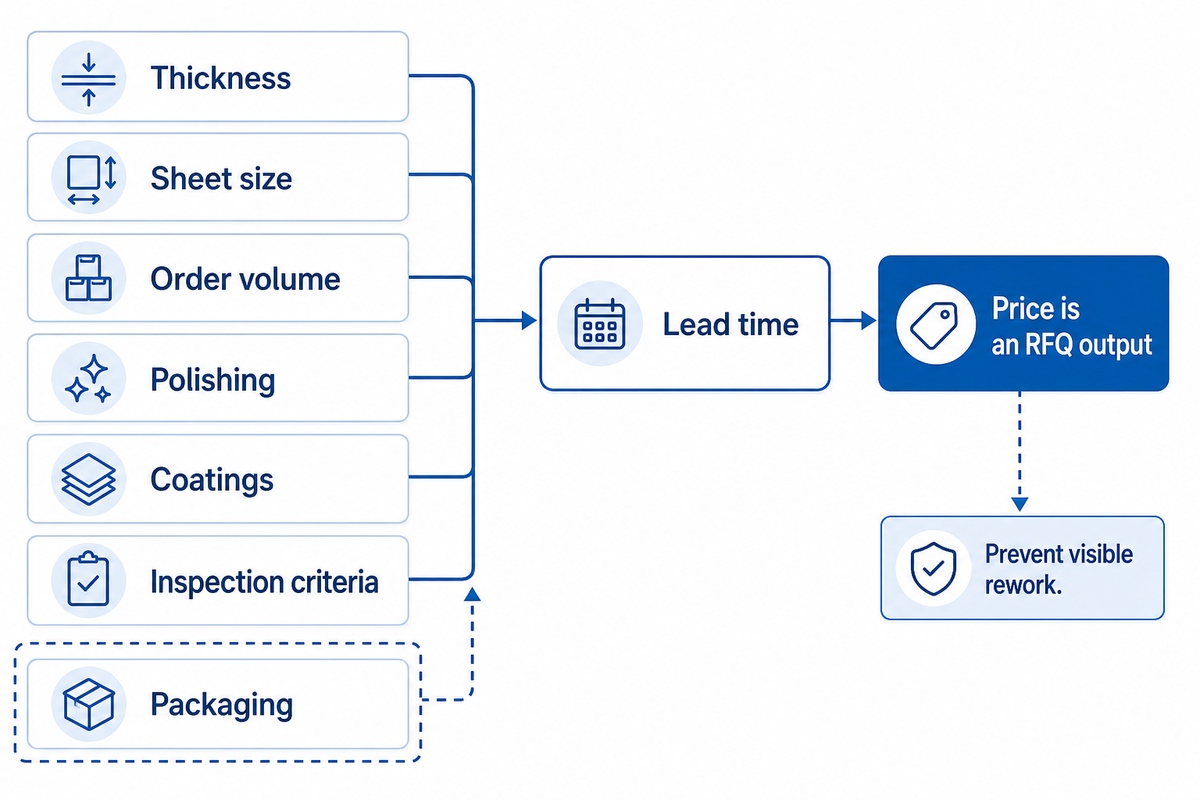
In many RFQs, low iron glass costs more than standard clear glass, but a universal percentage can mislead buyers. Price depends on thickness, sheet size, order volume, polishing, holes, tolerances, tempering, lamination, protective coating, print coverage, inspection criteria, packaging, and lead time. Treat price as an RFQ output, not a blog formula. Use the ANSI ASTM C1036 overview to separate base glass scope from commercial pricing variables.
For procurement teams, the useful cost question is whether low iron prevents a visible problem that would otherwise cause rework, rejection, or brand-quality complaints. On a display cover, lighting lens, or white appliance panel, the premium can be a quality-control decision. On a hidden pane, it can be waste.
Quote-Ready Glass Decision Checklist
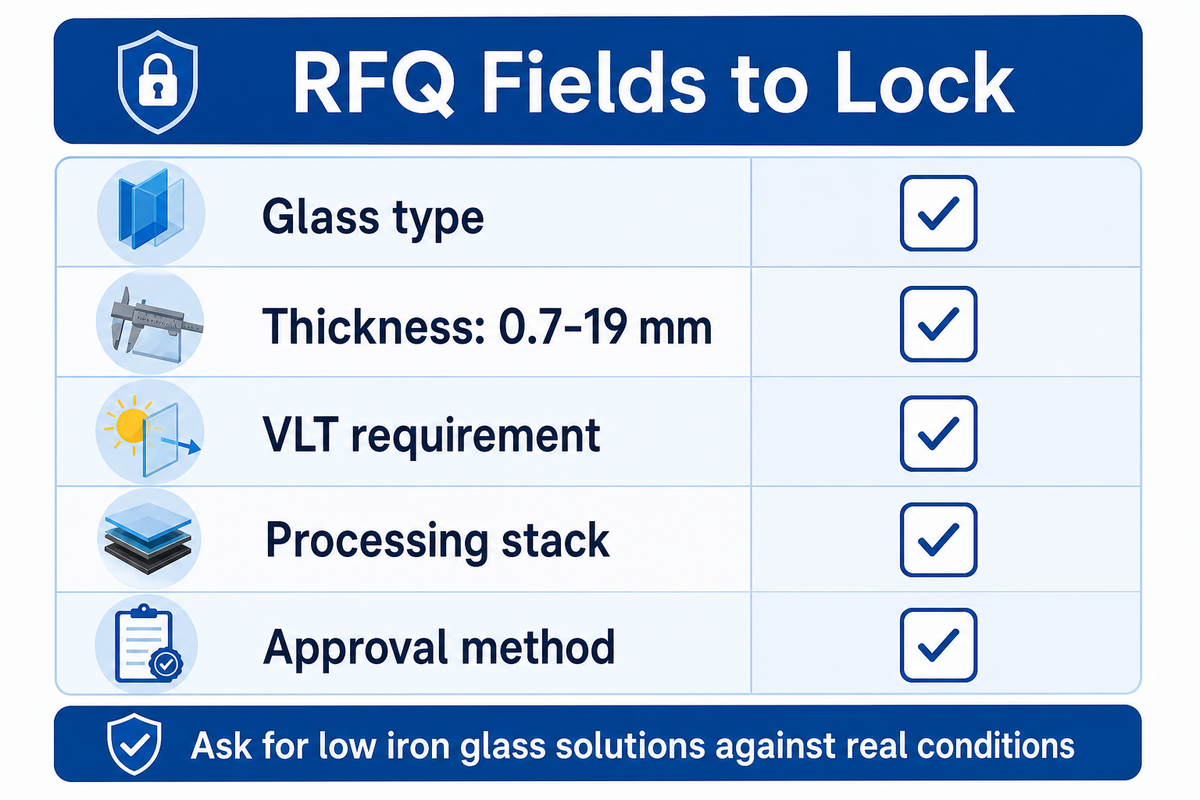
A strong RFQ makes the material choice testable. Instead of asking only for low iron glass price, state the glass used, target color, VLT requirement, processing stack, and approval method. Ask whether glass is available as a stock sheet, cut-to-size part, or custom glass program before locking the drawing. Saiwei can then quote low iron glass solutions against the actual performance and manufacturing conditions, with ASTM C1036-25 used only where flat-glass quality scope is relevant.
RFQ checklist – copy these into your quote request:
| Parámetro | Recommended range | Por qué es importante | How to verify |
|---|---|---|---|
| Tipo vidrio | Low iron, standard clear, laminated, or tempered | Defines optical baseline and safety route | Supplier material declaration |
| Espesor | 0.7-19 mm for Saiwei low iron context | Controls tint visibility, strength route, and weight | Drawing and sample measurement |
| Visible light target | State VLT target and test method | Prevents vague clarity claims | Data sheet or optical test report |
| Color requirement | White backing, brand color, display color, or no color-critical target | Decides whether low iron is worth specifying | Golden sample under final lighting |
| Edge and shape | CNC profile, polished edge, holes, slots, chamfers | Exposed edges make tint more visible | Drawing tolerance and inspection photos |
| Pila de superficies | AG, AR, AF, ITO, print, etch, or no coating | Coatings alter optical and handling behavior | Coated production sample |
| Availability | Stock sheet, cut-to-size blank, or custom glass run | Controls lead time, MOQ, and yield risk | Supplier availability confirmation |
| Aprobación | Prototype, pilot lot, then mass-production control plan | Prevents late substrate and color changes | Signed sample and QC checklist |
Conclusión clave
Specify low iron glass when color neutrality, edge clarity, and high visible light matter enough to be inspected; specify clear glass when those benefits are hidden, unmeasured, or not worth the cost in the final assembly.
Request a Low Iron Glass Quote
Preguntas frecuentes
These questions come from People Also Ask, NEURONwriter, GSC, and competitor SERP patterns. The answers are written for B2B buyers who need a defensible specification, not just a bathroom or shower-panel upgrade. Use them to decide whether low-iron glass is worth testing before your drawing is locked.
What are the disadvantages of low-iron glass?
The main disadvantages are higher material cost, tighter sourcing, and the risk of over-specifying it where the benefit will not be visible. It also does not replace tempered glass, lamination, coating, or impact testing. If the pane is framed, dark-backed, tinted, or not color-critical, standard clear glass may deliver the same buyer-visible result at lower cost. Buyers should still allow sample-approval time, because the value of low iron glass is judged in the final assembly.
¿el vidrio con bajo contenido de hierro realmente marca la diferencia?
Yes, when the viewer can see edge color, white backing, product color, printed graphics, LEDs, or a display through the pane. In thick exposed edges, greenish tint is easier to judge. Test hidden assemblies with samples because the difference may be minor.
Is low-iron glass more clear?
Visually, yes. Low-iron glass has less iron oxide and usually less green tint than standard clear glass. Request product-specific data because transmission depends on thickness, product family, coating, and test method, not just the material name for the final application.
Is ultra clear glass the same as low-iron glass?
In many commercial glass markets, ultra clear glass and extra clear glass are marketing terms for low-iron glass series. Make sure your RFQ specifications reflect the material specification: low iron or lower iron content, required thickness, transmittance target, color target, and processing stack. When brand names such as Starphire, UltraClear, or Optiwhite appear, treat them as specific products or product families.
Is low-iron shower glass worth it?
When considering a shower door or frameless shower enclosure, low iron glass is advantageous when the glass is thick, frameless, close to white tile, or visually dominant in the installation. For B2B applications, this reasoning applies to display cases, retail partitions, appliance glass, and lighting covers. What matters is whether the final user will perceive and value the color difference.
Referencias y fuentes
This article uses source-context values and avoids universal performance guarantees. Always confirm the final value for the exact glass product, thickness, coating, and processing route in the supplier data sheet.
- Saiwei Glass low iron glass material page
- Saiwei Glass sobre la página
- Guardian UltraClear product page
- Guardian Clear product page
- Vitro Starphire page
- Pilkington Optiwhite data sheet
- ASTM C1036 flat glass specification listing
- ASTM C1036-25 listing
- ANSI ASTM C1036 overview
- Google Patents low iron high transmission float glass example
- Berkeley Lab WINDOW software documentation
- Berkeley Lab Optics software documentation
- ASTM C1649 transmitted-color measurement listing
- 16 CFR Part 1201 architectural glazing safety standard
Entradas relacionadas

Tendencia ahora